Organizational Patterns of Paragraphs Since most of the information that HKAs will send to customers come from articles or selections, it is important to discuss the patterns by which paragraphs are written. Anticipating the order in which the material will be presented helps put the facts into perspective and to see how the parts fit into the whole. For example, if the selection begins by indicating that there are 4 important components of management, be alert to look for 4 key phrases. Likewise, if a comparison is suggested, note the points that are similar in nature. For material that shows cause and effect, expect the linkage and note the relationship. The mind responds to logical patterns; relating the small parts to the whole simplifies complexities of the material. Although key  signal words  help in identifying a pattern, a particular paragraph can be a mixture of different patterns.
Patterns with Sample Signal Words Simple Listing –  items are randomly listed in a series of supporting facts or details that have equal values. Changing the order of the items does not change the meaning of the paragraph.  Signal words:   in addition, another, for example, also, several, a number of
Patterns with Sample Signal Words Illustration –  explains abstract ideas by providing clear, specific, and concrete examples  Signal words:   for example, for instance, such as, similar to, specifically, to illustrate, much like, in the same way as
Patterns with Sample Signal Words Description –  comparable to listing; the characters that make up a description are no more than a simple listing of details  Signal words:   above, across, along, appears to be, as in, behind, below, beside, between, looks like, outside, under, down, near, over, in front of, onto, such as, to the right/left, on top of
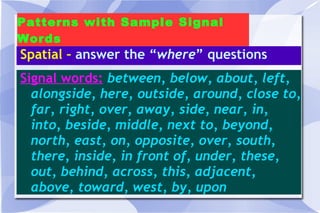
Patterns with Sample Signal Words Spatial –  answer the “ where ” questions Signal words:   between, below, about, left, alongside, here, outside, around, close to, far, right, over, away, side, near, in, into, beside, middle, next to, beyond, north, east, on, opposite, over, south, there, inside, in front of, under, these, out, behind, across, this, adjacent, above, toward, west, by, upon
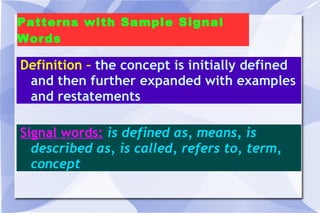
Patterns with Sample Signal Words Definition –  the concept is initially defined and then further expanded with examples and restatements Signal words:   is defined as, means, is described as, is called, refers to, term, concept
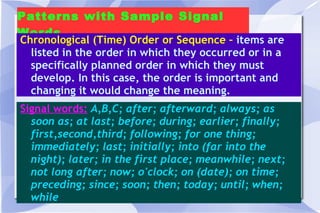
Patterns with Sample Signal Words Chronological (Time) Order or Sequence –  items are listed in the order in which they occurred or in a specifically planned order in which they must develop. In this case, the order is important and changing it would change the meaning.  Signal words:   A,B,C; after; afterward; always; as soon as; at last; before; during; earlier; finally; first,second,third; following; for one thing; immediately; last; initially; into (far into the night); later; in the first place; meanwhile; next; not long after; now; o'clock; on (date); on time; preceding; since; soon; then; today; until; when; while
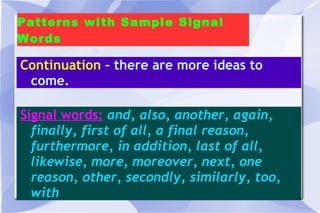
Patterns with Sample Signal Words Continuation –  there are more ideas to come. Signal words:   and, also, another, again, finally, first of all, a final reason, furthermore, in addition, last of all, likewise, more, moreover, next, one reason, other, secondly, similarly, too, with
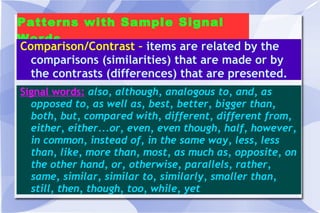
Patterns with Sample Signal Words Comparison/Contrast –  items are related by the comparisons (similarities) that are made or by the contrasts (differences) that are presented. Signal words:   also, although, analogous to, and, as opposed to, as well as, best, better, bigger than, both, but, compared with, different, different from, either, either...or, even, even though, half, however, in common, instead of, in the same way, less, less than, like, more than, most, as much as, opposite, on the other hand, or, otherwise, parallels, rather, same, similar, similar to, similarly, smaller than, still, then, though, too, while, yet
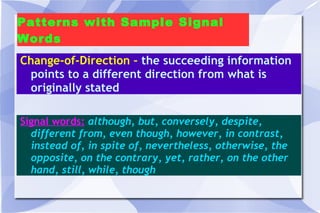
Patterns with Sample Signal Words Change-of-Direction –  the succeeding information points to a different direction from what is originally stated Signal words:   although, but, conversely, despite, different from, even though, however, in contrast, instead of, in spite of, nevertheless, otherwise, the opposite, on the contrary, yet, rather, on the other hand, still, while, though
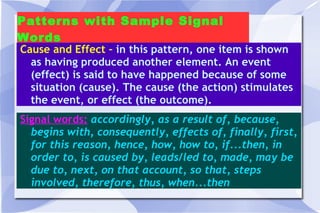
Patterns with Sample Signal Words Cause and Effect –  in this pattern, one item is shown as having produced another element. An event (effect) is said to have happened because of some situation (cause). The cause (the action) stimulates the event, or effect (the outcome). Signal words:   accordingly, as a result of, because, begins with, consequently, effects of, finally, first, for this reason, hence, how, how to, if...then, in order to, is caused by, leads/led to, made, may be due to, next, on that account, so that, steps involved, therefore, thus, when...then
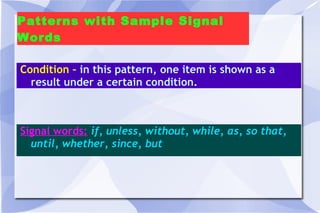
Patterns with Sample Signal Words Condition –  in this pattern, one item is shown as a result under a certain condition.  Signal words:   if, unless, without, while, as, so that, until, whether, since, but
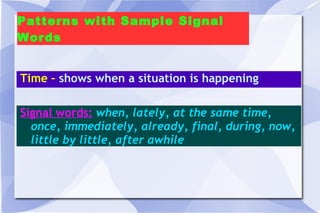
Patterns with Sample Signal Words Time –  shows when a situation is happening Signal words:   when, lately, at the same time, once, immediately, already, final, during, now, little by little, after awhile
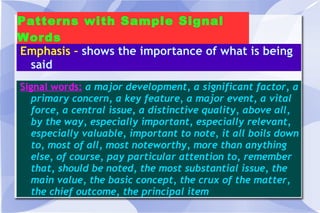
Patterns with Sample Signal Words Emphasis –  shows the importance of what is being said Signal words:   a major development, a significant factor, a primary concern, a key feature, a major event, a vital force, a central issue, a distinctive quality, above all, by the way, especially important, especially relevant, especially valuable, important to note, it all boils down to, most of all, most noteworthy, more than anything else, of course, pay particular attention to, remember that, should be noted, the most substantial issue, the main value, the basic concept, the crux of the matter, the chief outcome, the principal item
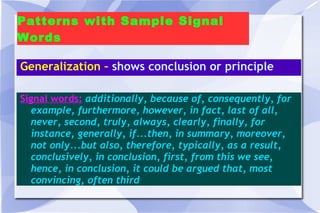
Patterns with Sample Signal Words Generalization –  shows conclusion or principle Signal words:   additionally, because of, consequently, for example, furthermore, however, in fact, last of all, never, second, truly, always, clearly, finally, for instance, generally, if...then, in summary, moreover, not only...but also, therefore, typically, as a result, conclusively, in conclusion, first, from this we see, hence, in conclusion, it could be argued that, most convincing, often third
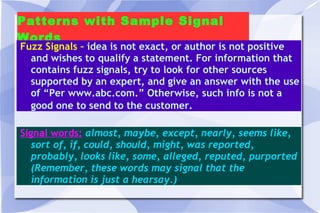
Patterns with Sample Signal Words Fuzz Signals –  idea is not exact, or author is not positive and wishes to qualify a statement. For information that contains fuzz signals, try to look for other sources supported by an expert, and give an answer with the use of “Per  www.abc.com .” Otherwise, such info is not a good one to send to the customer.  Signal words:   almost, maybe, except, nearly, seems like, sort of, if, could, should, might, was reported, probably, looks like, some, alleged, reputed, purported (Remember, these words may signal that the information is just a hearsay.)
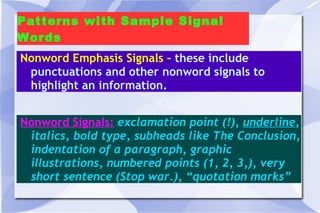
Patterns with Sample Signal Words Nonword Emphasis Signals –  these include punctuations and other nonword signals to highlight an information. Nonword Signals:   exclamation point (!),  underline , italics, bold type, subheads like The Conclusion, indentation of a paragraph, graphic illustrations, numbered points (1, 2, 3,), very short sentence (Stop war.), “quotation marks”

5 Organizational Patterns In Paragraphs

  • 1.
    Organizational Patterns ofParagraphs Since most of the information that HKAs will send to customers come from articles or selections, it is important to discuss the patterns by which paragraphs are written. Anticipating the order in which the material will be presented helps put the facts into perspective and to see how the parts fit into the whole. For example, if the selection begins by indicating that there are 4 important components of management, be alert to look for 4 key phrases. Likewise, if a comparison is suggested, note the points that are similar in nature. For material that shows cause and effect, expect the linkage and note the relationship. The mind responds to logical patterns; relating the small parts to the whole simplifies complexities of the material. Although key signal words help in identifying a pattern, a particular paragraph can be a mixture of different patterns.
  • 2.
    Patterns with SampleSignal Words Simple Listing – items are randomly listed in a series of supporting facts or details that have equal values. Changing the order of the items does not change the meaning of the paragraph. Signal words: in addition, another, for example, also, several, a number of
  • 3.
    Patterns with SampleSignal Words Illustration – explains abstract ideas by providing clear, specific, and concrete examples Signal words: for example, for instance, such as, similar to, specifically, to illustrate, much like, in the same way as
  • 4.
    Patterns with SampleSignal Words Description – comparable to listing; the characters that make up a description are no more than a simple listing of details Signal words: above, across, along, appears to be, as in, behind, below, beside, between, looks like, outside, under, down, near, over, in front of, onto, such as, to the right/left, on top of
  • 5.
    Patterns with SampleSignal Words Spatial – answer the “ where ” questions Signal words: between, below, about, left, alongside, here, outside, around, close to, far, right, over, away, side, near, in, into, beside, middle, next to, beyond, north, east, on, opposite, over, south, there, inside, in front of, under, these, out, behind, across, this, adjacent, above, toward, west, by, upon
  • 6.
    Patterns with SampleSignal Words Definition – the concept is initially defined and then further expanded with examples and restatements Signal words: is defined as, means, is described as, is called, refers to, term, concept
  • 7.
    Patterns with SampleSignal Words Chronological (Time) Order or Sequence – items are listed in the order in which they occurred or in a specifically planned order in which they must develop. In this case, the order is important and changing it would change the meaning. Signal words: A,B,C; after; afterward; always; as soon as; at last; before; during; earlier; finally; first,second,third; following; for one thing; immediately; last; initially; into (far into the night); later; in the first place; meanwhile; next; not long after; now; o'clock; on (date); on time; preceding; since; soon; then; today; until; when; while
  • 8.
    Patterns with SampleSignal Words Continuation – there are more ideas to come. Signal words: and, also, another, again, finally, first of all, a final reason, furthermore, in addition, last of all, likewise, more, moreover, next, one reason, other, secondly, similarly, too, with
  • 9.
    Patterns with SampleSignal Words Comparison/Contrast – items are related by the comparisons (similarities) that are made or by the contrasts (differences) that are presented. Signal words: also, although, analogous to, and, as opposed to, as well as, best, better, bigger than, both, but, compared with, different, different from, either, either...or, even, even though, half, however, in common, instead of, in the same way, less, less than, like, more than, most, as much as, opposite, on the other hand, or, otherwise, parallels, rather, same, similar, similar to, similarly, smaller than, still, then, though, too, while, yet
  • 10.
    Patterns with SampleSignal Words Change-of-Direction – the succeeding information points to a different direction from what is originally stated Signal words: although, but, conversely, despite, different from, even though, however, in contrast, instead of, in spite of, nevertheless, otherwise, the opposite, on the contrary, yet, rather, on the other hand, still, while, though
  • 11.
    Patterns with SampleSignal Words Cause and Effect – in this pattern, one item is shown as having produced another element. An event (effect) is said to have happened because of some situation (cause). The cause (the action) stimulates the event, or effect (the outcome). Signal words: accordingly, as a result of, because, begins with, consequently, effects of, finally, first, for this reason, hence, how, how to, if...then, in order to, is caused by, leads/led to, made, may be due to, next, on that account, so that, steps involved, therefore, thus, when...then
  • 12.
    Patterns with SampleSignal Words Condition – in this pattern, one item is shown as a result under a certain condition. Signal words: if, unless, without, while, as, so that, until, whether, since, but
  • 13.
    Patterns with SampleSignal Words Time – shows when a situation is happening Signal words: when, lately, at the same time, once, immediately, already, final, during, now, little by little, after awhile
  • 14.
    Patterns with SampleSignal Words Emphasis – shows the importance of what is being said Signal words: a major development, a significant factor, a primary concern, a key feature, a major event, a vital force, a central issue, a distinctive quality, above all, by the way, especially important, especially relevant, especially valuable, important to note, it all boils down to, most of all, most noteworthy, more than anything else, of course, pay particular attention to, remember that, should be noted, the most substantial issue, the main value, the basic concept, the crux of the matter, the chief outcome, the principal item
  • 15.
    Patterns with SampleSignal Words Generalization – shows conclusion or principle Signal words: additionally, because of, consequently, for example, furthermore, however, in fact, last of all, never, second, truly, always, clearly, finally, for instance, generally, if...then, in summary, moreover, not only...but also, therefore, typically, as a result, conclusively, in conclusion, first, from this we see, hence, in conclusion, it could be argued that, most convincing, often third
  • 16.
    Patterns with SampleSignal Words Fuzz Signals – idea is not exact, or author is not positive and wishes to qualify a statement. For information that contains fuzz signals, try to look for other sources supported by an expert, and give an answer with the use of “Per www.abc.com .” Otherwise, such info is not a good one to send to the customer. Signal words: almost, maybe, except, nearly, seems like, sort of, if, could, should, might, was reported, probably, looks like, some, alleged, reputed, purported (Remember, these words may signal that the information is just a hearsay.)
  • 17.
    Patterns with SampleSignal Words Nonword Emphasis Signals – these include punctuations and other nonword signals to highlight an information. Nonword Signals: exclamation point (!), underline , italics, bold type, subheads like The Conclusion, indentation of a paragraph, graphic illustrations, numbered points (1, 2, 3,), very short sentence (Stop war.), “quotation marks”