Punctuation Marks
in English
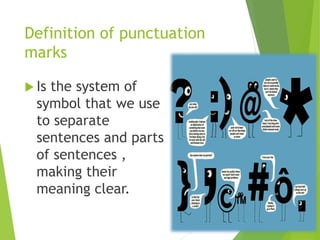
Definition of punctuation
marks
 Is the system of
symbol that we use
to separate
sentences and parts
of sentences ,
making their
meaning clear.
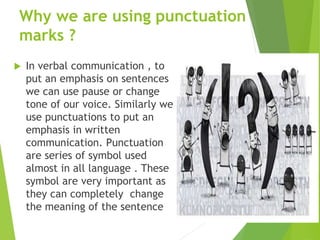
Why we are using punctuation
marks ?
 In verbal communication , to
put an emphasis on sentences
we can use pause or change
tone of our voice. Similarly we
use punctuations to put an
emphasis in written
communication. Punctuation
are series of symbol used
almost in all language . These
symbol are very important as
they can completely change
the meaning of the sentence
THE FULL STOP OR PERIOD(.)
at the end of a sentence:
- E.g. I’m going for a walk.
 sometimes after an
abbreviation:
- E.g. Marton Rd. / Mrs. White /
Dr. Evans
 as the decimal point in £3.5
million figures and amounts
of money. This is usually read
out as ‘point’
- E.g. £3.5 million
THE FULL STOP OR PERIOD(.)
to separate parts of email and
web addresses. This is read out
as ‘dot’:
- E.g.
http://dictionary.cambridge.org
THE COMMA (,)
 between items in a list:
- E.g. I need peas, butter, sugar and
eggs.
when you want to add extra
information:
-E.g. Mr. Farhat, the chairman of the
company, proposed the vote of
thanks.
To indicate words of address:
- E.g. Sir, I wish to get your
appointment.
THE COMMA (,)
 to show a pause in a long They didn’t
want to eat before sentence:
- E.g. They didn’t want to eat before
I’d arrived, but I was an hour late.
 before tag questions:
- E.g. You do love me, don’t you?
 To separate quoted sentences
- E.g. He said, “I love you.”
 To separate day and date, and date
and year.
- E.g. Saturday , the 1st March; 6th
September,1979
THE SEMI COLON (;)
 Indicates a longer pause than a
comma
 Used to separate independent
clauses not joined by a
conjunction.
- e.g. The chief guest came; the
Principal greeted him; then he walked
up to the dias.
 to separate two parts of a
sentence:
- E.g. I spoke to Linda on Monday; a
sentence she can’t come to the
meeting tomorrow.
THE COLON(:)
 Marks more complete pause than a semi-
colon.
 to introduce a list or a quotation in a
sentence:
- E.g. You need the following: paint,
brushes, water, cloths.
 in the US following the greeting in a
business Letter:
- E.g. Dear Customer:
Dear Mr. Stein:
Used after a question.
(interrogation):
- E.g. Who are you?
How are you?
What are you doing?
 to show doubt:
Sidney Morgan (1898? – 1972) was
little known until after his death.
THE QUESTION MARK(?)
THE EXCLAMATION MARK(!)
at the end of a sentence in
order to show surprise shock,
etc.
- E.g. I can’t believe it!
- Ouch! Yes!
- WoW! OMG!
to indicate a loud sound:
- E.g. Bang!
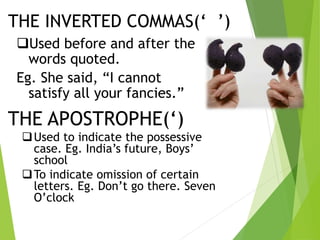
THE INVERTED COMMAS(‘ ’)
THE APOSTROPHE(‘)
Used to indicate the possessive
case. Eg. India’s future, Boys’
school
To indicate omission of certain
letters. Eg. Don’t go there. Seven
O’clock
Used before and after the
words quoted.
Eg. She said, “I cannot
satisfy all your fancies.”
THE HYPHEN(-)
 Used in compound words
Eg. Accounts-officer, telephone-directory,
self-help
THE DASH(--)
Suggests a sudden break in thought
eg. I want to tell you--but I think this can be done
later.
Two dashes are used to indicate parenthesis.
eg. A deep sense of gratitude--I have no words to
describe it -- overwhelms me
THE BRACKETS () []
 Used to separate a phrase or clause from the
main sentence
Eg. He gave up drinking(he had no other choice)
because the doctor warned him
THE CAPITAL LETTERS{A,B…}
 To begin sentences
 For names of people, places, mountains, rivers
 For nations and nationality
 For names of days, months, festivals and historical eras
 At the beginning of a sentence that is put in quotes eg. He
said, “This is a good book.”
 At the beginning of every line of poetry
Thank you for
listening

Punctuation in English

  • 1.
  • 2.
    Definition of punctuation marks Is the system of symbol that we use to separate sentences and parts of sentences , making their meaning clear.
  • 3.
    Why we areusing punctuation marks ?  In verbal communication , to put an emphasis on sentences we can use pause or change tone of our voice. Similarly we use punctuations to put an emphasis in written communication. Punctuation are series of symbol used almost in all language . These symbol are very important as they can completely change the meaning of the sentence
  • 4.
    THE FULL STOPOR PERIOD(.) at the end of a sentence: - E.g. I’m going for a walk.  sometimes after an abbreviation: - E.g. Marton Rd. / Mrs. White / Dr. Evans  as the decimal point in £3.5 million figures and amounts of money. This is usually read out as ‘point’ - E.g. £3.5 million
  • 5.
    THE FULL STOPOR PERIOD(.) to separate parts of email and web addresses. This is read out as ‘dot’: - E.g. http://dictionary.cambridge.org
  • 6.
    THE COMMA (,) between items in a list: - E.g. I need peas, butter, sugar and eggs. when you want to add extra information: -E.g. Mr. Farhat, the chairman of the company, proposed the vote of thanks. To indicate words of address: - E.g. Sir, I wish to get your appointment.
  • 7.
    THE COMMA (,) to show a pause in a long They didn’t want to eat before sentence: - E.g. They didn’t want to eat before I’d arrived, but I was an hour late.  before tag questions: - E.g. You do love me, don’t you?  To separate quoted sentences - E.g. He said, “I love you.”  To separate day and date, and date and year. - E.g. Saturday , the 1st March; 6th September,1979
  • 8.
    THE SEMI COLON(;)  Indicates a longer pause than a comma  Used to separate independent clauses not joined by a conjunction. - e.g. The chief guest came; the Principal greeted him; then he walked up to the dias.  to separate two parts of a sentence: - E.g. I spoke to Linda on Monday; a sentence she can’t come to the meeting tomorrow.
  • 9.
    THE COLON(:)  Marksmore complete pause than a semi- colon.  to introduce a list or a quotation in a sentence: - E.g. You need the following: paint, brushes, water, cloths.  in the US following the greeting in a business Letter: - E.g. Dear Customer: Dear Mr. Stein:
  • 10.
    Used after aquestion. (interrogation): - E.g. Who are you? How are you? What are you doing?  to show doubt: Sidney Morgan (1898? – 1972) was little known until after his death. THE QUESTION MARK(?)
  • 11.
    THE EXCLAMATION MARK(!) atthe end of a sentence in order to show surprise shock, etc. - E.g. I can’t believe it! - Ouch! Yes! - WoW! OMG! to indicate a loud sound: - E.g. Bang!
  • 12.
    THE INVERTED COMMAS(‘’) THE APOSTROPHE(‘) Used to indicate the possessive case. Eg. India’s future, Boys’ school To indicate omission of certain letters. Eg. Don’t go there. Seven O’clock Used before and after the words quoted. Eg. She said, “I cannot satisfy all your fancies.”
  • 13.
    THE HYPHEN(-)  Usedin compound words Eg. Accounts-officer, telephone-directory, self-help THE DASH(--) Suggests a sudden break in thought eg. I want to tell you--but I think this can be done later. Two dashes are used to indicate parenthesis. eg. A deep sense of gratitude--I have no words to describe it -- overwhelms me
  • 14.
    THE BRACKETS ()[]  Used to separate a phrase or clause from the main sentence Eg. He gave up drinking(he had no other choice) because the doctor warned him THE CAPITAL LETTERS{A,B…}  To begin sentences  For names of people, places, mountains, rivers  For nations and nationality  For names of days, months, festivals and historical eras  At the beginning of a sentence that is put in quotes eg. He said, “This is a good book.”  At the beginning of every line of poetry
  • 15.

Editor's Notes