Teacher Rio Mae Ramos
The
Necklace
by Guy de Maupassant
Online Classroom Netiquettes
Find a quiet place that is free from distraction.
Mute your microphone when you are not talking.
Always open your camera.
Have fun and enjoy learning.
Learning Objectives:
At the end of the lesson, students are expected to:
• Know the story of the Necklace;
• Analyze literature as a means of valuing other people and their
various circumstances in life.
• Define what is adverb;
• Use adverbs in narration.
GUIDEQUESTIONS:
What is the
picture all
about?
Have you
experience being
problematic with
financial matter?
The
Necklace
by Guy de Maupassant
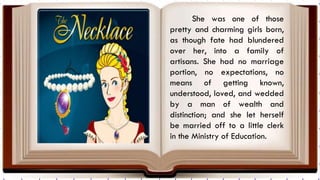
She was one of those
pretty and charming girls born,
as though fate had blundered
over her, into a family of
artisans. She had no marriage
portion, no expectations, no
means of getting known,
understood, loved, and wedded
by a man of wealth and
distinction; and she let herself
be married off to a little clerk
in the Ministry of Education.
Her tastes were simple because she had
never been able to afford any other, but she
was as unhappy as though she had married
beneath her; for women have no caste or
class, their beauty, grace, and charm serving
them for birth or family, their natural delicacy,
their instinctive elegance, their nimbleness of
wit, are their only mark of rank, and put the
slum girl on a level with the highest lady in
the land.
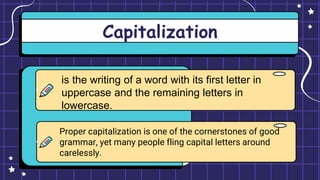
Capitalization
is the writing of a word with its first letter in
uppercase and the remaining letters in
lowercase.
Proper capitalization is one of the cornerstones of good
grammar, yet many people fling capital letters around
carelessly.
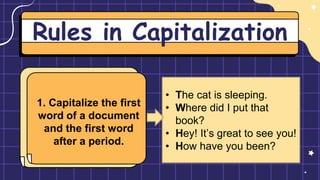
Rules in Capitalization
1. Capitalize the first
word of a document
and the first word
after a period.
• The cat is sleeping.
• Where did I put that
book?
• Hey! It’s great to see you!
• How have you been?
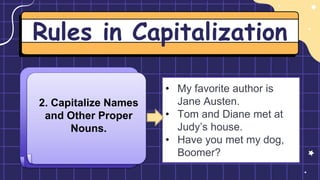
Rules in Capitalization
2. Capitalize Names
and Other Proper
Nouns.
• My favorite author is
Jane Austen.
• Tom and Diane met at
Judy’s house.
• Have you met my dog,
Boomer?
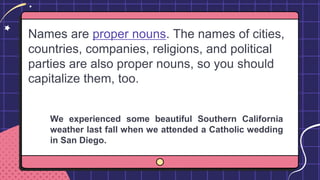
Names are proper nouns. The names of cities,
countries, companies, religions, and political
parties are also proper nouns, so you should
capitalize them, too.
We experienced some beautiful Southern California
weather last fall when we attended a Catholic wedding
in San Diego.
Rules in Capitalization
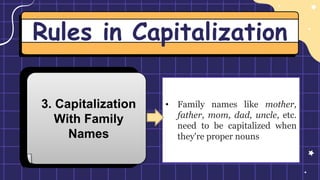
3. Capitalization
With Family
Names
• Family names like mother,
father, mom, dad, uncle, etc.
need to be capitalized when
they're proper nouns
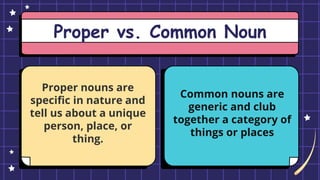
Proper vs. Common Noun
Proper nouns are
specific in nature and
tell us about a unique
person, place, or
thing.
Common nouns are
generic and club
together a category of
things or places
Rules in Capitalization
3. Capitalize the First
Word of a Quote
(Sometimes)
• Capitalize the first word of a
quote when the quote is a
complete sentence.
• Don’t capitalize the first word
of partial quotes.
Rules in Capitalization
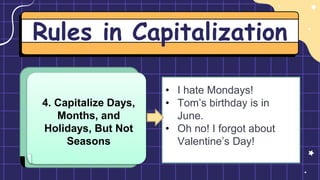
4. Capitalize Days,
Months, and
Holidays, But Not
Seasons
• I hate Mondays!
• Tom’s birthday is in
June.
• Oh no! I forgot about
Valentine’s Day!
Rules in Capitalization
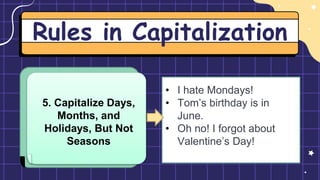
5. Capitalize Days,
Months, and
Holidays, But Not
Seasons
• I hate Mondays!
• Tom’s birthday is in
June.
• Oh no! I forgot about
Valentine’s Day!
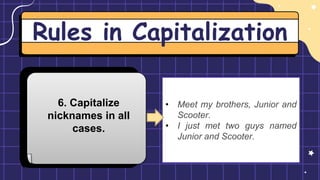
Rules in Capitalization
6. Capitalize
nicknames in all
cases.
• Meet my brothers, Junior and
Scooter.
• I just met two guys named
Junior and Scooter.
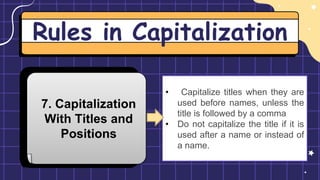
Rules in Capitalization
7. Capitalization
With Titles and
Positions
• Capitalize titles when they are
used before names, unless the
title is followed by a comma
• Do not capitalize the title if it is
used after a name or instead of
a name.
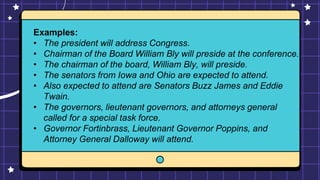
Examples:
• The president will address Congress.
• Chairman of the Board William Bly will preside at the conference.
• The chairman of the board, William Bly, will preside.
• The senators from Iowa and Ohio are expected to attend.
• Also expected to attend are Senators Buzz James and Eddie
Twain.
• The governors, lieutenant governors, and attorneys general
called for a special task force.
• Governor Fortinbrass, Lieutenant Governor Poppins, and
Attorney General Dalloway will attend.
Punctuation
Marks and Its
Uses
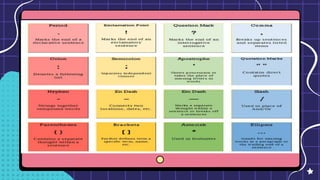
Punctuation Marks
● Punctuation marks are series of marks or special characters that
we use in the English language to accent, accentuate,
emphasize, mark or stress our written speech; that is, our
writings.
● Punctuation marks, among other things, indicate where our
expressions begin and where they stop.
Inanutshell, wecansaypunctuationmarksare:
•Standard marks that help to clarify meaning.
•Used to help convey the emphases and breathing pauses natural
to speech.
•Used to indicate sentence structure.
•Employed to enhance readability.
•Needed to help readers comprehend what we mean.
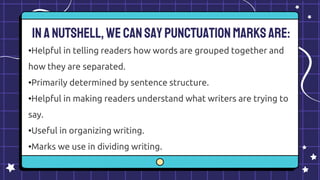
Inanutshell, wecansaypunctuationmarksare:
•Helpful in telling readers how words are grouped together and
how they are separated.
•Primarily determined by sentence structure.
•Helpful in making readers understand what writers are trying to
say.
•Useful in organizing writing.
•Marks we use in dividing writing.
Punctuation
Marks and Its
Uses
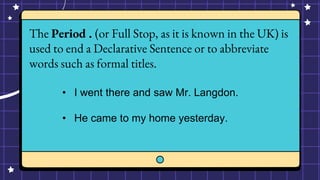
The Period . (or Full Stop, as it is known in the UK) is
used to end a Declarative Sentence or to abbreviate
words such as formal titles.
• I went there and saw Mr. Langdon.
• He came to my home yesterday.
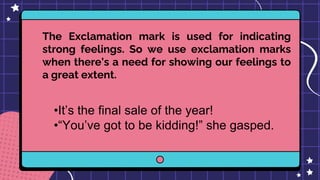
The Exclamation mark is used for indicating
strong feelings. So we use exclamation marks
when there’s a need for showing our feelings to
a great extent.
•It’s the final sale of the year!
•“You’ve got to be kidding!” she gasped.
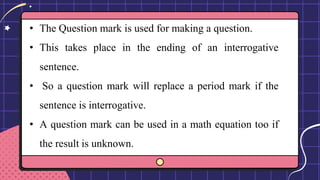
• The Question mark is used for making a question.
• This takes place in the ending of an interrogative
sentence.
• So a question mark will replace a period mark if the
sentence is interrogative.
• A question mark can be used in a math equation too if
the result is unknown.
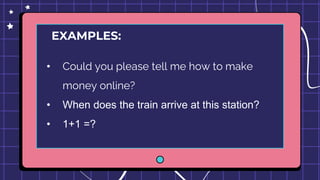
EXAMPLES:
• Could you please tell me how to make
money online?
• When does the train arrive at this station?
• 1+1 =?
The Comma ( , ) is an extremely versatile form of punctuation and has
various uses, most of which have to do with breaking up sentences to show
the clear meaning.
•In direct address: “What do you think, Joe?”
•Tying two complete sentences together: They went into town, but the
rest stayed home.
•Separating out a specific thought: The boy, who still wore his pajamas,
was clearly very tired.
•Or in lists: In the bag were apples, bananas, peppers and onions.
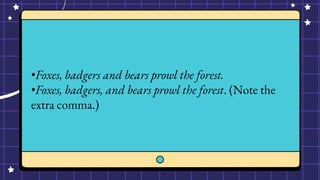
•Foxes, badgers and bears prowl the forest.
•Foxes, badgers, and bears prowl the forest. (Note the
extra comma.)
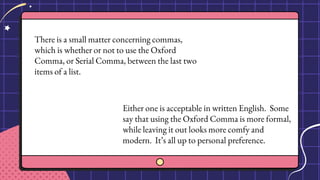
There is a small matter concerning commas,
which is whether or not to use the Oxford
Comma, or Serial Comma, between the last two
items of a list.
Either one is acceptable in written English. Some
say that using the Oxford Comma is more formal,
while leaving it out looks more comfy and
modern. It’s all up to personal preference.
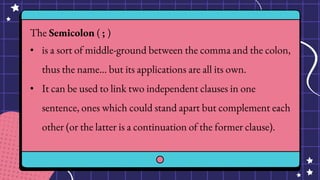
The Semicolon ( ; )
• is a sort of middle-ground between the comma and the colon,
thus the name… but its applications are all its own.
• It can be used to link two independent clauses in one
sentence, ones which could stand apart but complement each
other (or the latter is a continuation of the former clause).
•John could not fix the computer; he didn’t even know how to begin such a task.
Semicolons may also be placed at the end of one portion of
an extensive list, if extra clarity or structure is needed:
•We need many different ingredients: Flour, butter, sugar, corn starch, cocoa
and vanilla for flavoring; two metal bowls, a wooden spoon and a cookie sheet.
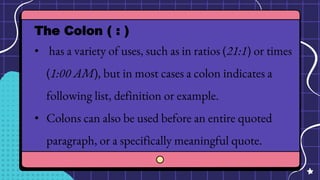
The Colon ( : )
• has a variety of uses, such as in ratios (21:1) or times
(1:00 AM), but in most cases a colon indicates a
following list, definition or example.
• Colons can also be used before an entire quoted
paragraph, or a specifically meaningful quote.
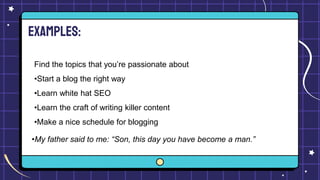
Examples:
Find the topics that you’re passionate about
•Start a blog the right way
•Learn white hat SEO
•Learn the craft of writing killer content
•Make a nice schedule for blogging
•My father said to me: “Son, this day you have become a man.”
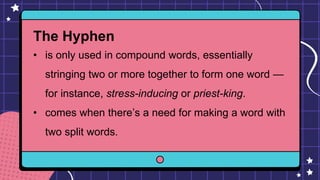
The Hyphen
• is only used in compound words, essentially
stringing two or more together to form one word —
for instance, stress-inducing or priest-king.
• comes when there’s a need for making a word with
two split words.
En Dash
• is described as being twice the length of a hyphen, though this
may vary depending on the font used.
• It stands for a span, range or link between two dates,
locations, etc.
For example, The Chicago–New York railway or 1879–1955.
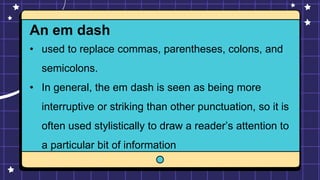
An em dash
• used to replace commas, parentheses, colons, and
semicolons.
• In general, the em dash is seen as being more
interruptive or striking than other punctuation, so it is
often used stylistically to draw a reader’s attention to
a particular bit of information
Examples:
•After days of deliberation, the jury came to its final verdict—not
guilty.
•I think something might be wrong with Jeff—he thinks he is a
squirrel.
•I love kittens—who doesn’t?—but that doesn’t mean I want to
adopt 50 of them.
•It turns out that Mr. Green—a man I always suspected—was the
true culprit.
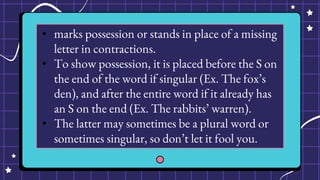
• marks possession or stands in place of a missing
letter in contractions.
• To show possession, it is placed before the S on
the end of the word if singular (Ex. The fox’s
den), and after the entire word if it already has
an S on the end (Ex. The rabbits’ warren).
• The latter may sometimes be a plural word or
sometimes singular, so don’t let it fool you.
● When using it in contractions or to take the place of missing
letters, the rule is: The apostrophe is placed where the
missing letters would normally go.
● Some examples: ’80s and ’90s (1980s and 1990s — the
apostrophe here is commonly placed before the S, even
though that’s not where the abbreviation is), or that’s (that
is), aren’t (are not), ma’am (madam), etc.
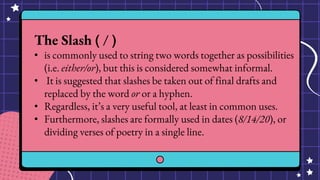
The Slash ( / )
• is commonly used to string two words together as possibilities
(i.e. either/or), but this is considered somewhat informal.
• It is suggested that slashes be taken out of final drafts and
replaced by the word or or a hyphen.
• Regardless, it’s a very useful tool, at least in common uses.
• Furthermore, slashes are formally used in dates (8/14/20), or
dividing verses of poetry in a single line.
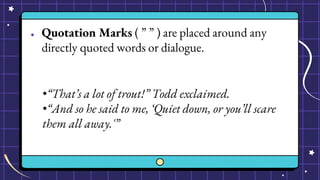
● Quotation Marks ( ” ” ) are placed around any
directly quoted words or dialogue.
•“That’s a lot of trout!” Todd exclaimed.
•“And so he said to me, ‘Quiet down, or you’ll scare
them all away.'”
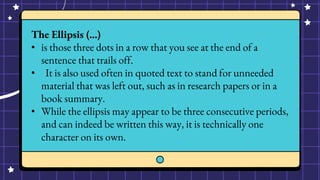
The Ellipsis (…)
• is those three dots in a row that you see at the end of a
sentence that trails off.
• It is also used often in quoted text to stand for unneeded
material that was left out, such as in research papers or in a
book summary.
• While the ellipsis may appear to be three consecutive periods,
and can indeed be written this way, it is technically one
character on its own.
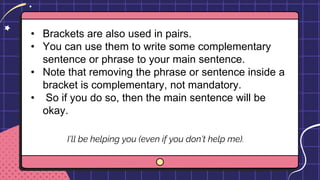
• Brackets are also used in pairs.
• You can use them to write some complementary
sentence or phrase to your main sentence.
• Note that removing the phrase or sentence inside a
bracket is complementary, not mandatory.
• So if you do so, then the main sentence will be
okay.
I’ll be helping you (even if you don’t help me).
Parentheses ( ) (known as Brackets or Round
Brackets in the UK) are used to contain a complete
thought which is inserted between existing text to
pile more info into the sentence without making it a
“run-on sentence”.
Thank
you!!!

Week 1-Punctuation Marks and Capitalization.pptx

  • 1.
  • 2.
  • 4.
    Online Classroom Netiquettes Finda quiet place that is free from distraction. Mute your microphone when you are not talking. Always open your camera. Have fun and enjoy learning.
  • 5.
    Learning Objectives: At theend of the lesson, students are expected to: • Know the story of the Necklace; • Analyze literature as a means of valuing other people and their various circumstances in life. • Define what is adverb; • Use adverbs in narration.
  • 8.
    GUIDEQUESTIONS: What is the pictureall about? Have you experience being problematic with financial matter?
  • 9.
  • 10.
    She was oneof those pretty and charming girls born, as though fate had blundered over her, into a family of artisans. She had no marriage portion, no expectations, no means of getting known, understood, loved, and wedded by a man of wealth and distinction; and she let herself be married off to a little clerk in the Ministry of Education.
  • 11.
    Her tastes weresimple because she had never been able to afford any other, but she was as unhappy as though she had married beneath her; for women have no caste or class, their beauty, grace, and charm serving them for birth or family, their natural delicacy, their instinctive elegance, their nimbleness of wit, are their only mark of rank, and put the slum girl on a level with the highest lady in the land.
  • 26.
    Capitalization is the writingof a word with its first letter in uppercase and the remaining letters in lowercase. Proper capitalization is one of the cornerstones of good grammar, yet many people fling capital letters around carelessly.
  • 27.
    Rules in Capitalization 1.Capitalize the first word of a document and the first word after a period. • The cat is sleeping. • Where did I put that book? • Hey! It’s great to see you! • How have you been?
  • 28.
    Rules in Capitalization 2.Capitalize Names and Other Proper Nouns. • My favorite author is Jane Austen. • Tom and Diane met at Judy’s house. • Have you met my dog, Boomer?
  • 29.
    Names are propernouns. The names of cities, countries, companies, religions, and political parties are also proper nouns, so you should capitalize them, too. We experienced some beautiful Southern California weather last fall when we attended a Catholic wedding in San Diego.
  • 30.
    Rules in Capitalization 3.Capitalization With Family Names • Family names like mother, father, mom, dad, uncle, etc. need to be capitalized when they're proper nouns
  • 31.
    Proper vs. CommonNoun Proper nouns are specific in nature and tell us about a unique person, place, or thing. Common nouns are generic and club together a category of things or places
  • 32.
    Rules in Capitalization 3.Capitalize the First Word of a Quote (Sometimes) • Capitalize the first word of a quote when the quote is a complete sentence. • Don’t capitalize the first word of partial quotes.
  • 33.
    Rules in Capitalization 4.Capitalize Days, Months, and Holidays, But Not Seasons • I hate Mondays! • Tom’s birthday is in June. • Oh no! I forgot about Valentine’s Day!
  • 34.
    Rules in Capitalization 5.Capitalize Days, Months, and Holidays, But Not Seasons • I hate Mondays! • Tom’s birthday is in June. • Oh no! I forgot about Valentine’s Day!
  • 35.
    Rules in Capitalization 6.Capitalize nicknames in all cases. • Meet my brothers, Junior and Scooter. • I just met two guys named Junior and Scooter.
  • 36.
    Rules in Capitalization 7.Capitalization With Titles and Positions • Capitalize titles when they are used before names, unless the title is followed by a comma • Do not capitalize the title if it is used after a name or instead of a name.
  • 37.
    Examples: • The presidentwill address Congress. • Chairman of the Board William Bly will preside at the conference. • The chairman of the board, William Bly, will preside. • The senators from Iowa and Ohio are expected to attend. • Also expected to attend are Senators Buzz James and Eddie Twain. • The governors, lieutenant governors, and attorneys general called for a special task force. • Governor Fortinbrass, Lieutenant Governor Poppins, and Attorney General Dalloway will attend.
  • 38.
  • 39.
    Punctuation Marks ● Punctuationmarks are series of marks or special characters that we use in the English language to accent, accentuate, emphasize, mark or stress our written speech; that is, our writings. ● Punctuation marks, among other things, indicate where our expressions begin and where they stop.
  • 40.
    Inanutshell, wecansaypunctuationmarksare: •Standard marksthat help to clarify meaning. •Used to help convey the emphases and breathing pauses natural to speech. •Used to indicate sentence structure. •Employed to enhance readability. •Needed to help readers comprehend what we mean.
  • 41.
    Inanutshell, wecansaypunctuationmarksare: •Helpful intelling readers how words are grouped together and how they are separated. •Primarily determined by sentence structure. •Helpful in making readers understand what writers are trying to say. •Useful in organizing writing. •Marks we use in dividing writing.
  • 42.
  • 45.
    The Period .(or Full Stop, as it is known in the UK) is used to end a Declarative Sentence or to abbreviate words such as formal titles. • I went there and saw Mr. Langdon. • He came to my home yesterday.
  • 47.
    The Exclamation markis used for indicating strong feelings. So we use exclamation marks when there’s a need for showing our feelings to a great extent. •It’s the final sale of the year! •“You’ve got to be kidding!” she gasped.
  • 49.
    • The Questionmark is used for making a question. • This takes place in the ending of an interrogative sentence. • So a question mark will replace a period mark if the sentence is interrogative. • A question mark can be used in a math equation too if the result is unknown.
  • 50.
    EXAMPLES: • Could youplease tell me how to make money online? • When does the train arrive at this station? • 1+1 =?
  • 52.
    The Comma (, ) is an extremely versatile form of punctuation and has various uses, most of which have to do with breaking up sentences to show the clear meaning. •In direct address: “What do you think, Joe?” •Tying two complete sentences together: They went into town, but the rest stayed home. •Separating out a specific thought: The boy, who still wore his pajamas, was clearly very tired. •Or in lists: In the bag were apples, bananas, peppers and onions.
  • 53.
    •Foxes, badgers andbears prowl the forest. •Foxes, badgers, and bears prowl the forest. (Note the extra comma.)
  • 54.
    There is asmall matter concerning commas, which is whether or not to use the Oxford Comma, or Serial Comma, between the last two items of a list. Either one is acceptable in written English. Some say that using the Oxford Comma is more formal, while leaving it out looks more comfy and modern. It’s all up to personal preference.
  • 56.
    The Semicolon (; ) • is a sort of middle-ground between the comma and the colon, thus the name… but its applications are all its own. • It can be used to link two independent clauses in one sentence, ones which could stand apart but complement each other (or the latter is a continuation of the former clause).
  • 57.
    •John could notfix the computer; he didn’t even know how to begin such a task. Semicolons may also be placed at the end of one portion of an extensive list, if extra clarity or structure is needed: •We need many different ingredients: Flour, butter, sugar, corn starch, cocoa and vanilla for flavoring; two metal bowls, a wooden spoon and a cookie sheet.
  • 59.
    The Colon (: ) • has a variety of uses, such as in ratios (21:1) or times (1:00 AM), but in most cases a colon indicates a following list, definition or example. • Colons can also be used before an entire quoted paragraph, or a specifically meaningful quote.
  • 60.
    Examples: Find the topicsthat you’re passionate about •Start a blog the right way •Learn white hat SEO •Learn the craft of writing killer content •Make a nice schedule for blogging •My father said to me: “Son, this day you have become a man.”
  • 62.
    The Hyphen • isonly used in compound words, essentially stringing two or more together to form one word — for instance, stress-inducing or priest-king. • comes when there’s a need for making a word with two split words.
  • 64.
    En Dash • isdescribed as being twice the length of a hyphen, though this may vary depending on the font used. • It stands for a span, range or link between two dates, locations, etc. For example, The Chicago–New York railway or 1879–1955.
  • 66.
    An em dash •used to replace commas, parentheses, colons, and semicolons. • In general, the em dash is seen as being more interruptive or striking than other punctuation, so it is often used stylistically to draw a reader’s attention to a particular bit of information
  • 67.
    Examples: •After days ofdeliberation, the jury came to its final verdict—not guilty. •I think something might be wrong with Jeff—he thinks he is a squirrel. •I love kittens—who doesn’t?—but that doesn’t mean I want to adopt 50 of them. •It turns out that Mr. Green—a man I always suspected—was the true culprit.
  • 69.
    • marks possessionor stands in place of a missing letter in contractions. • To show possession, it is placed before the S on the end of the word if singular (Ex. The fox’s den), and after the entire word if it already has an S on the end (Ex. The rabbits’ warren). • The latter may sometimes be a plural word or sometimes singular, so don’t let it fool you.
  • 70.
    ● When usingit in contractions or to take the place of missing letters, the rule is: The apostrophe is placed where the missing letters would normally go. ● Some examples: ’80s and ’90s (1980s and 1990s — the apostrophe here is commonly placed before the S, even though that’s not where the abbreviation is), or that’s (that is), aren’t (are not), ma’am (madam), etc.
  • 72.
    The Slash (/ ) • is commonly used to string two words together as possibilities (i.e. either/or), but this is considered somewhat informal. • It is suggested that slashes be taken out of final drafts and replaced by the word or or a hyphen. • Regardless, it’s a very useful tool, at least in common uses. • Furthermore, slashes are formally used in dates (8/14/20), or dividing verses of poetry in a single line.
  • 74.
    ● Quotation Marks( ” ” ) are placed around any directly quoted words or dialogue. •“That’s a lot of trout!” Todd exclaimed. •“And so he said to me, ‘Quiet down, or you’ll scare them all away.'”
  • 76.
    The Ellipsis (…) •is those three dots in a row that you see at the end of a sentence that trails off. • It is also used often in quoted text to stand for unneeded material that was left out, such as in research papers or in a book summary. • While the ellipsis may appear to be three consecutive periods, and can indeed be written this way, it is technically one character on its own.
  • 78.
    • Brackets arealso used in pairs. • You can use them to write some complementary sentence or phrase to your main sentence. • Note that removing the phrase or sentence inside a bracket is complementary, not mandatory. • So if you do so, then the main sentence will be okay. I’ll be helping you (even if you don’t help me).
  • 80.
    Parentheses ( )(known as Brackets or Round Brackets in the UK) are used to contain a complete thought which is inserted between existing text to pile more info into the sentence without making it a “run-on sentence”.
  • 82.