ENGLISH LESSON
GRADE: 9

TOPIC: PUNCTUATION

Presented by Maluleke T.S.
How Do You Use the Comma?
 Use a comma to separate independent
clause (sentences) in a compound
sentence.
I like English, BUT it is difficult.
How Do You Use the Comma?
Continue

Use commas to separate
words, phrases, and clauses when there are
three or more in a series.
For instance, Sanny can run, jump, and
skip.
More on Commas
When the date identifies the day of the
week, the date is set off with a comma.
See the example below:
On Thursday, August 25, school resumes.
More on Commas
 Use Comma to set off nouns of direct.

For example: “Gertrude, I want you to know
that Matilda like George.”
address.
 Use a comma to set off a year when it is
with a month and date.
- Julius was born June 25, 1954, in
Gauteng, Soweto.
More on Commas
 Use commas when writing full addresses

in sentence form. I live at 2345
Westchester Blvd., Springfield, IL 62703
 Use commas to set off introductory

phrases that come at the beginning of
a sentence. Feeling anxious, George
slowly stepped on the stage.
Use commas to set off nonrestrictive
relative clauses (not necessary to the
meaning of the sentence) from the rest of
the sentence. Who
Whose) Restrictive/nonrestrictive
Whom
Which) Nonrestrictive (needs a
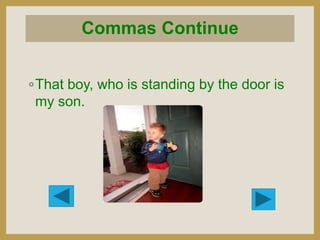
Commas Continue
◦That boy, who is standing by the door is
my son.
Commas
 Use commas to set of parenthetical

expressions.
-Jason is handsome, however, looks can be
deceiving.
Use a comma to set off short quoted
sentences from the rest of the sentence.
Hamlet said, “To be or not to be. That is the
question.”
Commas
 Use commas to set of parenthetical

expressions.
-Jason is handsome, however, looks can be
deceiving.
Use a comma to set off short quoted
sentences from the rest of the sentence.
Hamlet said, “To be or not to be. That is the
question.”
Use a semi-colon to separate independent
sentences. These are sentences that are
closed conned in thought and not joined by a
conjunction. For example, After class, I went
to the Pizza Hut; then I graded papers for an
hour.
Use a semi-colon to separate
independent clause if there are commas
within the parts. I wrote to George, Matilda,
and Gertrude; and Ellen notified Jason by
phone.
Capitals latters
A capital letter is normally used in
writing:
 For the first letter of the first word at
the beginning of a sentence

 For the first letter of proper nouns
(Kevin), countries (South Africa), cities
(Johannesburg), and titles (the
Champion).
Capitals latters


For the first letter of the names of days
(Tuesday), months (February), festivals
(Dwali).

 For the first letter of houses, ships,
streets, newspapers, books, play-titles
(King Street).
 For a person‟s initials (K.G. Baxter).
 For the word I.
Full stops
A full stop is used at the end of a
sentence, unless the sentence calls for
a question mark (?) or an exclamation
mark (!).
Example, Joyce went to the shop.
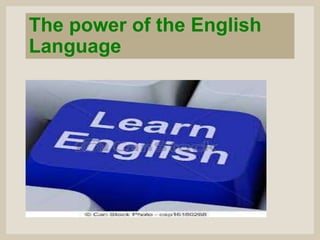
The power of the English
Language
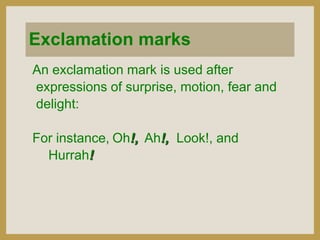
Exclamation marks
An exclamation mark is used after
expressions of surprise, motion, fear and
delight:
For instance, Oh!, Ah!, Look!, and
Hurrah!
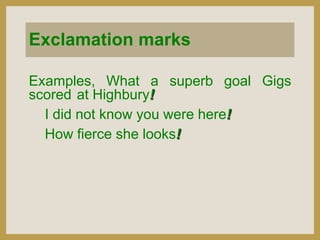
Exclamation marks
Examples, What a superb goal Gigs
scored at Highbury!
I did not know you were here!
How fierce she looks!
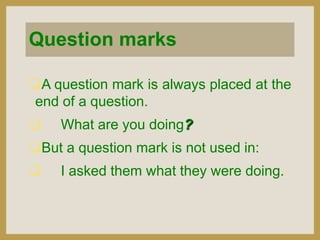
Question marks
A question mark is always placed at the
end of a question.


What are you doing?

But a question mark is not used in:


I asked them what they were doing.
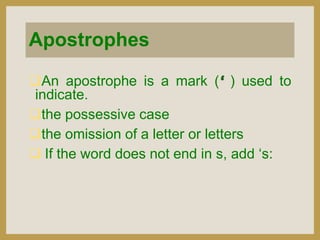
Apostrophes
An apostrophe is a mark (‘ ) used to
indicate.
the possessive case
the omission of a letter or letters
 If the word does not end in s, add „s:
Apostrophes
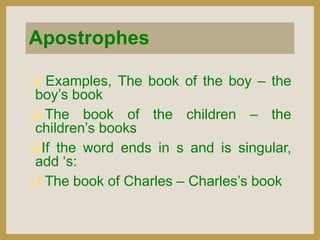
 Examples, The book of the boy – the
boy‟s book
 The book of the children – the
children‟s books
If the word ends in s and is singular,
add „s:
 The book of Charles – Charles‟s book
Quotation marks (inverted
commas
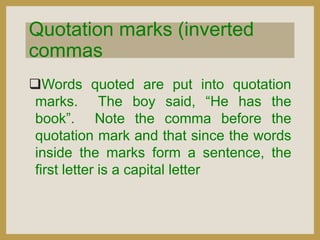
Words quoted are put into quotation
marks. The boy said, “He has the
book”. Note the comma before the
quotation mark and that since the words
inside the marks form a sentence, the
first letter is a capital letter
Hyphen
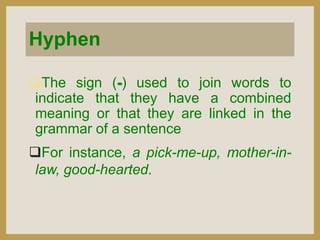
The sign (-) used to join words to
indicate that they have a combined
meaning or that they are linked in the
grammar of a sentence
For instance, a pick-me-up, mother-inlaw, good-hearted.
Parenthesis
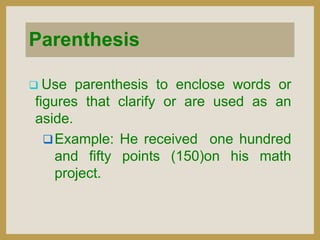
 Use

parenthesis to enclose words or
figures that clarify or are used as an
aside.
 Example: He received one hundred
and fifty points (150)on his math
project.
List of references
Kevin Baxter. September, 18. 2013
http://www.slideshare.net/KevinBaxter1/english-basics-punctuation
Karin Heart.2013,
http://www.slideshare.net/karrinheart/punctuation-13609611
Ellen Conner. 2010.
http://www.slideshare.net/conno1ej/punctuation-powerpoint3312708
Arundathie Abeysinghe, International Avlation Academy.Srilankan
Airline

http://www.slideshare.net/arundathie81/esl-punctuation-rulescommas
The End

Thank you

Punctuation powerpoint presentation

  • 1.
    ENGLISH LESSON GRADE: 9 TOPIC:PUNCTUATION Presented by Maluleke T.S.
  • 2.
    How Do YouUse the Comma?  Use a comma to separate independent clause (sentences) in a compound sentence. I like English, BUT it is difficult.
  • 3.
    How Do YouUse the Comma? Continue Use commas to separate words, phrases, and clauses when there are three or more in a series. For instance, Sanny can run, jump, and skip.
  • 4.
    More on Commas Whenthe date identifies the day of the week, the date is set off with a comma. See the example below: On Thursday, August 25, school resumes.
  • 5.
    More on Commas Use Comma to set off nouns of direct. For example: “Gertrude, I want you to know that Matilda like George.” address.  Use a comma to set off a year when it is with a month and date. - Julius was born June 25, 1954, in Gauteng, Soweto.
  • 6.
    More on Commas Use commas when writing full addresses in sentence form. I live at 2345 Westchester Blvd., Springfield, IL 62703  Use commas to set off introductory phrases that come at the beginning of a sentence. Feeling anxious, George slowly stepped on the stage.
  • 7.
    Use commas toset off nonrestrictive relative clauses (not necessary to the meaning of the sentence) from the rest of the sentence. Who Whose) Restrictive/nonrestrictive Whom Which) Nonrestrictive (needs a
  • 8.
    Commas Continue ◦That boy,who is standing by the door is my son.
  • 9.
    Commas  Use commasto set of parenthetical expressions. -Jason is handsome, however, looks can be deceiving. Use a comma to set off short quoted sentences from the rest of the sentence. Hamlet said, “To be or not to be. That is the question.”
  • 10.
    Commas  Use commasto set of parenthetical expressions. -Jason is handsome, however, looks can be deceiving. Use a comma to set off short quoted sentences from the rest of the sentence. Hamlet said, “To be or not to be. That is the question.”
  • 11.
    Use a semi-colonto separate independent sentences. These are sentences that are closed conned in thought and not joined by a conjunction. For example, After class, I went to the Pizza Hut; then I graded papers for an hour.
  • 12.
    Use a semi-colonto separate independent clause if there are commas within the parts. I wrote to George, Matilda, and Gertrude; and Ellen notified Jason by phone.
  • 13.
    Capitals latters A capitalletter is normally used in writing:  For the first letter of the first word at the beginning of a sentence  For the first letter of proper nouns (Kevin), countries (South Africa), cities (Johannesburg), and titles (the Champion).
  • 14.
    Capitals latters  For thefirst letter of the names of days (Tuesday), months (February), festivals (Dwali).  For the first letter of houses, ships, streets, newspapers, books, play-titles (King Street).  For a person‟s initials (K.G. Baxter).  For the word I.
  • 15.
    Full stops A fullstop is used at the end of a sentence, unless the sentence calls for a question mark (?) or an exclamation mark (!). Example, Joyce went to the shop.
  • 16.
    The power ofthe English Language
  • 17.
    Exclamation marks An exclamationmark is used after expressions of surprise, motion, fear and delight: For instance, Oh!, Ah!, Look!, and Hurrah!
  • 18.
    Exclamation marks Examples, Whata superb goal Gigs scored at Highbury! I did not know you were here! How fierce she looks!
  • 19.
    Question marks A questionmark is always placed at the end of a question.  What are you doing? But a question mark is not used in:  I asked them what they were doing.
  • 20.
    Apostrophes An apostrophe isa mark (‘ ) used to indicate. the possessive case the omission of a letter or letters  If the word does not end in s, add „s:
  • 21.
    Apostrophes  Examples, Thebook of the boy – the boy‟s book  The book of the children – the children‟s books If the word ends in s and is singular, add „s:  The book of Charles – Charles‟s book
  • 22.
    Quotation marks (inverted commas Wordsquoted are put into quotation marks. The boy said, “He has the book”. Note the comma before the quotation mark and that since the words inside the marks form a sentence, the first letter is a capital letter
  • 23.
    Hyphen The sign (-)used to join words to indicate that they have a combined meaning or that they are linked in the grammar of a sentence For instance, a pick-me-up, mother-inlaw, good-hearted.
  • 24.
    Parenthesis  Use parenthesis toenclose words or figures that clarify or are used as an aside.  Example: He received one hundred and fifty points (150)on his math project.
  • 25.
    List of references KevinBaxter. September, 18. 2013 http://www.slideshare.net/KevinBaxter1/english-basics-punctuation Karin Heart.2013, http://www.slideshare.net/karrinheart/punctuation-13609611 Ellen Conner. 2010. http://www.slideshare.net/conno1ej/punctuation-powerpoint3312708 Arundathie Abeysinghe, International Avlation Academy.Srilankan Airline http://www.slideshare.net/arundathie81/esl-punctuation-rulescommas
  • 26.