Punctuation
CLASS BA. SEM.-VI
Presentation By
Prof.Sneha Mohurle
Punctuation Types
• Full Stop / Period (.)
• Comma (,)
• Apostrophe ( ‘)
• Colon (: )
• Semi-colon (;)
Full stops are used
to mark the end of a sentence that is a complete
statement:
My name is Ram and I was born 20th July 2001.
After leaving school, she went to work in an
insurance company.
in some abbreviations, for example etc.,
Dec., or p.m.:
There’s a wide range of sandwiches, snacks, cakes,
etc. at very reasonable prices.
Full Stop / Period (.)
• in website and email addresses:
www.mgc.@gmail.com
• If an abbreviation with a full stop comes at the
end of a sentence you don’t need to add
another full stop:
I like apple,mango,cherry,banana etc.
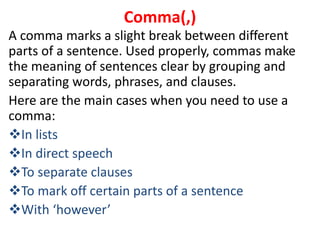
A comma marks a slight break between different
parts of a sentence. Used properly, commas make
the meaning of sentences clear by grouping and
separating words, phrases, and clauses.
Here are the main cases when you need to use a
comma:
In lists
In direct speech
To separate clauses
To mark off certain parts of a sentence
With ‘however’
Comma(,)
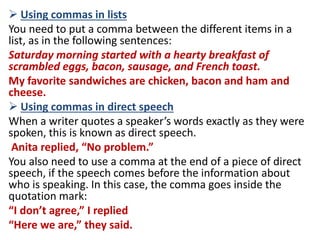
 Using commas in lists
You need to put a comma between the different items in a
list, as in the following sentences:
Saturday morning started with a hearty breakfast of
scrambled eggs, bacon, sausage, and French toast.
My favorite sandwiches are chicken, bacon and ham and
cheese.
 Using commas in direct speech
When a writer quotes a speaker’s words exactly as they were
spoken, this is known as direct speech.
Anita replied, “No problem.”
You also need to use a comma at the end of a piece of direct
speech, if the speech comes before the information about
who is speaking. In this case, the comma goes inside the
quotation mark:
“I don’t agree,” I replied
“Here we are,” they said.
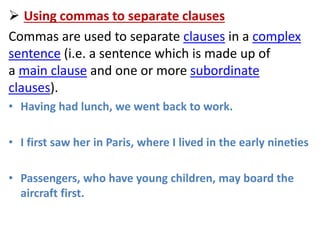
 Using commas to separate clauses
Commas are used to separate clauses in a complex
sentence (i.e. a sentence which is made up of
a main clause and one or more subordinate
clauses).
• Having had lunch, we went back to work.
• I first saw her in Paris, where I lived in the early nineties
• Passengers, who have young children, may board the
aircraft first.
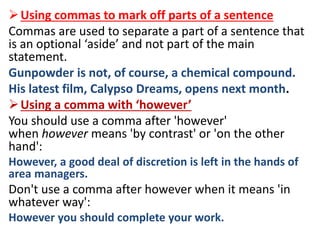
Using commas to mark off parts of a sentence
Commas are used to separate a part of a sentence that
is an optional ‘aside’ and not part of the main
statement.
Gunpowder is not, of course, a chemical compound.
His latest film, Calypso Dreams, opens next month.
Using a comma with ‘however’
You should use a comma after 'however'
when however means 'by contrast' or 'on the other
hand':
However, a good deal of discretion is left in the hands of
area managers.
Don't use a comma after however when it means 'in
whatever way':
However you should complete your work.
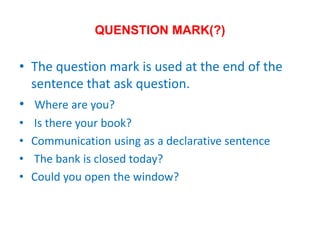
QUENSTION MARK(?)
• The question mark is used at the end of the
sentence that ask question.
• Where are you?
• Is there your book?
• Communication using as a declarative sentence
• The bank is closed today?
• Could you open the window?
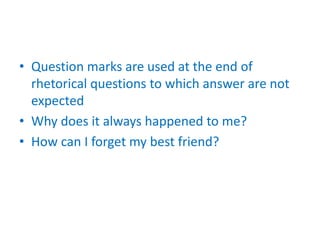
• Question marks are used at the end of
rhetorical questions to which answer are not
expected
• Why does it always happened to me?
• How can I forget my best friend?
The best way to get apostrophes right is to
understand when and why they are used. There are
two main cases –
1. Using apostrophes to show Possession.
2. Using apostrophes to show Omission.
ex.A Bag of Anita.
Anita’s a bag.
Apostrophe( s’)
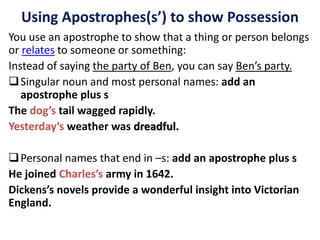
You use an apostrophe to show that a thing or person belongs
or relates to someone or something:
Instead of saying the party of Ben, you can say Ben’s party.
Singular noun and most personal names: add an
apostrophe plus s
The dog’s tail wagged rapidly.
Yesterday’s weather was dreadful.
Personal names that end in –s: add an apostrophe plus s
He joined Charles’s army in 1642.
Dickens’s novels provide a wonderful insight into Victorian
England.
Using Apostrophes(s’) to show Possession
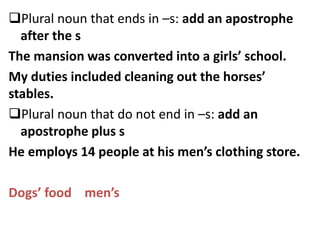
Plural noun that ends in –s: add an apostrophe
after the s
The mansion was converted into a girls’ school.
My duties included cleaning out the horses’
stables.
Plural noun that do not end in –s: add an
apostrophe plus s
He employs 14 people at his men’s clothing store.
Dogs’ food men’s
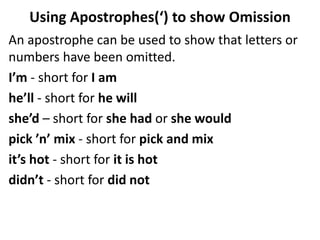
An apostrophe can be used to show that letters or
numbers have been omitted.
I’m - short for I am
he’ll - short for he will
she’d – short for she had or she would
pick ’n’ mix - short for pick and mix
it’s hot - short for it is hot
didn’t - short for did not
Using Apostrophes(‘) to show Omission
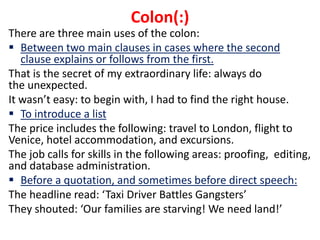
There are three main uses of the colon:
 Between two main clauses in cases where the second
clause explains or follows from the first.
That is the secret of my extraordinary life: always do
the unexpected.
It wasn’t easy: to begin with, I had to find the right house.
 To introduce a list
The price includes the following: travel to London, flight to
Venice, hotel accommodation, and excursions.
The job calls for skills in the following areas: proofing, editing,
and database administration.
 Before a quotation, and sometimes before direct speech:
The headline read: ‘Taxi Driver Battles Gangsters’
They shouted: ‘Our families are starving! We need land!’
Colon(:)
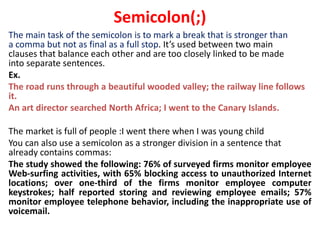
The main task of the semicolon is to mark a break that is stronger than
a comma but not as final as a full stop. It’s used between two main
clauses that balance each other and are too closely linked to be made
into separate sentences.
Ex.
The road runs through a beautiful wooded valley; the railway line follows
it.
An art director searched North Africa; I went to the Canary Islands.
The market is full of people :I went there when I was young child
You can also use a semicolon as a stronger division in a sentence that
already contains commas:
The study showed the following: 76% of surveyed firms monitor employee
Web-surfing activities, with 65% blocking access to unauthorized Internet
locations; over one-third of the firms monitor employee computer
keystrokes; half reported storing and reviewing employee emails; 57%
monitor employee telephone behavior, including the inappropriate use of
voicemail.
Semicolon(;)

Punctuation

  • 1.
  • 2.
    Punctuation Types • FullStop / Period (.) • Comma (,) • Apostrophe ( ‘) • Colon (: ) • Semi-colon (;)
  • 3.
    Full stops areused to mark the end of a sentence that is a complete statement: My name is Ram and I was born 20th July 2001. After leaving school, she went to work in an insurance company. in some abbreviations, for example etc., Dec., or p.m.: There’s a wide range of sandwiches, snacks, cakes, etc. at very reasonable prices. Full Stop / Period (.)
  • 4.
    • in websiteand email addresses: www.mgc.@gmail.com • If an abbreviation with a full stop comes at the end of a sentence you don’t need to add another full stop: I like apple,mango,cherry,banana etc.
  • 5.
    A comma marksa slight break between different parts of a sentence. Used properly, commas make the meaning of sentences clear by grouping and separating words, phrases, and clauses. Here are the main cases when you need to use a comma: In lists In direct speech To separate clauses To mark off certain parts of a sentence With ‘however’ Comma(,)
  • 6.
     Using commasin lists You need to put a comma between the different items in a list, as in the following sentences: Saturday morning started with a hearty breakfast of scrambled eggs, bacon, sausage, and French toast. My favorite sandwiches are chicken, bacon and ham and cheese.  Using commas in direct speech When a writer quotes a speaker’s words exactly as they were spoken, this is known as direct speech. Anita replied, “No problem.” You also need to use a comma at the end of a piece of direct speech, if the speech comes before the information about who is speaking. In this case, the comma goes inside the quotation mark: “I don’t agree,” I replied “Here we are,” they said.
  • 7.
     Using commasto separate clauses Commas are used to separate clauses in a complex sentence (i.e. a sentence which is made up of a main clause and one or more subordinate clauses). • Having had lunch, we went back to work. • I first saw her in Paris, where I lived in the early nineties • Passengers, who have young children, may board the aircraft first.
  • 8.
    Using commas tomark off parts of a sentence Commas are used to separate a part of a sentence that is an optional ‘aside’ and not part of the main statement. Gunpowder is not, of course, a chemical compound. His latest film, Calypso Dreams, opens next month. Using a comma with ‘however’ You should use a comma after 'however' when however means 'by contrast' or 'on the other hand': However, a good deal of discretion is left in the hands of area managers. Don't use a comma after however when it means 'in whatever way': However you should complete your work.
  • 9.
    QUENSTION MARK(?) • Thequestion mark is used at the end of the sentence that ask question. • Where are you? • Is there your book? • Communication using as a declarative sentence • The bank is closed today? • Could you open the window?
  • 10.
    • Question marksare used at the end of rhetorical questions to which answer are not expected • Why does it always happened to me? • How can I forget my best friend?
  • 11.
    The best wayto get apostrophes right is to understand when and why they are used. There are two main cases – 1. Using apostrophes to show Possession. 2. Using apostrophes to show Omission. ex.A Bag of Anita. Anita’s a bag. Apostrophe( s’)
  • 12.
    You use anapostrophe to show that a thing or person belongs or relates to someone or something: Instead of saying the party of Ben, you can say Ben’s party. Singular noun and most personal names: add an apostrophe plus s The dog’s tail wagged rapidly. Yesterday’s weather was dreadful. Personal names that end in –s: add an apostrophe plus s He joined Charles’s army in 1642. Dickens’s novels provide a wonderful insight into Victorian England. Using Apostrophes(s’) to show Possession
  • 13.
    Plural noun thatends in –s: add an apostrophe after the s The mansion was converted into a girls’ school. My duties included cleaning out the horses’ stables. Plural noun that do not end in –s: add an apostrophe plus s He employs 14 people at his men’s clothing store. Dogs’ food men’s
  • 14.
    An apostrophe canbe used to show that letters or numbers have been omitted. I’m - short for I am he’ll - short for he will she’d – short for she had or she would pick ’n’ mix - short for pick and mix it’s hot - short for it is hot didn’t - short for did not Using Apostrophes(‘) to show Omission
  • 15.
    There are threemain uses of the colon:  Between two main clauses in cases where the second clause explains or follows from the first. That is the secret of my extraordinary life: always do the unexpected. It wasn’t easy: to begin with, I had to find the right house.  To introduce a list The price includes the following: travel to London, flight to Venice, hotel accommodation, and excursions. The job calls for skills in the following areas: proofing, editing, and database administration.  Before a quotation, and sometimes before direct speech: The headline read: ‘Taxi Driver Battles Gangsters’ They shouted: ‘Our families are starving! We need land!’ Colon(:)
  • 16.
    The main taskof the semicolon is to mark a break that is stronger than a comma but not as final as a full stop. It’s used between two main clauses that balance each other and are too closely linked to be made into separate sentences. Ex. The road runs through a beautiful wooded valley; the railway line follows it. An art director searched North Africa; I went to the Canary Islands. The market is full of people :I went there when I was young child You can also use a semicolon as a stronger division in a sentence that already contains commas: The study showed the following: 76% of surveyed firms monitor employee Web-surfing activities, with 65% blocking access to unauthorized Internet locations; over one-third of the firms monitor employee computer keystrokes; half reported storing and reviewing employee emails; 57% monitor employee telephone behavior, including the inappropriate use of voicemail. Semicolon(;)