Shift in Stress
and
Intonation
MINDORO STATE COLLEGE OF AGRICULTURE AND TECHNOLOGY
BONGABONG CAMPUS
Labasan, Bongabong Oriental Mindoro
MinSCAT plants Responsibility Involvement Commitment Excellence
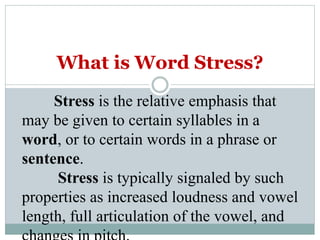
What is Word Stress?
Stress is the relative emphasis that
may be given to certain syllables in a
word, or to certain words in a phrase or
sentence.
Stress is typically signaled by such
properties as increased loudness and vowel
length, full articulation of the vowel, and
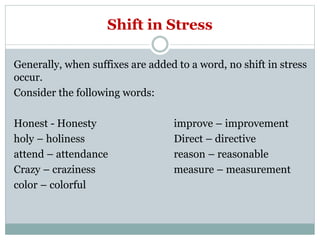
Shift in Stress
Generally, when suffixes are added to a word, no shift in stress
occur.
Consider the following words:
Honest - Honesty improve – improvement
holy – holiness Direct – directive
attend – attendance reason – reasonable
Crazy – craziness measure – measurement
color – colorful
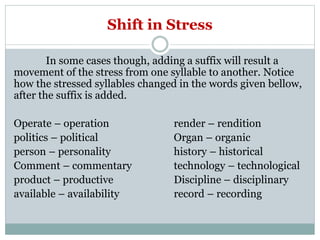
Shift in Stress
In some cases though, adding a suffix will result a
movement of the stress from one syllable to another. Notice
how the stressed syllables changed in the words given bellow,
after the suffix is added.
Operate – operation render – rendition
politics – political Organ – organic
person – personality history – historical
Comment – commentary technology – technological
product – productive Discipline – disciplinary
available – availability record – recording
Suffix
Take a good look at the list of suffixes below (suffixes
are word endings).
Your stress is going to come on the syllable right
before the suffix. This applies to words of all syllable
lengths.
Examples:
 able: ADDable, ARable, DURable
 ary: PRIMary, DIary, liBRary
 cial: juDIcial, nonSOcial
 cian: muSIcian, phySIcian, cliNICian
Prefixes
Usually, prefixes do not take the stress of a word.
There are a few exceptions to this rule, however,
like: un, in, pre, ex and mis, which are all stressed in their prefix.
Examples:
 ex: EXample, EXplanation, EXamine
 in: INside, INefficient, INterest
 mis: MISspoke, MIStake, MISspelled
 pre: PREcede, PREarrange, PREliminary
Video:
https://www.youtube.com/watch?v=HE4b0jL3gTQ
https://www.youtube.com/watch?v=TV6gSPkfwZE
Intonation
is variation of spoken pitch that is not used to
distinguish words; instead it is used for a range
of functions such as indicating the attitudes and
emotions of the speaker, signalling the difference
between statements and questions, and between
different types of questions, focusing attention on
important elements of the spoken message and
also helping to regulate conversational
interaction. It contrasts with tone, in which pitch
variation in some languages does distinguish
words, either lexically or grammatically.
Intonation
Pitch is raising and lowering the
voice while speaking. The use of pitch is
called intonation.
Introduction of Intonation video:
https://www.youtube.com/watch?v=tzh3Owutf5Y
In many descriptions of English, the following
intonation patterns are distinguished:
Rising Intonation
 means the pitch of the voice rises over time [↗];
Falling Intonation
 means that the pitch falls with time [↘];
Dipping or Fall-rise Intonation
 falls and then rises [↘↗];
Peaking or Rise-fall Intonation
 rises and then falls [↗↘].
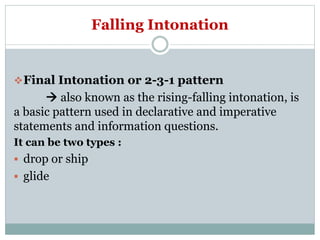
Falling Intonation
Final Intonation or 2-3-1 pattern
 also known as the rising-falling intonation, is
a basic pattern used in declarative and imperative
statements and information questions.
It can be two types :
 drop or ship
 glide
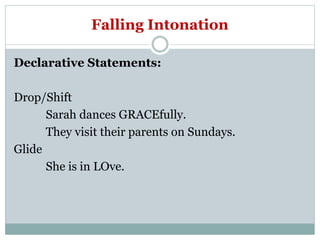
Falling Intonation
Declarative Statements:
Drop/Shift
Sarah dances GRACEfully.
They visit their parents on Sundays.
Glide
She is in LOve.
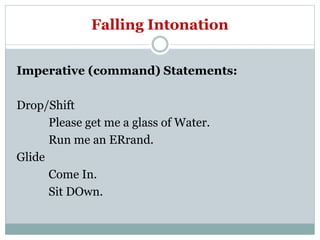
Falling Intonation
Imperative (command) Statements:
Drop/Shift
Please get me a glass of Water.
Run me an ERrand.
Glide
Come In.
Sit DOwn.
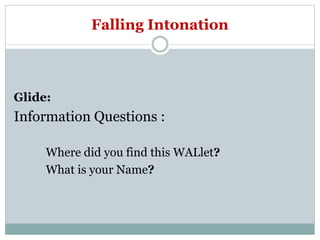
Falling Intonation
Glide:
Information Questions :
Where did you find this WALlet?
What is your Name?
Falling Intonation
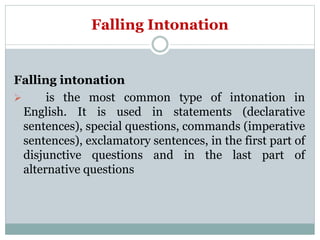
Falling intonation
 is the most common type of intonation in
English. It is used in statements (declarative
sentences), special questions, commands (imperative
sentences), exclamatory sentences, in the first part of
disjunctive questions and in the last part of
alternative questions
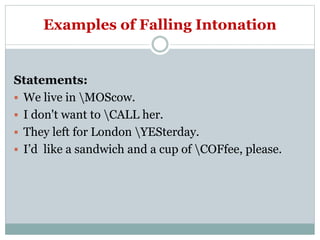
Examples of Falling Intonation
Statements:
 We live in MOScow.
 I don't want to CALL her.
 They left for London YESterday.
 I’d like a sandwich and a cup of COFfee, please.
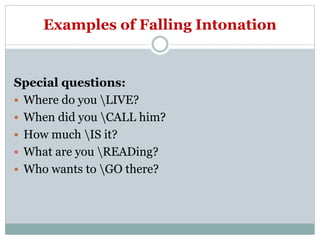
Examples of Falling Intonation
Special questions:
 Where do you LIVE?
 When did you CALL him?
 How much IS it?
 What are you READing?
 Who wants to GO there?
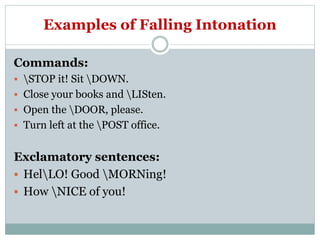
Examples of Falling Intonation
Commands:
 STOP it! Sit DOWN.
 Close your books and LISten.
 Open the DOOR, please.
 Turn left at the POST office.
Exclamatory sentences:
 HelLO! Good MORNing!
 How NICE of you!
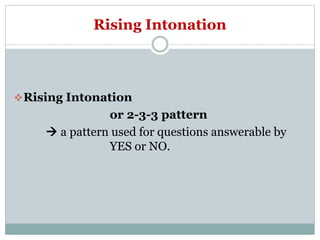
Rising Intonation
Rising Intonation
or 2-3-3 pattern
 a pattern used for questions answerable by
YES or NO.
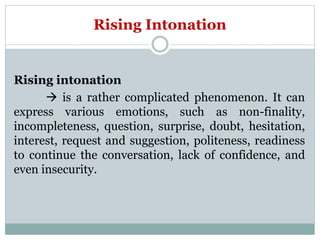
Rising Intonation
Rising intonation
 is a rather complicated phenomenon. It can
express various emotions, such as non-finality,
incompleteness, question, surprise, doubt, hesitation,
interest, request and suggestion, politeness, readiness
to continue the conversation, lack of confidence, and
even insecurity.
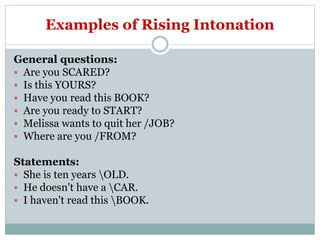
Examples of Rising Intonation
General questions:
 Are you SCARED?
 Is this YOURS?
 Have you read this BOOK?
 Are you ready to START?
 Melissa wants to quit her /JOB?
 Where are you /FROM?
Statements:
 She is ten years OLD.
 He doesn't have a CAR.
 I haven't read this BOOK.
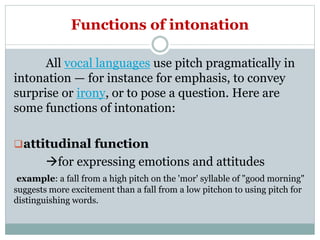
Functions of intonation
All vocal languages use pitch pragmatically in
intonation — for instance for emphasis, to convey
surprise or irony, or to pose a question. Here are
some functions of intonation:
attitudinal function
for expressing emotions and attitudes
example: a fall from a high pitch on the 'mor' syllable of "good morning"
suggests more excitement than a fall from a low pitchon to using pitch for
distinguishing words.
Functions of intonation
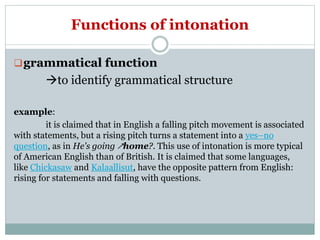
grammatical function
to identify grammatical structure
example:
it is claimed that in English a falling pitch movement is associated
with statements, but a rising pitch turns a statement into a yes–no
question, as in He's going ↗home?. This use of intonation is more typical
of American English than of British. It is claimed that some languages,
like Chickasaw and Kalaallisut, have the opposite pattern from English:
rising for statements and falling with questions.
Functions of intonation
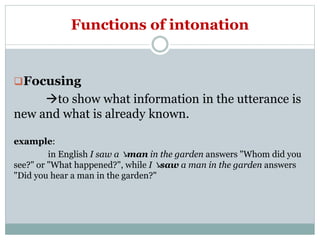
Focusing
to show what information in the utterance is
new and what is already known.
example:
in English I saw a ↘man in the garden answers "Whom did you
see?" or "What happened?", while I ↘saw a man in the garden answers
"Did you hear a man in the garden?"
Functions of intonation
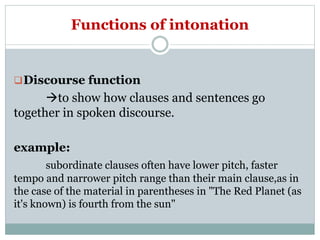
Discourse function
to show how clauses and sentences go
together in spoken discourse.
example:
subordinate clauses often have lower pitch, faster
tempo and narrower pitch range than their main clause,as in
the case of the material in parentheses in "The Red Planet (as
it's known) is fourth from the sun"
Functions of intonation
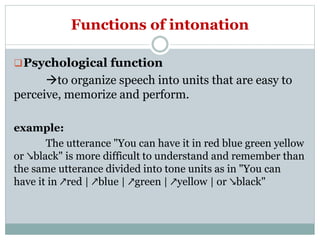
Psychological function
to organize speech into units that are easy to
perceive, memorize and perform.
example:
The utterance "You can have it in red blue green yellow
or ↘black" is more difficult to understand and remember than
the same utterance divided into tone units as in "You can
have it in ↗red | ↗blue | ↗green | ↗yellow | or ↘black"
Functions of intonation
Psychological function
to organize speech into units that are easy to
perceive, memorize and perform.
example:
The utterance "You can have it in red blue
green yellow or ↘black" is more difficult to
understand and remember than the same utterance
divided into tone units as in "You can have it in ↗red
| ↗blue | ↗green | ↗yellow | or ↘black"

Shift in Stress and Intonation

  • 1.
    Shift in Stress and Intonation MINDOROSTATE COLLEGE OF AGRICULTURE AND TECHNOLOGY BONGABONG CAMPUS Labasan, Bongabong Oriental Mindoro MinSCAT plants Responsibility Involvement Commitment Excellence
  • 2.
    What is WordStress? Stress is the relative emphasis that may be given to certain syllables in a word, or to certain words in a phrase or sentence. Stress is typically signaled by such properties as increased loudness and vowel length, full articulation of the vowel, and
  • 3.
    Shift in Stress Generally,when suffixes are added to a word, no shift in stress occur. Consider the following words: Honest - Honesty improve – improvement holy – holiness Direct – directive attend – attendance reason – reasonable Crazy – craziness measure – measurement color – colorful
  • 4.
    Shift in Stress Insome cases though, adding a suffix will result a movement of the stress from one syllable to another. Notice how the stressed syllables changed in the words given bellow, after the suffix is added. Operate – operation render – rendition politics – political Organ – organic person – personality history – historical Comment – commentary technology – technological product – productive Discipline – disciplinary available – availability record – recording
  • 5.
    Suffix Take a goodlook at the list of suffixes below (suffixes are word endings). Your stress is going to come on the syllable right before the suffix. This applies to words of all syllable lengths. Examples:  able: ADDable, ARable, DURable  ary: PRIMary, DIary, liBRary  cial: juDIcial, nonSOcial  cian: muSIcian, phySIcian, cliNICian
  • 6.
    Prefixes Usually, prefixes donot take the stress of a word. There are a few exceptions to this rule, however, like: un, in, pre, ex and mis, which are all stressed in their prefix. Examples:  ex: EXample, EXplanation, EXamine  in: INside, INefficient, INterest  mis: MISspoke, MIStake, MISspelled  pre: PREcede, PREarrange, PREliminary Video: https://www.youtube.com/watch?v=HE4b0jL3gTQ https://www.youtube.com/watch?v=TV6gSPkfwZE
  • 7.
    Intonation is variation ofspoken pitch that is not used to distinguish words; instead it is used for a range of functions such as indicating the attitudes and emotions of the speaker, signalling the difference between statements and questions, and between different types of questions, focusing attention on important elements of the spoken message and also helping to regulate conversational interaction. It contrasts with tone, in which pitch variation in some languages does distinguish words, either lexically or grammatically.
  • 8.
    Intonation Pitch is raisingand lowering the voice while speaking. The use of pitch is called intonation. Introduction of Intonation video: https://www.youtube.com/watch?v=tzh3Owutf5Y
  • 9.
    In many descriptionsof English, the following intonation patterns are distinguished: Rising Intonation  means the pitch of the voice rises over time [↗]; Falling Intonation  means that the pitch falls with time [↘]; Dipping or Fall-rise Intonation  falls and then rises [↘↗]; Peaking or Rise-fall Intonation  rises and then falls [↗↘].
  • 10.
    Falling Intonation Final Intonationor 2-3-1 pattern  also known as the rising-falling intonation, is a basic pattern used in declarative and imperative statements and information questions. It can be two types :  drop or ship  glide
  • 11.
    Falling Intonation Declarative Statements: Drop/Shift Sarahdances GRACEfully. They visit their parents on Sundays. Glide She is in LOve.
  • 12.
    Falling Intonation Imperative (command)Statements: Drop/Shift Please get me a glass of Water. Run me an ERrand. Glide Come In. Sit DOwn.
  • 13.
    Falling Intonation Glide: Information Questions: Where did you find this WALlet? What is your Name?
  • 14.
    Falling Intonation Falling intonation is the most common type of intonation in English. It is used in statements (declarative sentences), special questions, commands (imperative sentences), exclamatory sentences, in the first part of disjunctive questions and in the last part of alternative questions
  • 15.
    Examples of FallingIntonation Statements:  We live in MOScow.  I don't want to CALL her.  They left for London YESterday.  I’d like a sandwich and a cup of COFfee, please.
  • 16.
    Examples of FallingIntonation Special questions:  Where do you LIVE?  When did you CALL him?  How much IS it?  What are you READing?  Who wants to GO there?
  • 17.
    Examples of FallingIntonation Commands:  STOP it! Sit DOWN.  Close your books and LISten.  Open the DOOR, please.  Turn left at the POST office. Exclamatory sentences:  HelLO! Good MORNing!  How NICE of you!
  • 18.
    Rising Intonation Rising Intonation or2-3-3 pattern  a pattern used for questions answerable by YES or NO.
  • 19.
    Rising Intonation Rising intonation is a rather complicated phenomenon. It can express various emotions, such as non-finality, incompleteness, question, surprise, doubt, hesitation, interest, request and suggestion, politeness, readiness to continue the conversation, lack of confidence, and even insecurity.
  • 20.
    Examples of RisingIntonation General questions:  Are you SCARED?  Is this YOURS?  Have you read this BOOK?  Are you ready to START?  Melissa wants to quit her /JOB?  Where are you /FROM? Statements:  She is ten years OLD.  He doesn't have a CAR.  I haven't read this BOOK.
  • 21.
    Functions of intonation Allvocal languages use pitch pragmatically in intonation — for instance for emphasis, to convey surprise or irony, or to pose a question. Here are some functions of intonation: attitudinal function for expressing emotions and attitudes example: a fall from a high pitch on the 'mor' syllable of "good morning" suggests more excitement than a fall from a low pitchon to using pitch for distinguishing words.
  • 22.
    Functions of intonation grammaticalfunction to identify grammatical structure example: it is claimed that in English a falling pitch movement is associated with statements, but a rising pitch turns a statement into a yes–no question, as in He's going ↗home?. This use of intonation is more typical of American English than of British. It is claimed that some languages, like Chickasaw and Kalaallisut, have the opposite pattern from English: rising for statements and falling with questions.
  • 23.
    Functions of intonation Focusing toshow what information in the utterance is new and what is already known. example: in English I saw a ↘man in the garden answers "Whom did you see?" or "What happened?", while I ↘saw a man in the garden answers "Did you hear a man in the garden?"
  • 24.
    Functions of intonation Discoursefunction to show how clauses and sentences go together in spoken discourse. example: subordinate clauses often have lower pitch, faster tempo and narrower pitch range than their main clause,as in the case of the material in parentheses in "The Red Planet (as it's known) is fourth from the sun"
  • 25.
    Functions of intonation Psychologicalfunction to organize speech into units that are easy to perceive, memorize and perform. example: The utterance "You can have it in red blue green yellow or ↘black" is more difficult to understand and remember than the same utterance divided into tone units as in "You can have it in ↗red | ↗blue | ↗green | ↗yellow | or ↘black"
  • 26.
    Functions of intonation Psychologicalfunction to organize speech into units that are easy to perceive, memorize and perform. example: The utterance "You can have it in red blue green yellow or ↘black" is more difficult to understand and remember than the same utterance divided into tone units as in "You can have it in ↗red | ↗blue | ↗green | ↗yellow | or ↘black"