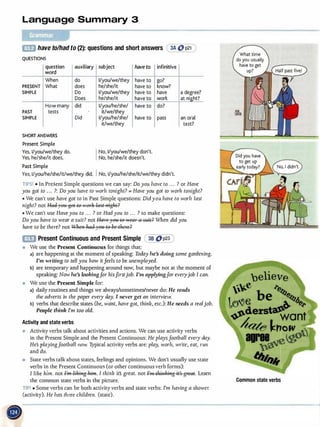
Language Summary 3


lm have to/had to (2): questions and short answers                             3A 0 p21
    QUESTIONS
            question           auxiliary subject            have to    infinitive
            word
            When           do               1/you/we/they   have to go?
    PRESENT What           does             he/she/it       have to know?
    SIMPLE                 Do               1/you/we/they   have to have            a degree?
                           Does             he/she/it       have to work            at night?
                  How many did              1/you/he/she/   have to do?
    PAST           tests                      it/we/they
    SIMPLE                 Did              1/you/he/she/   have to    pass         an oral
                                              it/we/they                             test?

    SHORT ANSWERS
    Present Simple

                                        I
    Yes, 1/you/we/they do.                  No, 1/you/we/they don't.
    Yes, he/she/it does.                    No, he/she/it doesn't.
Past Simple
Yes, 1/you/he/she/it/we/they did.       I No, 1/you/he/she/it/we/they didn't.
TIPS! • In Present Simple questions we can say: Do you lwve to . . . ? or Have
you got to . . . ?: Do you l�ave to worll tonight? = Have you got to worll tonigllt?
• We can't use have got to in Past Simple questions: Did you lwve to worll last

nigl1t? not Had)·eu get te werlz last night?
• We can't use Have you to . . . ? or Had you to . . . ? to make questions:

Do you have to wear a suit? not H veyeu te weara suit? Wllen did you
                                     a
have to be there? not V/lwl l1adyeu le he there?

    1m Present Continuous and Present Simple                      3B   0 p23
    •   Ne use the Present Continuous for things that:
        a) are happening at the moment of speaking: Today J1e's doing some gardening.

            I'm   writing to tell you lww it feels to be unemployed.
        b) are temporary and happening around now, but maybe not at the moment of
           speaking: Now J1e's looll ing for his first job. I'm al'l'lyingfor every job I can.
    •   We use the Present Simple for:
        a
        ) daily routines and things we always/sometimes/never do: He reads
            tl1e adverts in the paper eve1y clay. l never get an interviev.
        b) verbs that describe states   (be, want, have got, thinll, etc.): He needs a real job.
            People tJJinJl I'm too old.

    Activity and state verbs
    •   Activity verbs talk about activities and actions. We can use activity verbs
        in the Present Simple and the Present Continuous: He plays football eve1y clay.
        He5 playing football JJOV. Typical activity verbs are: play, worll, write, eat, run
        and do.
    •  State verbs talk about states, feelings and opinions. We don't usually use state
       verbs in the Present Continuous (or other continuous verb forms):
       I lille l1 im. not I'm liking him. I tl1inll its great. not I'm thinking itsgreat. Learn
        the common state verbs in the picture.                                                     Common state verbs
    TIP! • Some verbs can be both activity verbs and state verbs: I'm l�aving a showa
    (activity). He lws tll ree children. (state) .


•
Language Summary 3


Present Continuous                                                                 Present Simple
•    We make the Present Continuous with:                                          •  Fo r I!youlwe!tl1ey the Present Simple is the same as
     subject + be + (not) + verb+ing.                                                  the infinitive. For he/she/it we add -s or -es to the
                                                                                       infinitive: l1e lives, she watches, it goes.
POSITIVE
                                                                                   •   We make the Present Simple negative with:
I'm working at the moment.
                                                                                       don't or doesn't + infinitive.
You/We/They're looking for a job.
He/She/lt's waiting for you.                                                       POSITIVE
                                                                                   1/You/We/They live in the UK.
NEGATIVE
                                                                                   He/She/lt wants to go home.
I'm not driving very fast.
You/We/They aren't watching TV.                                                    NEGATIVE
He/She/lt isn't working now.                                                       1/You/We/They don't live in Germany.
                                                                                   He/She/lt doesn't want to go out.
WH- QUESTIONS
question word           auxiliary   subject           verb+ing                     PRESENT SIMPLE POSITIVE: SPELLING RULES
Where                   am          I                 going?                       spelling rule                                examples
What                    are         you/we/they       doing?
Who                     is          he/she/it         looking at?                  most verbs: add -s                           plays likes reads
                                                                                   verbs ending in -eh, -sh, -s, -ss, x or -z: watches /'wotf•zl
                                                                                                                       -


YES/NO QUESTIONS                                                                   add -es                                     finishes /'f•mf• zl
Am I working today?
                                                                                   verbs ending in consonant + y: -y � ies study � studies
                                                                                                                           -
Are you/we/they watching TV?
Is he/she/it waiting for me?                                                       the verbs go and do: add -es                 goes does ldAzl
                                                                                   the verb have is irregular                   has
SHORT ANSWERS
                                                                                   WH- QUESTIONS

                                    I
Yes, I am.                              No, I'm not.
Yes, you/we/they are.                   No, you/we/they aren't.                    question word     auxiliary         subject          infinitive
Yes, he/she/it is.                      No, he/she/it isn't.                       Where             do                1/you/we/they    live?
TIPS• • See G2.2 for the spelling rules for verb+ i ng forms.
                                                                                   What              does              he/she/it        do?
•We can also make negatives and negative short answers                             YES/NO QUESTIONS
with 're not and � not: They're not playing. Is she waiting?                       Do 1/you/we/they live here?
No, slu� not.                                                                      Does he/she/it come from England?
•   We often use the Present Continuous with: now, today, at                       SHORT ANSWERS


                                                                                                                   I
the moment.
                                                                                   Yes, 1/you/we/they do.              No, llyou/we/they don't.
                                                                                   Yes, he/she/it does.                No, he/she/it doesn't.


1;'1681 Apologies, reasons and promises                       (3D tJ p26)               TIPS!• There is often a pattern in this type of

                                                                                        conversation: we apo lo gise � we give a reason �
•     For apologies we often use:         I'm (really)   sorry,   (but) I can't/
                                                                                        we make a promise.
     couldn't + infinitive.
                                                                                        • T respond to an apology we often use these
     I'm really sony, but I can 't see you lonig/1(.
                                                                                           o

     I'm   sony,   I co ldn 't finish it yesterday.
                       "u
                                                                                        phrases:
                                                                                        Oh, don't worry. Another time, maybe.
•    For reasons we often use: I have to/had to + infinitive.
                                                                                        Oh, dea1: Wluit happened?
     I lu1ve to tahe a client out to dinner.
                                                                                        0/1, right. Wh)' not ?
     I h£1d to l•elp Kate.
•     For promises we often use:         I'll + infinitive.
     1 '11 do it now.
      I'll see you on Friday, I promise.


                                                                                                                                                     •

P124 125sb

  • 1.
    Language Summary 3 lmhave to/had to (2): questions and short answers 3A 0 p21 QUESTIONS question auxiliary subject have to infinitive word When do 1/you/we/they have to go? PRESENT What does he/she/it have to know? SIMPLE Do 1/you/we/they have to have a degree? Does he/she/it have to work at night? How many did 1/you/he/she/ have to do? PAST tests it/we/they SIMPLE Did 1/you/he/she/ have to pass an oral it/we/they test? SHORT ANSWERS Present Simple I Yes, 1/you/we/they do. No, 1/you/we/they don't. Yes, he/she/it does. No, he/she/it doesn't. Past Simple Yes, 1/you/he/she/it/we/they did. I No, 1/you/he/she/it/we/they didn't. TIPS! • In Present Simple questions we can say: Do you lwve to . . . ? or Have you got to . . . ?: Do you l�ave to worll tonight? = Have you got to worll tonigllt? • We can't use have got to in Past Simple questions: Did you lwve to worll last nigl1t? not Had)·eu get te werlz last night? • We can't use Have you to . . . ? or Had you to . . . ? to make questions: Do you have to wear a suit? not H veyeu te weara suit? Wllen did you a have to be there? not V/lwl l1adyeu le he there? 1m Present Continuous and Present Simple 3B 0 p23 • Ne use the Present Continuous for things that: a) are happening at the moment of speaking: Today J1e's doing some gardening. I'm writing to tell you lww it feels to be unemployed. b) are temporary and happening around now, but maybe not at the moment of speaking: Now J1e's looll ing for his first job. I'm al'l'lyingfor every job I can. • We use the Present Simple for: a ) daily routines and things we always/sometimes/never do: He reads tl1e adverts in the paper eve1y clay. l never get an interviev. b) verbs that describe states (be, want, have got, thinll, etc.): He needs a real job. People tJJinJl I'm too old. Activity and state verbs • Activity verbs talk about activities and actions. We can use activity verbs in the Present Simple and the Present Continuous: He plays football eve1y clay. He5 playing football JJOV. Typical activity verbs are: play, worll, write, eat, run and do. • State verbs talk about states, feelings and opinions. We don't usually use state verbs in the Present Continuous (or other continuous verb forms): I lille l1 im. not I'm liking him. I tl1inll its great. not I'm thinking itsgreat. Learn the common state verbs in the picture. Common state verbs TIP! • Some verbs can be both activity verbs and state verbs: I'm l�aving a showa (activity). He lws tll ree children. (state) . •
  • 2.
    Language Summary 3 PresentContinuous Present Simple • We make the Present Continuous with: • Fo r I!youlwe!tl1ey the Present Simple is the same as subject + be + (not) + verb+ing. the infinitive. For he/she/it we add -s or -es to the infinitive: l1e lives, she watches, it goes. POSITIVE • We make the Present Simple negative with: I'm working at the moment. don't or doesn't + infinitive. You/We/They're looking for a job. He/She/lt's waiting for you. POSITIVE 1/You/We/They live in the UK. NEGATIVE He/She/lt wants to go home. I'm not driving very fast. You/We/They aren't watching TV. NEGATIVE He/She/lt isn't working now. 1/You/We/They don't live in Germany. He/She/lt doesn't want to go out. WH- QUESTIONS question word auxiliary subject verb+ing PRESENT SIMPLE POSITIVE: SPELLING RULES Where am I going? spelling rule examples What are you/we/they doing? Who is he/she/it looking at? most verbs: add -s plays likes reads verbs ending in -eh, -sh, -s, -ss, x or -z: watches /'wotf•zl - YES/NO QUESTIONS add -es finishes /'f•mf• zl Am I working today? verbs ending in consonant + y: -y � ies study � studies - Are you/we/they watching TV? Is he/she/it waiting for me? the verbs go and do: add -es goes does ldAzl the verb have is irregular has SHORT ANSWERS WH- QUESTIONS I Yes, I am. No, I'm not. Yes, you/we/they are. No, you/we/they aren't. question word auxiliary subject infinitive Yes, he/she/it is. No, he/she/it isn't. Where do 1/you/we/they live? TIPS• • See G2.2 for the spelling rules for verb+ i ng forms. What does he/she/it do? •We can also make negatives and negative short answers YES/NO QUESTIONS with 're not and � not: They're not playing. Is she waiting? Do 1/you/we/they live here? No, slu� not. Does he/she/it come from England? • We often use the Present Continuous with: now, today, at SHORT ANSWERS I the moment. Yes, 1/you/we/they do. No, llyou/we/they don't. Yes, he/she/it does. No, he/she/it doesn't. 1;'1681 Apologies, reasons and promises (3D tJ p26) TIPS!• There is often a pattern in this type of conversation: we apo lo gise � we give a reason � • For apologies we often use: I'm (really) sorry, (but) I can't/ we make a promise. couldn't + infinitive. • T respond to an apology we often use these I'm really sony, but I can 't see you lonig/1(. o I'm sony, I co ldn 't finish it yesterday. "u phrases: Oh, don't worry. Another time, maybe. • For reasons we often use: I have to/had to + infinitive. Oh, dea1: Wluit happened? I lu1ve to tahe a client out to dinner. 0/1, right. Wh)' not ? I h£1d to l•elp Kate. • For promises we often use: I'll + infinitive. 1 '11 do it now. I'll see you on Friday, I promise. •