Present Time
Language Open Learning English
Grammar Guide
Present Time
Present Simple is formed with the bare
  infinitive.
  Infinitive –                 Bare Infinitive –
  To Like                      Like

We add S to the third person singular (he/she/it)

• I like, you like, he/she/it likes, we like, they like


www.LanguageOpenLearning.com
Present Time
Irregular verbs don’t always add S.

For example – To Have, To Be

• I have, you have, he/she/it has, we have, they have
• I am, you are, he/she/it is, we are, they are


www.LanguageOpenLearning.com
Present Time
Verbs ending in –

                         o, s, ch, sh, x

                           Add –ES

   • He goes, she misses, she watches, he wishes


www.LanguageOpenLearning.com
Present Time
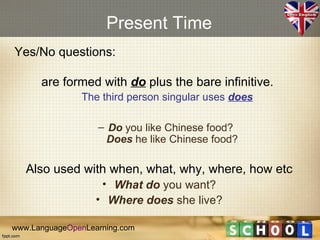
Yes/No questions:

      are formed with do plus the bare infinitive.
               The third person singular uses does

                   – Do you like Chinese food?
                     Does he like Chinese food?

   Also used with when, what, why, where, how etc
                    • What do you want?
                   • Where does she live?

www.LanguageOpenLearning.com
Present Time
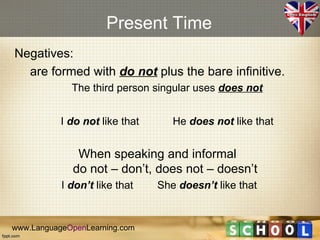
Negatives:
  are formed with do not plus the bare infinitive.
             The third person singular uses does not


           I do not like that      He does not like that


              When speaking and informal
             do not – don’t, does not – doesn’t
           I don’t like that    She doesn’t like that


www.LanguageOpenLearning.com
Present Time
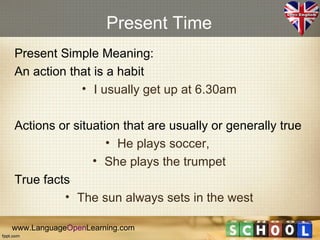
Present Simple Meaning:
An action that is a habit
            • I usually get up at 6.30am

Actions or situation that are usually or generally true
                  • He plays soccer,
               • She plays the trumpet
True facts
         • The sun always sets in the west

www.LanguageOpenLearning.com
Present Time
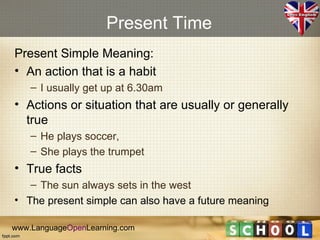
Present Simple Meaning:
• An action that is a habit
    – I usually get up at 6.30am
• Actions or situation that are usually or generally
  true
    – He plays soccer,
    – She plays the trumpet
• True facts
   – The sun always sets in the west
• The present simple can also have a future meaning

www.LanguageOpenLearning.com
Present Time
Present Simple Pronunciation:

Verbs which end with the sounds: z, dz, s, sh, tsch, and ks
Add an extra syllable to make the ending – IZ
• Watches, misses, relaxes

After – f, k, p, t – the third person sound is “s” – hit/hits
Other third person – s – pronounced “z” – see/sees
Does is pronounced – “duhz”


www.LanguageOpenLearning.com
Present Time
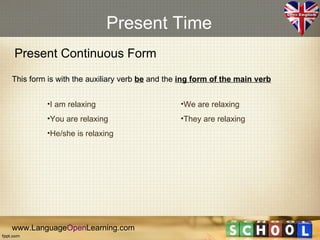
Present Continuous Form
This form is with the auxiliary verb be and the ing form of the main verb


         •I am relaxing                        •We are relaxing
         •You are relaxing                     •They are relaxing
         •He/she is relaxing


www.LanguageOpenLearning.com
Present Time
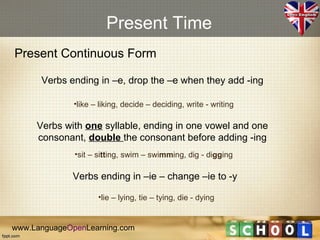
Present Continuous Form

      Verbs ending in –e, drop the –e when they add -ing

              •like – liking, decide – deciding, write - writing

     Verbs with one syllable, ending in one vowel and one
     consonant, double the consonant before adding -ing
              •sit – sitting, swim – swimming, dig - digging

             Verbs ending in –ie – change –ie to -y

                     •lie – lying, tie – tying, die - dying


www.LanguageOpenLearning.com
Present Time
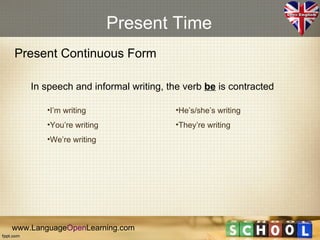
Present Continuous Form

    In speech and informal writing, the verb be is contracted

        •I’m writing                 •He’s/she’s writing
        •You’re writing              •They’re writing
        •We’re writing


www.LanguageOpenLearning.com
Present Time
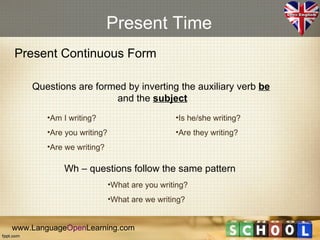
Present Continuous Form

    Questions are formed by inverting the auxiliary verb be
                      and the subject
        •Am I writing?                        •Is he/she writing?
        •Are you writing?                     •Are they writing?
        •Are we writing?

            Wh – questions follow the same pattern
                            •What are you writing?
                            •What are we writing?


www.LanguageOpenLearning.com
Present Time
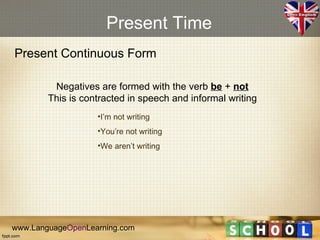
Present Continuous Form

         Negatives are formed with the verb be + not
        This is contracted in speech and informal writing
                   •I’m not writing
                   •You’re not writing
                   •We aren’t writing


www.LanguageOpenLearning.com
Present Time
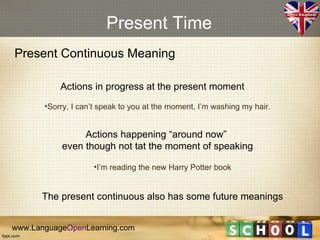
Present Continuous Meaning

           Actions in progress at the present moment
       •Sorry, I can’t speak to you at the moment, I’m washing my hair.


                Actions happening “around now”
           even though not tat the moment of speaking

                    •I’m reading the new Harry Potter book


      The present continuous also has some future meanings


www.LanguageOpenLearning.com
Want to know more?
Contact us

•   www.LanguageOpenLearning.com
•   www.Facebook.com/LanguageOpenLearning
•   Skype - AjarnKen
•   Twitter - @AjarnKen


www.LanguageOpenLearning.com

English Grammar - Present Tense

  • 1.
    Present Time Language OpenLearning English Grammar Guide
  • 2.
    Present Time Present Simpleis formed with the bare infinitive. Infinitive – Bare Infinitive – To Like Like We add S to the third person singular (he/she/it) • I like, you like, he/she/it likes, we like, they like www.LanguageOpenLearning.com
  • 3.
    Present Time Irregular verbsdon’t always add S. For example – To Have, To Be • I have, you have, he/she/it has, we have, they have • I am, you are, he/she/it is, we are, they are www.LanguageOpenLearning.com
  • 4.
    Present Time Verbs endingin – o, s, ch, sh, x Add –ES • He goes, she misses, she watches, he wishes www.LanguageOpenLearning.com
  • 5.
    Present Time Yes/No questions: are formed with do plus the bare infinitive. The third person singular uses does – Do you like Chinese food? Does he like Chinese food? Also used with when, what, why, where, how etc • What do you want? • Where does she live? www.LanguageOpenLearning.com
  • 6.
    Present Time Negatives: are formed with do not plus the bare infinitive. The third person singular uses does not I do not like that He does not like that When speaking and informal do not – don’t, does not – doesn’t I don’t like that She doesn’t like that www.LanguageOpenLearning.com
  • 7.
    Present Time Present SimpleMeaning: An action that is a habit • I usually get up at 6.30am Actions or situation that are usually or generally true • He plays soccer, • She plays the trumpet True facts • The sun always sets in the west www.LanguageOpenLearning.com
  • 8.
    Present Time Present SimpleMeaning: • An action that is a habit – I usually get up at 6.30am • Actions or situation that are usually or generally true – He plays soccer, – She plays the trumpet • True facts – The sun always sets in the west • The present simple can also have a future meaning www.LanguageOpenLearning.com
  • 9.
    Present Time Present SimplePronunciation: Verbs which end with the sounds: z, dz, s, sh, tsch, and ks Add an extra syllable to make the ending – IZ • Watches, misses, relaxes After – f, k, p, t – the third person sound is “s” – hit/hits Other third person – s – pronounced “z” – see/sees Does is pronounced – “duhz” www.LanguageOpenLearning.com
  • 10.
    Present Time Present ContinuousForm This form is with the auxiliary verb be and the ing form of the main verb •I am relaxing •We are relaxing •You are relaxing •They are relaxing •He/she is relaxing www.LanguageOpenLearning.com
  • 11.
    Present Time Present ContinuousForm Verbs ending in –e, drop the –e when they add -ing •like – liking, decide – deciding, write - writing Verbs with one syllable, ending in one vowel and one consonant, double the consonant before adding -ing •sit – sitting, swim – swimming, dig - digging Verbs ending in –ie – change –ie to -y •lie – lying, tie – tying, die - dying www.LanguageOpenLearning.com
  • 12.
    Present Time Present ContinuousForm In speech and informal writing, the verb be is contracted •I’m writing •He’s/she’s writing •You’re writing •They’re writing •We’re writing www.LanguageOpenLearning.com
  • 13.
    Present Time Present ContinuousForm Questions are formed by inverting the auxiliary verb be and the subject •Am I writing? •Is he/she writing? •Are you writing? •Are they writing? •Are we writing? Wh – questions follow the same pattern •What are you writing? •What are we writing? www.LanguageOpenLearning.com
  • 14.
    Present Time Present ContinuousForm Negatives are formed with the verb be + not This is contracted in speech and informal writing •I’m not writing •You’re not writing •We aren’t writing www.LanguageOpenLearning.com
  • 15.
    Present Time Present ContinuousMeaning Actions in progress at the present moment •Sorry, I can’t speak to you at the moment, I’m washing my hair. Actions happening “around now” even though not tat the moment of speaking •I’m reading the new Harry Potter book The present continuous also has some future meanings www.LanguageOpenLearning.com
  • 16.
    Want to knowmore? Contact us • www.LanguageOpenLearning.com • www.Facebook.com/LanguageOpenLearning • Skype - AjarnKen • Twitter - @AjarnKen www.LanguageOpenLearning.com