TDC 1
Pedagogical Grammar
Class 2
Book:
  Review                                  -    Pages 10 – 13 (Self-study)
                                              “Can you explain ELL
                                                  Grammar Errors?”
                                              “On the Hot Seat: Answering
 Definitions of Grammar                          ELL Questions”
 English Studied by Native Speakers
                                          Workbook:
  X
                                          -    Pages 1 – 5 (Self-study)
  English Studied as a Foreign Language       “Distinguishing Traditional
 The History of English                           Grammar and ELL
                                                   Grammar”
                                              “Answering / Researching ELL
                                                   Grammar Questions”
                                              “Identifying ELL Errors in
                                                   Authentic Material”
Approaches to Teaching ELL Grammar

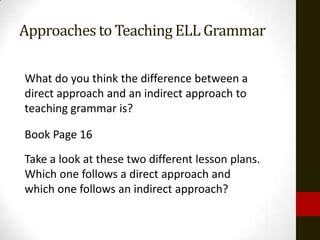
What do you think the difference between a
direct approach and an indirect approach to
teaching grammar is?

Book Page 16
Take a look at these two different lesson plans.
Which one follows a direct approach and
which one follows an indirect approach?
Approaches to Teaching ELL Grammar
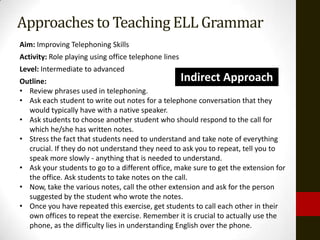
Aim: Improving Telephoning Skills
Activity: Role playing using office telephone lines
Level: Intermediate to advanced
Outline:                                          Indirect Approach
• Review phrases used in telephoning.
• Ask each student to write out notes for a telephone conversation that they
  would typically have with a native speaker.
• Ask students to choose another student who should respond to the call for
  which he/she has written notes.
• Stress the fact that students need to understand and take note of everything
  crucial. If they do not understand they need to ask you to repeat, tell you to
  speak more slowly - anything that is needed to understand.
• Ask your students to go to a different office, make sure to get the extension for
  the office. Ask students to take notes on the call.
• Now, take the various notes, call the other extension and ask for the person
  suggested by the student who wrote the notes.
• Once you have repeated this exercise, get students to call each other in their
  own offices to repeat the exercise. Remember it is crucial to actually use the
  phone, as the difficulty lies in understanding English over the phone.
Approaches to Teaching ELL Grammar
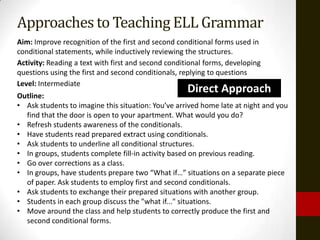
Aim: Improve recognition of the first and second conditional forms used in
conditional statements, while inductively reviewing the structures.
Activity: Reading a text with first and second conditional forms, developing
questions using the first and second conditionals, replying to questions
Level: Intermediate
Outline:
                                                     Direct Approach
• Ask students to imagine this situation: You’ve arrived home late at night and you
  find that the door is open to your apartment. What would you do?
• Refresh students awareness of the conditionals.
• Have students read prepared extract using conditionals.
• Ask students to underline all conditional structures.
• In groups, students complete fill-in activity based on previous reading.
• Go over corrections as a class.
• In groups, have students prepare two “What if…” situations on a separate piece
  of paper. Ask students to employ first and second conditionals.
• Ask students to exchange their prepared situations with another group.
• Students in each group discuss the "what if..." situations.
• Move around the class and help students to correctly produce the first and
  second conditional forms.
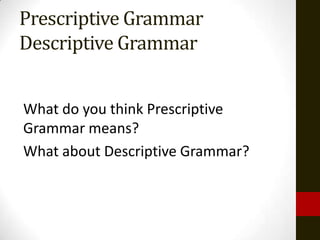
Prescriptive Grammar
Descriptive Grammar


What do you think Prescriptive
Grammar means?
What about Descriptive Grammar?
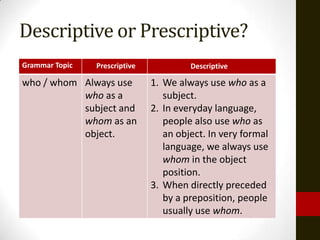
Descriptive or Prescriptive?
Grammar Topic        ?
                Prescriptive              ?
                                        Descriptive

who / whom Always use          1. We always use who as a
           who as a               subject.
           subject and         2. In everyday language,
           whom as an             people also use who as
           object.                an object. In very formal
                                  language, we always use
                                  whom in the object
                                  position.
                               3. When directly preceded
                                  by a preposition, people
                                  usually use whom.
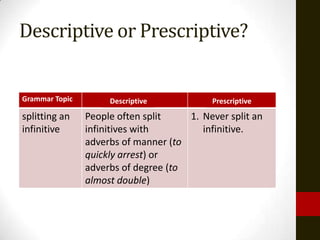
Descriptive or Prescriptive?


Grammar Topic         ?
                     Descriptive                    ?
                                           Prescriptive
splitting an    People often split    1. Never split an
infinitive      infinitives with         infinitive.
                adverbs of manner (to
                quickly arrest) or
                adverbs of degree (to
                almost double)
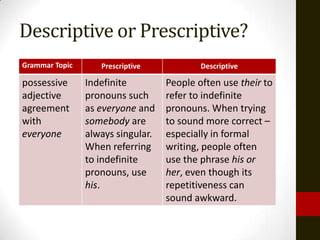
Descriptive or Prescriptive?
Grammar Topic         ?
                   Prescriptive                ?
                                           Descriptive

possessive      Indefinite         People often use their to
adjective       pronouns such      refer to indefinite
agreement       as everyone and    pronouns. When trying
with            somebody are       to sound more correct –
everyone        always singular.   especially in formal
                When referring     writing, people often
                to indefinite      use the phrase his or
                pronouns, use      her, even though its
                his.               repetitiveness can
                                   sound awkward.
Descriptive or Prescriptive?
Deductive X Inductive Teaching


    Learning Languages - Inductive and Deductive
    Methods - YouTube.mp4
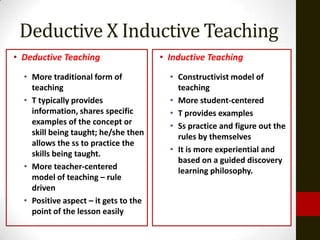
Deductive X Inductive Teaching
• Deductive Teaching                   • Inductive Teaching
  • More traditional form of             • Constructivist model of
    teaching                               teaching
  • T typically provides                 • More student-centered
    information, shares specific         • T provides examples
    examples of the concept or           • Ss practice and figure out the
    skill being taught; he/she then        rules by themselves
    allows the ss to practice the
    skills being taught.                 • It is more experiential and
                                           based on a guided discovery
  • More teacher-centered                  learning philosophy.
    model of teaching – rule
    driven
  • Positive aspect – it gets to the
    point of the lesson easily
Parts of Speech
• Noun
• Pronoun
• Adjective
• Verb
• Adverb
• Preposition
• Conjunction
• Interjection
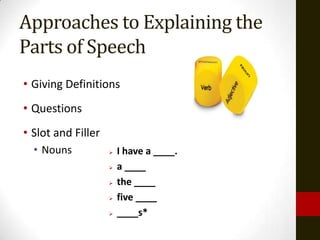
Approaches to Explaining the
Parts of Speech
• Giving Definitions
• Questions
• Slot and Filler
  • Nouns              I have a ____.
                       a ____
                       the ____
                       five ____
                       ____s*
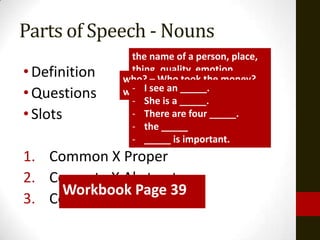
Parts of Speech - Nouns
                the name of a person, place,
• Definition    thing, quality, emotion...
               who? – Who took the money?
• Questions    what?see an _____. eat?
                - I – What did you
                - She is a _____.
• Slots         - There are four _____.
                - the _____
                - _____ is important.
1. Common X Proper
2. Concrete X Abstract
     Workbook Page 39
     ELLs’XUsual Errors?
3. Count Non-count
Parts of Speech
• Noun
• Pronoun         Page 51
• Adjective       Page 53

• Verb            Page 46

• Adverb          Page 55

• Preposition     Page 59

• Conjunction     Page 57

• Interjection    Page 62
Parts of Speech
• Noun
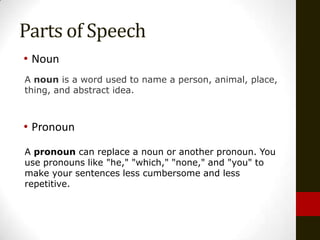
A noun is a word used to name a person, animal, place,
thing, and abstract idea.


• Pronoun
A pronoun can replace a noun or another pronoun. You
use pronouns like "he," "which," "none," and "you" to
make your sentences less cumbersome and less
repetitive.
Parts of Speech
• Adjective
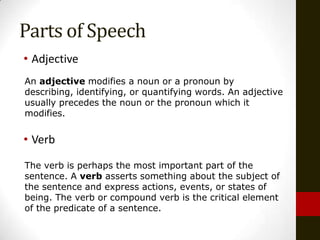
An adjective modifies a noun or a pronoun by
describing, identifying, or quantifying words. An adjective
usually precedes the noun or the pronoun which it
modifies.


• Verb

The verb is perhaps the most important part of the
sentence. A verb asserts something about the subject of
the sentence and express actions, events, or states of
being. The verb or compound verb is the critical element
of the predicate of a sentence.
Parts of Speech
• Adverb
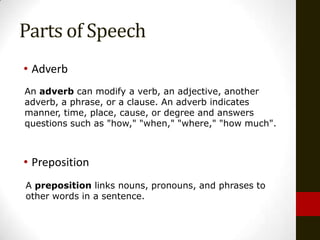
An adverb can modify a verb, an adjective, another
adverb, a phrase, or a clause. An adverb indicates
manner, time, place, cause, or degree and answers
questions such as "how," "when," "where," "how much".


• Preposition
A preposition links nouns, pronouns, and phrases to
other words in a sentence.
Parts of Speech
• Conjunction

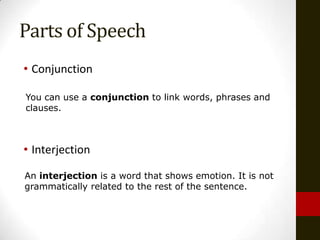
You can use a conjunction to link words, phrases and
clauses.


• Interjection

An interjection is a word that shows emotion. It is not
grammatically related to the rest of the sentence.
Homework
Book:
- Pages 42 – 73 (Self-study)
   “Parts of Speech”

Workbook:
- Pages 38 – 62 (Self-study)
   “Parts of Speech”
Moodle Week
1) Parts of Speech            4) Grammar Key 7
• Summary                     • Articles


2) Grammar Key 13             5) Why the Twelve
• Word Forms                  English Verb Tenses
                              Matter
                              • Participial Parts of a Verb
3) Grammar Key 5              • Verb Tenses - Introduction
• Count and Non-count Nouns

Tdc1 blended - class 2

  • 1.
  • 2.
    Book: Review - Pages 10 – 13 (Self-study) “Can you explain ELL Grammar Errors?” “On the Hot Seat: Answering  Definitions of Grammar ELL Questions”  English Studied by Native Speakers Workbook: X - Pages 1 – 5 (Self-study) English Studied as a Foreign Language “Distinguishing Traditional  The History of English Grammar and ELL Grammar” “Answering / Researching ELL Grammar Questions” “Identifying ELL Errors in Authentic Material”
  • 3.
    Approaches to TeachingELL Grammar What do you think the difference between a direct approach and an indirect approach to teaching grammar is? Book Page 16 Take a look at these two different lesson plans. Which one follows a direct approach and which one follows an indirect approach?
  • 4.
    Approaches to TeachingELL Grammar Aim: Improving Telephoning Skills Activity: Role playing using office telephone lines Level: Intermediate to advanced Outline: Indirect Approach • Review phrases used in telephoning. • Ask each student to write out notes for a telephone conversation that they would typically have with a native speaker. • Ask students to choose another student who should respond to the call for which he/she has written notes. • Stress the fact that students need to understand and take note of everything crucial. If they do not understand they need to ask you to repeat, tell you to speak more slowly - anything that is needed to understand. • Ask your students to go to a different office, make sure to get the extension for the office. Ask students to take notes on the call. • Now, take the various notes, call the other extension and ask for the person suggested by the student who wrote the notes. • Once you have repeated this exercise, get students to call each other in their own offices to repeat the exercise. Remember it is crucial to actually use the phone, as the difficulty lies in understanding English over the phone.
  • 5.
    Approaches to TeachingELL Grammar Aim: Improve recognition of the first and second conditional forms used in conditional statements, while inductively reviewing the structures. Activity: Reading a text with first and second conditional forms, developing questions using the first and second conditionals, replying to questions Level: Intermediate Outline: Direct Approach • Ask students to imagine this situation: You’ve arrived home late at night and you find that the door is open to your apartment. What would you do? • Refresh students awareness of the conditionals. • Have students read prepared extract using conditionals. • Ask students to underline all conditional structures. • In groups, students complete fill-in activity based on previous reading. • Go over corrections as a class. • In groups, have students prepare two “What if…” situations on a separate piece of paper. Ask students to employ first and second conditionals. • Ask students to exchange their prepared situations with another group. • Students in each group discuss the "what if..." situations. • Move around the class and help students to correctly produce the first and second conditional forms.
  • 6.
    Prescriptive Grammar Descriptive Grammar Whatdo you think Prescriptive Grammar means? What about Descriptive Grammar?
  • 7.
    Descriptive or Prescriptive? GrammarTopic ? Prescriptive ? Descriptive who / whom Always use 1. We always use who as a who as a subject. subject and 2. In everyday language, whom as an people also use who as object. an object. In very formal language, we always use whom in the object position. 3. When directly preceded by a preposition, people usually use whom.
  • 8.
    Descriptive or Prescriptive? GrammarTopic ? Descriptive ? Prescriptive splitting an People often split 1. Never split an infinitive infinitives with infinitive. adverbs of manner (to quickly arrest) or adverbs of degree (to almost double)
  • 9.
    Descriptive or Prescriptive? GrammarTopic ? Prescriptive ? Descriptive possessive Indefinite People often use their to adjective pronouns such refer to indefinite agreement as everyone and pronouns. When trying with somebody are to sound more correct – everyone always singular. especially in formal When referring writing, people often to indefinite use the phrase his or pronouns, use her, even though its his. repetitiveness can sound awkward.
  • 10.
  • 11.
    Deductive X InductiveTeaching Learning Languages - Inductive and Deductive Methods - YouTube.mp4
  • 12.
    Deductive X InductiveTeaching • Deductive Teaching • Inductive Teaching • More traditional form of • Constructivist model of teaching teaching • T typically provides • More student-centered information, shares specific • T provides examples examples of the concept or • Ss practice and figure out the skill being taught; he/she then rules by themselves allows the ss to practice the skills being taught. • It is more experiential and based on a guided discovery • More teacher-centered learning philosophy. model of teaching – rule driven • Positive aspect – it gets to the point of the lesson easily
  • 13.
    Parts of Speech •Noun • Pronoun • Adjective • Verb • Adverb • Preposition • Conjunction • Interjection
  • 14.
    Approaches to Explainingthe Parts of Speech • Giving Definitions • Questions • Slot and Filler • Nouns  I have a ____.  a ____  the ____  five ____  ____s*
  • 15.
    Parts of Speech- Nouns the name of a person, place, • Definition thing, quality, emotion... who? – Who took the money? • Questions what?see an _____. eat? - I – What did you - She is a _____. • Slots - There are four _____. - the _____ - _____ is important. 1. Common X Proper 2. Concrete X Abstract Workbook Page 39 ELLs’XUsual Errors? 3. Count Non-count
  • 16.
    Parts of Speech •Noun • Pronoun  Page 51 • Adjective  Page 53 • Verb  Page 46 • Adverb  Page 55 • Preposition  Page 59 • Conjunction  Page 57 • Interjection  Page 62
  • 17.
    Parts of Speech •Noun A noun is a word used to name a person, animal, place, thing, and abstract idea. • Pronoun A pronoun can replace a noun or another pronoun. You use pronouns like "he," "which," "none," and "you" to make your sentences less cumbersome and less repetitive.
  • 18.
    Parts of Speech •Adjective An adjective modifies a noun or a pronoun by describing, identifying, or quantifying words. An adjective usually precedes the noun or the pronoun which it modifies. • Verb The verb is perhaps the most important part of the sentence. A verb asserts something about the subject of the sentence and express actions, events, or states of being. The verb or compound verb is the critical element of the predicate of a sentence.
  • 19.
    Parts of Speech •Adverb An adverb can modify a verb, an adjective, another adverb, a phrase, or a clause. An adverb indicates manner, time, place, cause, or degree and answers questions such as "how," "when," "where," "how much". • Preposition A preposition links nouns, pronouns, and phrases to other words in a sentence.
  • 20.
    Parts of Speech •Conjunction You can use a conjunction to link words, phrases and clauses. • Interjection An interjection is a word that shows emotion. It is not grammatically related to the rest of the sentence.
  • 21.
    Homework Book: - Pages 42– 73 (Self-study) “Parts of Speech” Workbook: - Pages 38 – 62 (Self-study) “Parts of Speech”
  • 22.
    Moodle Week 1) Partsof Speech 4) Grammar Key 7 • Summary • Articles 2) Grammar Key 13 5) Why the Twelve • Word Forms English Verb Tenses Matter • Participial Parts of a Verb 3) Grammar Key 5 • Verb Tenses - Introduction • Count and Non-count Nouns