Academic
Writing
Academic Writing
• It refers to the forms of
expository and argumentative
prose used by students,
faculty & researchers to
convey a body of information
about a particular subject.
Academic Writing
• It is writing an essay, thesis,
report, journal article or other
document for purposes of
educating the reader or
achieving some scholarly aim
for the writer.
Academic Writing
• It deals with the underlying
theories and causes governing
processes and practices in
everyday life, as well as
exploring alternative
explanations for these events.
Academic Writing
• Precise
• Semi-Formal
• Impersonal
• Objective
Academic Writing
• Structure
• Essay Format
• Report Format
Academic Writing
• Essay Format
• It typically follows the format of
an essay
• Introduction
• Body
• Conclusion
Academic Writing
• Essay Format
• Introduction
• informs the reader about the
nature of the topic
• May also summarize very
succinctly, in a sentence or two,
your position on the issue
Academic Writing
• Essay Format
• Body
• It is where the topic is
discussed, elaborated and
evaluated
Academic Writing
• Essay Format
• Conclusion
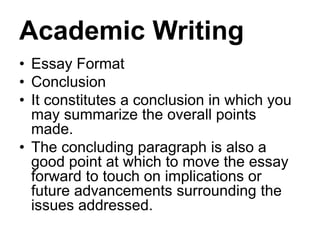
• It constitutes a conclusion in which you
may summarize the overall points
made.
• The concluding paragraph is also a
good point at which to move the essay
forward to touch on implications or
future advancements surrounding the
issues addressed.
Academic Writing
• Report Format
• It is often organized around the
identification of problems or
difficulties and corresponding
solutions.
• It is divided according to clearly
labelled sections, such as
“Introduction”, “Discussion”,
“Conclusions”, and
“Recommendations”.
Academic Writing
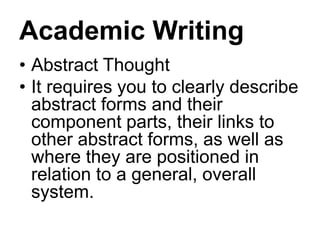
• Abstract Thought
• It requires you to clearly describe
abstract forms and their
component parts, their links to
other abstract forms, as well as
where they are positioned in
relation to a general, overall
system.
Academic Writing
• Audience
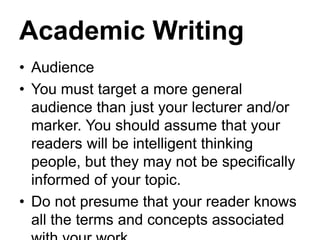
• You must target a more general
audience than just your lecturer and/or
marker. You should assume that your
readers will be intelligent thinking
people, but they may not be specifically
informed of your topic.
• Do not presume that your reader knows
all the terms and concepts associated

English 7 Academic Writing

  • 1.
  • 2.
    Academic Writing • Itrefers to the forms of expository and argumentative prose used by students, faculty & researchers to convey a body of information about a particular subject.
  • 3.
    Academic Writing • Itis writing an essay, thesis, report, journal article or other document for purposes of educating the reader or achieving some scholarly aim for the writer.
  • 4.
    Academic Writing • Itdeals with the underlying theories and causes governing processes and practices in everyday life, as well as exploring alternative explanations for these events.
  • 5.
    Academic Writing • Precise •Semi-Formal • Impersonal • Objective
  • 6.
    Academic Writing • Structure •Essay Format • Report Format
  • 7.
    Academic Writing • EssayFormat • It typically follows the format of an essay • Introduction • Body • Conclusion
  • 8.
    Academic Writing • EssayFormat • Introduction • informs the reader about the nature of the topic • May also summarize very succinctly, in a sentence or two, your position on the issue
  • 9.
    Academic Writing • EssayFormat • Body • It is where the topic is discussed, elaborated and evaluated
  • 10.
    Academic Writing • EssayFormat • Conclusion • It constitutes a conclusion in which you may summarize the overall points made. • The concluding paragraph is also a good point at which to move the essay forward to touch on implications or future advancements surrounding the issues addressed.
  • 11.
    Academic Writing • ReportFormat • It is often organized around the identification of problems or difficulties and corresponding solutions. • It is divided according to clearly labelled sections, such as “Introduction”, “Discussion”, “Conclusions”, and “Recommendations”.
  • 12.
    Academic Writing • AbstractThought • It requires you to clearly describe abstract forms and their component parts, their links to other abstract forms, as well as where they are positioned in relation to a general, overall system.
  • 13.
    Academic Writing • Audience •You must target a more general audience than just your lecturer and/or marker. You should assume that your readers will be intelligent thinking people, but they may not be specifically informed of your topic. • Do not presume that your reader knows all the terms and concepts associated