EXPOSITORY TEXT
Expository Text Structure Signal Words
Description of Expository (Informational) Text Structure:
Reading for information involves the engagement of the reader
with aspects of the real world and is most commonly associated
with textbooks, primary and secondary sources, newspaper and
magazine articles, essays and speeches. Informational text is
organized by topic and supporting details. It may have boldface
headings, graphics, illustrations and captions that signal
importance in the text. Often signal words are used that help
indicate which type of expository text structure is being used.
Some features that distinguish informational text from literary
text are organization and the way information is presented
(National Assessment of Educational Progress, 2005).
Rationale for Attending to Expository (Informational) Text
Structure:
Helps readers:
 Comprehend a variety of written materials
 Build and extend background knowledge about a variety of topics
 Develop vocabulary
 Learn how different texts are organized and written
 Improve the recall of key text information
 Discover what is likely to be most relevant for understanding the
story
(Teacher Reading Academies, 2001)
Most Common Expository (Informational) Text Structures:
1. Sequential: describes items or events in order or tells the steps to follow
to do something or make something
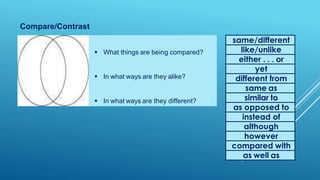
2. Compare/contrast: shows how two or more things are alike and/or how
they are different
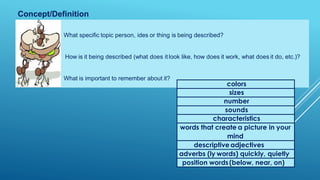
3. Concept/definition: a topic, idea, person, place, or thing that is described
by its features, characteristics or examples
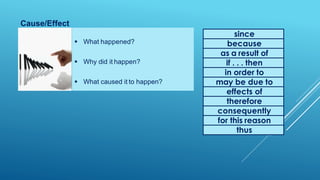
4. Cause/effect: cause is why something happened – effect is what
happened (shows a relationship between the two)
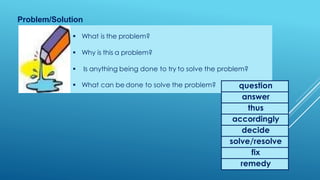
5. Problem/solution: tells about a problem (and sometimes says why there
is a problem) then gives one or more possible solutions
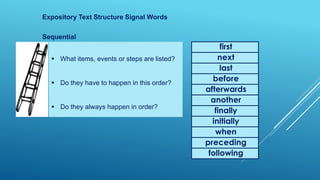
Sequential
Expository Text Structure Signal Words
 What items, events or steps are listed?
 Do they have to happen in this order?
 Do they always happen in order?
first
next
last
before
afterwards
another
finally
initially
when
preceding
following
Compare/Contrast
 What things are being compared?
 In what ways are they alike?
 In what ways are they different?
same/different
like/unlike
either . . . or
yet
different from
same as
similar to
as opposed to
instead of
although
however
compared with
as well as
Concept/Definition
What specific topic person, ides or thing is being described?
How is it being described (what does it look like, how does it work, what does it do, etc.)?
What is important to remember about it?
colors
sizes
number
sounds
characteristics
words that create a picture in your
mind
descriptive adjectives
adverbs (ly words) quickly, quietly
position words(below, near, on)
Cause/Effect
 What happened?
 Why did it happen?
 What caused it to happen?
since
because
as a result of
if . . . then
in order to
may be due to
effects of
therefore
consequently
for this reason
thus
Problem/Solution
 What is the problem?
 Why is this a problem?
 Is anything being done to try to solve the problem?
 What can be done to solve the problem? question
answer
thus
accordingly
decide
solve/resolve
fix
remedy

Expository text

  • 1.
    EXPOSITORY TEXT Expository TextStructure Signal Words
  • 2.
    Description of Expository(Informational) Text Structure: Reading for information involves the engagement of the reader with aspects of the real world and is most commonly associated with textbooks, primary and secondary sources, newspaper and magazine articles, essays and speeches. Informational text is organized by topic and supporting details. It may have boldface headings, graphics, illustrations and captions that signal importance in the text. Often signal words are used that help indicate which type of expository text structure is being used. Some features that distinguish informational text from literary text are organization and the way information is presented (National Assessment of Educational Progress, 2005).
  • 3.
    Rationale for Attendingto Expository (Informational) Text Structure: Helps readers:  Comprehend a variety of written materials  Build and extend background knowledge about a variety of topics  Develop vocabulary  Learn how different texts are organized and written  Improve the recall of key text information  Discover what is likely to be most relevant for understanding the story (Teacher Reading Academies, 2001)
  • 4.
    Most Common Expository(Informational) Text Structures: 1. Sequential: describes items or events in order or tells the steps to follow to do something or make something 2. Compare/contrast: shows how two or more things are alike and/or how they are different 3. Concept/definition: a topic, idea, person, place, or thing that is described by its features, characteristics or examples 4. Cause/effect: cause is why something happened – effect is what happened (shows a relationship between the two) 5. Problem/solution: tells about a problem (and sometimes says why there is a problem) then gives one or more possible solutions
  • 5.
    Sequential Expository Text StructureSignal Words  What items, events or steps are listed?  Do they have to happen in this order?  Do they always happen in order? first next last before afterwards another finally initially when preceding following
  • 6.
    Compare/Contrast  What thingsare being compared?  In what ways are they alike?  In what ways are they different? same/different like/unlike either . . . or yet different from same as similar to as opposed to instead of although however compared with as well as
  • 7.
    Concept/Definition What specific topicperson, ides or thing is being described? How is it being described (what does it look like, how does it work, what does it do, etc.)? What is important to remember about it? colors sizes number sounds characteristics words that create a picture in your mind descriptive adjectives adverbs (ly words) quickly, quietly position words(below, near, on)
  • 8.
    Cause/Effect  What happened? Why did it happen?  What caused it to happen? since because as a result of if . . . then in order to may be due to effects of therefore consequently for this reason thus
  • 9.
    Problem/Solution  What isthe problem?  Why is this a problem?  Is anything being done to try to solve the problem?  What can be done to solve the problem? question answer thus accordingly decide solve/resolve fix remedy