Features of an
academic paper
Group 2
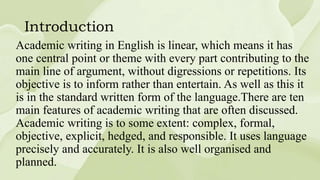
Introduction
Academic writing in English is linear, which means it has
one central point or theme with every part contributing to the
main line of argument, without digressions or repetitions. Its
objective is to inform rather than entertain. As well as this it
is in the standard written form of the language.There are ten
main features of academic writing that are often discussed.
Academic writing is to some extent: complex, formal,
objective, explicit, hedged, and responsible. It uses language
precisely and accurately. It is also well organised and
planned.
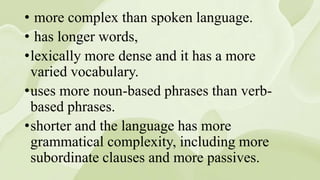
Complexity
• more complex than spoken language.
• has longer words,
•lexically more dense and it has a more
varied vocabulary.
•uses more noun-based phrases than verb-
based phrases.
•shorter and the language has more
grammatical complexity, including more
subordinate clauses and more passives.
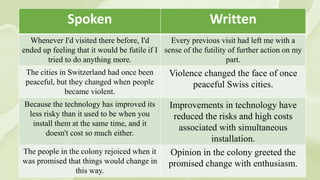
Spoken Written
Whenever I'd visited there before, I'd
ended up feeling that it would be futile if I
tried to do anything more.
Every previous visit had left me with a
sense of the futility of further action on my
part.
The cities in Switzerland had once been
peaceful, but they changed when people
became violent.
Violence changed the face of once
peaceful Swiss cities.
Because the technology has improved its
less risky than it used to be when you
install them at the same time, and it
doesn't cost so much either.
Improvements in technology have
reduced the risks and high costs
associated with simultaneous
installation.
The people in the colony rejoiced when it
was promised that things would change in
this way.
Opinion in the colony greeted the
promised change with enthusiasm.
Formality
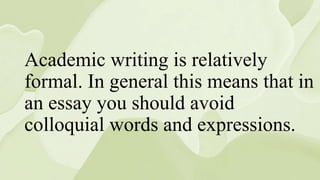
Academic writing is relatively
formal. In general this means that in
an essay you should avoid
colloquial words and expressions.
In general this means in an essay that
you should avoid:
a. colloquial words and expressions; ""stuff", "a lot
of", "thing", "sort of",
b. abbreviated forms: "can't", "doesn't", "shouldn't"
c. two word verbs: "put off", "bring up"
d. sub-headings, numbering and bullet-points in
formal essays - but use them in reports.
e. asking questions.
Formal: Julie, I'm your practice teacher, you're my
student. And I have to tell you to refrain from
using terms such as "loony", "fruitcake" "nutcase"
and "one sandwich short of a picnic" to describe
people with mental illness.
Not formal:
Person 1: Oh, come on, Clare! Don't be so PC. Are
you telling me you've never used those
expressions?
Person 2:Well, ... yes... but not in my dissertation.
Precision
In academic writing, facts and
figures are given precisely.
Example:
Chemists had attempted to synthesize quinine for the
previous hundred years but all they had achieved was
to discover the extreme complexity of the problem.
The volatile oily liquid beta-chloro-beta-ethyl sulphide
was first synthesized in 1854, and in 1887 it was
reported to produce blisters if it touched the skin. It
was called mustard gas and was used at Ypres in 19I7,
when it caused many thousands of casualties.
It is approximately eight inches in length
and runs from the urinary bladder,
through the prostate gland, under the front
of the pelvis, and, passing through the
corpus spongiosum, it ends at the tip of
the glans penis in an opening called the
urethral meatus .
Objectivity
•Written language is objective rather than
personal.
•has fewer words that refer to the writer or the
reader.
•the main emphasis should be on the information
you want to give and the arguments you want to
make, rather than you.
•academic writing tends to use nouns (and
adjectives), rather than verbs (and adverbs).
In general, avoid words like "I", "me", "myself".
A reader will normally assume that any idea not referenced is
your own. It is therefore unnecessary to make this explicit.
Don't write:" In my opinion, this a very interesting study."
Write: "This is a very interesting study."
Avoid "you" to refer to the reader or people in general.
Don't write: "You can easily forget how different life was 50
years ago."
Write: "It is easy to forget how difficult life was 50 years
ago."
Explicitness
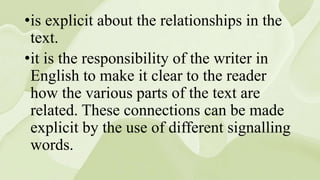
•is explicit about the relationships in the
text.
•it is the responsibility of the writer in
English to make it clear to the reader
how the various parts of the text are
related. These connections can be made
explicit by the use of different signalling
words.
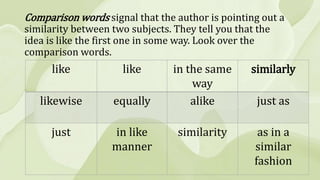
Comparison words signal that the author is pointing out a
similarity between two subjects. They tell you that the
idea is like the first one in some way. Look over the
comparison words.
like like in the same
way
similarly
likewise equally alike just as
just in like
manner
similarity as in a
similar
fashion
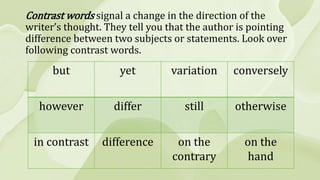
Contrast words signal a change in the direction of the
writer’s thought. They tell you that the author is pointing
difference between two subjects or statements. Look over
following contrast words.
but yet variation conversely
however differ still otherwise
in contrast difference on the
contrary
on the
hand
Accuracy
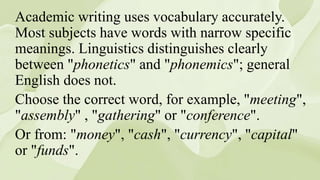
Academic writing uses vocabulary accurately.
Most subjects have words with narrow specific
meanings. Linguistics distinguishes clearly
between "phonetics" and "phonemics"; general
English does not.
Choose the correct word, for example, "meeting",
"assembly" , "gathering" or "conference".
Or from: "money", "cash", "currency", "capital"
or "funds".
Hedging
In any kind of academic writing you do, it
is necessary to make decisions about your
stance on a particular subject, or the
strength of the claims you are making.
Different subjects prefer to do this in
different ways.
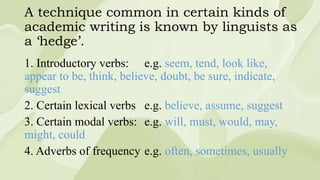
A technique common in certain kinds of
academic writing is known by linguists as
a ‘hedge’.
1. Introductory verbs: e.g. seem, tend, look like,
appear to be, think, believe, doubt, be sure, indicate,
suggest
2. Certain lexical verbs e.g. believe, assume, suggest
3. Certain modal verbs: e.g. will, must, would, may,
might, could
4. Adverbs of frequency e.g. often, sometimes, usually
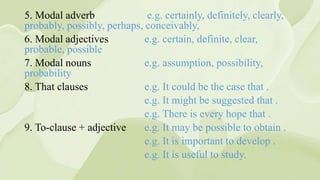
5. Modal adverb e.g. certainly, definitely, clearly,
probably, possibly, perhaps, conceivably,
6. Modal adjectives e.g. certain, definite, clear,
probable, possible
7. Modal nouns e.g. assumption, possibility,
probability
8. That clauses e.g. It could be the case that .
e.g. It might be suggested that .
e.g. There is every hope that .
9. To-clause + adjective e.g. It may be possible to obtain .
e.g. It is important to develop .
e.g. It is useful to study.
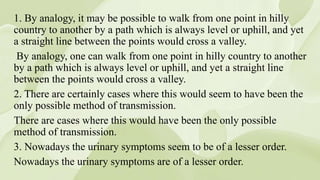
1. By analogy, it may be possible to walk from one point in hilly
country to another by a path which is always level or uphill, and yet
a straight line between the points would cross a valley.
By analogy, one can walk from one point in hilly country to another
by a path which is always level or uphill, and yet a straight line
between the points would cross a valley.
2. There are certainly cases where this would seem to have been the
only possible method of transmission.
There are cases where this would have been the only possible
method of transmission.
3. Nowadays the urinary symptoms seem to be of a lesser order.
Nowadays the urinary symptoms are of a lesser order.
Responsibility
•The writer must be responsible for, and must
be able to provide evidence and justification
for, any claims you make.
•are also responsible for demonstrating an
understanding of any source texts you use.
•This is done by paraphrasing and summarizing
what you read and acknowledging the source
of this information or ideas by a system of
citation.
Organization
Academic writing is well organised. It flows easily
from one section to the next in a logical fashion. A good
place to start is the genre of your text. Once you have
decided on the genre, the structure is easily
determined..
Students are asked to write many different kinds of
texts. Depending on your subject, these could be essays,
laboratory reports, case-studies, book reviews,
reflective diaries, posters, research proposals, and so on
and are normally referred to as genre families or genres.
Genres are defined by their purpose, their
audience and their structure. Looking at
typical structures can help you with your
organisation.
The following genres are common in higher
education.
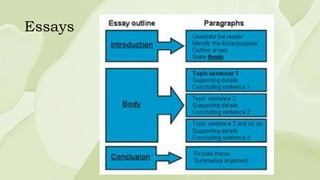
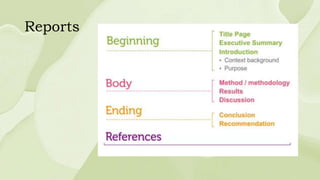
Essays
Reports
Case Studies
Research
proposals
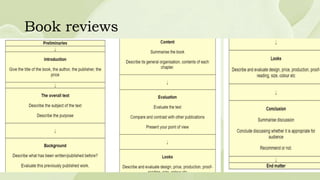
Book reviews
Planning
Academic writing is well planned. It usually takes
place after research and evaluation, according to a
specific purpose and plan.
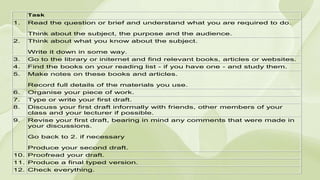
The following procedure is typical when writing
an extended essay or assignment.

assignment.

Task
1. Read the question or brief and understand what you are required to do.
Think about the subject, the purpose and the audience.
2. Think about what you know about the subject.
Write it down in some way.
3. Go to the library or initernet and find relevant books, articles or websites.
4. Find the books on your reading list - if you have one - and study them.
5. Make notes on these books and articles.
Record full details of the materials you use.
6. Organise your piece of work.
7. Type or write your first draft.
8. Discuss your first draft informally with friends, other members of your
class and your lecturer if possible.
9. Revise your first draft, bearing in mind any comments that were made in
your discussions.
Go back to 2. if necessary
Produce your second draft.
10. Proofread your draft.
11. Produce a final typed version.
12. Check everything.

EAPP_FEATURES_OF_AN_ACADEMIC_PAPER_ENGLISH_LESSON

  • 1.
  • 2.
    Introduction Academic writing inEnglish is linear, which means it has one central point or theme with every part contributing to the main line of argument, without digressions or repetitions. Its objective is to inform rather than entertain. As well as this it is in the standard written form of the language.There are ten main features of academic writing that are often discussed. Academic writing is to some extent: complex, formal, objective, explicit, hedged, and responsible. It uses language precisely and accurately. It is also well organised and planned.
  • 3.
  • 4.
    • more complexthan spoken language. • has longer words, •lexically more dense and it has a more varied vocabulary. •uses more noun-based phrases than verb- based phrases. •shorter and the language has more grammatical complexity, including more subordinate clauses and more passives.
  • 5.
    Spoken Written Whenever I'dvisited there before, I'd ended up feeling that it would be futile if I tried to do anything more. Every previous visit had left me with a sense of the futility of further action on my part. The cities in Switzerland had once been peaceful, but they changed when people became violent. Violence changed the face of once peaceful Swiss cities. Because the technology has improved its less risky than it used to be when you install them at the same time, and it doesn't cost so much either. Improvements in technology have reduced the risks and high costs associated with simultaneous installation. The people in the colony rejoiced when it was promised that things would change in this way. Opinion in the colony greeted the promised change with enthusiasm.
  • 6.
  • 7.
    Academic writing isrelatively formal. In general this means that in an essay you should avoid colloquial words and expressions.
  • 8.
    In general thismeans in an essay that you should avoid: a. colloquial words and expressions; ""stuff", "a lot of", "thing", "sort of", b. abbreviated forms: "can't", "doesn't", "shouldn't" c. two word verbs: "put off", "bring up" d. sub-headings, numbering and bullet-points in formal essays - but use them in reports. e. asking questions.
  • 9.
    Formal: Julie, I'myour practice teacher, you're my student. And I have to tell you to refrain from using terms such as "loony", "fruitcake" "nutcase" and "one sandwich short of a picnic" to describe people with mental illness. Not formal: Person 1: Oh, come on, Clare! Don't be so PC. Are you telling me you've never used those expressions? Person 2:Well, ... yes... but not in my dissertation.

  • 10.
  • 11.
    In academic writing,facts and figures are given precisely.
  • 12.
    Example: Chemists had attemptedto synthesize quinine for the previous hundred years but all they had achieved was to discover the extreme complexity of the problem. The volatile oily liquid beta-chloro-beta-ethyl sulphide was first synthesized in 1854, and in 1887 it was reported to produce blisters if it touched the skin. It was called mustard gas and was used at Ypres in 19I7, when it caused many thousands of casualties.
  • 13.
    It is approximatelyeight inches in length and runs from the urinary bladder, through the prostate gland, under the front of the pelvis, and, passing through the corpus spongiosum, it ends at the tip of the glans penis in an opening called the urethral meatus .
  • 14.
  • 15.
    •Written language isobjective rather than personal. •has fewer words that refer to the writer or the reader. •the main emphasis should be on the information you want to give and the arguments you want to make, rather than you. •academic writing tends to use nouns (and adjectives), rather than verbs (and adverbs).
  • 16.
    In general, avoidwords like "I", "me", "myself". A reader will normally assume that any idea not referenced is your own. It is therefore unnecessary to make this explicit. Don't write:" In my opinion, this a very interesting study." Write: "This is a very interesting study." Avoid "you" to refer to the reader or people in general. Don't write: "You can easily forget how different life was 50 years ago." Write: "It is easy to forget how difficult life was 50 years ago."
  • 17.
  • 18.
    •is explicit aboutthe relationships in the text. •it is the responsibility of the writer in English to make it clear to the reader how the various parts of the text are related. These connections can be made explicit by the use of different signalling words.
  • 19.
    Comparison words signalthat the author is pointing out a similarity between two subjects. They tell you that the idea is like the first one in some way. Look over the comparison words. like like in the same way similarly likewise equally alike just as just in like manner similarity as in a similar fashion
  • 20.
    Contrast words signala change in the direction of the writer’s thought. They tell you that the author is pointing difference between two subjects or statements. Look over following contrast words. but yet variation conversely however differ still otherwise in contrast difference on the contrary on the hand
  • 21.
  • 22.
    Academic writing usesvocabulary accurately. Most subjects have words with narrow specific meanings. Linguistics distinguishes clearly between "phonetics" and "phonemics"; general English does not. Choose the correct word, for example, "meeting", "assembly" , "gathering" or "conference". Or from: "money", "cash", "currency", "capital" or "funds".
  • 23.
  • 24.
    In any kindof academic writing you do, it is necessary to make decisions about your stance on a particular subject, or the strength of the claims you are making. Different subjects prefer to do this in different ways.
  • 25.
    A technique commonin certain kinds of academic writing is known by linguists as a ‘hedge’. 1. Introductory verbs: e.g. seem, tend, look like, appear to be, think, believe, doubt, be sure, indicate, suggest 2. Certain lexical verbs e.g. believe, assume, suggest 3. Certain modal verbs: e.g. will, must, would, may, might, could 4. Adverbs of frequency e.g. often, sometimes, usually
  • 26.
    5. Modal adverbe.g. certainly, definitely, clearly, probably, possibly, perhaps, conceivably, 6. Modal adjectives e.g. certain, definite, clear, probable, possible 7. Modal nouns e.g. assumption, possibility, probability 8. That clauses e.g. It could be the case that . e.g. It might be suggested that . e.g. There is every hope that . 9. To-clause + adjective e.g. It may be possible to obtain . e.g. It is important to develop . e.g. It is useful to study.
  • 27.
    1. By analogy,it may be possible to walk from one point in hilly country to another by a path which is always level or uphill, and yet a straight line between the points would cross a valley. By analogy, one can walk from one point in hilly country to another by a path which is always level or uphill, and yet a straight line between the points would cross a valley. 2. There are certainly cases where this would seem to have been the only possible method of transmission. There are cases where this would have been the only possible method of transmission. 3. Nowadays the urinary symptoms seem to be of a lesser order. Nowadays the urinary symptoms are of a lesser order.
  • 28.
  • 29.
    •The writer mustbe responsible for, and must be able to provide evidence and justification for, any claims you make. •are also responsible for demonstrating an understanding of any source texts you use. •This is done by paraphrasing and summarizing what you read and acknowledging the source of this information or ideas by a system of citation.
  • 30.
  • 31.
    Academic writing iswell organised. It flows easily from one section to the next in a logical fashion. A good place to start is the genre of your text. Once you have decided on the genre, the structure is easily determined.. Students are asked to write many different kinds of texts. Depending on your subject, these could be essays, laboratory reports, case-studies, book reviews, reflective diaries, posters, research proposals, and so on and are normally referred to as genre families or genres.
  • 32.
    Genres are definedby their purpose, their audience and their structure. Looking at typical structures can help you with your organisation. The following genres are common in higher education.
  • 33.
  • 34.
  • 35.
  • 36.
  • 37.
  • 38.
  • 39.
    Academic writing iswell planned. It usually takes place after research and evaluation, according to a specific purpose and plan. The following procedure is typical when writing an extended essay or assignment.
  • 40.
    assignment. Task 1. Read thequestion or brief and understand what you are required to do. Think about the subject, the purpose and the audience. 2. Think about what you know about the subject. Write it down in some way. 3. Go to the library or initernet and find relevant books, articles or websites. 4. Find the books on your reading list - if you have one - and study them. 5. Make notes on these books and articles. Record full details of the materials you use. 6. Organise your piece of work. 7. Type or write your first draft. 8. Discuss your first draft informally with friends, other members of your class and your lecturer if possible. 9. Revise your first draft, bearing in mind any comments that were made in your discussions. Go back to 2. if necessary Produce your second draft. 10. Proofread your draft. 11. Produce a final typed version. 12. Check everything.