TEACHING ENGLISH FOR READING AND WRITING SKILLS TO GRADE-11
LEARNERS (MANTANGALE SENIOR HIGH SCHOOL)
(A Lesson Plan Prepared for Demonstration Teaching Purposes)
Teaching Demonstrator: Roselyn E. Lazalita (Senior High School Teacher)
Teaching Approaches: In-direct-Instruction, Cooperative Learning, Reports, Content-
Based Instruction (CBI), Communicative Language
Teaching, and Comprehension-Based Approach, Differentiated
Instruction, Contextualization and ICT integration.
Theoretical Bases: Cognitivism, Constructivism, and Connectivism
Target Learners: Grade 11 (Senior High School)
Track: HUMSS (academic track)
Learning Competency: Identify the context in which a text was developed through Intertext
(EN11/12RWS-Ivac-7.2)
Specific Objectives: At the end of the lesson, the students are expected to: a.
➢ define intertext;
➢ identify intertext used in the text;
➢ explain how intertext is used in developing a particular text;
➢ tell the importance of recognizing one’s unique identity.
Subject Matter: Intertext
Skills Integrated: Listening, Speaking, Viewing and Reading
Skill in Focus: Writing and Speaking
Duration: 60 mins.
Teaching Aids: Preferred Materials/Teaching Devices:
PowerPoint Presentation (Software)
Pictures (from Google.com)
Video Clips
Laptop
Projector
Multi-Media Speakers
Task Sheets
PROCEDURES:
1. Preliminary Activities:
Greetings
Prayer
Checking of attendance
Setting of Rules
Review: The students are going to read the excerpt and answer the following questions that
follows.
The Filipino of today is soft, easy-going. His tendency is towards parasitism.
He is uninclined to sustained strenuous effort! He lacks earnestness. Face-
saving is the dominant note in the confused symphony of his existence. His
sense of righteousness is often dulled by the desire of personal gain. His norm
of conduct is generally prompted by expediency rather than by principle. He
shows a failing in that superb courage which impels action because it is right,
even at the cost of self-sacrifice. His greatest fear is not to do wrong, but of
being caught doing wrong.
-Excerpt from On Policies And Achievements Of The Government And
Regeneration Of The Filipino speech of President Manuel Quezon
asked the students about the previous topic through the following questions:
1. Are there how many links in the text?
2. How do you know they are links?
3. What happens when you click each of them?
4. Aside from traditional text, in what other forms of information will
it give when you clicked them?
5. Based on the information given by the hyperlink, what do you think
is the context of the speech excerpt?
(they are going to answer the five questions given to know how far they learnt
from the previous topic.)
Motivation: (the students answer the activity to connect the new lesson)
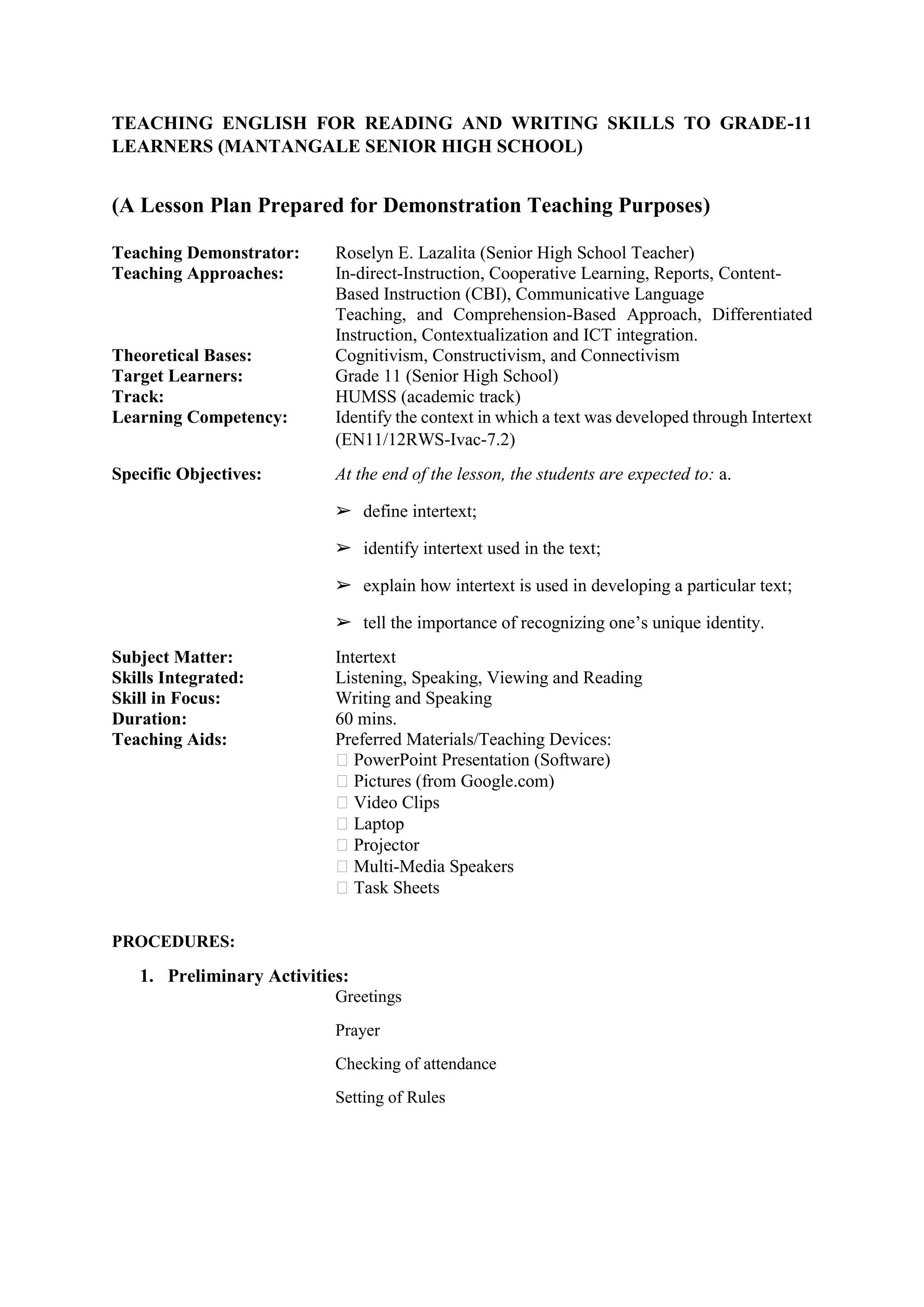
ACTIVITY-1
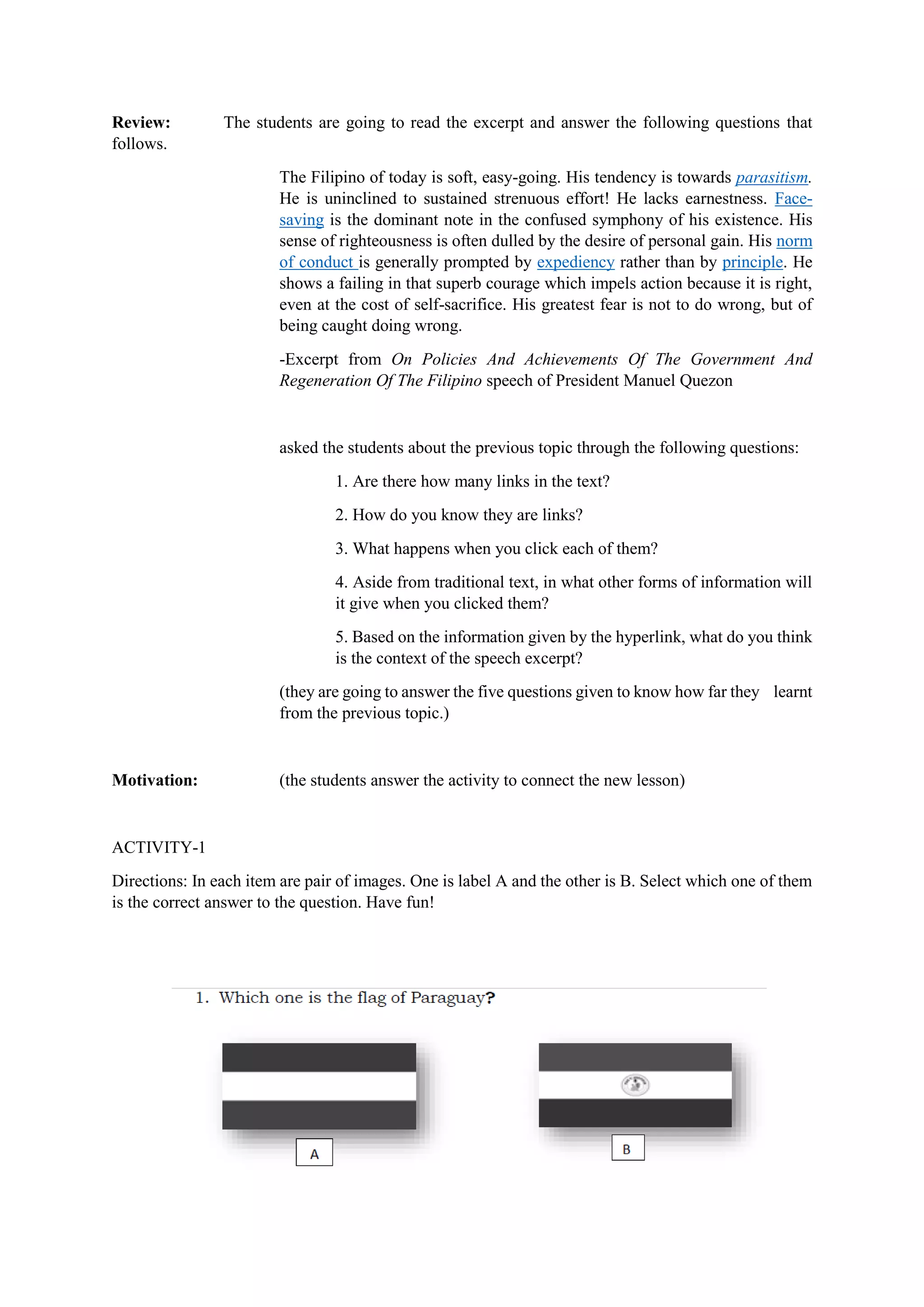
Directions: In each item are pair of images. One is label A and the other is B. Select which one of them
is the correct answer to the question. Have fun!
➢ Did you have fun finding the correct flags and logo? Is it easy or difficult? Why? What can you
say about the choices? Are they similar or different?
Establishing a Purpose for the Lesson
Learning Competency: Identify the context in which a text was developed through Intertext
(EN11/12RWS-Ivac-7.2)
Specific Objectives: At the end of the lesson, the students are expected to: a.
➢ define intertext;
➢ identify intertext used in the text;
➢ explain how intertext is used in developing a particular text;
➢ tell the importance of recognizing one’s unique identity.
2. Lesson Proper
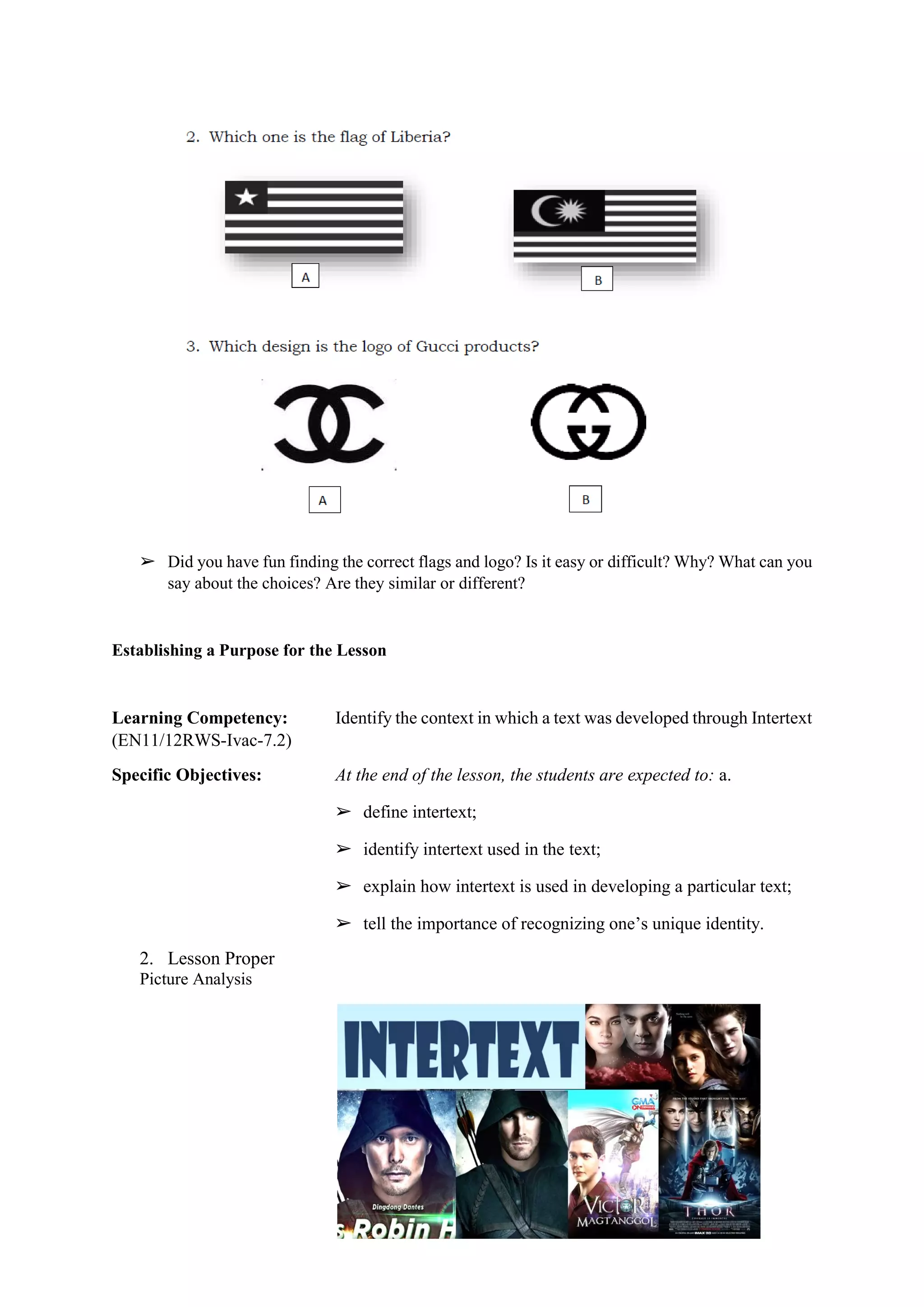
Picture Analysis
(the teacher will ask the students about the picture they seen in the screen. The teacher facilitates the
discussion of the students.)
Discussing New Concepts
The teacher discusses the following concept:
What is Intertextuality?
Intertextuality or intertext is one method of text development that enables the author to make another
text based on another text. It happens when some properties of an original text are incorporated in the
text that is created by another author.
➢ when an author borrows and transforms a prior text, or when you read one text and you
reference another.
➢ recognizes that the text is always influenced by previous texts and in turn anticipates future
texts.
GROUP ACTIVITY: Reporting (Types of Intertext)
(The teacher groups the students into five groups for the reporting purposes. Handout distributed to
each group for their references and netbook for the encoding of their findings.)
Form five groups and each group has three members. Choose your leader, secretary and reporter. The
reporter and the leader of the group are the one who present your findings in class. I will give you ten
minutes to discuss it with your group and after that let us begin our activity.
(Each group is assigned to discuss the one type of intertext and their sample)
Group 1- Revision
Group 2- translation
Group 3- Quotations
Group4- Parody
Group 5- Pastiche
(the teacher gives the points of the group after they reported)
Discusses New Concept #2
➢ How to use intertextuality?
➢ Do you want to honor the greatness of an author like Rizal?
➢ Then stage his novel in a new setting. If on the other hand you want to spoof an author, then
take what is silly or humorous about him and exaggerate it in a parody.
Viewing on CHRISTIAN ANTOLIN PARODY (Tanging Ina)
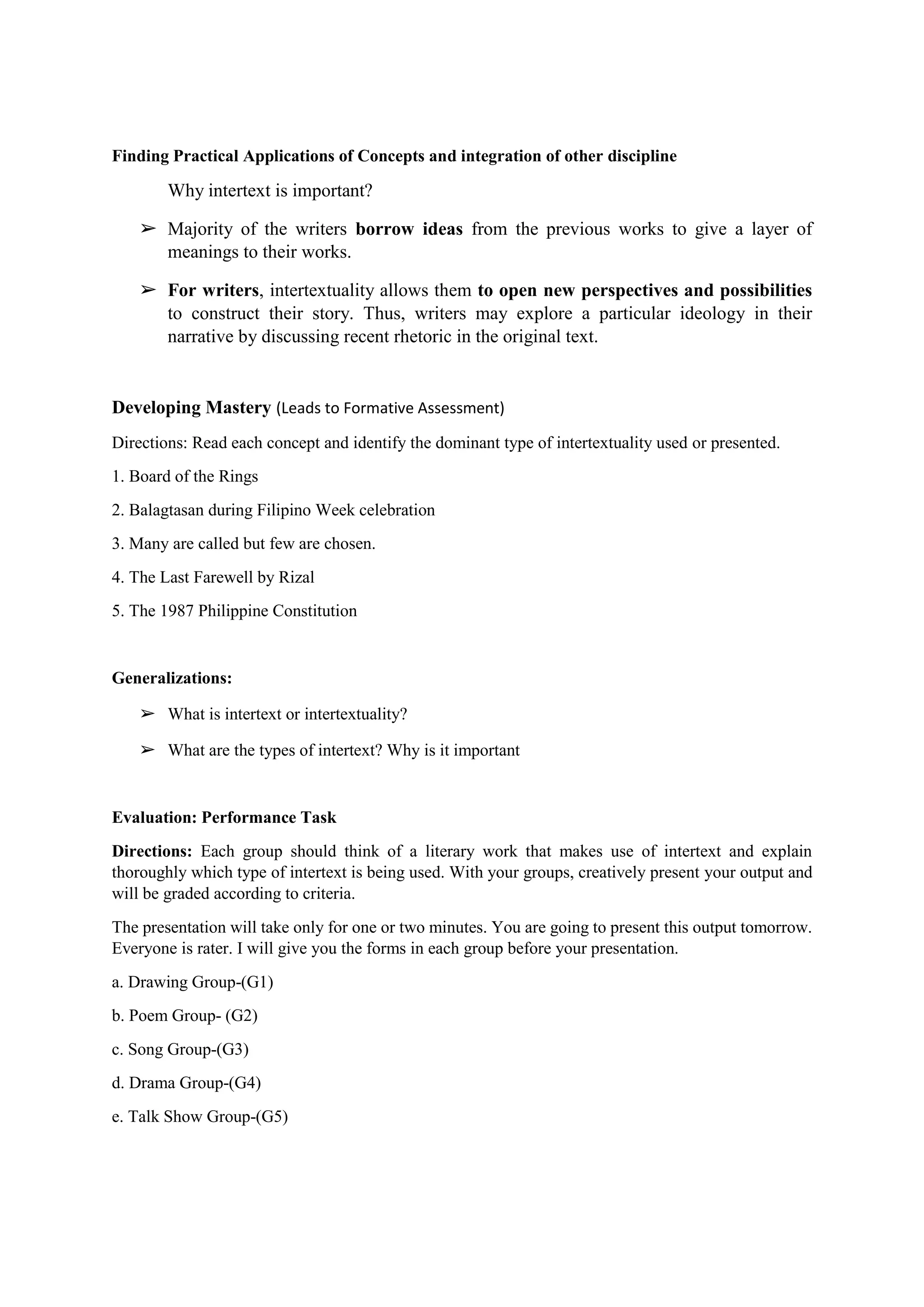
Finding Practical Applications of Concepts and integration of other discipline
Why intertext is important?
➢ Majority of the writers borrow ideas from the previous works to give a layer of
meanings to their works.
➢ For writers, intertextuality allows them to open new perspectives and possibilities
to construct their story. Thus, writers may explore a particular ideology in their
narrative by discussing recent rhetoric in the original text.
Developing Mastery (Leads to Formative Assessment)
Directions: Read each concept and identify the dominant type of intertextuality used or presented.
1. Board of the Rings
2. Balagtasan during Filipino Week celebration
3. Many are called but few are chosen.
4. The Last Farewell by Rizal
5. The 1987 Philippine Constitution
Generalizations:
➢ What is intertext or intertextuality?
➢ What are the types of intertext? Why is it important
Evaluation: Performance Task
Directions: Each group should think of a literary work that makes use of intertext and explain
thoroughly which type of intertext is being used. With your groups, creatively present your output and
will be graded according to criteria.
The presentation will take only for one or two minutes. You are going to present this output tomorrow.
Everyone is rater. I will give you the forms in each group before your presentation.
a. Drawing Group-(G1)
b. Poem Group- (G2)
c. Song Group-(G3)
d. Drama Group-(G4)
e. Talk Show Group-(G5)
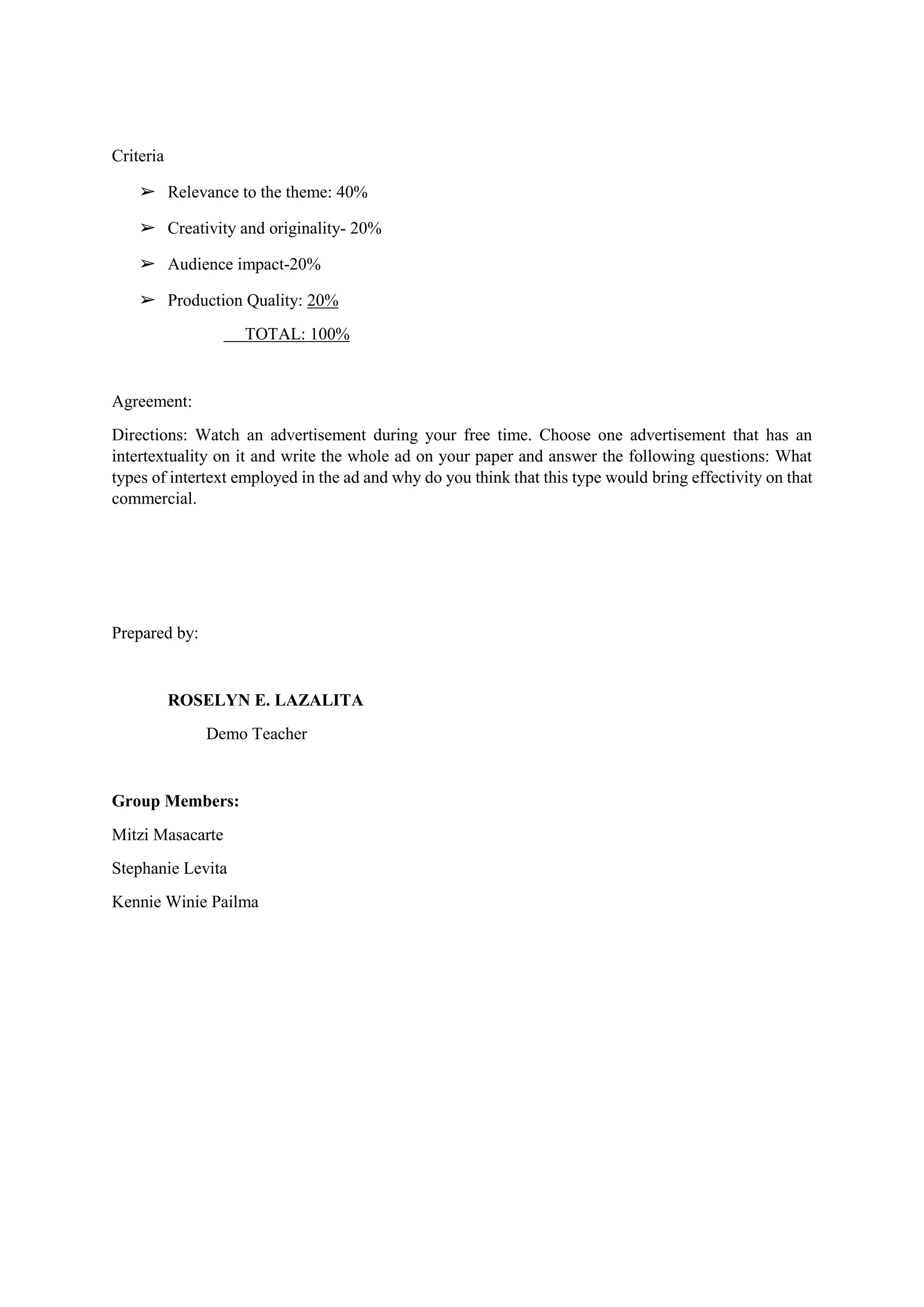
Criteria
➢ Relevance to the theme: 40%
➢ Creativity and originality- 20%
➢ Audience impact-20%
➢ Production Quality: 20%
TOTAL: 100%
Agreement:
Directions: Watch an advertisement during your free time. Choose one advertisement that has an
intertextuality on it and write the whole ad on your paper and answer the following questions: What
types of intertext employed in the ad and why do you think that this type would bring effectivity on that
commercial.
Prepared by:
ROSELYN E. LAZALITA
Demo Teacher
Group Members:
Mitzi Masacarte
Stephanie Levita
Kennie Winie Pailma
Lesson plan in intertext

Lesson plan in intertext

  • 1.
    TEACHING ENGLISH FORREADING AND WRITING SKILLS TO GRADE-11 LEARNERS (MANTANGALE SENIOR HIGH SCHOOL) (A Lesson Plan Prepared for Demonstration Teaching Purposes) Teaching Demonstrator: Roselyn E. Lazalita (Senior High School Teacher) Teaching Approaches: In-direct-Instruction, Cooperative Learning, Reports, Content- Based Instruction (CBI), Communicative Language Teaching, and Comprehension-Based Approach, Differentiated Instruction, Contextualization and ICT integration. Theoretical Bases: Cognitivism, Constructivism, and Connectivism Target Learners: Grade 11 (Senior High School) Track: HUMSS (academic track) Learning Competency: Identify the context in which a text was developed through Intertext (EN11/12RWS-Ivac-7.2) Specific Objectives: At the end of the lesson, the students are expected to: a. ➢ define intertext; ➢ identify intertext used in the text; ➢ explain how intertext is used in developing a particular text; ➢ tell the importance of recognizing one’s unique identity. Subject Matter: Intertext Skills Integrated: Listening, Speaking, Viewing and Reading Skill in Focus: Writing and Speaking Duration: 60 mins. Teaching Aids: Preferred Materials/Teaching Devices: PowerPoint Presentation (Software) Pictures (from Google.com) Video Clips Laptop Projector Multi-Media Speakers Task Sheets PROCEDURES: 1. Preliminary Activities: Greetings Prayer Checking of attendance Setting of Rules
  • 2.
    Review: The studentsare going to read the excerpt and answer the following questions that follows. The Filipino of today is soft, easy-going. His tendency is towards parasitism. He is uninclined to sustained strenuous effort! He lacks earnestness. Face- saving is the dominant note in the confused symphony of his existence. His sense of righteousness is often dulled by the desire of personal gain. His norm of conduct is generally prompted by expediency rather than by principle. He shows a failing in that superb courage which impels action because it is right, even at the cost of self-sacrifice. His greatest fear is not to do wrong, but of being caught doing wrong. -Excerpt from On Policies And Achievements Of The Government And Regeneration Of The Filipino speech of President Manuel Quezon asked the students about the previous topic through the following questions: 1. Are there how many links in the text? 2. How do you know they are links? 3. What happens when you click each of them? 4. Aside from traditional text, in what other forms of information will it give when you clicked them? 5. Based on the information given by the hyperlink, what do you think is the context of the speech excerpt? (they are going to answer the five questions given to know how far they learnt from the previous topic.) Motivation: (the students answer the activity to connect the new lesson) ACTIVITY-1 Directions: In each item are pair of images. One is label A and the other is B. Select which one of them is the correct answer to the question. Have fun!
  • 3.
    ➢ Did youhave fun finding the correct flags and logo? Is it easy or difficult? Why? What can you say about the choices? Are they similar or different? Establishing a Purpose for the Lesson Learning Competency: Identify the context in which a text was developed through Intertext (EN11/12RWS-Ivac-7.2) Specific Objectives: At the end of the lesson, the students are expected to: a. ➢ define intertext; ➢ identify intertext used in the text; ➢ explain how intertext is used in developing a particular text; ➢ tell the importance of recognizing one’s unique identity. 2. Lesson Proper Picture Analysis
  • 4.
    (the teacher willask the students about the picture they seen in the screen. The teacher facilitates the discussion of the students.) Discussing New Concepts The teacher discusses the following concept: What is Intertextuality? Intertextuality or intertext is one method of text development that enables the author to make another text based on another text. It happens when some properties of an original text are incorporated in the text that is created by another author. ➢ when an author borrows and transforms a prior text, or when you read one text and you reference another. ➢ recognizes that the text is always influenced by previous texts and in turn anticipates future texts. GROUP ACTIVITY: Reporting (Types of Intertext) (The teacher groups the students into five groups for the reporting purposes. Handout distributed to each group for their references and netbook for the encoding of their findings.) Form five groups and each group has three members. Choose your leader, secretary and reporter. The reporter and the leader of the group are the one who present your findings in class. I will give you ten minutes to discuss it with your group and after that let us begin our activity. (Each group is assigned to discuss the one type of intertext and their sample) Group 1- Revision Group 2- translation Group 3- Quotations Group4- Parody Group 5- Pastiche (the teacher gives the points of the group after they reported) Discusses New Concept #2 ➢ How to use intertextuality? ➢ Do you want to honor the greatness of an author like Rizal? ➢ Then stage his novel in a new setting. If on the other hand you want to spoof an author, then take what is silly or humorous about him and exaggerate it in a parody. Viewing on CHRISTIAN ANTOLIN PARODY (Tanging Ina)
  • 5.
    Finding Practical Applicationsof Concepts and integration of other discipline Why intertext is important? ➢ Majority of the writers borrow ideas from the previous works to give a layer of meanings to their works. ➢ For writers, intertextuality allows them to open new perspectives and possibilities to construct their story. Thus, writers may explore a particular ideology in their narrative by discussing recent rhetoric in the original text. Developing Mastery (Leads to Formative Assessment) Directions: Read each concept and identify the dominant type of intertextuality used or presented. 1. Board of the Rings 2. Balagtasan during Filipino Week celebration 3. Many are called but few are chosen. 4. The Last Farewell by Rizal 5. The 1987 Philippine Constitution Generalizations: ➢ What is intertext or intertextuality? ➢ What are the types of intertext? Why is it important Evaluation: Performance Task Directions: Each group should think of a literary work that makes use of intertext and explain thoroughly which type of intertext is being used. With your groups, creatively present your output and will be graded according to criteria. The presentation will take only for one or two minutes. You are going to present this output tomorrow. Everyone is rater. I will give you the forms in each group before your presentation. a. Drawing Group-(G1) b. Poem Group- (G2) c. Song Group-(G3) d. Drama Group-(G4) e. Talk Show Group-(G5)
  • 6.
    Criteria ➢ Relevance tothe theme: 40% ➢ Creativity and originality- 20% ➢ Audience impact-20% ➢ Production Quality: 20% TOTAL: 100% Agreement: Directions: Watch an advertisement during your free time. Choose one advertisement that has an intertextuality on it and write the whole ad on your paper and answer the following questions: What types of intertext employed in the ad and why do you think that this type would bring effectivity on that commercial. Prepared by: ROSELYN E. LAZALITA Demo Teacher Group Members: Mitzi Masacarte Stephanie Levita Kennie Winie Pailma