Academic writing
Aims of the session:
• importance of developing good writing skills
• understanding special characteristics of academic
style
• planning and structuring an essay
Session 2 2
What is the point of writing?
• Assignments require you to read, research, investigate,
and evaluate
• Writing focuses and clarifies your thinking and
reinforces your learning
• Writing enables your tutors to assess how much you
have learned and how well you can apply what you
know
3
Type of writting
Assignments / Coursework:
 Essays
 Business reports
 Reflective reports
 Book reports
 Literature reviews
 Project – Dissertation
 Exams
4Session 2
Approach writing
• Clarify the task
• Collect and record relevant information
• Organize and plan
• Reflect and evaluate
• Write outline plan – rough draft
• Work on your draft
• Write a final draft
5Session 2
Analysing question
• Identify the subject
• Identify instruction
• Identify the key aspects
• Identify what you already know
• Identify what you have to look for
• Identify relevant sources of information: library, web,
lecture notes
6Session 2
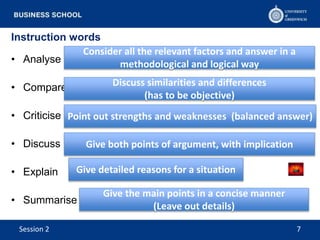
Instruction words
• Analyse
• Compare
• Criticise
• Discuss
• Explain
• Summarise
Consider all the relevant factors and answer in a
methodological and logical way
Discuss similarities and differences
(has to be objective)
Give detailed reasons for a situation
Give both points of argument, with implication
Point out strengths and weaknesses (balanced answer)
Give the main points in a concise manner
(Leave out details)
Session 2 7
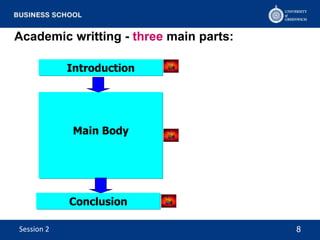
Conclusion
Introduction
Main Body
8
Academic writting - three main parts:
Session 2
Introduction
• Explain how you understand question
• Identify main issues you will be exploring
• Give a brief outline of what you are going
to do and in which order
• For 2000 words, Introduction = 200 - 400 words
9Session 2
Main body - academic writing
Follow the structure you gave in your introduction
Build up arguments - in each paragraph should:
• State you position
Sum up your argument in brief, clear sentence
• Support your argument
Present relevant evidence to back up
you ideas (reference, quotation)
• Consider your opposition
How you convince the reader that
disagrees with you
• Develop the argument to the next point - links
10Session 2
Writing Critically
• Analysing and evaluation owns and others
work and presenting a point of view which
they can support
Session 2 11
Writing critically
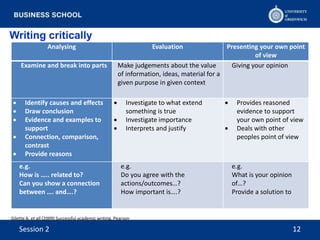
Analysing Evaluation Presenting your own point
of view
Examine and break into parts Make judgements about the value
of information, ideas, material for a
given purpose in given context
Giving your opinion
 Identify causes and effects
 Draw conclusion
 Evidence and examples to
support
 Connection, comparison,
contrast
 Provide reasons
 Investigate to what extend
something is true
 Investigate importance
 Interprets and justify
 Provides reasoned
evidence to support
your own point of view
 Deals with other
peoples point of view
e.g.
How is ….. related to?
Can you show a connection
between …. and….?
e.g.
Do you agree with the
actions/outcomes…?
How important is….?
e.g.
What is your opinion
of…?
Provide a solution to
Gilette A. et all (2009) Successful academic writing, Pearson
Session 2 12
Evidence
• A quotation (or paraphrase) from journals,
reports, books, or other published source
• Data from research
• Observations from specific experience
The sources of all evidence
must be referenced !!!!
13Session 2
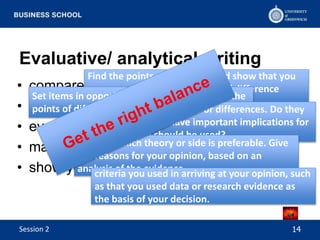
Evaluative/ analytical writing
• compare
• contrast
• evaluate significance
• make judgment
• show your criteria
14
Find the points of similarity, and show that you
are aware of any minor points of difference
within areas of overall similarity.
Set items in opposition, in order to bring out the
points of difference.Evaluate any similarities or differences. Do they
matter? Do they have important implications for
which model should be used?
Indicate which theory or side is preferable. Give
the reasons for your opinion, based on an
analysis of the evidence.criteria you used in arriving at your opinion, such
as that you used data or research evidence as
the basis of your decision.
Session 2
Conclusion
• Summarise the most important points in the main body
• Explain how these points answer the question in the title
• State clearly why, in your opinion, you agree (or
disagree) with the main issues raised by your evidence
For 2000 words, Conclusion = 200 - 400 words
15Session 2
Academic style
• Critical, objective, well balanced
• Argumentative good evidence from a respected source
• Follows a clear logical structure
• All sources of ideas and data are referenced
• Considers all sides of an argument – for and against
16Session 2
Writting style
• Use formal English – avoid slang
” Managers often have to take the flack from fed up
customers”
“Managers often have to receive complaints from
dissatisfied customers”
• Use words you fully understand
“As a result of the ever augmenting workload”
“As a result of the ever increasing workload”
• Avoid abraviation - e.g., didn`t, isn`t
17
Writting style
• Be impersonal – avoid „I, you, we”
I suggest It can be suggested
• Numbers – are written write in full
31% - thirty one percent
• Be objective - avoid personal, subjective words
nice, wondeful, usual, natural
18
Writting style
• Be concise - edit out unnecessary words
A man called John Smith said Smith (2010)
• Use continues prose – write in full sentence and
than group them together , avoid list of points.
• Be precise
Some writers - who?
At that time - when?
• Use – facts, opinion, arguments that can be
checked against evidence.
19
What can gain marks
• Identify relevant themes to include
• Identify the most relevant facts
• Clarity, precision, accuracy
• Present items in a best order
• Keep to the point
• Identify significance of what you describe
20Session 2
Remember
• Don’t go over the maximum words
• Cut out unnecessary or weak ideas
• Use straight forward, concise language
• Reduce the words in each sentence
write simple , short sentences - aim for 20 max
• Keep paragraphs short
develop one main idea per paragraph
• Check referencing and reference list
be careful of plagiarising!!!!!
21Session 2
Before handing it in
• Attach a ‘header sheet’
• Word-process finished draft
• Check word count (print at end of last page)
• Read it through - Use ‘Spell-Check’
• Use 11 or 12 pt font
22Session 2
Handing it in
• Aim for at least one day before deadline
• Computer breakdown is not an excuse
• Keep your receipts
• Late submission loses marks daily
• If you are ill, talk to your programme
leader/personal tutor immediately
23Session 2
Essay
• You have been give an essay task by the Management
Accounting and Ethics in Organisation course leader.
“CSR will be a game changer in future business
critically discuss”
• PPD will help you with evaluating academic papers you
have collected, structuring the essay and referencing.
• In 3 weeks time - presentation in small group of
academic paper that you have found and want to use
• In 5 weeks time – feedback on the draft of the essay
24Session 2
Tutorial Task
• During your tutorial you will be given three
essays to read
• Evaluate essays - discuss in small groups
strengths and weaknesses of each of them
and write your comments
• Feedback your findings to your tutorial
group
25Session 2

Academic writing

  • 1.
  • 2.
    Aims of thesession: • importance of developing good writing skills • understanding special characteristics of academic style • planning and structuring an essay Session 2 2
  • 3.
    What is thepoint of writing? • Assignments require you to read, research, investigate, and evaluate • Writing focuses and clarifies your thinking and reinforces your learning • Writing enables your tutors to assess how much you have learned and how well you can apply what you know 3
  • 4.
    Type of writting Assignments/ Coursework:  Essays  Business reports  Reflective reports  Book reports  Literature reviews  Project – Dissertation  Exams 4Session 2
  • 5.
    Approach writing • Clarifythe task • Collect and record relevant information • Organize and plan • Reflect and evaluate • Write outline plan – rough draft • Work on your draft • Write a final draft 5Session 2
  • 6.
    Analysing question • Identifythe subject • Identify instruction • Identify the key aspects • Identify what you already know • Identify what you have to look for • Identify relevant sources of information: library, web, lecture notes 6Session 2
  • 7.
    Instruction words • Analyse •Compare • Criticise • Discuss • Explain • Summarise Consider all the relevant factors and answer in a methodological and logical way Discuss similarities and differences (has to be objective) Give detailed reasons for a situation Give both points of argument, with implication Point out strengths and weaknesses (balanced answer) Give the main points in a concise manner (Leave out details) Session 2 7
  • 8.
  • 9.
    Introduction • Explain howyou understand question • Identify main issues you will be exploring • Give a brief outline of what you are going to do and in which order • For 2000 words, Introduction = 200 - 400 words 9Session 2
  • 10.
    Main body -academic writing Follow the structure you gave in your introduction Build up arguments - in each paragraph should: • State you position Sum up your argument in brief, clear sentence • Support your argument Present relevant evidence to back up you ideas (reference, quotation) • Consider your opposition How you convince the reader that disagrees with you • Develop the argument to the next point - links 10Session 2
  • 11.
    Writing Critically • Analysingand evaluation owns and others work and presenting a point of view which they can support Session 2 11
  • 12.
    Writing critically Analysing EvaluationPresenting your own point of view Examine and break into parts Make judgements about the value of information, ideas, material for a given purpose in given context Giving your opinion  Identify causes and effects  Draw conclusion  Evidence and examples to support  Connection, comparison, contrast  Provide reasons  Investigate to what extend something is true  Investigate importance  Interprets and justify  Provides reasoned evidence to support your own point of view  Deals with other peoples point of view e.g. How is ….. related to? Can you show a connection between …. and….? e.g. Do you agree with the actions/outcomes…? How important is….? e.g. What is your opinion of…? Provide a solution to Gilette A. et all (2009) Successful academic writing, Pearson Session 2 12
  • 13.
    Evidence • A quotation(or paraphrase) from journals, reports, books, or other published source • Data from research • Observations from specific experience The sources of all evidence must be referenced !!!! 13Session 2
  • 14.
    Evaluative/ analytical writing •compare • contrast • evaluate significance • make judgment • show your criteria 14 Find the points of similarity, and show that you are aware of any minor points of difference within areas of overall similarity. Set items in opposition, in order to bring out the points of difference.Evaluate any similarities or differences. Do they matter? Do they have important implications for which model should be used? Indicate which theory or side is preferable. Give the reasons for your opinion, based on an analysis of the evidence.criteria you used in arriving at your opinion, such as that you used data or research evidence as the basis of your decision. Session 2
  • 15.
    Conclusion • Summarise themost important points in the main body • Explain how these points answer the question in the title • State clearly why, in your opinion, you agree (or disagree) with the main issues raised by your evidence For 2000 words, Conclusion = 200 - 400 words 15Session 2
  • 16.
    Academic style • Critical,objective, well balanced • Argumentative good evidence from a respected source • Follows a clear logical structure • All sources of ideas and data are referenced • Considers all sides of an argument – for and against 16Session 2
  • 17.
    Writting style • Useformal English – avoid slang ” Managers often have to take the flack from fed up customers” “Managers often have to receive complaints from dissatisfied customers” • Use words you fully understand “As a result of the ever augmenting workload” “As a result of the ever increasing workload” • Avoid abraviation - e.g., didn`t, isn`t 17
  • 18.
    Writting style • Beimpersonal – avoid „I, you, we” I suggest It can be suggested • Numbers – are written write in full 31% - thirty one percent • Be objective - avoid personal, subjective words nice, wondeful, usual, natural 18
  • 19.
    Writting style • Beconcise - edit out unnecessary words A man called John Smith said Smith (2010) • Use continues prose – write in full sentence and than group them together , avoid list of points. • Be precise Some writers - who? At that time - when? • Use – facts, opinion, arguments that can be checked against evidence. 19
  • 20.
    What can gainmarks • Identify relevant themes to include • Identify the most relevant facts • Clarity, precision, accuracy • Present items in a best order • Keep to the point • Identify significance of what you describe 20Session 2
  • 21.
    Remember • Don’t goover the maximum words • Cut out unnecessary or weak ideas • Use straight forward, concise language • Reduce the words in each sentence write simple , short sentences - aim for 20 max • Keep paragraphs short develop one main idea per paragraph • Check referencing and reference list be careful of plagiarising!!!!! 21Session 2
  • 22.
    Before handing itin • Attach a ‘header sheet’ • Word-process finished draft • Check word count (print at end of last page) • Read it through - Use ‘Spell-Check’ • Use 11 or 12 pt font 22Session 2
  • 23.
    Handing it in •Aim for at least one day before deadline • Computer breakdown is not an excuse • Keep your receipts • Late submission loses marks daily • If you are ill, talk to your programme leader/personal tutor immediately 23Session 2
  • 24.
    Essay • You havebeen give an essay task by the Management Accounting and Ethics in Organisation course leader. “CSR will be a game changer in future business critically discuss” • PPD will help you with evaluating academic papers you have collected, structuring the essay and referencing. • In 3 weeks time - presentation in small group of academic paper that you have found and want to use • In 5 weeks time – feedback on the draft of the essay 24Session 2
  • 25.
    Tutorial Task • Duringyour tutorial you will be given three essays to read • Evaluate essays - discuss in small groups strengths and weaknesses of each of them and write your comments • Feedback your findings to your tutorial group 25Session 2