Cleaning & Grading
Equipments
For
Fruit and Vegetable
Cleaning
This is a treatment given to remove adhering dust, dirt, extraneous
matter, pathogenic load etc. from the surface of a commodity.
Cleaning basically sanitizes the produce and avoid entry of
undesirable contents to enter the packaging and storage line.
Cleaning is a broader term and includes, dusting, washing etc.
Methods Of Cleaning :-
1. Dry Method (Dusting etc.)
2. Wet Method (Washing)
1. Dry Method (Dusting etc.) :-
This method is mainly used to remove the adhering soil,
etc from commodity i.e. potato, root vegetables, carrot,
radish etc.
Dusting helps to shed undesirable
load (weight) of the commodity and thus reduce
transportation cost.
it also removes pathogens microorganisms
present in the soil from the surface of the vegetables.
2. Wet Method (Washing) :-
This method is used in most fruits and vegetables.
Washing is done at the pack house through automated
washing system fitted with overhead sprayers and
smooth rotating brushes to clean and wash the fruits.
Washing with clean water mixed with a
neutral detergent such as Teapol, Sandovit or Indtron at
0.1% (1 ml / litre of water) is effective.
The process of cleaning and washing will
take 3-5 minutes. The temperature of water should be at
room temperature (27°C)
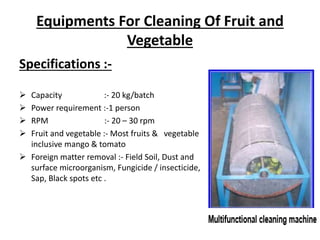
Equipments For Cleaning Of Fruit and
Vegetable
Specifications :-
 Capacity :- 20 kg/batch
 Power requirement :-1 person
 RPM :- 20 – 30 rpm
 Fruit and vegetable :- Most fruits & vegetable
inclusive mango & tomato
 Foreign matter removal :- Field Soil, Dust and
surface microorganism, Fungicide / insecticide,
Sap, Black spots etc .
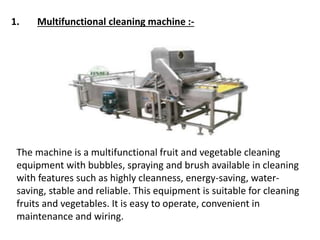
1. Multifunctional cleaning machine :-
The machine is a multifunctional fruit and vegetable cleaning
equipment with bubbles, spraying and brush available in cleaning
with features such as highly cleanness, energy-saving, water-
saving, stable and reliable. This equipment is suitable for cleaning
fruits and vegetables. It is easy to operate, convenient in
maintenance and wiring.
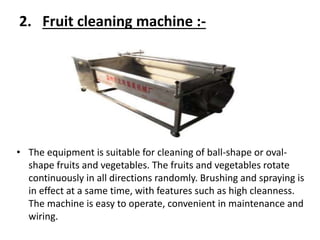
2. Fruit cleaning machine :-
• The equipment is suitable for cleaning of ball-shape or oval-
shape fruits and vegetables. The fruits and vegetables rotate
continuously in all directions randomly. Brushing and spraying is
in effect at a same time, with features such as high cleanness.
The machine is easy to operate, convenient in maintenance and
wiring.
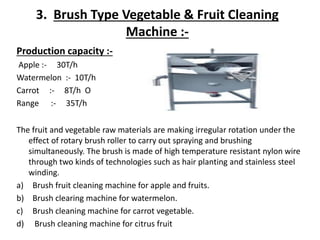
3. Brush Type Vegetable & Fruit Cleaning
Machine :-
The fruit and vegetable raw materials are making irregular rotation under the
effect of rotary brush roller to carry out spraying and brushing
simultaneously. The brush is made of high temperature resistant nylon wire
through two kinds of technologies such as hair planting and stainless steel
winding.
a) Brush fruit cleaning machine for apple and fruits.
b) Brush clearing machine for watermelon.
c) Brush cleaning machine for carrot vegetable.
d) Brush cleaning machine for citrus fruit
Production capacity :-
Apple :- 30T/h
Watermelon :- 10T/h
Carrot :- 8T/h O
Range :- 35T/h
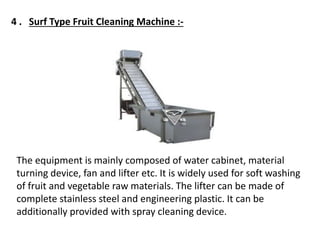
4 . Surf Type Fruit Cleaning Machine :-
The equipment is mainly composed of water cabinet, material
turning device, fan and lifter etc. It is widely used for soft washing
of fruit and vegetable raw materials. The lifter can be made of
complete stainless steel and engineering plastic. It can be
additionally provided with spray cleaning device.
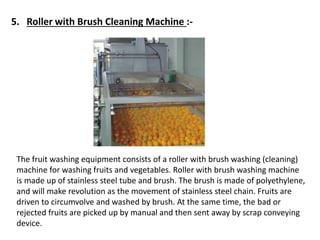
5. Roller with Brush Cleaning Machine :-
The fruit washing equipment consists of a roller with brush washing (cleaning)
machine for washing fruits and vegetables. Roller with brush washing machine
is made up of stainless steel tube and brush. The brush is made of polyethylene,
and will make revolution as the movement of stainless steel chain. Fruits are
driven to circumvolve and washed by brush. At the same time, the bad or
rejected fruits are picked up by manual and then sent away by scrap conveying
device.
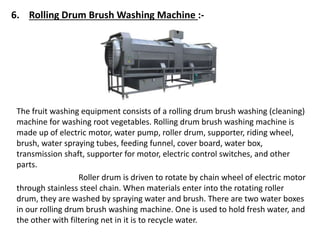
6. Rolling Drum Brush Washing Machine :-
The fruit washing equipment consists of a rolling drum brush washing (cleaning)
machine for washing root vegetables. Rolling drum brush washing machine is
made up of electric motor, water pump, roller drum, supporter, riding wheel,
brush, water spraying tubes, feeding funnel, cover board, water box,
transmission shaft, supporter for motor, electric control switches, and other
parts.
Roller drum is driven to rotate by chain wheel of electric motor
through stainless steel chain. When materials enter into the rotating roller
drum, they are washed by spraying water and brush. There are two water boxes
in our rolling drum brush washing machine. One is used to hold fresh water, and
the other with filtering net in it is to recycle water.
Grading
This may be done manually or by using a machine. Fruits are graded on the
basis of their colour, size and weight and sorted for freeness from damage
/diseases.
At the grading table, trained workers wearing gloves
sort out the oversized and undersized fruits, immature/scarred/blemished
fruits, diseased/insect damaged fruits and as well as fruits with sap injury (in
mango) under the supervision of quality supervisor.
The segregated fruits in grader machine kept bin plastic crates
are removed at the end each working shift from the process area and are
distinctly labeled for disposal.
Methods Of Grading :-
1. Dry Method (Dusting etc.)
2. Wet Method (Washing)
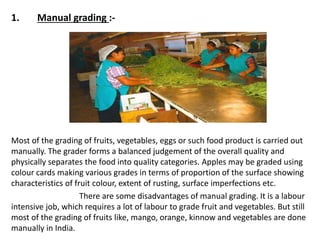
Most of the grading of fruits, vegetables, eggs or such food product is carried out
manually. The grader forms a balanced judgement of the overall quality and
physically separates the food into quality categories. Apples may be graded using
colour cards making various grades in terms of proportion of the surface showing
characteristics of fruit colour, extent of rusting, surface imperfections etc.
There are some disadvantages of manual grading. It is a labour
intensive job, which requires a lot of labour to grade fruit and vegetables. But still
most of the grading of fruits like, mango, orange, kinnow and vegetables are done
manually in India.
1. Manual grading :-
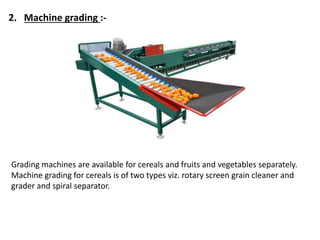
Grading machines are available for cereals and fruits and vegetables separately.
Machine grading for cereals is of two types viz. rotary screen grain cleaner and
grader and spiral separator.
2. Machine grading :-
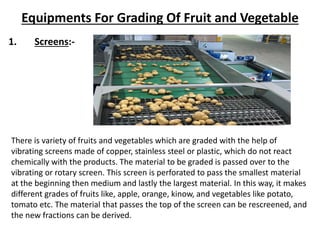
There is variety of fruits and vegetables which are graded with the help of
vibrating screens made of copper, stainless steel or plastic, which do not react
chemically with the products. The material to be graded is passed over to the
vibrating or rotary screen. This screen is perforated to pass the smallest material
at the beginning then medium and lastly the largest material. In this way, it makes
different grades of fruits like, apple, orange, kinow, and vegetables like potato,
tomato etc. The material that passes the top of the screen can be rescreened, and
the new fractions can be derived.
1. Screens:-
Equipments For Grading Of Fruit and Vegetable
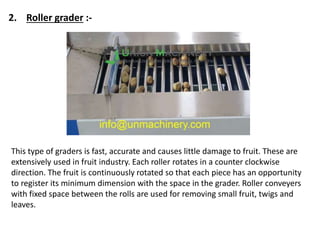
This type of graders is fast, accurate and causes little damage to fruit. These are
extensively used in fruit industry. Each roller rotates in a counter clockwise
direction. The fruit is continuously rotated so that each piece has an opportunity
to register its minimum dimension with the space in the grader. Roller conveyers
with fixed space between the rolls are used for removing small fruit, twigs and
leaves.
2. Roller grader :-
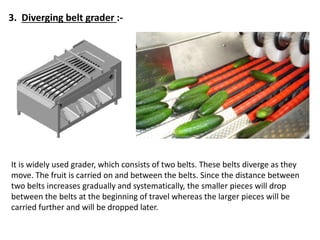
It is widely used grader, which consists of two belts. These belts diverge as they
move. The fruit is carried on and between the belts. Since the distance between
two belts increases gradually and systematically, the smaller pieces will drop
between the belts at the beginning of travel whereas the larger pieces will be
carried further and will be dropped later.
3. Diverging belt grader :-
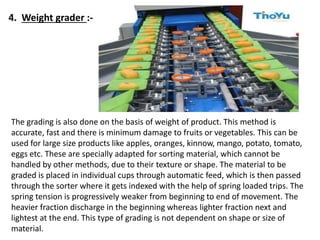
The grading is also done on the basis of weight of product. This method is
accurate, fast and there is minimum damage to fruits or vegetables. This can be
used for large size products like apples, oranges, kinnow, mango, potato, tomato,
eggs etc. These are specially adapted for sorting material, which cannot be
handled by other methods, due to their texture or shape. The material to be
graded is placed in individual cups through automatic feed, which is then passed
through the sorter where it gets indexed with the help of spring loaded trips. The
spring tension is progressively weaker from beginning to end of movement. The
heavier fraction discharge in the beginning whereas lighter fraction next and
lightest at the end. This type of grading is not dependent on shape or size of
material.
4. Weight grader :-

Cleaning & Grading Equipments For Fruit and Vegetable

  • 1.
  • 2.
    Cleaning This is atreatment given to remove adhering dust, dirt, extraneous matter, pathogenic load etc. from the surface of a commodity. Cleaning basically sanitizes the produce and avoid entry of undesirable contents to enter the packaging and storage line. Cleaning is a broader term and includes, dusting, washing etc. Methods Of Cleaning :- 1. Dry Method (Dusting etc.) 2. Wet Method (Washing)
  • 3.
    1. Dry Method(Dusting etc.) :- This method is mainly used to remove the adhering soil, etc from commodity i.e. potato, root vegetables, carrot, radish etc. Dusting helps to shed undesirable load (weight) of the commodity and thus reduce transportation cost. it also removes pathogens microorganisms present in the soil from the surface of the vegetables.
  • 4.
    2. Wet Method(Washing) :- This method is used in most fruits and vegetables. Washing is done at the pack house through automated washing system fitted with overhead sprayers and smooth rotating brushes to clean and wash the fruits. Washing with clean water mixed with a neutral detergent such as Teapol, Sandovit or Indtron at 0.1% (1 ml / litre of water) is effective. The process of cleaning and washing will take 3-5 minutes. The temperature of water should be at room temperature (27°C)
  • 5.
    Equipments For CleaningOf Fruit and Vegetable Specifications :-  Capacity :- 20 kg/batch  Power requirement :-1 person  RPM :- 20 – 30 rpm  Fruit and vegetable :- Most fruits & vegetable inclusive mango & tomato  Foreign matter removal :- Field Soil, Dust and surface microorganism, Fungicide / insecticide, Sap, Black spots etc .
  • 6.
    1. Multifunctional cleaningmachine :- The machine is a multifunctional fruit and vegetable cleaning equipment with bubbles, spraying and brush available in cleaning with features such as highly cleanness, energy-saving, water- saving, stable and reliable. This equipment is suitable for cleaning fruits and vegetables. It is easy to operate, convenient in maintenance and wiring.
  • 7.
    2. Fruit cleaningmachine :- • The equipment is suitable for cleaning of ball-shape or oval- shape fruits and vegetables. The fruits and vegetables rotate continuously in all directions randomly. Brushing and spraying is in effect at a same time, with features such as high cleanness. The machine is easy to operate, convenient in maintenance and wiring.
  • 8.
    3. Brush TypeVegetable & Fruit Cleaning Machine :- The fruit and vegetable raw materials are making irregular rotation under the effect of rotary brush roller to carry out spraying and brushing simultaneously. The brush is made of high temperature resistant nylon wire through two kinds of technologies such as hair planting and stainless steel winding. a) Brush fruit cleaning machine for apple and fruits. b) Brush clearing machine for watermelon. c) Brush cleaning machine for carrot vegetable. d) Brush cleaning machine for citrus fruit Production capacity :- Apple :- 30T/h Watermelon :- 10T/h Carrot :- 8T/h O Range :- 35T/h
  • 9.
    4 . SurfType Fruit Cleaning Machine :- The equipment is mainly composed of water cabinet, material turning device, fan and lifter etc. It is widely used for soft washing of fruit and vegetable raw materials. The lifter can be made of complete stainless steel and engineering plastic. It can be additionally provided with spray cleaning device.
  • 10.
    5. Roller withBrush Cleaning Machine :- The fruit washing equipment consists of a roller with brush washing (cleaning) machine for washing fruits and vegetables. Roller with brush washing machine is made up of stainless steel tube and brush. The brush is made of polyethylene, and will make revolution as the movement of stainless steel chain. Fruits are driven to circumvolve and washed by brush. At the same time, the bad or rejected fruits are picked up by manual and then sent away by scrap conveying device.
  • 11.
    6. Rolling DrumBrush Washing Machine :- The fruit washing equipment consists of a rolling drum brush washing (cleaning) machine for washing root vegetables. Rolling drum brush washing machine is made up of electric motor, water pump, roller drum, supporter, riding wheel, brush, water spraying tubes, feeding funnel, cover board, water box, transmission shaft, supporter for motor, electric control switches, and other parts. Roller drum is driven to rotate by chain wheel of electric motor through stainless steel chain. When materials enter into the rotating roller drum, they are washed by spraying water and brush. There are two water boxes in our rolling drum brush washing machine. One is used to hold fresh water, and the other with filtering net in it is to recycle water.
  • 12.
    Grading This may bedone manually or by using a machine. Fruits are graded on the basis of their colour, size and weight and sorted for freeness from damage /diseases. At the grading table, trained workers wearing gloves sort out the oversized and undersized fruits, immature/scarred/blemished fruits, diseased/insect damaged fruits and as well as fruits with sap injury (in mango) under the supervision of quality supervisor. The segregated fruits in grader machine kept bin plastic crates are removed at the end each working shift from the process area and are distinctly labeled for disposal. Methods Of Grading :- 1. Dry Method (Dusting etc.) 2. Wet Method (Washing)
  • 13.
    Most of thegrading of fruits, vegetables, eggs or such food product is carried out manually. The grader forms a balanced judgement of the overall quality and physically separates the food into quality categories. Apples may be graded using colour cards making various grades in terms of proportion of the surface showing characteristics of fruit colour, extent of rusting, surface imperfections etc. There are some disadvantages of manual grading. It is a labour intensive job, which requires a lot of labour to grade fruit and vegetables. But still most of the grading of fruits like, mango, orange, kinnow and vegetables are done manually in India. 1. Manual grading :-
  • 14.
    Grading machines areavailable for cereals and fruits and vegetables separately. Machine grading for cereals is of two types viz. rotary screen grain cleaner and grader and spiral separator. 2. Machine grading :-
  • 15.
    There is varietyof fruits and vegetables which are graded with the help of vibrating screens made of copper, stainless steel or plastic, which do not react chemically with the products. The material to be graded is passed over to the vibrating or rotary screen. This screen is perforated to pass the smallest material at the beginning then medium and lastly the largest material. In this way, it makes different grades of fruits like, apple, orange, kinow, and vegetables like potato, tomato etc. The material that passes the top of the screen can be rescreened, and the new fractions can be derived. 1. Screens:- Equipments For Grading Of Fruit and Vegetable
  • 16.
    This type ofgraders is fast, accurate and causes little damage to fruit. These are extensively used in fruit industry. Each roller rotates in a counter clockwise direction. The fruit is continuously rotated so that each piece has an opportunity to register its minimum dimension with the space in the grader. Roller conveyers with fixed space between the rolls are used for removing small fruit, twigs and leaves. 2. Roller grader :-
  • 17.
    It is widelyused grader, which consists of two belts. These belts diverge as they move. The fruit is carried on and between the belts. Since the distance between two belts increases gradually and systematically, the smaller pieces will drop between the belts at the beginning of travel whereas the larger pieces will be carried further and will be dropped later. 3. Diverging belt grader :-
  • 18.
    The grading isalso done on the basis of weight of product. This method is accurate, fast and there is minimum damage to fruits or vegetables. This can be used for large size products like apples, oranges, kinnow, mango, potato, tomato, eggs etc. These are specially adapted for sorting material, which cannot be handled by other methods, due to their texture or shape. The material to be graded is placed in individual cups through automatic feed, which is then passed through the sorter where it gets indexed with the help of spring loaded trips. The spring tension is progressively weaker from beginning to end of movement. The heavier fraction discharge in the beginning whereas lighter fraction next and lightest at the end. This type of grading is not dependent on shape or size of material. 4. Weight grader :-