Engineering Design Process

     Prof. Kawaldeep Singh
Engineering Design Process
The engineering design process involves a series
of steps that lead to the development of a new
product or system. In this design challenge,
students are to complete each step and
document their work as they develop their lunar
plant growth chamber. The students should be
able to do the following:
Engineering Design Process
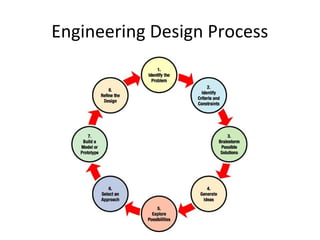
• STEP 1: Identify the Problem -- Students
  should state the challenge problem in their
  own words. Example: How can I design a
  __________ that will __________?
Engineering Design Process
• STEP 2: Identify Criteria and Constraints --
  Students should specify the design requirements
  (criteria). Example: Our growth chamber must
  have a growing surface of 10 square feet and
  have a delivery volume of 3 cubic feet or less.
  Students should list the limits on the design due
  to available resources and the environment
  (constraints). Example: Our growth chamber
  must be accessible to astronauts without the
  need for leaving the spacecraft.
Engineering Design Process
• STEP 3: Brainstorm Possible Solutions -- Each
  student in the group should sketch his or her
  own ideas as the group discusses ways to
  solve the problem. Labels and arrows should
  be included to identify parts and how they
  might move. These drawings should be quick
  and brief.
Engineering Design Process
• STEP 4: Generate Ideas -- In this step, each
  student should develop two or three ideas
  more thoroughly. Students should create new
  drawings that are orthographic projections
  (multiple views showing the top, front and
  one side) and isometric drawings (three-
  dimensional depiction). These are to be drawn
  neatly, using rulers to draw straight lines and
  to make parts proportional. Parts and
  measurements should be labelled clearly.
Engineering Design Process
• STEP 5: Explore Possibilities -- The developed
  ideas should be shared and discussed among
  the team members. Students should record
  pros and cons of each design idea directly on
  the paper next to the drawings.
Engineering Design Process
• STEP 6: Select an Approach -- Students should
  work in teams and identify the design that
  appears to solve the problem the best.
  Students should write a statement that
  describes why they chose the solution. This
  should include some reference to the criteria
  and constraints identified above.
Engineering Design Process
• STEP 7: Build a Model or Prototype --
  Students will construct a full-size or scale
  model based on their drawings. The teacher
  will help identify and acquire appropriate
  modelling materials and tools. See the design
  brief for a sample list.
Engineering Design Process
• STEP 8: Refine the Design -- Students will
  examine and evaluate their prototypes or
  designs based on the criteria and constraints.
  Groups may enlist students from other groups
  to review the solution and help identify
  changes that need to be made. Based on
  criteria and constraints, teams must identify
  any problems and proposed solutions.

Engineering design process

  • 1.
    Engineering Design Process Prof. Kawaldeep Singh
  • 2.
    Engineering Design Process Theengineering design process involves a series of steps that lead to the development of a new product or system. In this design challenge, students are to complete each step and document their work as they develop their lunar plant growth chamber. The students should be able to do the following:
  • 3.
  • 4.
    Engineering Design Process •STEP 1: Identify the Problem -- Students should state the challenge problem in their own words. Example: How can I design a __________ that will __________?
  • 5.
    Engineering Design Process •STEP 2: Identify Criteria and Constraints -- Students should specify the design requirements (criteria). Example: Our growth chamber must have a growing surface of 10 square feet and have a delivery volume of 3 cubic feet or less. Students should list the limits on the design due to available resources and the environment (constraints). Example: Our growth chamber must be accessible to astronauts without the need for leaving the spacecraft.
  • 6.
    Engineering Design Process •STEP 3: Brainstorm Possible Solutions -- Each student in the group should sketch his or her own ideas as the group discusses ways to solve the problem. Labels and arrows should be included to identify parts and how they might move. These drawings should be quick and brief.
  • 7.
    Engineering Design Process •STEP 4: Generate Ideas -- In this step, each student should develop two or three ideas more thoroughly. Students should create new drawings that are orthographic projections (multiple views showing the top, front and one side) and isometric drawings (three- dimensional depiction). These are to be drawn neatly, using rulers to draw straight lines and to make parts proportional. Parts and measurements should be labelled clearly.
  • 8.
    Engineering Design Process •STEP 5: Explore Possibilities -- The developed ideas should be shared and discussed among the team members. Students should record pros and cons of each design idea directly on the paper next to the drawings.
  • 9.
    Engineering Design Process •STEP 6: Select an Approach -- Students should work in teams and identify the design that appears to solve the problem the best. Students should write a statement that describes why they chose the solution. This should include some reference to the criteria and constraints identified above.
  • 10.
    Engineering Design Process •STEP 7: Build a Model or Prototype -- Students will construct a full-size or scale model based on their drawings. The teacher will help identify and acquire appropriate modelling materials and tools. See the design brief for a sample list.
  • 11.
    Engineering Design Process •STEP 8: Refine the Design -- Students will examine and evaluate their prototypes or designs based on the criteria and constraints. Groups may enlist students from other groups to review the solution and help identify changes that need to be made. Based on criteria and constraints, teams must identify any problems and proposed solutions.