LECTURE NOTES ON
CONCEPTS IN ENGINEERING DESIGN
UNIT-1
By
Dr.Yogesh Dewang
Assistant Professor
Lakshmi Narain College of Technology, Bhopal
Ph.D. (Mechanical Engineering) (MANIT,Bhopal)
M.Tech (Stress & Vibration Analysis) (MANIT,Bhopal)
B.E. (Mechanical Engineering) (RGPV,Bhopal)
E-Mail Id: yogesh_dewang@yahoo.co.in
Skype Id: yogesh.dewang1
09179829930
VARIOUS WAYS TO THINK ABOUT THE
ENGINEERING DESIGN PROCESS
 DESIGNING A SYSTEM :
1) By a system we imply about the entire combination of machines,
technology, people information and capital required to accomplish some
pre specified work. A system may be an electric power distribution network
for a village or city of a country. A complex system of railways for
transportation, combination of automobile parts production line or textile
manufacturing unit.
2) A large system is divided usually into subsystems, which in turn are made
up of parts or components. A product is made up of collection of parts
,sometimes called pieces. A part with a single pieces requires no
assembly. When two or more parts are joined together it is called an
assembly. Usually large assemblies are composed of a collection of smaller
assemblies called subassemblies.
VARIOUS WAYS TO THINK ABOUT THE
ENGINEERING DESIGN PROCESS
 DESIGNING A SYSTEM :
VARIOUS WAYS TO THINK ABOUT THE
ENGINEERING DESIGN PROCESS
 DESIGNING A SYSTEM :
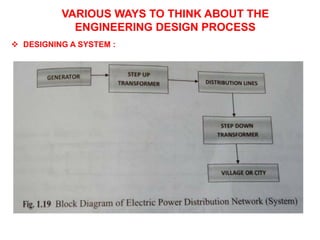
3) In the above figure, system of electric power distribution network has been
shown. The whole system can be subdivided into four subsystems that is
the Generator, Step up and Step down transformer, the distribution lines
and transmission to the village or city. The subsystem of transformer can
also be divided to form subassemblies and then individual parts or
component.
4) So ,the ways to think about design process is to break a complex system
which needs to be designed into smaller sub-systems and large assemblies
into sub-assemblies. The sub-assemblies are further broken into individual
components and parts. Design individual parts, perform quality check and
then go for subassembly and then for large assemblies and then a complex
system.
VARIOUS WAYS TO THINK ABOUT THE ENGINEERING DESIGN
PROCESS
 VISUALIZATION:
1) INTERPRETATION OF NON-VISUAL DATA:
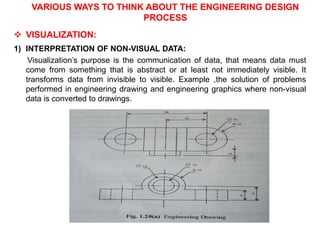
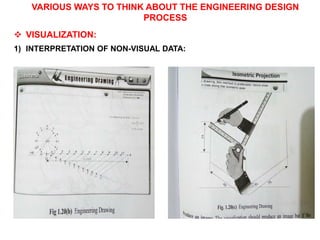
Visualization’s purpose is the communication of data, that means data must
come from something that is abstract or at least not immediately visible. It
transforms data from invisible to visible. Example ,the solution of problems
performed in engineering drawing and engineering graphics where non-visual
data is converted to drawings.
VARIOUS WAYS TO THINK ABOUT THE ENGINEERING DESIGN
PROCESS
 VISUALIZATION:
1) INTERPRETATION OF NON-VISUAL DATA:
VARIOUS WAYS TO THINK ABOUT THE ENGINEERING DESIGN
PROCESS
 VISUALIZATION:
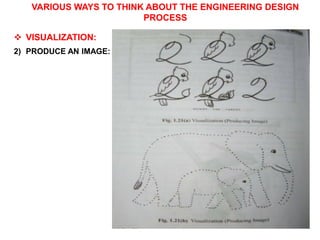
2) PRODUCE AN IMAGE:
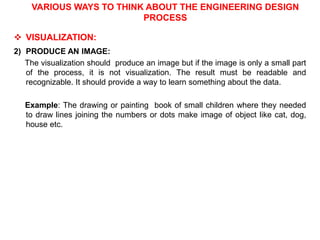
The visualization should produce an image but if the image is only a small part
of the process, it is not visualization. The result must be readable and
recognizable. It should provide a way to learn something about the data.
Example: The drawing or painting book of small children where they needed
to draw lines joining the numbers or dots make image of object like cat, dog,
house etc.
VARIOUS WAYS TO THINK ABOUT THE ENGINEERING DESIGN
PROCESS
 VISUALIZATION:
2) PRODUCE AN IMAGE:
VARIOUS WAYS TO THINK ABOUT THE ENGINEERING DESIGN
PROCESS
 PHOTOGRAPHY:
1) It is a science ,art and practice of creating durable images by recording light or
other electromagnetic radiation, either electronically by means of an image
sensor or chemically by means of a light sensitive material such as
photographic firm.
2) In photography, a lens is used to focus the light reflected or emitted from
objects into a real image on the light-sensitive surface inside a camera during a
times exposure. With an electronic image sensor, this produces an electrical
charge at each pixel, which is electronically processed and stored in a digital
image file for subsequent display or processing.
3) The result with photographic emulsion is an invisible latent image, which is
later chemically “ developed” into a visible image, either negative or positive
depending on the purpose of the photographic material and the method
processing. A negative on file is traditionally create a positive image on a paper
base, known as a print, either by using an enlarger or by contact printing.
VARIOUS WAYS TO THINK ABOUT THE ENGINEERING DESIGN
PROCESS
 PHOTOGRAPHY:
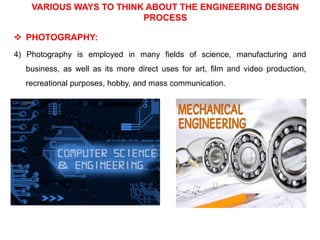
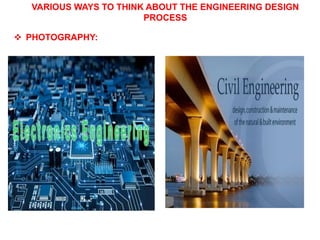
4) Photography is employed in many fields of science, manufacturing and
business, as well as its more direct uses for art, film and video production,
recreational purposes, hobby, and mass communication.
VARIOUS WAYS TO THINK ABOUT THE ENGINEERING DESIGN
PROCESS
 PHOTOGRAPHY:
SIMPLIFIED ITERATION MODEL
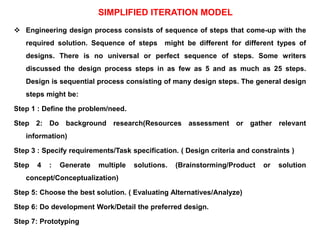
 Engineering design process consists of sequence of steps that come-up with the
required solution. Sequence of steps might be different for different types of
designs. There is no universal or perfect sequence of steps. Some writers
discussed the design process steps in as few as 5 and as much as 25 steps.
Design is sequential process consisting of many design steps. The general design
steps might be:
Step 1 : Define the problem/need.
Step 2: Do background research(Resources assessment or gather relevant
information)
Step 3 : Specify requirements/Task specification. ( Design criteria and constraints )
Step 4 : Generate multiple solutions. (Brainstorming/Product or solution
concept/Conceptualization)
Step 5: Choose the best solution. ( Evaluating Alternatives/Analyze)
Step 6: Do development Work/Detail the preferred design.
Step 7: Prototyping
ITERATION
• Iteration: repeating a process over and over until an
approximation of the solution is reached.
• Iteration means the act of repeating a process usually with the
aim of approaching a desire goal or target or result. Each
repetition of the process is also called an “Iteration", and the
results of one iteration are used as the starting point for the
next iteration.
• It is useful to solve certain types of problems.
13
SIMPLIFIED ITERATION MODEL
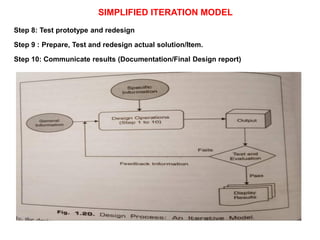
Step 8: Test prototype and redesign
Step 9 : Prepare, Test and redesign actual solution/Item.
Step 10: Communicate results (Documentation/Final Design report)
SIMPLIFIED ITERATION MODEL
 Design process is iterative in nature as shown in fig. Each operation requires
information, such as technical and business information. Obtaining information is
a dynamic and sometimes very difficult step in the design process.
 Design experience plays a vital role to acquire and apply the knowledge. The
design operation involves computational and /or experimental tools.
 It may be necessary to construct a mathematical model and conduct a computer
simulation to observe the behaviour/performance. After this stage, it is necessary
to construct a full-sized/scale prototype model and testing.
 Finally ,the design output must be evaluated and checked, whether it is satisfying
the need or not ? Each objective of every design step requires evaluation. If the
testing and evaluation finds deficiency, then the design operation must be
repeated with new information.
 This process of repetition is called iteration. It is common to conduct repeated
trials or iterations. This iterative aspect of design may take sometime to come up
with satisfactory solution. So its clear that the design process involves iterative
model.
SIMPLIFIED ITERATION MODEL
 Repeated trials and iterations ( to go back and try again) should not be considered
a personal failure or weakness. Design is an intellectual process. All new
creations of the mind are the result of trial and error. If more knowledge apply to
solve the problem, will get faster acceptable solution.
IMPORTANCE OF ITERATIVE MODEL
 The iterative nature of design provides an opportunity to improve the design
after each iteration or loop completion. This leads to bring-up the best
possible solution.
 For example, maximum efficiency of boiler with minimum fuel consumption
and minimum environmental damage.suh type of results obtained are termed
as optimized results and the process is known as optimization process.
 There are number of optimizing techniques developed. Optimization methods
are technically interesting and intellectually pleasing. But they often have
limited application in a complex design conditions.
 In the usual situation of design, there may be too many variables.
Optimization of all of them might not possible due to various other
constraints. The values chosen for the design are then closer to but not at
optimum values. This design situation usually refer as “near –optimal
design” within the constraints.
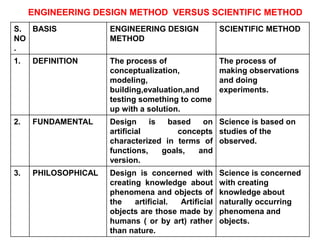
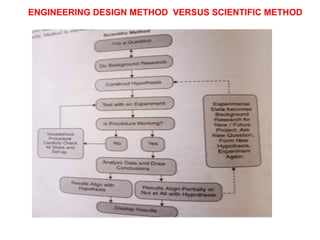
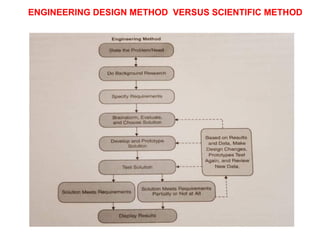
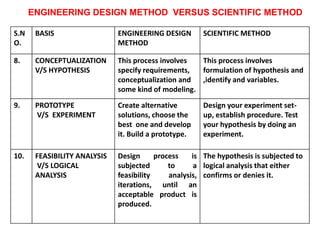
ENGINEERING DESIGN METHOD VERSUS SCIENTIFIC METHOD
S.
NO
.
BASIS ENGINEERING DESIGN
METHOD
SCIENTIFIC METHOD
1. DEFINITION The process of
conceptualization,
modeling,
building,evaluation,and
testing something to come
up with a solution.
The process of
making observations
and doing
experiments.
2. FUNDAMENTAL Design is based on
artificial concepts
characterized in terms of
functions, goals, and
version.
Science is based on
studies of the
observed.
3. PHILOSOPHICAL Design is concerned with
creating knowledge about
phenomena and objects of
the artificial. Artificial
objects are those made by
humans ( or by art) rather
than nature.
Science is concerned
with creating
knowledge about
naturally occurring
phenomena and
objects.
ENGINEERING DESIGN METHOD VERSUS SCIENTIFIC METHOD
S.N
O.
BASIS ENGINEERING DESIGN
METHOD
SCIENTIFIC METHOD
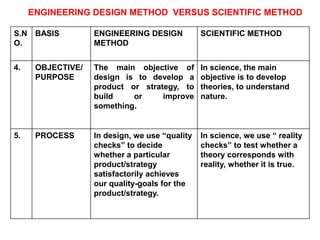
4. OBJECTIVE/
PURPOSE
The main objective of
design is to develop a
product or strategy, to
build or improve
something.
In science, the main
objective is to develop
theories, to understand
nature.
5. PROCESS In design, we use “quality
checks” to decide
whether a particular
product/strategy
satisfactorily achieves
our quality-goals for the
product/strategy.
In science, we use “ reality
checks” to test whether a
theory corresponds with
reality, whether it is true.
ENGINEERING DESIGN METHOD VERSUS SCIENTIFIC METHOD
S.N
O.
BASIS ENGINEERING DESIGN
METHOD
SCIENTIFIC METHOD
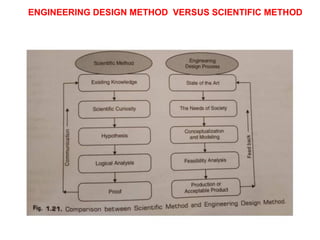
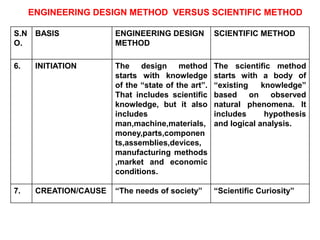
6. INITIATION The design method
starts with knowledge
of the “state of the art”.
That includes scientific
knowledge, but it also
includes
man,machine,materials,
money,parts,componen
ts,assemblies,devices,
manufacturing methods
,market and economic
conditions.
The scientific method
starts with a body of
“existing knowledge”
based on observed
natural phenomena. It
includes hypothesis
and logical analysis.
7. CREATION/CAUSE “The needs of society” “Scientific Curiosity”
ENGINEERING DESIGN METHOD VERSUS SCIENTIFIC METHOD
S.N
O.
BASIS ENGINEERING DESIGN
METHOD
SCIENTIFIC METHOD
8. CONCEPTUALIZATION
V/S HYPOTHESIS
This process involves
specify requirements,
conceptualization and
some kind of modeling.
This process involves
formulation of hypothesis and
,identify and variables.
9. PROTOTYPE
V/S EXPERIMENT
Create alternative
solutions, choose the
best one and develop
it. Build a prototype.
Design your experiment set-
up, establish procedure. Test
your hypothesis by doing an
experiment.
10. FEASIBILITY ANALYSIS
V/S LOGICAL
ANALYSIS
Design process is
subjected to a
feasibility analysis,
iterations, until an
acceptable product is
produced.
The hypothesis is subjected to
logical analysis that either
confirms or denies it.
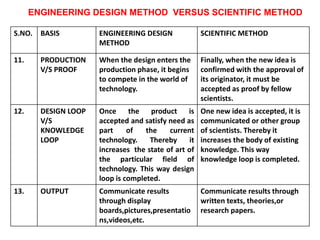
ENGINEERING DESIGN METHOD VERSUS SCIENTIFIC METHOD
S.NO. BASIS ENGINEERING DESIGN
METHOD
SCIENTIFIC METHOD
11. PRODUCTION
V/S PROOF
When the design enters the
production phase, it begins
to compete in the world of
technology.
Finally, when the new idea is
confirmed with the approval of
its originator, it must be
accepted as proof by fellow
scientists.
12. DESIGN LOOP
V/S
KNOWLEDGE
LOOP
Once the product is
accepted and satisfy need as
part of the current
technology. Thereby it
increases the state of art of
the particular field of
technology. This way design
loop is completed.
One new idea is accepted, it is
communicated or other group
of scientists. Thereby it
increases the body of existing
knowledge. This way
knowledge loop is completed.
13. OUTPUT Communicate results
through display
boards,pictures,presentatio
ns,videos,etc.
Communicate results through
written texts, theories,or
research papers.
CAR CRASH TEST: VIDEO- EXPERIMENTAL
SIMULATION OF CAR CRASH TEST
WIND TUNNEL TESTING OF CAR: EXPERIMENTAL
MACHINING PROCESS SHOWING CHIP FORMATION:
EXPERIMENTAL
SIMULATION OF MACHNING PROCESS (ABAQUS SOFTWARE)
3D PRINTING PROCESS
3D PRINTING PROCESS
A PROBLEM SOLVING METHODOLOGY
Designing can be considered as a problem which needs to be solved.
This problem solving methodology can be used at any time in the design
process; it may be at the conception of a product or the design of a
product. A problem-solving methodology that is helpful in design consists
of the following steps.
1. Definition of the problem
2. Search of Information
3. Generation of alternatives solutions
4. Evaluation of alternatives solutions and decision making
5. Communication of the results
DEFINITION OF THE PROBLEM
• The most critical part in the solution of a problem is the problem
definition or problem formulation. The true problem is not always what
it seems at first instance. As this step apparently requires a very small
part of the total time to reach at a solution, its importance is usually
ignored.
• Design can differ greatly depending upon how the problem is
identified. The definition or need of the design should start by writing
down a problem statement. This document should express as
particularly as possible what the problem is. It should include goals
and objectives, the current situation and the desired state, any
limitations or restrictions placed on solution of problem, and the
definition of any technical terms.
• Problem definition is called needs analysis. While it is important to
identify the needs and requirements clearly and closely at the
beginning of a design process, it should be understood that it is
difficult to do so for a product.
DEFINITION OF THE PROBLEM
• It is the nature of the designing process that new needs established
as the design process proceeds as new problems arise as the design
evolves. At this time, the likeness of design as problem solving is less
fitting.
• Design is problem solving only when all needs and potential issues
with alternatives are known. Of course, if these additional needs
require change of design of components that have been completed,
then time and money is waste.
SEARCH OF INFORMATION
• Information gathering is often the greatest frustration one will encounter
when one embarks on the first design project. Once responsibility does
not stop with the knowledge content in a few chapters of a book.
• The assigned problem may be a technical area in which you have
previous background, and you may not have eve a single basic
reference on the subject. On the other hand you may be presented with
a mountain of reports of previous work. Whatever the situation, the
immediate task is to identify the required piece of information and find
a develop that information.
• An important point to realize is that the information needed in design is
different from that usually associated with an academic course.
Textbooks and articles published in the scholarly technical journals
usually are of lesser importance.
SEARCH OF INFORMATION
• The need often is for more specific than the current information that is
provided by those sources. Technical reports published as a result of
government sponsored R& D reports, company reports, trade journals,
patents, catalogs and hand book and literature published by vendors
and suppliers of materials and equipments are important sources of
information.
• The internet has become a very useful resource. Often the missing
piece of information can be supplied by an internet search or by a
telephone call or an e-mail to a key supplier.
GENERATION OF ALTERNATIVE SOLUTIONS
• Generating alternatives solutions or design concepts involves the use
of creativity stimulation method, the application of physical principles
and qualitative reasoning and the ability to find and use information. Of
course, experience helps greatly in this task. The ability to generate
high quality solutions is vital to a successful design.
EVALUATION OF ALTERNATIVE SOLUTIONS AND
DECISION MAKING
• The evaluation of alternatives involves systematic methods for
selecting the best among several solutions often in the face of
incomplete information. Engineering analysis procedures provides the
basis for making decisions about service perfomance.Design for
manufacturing analysis provides other important information. Various
other types of engineering analysis also information.
• Simulation of performance with computer models is finding wide usage.
Simulated service testing of an experimental model and testing of full-
sized prototype often provide critical data without this quantitative
information it is not possible to make valid evaluation.
• An important activity at very step in the design process is information
and checking, but specially as the design near completion, is checking.
In general there are two types of checks that can be made:
EVALUATION OF ALTERNATIVE SOLUTIONS AND
DECISION MAKING
• Mathematical Checks:
 These are concerned with checking the arithmetic and the equations
for errors in the conversion of units used in the analytical models.
Incidentally, the frequency of careless math error is a good reason why
you should adopt the practice of making all your design calculations in
a bound note-book.
 In that way you would not be missing a vital calculation when you are
forced by an error to go back and check things out. Just draw a line
through the section in error and continue. It is of special importance to
ensure that every equation is dimensionally consistent.
EVALUATION OF ALTERNATIVE SOLUTIONS AND
DECISION MAKING
• Engineering sense Checks:
 These have to do with whether the answers “seem right". Even though
the reliability of your intuition increases with experince,you can now
develop the habit of steering at your answers for a full minute, rather
than rushing on to do the next calculation.
 If the calculated stress is weight of a person is 800 Kg, you know
something wrong. Limit checks are a good form of engineering sense
checks. Let a critical parameter in your design approach some limit
(zero,infinity,etc.) ,and observed whether the equation behaves
properly.
COMMUNICATION OF THE RESULTS
• It must always be kept in mind that the purpose of the design is to
satisfy the needs of a customer or client.Therefore,the finalized design
must be properly communicated, or it may lose much of its importance
or significance.
• The communication is usually by oral presentation to the sponsor as
well as by a written design report.
• Detailed engineering drawings, computer programs,3-D computer
models, and working models are frequently among the “deliverables” to
the customer.
• It hardly needs to be emphasized that communication is not a one-time
occurrence to be carried out at the end of the project.
• In a well-run design project there is continual oral and written dialog
between the project manager and the customer.

Ced unit 1 notes-new

  • 1.
    LECTURE NOTES ON CONCEPTSIN ENGINEERING DESIGN UNIT-1 By Dr.Yogesh Dewang Assistant Professor Lakshmi Narain College of Technology, Bhopal Ph.D. (Mechanical Engineering) (MANIT,Bhopal) M.Tech (Stress & Vibration Analysis) (MANIT,Bhopal) B.E. (Mechanical Engineering) (RGPV,Bhopal) E-Mail Id: yogesh_dewang@yahoo.co.in Skype Id: yogesh.dewang1 09179829930
  • 2.
    VARIOUS WAYS TOTHINK ABOUT THE ENGINEERING DESIGN PROCESS  DESIGNING A SYSTEM : 1) By a system we imply about the entire combination of machines, technology, people information and capital required to accomplish some pre specified work. A system may be an electric power distribution network for a village or city of a country. A complex system of railways for transportation, combination of automobile parts production line or textile manufacturing unit. 2) A large system is divided usually into subsystems, which in turn are made up of parts or components. A product is made up of collection of parts ,sometimes called pieces. A part with a single pieces requires no assembly. When two or more parts are joined together it is called an assembly. Usually large assemblies are composed of a collection of smaller assemblies called subassemblies.
  • 3.
    VARIOUS WAYS TOTHINK ABOUT THE ENGINEERING DESIGN PROCESS  DESIGNING A SYSTEM :
  • 4.
    VARIOUS WAYS TOTHINK ABOUT THE ENGINEERING DESIGN PROCESS  DESIGNING A SYSTEM : 3) In the above figure, system of electric power distribution network has been shown. The whole system can be subdivided into four subsystems that is the Generator, Step up and Step down transformer, the distribution lines and transmission to the village or city. The subsystem of transformer can also be divided to form subassemblies and then individual parts or component. 4) So ,the ways to think about design process is to break a complex system which needs to be designed into smaller sub-systems and large assemblies into sub-assemblies. The sub-assemblies are further broken into individual components and parts. Design individual parts, perform quality check and then go for subassembly and then for large assemblies and then a complex system.
  • 5.
    VARIOUS WAYS TOTHINK ABOUT THE ENGINEERING DESIGN PROCESS  VISUALIZATION: 1) INTERPRETATION OF NON-VISUAL DATA: Visualization’s purpose is the communication of data, that means data must come from something that is abstract or at least not immediately visible. It transforms data from invisible to visible. Example ,the solution of problems performed in engineering drawing and engineering graphics where non-visual data is converted to drawings.
  • 6.
    VARIOUS WAYS TOTHINK ABOUT THE ENGINEERING DESIGN PROCESS  VISUALIZATION: 1) INTERPRETATION OF NON-VISUAL DATA:
  • 7.
    VARIOUS WAYS TOTHINK ABOUT THE ENGINEERING DESIGN PROCESS  VISUALIZATION: 2) PRODUCE AN IMAGE: The visualization should produce an image but if the image is only a small part of the process, it is not visualization. The result must be readable and recognizable. It should provide a way to learn something about the data. Example: The drawing or painting book of small children where they needed to draw lines joining the numbers or dots make image of object like cat, dog, house etc.
  • 8.
    VARIOUS WAYS TOTHINK ABOUT THE ENGINEERING DESIGN PROCESS  VISUALIZATION: 2) PRODUCE AN IMAGE:
  • 9.
    VARIOUS WAYS TOTHINK ABOUT THE ENGINEERING DESIGN PROCESS  PHOTOGRAPHY: 1) It is a science ,art and practice of creating durable images by recording light or other electromagnetic radiation, either electronically by means of an image sensor or chemically by means of a light sensitive material such as photographic firm. 2) In photography, a lens is used to focus the light reflected or emitted from objects into a real image on the light-sensitive surface inside a camera during a times exposure. With an electronic image sensor, this produces an electrical charge at each pixel, which is electronically processed and stored in a digital image file for subsequent display or processing. 3) The result with photographic emulsion is an invisible latent image, which is later chemically “ developed” into a visible image, either negative or positive depending on the purpose of the photographic material and the method processing. A negative on file is traditionally create a positive image on a paper base, known as a print, either by using an enlarger or by contact printing.
  • 10.
    VARIOUS WAYS TOTHINK ABOUT THE ENGINEERING DESIGN PROCESS  PHOTOGRAPHY: 4) Photography is employed in many fields of science, manufacturing and business, as well as its more direct uses for art, film and video production, recreational purposes, hobby, and mass communication.
  • 11.
    VARIOUS WAYS TOTHINK ABOUT THE ENGINEERING DESIGN PROCESS  PHOTOGRAPHY:
  • 12.
    SIMPLIFIED ITERATION MODEL Engineering design process consists of sequence of steps that come-up with the required solution. Sequence of steps might be different for different types of designs. There is no universal or perfect sequence of steps. Some writers discussed the design process steps in as few as 5 and as much as 25 steps. Design is sequential process consisting of many design steps. The general design steps might be: Step 1 : Define the problem/need. Step 2: Do background research(Resources assessment or gather relevant information) Step 3 : Specify requirements/Task specification. ( Design criteria and constraints ) Step 4 : Generate multiple solutions. (Brainstorming/Product or solution concept/Conceptualization) Step 5: Choose the best solution. ( Evaluating Alternatives/Analyze) Step 6: Do development Work/Detail the preferred design. Step 7: Prototyping
  • 13.
    ITERATION • Iteration: repeatinga process over and over until an approximation of the solution is reached. • Iteration means the act of repeating a process usually with the aim of approaching a desire goal or target or result. Each repetition of the process is also called an “Iteration", and the results of one iteration are used as the starting point for the next iteration. • It is useful to solve certain types of problems. 13
  • 14.
    SIMPLIFIED ITERATION MODEL Step8: Test prototype and redesign Step 9 : Prepare, Test and redesign actual solution/Item. Step 10: Communicate results (Documentation/Final Design report)
  • 15.
    SIMPLIFIED ITERATION MODEL Design process is iterative in nature as shown in fig. Each operation requires information, such as technical and business information. Obtaining information is a dynamic and sometimes very difficult step in the design process.  Design experience plays a vital role to acquire and apply the knowledge. The design operation involves computational and /or experimental tools.  It may be necessary to construct a mathematical model and conduct a computer simulation to observe the behaviour/performance. After this stage, it is necessary to construct a full-sized/scale prototype model and testing.  Finally ,the design output must be evaluated and checked, whether it is satisfying the need or not ? Each objective of every design step requires evaluation. If the testing and evaluation finds deficiency, then the design operation must be repeated with new information.  This process of repetition is called iteration. It is common to conduct repeated trials or iterations. This iterative aspect of design may take sometime to come up with satisfactory solution. So its clear that the design process involves iterative model.
  • 16.
    SIMPLIFIED ITERATION MODEL Repeated trials and iterations ( to go back and try again) should not be considered a personal failure or weakness. Design is an intellectual process. All new creations of the mind are the result of trial and error. If more knowledge apply to solve the problem, will get faster acceptable solution.
  • 17.
    IMPORTANCE OF ITERATIVEMODEL  The iterative nature of design provides an opportunity to improve the design after each iteration or loop completion. This leads to bring-up the best possible solution.  For example, maximum efficiency of boiler with minimum fuel consumption and minimum environmental damage.suh type of results obtained are termed as optimized results and the process is known as optimization process.  There are number of optimizing techniques developed. Optimization methods are technically interesting and intellectually pleasing. But they often have limited application in a complex design conditions.  In the usual situation of design, there may be too many variables. Optimization of all of them might not possible due to various other constraints. The values chosen for the design are then closer to but not at optimum values. This design situation usually refer as “near –optimal design” within the constraints.
  • 18.
    ENGINEERING DESIGN METHODVERSUS SCIENTIFIC METHOD S. NO . BASIS ENGINEERING DESIGN METHOD SCIENTIFIC METHOD 1. DEFINITION The process of conceptualization, modeling, building,evaluation,and testing something to come up with a solution. The process of making observations and doing experiments. 2. FUNDAMENTAL Design is based on artificial concepts characterized in terms of functions, goals, and version. Science is based on studies of the observed. 3. PHILOSOPHICAL Design is concerned with creating knowledge about phenomena and objects of the artificial. Artificial objects are those made by humans ( or by art) rather than nature. Science is concerned with creating knowledge about naturally occurring phenomena and objects.
  • 19.
    ENGINEERING DESIGN METHODVERSUS SCIENTIFIC METHOD
  • 20.
    ENGINEERING DESIGN METHODVERSUS SCIENTIFIC METHOD
  • 21.
    ENGINEERING DESIGN METHODVERSUS SCIENTIFIC METHOD
  • 22.
    ENGINEERING DESIGN METHODVERSUS SCIENTIFIC METHOD S.N O. BASIS ENGINEERING DESIGN METHOD SCIENTIFIC METHOD 4. OBJECTIVE/ PURPOSE The main objective of design is to develop a product or strategy, to build or improve something. In science, the main objective is to develop theories, to understand nature. 5. PROCESS In design, we use “quality checks” to decide whether a particular product/strategy satisfactorily achieves our quality-goals for the product/strategy. In science, we use “ reality checks” to test whether a theory corresponds with reality, whether it is true.
  • 23.
    ENGINEERING DESIGN METHODVERSUS SCIENTIFIC METHOD S.N O. BASIS ENGINEERING DESIGN METHOD SCIENTIFIC METHOD 6. INITIATION The design method starts with knowledge of the “state of the art”. That includes scientific knowledge, but it also includes man,machine,materials, money,parts,componen ts,assemblies,devices, manufacturing methods ,market and economic conditions. The scientific method starts with a body of “existing knowledge” based on observed natural phenomena. It includes hypothesis and logical analysis. 7. CREATION/CAUSE “The needs of society” “Scientific Curiosity”
  • 24.
    ENGINEERING DESIGN METHODVERSUS SCIENTIFIC METHOD S.N O. BASIS ENGINEERING DESIGN METHOD SCIENTIFIC METHOD 8. CONCEPTUALIZATION V/S HYPOTHESIS This process involves specify requirements, conceptualization and some kind of modeling. This process involves formulation of hypothesis and ,identify and variables. 9. PROTOTYPE V/S EXPERIMENT Create alternative solutions, choose the best one and develop it. Build a prototype. Design your experiment set- up, establish procedure. Test your hypothesis by doing an experiment. 10. FEASIBILITY ANALYSIS V/S LOGICAL ANALYSIS Design process is subjected to a feasibility analysis, iterations, until an acceptable product is produced. The hypothesis is subjected to logical analysis that either confirms or denies it.
  • 25.
    ENGINEERING DESIGN METHODVERSUS SCIENTIFIC METHOD S.NO. BASIS ENGINEERING DESIGN METHOD SCIENTIFIC METHOD 11. PRODUCTION V/S PROOF When the design enters the production phase, it begins to compete in the world of technology. Finally, when the new idea is confirmed with the approval of its originator, it must be accepted as proof by fellow scientists. 12. DESIGN LOOP V/S KNOWLEDGE LOOP Once the product is accepted and satisfy need as part of the current technology. Thereby it increases the state of art of the particular field of technology. This way design loop is completed. One new idea is accepted, it is communicated or other group of scientists. Thereby it increases the body of existing knowledge. This way knowledge loop is completed. 13. OUTPUT Communicate results through display boards,pictures,presentatio ns,videos,etc. Communicate results through written texts, theories,or research papers.
  • 26.
    CAR CRASH TEST:VIDEO- EXPERIMENTAL
  • 27.
  • 28.
    WIND TUNNEL TESTINGOF CAR: EXPERIMENTAL
  • 29.
    MACHINING PROCESS SHOWINGCHIP FORMATION: EXPERIMENTAL
  • 30.
    SIMULATION OF MACHNINGPROCESS (ABAQUS SOFTWARE)
  • 31.
  • 32.
  • 33.
    A PROBLEM SOLVINGMETHODOLOGY Designing can be considered as a problem which needs to be solved. This problem solving methodology can be used at any time in the design process; it may be at the conception of a product or the design of a product. A problem-solving methodology that is helpful in design consists of the following steps. 1. Definition of the problem 2. Search of Information 3. Generation of alternatives solutions 4. Evaluation of alternatives solutions and decision making 5. Communication of the results
  • 34.
    DEFINITION OF THEPROBLEM • The most critical part in the solution of a problem is the problem definition or problem formulation. The true problem is not always what it seems at first instance. As this step apparently requires a very small part of the total time to reach at a solution, its importance is usually ignored. • Design can differ greatly depending upon how the problem is identified. The definition or need of the design should start by writing down a problem statement. This document should express as particularly as possible what the problem is. It should include goals and objectives, the current situation and the desired state, any limitations or restrictions placed on solution of problem, and the definition of any technical terms. • Problem definition is called needs analysis. While it is important to identify the needs and requirements clearly and closely at the beginning of a design process, it should be understood that it is difficult to do so for a product.
  • 35.
    DEFINITION OF THEPROBLEM • It is the nature of the designing process that new needs established as the design process proceeds as new problems arise as the design evolves. At this time, the likeness of design as problem solving is less fitting. • Design is problem solving only when all needs and potential issues with alternatives are known. Of course, if these additional needs require change of design of components that have been completed, then time and money is waste.
  • 36.
    SEARCH OF INFORMATION •Information gathering is often the greatest frustration one will encounter when one embarks on the first design project. Once responsibility does not stop with the knowledge content in a few chapters of a book. • The assigned problem may be a technical area in which you have previous background, and you may not have eve a single basic reference on the subject. On the other hand you may be presented with a mountain of reports of previous work. Whatever the situation, the immediate task is to identify the required piece of information and find a develop that information. • An important point to realize is that the information needed in design is different from that usually associated with an academic course. Textbooks and articles published in the scholarly technical journals usually are of lesser importance.
  • 37.
    SEARCH OF INFORMATION •The need often is for more specific than the current information that is provided by those sources. Technical reports published as a result of government sponsored R& D reports, company reports, trade journals, patents, catalogs and hand book and literature published by vendors and suppliers of materials and equipments are important sources of information. • The internet has become a very useful resource. Often the missing piece of information can be supplied by an internet search or by a telephone call or an e-mail to a key supplier.
  • 38.
    GENERATION OF ALTERNATIVESOLUTIONS • Generating alternatives solutions or design concepts involves the use of creativity stimulation method, the application of physical principles and qualitative reasoning and the ability to find and use information. Of course, experience helps greatly in this task. The ability to generate high quality solutions is vital to a successful design.
  • 39.
    EVALUATION OF ALTERNATIVESOLUTIONS AND DECISION MAKING • The evaluation of alternatives involves systematic methods for selecting the best among several solutions often in the face of incomplete information. Engineering analysis procedures provides the basis for making decisions about service perfomance.Design for manufacturing analysis provides other important information. Various other types of engineering analysis also information. • Simulation of performance with computer models is finding wide usage. Simulated service testing of an experimental model and testing of full- sized prototype often provide critical data without this quantitative information it is not possible to make valid evaluation. • An important activity at very step in the design process is information and checking, but specially as the design near completion, is checking. In general there are two types of checks that can be made:
  • 40.
    EVALUATION OF ALTERNATIVESOLUTIONS AND DECISION MAKING • Mathematical Checks:  These are concerned with checking the arithmetic and the equations for errors in the conversion of units used in the analytical models. Incidentally, the frequency of careless math error is a good reason why you should adopt the practice of making all your design calculations in a bound note-book.  In that way you would not be missing a vital calculation when you are forced by an error to go back and check things out. Just draw a line through the section in error and continue. It is of special importance to ensure that every equation is dimensionally consistent.
  • 41.
    EVALUATION OF ALTERNATIVESOLUTIONS AND DECISION MAKING • Engineering sense Checks:  These have to do with whether the answers “seem right". Even though the reliability of your intuition increases with experince,you can now develop the habit of steering at your answers for a full minute, rather than rushing on to do the next calculation.  If the calculated stress is weight of a person is 800 Kg, you know something wrong. Limit checks are a good form of engineering sense checks. Let a critical parameter in your design approach some limit (zero,infinity,etc.) ,and observed whether the equation behaves properly.
  • 42.
    COMMUNICATION OF THERESULTS • It must always be kept in mind that the purpose of the design is to satisfy the needs of a customer or client.Therefore,the finalized design must be properly communicated, or it may lose much of its importance or significance. • The communication is usually by oral presentation to the sponsor as well as by a written design report. • Detailed engineering drawings, computer programs,3-D computer models, and working models are frequently among the “deliverables” to the customer. • It hardly needs to be emphasized that communication is not a one-time occurrence to be carried out at the end of the project. • In a well-run design project there is continual oral and written dialog between the project manager and the customer.