Engineering Design Process
Courtesy of:
www.engineering-ed.org/documents/week_1_design_process.ppt
Engineering design is…
the process of devising a system,
component or process to meet needs
a decision-making process in which
science and mathematics are applied to
convert resources to meet objectives
establishing objectives & criteria,
synthesis, analysis, construction,
testing, and evaluation
Problem Characteristics
Engineering Problem
 Problem statement
incomplete,
ambiguous
 No readily
identifiable closure
 Solutions neither
unique nor compact
 Solution needs
integration of many
specialties
Science Problem
 Succinct problem
statement
 Identifiable closure
 Unique solution
 Problem defined
and solved with
specialized
knowledge
Typical Design Problems
“Design a system for lifting and moving loads of up
to 5000 lb in a manufacturing facility. The facility
has an unobstructed span of 50 ft. The lifting
system should be inexpensive and satisfy all
relevant safety standards.”
Studying Engineering Design
Develop student creativity
Use open-ended problems
Use design theory and methods
Formulate design problem statements
and specifications
Consider alternative solutions
Consider feasibility
Studying Engineering Design
Know and apply production processes
Understand concurrent engineering
design
Create detailed system descriptions
Include realistic constraints such as…
 Economic factors, safety, reliability
 aesthetics, ethics, social impacts
“Awesome” Engineers…
Place ethics and morals above all else
Are team players
Follow a deterministic design process
Follow a schedule
Document their work
Never stop learning
Module Organization:
The Design Process
1. Identify a need, who is the “customer”
2. Establish design criteria and constraints
3. Evaluate alternatives (systems or
components)
4. Build a prototype
5. Test/evaluate prototype against criteria
6. Analyze, “tweak” (), redesign (), retest
7. Document specifications, drawings to build
Engineering Design Process
Backup Chart
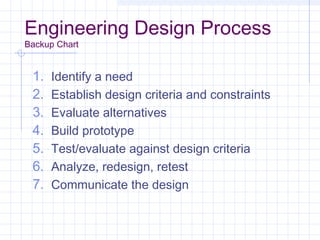
1. Identify a need
2. Establish design criteria and constraints
3. Evaluate alternatives
4. Build prototype
5. Test/evaluate against design criteria
6. Analyze, redesign, retest
7. Communicate the design
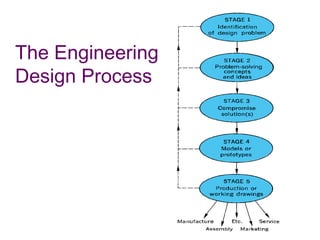
The Engineering
Design Process
Design is an Iterative Process
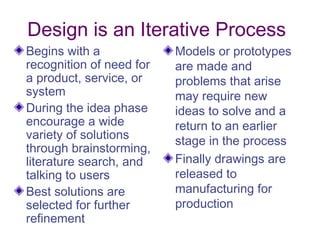
Begins with a
recognition of need for
a product, service, or
system
During the idea phase
encourage a wide
variety of solutions
through brainstorming,
literature search, and
talking to users
Best solutions are
selected for further
refinement
Models or prototypes
are made and
problems that arise
may require new
ideas to solve and a
return to an earlier
stage in the process
Finally drawings are
released to
manufacturing for
production
Engineering Design Defined
The crux of the design process
is creating a satisfactory
solution to a need Harrisberger
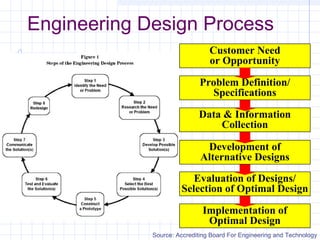
Engineering Design Process
Customer Need
or Opportunity
Implementation of
Optimal Design
Evaluation of Designs/
Selection of Optimal Design
Development of
Alternative Designs
Data & Information
Collection
Problem Definition/
Specifications
Source: Accrediting Board For Engineering and Technology
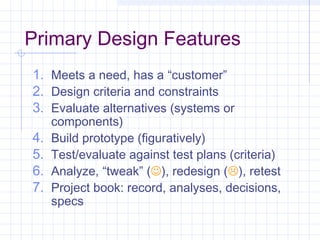
Primary Design Features
1. Meets a need, has a “customer”
2. Design criteria and constraints
3. Evaluate alternatives (systems or
components)
4. Build prototype (figuratively)
5. Test/evaluate against test plans (criteria)
6. Analyze, “tweak” (), redesign (), retest
7. Project book: record, analyses, decisions,
specs
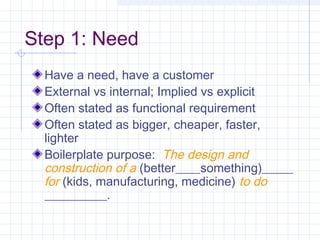
Step 1: Need
Have a need, have a customer
External vs internal; Implied vs explicit
Often stated as functional requirement
Often stated as bigger, cheaper, faster,
lighter
Boilerplate purpose: The design and
construction of a (better____something)_____
for (kids, manufacturing, medicine) to do
__________.
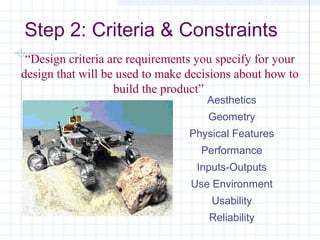
Step 2: Criteria & Constraints
“Design criteria are requirements you specify for your
design that will be used to make decisions about how to
build the product”
Aesthetics
Geometry
Physical Features
Performance
Inputs-Outputs
Use Environment
Usability
Reliability
Some Design Constraints
Cost
Time
Knowledge
Legal, ethical
Physical: size, weight, power, durability
Natural, topography, climate, resources
Company practices
Step 3: Evaluate Alternatives
Needs best stated as function, not form
Likely to find good alternatives for
cheapest, fastest, lightest, and encourage
discovery
Research should reveal what has been
done
Improve on what has been done
Play alternatives off criteria and constraints
Brainstorming helps
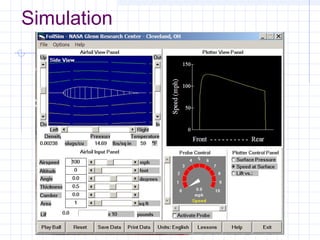
Simulation
Best Design
Choose best design that meets criteria
Demonstrate tradeoff analyses (among
criteria and constraints) are high quality
Cost (lifecycle) is always consideration
Resist overbuilding; drives complexity,
cost, time, resources
A quality design meets customers expectations!
Step 4: Prototype
Prototype is implementation of chosen
design alternative
It is a proof of design, production and
suitability
Prototypes are often cost prohibitive:
Models and simulations may suffice
Quality design does not include
redesigning a lot of prototypes
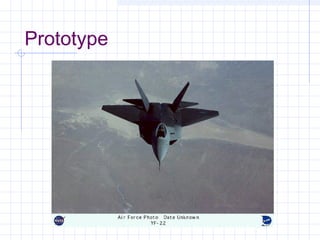
Prototype
Prototype
picture of 747
Step 5: Test it Well
Test and optimize design against
constraints and customer expectations.
Create a test plan showing how to test
Test in the conditions of use
Good test plan shows what test,
expected results how to test, and what
analyses will be. It relates to
specification requirements
e.g. test plan for light bulb (activity)
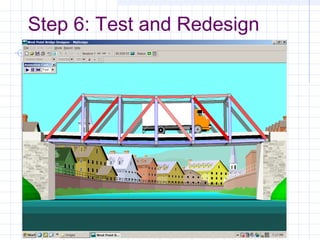
Step 6: Test and Redesign
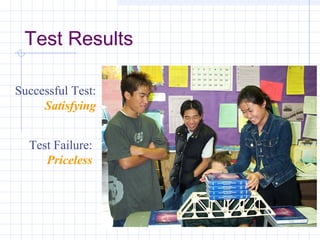
Test Results
Successful Test:
Satisfying
Test Failure:
Priceless
Step 7: Documentation
Project data book A complete record
All key decisions
Good drawings
Test plans
Results
Conclusions
Things learned
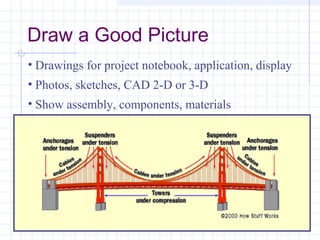
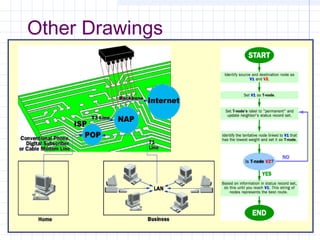
Draw a Good Picture
• Drawings for project notebook, application, display
• Photos, sketches, CAD 2-D or 3-D
• Show assembly, components, materials
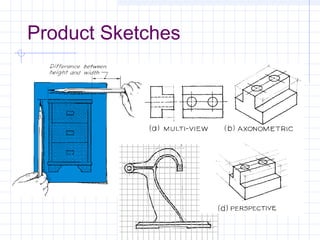
Product Sketches
Other Drawings

Engineering design process

  • 1.
    Engineering Design Process Courtesyof: www.engineering-ed.org/documents/week_1_design_process.ppt
  • 2.
    Engineering design is… theprocess of devising a system, component or process to meet needs a decision-making process in which science and mathematics are applied to convert resources to meet objectives establishing objectives & criteria, synthesis, analysis, construction, testing, and evaluation
  • 3.
    Problem Characteristics Engineering Problem Problem statement incomplete, ambiguous  No readily identifiable closure  Solutions neither unique nor compact  Solution needs integration of many specialties Science Problem  Succinct problem statement  Identifiable closure  Unique solution  Problem defined and solved with specialized knowledge
  • 4.
    Typical Design Problems “Designa system for lifting and moving loads of up to 5000 lb in a manufacturing facility. The facility has an unobstructed span of 50 ft. The lifting system should be inexpensive and satisfy all relevant safety standards.”
  • 5.
    Studying Engineering Design Developstudent creativity Use open-ended problems Use design theory and methods Formulate design problem statements and specifications Consider alternative solutions Consider feasibility
  • 6.
    Studying Engineering Design Knowand apply production processes Understand concurrent engineering design Create detailed system descriptions Include realistic constraints such as…  Economic factors, safety, reliability  aesthetics, ethics, social impacts
  • 7.
    “Awesome” Engineers… Place ethicsand morals above all else Are team players Follow a deterministic design process Follow a schedule Document their work Never stop learning
  • 8.
    Module Organization: The DesignProcess 1. Identify a need, who is the “customer” 2. Establish design criteria and constraints 3. Evaluate alternatives (systems or components) 4. Build a prototype 5. Test/evaluate prototype against criteria 6. Analyze, “tweak” (), redesign (), retest 7. Document specifications, drawings to build
  • 9.
    Engineering Design Process BackupChart 1. Identify a need 2. Establish design criteria and constraints 3. Evaluate alternatives 4. Build prototype 5. Test/evaluate against design criteria 6. Analyze, redesign, retest 7. Communicate the design
  • 10.
  • 11.
    Design is anIterative Process Begins with a recognition of need for a product, service, or system During the idea phase encourage a wide variety of solutions through brainstorming, literature search, and talking to users Best solutions are selected for further refinement Models or prototypes are made and problems that arise may require new ideas to solve and a return to an earlier stage in the process Finally drawings are released to manufacturing for production
  • 12.
    Engineering Design Defined Thecrux of the design process is creating a satisfactory solution to a need Harrisberger
  • 13.
    Engineering Design Process CustomerNeed or Opportunity Implementation of Optimal Design Evaluation of Designs/ Selection of Optimal Design Development of Alternative Designs Data & Information Collection Problem Definition/ Specifications Source: Accrediting Board For Engineering and Technology
  • 14.
    Primary Design Features 1.Meets a need, has a “customer” 2. Design criteria and constraints 3. Evaluate alternatives (systems or components) 4. Build prototype (figuratively) 5. Test/evaluate against test plans (criteria) 6. Analyze, “tweak” (), redesign (), retest 7. Project book: record, analyses, decisions, specs
  • 15.
    Step 1: Need Havea need, have a customer External vs internal; Implied vs explicit Often stated as functional requirement Often stated as bigger, cheaper, faster, lighter Boilerplate purpose: The design and construction of a (better____something)_____ for (kids, manufacturing, medicine) to do __________.
  • 16.
    Step 2: Criteria& Constraints “Design criteria are requirements you specify for your design that will be used to make decisions about how to build the product” Aesthetics Geometry Physical Features Performance Inputs-Outputs Use Environment Usability Reliability
  • 17.
    Some Design Constraints Cost Time Knowledge Legal,ethical Physical: size, weight, power, durability Natural, topography, climate, resources Company practices
  • 18.
    Step 3: EvaluateAlternatives Needs best stated as function, not form Likely to find good alternatives for cheapest, fastest, lightest, and encourage discovery Research should reveal what has been done Improve on what has been done Play alternatives off criteria and constraints Brainstorming helps
  • 19.
  • 20.
    Best Design Choose bestdesign that meets criteria Demonstrate tradeoff analyses (among criteria and constraints) are high quality Cost (lifecycle) is always consideration Resist overbuilding; drives complexity, cost, time, resources A quality design meets customers expectations!
  • 21.
    Step 4: Prototype Prototypeis implementation of chosen design alternative It is a proof of design, production and suitability Prototypes are often cost prohibitive: Models and simulations may suffice Quality design does not include redesigning a lot of prototypes
  • 22.
  • 23.
    Step 5: Testit Well Test and optimize design against constraints and customer expectations. Create a test plan showing how to test Test in the conditions of use Good test plan shows what test, expected results how to test, and what analyses will be. It relates to specification requirements e.g. test plan for light bulb (activity)
  • 24.
    Step 6: Testand Redesign
  • 25.
  • 26.
    Step 7: Documentation Projectdata book A complete record All key decisions Good drawings Test plans Results Conclusions Things learned
  • 27.
    Draw a GoodPicture • Drawings for project notebook, application, display • Photos, sketches, CAD 2-D or 3-D • Show assembly, components, materials
  • 28.
  • 29.

Editor's Notes

  • #3 From Richard Chung and ABETrev 6-24-02 Engineering design is the process of devising a system, component, or process to meet desired needs. It is a decision-making process (often iterative), in which the basic sciences and mathematics, and engineering sciences are applied to convert resources optimally to meet a stated objective. Among the fundamental elements of the design process are the establishment of objectives and criteria, synthesis, analysis, construction, testing, and evaluation.
  • #4 From Chung, SJSU,
  • #5 From Chung, SJSU Have Students research and find other examples of design problem statements. As a classroom exercise, divide the students into design teams and have a quick design contest to come up with alternative solutions to this or other simlple design problem statements. Use imagination and be fanciful
  • #6 Chung ABET Definition of Design (cont.) The engineering design component of a curriculum must include most of the following features: – development of student creativity, – use of open-ended problems, – development and use of modern design theory and methodology, – formulation of design problem statements and specifications, – consideration of alternative solutions, – feasibility considerations, – production processes, – concurrent engineering design, and – detailed system descriptions. Further, it is essential to include a variety of realistic constraints, such as economic factors, safety, reliability, aesthetics, ethics, and social impact.
  • #7 Chung ABET Definition of Design (cont.) The engineering design component of a curriculum must include most of the following features: – development of student creativity, – use of open-ended problems, – development and use of modern design theory and methodology, – formulation of design problem statements and specifications, – consideration of alternative solutions, – feasibility considerations, – production processes, – concurrent engineering design, and – detailed system descriptions. Further, it is essential to include a variety of realistic constraints, such as economic factors, safety, reliability, aesthetics, ethics, and social impact.
  • #8 From “Design is a passionate process” Consider the design engineer. A design engineer is an engineer whose job is to produce a detailed design from a conceptual design, thereby bringing the real from the abstract. A design engineer’s product is usually a set of drawings and specifications that should produce a working product with very little final adjustment needed. If significant rework is required in the construction, startup, or manufacturing phase, the design engineer did not do an acceptable job. This ability to foresee potential problems is a key skill for a design engineer. Flaws in the conceptual design that go uncaught by the design engineer or others will not surface until production or construction. A design engineer would usually work on a newer and less proven design than a designer, since once the engineering principles are proven to be correct in a similar design, further engineering knowledge and skill is not generally needed to produce similar designs. Combining design and engineering into a single discipline is perhaps a lost practice due to increasing division of work and specialization. However, current (1990s and on) trends in the engineering of complex systems are largely towards re-integration of work processes. For example, the notions of Integrated Product Teams and Concurrent Engineering place design firmly within the scope of a wider engineering activity. Design engineer From Wikipedia, the free encyclopedia, wikipedia.com, August 2006
  • #9 “The crux of the design process is creating a satisfactory solution to a need. The need may be to improve an existing situation or to eliminate a problem.
  • #10 This is a simplified design process appropriate to introduce high school-ers to a problem solving method. It includes building something tangible and is exactly the process we created for the science fair association. We have this process in the science fair handbook, so hopefully many more students and teachers will be using it to improve fair exhibits. It recognizes the resource and time constraints in the classroom. These steps are not inconsistent with the ABET criteria. Some ABET steps, like “implement the design,” are beyond the scope of a six-week module. ABET is the Accrediting Board for Engineering and Technology and they define processes for college programs. Richard knows
  • #13 “The crux of the design process is creating a satisfactory solution to a need. The need may be to improve an existing situation or to eliminate a problem. Or, the need may be to develop a use for a new discovery or concept. In any case, it is what engineering is all about—using knowledge and know-how to achieve a desired outcome. Designing is problem solving. It is creative problem solving. A change has to be created. Something different will be produced, and someone will have to decide what to do with the result.” “Engineers are applications specialists. They apply the principles, discoveries, experiences, techniques, and methods derived from ages of research, experimentation, trial and error, and invention. It really takes some doing to determine which elements of this vast storehouse of knowledge apply to the situation at hand. Developing the best combination of principles and procedures into a highly desirable plan and/or product is an engineer's business and it's tough work. The design process is not just a matter of dreaming up clever ideas and schemes. It is a long process of imaginative planning, detailed analysis, computational prognostication, experimentation, detailed sizing, specifications for every piece and part, development of tools and manufacturing procedures, selection of materials, and detailed planning for assembly, maintenance, repair, safety, durability, sales appeal, etc. And, superimposed on all of this activity is the continuous and necessary attention to cost. The design process is an integration of technical knowledge drawn from the research laboratory and applied to the market place and customer use. It converts information into decisions and ideas into useful hardware.” from Lee Harrisberger, "Engineersmanship ... The Doing of Engineering Design," 2nd Ed, Brooks/Cole Engineering Division, Monterey CA, 1982. From: Lee Harrisberger, "Engineersmanship ... The Doing of Engineering Design," 2nd Ed, Brooks/Cole Engineering Division, Monterey CA, 1982
  • #14 Need established by customer missile for launching satellite
  • #16 Step 1. Identify a need. Needs (also called the problem you are solving or the engineering goal) are frequently identified by customers--the users of the product. The customer could be a retail consumer or the next team in a product development. Customers may express needs by describing a product (I need a car) or as a functional requirement (I need a way to get to school). The need should be described in a simple statement that includes what you are designing (the product), who it is for (customer), what need does it satisfy (problem to solve), and how does it improve previous designs (easy to use, less expensive, more efficient, safer). Need established by customer missile for launching satellite Opportunity identified by company little pieces of paper which could stick onto almost anything but could be removed easily without leaving any trace
  • #17 Step 2. Establish design criteria and constraints. Design criteria are requirements you specify that will be used to make decisions about how to build and evaluate the product. Criteria are derived from needs expressed by customers. Criteria define the product physical and functional characteristics. Some examples of criteria are shape, size, weight, speed, ruggedness, and ease of manufacture.   Constraints are factors that limit the engineer’s flexibility. Some typical constraints are cost, time, and knowledge; legal issues; natural factors such as topography, climate, raw materials; and where the product will be used. Good designs will meet important design criteria within the limits fixed by the constraints. Good designs are also economical to make and use because cost is always a design constraint!
  • #18 From battle bots the five constraints are cost, time, knowledge, power, weight Cost is always. Cost to design, produce, maintain, support, guarantee, be competitive Time usually always an engineering constraint. Complex project schedules, delivery dates, down-stream process, time to market Knowledge often a problem cannot be solved without discovery or new invention. Strength to weight ratios, E.g. turbine disks Legal ethical, patents, intellectual property, product liability, safety requirements. All cars must have air bag Physical. Driven by tradeoffs, other constraints, customer expectations, interfaces. Normally more weight requires more power, but more strength does not necessarily mean more weight. It may cost more, though. Aluminum, steel, titanium, graphite composites Natural. 1 constraint is building is the obstacle. How far to span drives bridge configuration. Temperature extremes very important too Company May have to use common parts, manufacturing processes There are others all these may not apply, but the design team needs to be aware of all
  • #19 Step 3. Evaluate alternative designs. Your research into possible solutions will reveal what has been done to satisfy similar needs. You’ll discover where knowledge and science limit your solutions, how previous solutions may be improved, and what different approaches may meet design objectives. You should to consider at least two-to-three alternative designs and consider using available technology, modifying current designs, or inventing new solutions. Superior work will demonstrate tradeoff analyses such as comparing the strength vs. cost of various bridge-building materials. It’s important to document in your project book how you chose and evaluated alternative designs. Development of Alternative Designs involves creativity and engineering tools CADD & computer modeling stress analysis material science manufacturing processes constraints must be identified & met availability of parts & materials personnel facilities
  • #20 Using a simulation to do science experiment, engineering analysis, select alternatives, example, the effect of altitude on lift. How the higher the altitude, the less the lift for a constant angle of attack and at an altitude of 1000’ Design tool Example, how big should my wing be to lift 20,000 d analysis. What’s the maximum lift I can get from various shapes, chamber testing. What race car has the least drag?
  • #22 Step 4. Build prototype of best design. Use your alternatives analyses to choose the design that best meets criteria considering the constraints, then build a prototype. A prototype is the “first full scale and usually functional form of a new type or design” (Webster’s Dictionary). Expense may limit full-scale; often prototype components Prototype 1. An original model upon which something is patterned (Webster) 2. A standard or typical example. 3. A first full scale and usually functional form of a new type or design By definition represents the chosen alternative
  • #23 Prototype 1. An original model upon which something is patterned (Webster) 2. A standard or typical example. 3. A first full scale and usually functional form of a new type or design By definition represents the chosen alternative Expected in a science project. Expense may limit full-scale; often prototype components
  • #24 Step 5. Test and evaluate the prototype against important design criteria to show how well the product meets the need. You should develop a test plan describing what you will test, how you will test, and how you’ll perform analyses. You must test your prototype under actual or simulated operating conditions. Customers are usually involved in product testing so be sure you have their approval.
  • #25 Step 6. Analyze test results, make design changes and retest. Testing will disclose some deficiencies in your design. Sometimes the testing fails completely and sends the designer “back to the drawing board.” Make corrections and retest OR prepare an analysis of what went wrong and how you will fix it. As always, document your analyses, fixes, and retests in you project book.
  • #27 Step 7. Communicate the design. The designer’s real product is the description of a design from which others will build the product. You’ll use project book and the fair exhibits/posters to communicate the design to your customer and the judges. Your product description will be conveyed in drawings, photos, materials lists, assembly instructions, test plans and results. Consider listing lessons learned so future designers need not repeat any of your “frustrations.” You’ll have clear instructions on how to produce your design in quantities, along with production cost estimates.
  • #28 Most important aspect of patent types of designs isometric projection cad tools photograph schematics flow chart process chart Picture of satellite
  • #30 Circuit design Functional diagrams Configuration Connections Flow Charts