Air Pollution:
       Reasons:
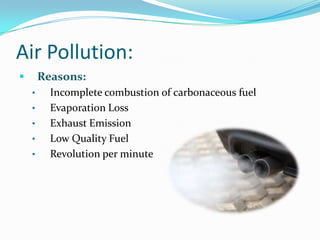
    •     Incomplete combustion of carbonaceous fuel
    •     Evaporation Loss
    •     Exhaust Emission
    •     Low Quality Fuel
    •     Revolution per minute
Major Pollutants:
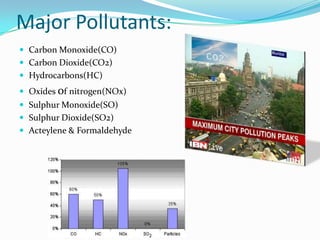
 Carbon Monoxide(CO)
 Carbon Dioxide(CO2)
 Hydrocarbons(HC)
 Oxides of nitrogen(NOx)
 Sulphur Monoxide(SO)
 Sulphur Dioxide(SO2)
 Acteylene & Formaldehyde
How to reduce Air Pollution:

   Increasing amount of air          reduces
    incomplete combustion projects

   Use of appropriate A/F ratio

   Engine should be maintained properly.

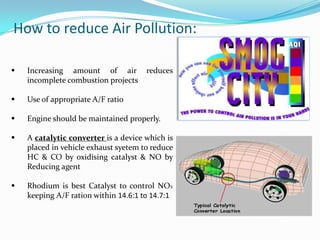
   A catalytic converter is a device which is
    placed in vehicle exhaust syetem to reduce
    HC & CO by oxidising catalyst & NO by
    Reducing agent

   Rhodium is best Catalyst to control NOX
    keeping A/F ration within 14.6:1 to 14.7:1
Idling:
 Idling is running a vehicle's engine when the vehicle is
  not in motion.
 Acute Effects:
      Neurophysiologic: nausea
      Respiratory
      Cough, phlegm congestion
      Immunologic: allergic or asthma
      Decreased Lung Function


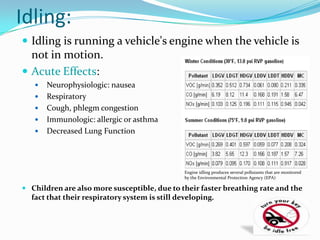
                                                Engine idling produces several pollutants that are monitored
                                                by the Environmental Protection Agency (EPA)

 Children are also more susceptible, due to their faster breathing rate and the
  fact that their respiratory system is still developing.
Conclusion:
 An internal combustion engine is compact and lighter
 An internal combustion engine can be started immediately
 An internal combustion engine has higher efficiency than external combustion
  engine

      Each type of engines has some advantages over the other one. Thus, the selection
  of the appropriate engine requires determining the conditions of application.

A vast research has to be done in this sector to:
    More Efficiency
    Less Fuel Combustion
    Least Pollution
    Use Bio Fuels


      A European Union-funded project, called ‘New integrated
  combustion system for future passenger car engines’, or ‘NICE’,
  aiming to develop a new integrated combustion system.

IC Engine Air pollution & conclusion

  • 1.
    Air Pollution:  Reasons: • Incomplete combustion of carbonaceous fuel • Evaporation Loss • Exhaust Emission • Low Quality Fuel • Revolution per minute
  • 2.
    Major Pollutants:  CarbonMonoxide(CO)  Carbon Dioxide(CO2)  Hydrocarbons(HC)  Oxides of nitrogen(NOx)  Sulphur Monoxide(SO)  Sulphur Dioxide(SO2)  Acteylene & Formaldehyde
  • 3.
    How to reduceAir Pollution:  Increasing amount of air reduces incomplete combustion projects  Use of appropriate A/F ratio  Engine should be maintained properly.  A catalytic converter is a device which is placed in vehicle exhaust syetem to reduce HC & CO by oxidising catalyst & NO by Reducing agent  Rhodium is best Catalyst to control NOX keeping A/F ration within 14.6:1 to 14.7:1
  • 4.
    Idling:  Idling isrunning a vehicle's engine when the vehicle is not in motion.  Acute Effects:  Neurophysiologic: nausea  Respiratory  Cough, phlegm congestion  Immunologic: allergic or asthma  Decreased Lung Function Engine idling produces several pollutants that are monitored by the Environmental Protection Agency (EPA)  Children are also more susceptible, due to their faster breathing rate and the fact that their respiratory system is still developing.
  • 5.
    Conclusion:  An internalcombustion engine is compact and lighter  An internal combustion engine can be started immediately  An internal combustion engine has higher efficiency than external combustion engine Each type of engines has some advantages over the other one. Thus, the selection of the appropriate engine requires determining the conditions of application. A vast research has to be done in this sector to:  More Efficiency  Less Fuel Combustion  Least Pollution  Use Bio Fuels A European Union-funded project, called ‘New integrated combustion system for future passenger car engines’, or ‘NICE’, aiming to develop a new integrated combustion system.