Introduction to
Maritime Labour 
Convention 2006Convention, 2006
General Introduction
Guidance and Application
By Prabhash Sinha
GENERAL EXPLANATION OF THE MLC, 2006GENERAL EXPLANATION OF THE MLC, 2006
• Consolidate and update more than 60 earlier ILO
C ti d R d tiConventions and Recommendations;
• Set minimum requirements for seafarers to work on a ship;
• Address conditions of employment, accommodation,
recreational facilities, food and catering, health protection,
medical care, welfare and social security protection;
• Promote compliance by ship‐owners and give governments
sufficient flexibility to implement its requirements; and
• Strengthen enforcement mechanisms, including complaint
procedures available to seafarers, the ship‐owners’ andp p
shipmasters’ supervision on their ships, the flag States’
control, and PSC of foreign ships.
WHY WAS THE MLC, 2006 ADOPTED?WHY WAS THE MLC, 2006 ADOPTED?
• Many of the existing ILO instruments needed to be updated to reflect the 
working conditions in the industryworking conditions in the industry.
• Increased internationalization of ship registries and “Flags of Convenience”.
• Changes in ownership, financing and the rise of ship management 
l f h f h l b k f fcompanies resulting in significant shifts in the labor market for seafarers.
• Development of mixed nationality crews in highly organized global 
network linking ship‐owners, ship managers and crew managers.
• A need to provide a “level playing field” and avoid exploitation of workers.
• Increased stress and complexity in the maritime work place that has an 
impact on the health and social security.
ADVANTAGES OF THE MLC, 2006ADVANTAGES OF THE MLC, 2006
For Seafarers
• A comprehensive set of basic maritime labour
principles and rights as well as ILO fundamental rights.
• Convention spells out in one place and clear languagep p g g
seafarers’ basic employment rights.
• Seafarers better informed of their rights and remedies
available.
• Improved enforcement of minimum working and living
conditions.
• Right to make complaints both on board and ashore.Right to make complaints both on board and ashore.
• Clear identification of who is the ship‐owner with
overall responsibility.
SEAFARERS’ EMPLOYMENT AND SOCIAL RIGHTSSEAFARERS EMPLOYMENT AND  SOCIAL RIGHTS
As a bare minimum every seafarer has:
• The right to a safe and secure workplace that  complies with safety 
standards.
• A right to fair terms of employment.g p y
• A right to decent working and living conditions on  board ship.
• A right to health protection, medical care, welfare measures and other 
forms of social protectionforms of social protection.
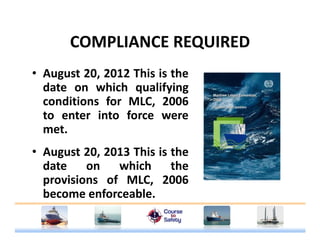
COMPLIANCE REQUIREDCOMPLIANCE REQUIRED
• August 20, 2012 This is theAugust 20, 2012 This is the
date on which qualifying
conditions for MLC, 2006
to enter into force were
met.
• August 20, 2013 This is the
date on which the
provisions of MLC, 2006
become enforceable.
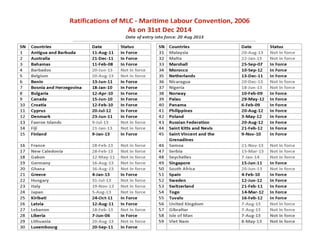
MLC, 2006 RATIFICATIONMLC, 2006 RATIFICATION
Q: Why is it important toQ: Why is it important to
know which countries have
ratified the Convention?ratified the Convention?
A: No more favorableA: No more favorable
treatment clause.
List of Countries that  Ratified MLC ‐ 2006
NO MORE FAVOURABLE TREATMENTNO MORE FAVOURABLE TREATMENT
DefinitionDefinition:: The concept which prevents ships flying flags of States that
h ’t i d th C ti f h i f i d thaven’t signed the Convention from having an unfair advantage over
ships flying the flag of States that have.
Article V establishes the principle of “no more favourable treatment”, a
principle that is also found in the key IMO conventions:principle that is also found in the key IMO conventions:
Essentially it requires a ratifying Member to apply Convention
standards to a foreign ship in its ports (if it chooses to inspect the
ship), even if the flag State of the ship has not ratified the
Convention.
This may provide an incentive for ratification of the Convention
and help to secure a level playing field with respect to
employment rightsemployment rights.
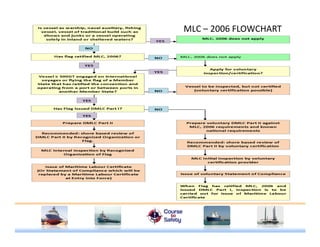
MLC – 2006 FLOWCHART
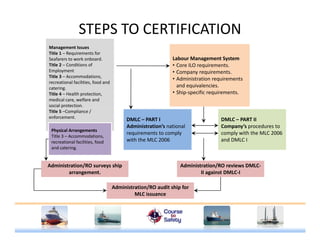
STEPS TO CERTIFICATION
Management Issues
Title 1 – Requirements for 
Seafarers to work onboard.
Title 2 – Conditions of 
Employment
Title 3 – Accommodations
Labour Management System
• Core ILO requirements.
• Company requirements.
dTitle 3 – Accommodations, 
recreational facilities, food and 
catering.
Title 4 – Health protection, 
medical care, welfare and 
social protection.
• Administration requirements 
and equivalencies.
• Ship‐specific requirements. 
p
Title 5 –Compliance / 
enforcement.
Physical Arrangements
Title 3 – Accommodations, 
DMLC – PART I
Administration’s national 
requirements to comply 
with the MLC 2006
DMLC – PART II
Company’s procedures to 
comply with the MLC 2006 
and DMLC Irecreational facilities, food 
and catering.
Administration/RO reviews DMLC‐Administration/RO surveys ship 
with the MLC 2006 and DMLC I
II against DMLC‐I
Administration/RO audit ship for 
MLC issuance
arrangement.
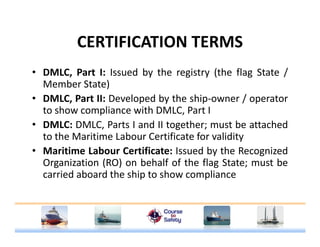
CERTIFICATION TERMSCERTIFICATION TERMS
• DMLC, Part I: Issued by the registry (the flag State /, y g y ( g /
Member State)
• DMLC, Part II: Developed by the ship‐owner / operator
t h li ith DMLC P t Ito show compliance with DMLC, Part I
• DMLC: DMLC, Parts I and II together; must be attached
to the Maritime Labour Certificate for validityto the Maritime Labour Certificate for validity
• Maritime Labour Certificate: Issued by the Recognized
Organization (RO) on behalf of the flag State; must be
carried aboard the ship to show compliance
14 AREAS OF INSPECTION 
Which Are Most Problematic For Compliance? 
1. Minimum Age 
2 M di l C tifi ti2. Medical Certification 
3. Qualification of Seafarers 
4. Seafarers’ Employment Agreements 
5. Use of Private Recruitment and Placement Services 
6. Hours of Work or Rest 
7. Manning Levels 
8. Accommodation 
9 On Board Recreational Facilities9. On‐Board Recreational Facilities 
10. Food and Catering 
11. Heath Safety and Accident Prevention 
12. On‐Board Medical Care 
13. On‐Board Complaint Procedures 
14. Payment of Wages 
STARTING THE COMPLIANCE PROCESSSTARTING THE COMPLIANCE PROCESS 
Step 1:  Perform a gap analysis*
S 2 B i f h h b i l i l /Step 2:  Bring any areas of concern, such as where a substantial equivalency/ 
exemption may be permitted and necessary, to the attention of the 
Administrator. 
Step 3:  Formally request the issuance of a DMLC, Part I 
h d i i i h ffi i lStep 4:  The Administrator issues the official DMLC, Part I 
Step 5:  The DMLC, Part II is prepared by the Company/Shipowner (in consultation 
with the RO) for certification of the DMLC, Part II by the RO. 
Step 6:  Upon completion of the DMLC (Part I and Part II), the vessel inspection 
f f h fprocess for issuance of the ML Certificate is arranged. 
*Since the DMLC II is the initial legal document to be prepared by ship owners for
MLC, 2006 for shipboard inspection and certification, the 14 areas of the DMLC II arep p
identified as the processes necessary for effective implementation of the MLC, 2006
requirements, and these areas of the DMLC II are identical to the ISM code and other
related IMO/ILO conventions.
MLC – 2006 OverviewMLC 2006 Overview
• for ship-owners it will provide the proverbialfor ship owners it will provide the proverbial
‘level playing field’ that they need in the
competitive global enterprise of shipping
• for unions it will be a bill of rights
• for maritime ministry practitioners it will be a
companion to the Holy Bible.
• for seafarers it will provide international
t ti i t l it ti d bprotection against exploitation and abuse.
CONCLUSIONCONCLUSION
Don’t Panic 
• Much of MLC, 2006 is documenting 
compliance rather than fundamentally 
changing how we operate. 
Take Action to Comply p y
• Begin a dialog with  Flag State and RO 
(Classification Society).(Classification Society).
THANK YOUTHANK YOU

MlC 2006 General Introduction and Preparation

  • 1.
  • 2.
    GENERAL EXPLANATION OFTHE MLC, 2006GENERAL EXPLANATION OF THE MLC, 2006 • Consolidate and update more than 60 earlier ILO C ti d R d tiConventions and Recommendations; • Set minimum requirements for seafarers to work on a ship; • Address conditions of employment, accommodation, recreational facilities, food and catering, health protection, medical care, welfare and social security protection; • Promote compliance by ship‐owners and give governments sufficient flexibility to implement its requirements; and • Strengthen enforcement mechanisms, including complaint procedures available to seafarers, the ship‐owners’ andp p shipmasters’ supervision on their ships, the flag States’ control, and PSC of foreign ships.
  • 3.
    WHY WAS THEMLC, 2006 ADOPTED?WHY WAS THE MLC, 2006 ADOPTED? • Many of the existing ILO instruments needed to be updated to reflect the  working conditions in the industryworking conditions in the industry. • Increased internationalization of ship registries and “Flags of Convenience”. • Changes in ownership, financing and the rise of ship management  l f h f h l b k f fcompanies resulting in significant shifts in the labor market for seafarers. • Development of mixed nationality crews in highly organized global  network linking ship‐owners, ship managers and crew managers. • A need to provide a “level playing field” and avoid exploitation of workers. • Increased stress and complexity in the maritime work place that has an  impact on the health and social security.
  • 4.
    ADVANTAGES OF THEMLC, 2006ADVANTAGES OF THE MLC, 2006 For Seafarers • A comprehensive set of basic maritime labour principles and rights as well as ILO fundamental rights. • Convention spells out in one place and clear languagep p g g seafarers’ basic employment rights. • Seafarers better informed of their rights and remedies available. • Improved enforcement of minimum working and living conditions. • Right to make complaints both on board and ashore.Right to make complaints both on board and ashore. • Clear identification of who is the ship‐owner with overall responsibility.
  • 5.
    SEAFARERS’ EMPLOYMENT ANDSOCIAL RIGHTSSEAFARERS EMPLOYMENT AND  SOCIAL RIGHTS As a bare minimum every seafarer has: • The right to a safe and secure workplace that  complies with safety  standards. • A right to fair terms of employment.g p y • A right to decent working and living conditions on  board ship. • A right to health protection, medical care, welfare measures and other  forms of social protectionforms of social protection.
  • 6.
    COMPLIANCE REQUIREDCOMPLIANCE REQUIRED • August20, 2012 This is theAugust 20, 2012 This is the date on which qualifying conditions for MLC, 2006 to enter into force were met. • August 20, 2013 This is the date on which the provisions of MLC, 2006 become enforceable.
  • 7.
    MLC, 2006 RATIFICATIONMLC, 2006 RATIFICATION Q:Why is it important toQ: Why is it important to know which countries have ratified the Convention?ratified the Convention? A: No more favorableA: No more favorable treatment clause. List of Countries that  Ratified MLC ‐ 2006
  • 8.
    NO MORE FAVOURABLETREATMENTNO MORE FAVOURABLE TREATMENT DefinitionDefinition:: The concept which prevents ships flying flags of States that h ’t i d th C ti f h i f i d thaven’t signed the Convention from having an unfair advantage over ships flying the flag of States that have. Article V establishes the principle of “no more favourable treatment”, a principle that is also found in the key IMO conventions:principle that is also found in the key IMO conventions: Essentially it requires a ratifying Member to apply Convention standards to a foreign ship in its ports (if it chooses to inspect the ship), even if the flag State of the ship has not ratified the Convention. This may provide an incentive for ratification of the Convention and help to secure a level playing field with respect to employment rightsemployment rights.
  • 9.
  • 10.
    STEPS TO CERTIFICATION Management Issues Title 1 – Requirements for  Seafarers to work onboard. Title 2 – Conditions of  Employment Title3 – Accommodations Labour Management System • Core ILO requirements. • Company requirements. dTitle 3 – Accommodations,  recreational facilities, food and  catering. Title 4 – Health protection,  medical care, welfare and  social protection. • Administration requirements  and equivalencies. • Ship‐specific requirements.  p Title 5 –Compliance /  enforcement. Physical Arrangements Title 3 – Accommodations,  DMLC – PART I Administration’s national  requirements to comply  with the MLC 2006 DMLC – PART II Company’s procedures to  comply with the MLC 2006  and DMLC Irecreational facilities, food  and catering. Administration/RO reviews DMLC‐Administration/RO surveys ship  with the MLC 2006 and DMLC I II against DMLC‐I Administration/RO audit ship for  MLC issuance arrangement.
  • 11.
    CERTIFICATION TERMSCERTIFICATION TERMS • DMLC,Part I: Issued by the registry (the flag State /, y g y ( g / Member State) • DMLC, Part II: Developed by the ship‐owner / operator t h li ith DMLC P t Ito show compliance with DMLC, Part I • DMLC: DMLC, Parts I and II together; must be attached to the Maritime Labour Certificate for validityto the Maritime Labour Certificate for validity • Maritime Labour Certificate: Issued by the Recognized Organization (RO) on behalf of the flag State; must be carried aboard the ship to show compliance
  • 12.
    14 AREAS OF INSPECTION  Which Are Most Problematic For Compliance?  1. Minimum Age  2 Mdi l C tifi ti2. Medical Certification  3. Qualification of Seafarers  4. Seafarers’ Employment Agreements  5. Use of Private Recruitment and Placement Services  6. Hours of Work or Rest  7. Manning Levels  8. Accommodation  9 On Board Recreational Facilities9. On‐Board Recreational Facilities  10. Food and Catering  11. Heath Safety and Accident Prevention  12. On‐Board Medical Care  13. On‐Board Complaint Procedures  14. Payment of Wages 
  • 13.
    STARTING THE COMPLIANCEPROCESSSTARTING THE COMPLIANCE PROCESS  Step 1:  Perform a gap analysis* S 2 B i f h h b i l i l /Step 2:  Bring any areas of concern, such as where a substantial equivalency/  exemption may be permitted and necessary, to the attention of the  Administrator.  Step 3:  Formally request the issuance of a DMLC, Part I  h d i i i h ffi i lStep 4:  The Administrator issues the official DMLC, Part I  Step 5:  The DMLC, Part II is prepared by the Company/Shipowner (in consultation  with the RO) for certification of the DMLC, Part II by the RO.  Step 6:  Upon completion of the DMLC (Part I and Part II), the vessel inspection  f f h fprocess for issuance of the ML Certificate is arranged.  *Since the DMLC II is the initial legal document to be prepared by ship owners for MLC, 2006 for shipboard inspection and certification, the 14 areas of the DMLC II arep p identified as the processes necessary for effective implementation of the MLC, 2006 requirements, and these areas of the DMLC II are identical to the ISM code and other related IMO/ILO conventions.
  • 14.
    MLC – 2006OverviewMLC 2006 Overview • for ship-owners it will provide the proverbialfor ship owners it will provide the proverbial ‘level playing field’ that they need in the competitive global enterprise of shipping • for unions it will be a bill of rights • for maritime ministry practitioners it will be a companion to the Holy Bible. • for seafarers it will provide international t ti i t l it ti d bprotection against exploitation and abuse.
  • 15.
  • 16.