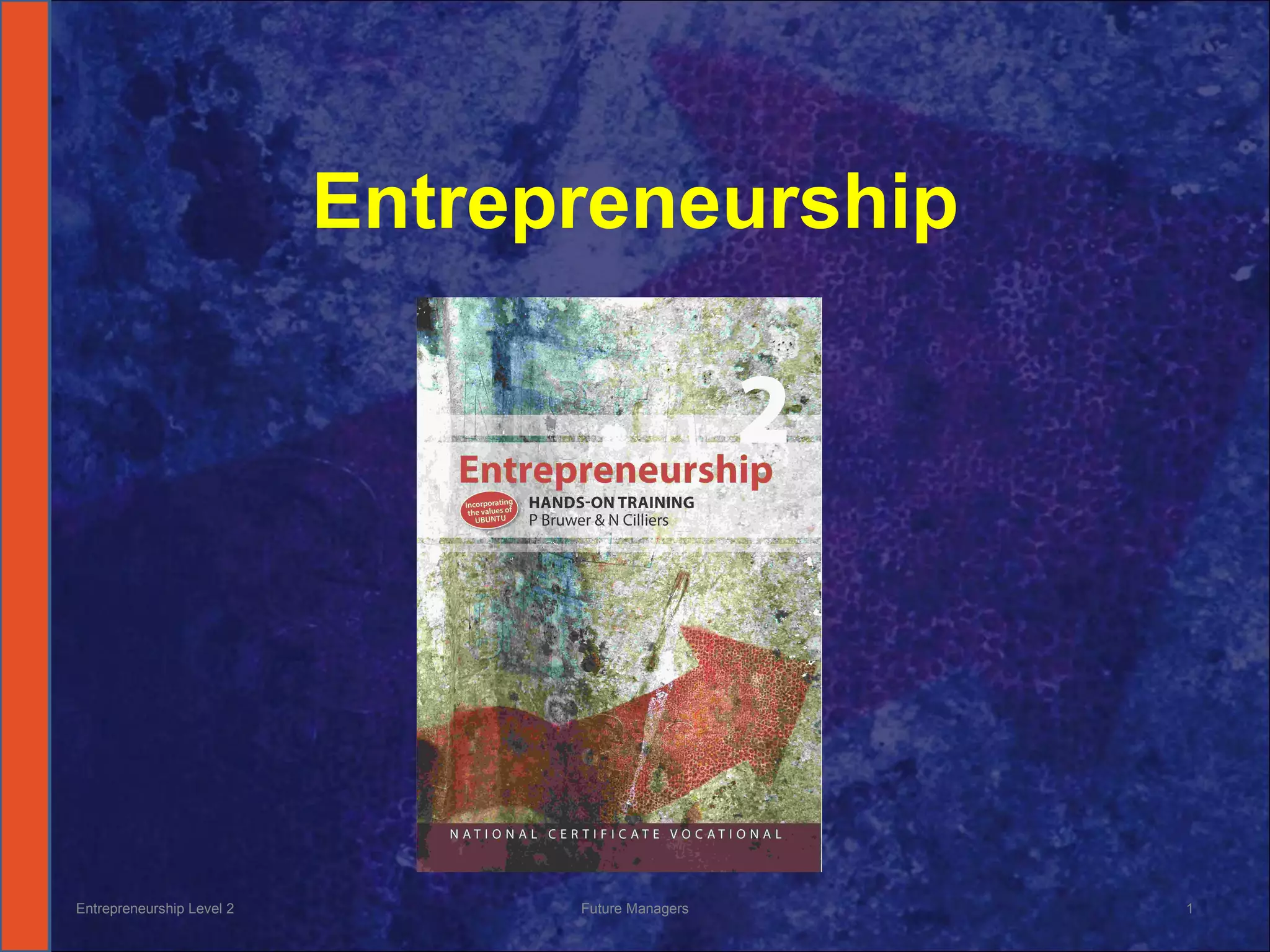
Entrepreneurship Entrepreneurship Level 2 Future Managers
What we cover The entrepreneur Identify and discuss the characteristics of an entrepreneur Advantages and disadvantages of entrepreneurship Identify good business ideas Discuss and prepare a SWOT analysis Entrepreneurship Level 2 Future Managers
What we cover Marketing and customer relations Identify potential customers for a new venture Survey opinions for products of the new venture Promote product / service of the new venture Discuss customer relations Explain basic principles of negotiation to secure new business Entrepreneurship Level 2 Future Managers
What we cover Basic finances Basic financial terminology Processes and principles for pricing a product Financial management, record keeping and stock control Manage time and work processes Create and maintain a task list Use and maintain a diary Entrepreneurship Level 2 Future Managers
What we cover Manage time and work processes Create and maintain a task list Use and maintain a diary Proritise tasks Plan and follow a work schedule Compile entrepreneurial goals The Business Plan Planning your business plan Assessing the components of a given business plan Entrepreneurship Level 2 Future Managers
Module 1: The Entrepreneur Entrepreneurship Level 2 Future Managers
Module 1: The Entrepreneur After completing this module, you will be able to: identify and discuss the characteristics of an entrepreneur identify advantages of entrepreneurship and the reasons why it fails identify entrepreneurial opportunities discuss and prepare a SWOT analysis Entrepreneurship Level 2 Future Managers
1. Identify and discuss the characteristics of an entrepreneur At the end of this outcome, you should be able to: define the concept of entrepreneurship identify and discuss, by means of an explanation and examples the characteristics required of an entrepreneur to start a successful small business differentiate between the skills, personality traits and values of an entrepreneur Entrepreneurship Level 2 Future Managers
1.1 Defining Entrepreneurship What is entrepreneurship? Key words Unfulfilled need Opportunity Profitable business Uncertainty Risk-taker Entrepreneurship Level 2 Future Managers
1.1 Defining Entrepreneurship What is entrepreneurship? Hunter spirit  enterprising restless enduring  innovative have the capacity to work hard and to take risks improvise Entrepreneurship Level 2 Future Managers
1.1 Defining Entrepreneurship There are three essential requirements for becoming an entrepreneur. Do you have any idea what they are? Technical requirements Business requirements Management requirements Entrepreneurship Level 2 Future Managers
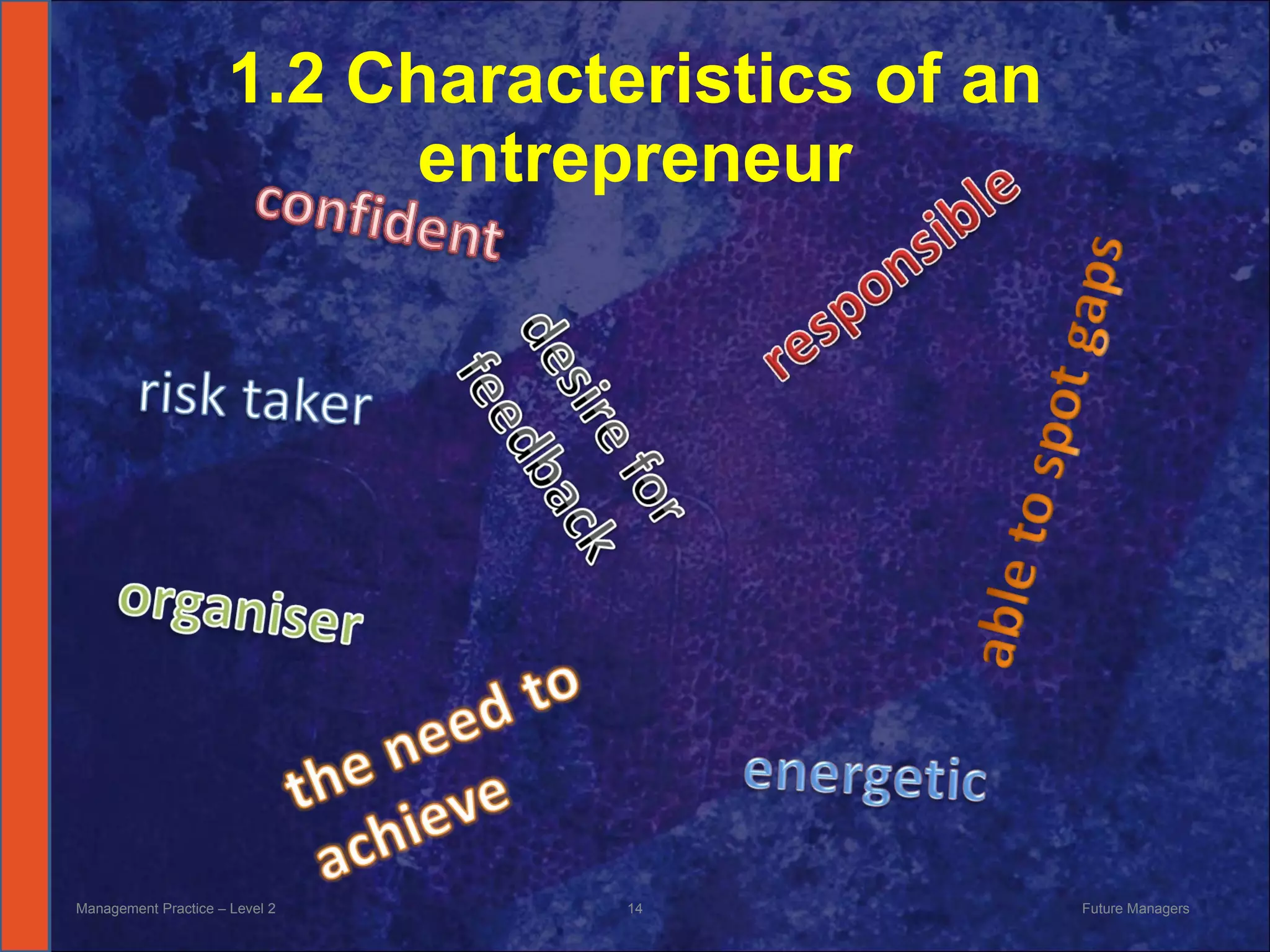
1.2 Characteristics of an entrepreneur See if you can name some of the characteristics of a successful entrepreneur Confidence in your ability to succeed Preference for moderate risk Desire for responsibility Energetic Identifying opportunities Organising skills Need to achieve Desire for immediate feedback Entrepreneurship Level 2 Future Managers
1.2 Characteristics of an entrepreneur Management Practice – Level 2 Future Managers
Activity 1 Identify one successful entrepreneur either in your own community or someone that is often in the news Write  a brief description about this person In a table format, give examples of how this individual meets the technical, business and management requirements of a successful entrepreneur Entrepreneurship Level 2 Future Managers
Activity 2 How do you know whether or not you will be a good entrepreneur? The answer is not an easy one.  There are so many different aspects that might influence your success or failure as an entrepreneur.  If you have just lost your job and have children at home, your urge to achieve is so much greater.  The questionnaire on page 7 is a general guideline.  Will it help you to answer this difficult question?  Follow the instructions and decide for yourself. Entrepreneurship Level 2 Future Managers
Activity 2 Instructions Complete the questionnaire on page 7 of your text book individually by answering “yes” or “no” to each question Count how many “yes” and how many “no” answers you have given Add all the “yes” answers of your group together.  What is the total? Divide the total by the number of members in your group.  What is your group average? Is your own average above or below the group? According to your group, which question is the most important question requiring a “yes” answer? Give reasons for your answer. Entrepreneurship Level 2 Future Managers
1.3 Skills, personality traits and values of the entrepreneur 1.3.1 What do you think the main personality traits of an entrepreneur are? Outgoing Willing to take calculated risks Optimistic Self-actualisation  Meticulous  Creative and innovative Leadership qualities  Entrepreneurship Level 2 Future Managers
1.3 Skills, personality traits and values of the entrepreneur 1.3.2 Quickly, brainstorm what you think are important skills for the entrepreneur to have Computer literacy Technical skills Inter-personal skills Accounting and bookkeeping skills Management skills Entrepreneurship Level 2 Future Managers
1.3.3 Values for an entrepreneur Do you know what Ubuntu is? Ubuntu values for the entrepreneur include: Respect for human dignity Sharing of success Goodwill Trust and honesty Continuous cross-cultural interaction Pride in achieving goals A discrimination-free workplace Entrepreneurship Level 2 Future Managers
1.3.3 Values of an entrepreneur Values which are not acceptable Accumulation for the sake of accumulation Selfishness and individualism Corruption Empowerment which is equal to self-enrichment Entrepreneurship Level 2 Future Managers
Activity 3: The ubuntu debate Read the definition of entrepreneurship again and compare it with the values of ubuntu.  Listed below are a number of topics you will debate within your groups.  Study the topics below and choose one Ubuntu is the opposite of entrepreneurship. Entrepreneurship can help with the implementation of ubuntu. Entrepreneurship is all about the individual Ubuntu is what South Africa needs Entrepreneurship Level 2 Future Managers
Business plan activity In your business plan workbook, find the “Self analysis” section and complete it to the best of your ability Ask a member of your group to read your “self-analysis” and to say what he or she thinks.  Other people often see positives and negatives in us of which we are not even aware.  This will help you to remain realistic. Entrepreneurship Level 2 Future Managers
Case Study Read the case study on page 13 and answer the questions that follow: Hamsa Faroqui is the MD of a satellite radio company in South Africa.  What is the name of his company? What is Hamsa’s golden rule for starting a business? List 5 characteristics Hamsa views as very important to start a business According to Hamsa, what does it take to be a successful entrepreneur? Entrepreneurship Level 2 Future Managers
2. Advantages and disadvantages of entrepreneurship At the end of this outcome, you should be able to: Identify the merits (advantages) of an entrepreneur Discuss with examples reasons why entrepreneurs fail or succeed Describe the business environment Describe the economic environment, with emphasis on the need and importance of the entrepreneur within this environment Explain how a small business is influenced by the external business environment Entrepreneurship Level 2 Future Managers
2.1 Merits of being an entrepreneur What is beneficial to you about being an entrepreneur? You reach your full potential You reap profits You contribute to society and are recognised for your efforts You gain control over your own destiny Entrepreneurship Level 2 Future Managers
2.2 Reasons why entrepreneurs succeed or fail Management skill Experience Financial control Changes in the business environment Entrepreneurship Level 2 Future Managers
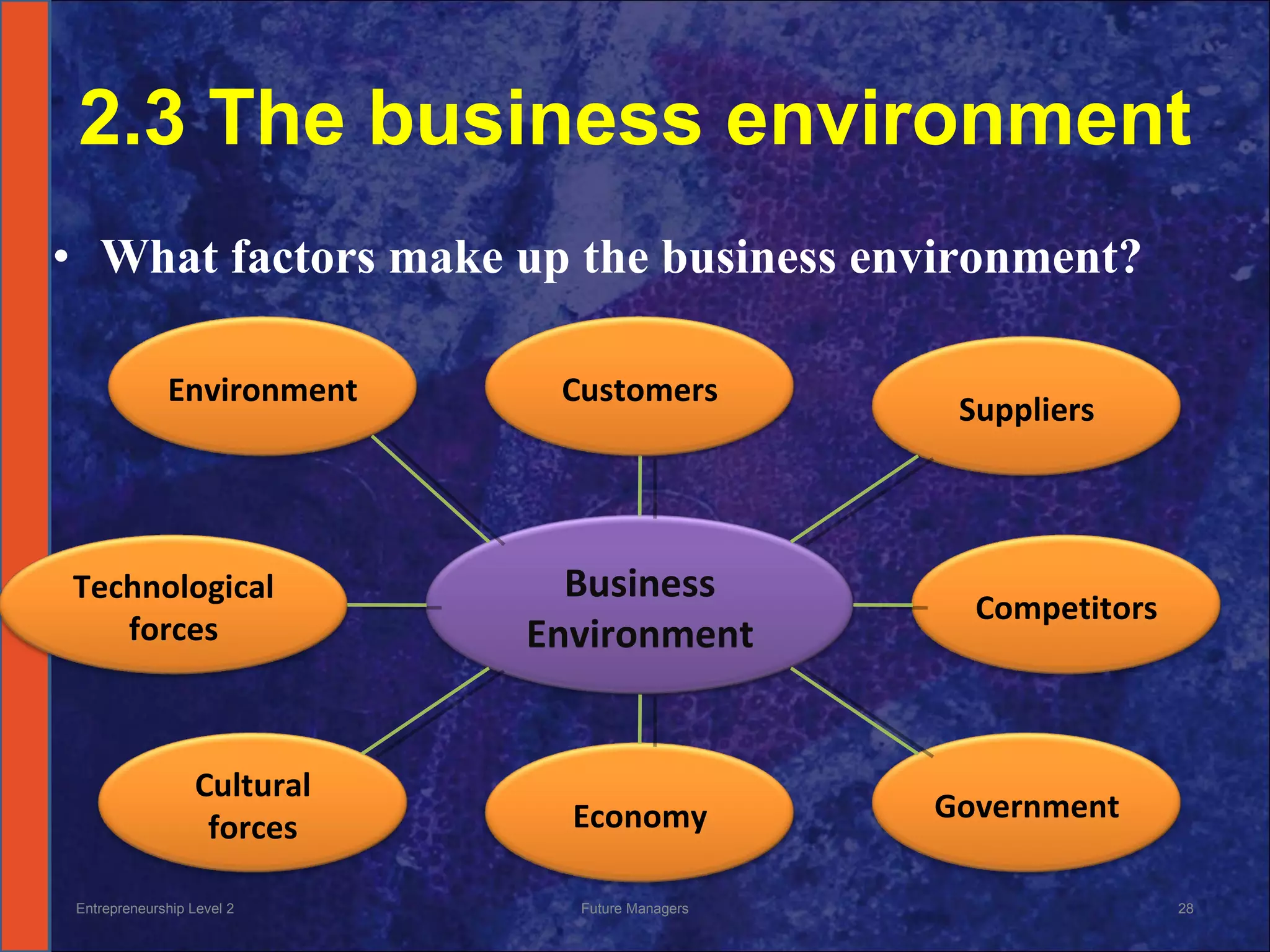
2.3 The business environment What factors make up the business environment? Entrepreneurship Level 2 Future Managers Business Environment Customers Suppliers Competitors Government Economy Cultural forces Technological forces Environment
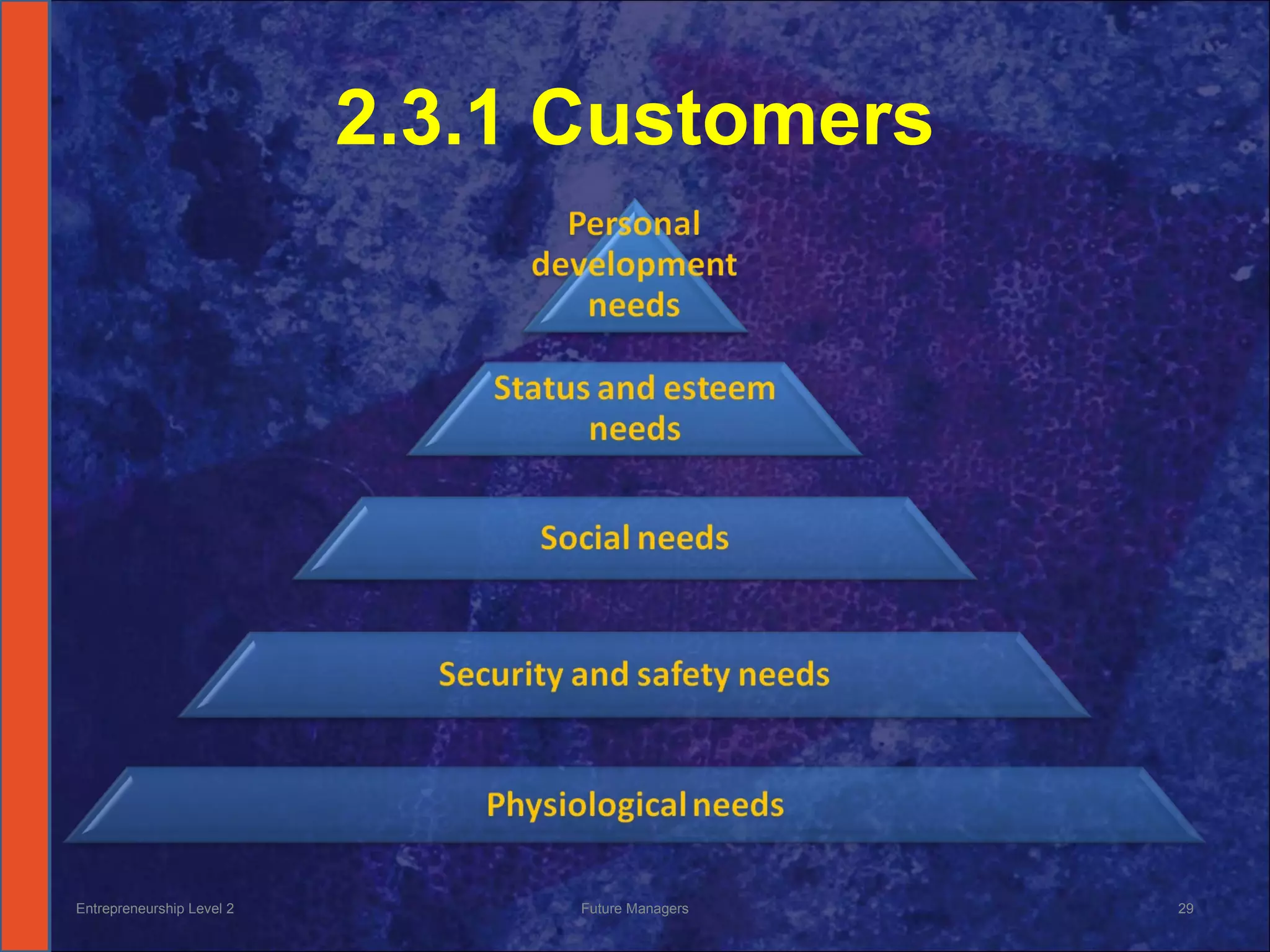
2.3.1 Customers Entrepreneurship Level 2 Future Managers
2.3.2 Suppliers Good suppliers will supply the following: Good quality materials. Essential for: Reduction in waste Reducing defects in products Reducing labour time Reducing returns from customers Losing dissatisfied customers Excellent service Reasonable pricing Entrepreneurship Level 2 Future Managers
2.3.3 Competitors How can you gain the edge over your competitors? Price Promotions Better customer service Improvements on products and services Difficult business concept Entrepreneurship Level 2 Future Managers
2.3.4 Government Government can create conditions which make it easier for small businesses (or harder) The effects of legislation New legislation can create or take away opportunities New legislation can make certain companies more competitive while others will become less competitive (think of BEE) Legislation can also protect South African industries through tariffs and quotas (do you think this is a good thing? Why? Entrepreneurship Level 2 Future Managers
2.3.5 Economy What are the effects of each of the following? Interest rates Inflation Exchange rates Increased government spending An economic downturn An end to the Zimbabwe crisis Entrepreneurship Level 2 Future Managers
2.3.5 Economy Why are entrepreneurs important? New businesses create jobs and therefore reduce unemployment New businesses make profits and are taxed by the government. Taxes are used to improve the living conditions of all South Africans People with jobs are less likely to get involved with crime New businesses employ previously unemployed people and the employees start paying taxes New businesses make our country more competitive internationally  Entrepreneurship Level 2 Future Managers
2.3.7 Technological forces Q: What is technology? A: Any item, technique or know-how that helps a business sell a product or service It includes the following: Machinery Telecommunication  Computers Equipment Tools Entrepreneurship Level 2 Future Managers
Activity 5 MP3 players or iPods are computerised devices that record and play music  Which specific business environment was affected by the arrival of MP3 players? Name 3 other products that were or will be affected by the arrival of MP3 players Does this development provide any new business opportunities? Entrepreneurship Level 2 Future Managers
2.3.8 Natural environment What are the threats to the environment? Overpopulation Pollution  Wrong farming methods Poaching General carelessness regarding the ecosystem What must entrepreneurs do or not do, with regard to the environment? Entrepreneurship Level 2 Future Managers
3. Identify good business ideas   At the end of this outcome, you should be able to: prepare an individual entrepreneurial profile.  using this information, prepare a SWOT analysis develop a personal growth programme to attend to identified skills weaknesses that need addressing define and give generic examples of evaluation tools that can be used to measure strengths & weaknesses identify measurement and evaluation tools used to maximise strengths and reduce weaknesses identify entrepreneurial opportunities within your own entrepreneurial profile and personal growth plan Entrepreneurship Level 2 Future Managers
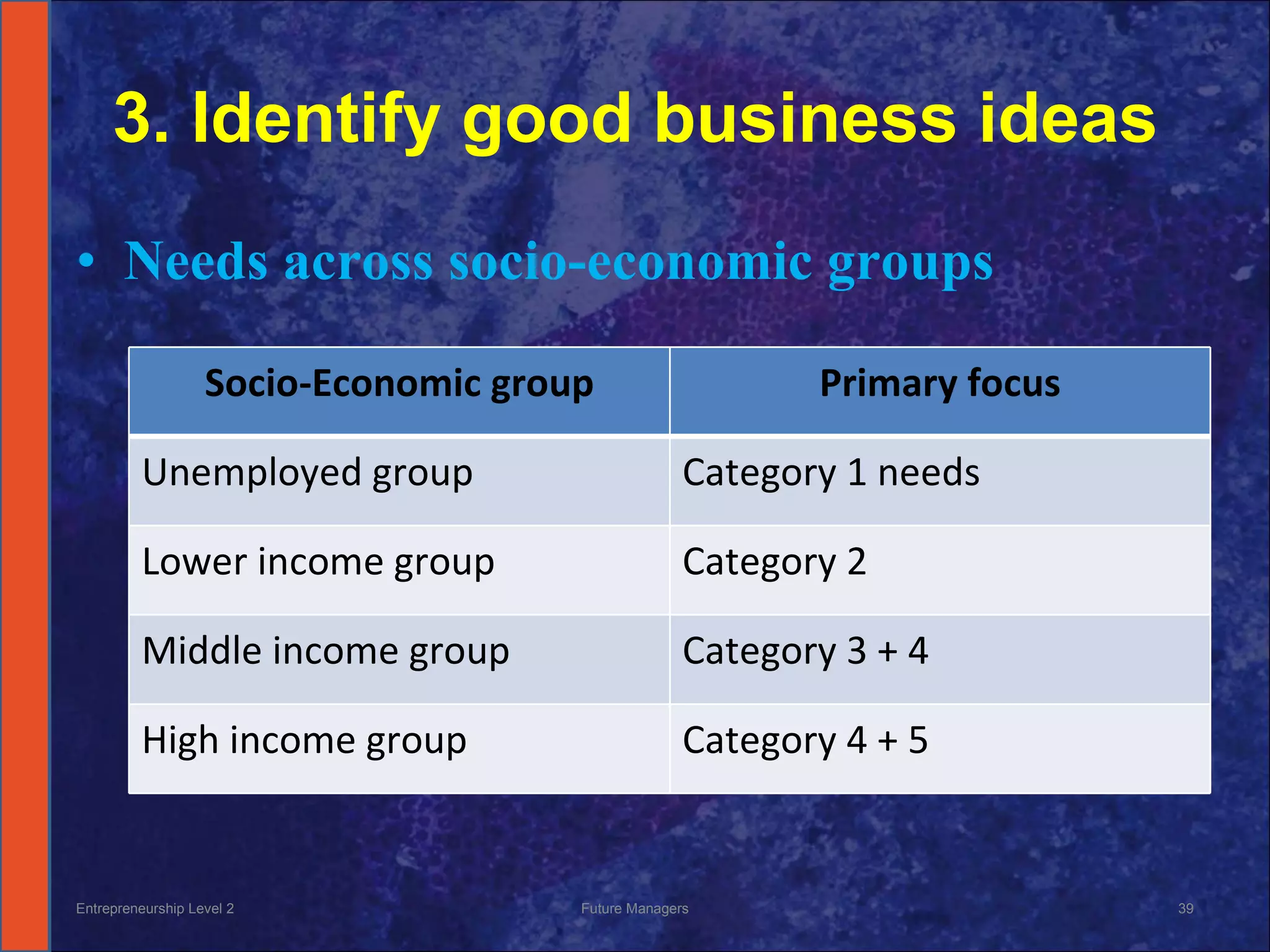
3. Identify good business ideas Needs across socio-economic groups Entrepreneurship Level 2 Future Managers Socio-Economic group Primary focus Unemployed group Category 1 needs Lower income group Category 2 Middle income group Category 3 + 4 High income group Category 4 + 5
Activity 6 Select three different needs from category four or five and write them down. Next to each one of them write a need selected from category one For each one of the three discuss how you would feel about the category five need if the corresponding category one need is not satisfied Summarise the group’s reaction or feelings to each of the three categories. Present your groups final conclusion to the rest of the class Given your above discussion, where should your focus be when trying to identify a new business idea? Entrepreneurship Level 2 Future Managers
Activity 7 Make a list of 5 products or services that people in your community need and are able to afford Look at this list and try to write down examples of a business that will deal with the different needs.  This can be done in small groups, each group discussing all the needs in one category Use these lists in the next section when experimenting with the different creativity techniques. Entrepreneurship Level 2 Future Managers
3.1 Innovation and creativity Hobbies, sport and entertainment Shopping Travelling Watching television Reading newspapers and magazines Internet Entrepreneurship Level 2 Future Managers
3.1 Innovation and creativity Trade shows and exhibitions Places where people gather Flea markets Innovation Gaps in the market Entrepreneurship Level 2 Future Managers
Activity 8 Visit www.google.co.za and type in “business ideas” How many ideas are listed? Write down five ideas of which you have never heard Identify five ideas that interest you or that you would like to know more about Click on one of the ideas that you like and print the details given Entrepreneurship Level 2 Future Managers
3.2 Creative methods Management Practice – Level 2 Future Managers
3.2 Creative methods Brainstorming What if? Mind mapping Generation of alternatives Reverse method Entrepreneurship Level 2 Future Managers
3.2.1 Brainstorming Form a group of 5 members Appoint a writer who will write down all the ideas Elect a chairperson who must make sure that the group does not comment or laugh at one another’s contributions Write the problem or challenge on a big board or piece of paper Decide on the time – 5 minutes is normally long enough Ideas time! – all ideas, thoughts, suggestions, etc.  are written down.  The golden rule is that members are not allowed to comment on one another’s contributions during this period Time’s up Group the thoughts.  The chairperson, with the help of the group, tries to group similar thoughts together.  Even the silly ones are grouped Try to link groups, especially those that have nothing to do with one another Reaching conclusions.  Did this new way of looking at an old problem result in a new idea? Entrepreneurship Level 2 Future Managers
Activity 9 The following are problems (you may identify your own or use the list of needs): Getting rid of crime in your area Lack of fresh water in your residential area Very expensive medicine Entrepreneurship Level 2 Future Managers
3.3 Is it a good business idea Try to think of some ideas for starting a business Now evaluate which ones you think work and which don’t Entrepreneurship Level 2 Future Managers
Activity 10 Choose any business idea from the list of possible “businesses ideas”.  Write any four types of skills and/or knowledge that a person who starts such a business will require.  Compare it with other members of your group.  Is there something you did not think about? Entrepreneurship Level 2 Future Managers
Business plan activity It is now the time to decide which business idea interests you; about which you have the most knowledge and want to investigate further.  This business idea will form the basis of all the activities that follow and will lead to a formal business plan.  Write down your business idea with a short description in your ‘Business Plan Workbook’ and submit it for approval. Entrepreneurship Level 2 Future Managers
3.4 Protecting your ideas Secrecy Patents Trademarks ® Copyright © Piracy Entrepreneurship Level 2 Future Managers
4. Discuss and prepare a SWOT analysis At the end of this outcome, you should be able to: Prepare an individual entrepreneurial profile (self-analysis) Using this information, prepare a SWOT (Strength; Weaknesses Opportunities and Threats) analysis Define and give generic examples of evaluation tools that can be used to measure strengths and weaknesses Identify measurement and evaluation tools used to maximise  strengths and reduce weaknesses.  Entrepreneurship Level 2 Future Managers
4.1 Individual entrepreneurial profile Step 1: Match your ideas to your personal resources Knowledge and skills Contacts and friends Finance Costing and pricing Break-even point Cost of inventory and debtors Entrepreneurship Level 2 Future Managers
4.1 Individual entrepreneurial profile  Step 2: Identify your critical success factors Factors that are critical for your business to succeed What are the critical success factors for a taxi business? Entrepreneurship Level 2 Future Managers
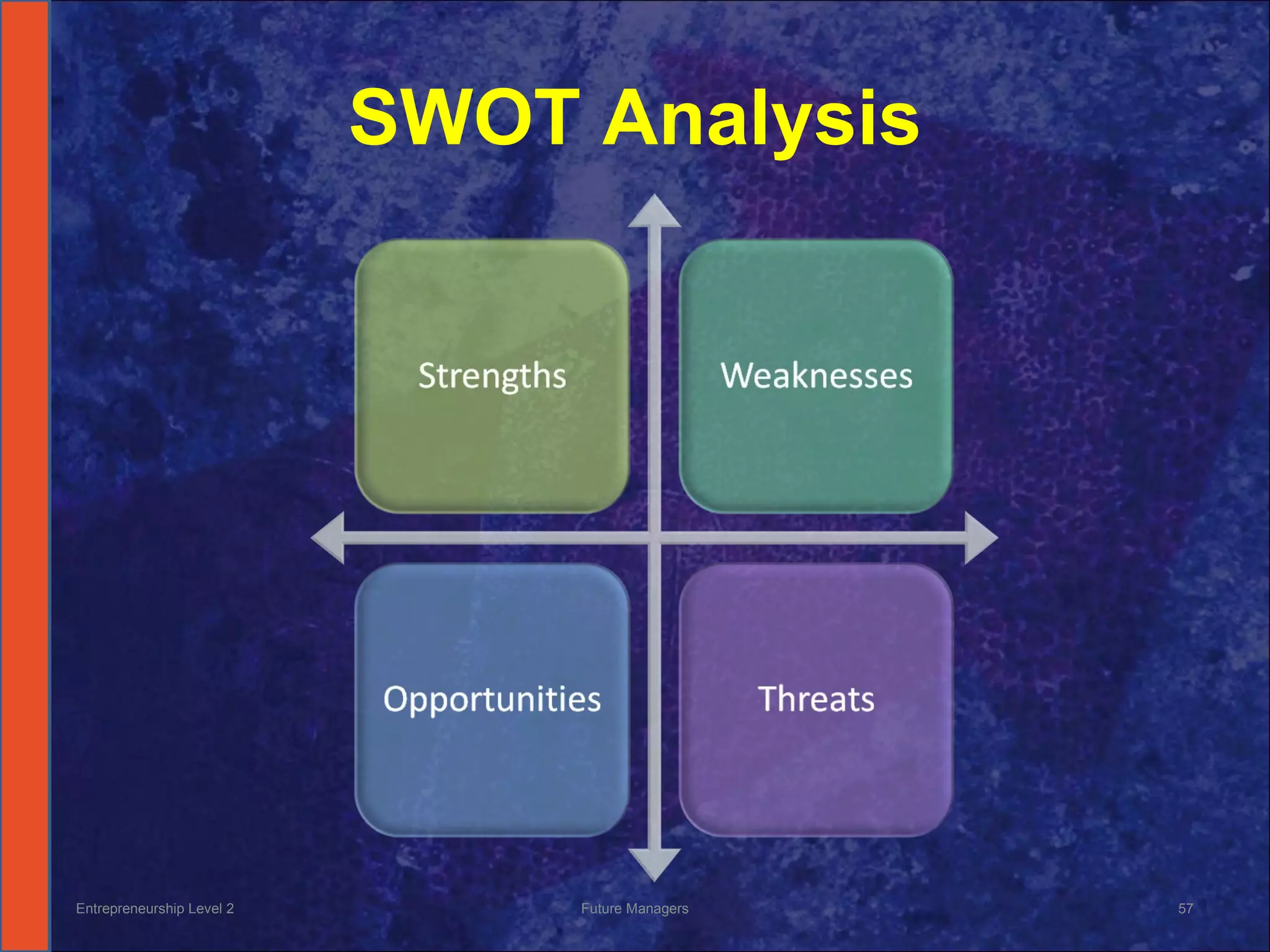
4.3 Compile a SWOT analysis Strengths and Weaknesses deal with your own current situation, the “here and now” while Opportunities and Threats will happen sometime in the future Strengths and Weaknesses normally refer to you as a person or matters inside your business, while Opportunities and Threats mostly come from outside the business  You have less control over Opportunities and Threats You can still do something about your Strengths and Weaknesses. Entrepreneurship Level 2 Future Managers
SWOT Analysis Entrepreneurship Level 2 Future Managers
4.4 Evaluation tools Psychometric tests Thomas profile Myers-Briggs Type Index Some of tests can be done freely on the web. Try googling MBTI Entrepreneurship Level 2 Future Managers
Activity 11 Consider asking a friend or colleague to provide you with their opinion of your Strengths and Weaknesses using the SWOT analysis tick-list below. Ask them to be as honest as possible and thus provide you with a wider and more realistic perspective of yourself.  Complete the personal SWOT in your business plan workbook by following steps 1 to 4. Entrepreneurship Level 2 Future Managers
Activity 11 Step 1  - Write down ALL your Strengths, Weaknesses, Opportunities & Threats on a piece of plain A4 paper. Use a separate page for each category (including the feedback received from your friends, colleagues and family members).  Step 2  - Identify ‘key words’ and ‘key phrases’ to describe each quality or factor. For example, you may have seen from your background information profile that you displayed a lot of tenacity in completing your studies part-time. In this case you may use the word ‘tenacity’ to describe one of your strengths.  Step 3  -Check words that have a similar meaning and cross out the ones that make the least sense to you.  Step 4  - List each key word or phrase under the relevant heading on your SWOT map. Entrepreneurship Level 2 Future Managers
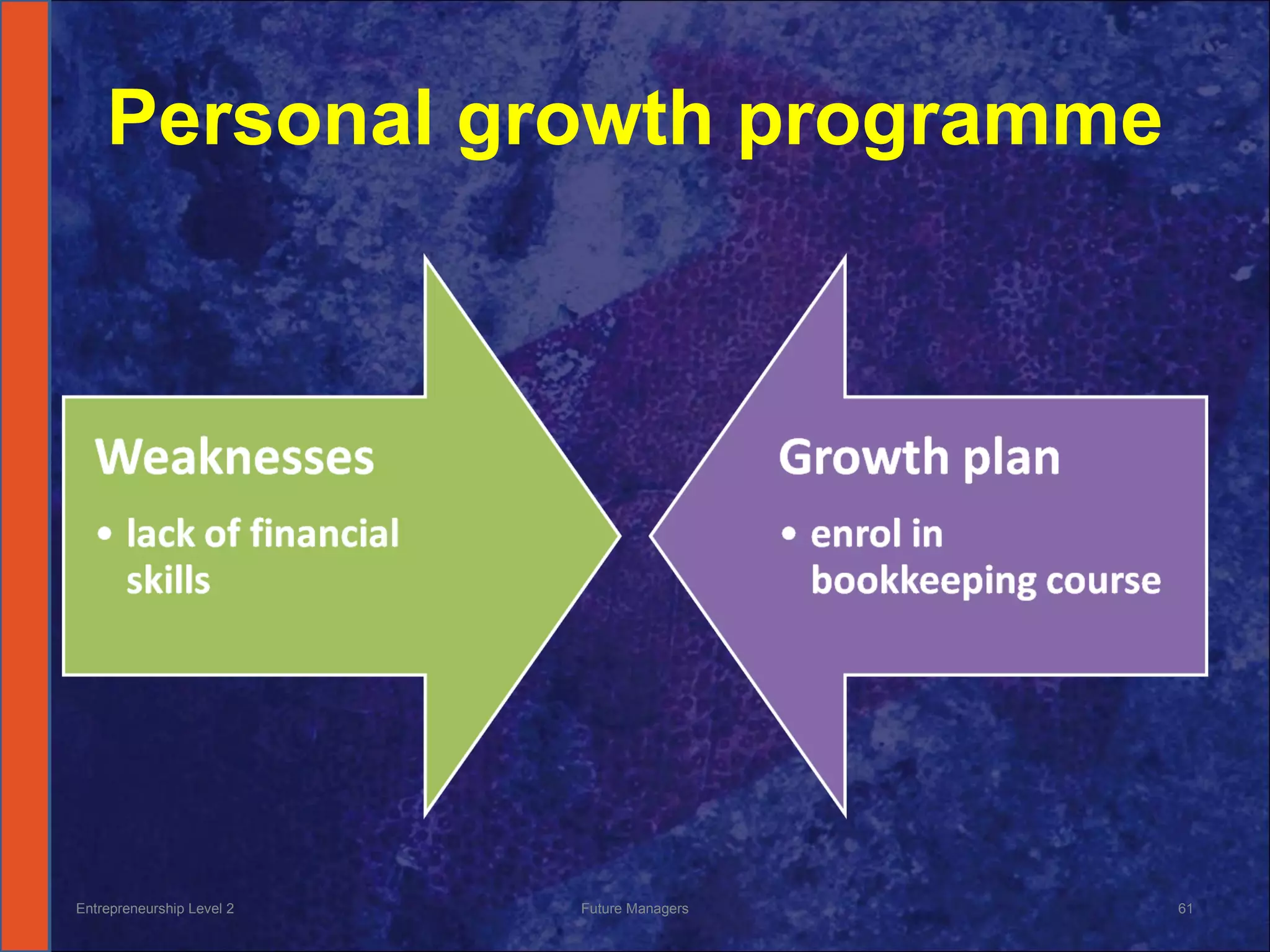
Personal growth programme Entrepreneurship Level 2 Future Managers
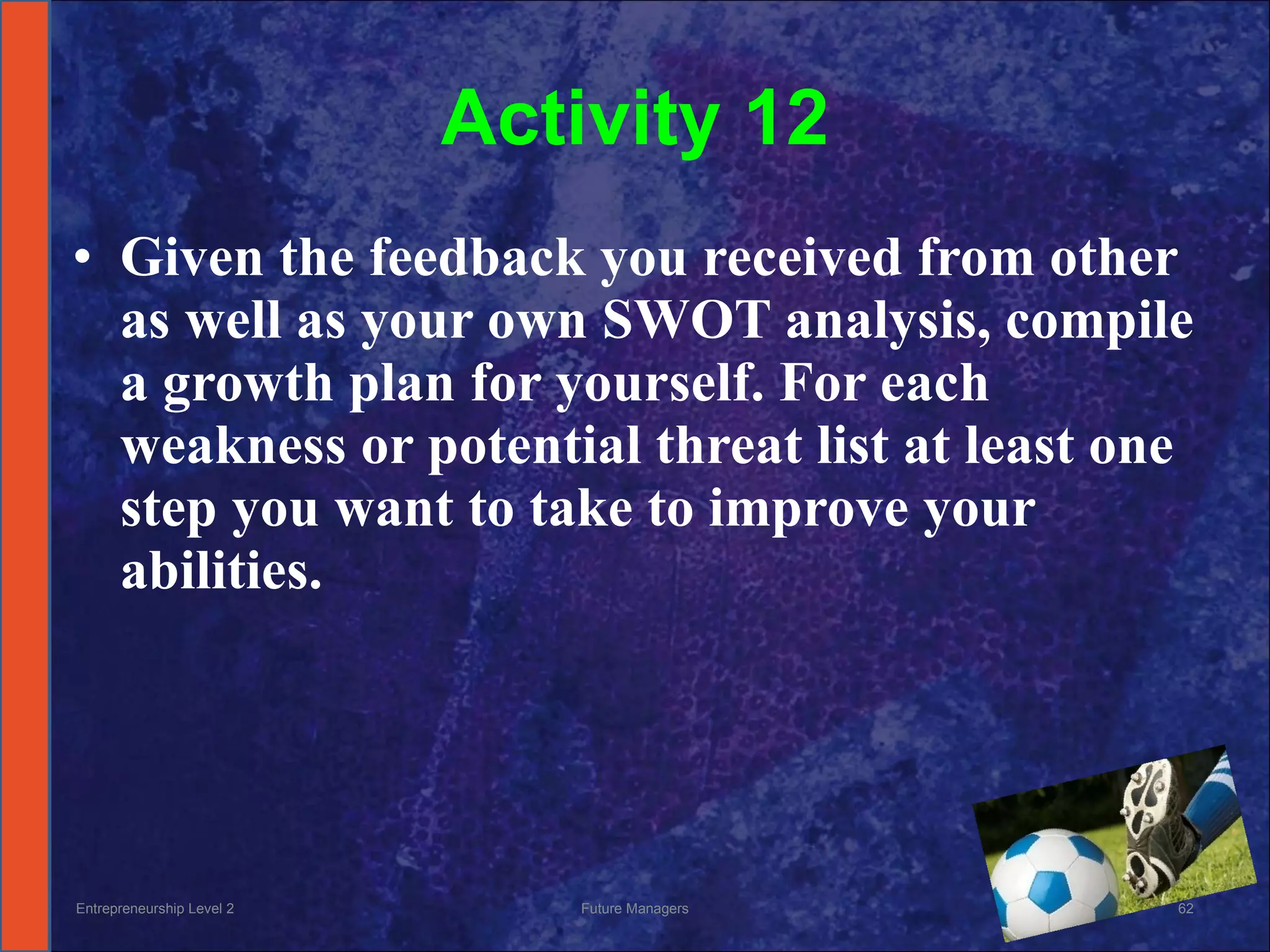
Activity 12 Given the feedback you received from other as well as your own SWOT analysis, compile a growth plan for yourself. For each weakness or potential threat list at least one step you want to take to improve your abilities. Entrepreneurship Level 2 Future Managers
Business plan activity Compile a SWOT analysis for your new business idea Entrepreneurship Level 2 Future Managers
Case study Keeping in mind the following guidelines, read the article on page 49 of your text book and answer the questions that follow All the questions refer to a section of the theory in the module you have just studied.  Try to identify that section first If the section you have identified is, for example, three steps, then your answer must follow those three steps Once you have followed the steps or named facts that are relevant to your answer, give your personal opinion or conclusion.  In other words your answer must be backed up by facts as you give your informed opinion Consider the mark allocation before you start answering.  If many marks are allocated, you need to give a very detailed answer.  On the other hand, if only two marks are allocated, a single word or a short phrase will be sufficient The mark allocation is generally two marks per correct fact or per reason/conclusion you give.  Therefore, if the question was allocated six marks, you need a correct answer plus two reasons. Entrepreneurship Level 2 Future Managers
Case study What is the name of the traditional root discussed in the case study? (2) Name two other products they now cultivate.  (4) Name at least two business environments that have influenced or will hopefully influence the lives of Trynah Msomi and other villagers in the KwaZulu –Natal South Coast.  (12 – 6 per environment) To which “Golden rule” of business is the Umbumbala community adhering? (2) Entrepreneurship Level 2 Future Managers
Case study Which one of the business idea generation techniques or creativity methods best explains how this community or Dr Modi came up with this unique business idea? (4) Is this idea a good business idea? (20) Which values of Ubuntu are clearly applied by the Umbumbulu community? (10) How would you suggest that the Umbumbulu community should protect its business idea? (8) Compile a SWOT analysis for the Ezemvelo Farmers’ Organisation. Entrepreneurship Level 2 Future Managers
Recap Can you identify and discuss the characteristics of an entrepreneur? identify advantages of entrepreneurship and the reasons why it fails? identify entrepreneurial opportunities? discuss and prepare a SWOT analysis? Entrepreneurship Level 2 Future Managers
1. Identify and discuss the characteristics of an entrepreneur At the end of this outcome, you should be able to: define the concept of entrepreneurship identify and discuss, by means of an explanation and examples the characteristics required of an entrepreneur to start a successful small business differentiate between the skills, personality traits and values of an entrepreneur Entrepreneurship Level 2 Future Managers
Recap Can you identify and discuss the characteristics of an entrepreneur define the concept of entrepreneurship? identify and discuss, by means of an explanation and examples the characteristics required of an entrepreneur to start a successful small business? differentiate between the skills, personality traits and values of an entrepreneur? Entrepreneurship Level 2 Future Managers
Recap Can you identify the advantages and disadvantages of entrepreneurship and why it fails Identify the merits (advantages) of an entrepreneur? Discuss with examples reasons why entrepreneurs fail or succeed? Describe the business environment? Describe the economic environment, with emphasis on the need and importance of the entrepreneur within this environment? Explain how a small business is influenced by the external business environment? Entrepreneurship Level 2 Future Managers
Recap   Can you   identify good business ideas? Prepare an individual entrepreneurial profile? Using this information, prepare a SWOT analysis? Develop a personal growth programme to attend to identified skills weaknesses that need addressing? Define and give generic examples of evaluation tools that can be used to measure strengths & weaknesses? Identify measurement and evaluation tools used to maximise strengths and reduce weaknesses? Identify entrepreneurial opportunities within your own entrepreneurial profile and personal growth plan? Entrepreneurship Level 2 Future Managers
Recap Can you discuss and prepare a SWOT analysis? Prepare an individual entrepreneurial profile (self-analysis)? Using this information, prepare a SWOT (Strength; Weaknesses Opportunities and Threats) analysis? Define and give generic examples of evaluation tools that can be used to measure strengths and weaknesses? Identify measurement and evaluation tools used to maximise  strengths and reduce weaknesses? If you can, congratulations, you are ready to move onto the next module Entrepreneurship Level 2 Future Managers

NCV 2 Entrepreneurship Hands-On Support Slide Show - Module 1

  • 1.
  • 2.
    What we coverThe entrepreneur Identify and discuss the characteristics of an entrepreneur Advantages and disadvantages of entrepreneurship Identify good business ideas Discuss and prepare a SWOT analysis Entrepreneurship Level 2 Future Managers
  • 3.
    What we coverMarketing and customer relations Identify potential customers for a new venture Survey opinions for products of the new venture Promote product / service of the new venture Discuss customer relations Explain basic principles of negotiation to secure new business Entrepreneurship Level 2 Future Managers
  • 4.
    What we coverBasic finances Basic financial terminology Processes and principles for pricing a product Financial management, record keeping and stock control Manage time and work processes Create and maintain a task list Use and maintain a diary Entrepreneurship Level 2 Future Managers
  • 5.
    What we coverManage time and work processes Create and maintain a task list Use and maintain a diary Proritise tasks Plan and follow a work schedule Compile entrepreneurial goals The Business Plan Planning your business plan Assessing the components of a given business plan Entrepreneurship Level 2 Future Managers
  • 6.
    Module 1: TheEntrepreneur Entrepreneurship Level 2 Future Managers
  • 7.
    Module 1: TheEntrepreneur After completing this module, you will be able to: identify and discuss the characteristics of an entrepreneur identify advantages of entrepreneurship and the reasons why it fails identify entrepreneurial opportunities discuss and prepare a SWOT analysis Entrepreneurship Level 2 Future Managers
  • 8.
    1. Identify anddiscuss the characteristics of an entrepreneur At the end of this outcome, you should be able to: define the concept of entrepreneurship identify and discuss, by means of an explanation and examples the characteristics required of an entrepreneur to start a successful small business differentiate between the skills, personality traits and values of an entrepreneur Entrepreneurship Level 2 Future Managers
  • 9.
    1. Identify anddiscuss the characteristics of an entrepreneur At the end of this outcome, you should be able to: define the concept of entrepreneurship identify and discuss, by means of an explanation and examples the characteristics required of an entrepreneur to start a successful small business differentiate between the skills, personality traits and values of an entrepreneur Entrepreneurship Level 2 Future Managers
  • 10.
    1.1 Defining EntrepreneurshipWhat is entrepreneurship? Key words Unfulfilled need Opportunity Profitable business Uncertainty Risk-taker Entrepreneurship Level 2 Future Managers
  • 11.
    1.1 Defining EntrepreneurshipWhat is entrepreneurship? Hunter spirit enterprising restless enduring innovative have the capacity to work hard and to take risks improvise Entrepreneurship Level 2 Future Managers
  • 12.
    1.1 Defining EntrepreneurshipThere are three essential requirements for becoming an entrepreneur. Do you have any idea what they are? Technical requirements Business requirements Management requirements Entrepreneurship Level 2 Future Managers
  • 13.
    1.2 Characteristics ofan entrepreneur See if you can name some of the characteristics of a successful entrepreneur Confidence in your ability to succeed Preference for moderate risk Desire for responsibility Energetic Identifying opportunities Organising skills Need to achieve Desire for immediate feedback Entrepreneurship Level 2 Future Managers
  • 14.
    1.2 Characteristics ofan entrepreneur Management Practice – Level 2 Future Managers
  • 15.
    Activity 1 Identifyone successful entrepreneur either in your own community or someone that is often in the news Write a brief description about this person In a table format, give examples of how this individual meets the technical, business and management requirements of a successful entrepreneur Entrepreneurship Level 2 Future Managers
  • 16.
    Activity 2 Howdo you know whether or not you will be a good entrepreneur? The answer is not an easy one. There are so many different aspects that might influence your success or failure as an entrepreneur. If you have just lost your job and have children at home, your urge to achieve is so much greater. The questionnaire on page 7 is a general guideline. Will it help you to answer this difficult question? Follow the instructions and decide for yourself. Entrepreneurship Level 2 Future Managers
  • 17.
    Activity 2 InstructionsComplete the questionnaire on page 7 of your text book individually by answering “yes” or “no” to each question Count how many “yes” and how many “no” answers you have given Add all the “yes” answers of your group together. What is the total? Divide the total by the number of members in your group. What is your group average? Is your own average above or below the group? According to your group, which question is the most important question requiring a “yes” answer? Give reasons for your answer. Entrepreneurship Level 2 Future Managers
  • 18.
    1.3 Skills, personalitytraits and values of the entrepreneur 1.3.1 What do you think the main personality traits of an entrepreneur are? Outgoing Willing to take calculated risks Optimistic Self-actualisation Meticulous Creative and innovative Leadership qualities Entrepreneurship Level 2 Future Managers
  • 19.
    1.3 Skills, personalitytraits and values of the entrepreneur 1.3.2 Quickly, brainstorm what you think are important skills for the entrepreneur to have Computer literacy Technical skills Inter-personal skills Accounting and bookkeeping skills Management skills Entrepreneurship Level 2 Future Managers
  • 20.
    1.3.3 Values foran entrepreneur Do you know what Ubuntu is? Ubuntu values for the entrepreneur include: Respect for human dignity Sharing of success Goodwill Trust and honesty Continuous cross-cultural interaction Pride in achieving goals A discrimination-free workplace Entrepreneurship Level 2 Future Managers
  • 21.
    1.3.3 Values ofan entrepreneur Values which are not acceptable Accumulation for the sake of accumulation Selfishness and individualism Corruption Empowerment which is equal to self-enrichment Entrepreneurship Level 2 Future Managers
  • 22.
    Activity 3: Theubuntu debate Read the definition of entrepreneurship again and compare it with the values of ubuntu. Listed below are a number of topics you will debate within your groups. Study the topics below and choose one Ubuntu is the opposite of entrepreneurship. Entrepreneurship can help with the implementation of ubuntu. Entrepreneurship is all about the individual Ubuntu is what South Africa needs Entrepreneurship Level 2 Future Managers
  • 23.
    Business plan activityIn your business plan workbook, find the “Self analysis” section and complete it to the best of your ability Ask a member of your group to read your “self-analysis” and to say what he or she thinks. Other people often see positives and negatives in us of which we are not even aware. This will help you to remain realistic. Entrepreneurship Level 2 Future Managers
  • 24.
    Case Study Readthe case study on page 13 and answer the questions that follow: Hamsa Faroqui is the MD of a satellite radio company in South Africa. What is the name of his company? What is Hamsa’s golden rule for starting a business? List 5 characteristics Hamsa views as very important to start a business According to Hamsa, what does it take to be a successful entrepreneur? Entrepreneurship Level 2 Future Managers
  • 25.
    2. Advantages anddisadvantages of entrepreneurship At the end of this outcome, you should be able to: Identify the merits (advantages) of an entrepreneur Discuss with examples reasons why entrepreneurs fail or succeed Describe the business environment Describe the economic environment, with emphasis on the need and importance of the entrepreneur within this environment Explain how a small business is influenced by the external business environment Entrepreneurship Level 2 Future Managers
  • 26.
    2.1 Merits ofbeing an entrepreneur What is beneficial to you about being an entrepreneur? You reach your full potential You reap profits You contribute to society and are recognised for your efforts You gain control over your own destiny Entrepreneurship Level 2 Future Managers
  • 27.
    2.2 Reasons whyentrepreneurs succeed or fail Management skill Experience Financial control Changes in the business environment Entrepreneurship Level 2 Future Managers
  • 28.
    2.3 The businessenvironment What factors make up the business environment? Entrepreneurship Level 2 Future Managers Business Environment Customers Suppliers Competitors Government Economy Cultural forces Technological forces Environment
  • 29.
    2.3.1 Customers EntrepreneurshipLevel 2 Future Managers
  • 30.
    2.3.2 Suppliers Goodsuppliers will supply the following: Good quality materials. Essential for: Reduction in waste Reducing defects in products Reducing labour time Reducing returns from customers Losing dissatisfied customers Excellent service Reasonable pricing Entrepreneurship Level 2 Future Managers
  • 31.
    2.3.3 Competitors Howcan you gain the edge over your competitors? Price Promotions Better customer service Improvements on products and services Difficult business concept Entrepreneurship Level 2 Future Managers
  • 32.
    2.3.4 Government Governmentcan create conditions which make it easier for small businesses (or harder) The effects of legislation New legislation can create or take away opportunities New legislation can make certain companies more competitive while others will become less competitive (think of BEE) Legislation can also protect South African industries through tariffs and quotas (do you think this is a good thing? Why? Entrepreneurship Level 2 Future Managers
  • 33.
    2.3.5 Economy Whatare the effects of each of the following? Interest rates Inflation Exchange rates Increased government spending An economic downturn An end to the Zimbabwe crisis Entrepreneurship Level 2 Future Managers
  • 34.
    2.3.5 Economy Whyare entrepreneurs important? New businesses create jobs and therefore reduce unemployment New businesses make profits and are taxed by the government. Taxes are used to improve the living conditions of all South Africans People with jobs are less likely to get involved with crime New businesses employ previously unemployed people and the employees start paying taxes New businesses make our country more competitive internationally Entrepreneurship Level 2 Future Managers
  • 35.
    2.3.7 Technological forcesQ: What is technology? A: Any item, technique or know-how that helps a business sell a product or service It includes the following: Machinery Telecommunication Computers Equipment Tools Entrepreneurship Level 2 Future Managers
  • 36.
    Activity 5 MP3players or iPods are computerised devices that record and play music Which specific business environment was affected by the arrival of MP3 players? Name 3 other products that were or will be affected by the arrival of MP3 players Does this development provide any new business opportunities? Entrepreneurship Level 2 Future Managers
  • 37.
    2.3.8 Natural environmentWhat are the threats to the environment? Overpopulation Pollution Wrong farming methods Poaching General carelessness regarding the ecosystem What must entrepreneurs do or not do, with regard to the environment? Entrepreneurship Level 2 Future Managers
  • 38.
    3. Identify goodbusiness ideas   At the end of this outcome, you should be able to: prepare an individual entrepreneurial profile. using this information, prepare a SWOT analysis develop a personal growth programme to attend to identified skills weaknesses that need addressing define and give generic examples of evaluation tools that can be used to measure strengths & weaknesses identify measurement and evaluation tools used to maximise strengths and reduce weaknesses identify entrepreneurial opportunities within your own entrepreneurial profile and personal growth plan Entrepreneurship Level 2 Future Managers
  • 39.
    3. Identify goodbusiness ideas Needs across socio-economic groups Entrepreneurship Level 2 Future Managers Socio-Economic group Primary focus Unemployed group Category 1 needs Lower income group Category 2 Middle income group Category 3 + 4 High income group Category 4 + 5
  • 40.
    Activity 6 Selectthree different needs from category four or five and write them down. Next to each one of them write a need selected from category one For each one of the three discuss how you would feel about the category five need if the corresponding category one need is not satisfied Summarise the group’s reaction or feelings to each of the three categories. Present your groups final conclusion to the rest of the class Given your above discussion, where should your focus be when trying to identify a new business idea? Entrepreneurship Level 2 Future Managers
  • 41.
    Activity 7 Makea list of 5 products or services that people in your community need and are able to afford Look at this list and try to write down examples of a business that will deal with the different needs. This can be done in small groups, each group discussing all the needs in one category Use these lists in the next section when experimenting with the different creativity techniques. Entrepreneurship Level 2 Future Managers
  • 42.
    3.1 Innovation andcreativity Hobbies, sport and entertainment Shopping Travelling Watching television Reading newspapers and magazines Internet Entrepreneurship Level 2 Future Managers
  • 43.
    3.1 Innovation andcreativity Trade shows and exhibitions Places where people gather Flea markets Innovation Gaps in the market Entrepreneurship Level 2 Future Managers
  • 44.
    Activity 8 Visitwww.google.co.za and type in “business ideas” How many ideas are listed? Write down five ideas of which you have never heard Identify five ideas that interest you or that you would like to know more about Click on one of the ideas that you like and print the details given Entrepreneurship Level 2 Future Managers
  • 45.
    3.2 Creative methodsManagement Practice – Level 2 Future Managers
  • 46.
    3.2 Creative methodsBrainstorming What if? Mind mapping Generation of alternatives Reverse method Entrepreneurship Level 2 Future Managers
  • 47.
    3.2.1 Brainstorming Forma group of 5 members Appoint a writer who will write down all the ideas Elect a chairperson who must make sure that the group does not comment or laugh at one another’s contributions Write the problem or challenge on a big board or piece of paper Decide on the time – 5 minutes is normally long enough Ideas time! – all ideas, thoughts, suggestions, etc. are written down. The golden rule is that members are not allowed to comment on one another’s contributions during this period Time’s up Group the thoughts. The chairperson, with the help of the group, tries to group similar thoughts together. Even the silly ones are grouped Try to link groups, especially those that have nothing to do with one another Reaching conclusions. Did this new way of looking at an old problem result in a new idea? Entrepreneurship Level 2 Future Managers
  • 48.
    Activity 9 Thefollowing are problems (you may identify your own or use the list of needs): Getting rid of crime in your area Lack of fresh water in your residential area Very expensive medicine Entrepreneurship Level 2 Future Managers
  • 49.
    3.3 Is ita good business idea Try to think of some ideas for starting a business Now evaluate which ones you think work and which don’t Entrepreneurship Level 2 Future Managers
  • 50.
    Activity 10 Chooseany business idea from the list of possible “businesses ideas”. Write any four types of skills and/or knowledge that a person who starts such a business will require. Compare it with other members of your group. Is there something you did not think about? Entrepreneurship Level 2 Future Managers
  • 51.
    Business plan activityIt is now the time to decide which business idea interests you; about which you have the most knowledge and want to investigate further. This business idea will form the basis of all the activities that follow and will lead to a formal business plan.  Write down your business idea with a short description in your ‘Business Plan Workbook’ and submit it for approval. Entrepreneurship Level 2 Future Managers
  • 52.
    3.4 Protecting yourideas Secrecy Patents Trademarks ® Copyright © Piracy Entrepreneurship Level 2 Future Managers
  • 53.
    4. Discuss andprepare a SWOT analysis At the end of this outcome, you should be able to: Prepare an individual entrepreneurial profile (self-analysis) Using this information, prepare a SWOT (Strength; Weaknesses Opportunities and Threats) analysis Define and give generic examples of evaluation tools that can be used to measure strengths and weaknesses Identify measurement and evaluation tools used to maximise strengths and reduce weaknesses. Entrepreneurship Level 2 Future Managers
  • 54.
    4.1 Individual entrepreneurialprofile Step 1: Match your ideas to your personal resources Knowledge and skills Contacts and friends Finance Costing and pricing Break-even point Cost of inventory and debtors Entrepreneurship Level 2 Future Managers
  • 55.
    4.1 Individual entrepreneurialprofile Step 2: Identify your critical success factors Factors that are critical for your business to succeed What are the critical success factors for a taxi business? Entrepreneurship Level 2 Future Managers
  • 56.
    4.3 Compile aSWOT analysis Strengths and Weaknesses deal with your own current situation, the “here and now” while Opportunities and Threats will happen sometime in the future Strengths and Weaknesses normally refer to you as a person or matters inside your business, while Opportunities and Threats mostly come from outside the business You have less control over Opportunities and Threats You can still do something about your Strengths and Weaknesses. Entrepreneurship Level 2 Future Managers
  • 57.
    SWOT Analysis EntrepreneurshipLevel 2 Future Managers
  • 58.
    4.4 Evaluation toolsPsychometric tests Thomas profile Myers-Briggs Type Index Some of tests can be done freely on the web. Try googling MBTI Entrepreneurship Level 2 Future Managers
  • 59.
    Activity 11 Considerasking a friend or colleague to provide you with their opinion of your Strengths and Weaknesses using the SWOT analysis tick-list below. Ask them to be as honest as possible and thus provide you with a wider and more realistic perspective of yourself. Complete the personal SWOT in your business plan workbook by following steps 1 to 4. Entrepreneurship Level 2 Future Managers
  • 60.
    Activity 11 Step1 - Write down ALL your Strengths, Weaknesses, Opportunities & Threats on a piece of plain A4 paper. Use a separate page for each category (including the feedback received from your friends, colleagues and family members). Step 2 - Identify ‘key words’ and ‘key phrases’ to describe each quality or factor. For example, you may have seen from your background information profile that you displayed a lot of tenacity in completing your studies part-time. In this case you may use the word ‘tenacity’ to describe one of your strengths. Step 3 -Check words that have a similar meaning and cross out the ones that make the least sense to you. Step 4 - List each key word or phrase under the relevant heading on your SWOT map. Entrepreneurship Level 2 Future Managers
  • 61.
    Personal growth programmeEntrepreneurship Level 2 Future Managers
  • 62.
    Activity 12 Giventhe feedback you received from other as well as your own SWOT analysis, compile a growth plan for yourself. For each weakness or potential threat list at least one step you want to take to improve your abilities. Entrepreneurship Level 2 Future Managers
  • 63.
    Business plan activityCompile a SWOT analysis for your new business idea Entrepreneurship Level 2 Future Managers
  • 64.
    Case study Keepingin mind the following guidelines, read the article on page 49 of your text book and answer the questions that follow All the questions refer to a section of the theory in the module you have just studied. Try to identify that section first If the section you have identified is, for example, three steps, then your answer must follow those three steps Once you have followed the steps or named facts that are relevant to your answer, give your personal opinion or conclusion. In other words your answer must be backed up by facts as you give your informed opinion Consider the mark allocation before you start answering. If many marks are allocated, you need to give a very detailed answer. On the other hand, if only two marks are allocated, a single word or a short phrase will be sufficient The mark allocation is generally two marks per correct fact or per reason/conclusion you give. Therefore, if the question was allocated six marks, you need a correct answer plus two reasons. Entrepreneurship Level 2 Future Managers
  • 65.
    Case study Whatis the name of the traditional root discussed in the case study? (2) Name two other products they now cultivate. (4) Name at least two business environments that have influenced or will hopefully influence the lives of Trynah Msomi and other villagers in the KwaZulu –Natal South Coast. (12 – 6 per environment) To which “Golden rule” of business is the Umbumbala community adhering? (2) Entrepreneurship Level 2 Future Managers
  • 66.
    Case study Whichone of the business idea generation techniques or creativity methods best explains how this community or Dr Modi came up with this unique business idea? (4) Is this idea a good business idea? (20) Which values of Ubuntu are clearly applied by the Umbumbulu community? (10) How would you suggest that the Umbumbulu community should protect its business idea? (8) Compile a SWOT analysis for the Ezemvelo Farmers’ Organisation. Entrepreneurship Level 2 Future Managers
  • 67.
    Recap Can youidentify and discuss the characteristics of an entrepreneur? identify advantages of entrepreneurship and the reasons why it fails? identify entrepreneurial opportunities? discuss and prepare a SWOT analysis? Entrepreneurship Level 2 Future Managers
  • 68.
    1. Identify anddiscuss the characteristics of an entrepreneur At the end of this outcome, you should be able to: define the concept of entrepreneurship identify and discuss, by means of an explanation and examples the characteristics required of an entrepreneur to start a successful small business differentiate between the skills, personality traits and values of an entrepreneur Entrepreneurship Level 2 Future Managers
  • 69.
    Recap Can youidentify and discuss the characteristics of an entrepreneur define the concept of entrepreneurship? identify and discuss, by means of an explanation and examples the characteristics required of an entrepreneur to start a successful small business? differentiate between the skills, personality traits and values of an entrepreneur? Entrepreneurship Level 2 Future Managers
  • 70.
    Recap Can youidentify the advantages and disadvantages of entrepreneurship and why it fails Identify the merits (advantages) of an entrepreneur? Discuss with examples reasons why entrepreneurs fail or succeed? Describe the business environment? Describe the economic environment, with emphasis on the need and importance of the entrepreneur within this environment? Explain how a small business is influenced by the external business environment? Entrepreneurship Level 2 Future Managers
  • 71.
    Recap   Canyou identify good business ideas? Prepare an individual entrepreneurial profile? Using this information, prepare a SWOT analysis? Develop a personal growth programme to attend to identified skills weaknesses that need addressing? Define and give generic examples of evaluation tools that can be used to measure strengths & weaknesses? Identify measurement and evaluation tools used to maximise strengths and reduce weaknesses? Identify entrepreneurial opportunities within your own entrepreneurial profile and personal growth plan? Entrepreneurship Level 2 Future Managers
  • 72.
    Recap Can youdiscuss and prepare a SWOT analysis? Prepare an individual entrepreneurial profile (self-analysis)? Using this information, prepare a SWOT (Strength; Weaknesses Opportunities and Threats) analysis? Define and give generic examples of evaluation tools that can be used to measure strengths and weaknesses? Identify measurement and evaluation tools used to maximise strengths and reduce weaknesses? If you can, congratulations, you are ready to move onto the next module Entrepreneurship Level 2 Future Managers