A Presentation on
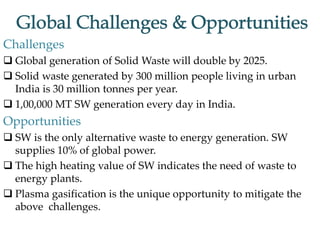
Challenges 
 Global generation of Solid Waste will double by 2025. 
 Solid waste generated by 300 million people living in urban 
India is 30 million tonnes per year. 
 1,00,000 MT SW generation every day in India. 
Opportunities 
 SW is the only alternative waste to energy generation. SW 
supplies 10% of global power. 
 The high heating value of SW indicates the need of waste to 
energy plants. 
 Plasma gasification is the unique opportunity to mitigate the 
above challenges.
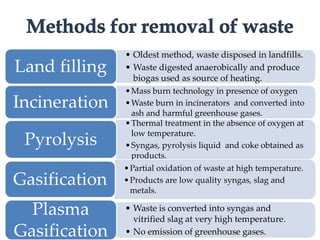
• Oldest method, waste disposed in landfills. 
• Waste digested anaerobically and produce 
biogas used as source of heating. 
Land filling 
•Mass burn technology in presence of oxygen 
•Waste burn in incinerators and converted into 
ash and harmful greenhouse gases. 
Incineration 
•Thermal treatment in the absence of oxygen at 
low temperature. 
•Syngas, pyrolysis liquid and coke obtained as 
products. 
Pyrolysis 
•Partial oxidation of waste at high temperature. 
•Products are low quality syngas, slag and 
metals. 
Gasification 
• Waste is converted into syngas and 
vitrified slag at very high temperature. 
• No emission of greenhouse gases. 
Plasma 
Gasification
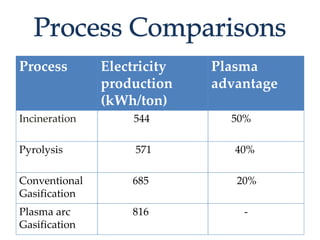
Process Electricity 
production 
(kWh/ton) 
Plasma 
advantage 
Incineration 544 50% 
Pyrolysis 571 40% 
Conventional 
Gasification 
685 20% 
Plasma arc 
Gasification 
816 -
Origin of Plasma 
• Plasma is a fourth state of matter. 
• Discovered by British physicist Sir William 
Crookes in 1879. 
• Heating a gas at very high temperature lead to ionization 
of atoms and turns it into plasma. 
• Natural plasma can be seen in lightning, sun stars, comet 
etc. 
• Firstly used by metal industry in 1800 in metallurgical, 
mechanical operations and in 1900 chemical industry made 
acetylene from natural gas. 
• Plasma technology used by NASA in 1960 and become 
popular.
•Plasma consists high electrical conductivity, more 
independently acting species, high velocity particles and 
particles interact at long range through electric or magnetic 
forces. 
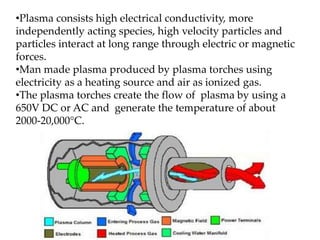
•Man made plasma produced by plasma torches using 
electricity as a heating source and air as ionized gas. 
•The plasma torches create the flow of plasma by using a 
650V DC or AC and generate the temperature of about 
2000-20,000°C.
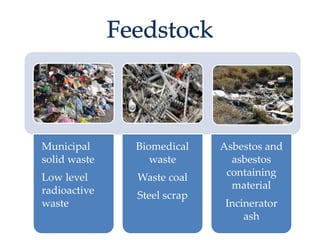
Municipal 
solid waste 
Low level 
radioactive 
waste 
Biomedical 
waste 
Waste coal 
Steel scrap 
Asbestos and 
asbestos 
containing 
material 
Incinerator 
ash
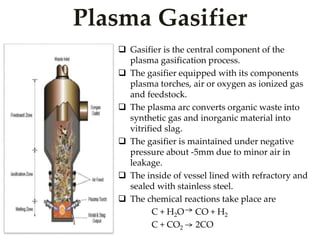
Plasma Gasifier 
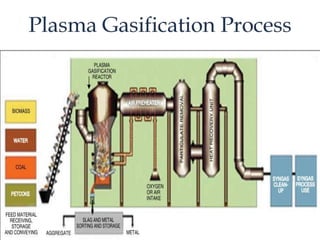
 Gasifier is the central component of the 
plasma gasification process. 
 The gasifier equipped with its components 
plasma torches, air or oxygen as ionized gas 
and feedstock. 
 The plasma arc converts organic waste into 
synthetic gas and inorganic material into 
vitrified slag. 
 The gasifier is maintained under negative 
pressure about -5mm due to minor air in 
leakage. 
 The inside of vessel lined with refractory and 
sealed with stainless steel. 
 The chemical reactions take place are 
C + H2O CO + H2 
C + CO2 2CO
• The major products are synthesis gas and 
vitrified slag. 
• Syngas has a high temperature cooled down 
through heat recovery units. 
• Syngas as a fuel for electricity generation. 
• Rock like vitrified slag as construction 
aggregates. 
• Other products are hydrochloric acid, hydrogen 
sulfide obtained from syngas cleaning.
Plasma gasification holds a potential to add to the supply of 
renewable energy resource in these times of uncertain 
energy supplies. 
Any material can be processed in plasma arc system. To 
achieve a favorable energy balance the volume of inorganic 
should be minimized. 
There is no emission of harmful greenhouse gases. 
Concentrations of dioxins are very low as compared to 
incineration due to high temperature. 
Plasma gasification technology has a high operating cost and 
capital cost due to high electrical power requirement
• 2009 BP statistical review of world BP plc. 
57th edition 45p. 
• Lisa Zyga (2012) plasma gasification 
transforms garbage into clean energy, science 
blogger. Inventorspot.com, via: popular 
science 
• Helsen, L.,2000 low temperature pyrolysis of 
CCA treated wood waste. PhD. Thesis, 
Heverlee, KU Leven. 
• Manual of solid waste 2008
Plasma gasification of solid waste into fuel

Plasma gasification of solid waste into fuel

  • 1.
  • 3.
    Challenges  Globalgeneration of Solid Waste will double by 2025.  Solid waste generated by 300 million people living in urban India is 30 million tonnes per year.  1,00,000 MT SW generation every day in India. Opportunities  SW is the only alternative waste to energy generation. SW supplies 10% of global power.  The high heating value of SW indicates the need of waste to energy plants.  Plasma gasification is the unique opportunity to mitigate the above challenges.
  • 4.
    • Oldest method,waste disposed in landfills. • Waste digested anaerobically and produce biogas used as source of heating. Land filling •Mass burn technology in presence of oxygen •Waste burn in incinerators and converted into ash and harmful greenhouse gases. Incineration •Thermal treatment in the absence of oxygen at low temperature. •Syngas, pyrolysis liquid and coke obtained as products. Pyrolysis •Partial oxidation of waste at high temperature. •Products are low quality syngas, slag and metals. Gasification • Waste is converted into syngas and vitrified slag at very high temperature. • No emission of greenhouse gases. Plasma Gasification
  • 5.
    Process Electricity production (kWh/ton) Plasma advantage Incineration 544 50% Pyrolysis 571 40% Conventional Gasification 685 20% Plasma arc Gasification 816 -
  • 6.
    Origin of Plasma • Plasma is a fourth state of matter. • Discovered by British physicist Sir William Crookes in 1879. • Heating a gas at very high temperature lead to ionization of atoms and turns it into plasma. • Natural plasma can be seen in lightning, sun stars, comet etc. • Firstly used by metal industry in 1800 in metallurgical, mechanical operations and in 1900 chemical industry made acetylene from natural gas. • Plasma technology used by NASA in 1960 and become popular.
  • 7.
    •Plasma consists highelectrical conductivity, more independently acting species, high velocity particles and particles interact at long range through electric or magnetic forces. •Man made plasma produced by plasma torches using electricity as a heating source and air as ionized gas. •The plasma torches create the flow of plasma by using a 650V DC or AC and generate the temperature of about 2000-20,000°C.
  • 9.
    Municipal solid waste Low level radioactive waste Biomedical waste Waste coal Steel scrap Asbestos and asbestos containing material Incinerator ash
  • 10.
    Plasma Gasifier Gasifier is the central component of the plasma gasification process.  The gasifier equipped with its components plasma torches, air or oxygen as ionized gas and feedstock.  The plasma arc converts organic waste into synthetic gas and inorganic material into vitrified slag.  The gasifier is maintained under negative pressure about -5mm due to minor air in leakage.  The inside of vessel lined with refractory and sealed with stainless steel.  The chemical reactions take place are C + H2O CO + H2 C + CO2 2CO
  • 11.
    • The majorproducts are synthesis gas and vitrified slag. • Syngas has a high temperature cooled down through heat recovery units. • Syngas as a fuel for electricity generation. • Rock like vitrified slag as construction aggregates. • Other products are hydrochloric acid, hydrogen sulfide obtained from syngas cleaning.
  • 12.
    Plasma gasification holdsa potential to add to the supply of renewable energy resource in these times of uncertain energy supplies. Any material can be processed in plasma arc system. To achieve a favorable energy balance the volume of inorganic should be minimized. There is no emission of harmful greenhouse gases. Concentrations of dioxins are very low as compared to incineration due to high temperature. Plasma gasification technology has a high operating cost and capital cost due to high electrical power requirement
  • 13.
    • 2009 BPstatistical review of world BP plc. 57th edition 45p. • Lisa Zyga (2012) plasma gasification transforms garbage into clean energy, science blogger. Inventorspot.com, via: popular science • Helsen, L.,2000 low temperature pyrolysis of CCA treated wood waste. PhD. Thesis, Heverlee, KU Leven. • Manual of solid waste 2008

Editor's Notes

  • #3  Per capita waste generation in major cities ranges from 0.20 Kg to 0.6 Kg. Generally the collection efficiency ranges between 70 to 90% in major metro cities whereas in several smaller cities the collection efficiency is below 50%.
  • #5 In old times, the land filling is the least sustainable and most popular method for disposing of trash. The waste disposed is digested anaerobically also called a biochemical conversion and produce biogas used as a source of heating. It has drawbacks such as producing harmful gases like CO2 and methane and large surface area is needed for disposal. Pyrolysis is a thermo chemical degradation of organic material in the absence of oxygen. The products obtained are pyrolysis gas called syngas, pyrolysis liquid and solid cake richer in carbon content. Indirect heating is done in different reactors like fluidized bed, rotary kiln, moving bed, fixed bed etc. The temperature maintained at 450-550°C. Due to its low temperature produces less pollutants. Pyrolysis process has some drawbacks like solid residue disposed to landfill, a major environmental disposing. It is a mass burn technology. It is oxidation of combustible material contained in the waste. Excess O2 is added to attain burning at low temperature. It converts the waste into flue gas, ash and heat. The flue gases obtained are CO2 and H2O with emission of harmful gases like NOx, SOx, VOC etc. This process has drawbacks such as high level of green house gases and large amount of ash sent to a landfill for disposal. Pyrolysis is a thermo chemical degradation of organic material in the absence of oxygen. The products obtained are pyrolysis gas called syngas, pyrolysis liquid and solid cake richer in carbon content. Indirect heating is done in different reactors like fluidized bed, rotary kiln, moving bed, fixed bed etc. The temperature maintained at 450-550°C. Due to its low temperature produces less pollutants. Pyrolysis process has some drawbacks like solid residue disposed to landfill, a major environmental disposing.
  • #7 Plasma consists of a collection of free moving electrons and ions. Energy is needed to strip electrons from atoms to make plasma. The energy can be thermal, electrical or light . DC torches are better than AC torches due to less flicker generation, less noise, better control, lower electrode consumption and lower power consumption. The transferred torches or non transferred torches classification depends on whether arc is electrically transferre to work piece or not. The transferred torch operate with low gas flows and high operate voltages. But in non transferred torch needs high operating currents and have lower efficiencies. Thermal-plasmas are atmospheric-pressure plasmas characterized by high enthalpy content and temperatures around 2000–20,000 degrees. Non-equilibrium plasmas are low-pressure plasmas charac-terized by high electron temperatures and low ion and neutral temperatures. This paper focuses on thermal-plasma, which is a source of concentrated energy, posi-tive and negative ions, highly active radicals and intense radiation. Thermal-plasma devices operate from a few tens of watts to a few MW.
  • #8  It is important to note that although they are unbound, these particles are not ‘free’. When the charges move they generate electrical currents with magnetic fields, and as a result, they are affected by each other’s fields. This governs their collective behavior with many degrees of freedom.
  • #9 Products are syngas which has calorific value of about 320Btu/cubic foot and used as an alternative for fuel and vitrified slag used in construction aggregates. Other products hydrogen sulfide, hydrochloric acid etc. depends on the formation of feedstock and are separated in cleaning system from syngas
  • #11 Steam is also added to promote syngas reactions. The production of other products other than syngas depends on waste stream. It is sealed with stainless steel. The plasma gasifier is a refractory lined vessel and sealed with stainless steel. The reactors are large and operate at a slightly negative pressure, meaning that the feed system is simplified because the gas does not want to escape. The gas has to be pulled from the reactor by the suction of the compressor. Each reactor can process 20 tons per hour (tph) compared to 3 tph for typical gasifiers. Because of the size and the negative pressure, the feed system can handle bundles of material up to 1 meter in size. This means that whole drums or bags of waste can be fed directly into the reactor making the system ideal for large scale production.  Exit Gas, 1700 C Coke Bed, 1800 – 4000 C Torch Plume, > 5000 C Slag Pool, 1700 – 1800 C
  • #13 First, it is a convenient way to provide thermal energy in a gasification process. Second, controlling the amount of heat input to the process by means of the plasma torches allows controlling the composition of the syngas. Third, the hydrogen to carbon monoxide ratio can be modified easily to suit the needs of the end use.