This document defines verbs and discusses their different types and uses. It begins by defining a verb as a "doing word" and provides examples of verbs in sentences. It then describes the main types of verbs as transitive verbs, which express an action directed at a receiver or object, and intransitive verbs, which do not pass an action to an object. Other verb types discussed include regular and irregular verbs, finite and non-finite verbs, auxiliary verbs, stative verbs, and modal verbs. Examples are given for each verb type to illustrate their meanings and uses.
Examples
1.THE RAINPATTERED AGAINST THE
WINDOW PANES
THE WIND HOWLED THROUGH THE
TREES
THE LIGHTNING FLASHED ACROSS THE
SKY
THE THUNDER RUMBLED IN THIS
DISTANCE
5.
SENTENCES
I. THE BABYIS JUST LEARNING TO CRAWL
II. THE CHAIR CREAKED AS DEEPIKA SAT
DOWN
III. THE BUS CRASHED INTO A TREE
IV. THE OLD MAN PLOODED SLOWLY UP
THE HILL
V. THE TRAM DRIVER CHANGED HIS BELL
6.
EXAMPES with PICS.
A BOY WHILE SLEEPING
A BOY WHILE SINGING
A BOY WHILE WRITING
KIDS WHILE PLAYING
A BOY WHILE FLYING KITE
TYPES OF VERBS
•Transitive & Intransitive verbs
• Regular and Irregular verbs
• Finite and Non-Finite verbs
• Auxiliary verbs
• Stative verbs
• Modal verbs
13.
TRANSITIVE VERBS
Expressan action directed toward a person, a
place, a thing, or an idea (a.k.a., nouns)
The action passes from the doer (the subject) to
the receiver of the action.
The words that receive the action of transitive
verbs direct objects always nouns
Transitive verbs can only be action verbs.
Linking verbs are NEVER transitive.
14.
TRANSITIVE VERBS EX.
•Derrick greeted the visitors.
Derrick greeted whom? The action
(greeted) passes from the subject
(Derrick) to the object (visitors).
• When will Felicia paint her room?
Felicia will paint what? The action (will
paint) passes from the subject (Felicia) to
the object (room).
15.
INTRANSITIVE VERBS
• Expressaction or tell something about
the subject without the action passing to
a receiver, or object
• Intransitive verbs may be either action
or linking verbs.
16.
INTRANSITIVE VERBS EX.
•The train stopped.
• The train stopped what? There is nothing in
the sentence to say what the train stopped (i.e.,
there is no object). There is no transfer of
action.
• Last night we ate on the patio.
• We ate what? There is nothing in the sentence
to say what we ate (i.e., there is no object). We
did not eat some “on the patio.” This is a
prepositional phrase telling where we ate, not
what. There is no transfer of action.
17.
REGULAR VERBS
• Averb that forms its past tense & present
participle by adding.
–d or –ed
• Or in some cases –t to the base form (which
is known as weak verb).
EXPAMPLES
Examples of–s form
If I have a thousand ideas and only one turns
out to be good, I am satisfied.“
Examples of –ed Form
I've searched all the parks in all the cities and
found no statues of committees.
Examples of –ing Form
I've always been trying hard to give the best
and got the best result after being rewarded.
20.
IRREGULAR VERBS
Averb that does not follow the usual
rules for verb forms
Verbs in English are irregular if they
don't have a conventional -ed ending
(like asked or ended)
Example:1. Throughout my career I
swam for form. Speed came as a result.
21.
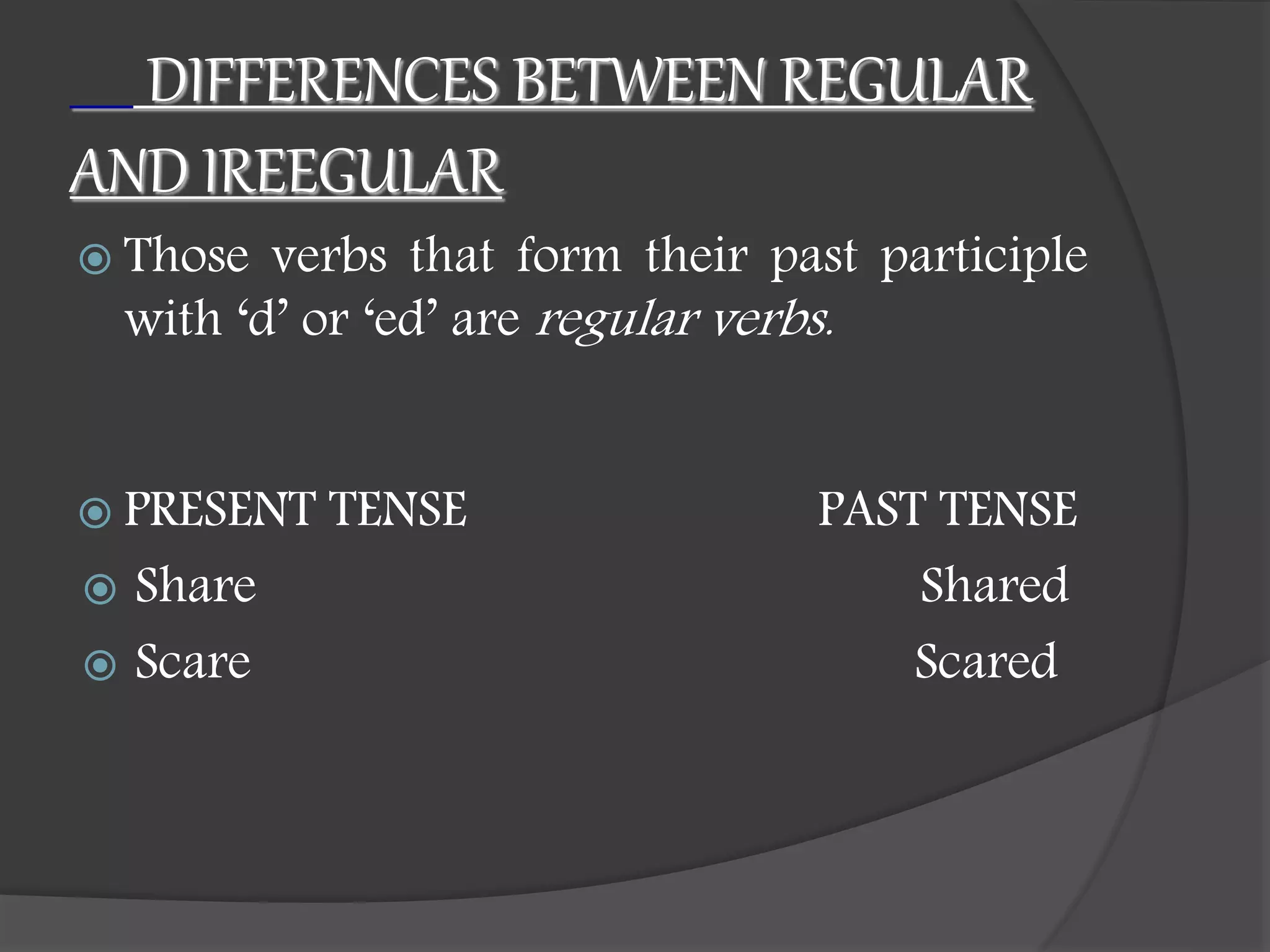
DIFFERENCES BETWEEN REGULAR
ANDIREEGULAR
Those verbs that form their past participle
with ‘d’ or ‘ed’ are regular verbs.
PRESENT TENSE PAST TENSE
Share Shared
Scare Scared
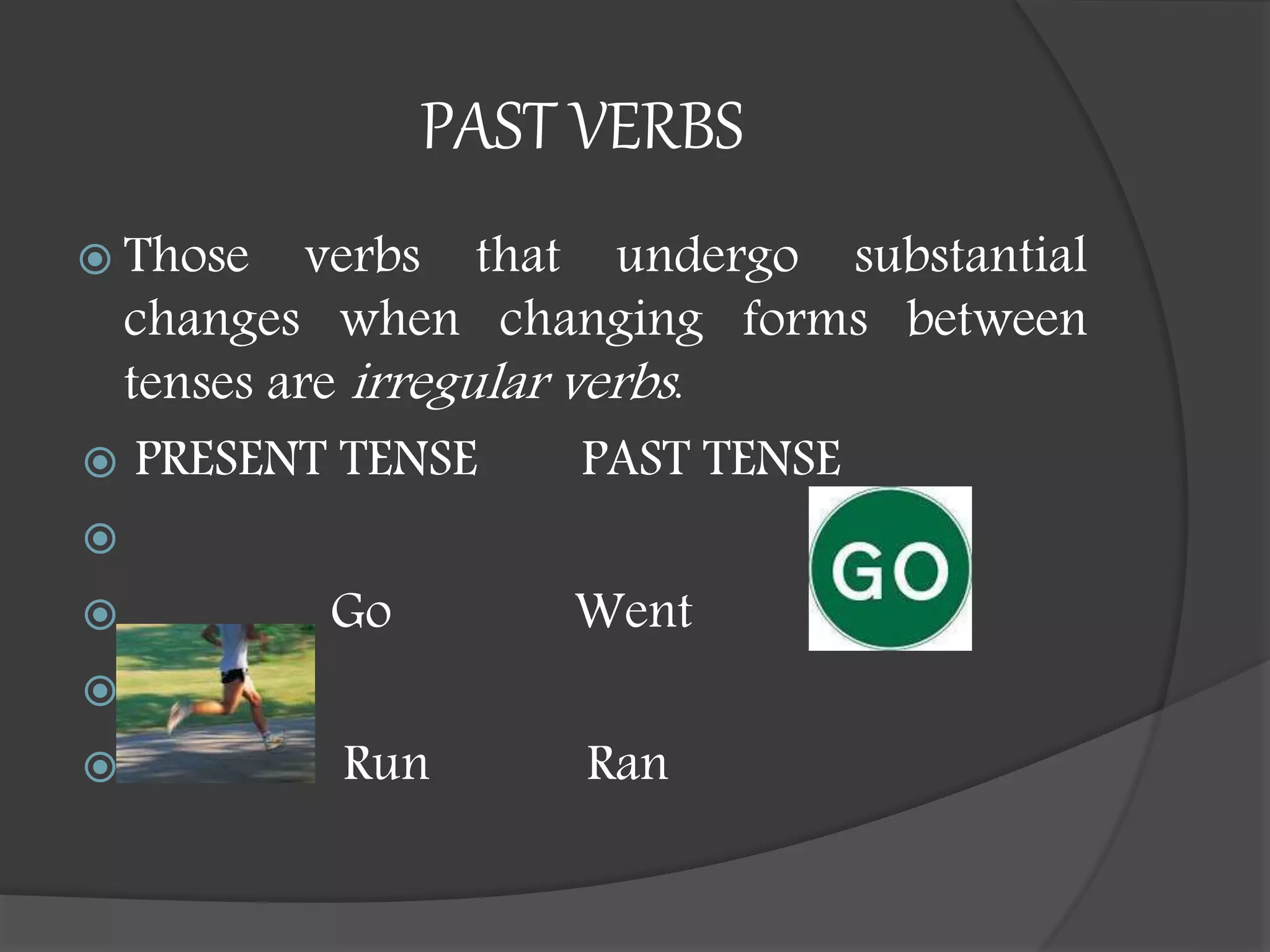
22.
PAST VERBS
Thoseverbs that undergo substantial
changes when changing forms between
tenses are irregular verbs.
PRESENT TENSE PAST TENSE
Go Went
Run Ran
23.
FINITE VERB
Verbswhich have the past or the present If
there is just one verb in a sentence, it is finite.
Finite verbs are sometimes called tensed verbs.
Examples of Finite Verb
1.Drive a car. [1st person, singular, present
tense]
2. He drives a car. [3rd person, singular.
present tense]
form are called FINITE verbs
24.
INFINITE VERB
Verbsin any other form (infinitive, -ing or
-ed) are called Infinite Verbs.
25.
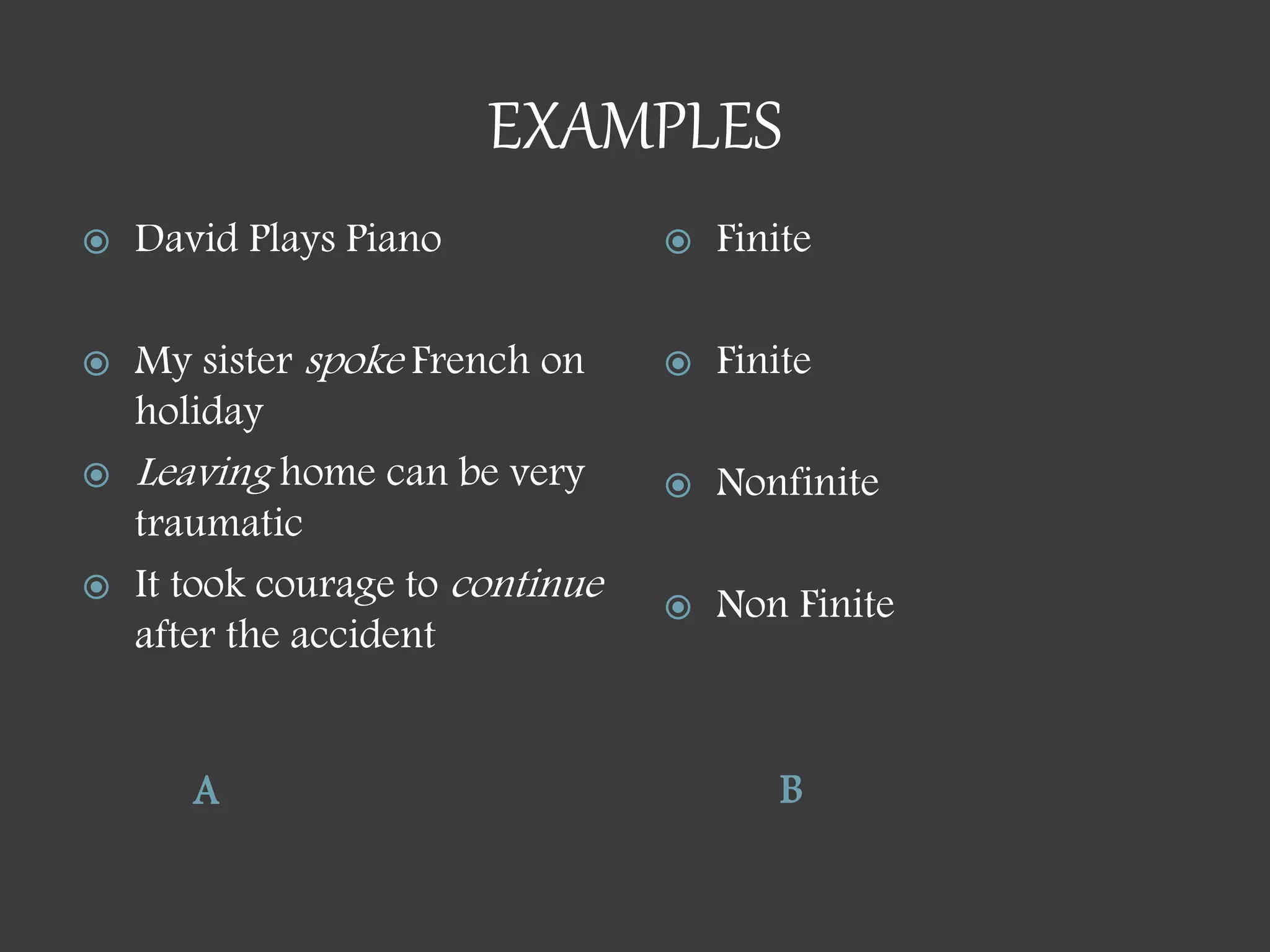
EXAMPLES
A B
DavidPlays Piano
My sister spoke French on
holiday
Leaving home can be very
traumatic
It took courage to continue
after the accident
Finite
Finite
Nonfinite
Non Finite
26.
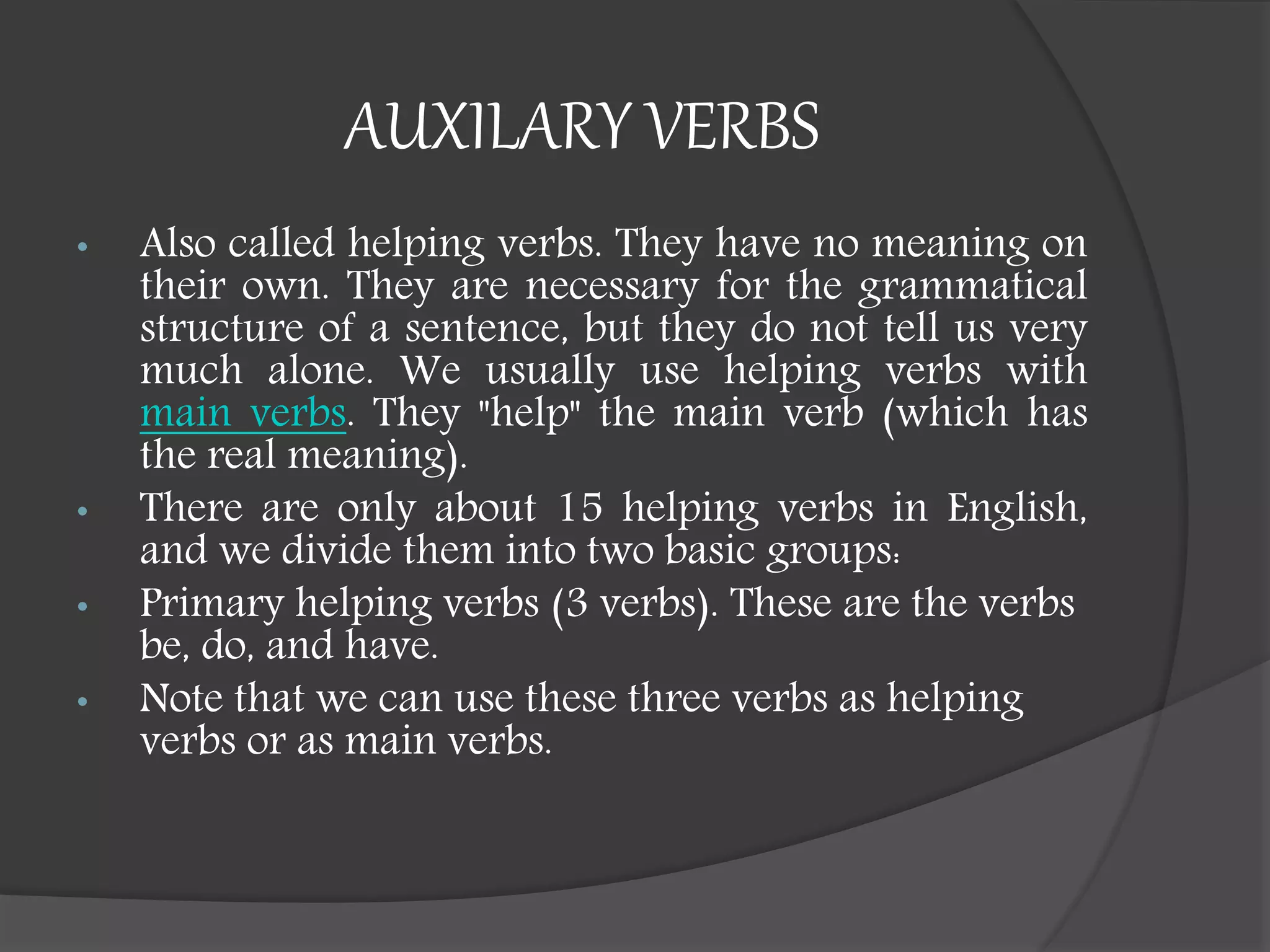
AUXILARY VERBS
• Alsocalled helping verbs. They have no meaning on
their own. They are necessary for the grammatical
structure of a sentence, but they do not tell us very
much alone. We usually use helping verbs with
main verbs. They "help" the main verb (which has
the real meaning).
• There are only about 15 helping verbs in English,
and we divide them into two basic groups:
• Primary helping verbs (3 verbs). These are the verbs
be, do, and have.
• Note that we can use these three verbs as helping
verbs or as main verbs.
27.
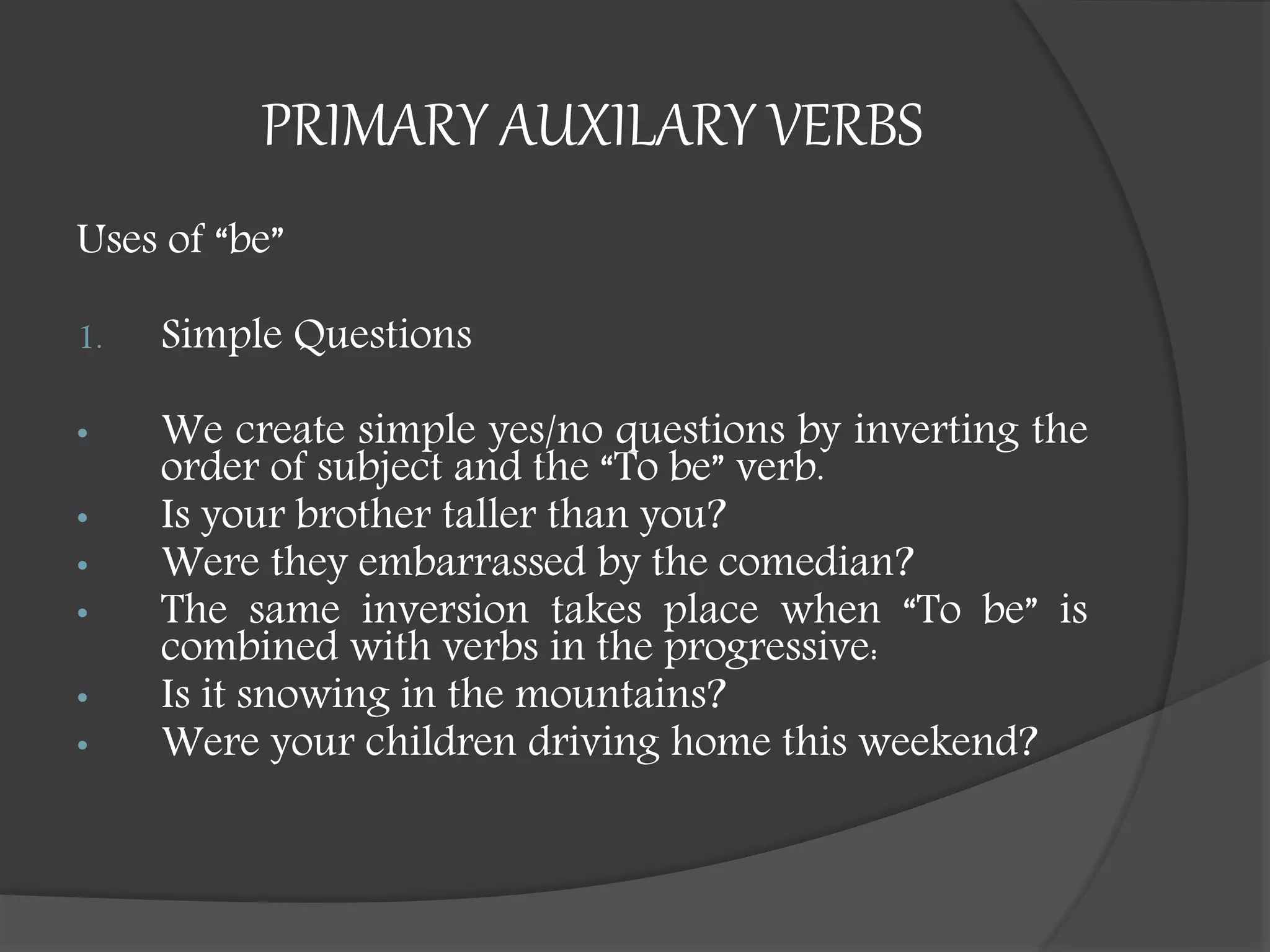
PRIMARY AUXILARY VERBS
Usesof “be”
1. Simple Questions
• We create simple yes/no questions by inverting the
order of subject and the “To be” verb.
• Is your brother taller than you?
• Were they embarrassed by the comedian?
• The same inversion takes place when “To be” is
combined with verbs in the progressive:
• Is it snowing in the mountains?
• Were your children driving home this weekend?
28.
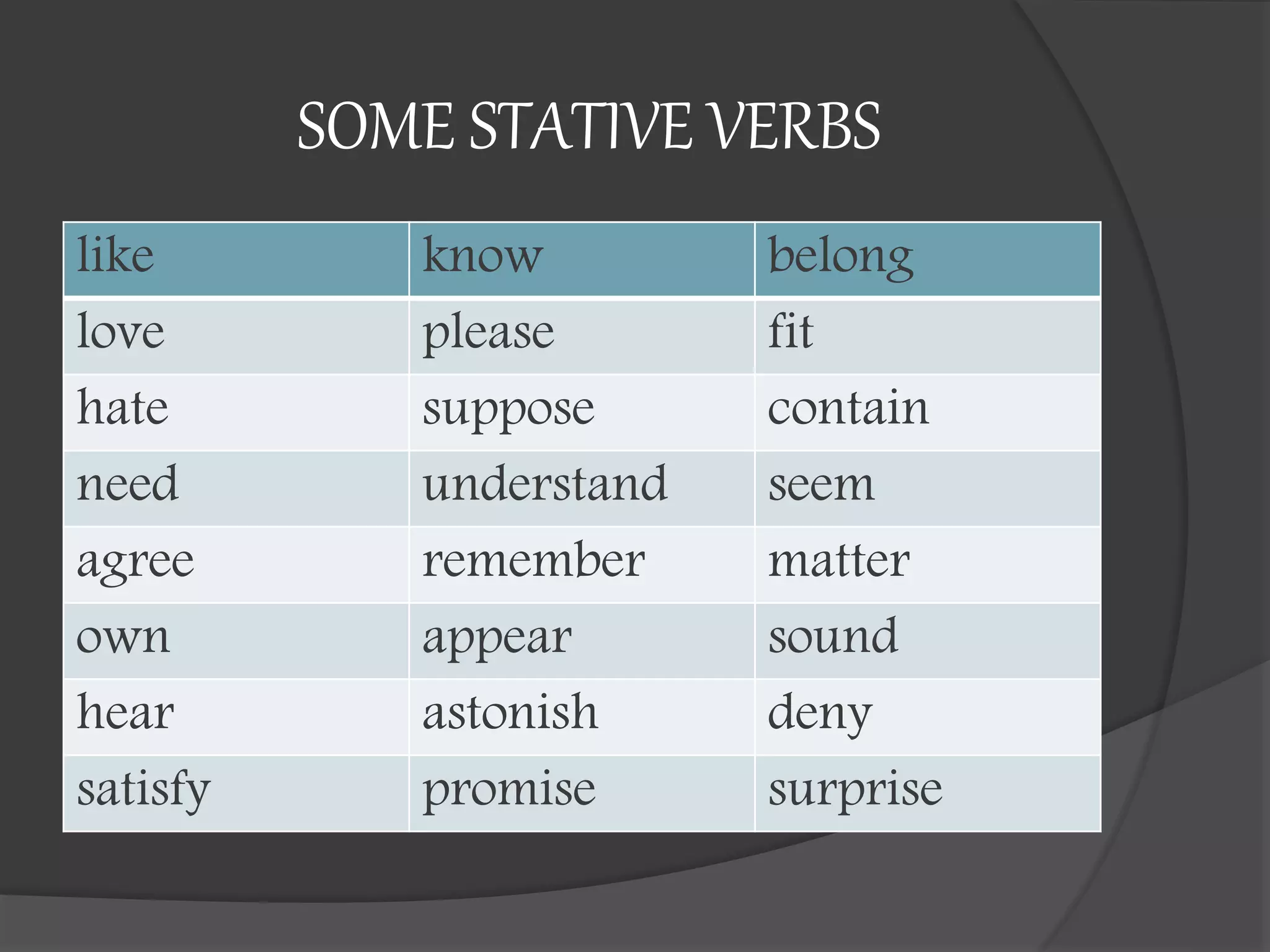
SOME STATIVE VERBS
likeknow belong
love please fit
hate suppose contain
need understand seem
agree remember matter
own appear sound
hear astonish deny
satisfy promise surprise
29.
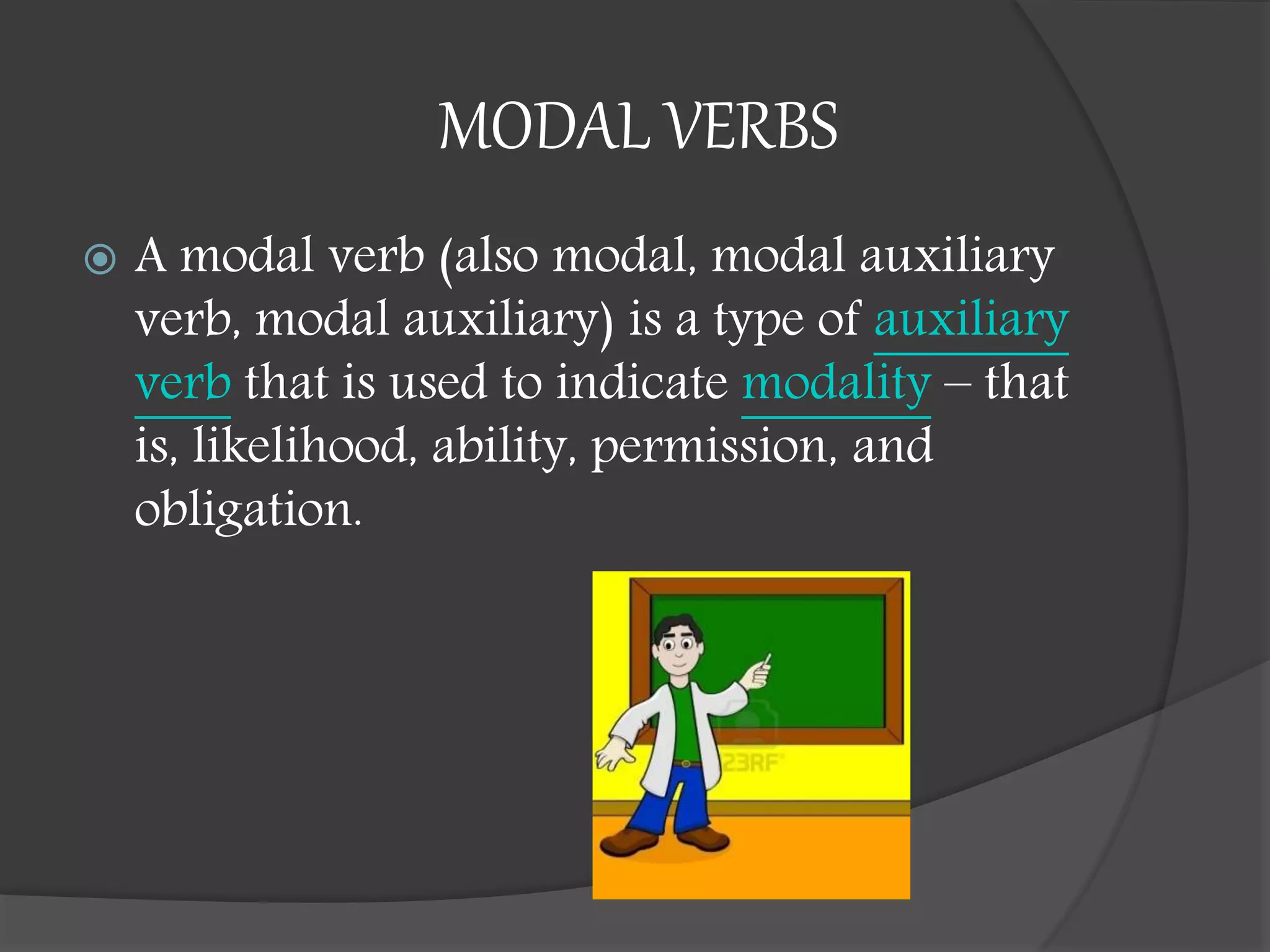
MODAL VERBS
Amodal verb (also modal, modal auxiliary
verb, modal auxiliary) is a type of auxiliary
verb that is used to indicate modality – that
is, likelihood, ability, permission, and
obligation.
30.
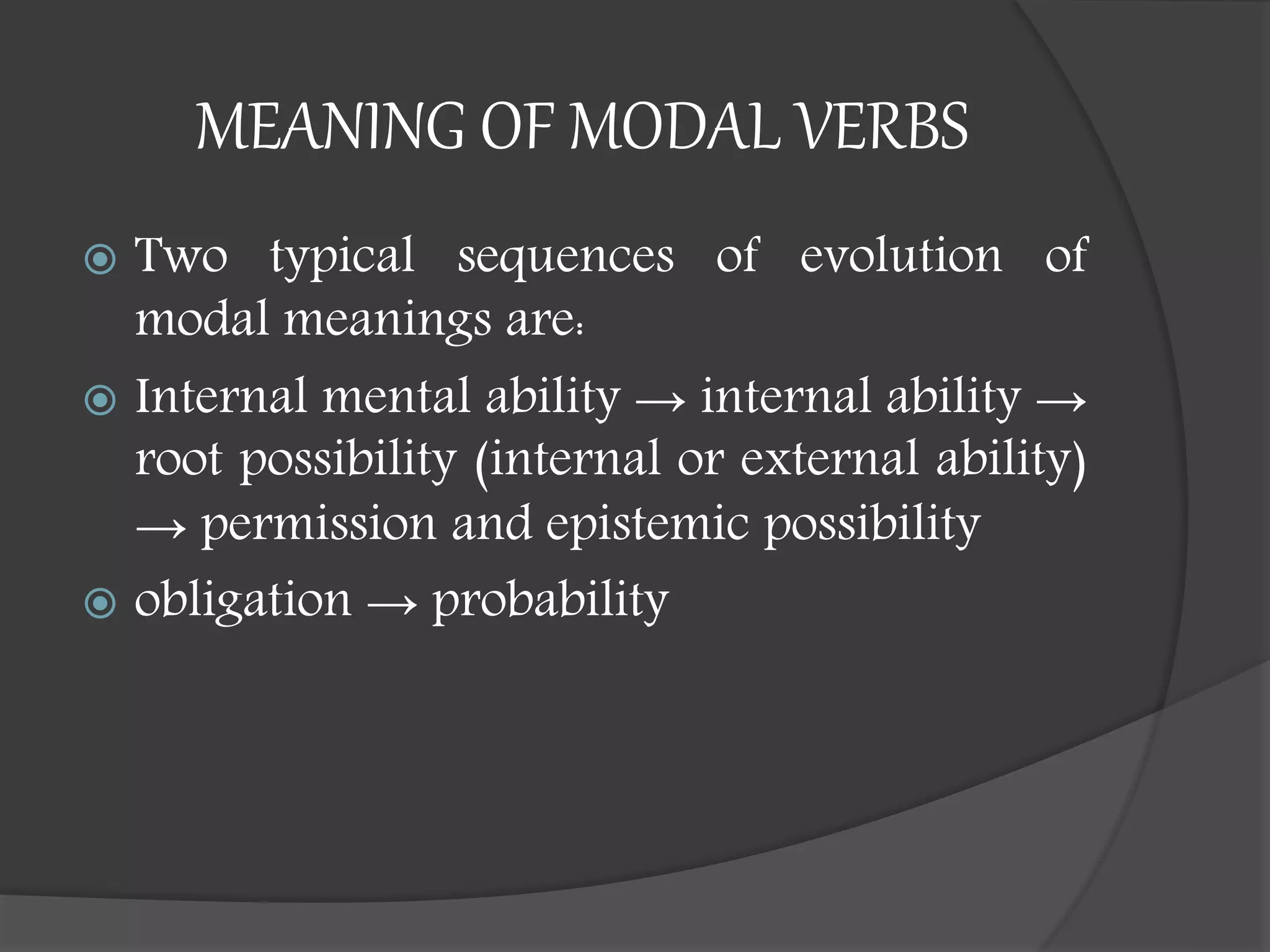
MEANING OF MODALVERBS
Two typical sequences of evolution of
modal meanings are:
Internal mental ability → internal ability →
root possibility (internal or external ability)
→ permission and epistemic possibility
obligation → probability
31.
EXAMPLES
Examples includethe English verbs
can/could, may/might, must, will/would,
and shall/should.
You shall not pass.
You should stop that.
She can really sing.
That may be a problem
Sam must go to school
32.
Thanks for viewing
Thanks for viewing my presentation. I hope you like it and
please don’t forget to like it and share it . Also comment if
u like it and if u don’t like comment so that I can do
correction in the presentation
Follow me- twITTER-@aryan31703







![FINITE VERB
Verbs which have the past or the present If
there is just one verb in a sentence, it is finite.
Finite verbs are sometimes called tensed verbs.
Examples of Finite Verb
1.Drive a car. [1st person, singular, present
tense]
2. He drives a car. [3rd person, singular.
present tense]
form are called FINITE verbs](https://image.slidesharecdn.com/engpresentationverb-141012053717-conversion-gate01/75/Eng-presentation-verb-23-2048.jpg)