Subject – Verb
   Agreement
 Why do subjects and verbs have to
agree? After all, they are only words!
Rules in Subject-Verb Agreement
1. Every verb must agree with its subject.

   Singular                                    Plural
   Subject                                    Subject


              Singular               Plural
                Verb                 Verb
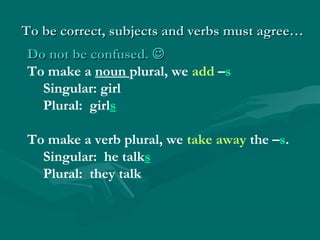
To be correct, subjects and verbs must agree…
Do not be confused. 
To make a noun plural, we add –s
  Singular: girl
  Plural: girls

To make a verb plural, we take away the –s.
  Singular: he talks
  Plural: they talk
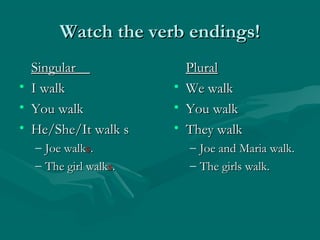
Watch the verb endings!
  Singular              Plural
• I walk              • We walk
• You walk            • You walk
• He/She/It walk s    • They walk
  – Joe walks.          – Joe and Maria walk.
  – The girl walks.     – The girls walk.
Rule Number 1
1. Generally, if the subject doesn’t end in –S,
                 the verb will.
If the subject does end in –S, the verb won’t.
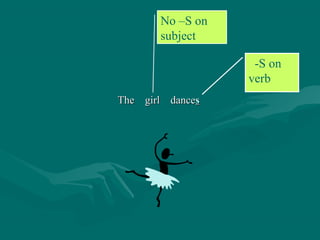
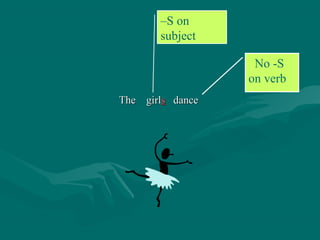
No –S on
       subject

                   -S on
                  verb
The girl dances
–S on
       subject

                   No -S
                  on verb
The girls dance
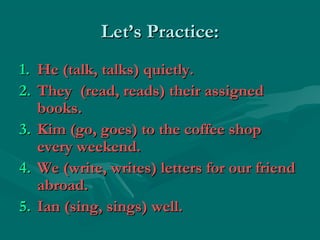
Let’s Practice:
1.   He (talk, talks) quietly.
2.   They (read, reads) their assigned
     books.
3.   Kim (go, goes) to the coffee shop
     every weekend.
4.   We (write, writes) letters for our friend
     abroad.
5.   Ian (sing, sings) well.
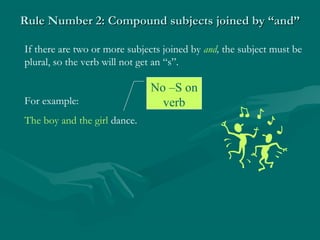
Rule Number 2: Compound subjects joined by “and”

If there are two or more subjects joined by and, the subject must be
plural, so the verb will not get an “s”.

                              No –S on
For example:                    verb
The boy and the girl dance.
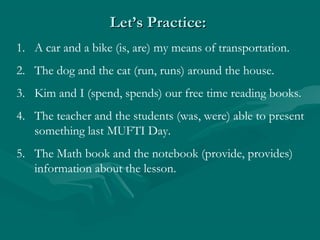
Let’s Practice:
1. A car and a bike (is, are) my means of transportation.
2. The dog and the cat (run, runs) around the house.
3. Kim and I (spend, spends) our free time reading books.
4. The teacher and the students (was, were) able to present
   something last MUFTI Day.
5. The Math book and the notebook (provide, provides)
   information about the lesson.
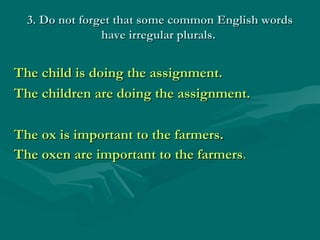
3. Do not forget that some common English words
                have irregular plurals.


The child is doing the assignment.
The children are doing the assignment.

The ox is important to the farmers.
The oxen are important to the farmers.
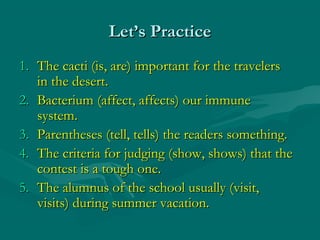
Let’s Practice
1. The cacti (is, are) important for the travelers
   in the desert.
2. Bacterium (affect, affects) our immune
   system.
3. Parentheses (tell, tells) the readers something.
4. The criteria for judging (show, shows) that the
   contest is a tough one.
5. The alumnus of the school usually (visit,
   visits) during summer vacation.
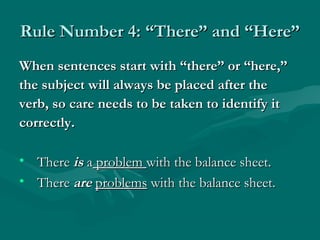
Rule Number 4: “There” and “Here”
When sentences start with “there” or “here,”
the subject will always be placed after the
verb, so care needs to be taken to identify it
correctly.

• There is a problem with the balance sheet.
• There are problems with the balance sheet.
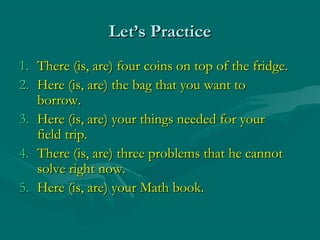
Let’s Practice
1. There (is, are) four coins on top of the fridge.
2. Here (is, are) the bag that you want to
   borrow.
3. Here (is, are) your things needed for your
   field trip.
4. There (is, are) three problems that he cannot
   solve right now.
5. Here (is, are) your Math book.
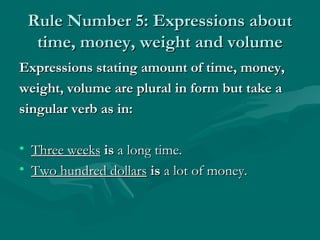
Rule Number 5: Expressions about
  time, money, weight and volume
Expressions stating amount of time, money,
weight, volume are plural in form but take a
singular verb as in:

• Three weeks is a long time.
• Two hundred dollars is a lot of money.
Let’s Practice

Subject- Verb Agreement Rules

  • 1.
    Subject – Verb Agreement Why do subjects and verbs have to agree? After all, they are only words!
  • 2.
    Rules in Subject-VerbAgreement 1. Every verb must agree with its subject. Singular Plural Subject Subject Singular Plural Verb Verb
  • 3.
    To be correct,subjects and verbs must agree… Do not be confused.  To make a noun plural, we add –s Singular: girl Plural: girls To make a verb plural, we take away the –s. Singular: he talks Plural: they talk
  • 4.
    Watch the verbendings! Singular Plural • I walk • We walk • You walk • You walk • He/She/It walk s • They walk – Joe walks. – Joe and Maria walk. – The girl walks. – The girls walk.
  • 5.
    Rule Number 1 1.Generally, if the subject doesn’t end in –S, the verb will. If the subject does end in –S, the verb won’t.
  • 6.
    No –S on subject -S on verb The girl dances
  • 7.
    –S on subject No -S on verb The girls dance
  • 8.
    Let’s Practice: 1. He (talk, talks) quietly. 2. They (read, reads) their assigned books. 3. Kim (go, goes) to the coffee shop every weekend. 4. We (write, writes) letters for our friend abroad. 5. Ian (sing, sings) well.
  • 9.
    Rule Number 2:Compound subjects joined by “and” If there are two or more subjects joined by and, the subject must be plural, so the verb will not get an “s”. No –S on For example: verb The boy and the girl dance.
  • 10.
    Let’s Practice: 1. Acar and a bike (is, are) my means of transportation. 2. The dog and the cat (run, runs) around the house. 3. Kim and I (spend, spends) our free time reading books. 4. The teacher and the students (was, were) able to present something last MUFTI Day. 5. The Math book and the notebook (provide, provides) information about the lesson.
  • 11.
    3. Do notforget that some common English words have irregular plurals. The child is doing the assignment. The children are doing the assignment. The ox is important to the farmers. The oxen are important to the farmers.
  • 12.
    Let’s Practice 1. Thecacti (is, are) important for the travelers in the desert. 2. Bacterium (affect, affects) our immune system. 3. Parentheses (tell, tells) the readers something. 4. The criteria for judging (show, shows) that the contest is a tough one. 5. The alumnus of the school usually (visit, visits) during summer vacation.
  • 13.
    Rule Number 4:“There” and “Here” When sentences start with “there” or “here,” the subject will always be placed after the verb, so care needs to be taken to identify it correctly. • There is a problem with the balance sheet. • There are problems with the balance sheet.
  • 14.
    Let’s Practice 1. There(is, are) four coins on top of the fridge. 2. Here (is, are) the bag that you want to borrow. 3. Here (is, are) your things needed for your field trip. 4. There (is, are) three problems that he cannot solve right now. 5. Here (is, are) your Math book.
  • 15.
    Rule Number 5:Expressions about time, money, weight and volume Expressions stating amount of time, money, weight, volume are plural in form but take a singular verb as in: • Three weeks is a long time. • Two hundred dollars is a lot of money.
  • 16.