RELATIVE
CLAUSES
U N I T 8 : B R A I N D R A I N
who where
whose
which
By Mohamed Lahbib KATHI
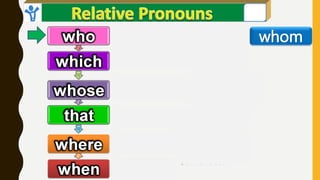
RELATIVE PRONOUNS
‫الموصولة‬ ‫األسماء‬
Do we
know
anything
about the
bank?
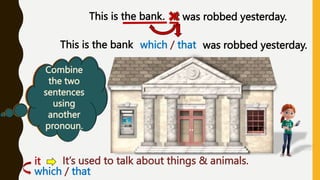
This is the bank. It was robbed yesterday.
Are the two
sentences
related?
When do
we use the
pronoun
« it »
Combine
the two
sentences
using
another
pronoun.
which / that
This is the bank was robbed yesterday.
it: It’s used to talk about things & animals.
which / that
Do we
know
anything
about the
girl?
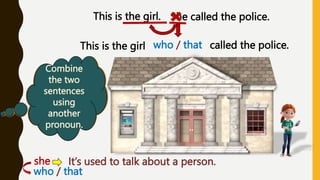
This is the girl. She called the police.
Are the two
sentences
related?
When do
we use the
pronoun
« she »
Combine
the two
sentences
using
another
pronoun.
who / that
This is the girl called the police.
she: It’s used to talk about a person.
who / that
Do we
know
anything
about the
p. station?
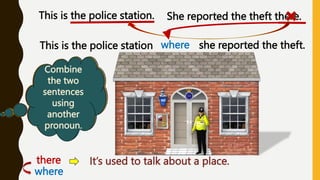
This is the police station. She reported the theft there.
Are the two
sentences
related?
When do
we use the
adverb
« there »
Combine
the two
sentences
using
another
pronoun.
where
This is the police station she reported the theft.
there: It’s used to talk about a place.
where
Do we
know
anything
about the
girl?
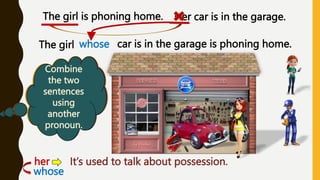
The girl is phoning home. Her car is in the garage.
Are the two
sentences
related?
When do
we use the
pronoun
« her »
Combine
the two
sentences
using
another
pronoun.
whose
The girl car is in the garage is phoning home.
her: It’s used to talk about possession.
whose
Do we
know
anything
about the
day?
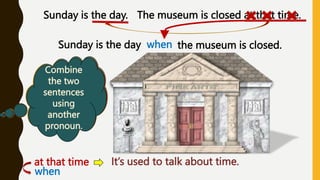
Sunday is the day. The museum is closed at that time.
Are the two
sentences
related?
When do
we use « at
that time »
Combine
the two
sentences
using
another
pronoun.
when
Sunday is the day the museum is closed.
at that time: It’s used to talk about time.
when
Do we
know
anything
about the
man?
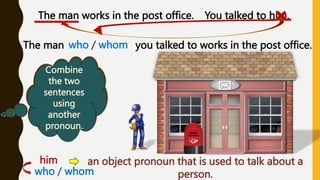
The man works in the post office. You talked to him.
Are the two
sentences
related?
When do
we use the
pronoun
« him »
Combine
the two
sentences
using
another
pronoun.
who / whom
The man you talked to works in the post office.
him: an object pronoun that is used to talk about a
person.
who / whom
whom
RELATIVE CLAUSES
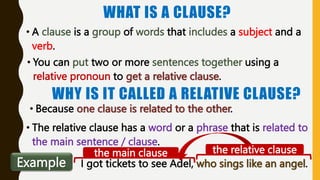
WHAT IS A CLAUSE?
• A clause is a group of words that includes a subject and a
verb.
WHY IS IT CALLED A RELATIVE CLAUSE?
• Because one clause is related to the other.
• You can put two or more sentences together using a
relative pronoun to get a relative clause.
• The relative clause has a word or a phrase that is related to
the main sentence / clause.
Example I got tickets to see Adel, who sings like an angel.
the relative clause
the main clause
Are all children likely to be
healthy?
1. Does the clause give us
important information?
2. Are commas (,) used?
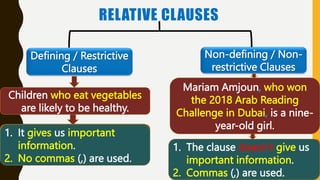
RELATIVE CLAUSES
Defining / Restrictive
Clauses
Non-defining / Non-
restrictive Clauses
Children who eat vegetables
are likely to be healthy.
1. It gives us important
information.
2. No commas (,) are used.
Mariam Amjoun, who won
the 2018 Arab Reading
Challenge in Dubai, is a nine-
year-old girl.
Do we know the girl?
1. Does the clause give us
important information?
2. Are commas (,) used?
1. The clause doesn’t give us
important information.
2. Commas (,) are used.
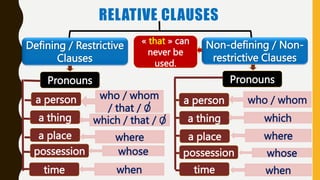
Pronouns
RELATIVE CLAUSES
Defining / Restrictive
Clauses
Non-defining / Non-
restrictive Clauses
Pronouns
a person
a thing
a place
possession
time
who / whom
/ that / Ο
which / that / Ο
where
whose
when
a person
a thing
a place
possession
time
who / whom
which
where
whose
when
« that » can
never be
used.
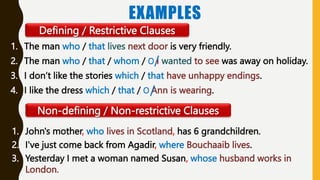
EXAMPLES
1. The man who / that lives next door is very friendly.
2. The man who / that / whom / Ο I wanted to see was away on holiday.
3. I don’t like the stories which / that have unhappy endings.
4. I like the dress which / that / Ο Ann is wearing.
Defining / Restrictive Clauses
Non-defining / Non-restrictive Clauses
1. John's mother, who lives in Scotland, has 6 grandchildren.
2. I've just come back from Agadir, where Bouchaaib lives.
3. Yesterday I met a woman named Susan, whose husband works in
London.
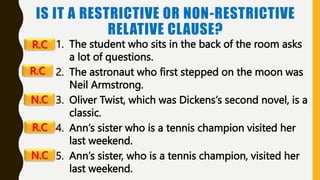
IS IT A RESTRICTIVE OR NON-RESTRICTIVE
RELATIVE CLAUSE?
1. The student who sits in the back of the room asks
a lot of questions.
2. The astronaut who first stepped on the moon was
Neil Armstrong.
3. Oliver Twist, which was Dickens’s second novel, is a
classic.
4. Ann’s sister who is a tennis champion visited her
last weekend.
5. Ann’s sister, who is a tennis champion, visited her
last weekend.
R.C
R.C
N.C
R.C
N.C
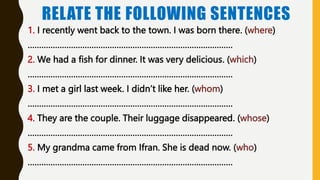
RELATE THE FOLLOWING SENTENCES
1. I recently went back to the town. I was born there. (where)
………………………………………………………………………………
2. We had a fish for dinner. It was very delicious. (which)
………………………………………………………………………………
3. I met a girl last week. I didn’t like her. (whom)
………………………………………………………………………………
4. They are the couple. Their luggage disappeared. (whose)
………………………………………………………………………………
5. My grandma came from Ifran. She is dead now. (who)
………………………………………………………………………………

restrictive-and-nonrestrictive-relative-clauses-excelent file.pptx

  • 1.
    RELATIVE CLAUSES U N IT 8 : B R A I N D R A I N who where whose which By Mohamed Lahbib KATHI
  • 2.
  • 3.
    Do we know anything about the bank? Thisis the bank. It was robbed yesterday. Are the two sentences related? When do we use the pronoun « it » Combine the two sentences using another pronoun. which / that This is the bank was robbed yesterday. it: It’s used to talk about things & animals. which / that
  • 4.
    Do we know anything about the girl? Thisis the girl. She called the police. Are the two sentences related? When do we use the pronoun « she » Combine the two sentences using another pronoun. who / that This is the girl called the police. she: It’s used to talk about a person. who / that
  • 5.
    Do we know anything about the p.station? This is the police station. She reported the theft there. Are the two sentences related? When do we use the adverb « there » Combine the two sentences using another pronoun. where This is the police station she reported the theft. there: It’s used to talk about a place. where
  • 6.
    Do we know anything about the girl? Thegirl is phoning home. Her car is in the garage. Are the two sentences related? When do we use the pronoun « her » Combine the two sentences using another pronoun. whose The girl car is in the garage is phoning home. her: It’s used to talk about possession. whose
  • 7.
    Do we know anything about the day? Sundayis the day. The museum is closed at that time. Are the two sentences related? When do we use « at that time » Combine the two sentences using another pronoun. when Sunday is the day the museum is closed. at that time: It’s used to talk about time. when
  • 8.
    Do we know anything about the man? Theman works in the post office. You talked to him. Are the two sentences related? When do we use the pronoun « him » Combine the two sentences using another pronoun. who / whom The man you talked to works in the post office. him: an object pronoun that is used to talk about a person. who / whom
  • 9.
  • 10.
  • 11.
    WHAT IS ACLAUSE? • A clause is a group of words that includes a subject and a verb. WHY IS IT CALLED A RELATIVE CLAUSE? • Because one clause is related to the other. • You can put two or more sentences together using a relative pronoun to get a relative clause. • The relative clause has a word or a phrase that is related to the main sentence / clause. Example I got tickets to see Adel, who sings like an angel. the relative clause the main clause
  • 12.
    Are all childrenlikely to be healthy? 1. Does the clause give us important information? 2. Are commas (,) used? RELATIVE CLAUSES Defining / Restrictive Clauses Non-defining / Non- restrictive Clauses Children who eat vegetables are likely to be healthy. 1. It gives us important information. 2. No commas (,) are used. Mariam Amjoun, who won the 2018 Arab Reading Challenge in Dubai, is a nine- year-old girl. Do we know the girl? 1. Does the clause give us important information? 2. Are commas (,) used? 1. The clause doesn’t give us important information. 2. Commas (,) are used.
  • 13.
    Pronouns RELATIVE CLAUSES Defining /Restrictive Clauses Non-defining / Non- restrictive Clauses Pronouns a person a thing a place possession time who / whom / that / Ο which / that / Ο where whose when a person a thing a place possession time who / whom which where whose when « that » can never be used.
  • 14.
    EXAMPLES 1. The manwho / that lives next door is very friendly. 2. The man who / that / whom / Ο I wanted to see was away on holiday. 3. I don’t like the stories which / that have unhappy endings. 4. I like the dress which / that / Ο Ann is wearing. Defining / Restrictive Clauses Non-defining / Non-restrictive Clauses 1. John's mother, who lives in Scotland, has 6 grandchildren. 2. I've just come back from Agadir, where Bouchaaib lives. 3. Yesterday I met a woman named Susan, whose husband works in London.
  • 15.
    IS IT ARESTRICTIVE OR NON-RESTRICTIVE RELATIVE CLAUSE? 1. The student who sits in the back of the room asks a lot of questions. 2. The astronaut who first stepped on the moon was Neil Armstrong. 3. Oliver Twist, which was Dickens’s second novel, is a classic. 4. Ann’s sister who is a tennis champion visited her last weekend. 5. Ann’s sister, who is a tennis champion, visited her last weekend. R.C R.C N.C R.C N.C
  • 16.
    RELATE THE FOLLOWINGSENTENCES 1. I recently went back to the town. I was born there. (where) ……………………………………………………………………………… 2. We had a fish for dinner. It was very delicious. (which) ……………………………………………………………………………… 3. I met a girl last week. I didn’t like her. (whom) ……………………………………………………………………………… 4. They are the couple. Their luggage disappeared. (whose) ……………………………………………………………………………… 5. My grandma came from Ifran. She is dead now. (who) ………………………………………………………………………………