DEFINITION
   Function words (closed class
    words/grammatical words) are words
    that have little meaning in the dictionary
    sense but which serve important
    functions to express grammatical
    relationship with other words within a
    sentence.
KINDS OF FUNCTION
WORD
 Articles
 Auxiliary verbs
 Conjunctions
 Determiners
 Intensifiers
 Prepositions
 Pronouns
 Intensifiers
ARTICLES
Article is a type of determiner that precedes a
   noun.
There are two types of article in English:
 definite article (the)
   The definite article is a determiner that refers
   to a particular person or thing.
   The may be used with a singular or a plural
   noun.
 indefinite (a/an)
   The indefinite article is a determiner which
   marks an unspecified count noun. A/an is
   generally used with a single countable noun.
Cont…definite article
The can refer . . .
 back to another noun:
  She bought a car and a bike, but she
  used the bike more.
 to human institutions that we
  sporadically use, attend, observe, etc.
  I went to the theatre.
  I watched the news on TV.
Cont…indefinite article
 Use a before a word that starts with a
  consonant sound ("a bat," "a unicorn")
 Use an before a word that starts with a
  vowel sound ("an uncle," "an hour").
AUXILIARY VERBS
 Auxiliary verbs are “helping” verbs that
  combine with various parts of other
  verbs to make verb phrases.
 Kinds of auxiliary verb: be, have, do,
  modals
The verb "be"
   The verb be can be used as an auxiliary and a
    full verb. As an auxiliary we use this verb for -
    ing present participle and the passive voice.
    Note that be is an irregular verb:
         is, am, are
         was, were
         be, been
   He is playing football. (aux. verb)
   The house is/was built. (aux. verb)
   He had been playing football. (aux. verb)
   They are fifteen years old. (full verb)
The verb "have"
   The verb have can be used both as an
    auxiliary and as a full verb. As an auxiliary we
    use this verb to form compound tenses
    (perfect tense) in active and passive voice.
    he/she/it         : has
                                       Present Tense
    the/we/I/you      : have
    he/she/it/they/we/I/you: had (past tense)
   He has played football.
   He had played football.
   The house has/had been built.
   I have a car. (full verb)
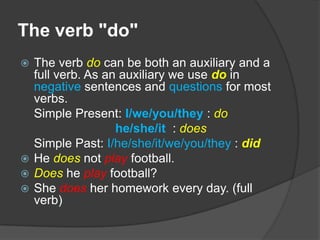
The verb "do"
 The verb do can be both an auxiliary and a
  full verb. As an auxiliary we use do in
  negative sentences and questions for most
  verbs.
  Simple Present: I/we/you/they : do
                  he/she/it : does
  Simple Past: I/he/she/it/we/you/they : did
 He does not play football.
 Does he play football?
 She does her homework every day. (full
  verb)
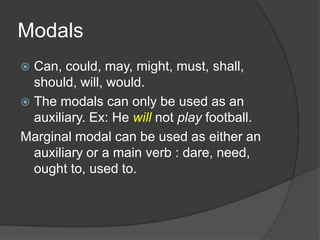
Modals
 Can, could, may, might, must, shall,
  should, will, would.
 The modals can only be used as an
  auxiliary. Ex: He will not play football.
Marginal modal can be used as either an
  auxiliary or a main verb : dare, need,
  ought to, used to.
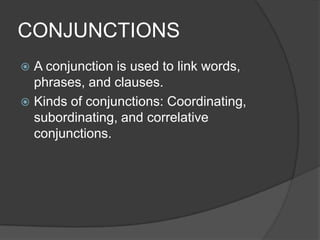
CONJUNCTIONS
 A conjunction is used to link words,
  phrases, and clauses.
 Kinds of conjunctions: Coordinating,
  subordinating, and correlative
  conjunctions.
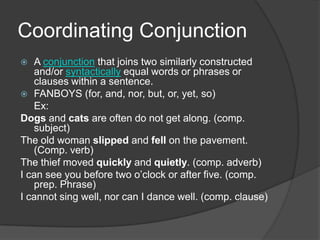
Coordinating Conjunction
  A conjunction that joins two similarly constructed
   and/or syntactically equal words or phrases or
   clauses within a sentence.
 FANBOYS (for, and, nor, but, or, yet, so)
   Ex:
Dogs and cats are often do not get along. (comp.
   subject)
The old woman slipped and fell on the pavement.
   (Comp. verb)
The thief moved quickly and quietly. (comp. adverb)
I can see you before two o’clock or after five. (comp.
   prep. Phrase)
I cannot sing well, nor can I dance well. (comp. clause)
Subordinating Conjunction
 A conjunction that introduces a
  dependent clause.
 If I have much money, I will buy many
  books.
 Although I have many friends, I feel
  lonely.
Correlative Conjunction
   A paired conjunction that links balanced
    words, phrases, and clauses.
   The elements connected by correlative
    conjunctions are usually parallel--that is,
    similar in length and grammatical form.
   These are the primary correlative conjunctions
    in English:
    both . . . and
    either . . . or
    neither . . . nor
    not . . . but
    not only . . . but also
Example

 Both Mark and I do the assignment.
 Not only the woman but (also) the man
  loved this strange little man.
 She will either pay for the ring or return
  it.
 Neither money nor power has made
  him arrogant.
DETERMINERS
   A word or a group of words that introduces
    a noun. Determiners include articles,
    demonstratives, quantifiers, and
    possessive determiners.
   Article: the, a/an
   Demonstratives: this, that, these, those
   Quantifiers: all, some, much, many, a lot of,
    etc.
   Possessive determiners in English are my,
    your, his, her, its, our, and their.
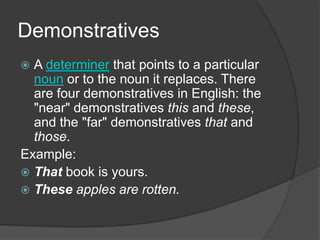
Demonstratives
 A determiner that points to a particular
  noun or to the noun it replaces. There
  are four demonstratives in English: the
  "near" demonstratives this and these,
  and the "far" demonstratives that and
  those.
Example:
 That book is yours.
 These apples are rotten.
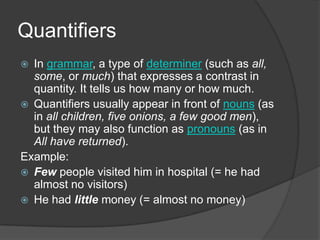
Quantifiers
 In grammar, a type of determiner (such as all,
  some, or much) that expresses a contrast in
  quantity. It tells us how many or how much.
 Quantifiers usually appear in front of nouns (as
  in all children, five onions, a few good men),
  but they may also function as pronouns (as in
  All have returned).
Example:
 Few people visited him in hospital (= he had
  almost no visitors)
 He had little money (= almost no money)
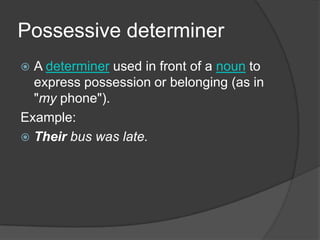
Possessive determiner
 A determiner used in front of a noun to
  express possession or belonging (as in
  "my phone").
Example:
 Their bus was late.
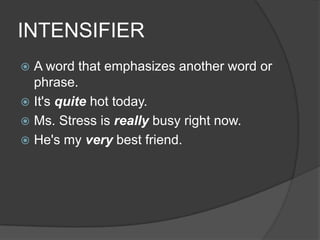
INTENSIFIER
 A word that emphasizes another word or
  phrase.
 It's quite hot today.
 Ms. Stress is really busy right now.
 He's my very best friend.
PREPOSITIONS
 Prepositions are the words that indicate
  location. Usually, prepositions show this
  location in the physical world.
Example:
 The puppy is on the floor.
 The puppy is in the trash can.
 The puppy is beside the phone.
 Prepositions can also show location in time.
  Pay attention the next three examples:
 At midnight, Jill craved mashed potatoes with
  grape jelly.
 In the spring, I always vow to plant tomatoes
  but end up buying them at the supermarket.
 During the marathon, Iggy's legs complained
  with sharp pains shooting up his thighs.
Note: but means the same as except—Everyone
  ate frog legs but Jamie
PRONOUNS
   A word that takes the place of a noun,
    noun phrase, or noun clause.
Personal Pronouns

A personal pronoun refers to a specific person or thing
   and changes its form to indicate person, number,
   gender, and case.
 A subjective personal pronoun indicates that the
   pronoun is acting as the subject of the sentence. The
   subjective personal pronouns are "I," "you," "she,"
   "he," "it," "we," "you," "they.“
Example:
 I was glad to find the bus pass in the bottom of the
   green knapsack.
 You are surely the strangest child I have ever met.
 An objective personal pronoun
  indicates that the pronoun is acting as
  an object of a verb, compound verb,
  preposition, or infinitive phrase. The
  objective personal pronouns are: "me,"
  "you," "her," "him," "it," "us," "you," and
  "them."
Example:
 After reading the pamphlet, Judy threw
  it into the garbage can.
 A possessive pronoun indicates that
  the pronoun is acting as a marker of
  possession and defines who owns a
  particular object or person. The
  possessive personal pronouns are
  "mine," "yours," "hers," "his," "its,"
  "ours," and "theirs.“
Example:
 The smallest gift is mine.
 A demonstrative pronoun points to
  and identifies a noun or a pronoun.
  "This" and "these" refer to things that
  are nearby either in space or in time,
  while "that" and "those" refer to things
  that are farther away in space or time.
Example:
 This must not continue.
 An interrogative pronoun is used to
  ask questions. The interrogative
  pronouns are "who," "whom," "which,"
  "what" and the compounds formed with
  the suffix "ever" ("whoever,"
  "whomever," "whichever," and
  "whatever").
Example:
 Whom do you think we should invite?
 Whoever told you to do such a thing?
 a relative pronoun is used to link one
  phrase or clause to another phrase or
  clause. The relative pronouns are "who,"
  "whom," "that," and "which." The
  compounds "whoever," "whomever," and
  "whichever" are also relative pronouns.
Example:
 The man who answered the phone was
  rude.
 You may invite whomever you like to the
  party.
 An indefinite pronoun is a pronoun referring to an
  identifiable but not specified person or thing. An
  indefinite pronoun conveys the idea of all, any, none,
  or some.
 The most common indefinite pronouns are "all,"
  "another," "any," "anybody," "anyone," "anything,"
  "each," "everybody," "everyone," "everything," "few,"
  "many," "nobody," "none," "one," "several," "some,"
  "somebody,“
Example:
 Many were invited to the lunch but only twelve
  showed up.
 A reflexive pronoun is used to refer back
  to the subject of the clause or sentence.
 The reflexive pronouns are "myself,"
  "yourself," "herself," "himself," "itself,"
  "ourselves," "yourselves," and
  "themselves." Note each of these can also
  act as an intensive pronoun.
Example:
 After the party, I asked myself why I had
  faxed invitations to everyone in my office
  building.
 An intensive pronoun is a pronoun
  used to emphasize its antecedent.
  Intensive pronouns are identical in form
  to reflexive pronouns.
Example:
 They themselves promised to come to
  the party even though they had a final
  exam at the same time.
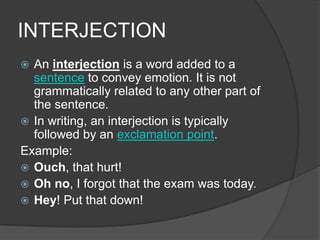
INTERJECTION
 An interjection is a word added to a
  sentence to convey emotion. It is not
  grammatically related to any other part of
  the sentence.
 In writing, an interjection is typically
  followed by an exclamation point.
Example:
 Ouch, that hurt!
 Oh no, I forgot that the exam was today.
 Hey! Put that down!
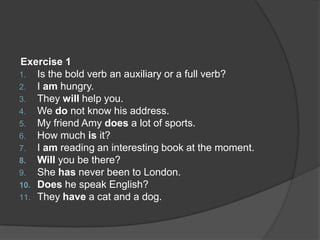
Exercise 1
1. Is the bold verb an auxiliary or a full verb?
2. I am hungry.
3. They will help you.
4. We do not know his address.
5. My friend Amy does a lot of sports.
6. How much is it?
7. I am reading an interesting book at the moment.
8. Will you be there?
9. She has never been to London.
10. Does he speak English?
11. They have a cat and a dog.

Function words & content words

  • 2.
    DEFINITION  Function words (closed class words/grammatical words) are words that have little meaning in the dictionary sense but which serve important functions to express grammatical relationship with other words within a sentence.
  • 3.
    KINDS OF FUNCTION WORD Articles  Auxiliary verbs  Conjunctions  Determiners  Intensifiers  Prepositions  Pronouns  Intensifiers
  • 4.
    ARTICLES Article is atype of determiner that precedes a noun. There are two types of article in English:  definite article (the) The definite article is a determiner that refers to a particular person or thing. The may be used with a singular or a plural noun.  indefinite (a/an) The indefinite article is a determiner which marks an unspecified count noun. A/an is generally used with a single countable noun.
  • 5.
    Cont…definite article The canrefer . . .  back to another noun: She bought a car and a bike, but she used the bike more.  to human institutions that we sporadically use, attend, observe, etc. I went to the theatre. I watched the news on TV.
  • 6.
    Cont…indefinite article  Usea before a word that starts with a consonant sound ("a bat," "a unicorn")  Use an before a word that starts with a vowel sound ("an uncle," "an hour").
  • 7.
    AUXILIARY VERBS  Auxiliaryverbs are “helping” verbs that combine with various parts of other verbs to make verb phrases.  Kinds of auxiliary verb: be, have, do, modals
  • 8.
    The verb "be"  The verb be can be used as an auxiliary and a full verb. As an auxiliary we use this verb for - ing present participle and the passive voice. Note that be is an irregular verb: is, am, are was, were be, been  He is playing football. (aux. verb)  The house is/was built. (aux. verb)  He had been playing football. (aux. verb)  They are fifteen years old. (full verb)
  • 9.
    The verb "have"  The verb have can be used both as an auxiliary and as a full verb. As an auxiliary we use this verb to form compound tenses (perfect tense) in active and passive voice. he/she/it : has Present Tense the/we/I/you : have he/she/it/they/we/I/you: had (past tense)  He has played football.  He had played football.  The house has/had been built.  I have a car. (full verb)
  • 10.
    The verb "do" The verb do can be both an auxiliary and a full verb. As an auxiliary we use do in negative sentences and questions for most verbs. Simple Present: I/we/you/they : do he/she/it : does Simple Past: I/he/she/it/we/you/they : did  He does not play football.  Does he play football?  She does her homework every day. (full verb)
  • 11.
    Modals  Can, could,may, might, must, shall, should, will, would.  The modals can only be used as an auxiliary. Ex: He will not play football. Marginal modal can be used as either an auxiliary or a main verb : dare, need, ought to, used to.
  • 12.
    CONJUNCTIONS  A conjunctionis used to link words, phrases, and clauses.  Kinds of conjunctions: Coordinating, subordinating, and correlative conjunctions.
  • 13.
    Coordinating Conjunction  A conjunction that joins two similarly constructed and/or syntactically equal words or phrases or clauses within a sentence.  FANBOYS (for, and, nor, but, or, yet, so) Ex: Dogs and cats are often do not get along. (comp. subject) The old woman slipped and fell on the pavement. (Comp. verb) The thief moved quickly and quietly. (comp. adverb) I can see you before two o’clock or after five. (comp. prep. Phrase) I cannot sing well, nor can I dance well. (comp. clause)
  • 14.
    Subordinating Conjunction  Aconjunction that introduces a dependent clause.  If I have much money, I will buy many books.  Although I have many friends, I feel lonely.
  • 15.
    Correlative Conjunction  A paired conjunction that links balanced words, phrases, and clauses.  The elements connected by correlative conjunctions are usually parallel--that is, similar in length and grammatical form.  These are the primary correlative conjunctions in English: both . . . and either . . . or neither . . . nor not . . . but not only . . . but also
  • 16.
    Example  Both Markand I do the assignment.  Not only the woman but (also) the man loved this strange little man.  She will either pay for the ring or return it.  Neither money nor power has made him arrogant.
  • 17.
    DETERMINERS  A word or a group of words that introduces a noun. Determiners include articles, demonstratives, quantifiers, and possessive determiners.  Article: the, a/an  Demonstratives: this, that, these, those  Quantifiers: all, some, much, many, a lot of, etc.  Possessive determiners in English are my, your, his, her, its, our, and their.
  • 18.
    Demonstratives  A determinerthat points to a particular noun or to the noun it replaces. There are four demonstratives in English: the "near" demonstratives this and these, and the "far" demonstratives that and those. Example:  That book is yours.  These apples are rotten.
  • 19.
    Quantifiers  In grammar,a type of determiner (such as all, some, or much) that expresses a contrast in quantity. It tells us how many or how much.  Quantifiers usually appear in front of nouns (as in all children, five onions, a few good men), but they may also function as pronouns (as in All have returned). Example:  Few people visited him in hospital (= he had almost no visitors)  He had little money (= almost no money)
  • 20.
    Possessive determiner  Adeterminer used in front of a noun to express possession or belonging (as in "my phone"). Example:  Their bus was late.
  • 21.
    INTENSIFIER  A wordthat emphasizes another word or phrase.  It's quite hot today.  Ms. Stress is really busy right now.  He's my very best friend.
  • 22.
    PREPOSITIONS  Prepositions arethe words that indicate location. Usually, prepositions show this location in the physical world. Example:  The puppy is on the floor.  The puppy is in the trash can.  The puppy is beside the phone.
  • 23.
     Prepositions canalso show location in time. Pay attention the next three examples:  At midnight, Jill craved mashed potatoes with grape jelly.  In the spring, I always vow to plant tomatoes but end up buying them at the supermarket.  During the marathon, Iggy's legs complained with sharp pains shooting up his thighs. Note: but means the same as except—Everyone ate frog legs but Jamie
  • 24.
    PRONOUNS  A word that takes the place of a noun, noun phrase, or noun clause.
  • 25.
    Personal Pronouns A personalpronoun refers to a specific person or thing and changes its form to indicate person, number, gender, and case.  A subjective personal pronoun indicates that the pronoun is acting as the subject of the sentence. The subjective personal pronouns are "I," "you," "she," "he," "it," "we," "you," "they.“ Example:  I was glad to find the bus pass in the bottom of the green knapsack.  You are surely the strangest child I have ever met.
  • 26.
     An objectivepersonal pronoun indicates that the pronoun is acting as an object of a verb, compound verb, preposition, or infinitive phrase. The objective personal pronouns are: "me," "you," "her," "him," "it," "us," "you," and "them." Example:  After reading the pamphlet, Judy threw it into the garbage can.
  • 27.
     A possessivepronoun indicates that the pronoun is acting as a marker of possession and defines who owns a particular object or person. The possessive personal pronouns are "mine," "yours," "hers," "his," "its," "ours," and "theirs.“ Example:  The smallest gift is mine.
  • 28.
     A demonstrativepronoun points to and identifies a noun or a pronoun. "This" and "these" refer to things that are nearby either in space or in time, while "that" and "those" refer to things that are farther away in space or time. Example:  This must not continue.
  • 29.
     An interrogativepronoun is used to ask questions. The interrogative pronouns are "who," "whom," "which," "what" and the compounds formed with the suffix "ever" ("whoever," "whomever," "whichever," and "whatever"). Example:  Whom do you think we should invite?  Whoever told you to do such a thing?
  • 30.
     a relativepronoun is used to link one phrase or clause to another phrase or clause. The relative pronouns are "who," "whom," "that," and "which." The compounds "whoever," "whomever," and "whichever" are also relative pronouns. Example:  The man who answered the phone was rude.  You may invite whomever you like to the party.
  • 31.
     An indefinitepronoun is a pronoun referring to an identifiable but not specified person or thing. An indefinite pronoun conveys the idea of all, any, none, or some.  The most common indefinite pronouns are "all," "another," "any," "anybody," "anyone," "anything," "each," "everybody," "everyone," "everything," "few," "many," "nobody," "none," "one," "several," "some," "somebody,“ Example:  Many were invited to the lunch but only twelve showed up.
  • 32.
     A reflexivepronoun is used to refer back to the subject of the clause or sentence.  The reflexive pronouns are "myself," "yourself," "herself," "himself," "itself," "ourselves," "yourselves," and "themselves." Note each of these can also act as an intensive pronoun. Example:  After the party, I asked myself why I had faxed invitations to everyone in my office building.
  • 33.
     An intensivepronoun is a pronoun used to emphasize its antecedent. Intensive pronouns are identical in form to reflexive pronouns. Example:  They themselves promised to come to the party even though they had a final exam at the same time.
  • 34.
    INTERJECTION  An interjectionis a word added to a sentence to convey emotion. It is not grammatically related to any other part of the sentence.  In writing, an interjection is typically followed by an exclamation point. Example:  Ouch, that hurt!  Oh no, I forgot that the exam was today.  Hey! Put that down!
  • 35.
    Exercise 1 1. Isthe bold verb an auxiliary or a full verb? 2. I am hungry. 3. They will help you. 4. We do not know his address. 5. My friend Amy does a lot of sports. 6. How much is it? 7. I am reading an interesting book at the moment. 8. Will you be there? 9. She has never been to London. 10. Does he speak English? 11. They have a cat and a dog.