What is a Verb?
A verb express action, events, or states of being. Many verbs
give the idea of action, of "doing" something.
0 Run, fight and work.
But some verbs do not give the idea of action; they give the
idea of existence, of state, of "being".
0 Be, exist, seem and belong.
A verb always has a subject.
0 John speaks english.
Verb Classification
0 Helping verbs
0 Main verbs
Helping verbs
Auxiliary verbs.
Helping verbs have no meaning on their own.
We usually use helping verbs with main verbs. They
"help" the main verb .
0 Primary helping verbs.
0 Modal helping verbs.
Primary helping verbs
0 Be
To make continuous tenses = He is watching TV.
To make the passive = Small fish are eaten by big fish.
0 Have
to make perfect tenses = I have finished my homework.
0 Do
To make negatives = I do not like you.
To ask questions = Do you want some coffee?
To show emphasis = I do want you to pass your exam.
To stand for a main verb in some constructions = He speaks
faster than she does.
Modal helping verbs
We use modal helping verbs to "modify" the meaning of the
main verb in some way.
Can, could, may, might, will, would, shall, should, must, ought to.
Here are examples using modal verbs:
0 I can't speak Chinese.
0 John may arrive late.
0 Would you like a cup of coffee?
0 You should see a doctor.
0 I really must go now.
Main verb
Main verbs have meaning on their own.
0 Transitive and intransitive verbs.
0 Linking verbs
0 Dynamic and stative verbs.
0 Regular and irregular verbs
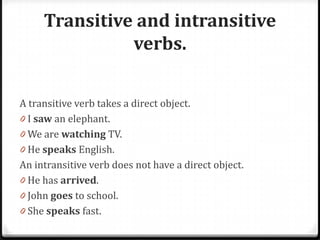
Transitive and intransitive
verbs.
A transitive verb takes a direct object.
0 I saw an elephant.
0 We are watching TV.
0 He speaks English.
An intransitive verb does not have a direct object.
0 He has arrived.
0 John goes to school.
0 She speaks fast.
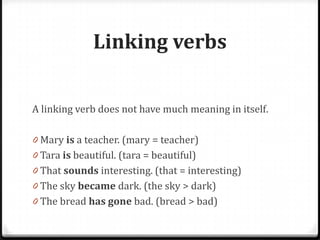
Linking verbs
A linking verb does not have much meaning in itself.
0 Mary is a teacher. (mary = teacher)
0 Tara is beautiful. (tara = beautiful)
0 That sounds interesting. (that = interesting)
0 The sky became dark. (the sky > dark)
0 The bread has gone bad. (bread > bad)
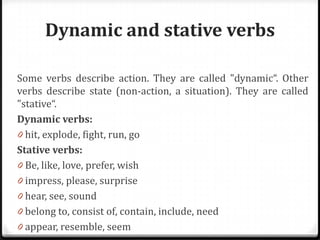
Dynamic and stative verbs
Some verbs describe action. They are called "dynamic“. Other
verbs describe state (non-action, a situation). They are called
"stative“.
Dynamic verbs:
0 hit, explode, fight, run, go
Stative verbs:
0 Be, like, love, prefer, wish
0 impress, please, surprise
0 hear, see, sound
0 belong to, consist of, contain, include, need
0 appear, resemble, seem
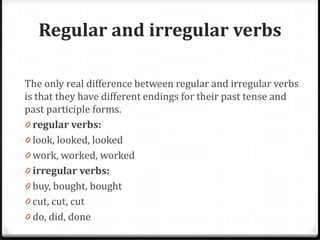
Regular and irregular verbs
The only real difference between regular and irregular verbs
is that they have different endings for their past tense and
past participle forms.
0 regular verbs:
0 look, looked, looked
0 work, worked, worked
0 irregular verbs:
0 buy, bought, bought
0 cut, cut, cut
0 do, did, done
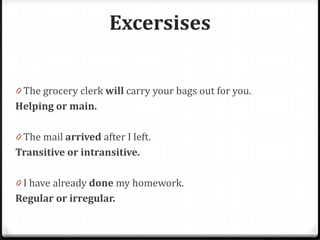
Excersises
0 The grocery clerk will carry your bags out for you.
Helping or main.
0 The mail arrived after I left.
Transitive or intransitive.
0 I have already done my homework.
Regular or irregular.
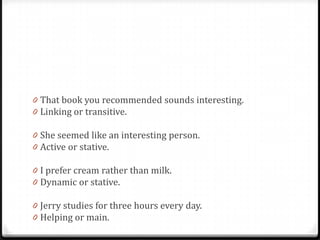
0 That book you recommended sounds interesting.
0 Linking or transitive.
0 She seemed like an interesting person.
0 Active or stative.
0 I prefer cream rather than milk.
0 Dynamic or stative.
0 Jerry studies for three hours every day.
0 Helping or main.
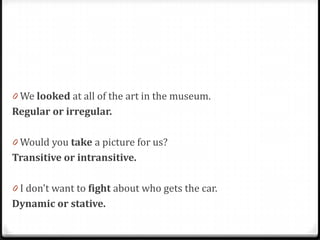
0 We looked at all of the art in the museum.
Regular or irregular.
0 Would you take a picture for us?
Transitive or intransitive.
0 I don't want to fight about who gets the car.
Dynamic or stative.

Part of the speech

  • 2.
    What is aVerb? A verb express action, events, or states of being. Many verbs give the idea of action, of "doing" something. 0 Run, fight and work. But some verbs do not give the idea of action; they give the idea of existence, of state, of "being". 0 Be, exist, seem and belong.
  • 3.
    A verb alwayshas a subject. 0 John speaks english. Verb Classification 0 Helping verbs 0 Main verbs
  • 4.
    Helping verbs Auxiliary verbs. Helpingverbs have no meaning on their own. We usually use helping verbs with main verbs. They "help" the main verb . 0 Primary helping verbs. 0 Modal helping verbs.
  • 5.
    Primary helping verbs 0Be To make continuous tenses = He is watching TV. To make the passive = Small fish are eaten by big fish. 0 Have to make perfect tenses = I have finished my homework.
  • 6.
    0 Do To makenegatives = I do not like you. To ask questions = Do you want some coffee? To show emphasis = I do want you to pass your exam. To stand for a main verb in some constructions = He speaks faster than she does.
  • 7.
    Modal helping verbs Weuse modal helping verbs to "modify" the meaning of the main verb in some way. Can, could, may, might, will, would, shall, should, must, ought to. Here are examples using modal verbs: 0 I can't speak Chinese. 0 John may arrive late. 0 Would you like a cup of coffee? 0 You should see a doctor. 0 I really must go now.
  • 8.
    Main verb Main verbshave meaning on their own. 0 Transitive and intransitive verbs. 0 Linking verbs 0 Dynamic and stative verbs. 0 Regular and irregular verbs
  • 9.
    Transitive and intransitive verbs. Atransitive verb takes a direct object. 0 I saw an elephant. 0 We are watching TV. 0 He speaks English. An intransitive verb does not have a direct object. 0 He has arrived. 0 John goes to school. 0 She speaks fast.
  • 10.
    Linking verbs A linkingverb does not have much meaning in itself. 0 Mary is a teacher. (mary = teacher) 0 Tara is beautiful. (tara = beautiful) 0 That sounds interesting. (that = interesting) 0 The sky became dark. (the sky > dark) 0 The bread has gone bad. (bread > bad)
  • 11.
    Dynamic and stativeverbs Some verbs describe action. They are called "dynamic“. Other verbs describe state (non-action, a situation). They are called "stative“. Dynamic verbs: 0 hit, explode, fight, run, go Stative verbs: 0 Be, like, love, prefer, wish 0 impress, please, surprise 0 hear, see, sound 0 belong to, consist of, contain, include, need 0 appear, resemble, seem
  • 12.
    Regular and irregularverbs The only real difference between regular and irregular verbs is that they have different endings for their past tense and past participle forms. 0 regular verbs: 0 look, looked, looked 0 work, worked, worked 0 irregular verbs: 0 buy, bought, bought 0 cut, cut, cut 0 do, did, done
  • 13.
    Excersises 0 The groceryclerk will carry your bags out for you. Helping or main. 0 The mail arrived after I left. Transitive or intransitive. 0 I have already done my homework. Regular or irregular.
  • 14.
    0 That bookyou recommended sounds interesting. 0 Linking or transitive. 0 She seemed like an interesting person. 0 Active or stative. 0 I prefer cream rather than milk. 0 Dynamic or stative. 0 Jerry studies for three hours every day. 0 Helping or main.
  • 15.
    0 We lookedat all of the art in the museum. Regular or irregular. 0 Would you take a picture for us? Transitive or intransitive. 0 I don't want to fight about who gets the car. Dynamic or stative.