Introduction To Verb
Presented By
Baydaar Bakht
ENGLISH GRAMMAR
WHAT IS VERB ?
A word that shows an action, state or an event. It is an essential
part of a sentence and it is also known as the soul of English
language.
Example:
They study English grammar (Action)
We Sleep at night (State)
We Celebrate Eid (Event)
KINDS OF VERB
• Regular Verb
• Irregular Verb
• Linking Verb
• Transitive Verb
• Intransitive Verb
• Finite Verb
• Infinite Verb
REGULAR VERB
A verb that is past (2nd form) and past participle (3rd form) is made
by adding “d” or “ed” this is called as regular verb.
Example:
1st Form 2nd Form 3rd Form
Walk Walked Walked
Talk Talked Talked
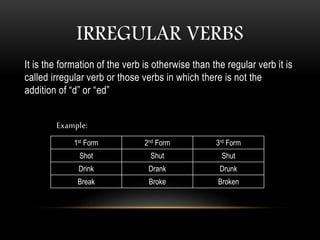
IRREGULAR VERBS
It is the formation of the verb is otherwise than the regular verb it is
called irregular verb or those verbs in which there is not the
addition of “d” or “ed”
Example:
1st Form 2nd Form 3rd Form
Shot Shut Shut
Drink Drank Drunk
Break Broke Broken
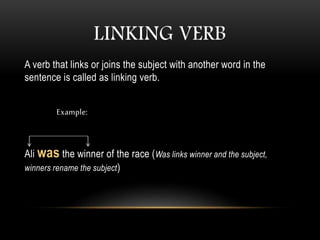
LINKING VERB
A verb that links or joins the subject with another word in the
sentence is called as linking verb.
Example:
Ali was the winner of the race (Was links winner and the subject,
winners rename the subject)
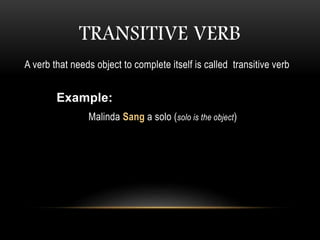
TRANSITIVE VERB
A verb that needs object to complete itself is called transitive verb
Example:
Malinda Sang a solo (solo is the object)
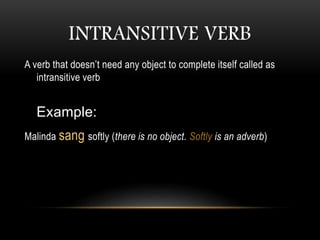
INTRANSITIVE VERB
A verb that doesn’t need any object to complete itself called as
intransitive verb
Example:
Malinda sang softly (there is no object. Softly is an adverb)
FINITE VERB
The verb that can make its own predicate is called finite verb
Example:
They open the door. (Here “open the door” has very clear meaning
without subject. Hence, verb “ OPEN” is finite verb)
[Details about the subject in the
sentence is called as Predicate]
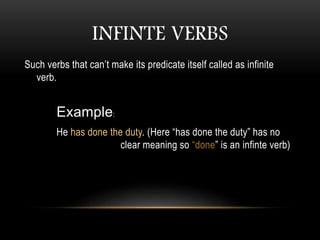
INFINTE VERBS
Such verbs that can’t make its predicate itself called as infinite
verb.
Example:
He has done the duty. (Here “has done the duty” has no
clear meaning so “done” is an infinte verb)
INFINITIVE
An infinitive is a verb form that usually begins with “to”. It is used
as a noun, an adjective or an adverb
Example:
Noun: To err is human [Subject]
Adjective: This year India is the team to beat [to beat
modifies the noun]
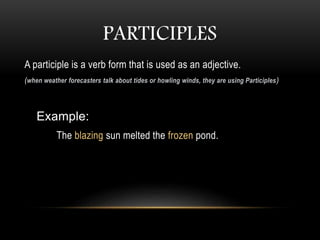
PARTICIPLES
A participle is a verb form that is used as an adjective.
(when weather forecasters talk about tides or howling winds, they are using Participles)
Example:
The blazing sun melted the frozen pond.
GERUNDS
A gerund is a verb form that is used as a noun and it ends with
“ing”
Example:
Talking is not allowed in the study hall. [talking is used as a noun,
the subject of the sentence]
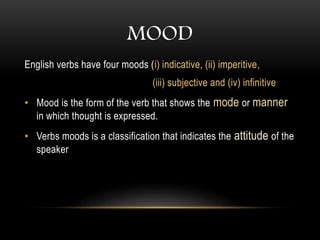
MOOD
English verbs have four moods (i) indicative, (ii) imperitive,
(iii) subjective and (iv) infinitive
• Mood is the form of the verb that shows the mode or manner
in which thought is expressed.
• Verbs moods is a classification that indicates the attitude of the
speaker
AUXILIARY
Auxiliary verbs are helping verbs. They are used with full verbs to
give other information action and states.
Example:
Is, am, are, was, were.

Presentation On Verbs

  • 1.
    Introduction To Verb PresentedBy Baydaar Bakht ENGLISH GRAMMAR
  • 2.
    WHAT IS VERB? A word that shows an action, state or an event. It is an essential part of a sentence and it is also known as the soul of English language. Example: They study English grammar (Action) We Sleep at night (State) We Celebrate Eid (Event)
  • 3.
    KINDS OF VERB •Regular Verb • Irregular Verb • Linking Verb • Transitive Verb • Intransitive Verb • Finite Verb • Infinite Verb
  • 4.
    REGULAR VERB A verbthat is past (2nd form) and past participle (3rd form) is made by adding “d” or “ed” this is called as regular verb. Example: 1st Form 2nd Form 3rd Form Walk Walked Walked Talk Talked Talked
  • 5.
    IRREGULAR VERBS It isthe formation of the verb is otherwise than the regular verb it is called irregular verb or those verbs in which there is not the addition of “d” or “ed” Example: 1st Form 2nd Form 3rd Form Shot Shut Shut Drink Drank Drunk Break Broke Broken
  • 6.
    LINKING VERB A verbthat links or joins the subject with another word in the sentence is called as linking verb. Example: Ali was the winner of the race (Was links winner and the subject, winners rename the subject)
  • 7.
    TRANSITIVE VERB A verbthat needs object to complete itself is called transitive verb Example: Malinda Sang a solo (solo is the object)
  • 8.
    INTRANSITIVE VERB A verbthat doesn’t need any object to complete itself called as intransitive verb Example: Malinda sang softly (there is no object. Softly is an adverb)
  • 9.
    FINITE VERB The verbthat can make its own predicate is called finite verb Example: They open the door. (Here “open the door” has very clear meaning without subject. Hence, verb “ OPEN” is finite verb) [Details about the subject in the sentence is called as Predicate]
  • 10.
    INFINTE VERBS Such verbsthat can’t make its predicate itself called as infinite verb. Example: He has done the duty. (Here “has done the duty” has no clear meaning so “done” is an infinte verb)
  • 11.
    INFINITIVE An infinitive isa verb form that usually begins with “to”. It is used as a noun, an adjective or an adverb Example: Noun: To err is human [Subject] Adjective: This year India is the team to beat [to beat modifies the noun]
  • 12.
    PARTICIPLES A participle isa verb form that is used as an adjective. (when weather forecasters talk about tides or howling winds, they are using Participles) Example: The blazing sun melted the frozen pond.
  • 13.
    GERUNDS A gerund isa verb form that is used as a noun and it ends with “ing” Example: Talking is not allowed in the study hall. [talking is used as a noun, the subject of the sentence]
  • 14.
    MOOD English verbs havefour moods (i) indicative, (ii) imperitive, (iii) subjective and (iv) infinitive • Mood is the form of the verb that shows the mode or manner in which thought is expressed. • Verbs moods is a classification that indicates the attitude of the speaker
  • 15.
    AUXILIARY Auxiliary verbs arehelping verbs. They are used with full verbs to give other information action and states. Example: Is, am, are, was, were.