Today you'll learnabout
how to:
•Identify human activities,
such as farming,
construction of structures,
and waste disposal, that
affect the quality and
quantity of soil. S11ES-lh-17
•Give ways of conserving
and protecting the soil for
future generations. S11ES-
Ih-i-18
• is howwell soil does what
we want it to do. It is the
capacity of a specific kind
of soil to function, within
natural or managed
ecosystem boundaries, to
sustain plant and animal
productivity, maintain or
enhance water and air
quality and support human
health and habituation.
SOIL
QUALITY
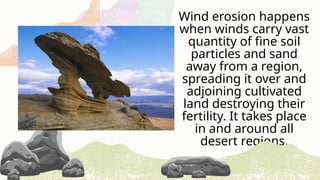
5.
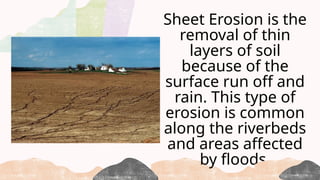
• is theamount
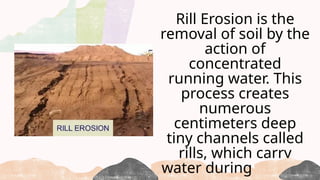
or measure of
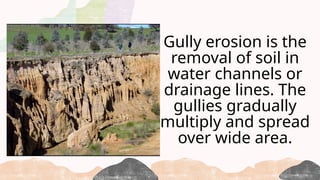
soil in a specific
area.
SOIL
QUANTITY
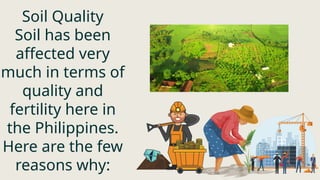
Soil Quality
Soil hasbeen
affected very
much in terms of
quality and
fertility here in
the Philippines.
Here are the few
reasons why:
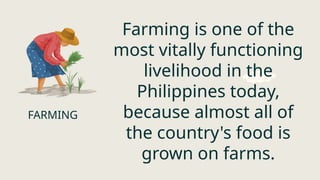
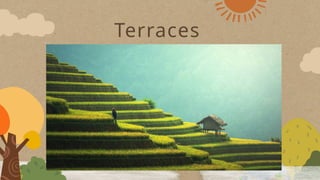
8.
Farming is oneof the
most vitally functioning
livelihood in the
Philippines today,
because almost all of
the country's food is
grown on farms.
FARMING
9.
However, farming hassome
harmful effects and can lead
to soil loss. Farmers often
add nutrients to soil in the
form of organic or artificial
fertilizers to make their crops
grow better. However, some
fertilizers can make it difficult
for microorganisms in the
soil to produce nutrients
naturally.
10.
Fertilizers also addto
water pollution when
rainwater draining from
fields carries the excess
nutrients to rivers, lakes,
and oceans. Over time,
many farming practices
lead to the loss of soil.
11.
Construction and
Development
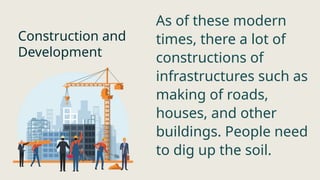
As ofthese modern
times, there a lot of
constructions of
infrastructures such as
making of roads,
houses, and other
buildings. People need
to dig up the soil.
12.
Construction and
Development
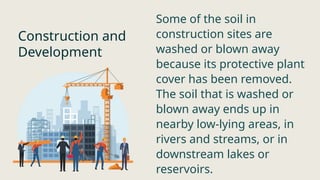
Some ofthe soil in
construction sites are
washed or blown away
because its protective plant
cover has been removed.
The soil that is washed or
blown away ends up in
nearby low-lying areas, in
rivers and streams, or in
downstream lakes or
reservoirs.
13.
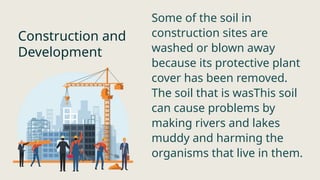
Construction and
Development
Some ofthe soil in
construction sites are
washed or blown away
because its protective plant
cover has been removed.
The soil that is wasThis soil
can cause problems by
making rivers and lakes
muddy and harming the
organisms that live in them.
14.
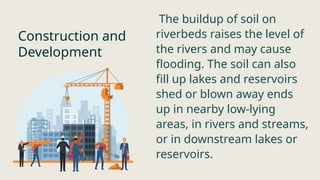
Construction and
Development
The buildupof soil on
riverbeds raises the level of
the rivers and may cause
flooding. The soil can also
fill up lakes and reservoirs
shed or blown away ends
up in nearby low-lying
areas, in rivers and streams,
or in downstream lakes or
reservoirs.
15.
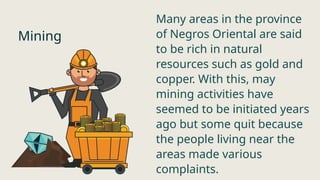
Mining
Many areas inthe province
of Negros Oriental are said
to be rich in natural
resources such as gold and
copper. With this, may
mining activities have
seemed to be initiated years
ago but some quit because
the people living near the
areas made various
complaints.
16.
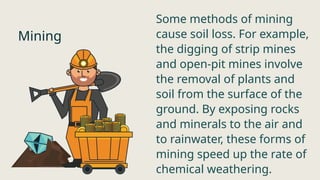
Mining
Some methods ofmining
cause soil loss. For example,
the digging of strip mines
and open-pit mines involve
the removal of plants and
soil from the surface of the
ground. By exposing rocks
and minerals to the air and
to rainwater, these forms of
mining speed up the rate of
chemical weathering.
17.
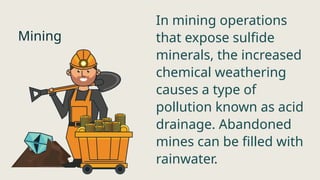
Mining
In mining operations
thatexpose sulfide
minerals, the increased
chemical weathering
causes a type of
pollution known as acid
drainage. Abandoned
mines can be filled with
rainwater.
18.
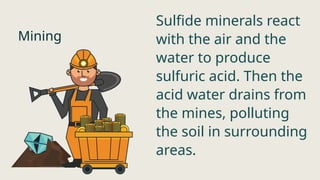
Mining
Sulfide minerals react
withthe air and the
water to produce
sulfuric acid. Then the
acid water drains from
the mines, polluting
the soil in surrounding
areas.
19.
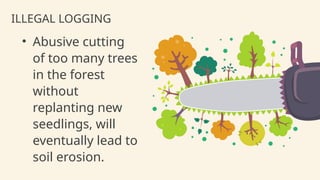
ILLEGAL LOGGING
• Abusivecutting
of too many trees
in the forest
without
replanting new
seedlings, will
eventually lead to
soil erosion.
Erosion is the
movementof
weathered rock and
soil from one place to
another. This process
is powerful enough to
level hills and
mountains.
22.
Why isn’t theworld as
flat as pancake by now?
Because forces inside
the Earth build
mountains and lift the
land after erosion has
flattened it. More
erosion follows the
The agents oferosion are
gravity, running water,
ice, wind, and people.
Running water plays the
biggest part.
25.
Wind erosion happens
whenwinds carry vast
quantity of fine soil
particles and sand
away from a region,
spreading it over and
adjoining cultivated
land destroying their
fertility. It takes place
in and around all
desert regions.
26.
Sheet Erosion isthe
removal of thin
layers of soil
because of the
surface run off and
rain. This type of
erosion is common
along the riverbeds
and areas affected
by floods.
27.
Rill Erosion isthe
removal of soil by the
action of
concentrated
running water. This
process creates
numerous
centimeters deep
tiny channels called
rills, which carry
water during storms.
28.
Gully erosion isthe
removal of soil in
water channels or
drainage lines. The
gullies gradually
multiply and spread
over wide area.
Erosion is anatural process.
Too much soil erosion,
however, is a national
disaster. Practicing good
farming methods now is vital
saving our topsoil for the
future.
32.
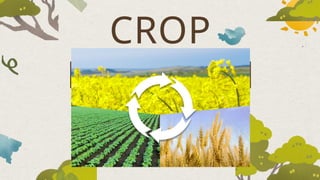
CROP
ROTATION
IS THE PRACTICEOF PLANTING
DIFFERENT CROPS ON THE SAME
FIELD IN DIFFERENT YEARS OR
GROWING SEASONS. GRAIN
CROPS, SUCH AS WHEAT, USE UP A
LOT OF THE NITROGEN—A
NECESSARY PLANT NUTRIENT—IN
THE SOIL.
33.
CROP
ROTATION
THE ROOTS OFBEAN CROPS,
SUCH AS SOYBEANS, CONTAIN
BACTERIA THAT RESTORE
NITROGEN TO THE SOIL. BY
ROTATING THESE CROPS,
FARMERS CAN HELP MAINTAIN
SOIL FERTILITY.
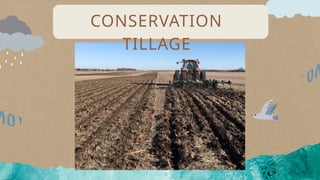
The less soilis disturbed by
plowing, the less likely it is to
be washed or blown away. In
one method of conservation
tillage, fields are not plowed at
all.
CONSERVATION
TILLAGE
39.
The remains ofharvested crops
are simply left on the fields to
cover and protect the soil. New
seeds are planted in narrow
bands of soil.
CONSERVATION
TILLAGE
Terraces are flat,step-
like areas built on a
hillside to hold rainwater
and prevent it from
running downhill. Crops
are planted on the flat
tops of the terraces.
42.
Contour plowing isthe
practice of plowing along
the curves, or contours, of
a slope. Contour plowing
helps channel rainwater
so that it does not run
straight downhill, carrying
away soil with it.
Strips of grasses,shrubs,
or other plants are planted
between bands of a grain
crop along the contour of a
slope. These strips of
plants also help slow the
runoff of water.





![谷歌留痕技术 [ 𝙩𝙤𝙥 𝟮𝟯𝟯. 𝙘 𝙤𝙢 ]](https://cdn.slidesharecdn.com/ss_thumbnails/top233-260130174328-3833018c-thumbnail.jpg?width=640&height=640&fit=bounds)


