Environmental & Energy-Saving 
Design 
节能环保---设计篇 
Ray Wang 
Senior Real Estate Manager, Microsoft 
28th August, 2014 @ Green Drinks Shanghai 
81
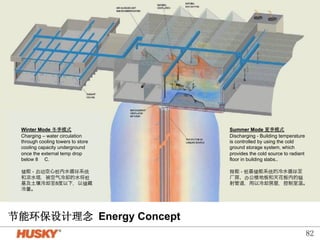
节能环保设计理念 Energy Concept  
Summer Mode 夏季模式 
Discharging - Building temperature 
is controlled by using the cold 
ground storage system, which 
provides the cold source to radiant 
floor in building slabs.. 
释能 - 桩基储能系统的冷水循环至 
厂房、办公楼地板和天花板内的辐 
射管道,用以冷却房屋,控制室温。 
Winter Mode 冬季模式 
Charging – water circulation 
through cooling towers to store 
cooling capacity underground 
once the external temp drop 
below 8 C. 
储能 - 启动空心桩内水循环系统 
和凉水塔,被空气冷却的水将桩 
基及土壤冷却至8度以下,以储藏 
冷量。 
82
Husky Energy-saving Design Concept 
节能环保设计理念-1 
从设计到设备材料选型到运行都贯穿节能环保的理念,并坚持持续改善。 
HAVC 中央空调系统 
1. Piling Storage System 桩基储能系统, 冬季储存冷量到地下,作为夏季的部分冷源。同时选 
用COP较高且对大气无污染的CFC-free chiller (AMMONIA)氨冷冻机作为冷源,并合理配 
置Chiller的容量及台数,实际运行中根据天气及负荷实际情况,合理选用冷源,使运行最经 
济。 
2. 采用天花地板辐射空调系统,在提高舒适度的同时,可以在夜间用电低谷时运行储存冷量, 
这样白天的负荷会下降很多,起到削峰平谷的作用,Chiller的容量可以小很多,同时节约大 
量电费。 
3. 冬季制热及夏季除湿机再生的热源选用附近电厂的废热产生的蒸气,同时将蒸气冷凝水作 
为生活热水的热源。 
4. 先进的BAS楼宇自控系统,合理分布的各种传感器,良好的控制逻辑,加上操作人员及时 
的干预,使各系统尽可能地运行于最优状态,这几年不断地优化程序,在保证舒适度的同 
时使运行最经济。 
5. 办公楼排风经热回收转轮,预处理新风。办公楼以前是全新风系统,后来在保证舒适度, 
CO2浓度的情况下,改造管道,增加调节阀,使办公楼运行于30~80%的新风,节约冷热负 
荷及除湿量。 
6. 液相干燥剂除湿,和固体干燥转轮除湿以及充分利用二次回风的热量 
7. Displacement ventilation置换式通风系统 
83
84 
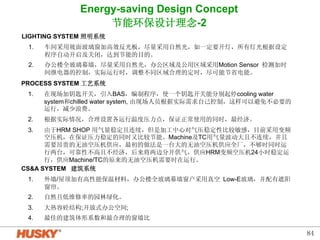
Energy-saving Design Concept 
节能环保设计理念-2 
LIGHTING SYSTEM 照明系统 
1. 车间采用坡面玻璃窗加高效反光板,尽量采用自然光,如一定要开灯,所有灯光根据设定 
程序自动开启及关闭,达到节能的目的。 
2. 办公楼全玻璃幕墙,尽量采用自然光,办公区域及公用区域采用Motion Sensor 检测加时 
间继电器的控制,实际运行时,调整不同区域合理的定时,尽可能节省电能。 
PROCESS SYSTEM 工艺系统 
1. 在现场加钥匙开关,引入BAS,编制程序,使一个钥匙开关能分别起停cooling water 
system和chilled water system, 由现场人员根据实际需求自己控制,这样可以避免不必要的 
运行,减少浪费。 
2. 根据实际情况,合理设置各运行温度压力点,保证正常使用的同时,最经济。 
3. 由于HRM SHOP 用气量稳定且连续,但是加工中心对气压稳定性比较敏感,目前采用变频 
空压机,在保证压力稳定的同时又比较节能。Machine及TC用气量波动大且不连续,并且 
需要昂贵的无油空压机供应,最初的做法是一台大的无油空压机供应全厂,不够时同时运 
行两台,可靠性不高且不经济,后来将两边分开供气,供应HRM变频空压机24小时稳定运 
行,供应Machine/TC的原来的无油空压机需要时在运行。 
CSA SYSTEM 建筑系统 
1. 外墙/屋顶加有高性能保温材料,办公楼全玻璃幕墙窗户采用真空 Low-E玻璃,并配有遮阳 
窗帘。 
2. 自然且低维修率的园林绿化。 
3. 大热容砼结构;开放式办公空间; 
4. 最佳的建筑体形系数和最合理的窗墙比
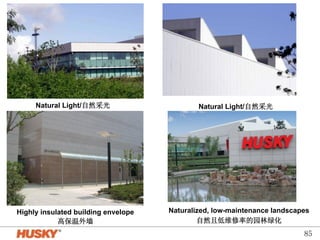
Natural Light/自然采光 
Highly insulated building envelope 
高保温外墙 
 
Naturalized, low-maintenance landscapes 
自然且低维修率的园林绿化 
Natural Lig ht/自然采光 
85
86 
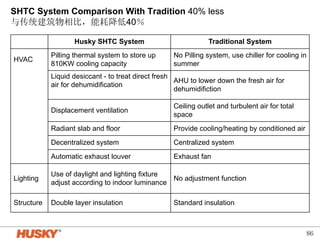
SHTC System Comparison With Tradition 40% less 
与传统建筑物相比,能耗降低40% 
 Husky SHTC System Traditional System 
HVAC Pilling thermal system to store up 
810KW cooling capacity 
No Pilling system, use chiller for cooling in 
summer 
  
Liquid desiccant - to treat direct fresh 
air for dehumidification 
AHU to lower down the fresh air for 
dehumidifiction 
 Displacement ventilation Ceiling outlet and turbulent air for total 
space 
 Radiant slab and floor Provide cooling/heating by conditioned air 
 Decentralized system Centralized system 
 Automatic exhaust louver Exhaust fan 
Lighting Use of daylight and lighting fixture 
adjust according to indoor luminance No adjustment function 
Structure Double layer insulation Standard insulation
87 
Environmental Construction 
节能环保…施工篇
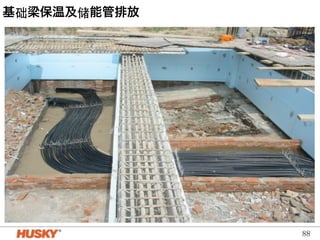
基础梁保温及储能管排放 
88
地面储能管安装 
89
90 
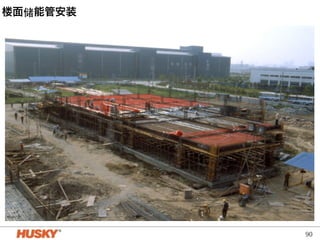
楼面储能管安装
91 
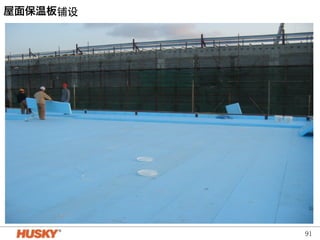
屋面保温板铺设
Real Estate and Facilities
Heat Recovery Wheel 
• Sensible/Latent Heat Recovery Wheel on Fresh Air Units 
on roof AHUs 
Ice Storage 
• Peak shaving 
• Loading (ice build) in off-peak period (when 
utility rates are cheap) 
• Unloading (ice melt) during peak or shoulder 
peak period 
• Saving utility bill (difference between day and 
night utility rates) 
Free Cooling 
• CRAC with Airside Free Cooling 
(enthalpy controlled)
Low-E Curtain Wall Glazing 
• Low-e glass stands for low emissivity glass and is a type of 
insulating glass, which increases the energy efficiency of 
windows by reducing the transfer of heat or cold through glass. 
Natural Daylight 
• By designing the distribution of building services under the 
raised floor, there is no requirement for a false suspended 
ceiling within the office building. This mitigates the production 
of such material and allows significantly more natural light into 
the building reducing consumption of electricity for lighting. 
Under Floor Air Distribution 
(UFAD) 
• UFAD is a new method of supplying heated or 
cooled air throughout a building within China. 
Reported advantages include high efficiency 
resulting in energy savings and improved indoor 
air quality.
VAV 
Damper 
VAV 
Damper 
FT 
U 
FT 
U 
Open Office 
Area 
FP 
TU 
Abbreviations: 
• VAV – Variable Air Volume 
• FTU – Fan Terminal Unit 
• FPTU – Fan Powered Terminal 
Unit 
• IDU – Induction Unit 
• AHU – Air Handling Unit 
Façade 
ID 
U 
FT 
U 
AHU – 
1-1 
Conference 
room 
To Other 
floors 
Typical 
Floor 
Return 
Air 
System Description: 
1. Total 4 AHUs (AHU-1-1~4) 
installed on roof serving total 
office area. 
2. Office area: room temperature 
maintained by the adjustment of 
supplied cooled air volume 
through FTU. 
3. IDU to cool / heat the area near 
façade and conference room 
temperature is controlled by 
FPTU. 
4. VAV damper to adjust the air 
volume supplied to under-floor 
plenum to make up the air 
extracted by FTUs. 
5. AHU fan speed modulated to 
maintain the SP level in the 
main duct. 
Conditioned 
Air 
VAV 
Damper 
Fresh Air 
Exhaust Air Intake 
Under-floor plenum
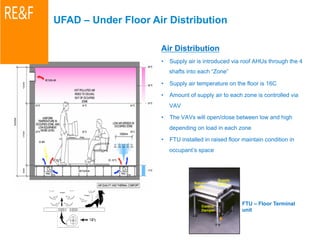
Air Distribution 
• Supply air is introduced via roof AHUs through the 4 
shafts into each “Zone” 
• Supply air temperature on the floor is 16C 
• Amount of supply air to each zone is controlled via 
Return 
Grille 
Control 
Damper 
Supply 
Grille 
VAV 
• The VAVs will open/close between low and high 
depending on load in each zone 
• FTU installed in raised floor maintain condition in 
occupant’s space 
FTU – Floor Terminal 
unit
Roof 
Ceilin 
g 
Exhaust Fresh Air 
Air 
Return 
Air 
Sever Rack 
RAD 
EAD 
FAD 
5F 
Lab 
Room 
Raised Floor 
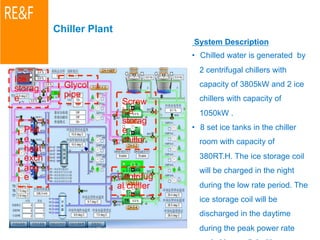
System Description 
• IT rooms on top floor are 
equipped with EAD (exhaust 
air damper) which could 
make CRAC ‘s run at whole 
capacity with fresh air model 
at winter when outdoors 
temperature is below 16. 
• FAD (fresh air damper) can 
be opened manually by 
BMS according to out 
temperature . FAD and 
RAD (return air damper) are 
connected with inverse ratio. 
CRAC
System Description 
• Chilled water is generated by 
2 centrifugal chillers with 
capacity of 3805kW and 2 ice 
chillers with capacity of 
1050kW . 
• 8 set ice tanks in the chiller 
room with capacity of 
380RT.H. The ice storage coil 
will be charged in the night 
during the low rate period. The 
ice storage coil will be 
discharged in the daytime 
during the peak power rate 
period in parallel with 
Ice 
storag 
e 
Glycol 
pipe 
Plat 
e 
heat 
exch 
ang 
e 
Screw 
ice 
storag 
e 
chiller 
Centrifug 
al chiller
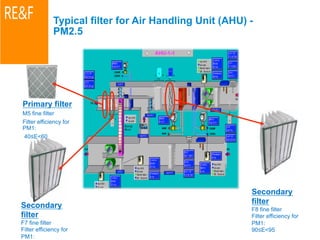
Primary filter 
M5 fine filter 
Filter efficiency for 
PM1: 
40≤E60 
Secondary 
filter 
F7 fine filter 
Filter efficiency for 
PM1: 
80≤E90 
Secondary 
filter 
F8 fine filter 
Filter efficiency for 
PM1: 
90≤E95

Energy Efficiency in Offices

  • 1.
    Environmental & Energy-Saving Design 节能环保---设计篇 Ray Wang Senior Real Estate Manager, Microsoft 28th August, 2014 @ Green Drinks Shanghai 81
  • 2.
    节能环保设计理念 Energy Concept Summer Mode 夏季模式 Discharging - Building temperature is controlled by using the cold ground storage system, which provides the cold source to radiant floor in building slabs.. 释能 - 桩基储能系统的冷水循环至 厂房、办公楼地板和天花板内的辐 射管道,用以冷却房屋,控制室温。 Winter Mode 冬季模式 Charging – water circulation through cooling towers to store cooling capacity underground once the external temp drop below 8 C. 储能 - 启动空心桩内水循环系统 和凉水塔,被空气冷却的水将桩 基及土壤冷却至8度以下,以储藏 冷量。 82
  • 3.
    Husky Energy-saving DesignConcept 节能环保设计理念-1 从设计到设备材料选型到运行都贯穿节能环保的理念,并坚持持续改善。 HAVC 中央空调系统 1. Piling Storage System 桩基储能系统, 冬季储存冷量到地下,作为夏季的部分冷源。同时选 用COP较高且对大气无污染的CFC-free chiller (AMMONIA)氨冷冻机作为冷源,并合理配 置Chiller的容量及台数,实际运行中根据天气及负荷实际情况,合理选用冷源,使运行最经 济。 2. 采用天花地板辐射空调系统,在提高舒适度的同时,可以在夜间用电低谷时运行储存冷量, 这样白天的负荷会下降很多,起到削峰平谷的作用,Chiller的容量可以小很多,同时节约大 量电费。 3. 冬季制热及夏季除湿机再生的热源选用附近电厂的废热产生的蒸气,同时将蒸气冷凝水作 为生活热水的热源。 4. 先进的BAS楼宇自控系统,合理分布的各种传感器,良好的控制逻辑,加上操作人员及时 的干预,使各系统尽可能地运行于最优状态,这几年不断地优化程序,在保证舒适度的同 时使运行最经济。 5. 办公楼排风经热回收转轮,预处理新风。办公楼以前是全新风系统,后来在保证舒适度, CO2浓度的情况下,改造管道,增加调节阀,使办公楼运行于30~80%的新风,节约冷热负 荷及除湿量。 6. 液相干燥剂除湿,和固体干燥转轮除湿以及充分利用二次回风的热量 7. Displacement ventilation置换式通风系统 83
  • 4.
    84 Energy-saving DesignConcept 节能环保设计理念-2 LIGHTING SYSTEM 照明系统 1. 车间采用坡面玻璃窗加高效反光板,尽量采用自然光,如一定要开灯,所有灯光根据设定 程序自动开启及关闭,达到节能的目的。 2. 办公楼全玻璃幕墙,尽量采用自然光,办公区域及公用区域采用Motion Sensor 检测加时 间继电器的控制,实际运行时,调整不同区域合理的定时,尽可能节省电能。 PROCESS SYSTEM 工艺系统 1. 在现场加钥匙开关,引入BAS,编制程序,使一个钥匙开关能分别起停cooling water system和chilled water system, 由现场人员根据实际需求自己控制,这样可以避免不必要的 运行,减少浪费。 2. 根据实际情况,合理设置各运行温度压力点,保证正常使用的同时,最经济。 3. 由于HRM SHOP 用气量稳定且连续,但是加工中心对气压稳定性比较敏感,目前采用变频 空压机,在保证压力稳定的同时又比较节能。Machine及TC用气量波动大且不连续,并且 需要昂贵的无油空压机供应,最初的做法是一台大的无油空压机供应全厂,不够时同时运 行两台,可靠性不高且不经济,后来将两边分开供气,供应HRM变频空压机24小时稳定运 行,供应Machine/TC的原来的无油空压机需要时在运行。 CSA SYSTEM 建筑系统 1. 外墙/屋顶加有高性能保温材料,办公楼全玻璃幕墙窗户采用真空 Low-E玻璃,并配有遮阳 窗帘。 2. 自然且低维修率的园林绿化。 3. 大热容砼结构;开放式办公空间; 4. 最佳的建筑体形系数和最合理的窗墙比
  • 5.
    Natural Light/自然采光 Highlyinsulated building envelope 高保温外墙 Naturalized, low-maintenance landscapes 自然且低维修率的园林绿化 Natural Lig ht/自然采光 85
  • 6.
    86 SHTC SystemComparison With Tradition 40% less 与传统建筑物相比,能耗降低40%  Husky SHTC System Traditional System HVAC Pilling thermal system to store up 810KW cooling capacity No Pilling system, use chiller for cooling in summer   Liquid desiccant - to treat direct fresh air for dehumidification AHU to lower down the fresh air for dehumidifiction  Displacement ventilation Ceiling outlet and turbulent air for total space  Radiant slab and floor Provide cooling/heating by conditioned air  Decentralized system Centralized system  Automatic exhaust louver Exhaust fan Lighting Use of daylight and lighting fixture adjust according to indoor luminance No adjustment function Structure Double layer insulation Standard insulation
  • 7.
    87 Environmental Construction 节能环保…施工篇
  • 8.
  • 9.
  • 10.
  • 11.
  • 12.
    Real Estate andFacilities
  • 13.
    Heat Recovery Wheel • Sensible/Latent Heat Recovery Wheel on Fresh Air Units on roof AHUs Ice Storage • Peak shaving • Loading (ice build) in off-peak period (when utility rates are cheap) • Unloading (ice melt) during peak or shoulder peak period • Saving utility bill (difference between day and night utility rates) Free Cooling • CRAC with Airside Free Cooling (enthalpy controlled)
  • 14.
    Low-E Curtain WallGlazing • Low-e glass stands for low emissivity glass and is a type of insulating glass, which increases the energy efficiency of windows by reducing the transfer of heat or cold through glass. Natural Daylight • By designing the distribution of building services under the raised floor, there is no requirement for a false suspended ceiling within the office building. This mitigates the production of such material and allows significantly more natural light into the building reducing consumption of electricity for lighting. Under Floor Air Distribution (UFAD) • UFAD is a new method of supplying heated or cooled air throughout a building within China. Reported advantages include high efficiency resulting in energy savings and improved indoor air quality.
  • 15.
    VAV Damper VAV Damper FT U FT U Open Office Area FP TU Abbreviations: • VAV – Variable Air Volume • FTU – Fan Terminal Unit • FPTU – Fan Powered Terminal Unit • IDU – Induction Unit • AHU – Air Handling Unit Façade ID U FT U AHU – 1-1 Conference room To Other floors Typical Floor Return Air System Description: 1. Total 4 AHUs (AHU-1-1~4) installed on roof serving total office area. 2. Office area: room temperature maintained by the adjustment of supplied cooled air volume through FTU. 3. IDU to cool / heat the area near façade and conference room temperature is controlled by FPTU. 4. VAV damper to adjust the air volume supplied to under-floor plenum to make up the air extracted by FTUs. 5. AHU fan speed modulated to maintain the SP level in the main duct. Conditioned Air VAV Damper Fresh Air Exhaust Air Intake Under-floor plenum
  • 16.
    Air Distribution •Supply air is introduced via roof AHUs through the 4 shafts into each “Zone” • Supply air temperature on the floor is 16C • Amount of supply air to each zone is controlled via Return Grille Control Damper Supply Grille VAV • The VAVs will open/close between low and high depending on load in each zone • FTU installed in raised floor maintain condition in occupant’s space FTU – Floor Terminal unit
  • 17.
    Roof Ceilin g Exhaust Fresh Air Air Return Air Sever Rack RAD EAD FAD 5F Lab Room Raised Floor System Description • IT rooms on top floor are equipped with EAD (exhaust air damper) which could make CRAC ‘s run at whole capacity with fresh air model at winter when outdoors temperature is below 16. • FAD (fresh air damper) can be opened manually by BMS according to out temperature . FAD and RAD (return air damper) are connected with inverse ratio. CRAC
  • 18.
    System Description •Chilled water is generated by 2 centrifugal chillers with capacity of 3805kW and 2 ice chillers with capacity of 1050kW . • 8 set ice tanks in the chiller room with capacity of 380RT.H. The ice storage coil will be charged in the night during the low rate period. The ice storage coil will be discharged in the daytime during the peak power rate period in parallel with Ice storag e Glycol pipe Plat e heat exch ang e Screw ice storag e chiller Centrifug al chiller
  • 19.
    Primary filter M5fine filter Filter efficiency for PM1: 40≤E60 Secondary filter F7 fine filter Filter efficiency for PM1: 80≤E90 Secondary filter F8 fine filter Filter efficiency for PM1: 90≤E95