ABOUT H&M | THE H&M GROUP
ABOUT H&M | THE H&M OFFER
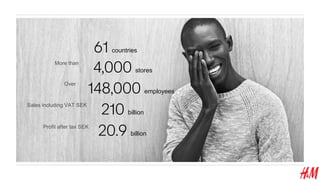
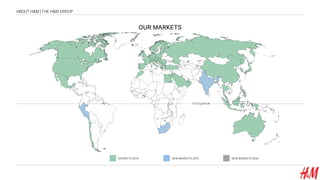
61 countries
4,000 stores
148,000 employees
More than
Over
Sales including VAT SEK
210 billion
20.9 billion
Profit after tax SEK
ABOUT H&M | THE H&M GROUP
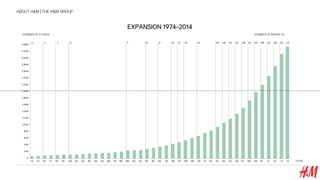
EXPANSION 1974–2014
ABOUT H&M
ABOUT H&M
Conscious materials
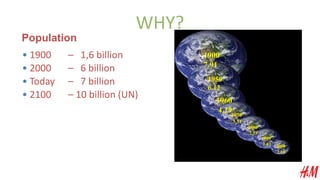
WHY?
1900
7.91
1950
6.12
1960
4.29
1970
3.51
1980
2.93
1990
2.47
2000
2.15
Population
• 1900 – 1,6 billion
• Today – 7 billion
• 2000 – 6 billion
• 2100 – 10 billion (UN)
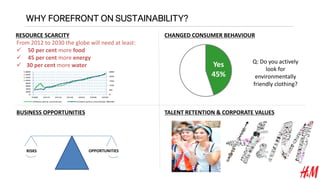
WHY FOREFRONT ON SUSTAINABILITY?
Q: Do you actively
look for
environmentally
friendly clothing?
CHANGED CONSUMER BEHAVIOUR
From 2012 to 2030 the globe will need at least:
 50 per cent more food
 45 per cent more energy
 30 per cent more water
RESOURCE SCARCITY
BUSINESS OPPORTUNITIES TALENT RETENTION & CORPORATE VALUES
RISKS OPPORTUNITIES
Yes
45%
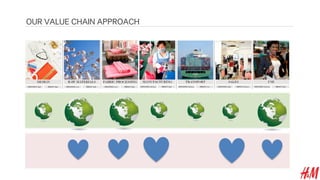
OUR VALUE CHAIN APPROACH
Company strategy
VISION
H&M’s business operations aim to be run in a way that is
economically, socially and environmentally sustainable.
By sustainable, we mean that the needs of both present
and future generations must be fulfilled.
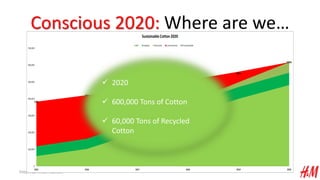
Conscious 2020: Where are we…
Internal information
 2020
 600,000 Tons of Cotton
 60,000 Tons of Recycled
Cotton
CLOSED LOOP
Hong Kong, September 2015
https://www.youtube.com/watch?v=s4xnyr2mCuI
H&M CAMPAIGN
https://www.youtube.com/watch?v=bXckKRRQubo
H&M China
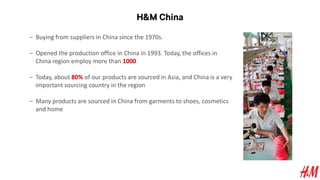
− Buying from suppliers in China since the 1970s.
− Opened the production office in China in 1993. Today, the offices in
China region employ more than 1000
− Today, about 80% of our products are sourced in Asia, and China is a very
important sourcing country in the region
− Many products are sourced in China from garments to shoes, cosmetics
and home
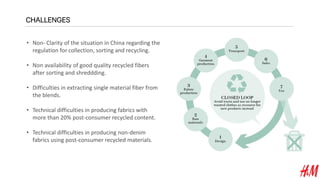
CHALLENGES
• Non- Clarity of the situation in China regarding the
regulation for collection, sorting and recycling.
• Non availability of good quality recycled fibers
after sorting and shreddding.
• Difficulties in extracting single material fiber from
the blends.
• Technical difficulties in producing fabrics with
more than 20% post-consumer recycled content.
• Technical difficulties in producing non-denim
fabrics using post-consumer recycled materials.
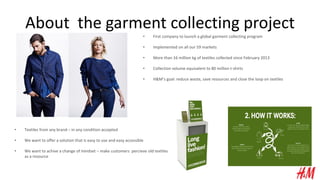
About the garment collecting project
• First company to launch a global garment collecting program
• Implemented on all our 59 markets
• More than 16 million kg of textiles collected since February 2013
• Collection volume equivalent to 80 million t-shirts
• H&M’s goal: reduce waste, save resources and close the loop on textiles
• Textiles from any brand – in any condition accepted
• We want to offer a solution that is easy to use and easy accessible
• We want to achive a change of mindset – make customers percieve old textiles
as a resource
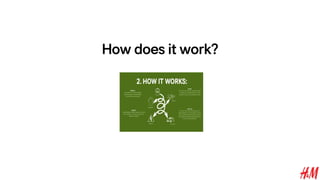
How does it work?
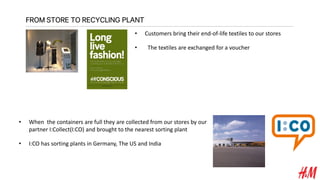
FROM STORE TO RECYCLING PLANT
• Customers bring their end-of-life textiles to our stores
• The textiles are exchanged for a voucher
• When the containers are full they are collected from our stores by our
partner I:Collect(I:CO) and brought to the nearest sorting plant
• I:CO has sorting plants in Germany, The US and India
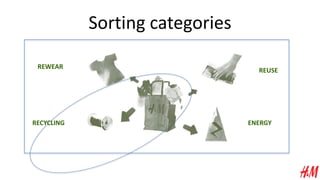
Sorting categories
REWEAR
REUSE
RECYCLING ENERGY
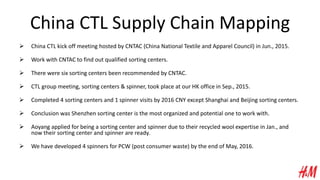
China CTL Supply Chain Mapping
 China CTL kick off meeting hosted by CNTAC (China National Textile and Apparel Council) in Jun., 2015.
 Work with CNTAC to find out qualified sorting centers.
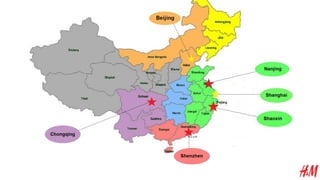
 There were six sorting centers been recommended by CNTAC.
 CTL group meeting, sorting centers & spinner, took place at our HK office in Sep., 2015.
 Completed 4 sorting centers and 1 spinner visits by 2016 CNY except Shanghai and Beijing sorting centers.
 Conclusion was Shenzhen sorting center is the most organized and potential one to work with.
 Aoyang applied for being a sorting center and spinner due to their recycled wool expertise in Jan., and
now their sorting center and spinner are ready.
 We have developed 4 spinners for PCW (post consumer waste) by the end of May, 2016.
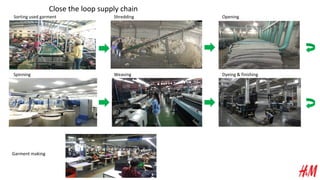
Close the loop supply chain
Sorting used garment Shredding Opening
Spinning Weaving Dyeing & finishing
Garment making
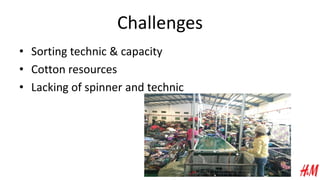
Challenges
• Sorting technic & capacity
• Cotton resources
• Lacking of spinner and technic
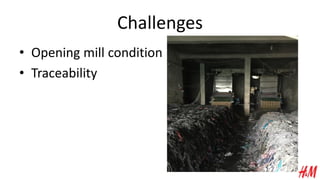
Challenges
• Opening mill condition
• Traceability
Challenges
• Fabric quality – foreign yarns
• Price - 110
• Compliance requirement
Future Plan
 Smart sorting with proper quality analysis.
 No capacity concern – available yarns in the market.
 Collaboration among sorting centers.
 I:CO is trying to collaborate with local sorting centers
 Price goes down to be lower than virgin cotton.
 Smart sorting
 Competition
 Virgin cotton price goes up
LEARN MORE:
www.hm.com/CONSCIOUS
www.globalchangeaward.com
THANK YOU!

New Material_H&M sustainability introduction

  • 1.
    ABOUT H&M |THE H&M GROUP
  • 2.
    ABOUT H&M |THE H&M OFFER
  • 3.
    61 countries 4,000 stores 148,000employees More than Over Sales including VAT SEK 210 billion 20.9 billion Profit after tax SEK
  • 4.
    ABOUT H&M |THE H&M GROUP
  • 5.
    ABOUT H&M |THE H&M GROUP EXPANSION 1974–2014
  • 6.
  • 7.
  • 8.
  • 9.
    WHY? 1900 7.91 1950 6.12 1960 4.29 1970 3.51 1980 2.93 1990 2.47 2000 2.15 Population • 1900 –1,6 billion • Today – 7 billion • 2000 – 6 billion • 2100 – 10 billion (UN)
  • 10.
    WHY FOREFRONT ONSUSTAINABILITY? Q: Do you actively look for environmentally friendly clothing? CHANGED CONSUMER BEHAVIOUR From 2012 to 2030 the globe will need at least:  50 per cent more food  45 per cent more energy  30 per cent more water RESOURCE SCARCITY BUSINESS OPPORTUNITIES TALENT RETENTION & CORPORATE VALUES RISKS OPPORTUNITIES Yes 45%
  • 11.
  • 12.
    Company strategy VISION H&M’s businessoperations aim to be run in a way that is economically, socially and environmentally sustainable. By sustainable, we mean that the needs of both present and future generations must be fulfilled.
  • 13.
    Conscious 2020: Whereare we… Internal information  2020  600,000 Tons of Cotton  60,000 Tons of Recycled Cotton
  • 14.
    CLOSED LOOP Hong Kong,September 2015 https://www.youtube.com/watch?v=s4xnyr2mCuI
  • 15.
  • 16.
    H&M China − Buyingfrom suppliers in China since the 1970s. − Opened the production office in China in 1993. Today, the offices in China region employ more than 1000 − Today, about 80% of our products are sourced in Asia, and China is a very important sourcing country in the region − Many products are sourced in China from garments to shoes, cosmetics and home
  • 17.
    CHALLENGES • Non- Clarityof the situation in China regarding the regulation for collection, sorting and recycling. • Non availability of good quality recycled fibers after sorting and shreddding. • Difficulties in extracting single material fiber from the blends. • Technical difficulties in producing fabrics with more than 20% post-consumer recycled content. • Technical difficulties in producing non-denim fabrics using post-consumer recycled materials.
  • 18.
    About the garmentcollecting project • First company to launch a global garment collecting program • Implemented on all our 59 markets • More than 16 million kg of textiles collected since February 2013 • Collection volume equivalent to 80 million t-shirts • H&M’s goal: reduce waste, save resources and close the loop on textiles • Textiles from any brand – in any condition accepted • We want to offer a solution that is easy to use and easy accessible • We want to achive a change of mindset – make customers percieve old textiles as a resource
  • 19.
  • 20.
    FROM STORE TORECYCLING PLANT • Customers bring their end-of-life textiles to our stores • The textiles are exchanged for a voucher • When the containers are full they are collected from our stores by our partner I:Collect(I:CO) and brought to the nearest sorting plant • I:CO has sorting plants in Germany, The US and India
  • 21.
  • 22.
    China CTL SupplyChain Mapping  China CTL kick off meeting hosted by CNTAC (China National Textile and Apparel Council) in Jun., 2015.  Work with CNTAC to find out qualified sorting centers.  There were six sorting centers been recommended by CNTAC.  CTL group meeting, sorting centers & spinner, took place at our HK office in Sep., 2015.  Completed 4 sorting centers and 1 spinner visits by 2016 CNY except Shanghai and Beijing sorting centers.  Conclusion was Shenzhen sorting center is the most organized and potential one to work with.  Aoyang applied for being a sorting center and spinner due to their recycled wool expertise in Jan., and now their sorting center and spinner are ready.  We have developed 4 spinners for PCW (post consumer waste) by the end of May, 2016.
  • 24.
    Close the loopsupply chain Sorting used garment Shredding Opening Spinning Weaving Dyeing & finishing Garment making
  • 25.
    Challenges • Sorting technic& capacity • Cotton resources • Lacking of spinner and technic
  • 26.
    Challenges • Opening millcondition • Traceability
  • 27.
    Challenges • Fabric quality– foreign yarns • Price - 110 • Compliance requirement
  • 28.
    Future Plan  Smartsorting with proper quality analysis.  No capacity concern – available yarns in the market.  Collaboration among sorting centers.  I:CO is trying to collaborate with local sorting centers  Price goes down to be lower than virgin cotton.  Smart sorting  Competition  Virgin cotton price goes up
  • 29.