Michael Geraghty
Building Services Engineer (DipEng)
Company owner and managing director
michael@entropic.ie
MAXIMISING ENERGY EFFICIENCY IN DATA
CENTRE DESIGN
Outline
1. Data centre cooling technologies(non exhaustive list) – a basis for
discussion, how we can do better using the EXCEED methodology
2. Current environmental considerations
3. Common types of data centres
4. Most common cooling systems and components
5. Design considerations
Current environmental considerations
Remind ourselves of our responspility to future generations
‘keep fossil fuels in the ground’
Common types of data centres
Hyperscale
• Facebook, Google, Amazon, Microsoft, Apple
Multi-tenant Co-location
• EdgeConnex, K2, Keppel
hyperscale companies lease ‘white space’ in these buildings
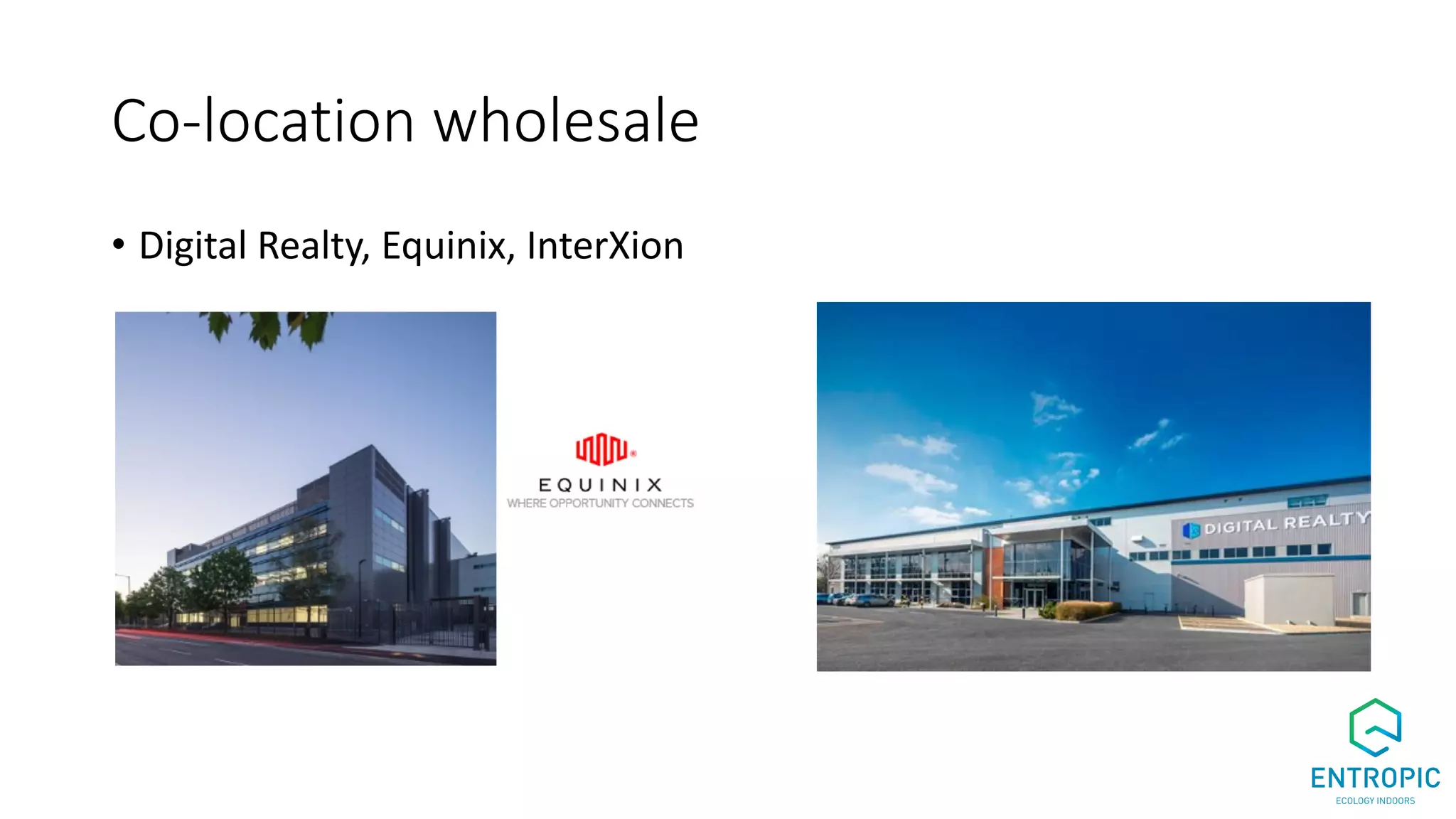
Co-location wholesale
• Digital Realty, Equinix, InterXion
Private
• BT, Eir, OPW, Irish Rail Centralised Traffic Control centre
Edge data centres
• Not yet in Ireland
• 500kW to 1MW
• Located close to end user to improve speed
Data Centres are not built in Ireland because
of the weather
• They are here because:
• Others are here
• Critical mass here, designers, contractors, I.T. companies
• Suitable infrastructure
• They are US companies
• Chance of interruption is low
Increasing load
Power Usage Effectiveness
!"# =
%&'() *(+,),'- !&./0
1. %. #34,56/7' !&./0
Google data center PUE measurement boundaries
Common cooling systems
Design issues
A lot of air is required
Q=mcΔt
1000kW = m x 1.2 x 1.02 x 10K
1000kW/ 12.24 = m
81.69m3/s = m
https://www.iesve.com/case_studies/images/cbo-data-centre/hall.jpg
Fresh air intake
• Louvres
• Water/snow separation efficiency
• Corrosion resistance (costal locations)
• Pressure drop resistance to airflow
• Security vs removable for maintenance
• Fly mesh
• Resistance
• Cleaning
• Material
Fresh air intake
• Bird and vermin screens
• Security grids
• Corrosion
Fresh air intake
• Fresh air intake dampers
• Resistance to airflow, pressure drop when open
• Very large modules, the bigger the better
• Faster installation
• Fewer actuators
• Less wiring
• Less maintenance
• Faster commissioning
• Corrosion resistance
• Location of data centre, salty air
• Shut-off characteristics of the damper, very low leakage
• Risk of condensation and ice inside the damper when closed
• Thermal conductivity of materials
Fresh air intake
• Fresh air intake dampers
• Access for maintenance, actuators inside structural colums
Design issues
Louvres
1MW at 10ΔT = 81.69m3/s
At 2m/s => 6.4m x 6.4m intake
Design issues
Dampers
Use largest available
(2.4m x 2.4m)
Design issues
Dampers – corrosion risk
Costal areas with salty air
Design issues
Dampers – condensation and ice risk
In cold ambient conditions
Inside building when dampers are closed
https://www.iesve.com/case_studies/images/cbo-data-centre/hall.jpg
Design issues
Dampers – condensation and ice risk
Frame Entropic Halton UTT Alternate solution
Material Stainless steel, AISI 304 Aluminium
Density (kg/m3) 8000 2700
Heat capacity (J/kg*K) 500 897
Heat conductivity
(W/m*K)
16.2 205
Outdoor temp (K) 263.15 263.15
Surface area (mm2) 890 506
Indoor temp 283.15 283.15
Heat flux* (W/m2) 0.1 10
Total heat loss (W) 0.089*10-3 5.06*10-3
Design issues /
opportunities
Mixing ventilation system
ΔT = room temp – supply temp
Displacement ventilation
Extract temp – supply air temp
=> Less air is required
The cooler the cold aisle, and
the hotter the hot aisle, the less
air required (optimum operating
temperature of servers to be
observed)
Hot air containment
The hotter the air in the hot
aisle, the higher performance
from CRAC units
The greater the ΔT between hot
air on to cooling coil and mean
water temp in the coil the
greater the performance and
opportunity to use free cooling
from dry air coolers.
Take advantage of the EC motors,
reduce the fan speed when
possible
50% reduction in fan speed
reduces motive power by almost
90%
Reduce the fan speed, increase
the hot aisle air temp, improve
CRAC efficiency.
Design issues / opportunities
Fan selection
Motor selection
AC or EC, IE3 to IE5
Filtration
Louvre for rain and snow
Bird mesh (10mm x 10mm)
Fly mesh
Panel filters (low grade filters)
High grade filters
Very high pressure drop => no opportunity for 100% natural ventilation (yet!)
Potential for electrostatic precipitators (very low pressure drop)
Cooling
Air
Water
Dry air coolers
Evaporative coolers (water usage)
Phase Change Materials (PCM)
Fans
Fresh air for Co Lo’s
• Min fresh air, all cooling is done via recirculation through cooling coils
in the room
• The fresh air has to be treated to control the moisture content
• In cold weather its too dry in the room – static electricity problems
• In hot and humid weather the moisture content is too high in the
room
• Design external design temps vary depending on location (-30C to
+40C is common)
• Special air treatment units required
Fresh air for Co Lo’s
Normal Summer processReturn 5080m3/h
34C & 27.18% (9g/kg)
Fresh air m3/h
40C & 30% R.H
(13.88g/kg)
Dump 496-0m3/h
5730m3/h
Cooling 50kW
Off coil =13C & 97% (9g/kg)
Mixed air with 20% FA
5730m3/h
35.21C & 28.13%
(9.98g/kg)
5730m3/h
Heating 17kW
Off coil = 22C & 9g/kg
Project:
Subject: Summer mode - Analysis
of air as it flows through the AHU
Date: 20-02-2017
Author: Mark Mc Dougall, Entropic
20-100% Fresh Air 1146-5730m3/hr
80-0% Recirc 4584-0m3/h
Humidifier offSupply Air 5730m3/h
22C & 54.7% (9g/kg)
Fresh air 5730m3/h
40C & 30%
(13.88g/kg)
5730m3/h
Cooling 74kW
Off coil =13C & 97% (9g/kg)
5730m3/h
Heating 17kW
Off coil = 22C & 9g/kg
Fresh air for Co Lo’s
Free cooling – ambient air goes into the data
hall
Free cooling – indirect air cooling
OCP – Facebook
• Cold aisle 18 to 29 deg C
• Dew point 5.5 deg C
• 65% RH
• Prineville site
• Max ambient 43C
• 21C Wet Bulb
• Min ambient -35C
• Direct evaporative cooling – no refrigerants
Resilience
• 3 cables on zip-wire
• Chillers – micro bore condenser coils, not as robust as the old copper
pipe condensers
Summary
Low hanging fruit
• Reduce pressure required
• Change from IE3 to IE5 efficiency fans
• Vary the fan speed to match the load (reducing fan vol by 50% >85%
reduction in electricity
• Use information from the process for the HVAC system
• Go with nature, use natural laws to provide the solution
• Displacement ventilation
• Improved air diffusion to cold aisles
• Capture and containment of hot air
• Displacement calculations – not supply air temp to room temp but supply to extract
air (Q=mcΔT)
Every job is different….
• To get the best HVAC system for the project we have to listen to our
clients, ask the right questions and merge the benefits of their
experiences with all on the design team
• (eg – vibration monitoring on all fan and motor bearings)
• Bring in fresh air?
• Not ok for some clients
• Generally, more efficiency costs more at the beginning. The EXCEED
methodology helps get the best solution built.
• Currently ‘Turnkey’ means whole project
• Greenfield site, groundworks, building, architecture, QS, Eng, MEP….
• There is lots of work to do, a lot of opportunity to improve and refine
designs, drawings, spec’s and EXCEED methodology gives time to
consider design options in terms of efficiency.
• We are all part of the solution.
EXCEED
Its a chance to consider improvements.
EXCEED
It’s a way of thinking
michael@entropic.ie
+353 (0)86 2515416

Entropic Ecology indoors: Energy Efficiency in Data Centre Design

  • 1.
    Michael Geraghty Building ServicesEngineer (DipEng) Company owner and managing director michael@entropic.ie MAXIMISING ENERGY EFFICIENCY IN DATA CENTRE DESIGN
  • 2.
    Outline 1. Data centrecooling technologies(non exhaustive list) – a basis for discussion, how we can do better using the EXCEED methodology 2. Current environmental considerations 3. Common types of data centres 4. Most common cooling systems and components 5. Design considerations
  • 3.
    Current environmental considerations Remindourselves of our responspility to future generations
  • 8.
    ‘keep fossil fuelsin the ground’
  • 13.
    Common types ofdata centres
  • 14.
    Hyperscale • Facebook, Google,Amazon, Microsoft, Apple
  • 15.
    Multi-tenant Co-location • EdgeConnex,K2, Keppel hyperscale companies lease ‘white space’ in these buildings
  • 16.
    Co-location wholesale • DigitalRealty, Equinix, InterXion
  • 17.
    Private • BT, Eir,OPW, Irish Rail Centralised Traffic Control centre
  • 18.
    Edge data centres •Not yet in Ireland • 500kW to 1MW • Located close to end user to improve speed
  • 19.
    Data Centres arenot built in Ireland because of the weather • They are here because: • Others are here • Critical mass here, designers, contractors, I.T. companies • Suitable infrastructure • They are US companies • Chance of interruption is low
  • 20.
  • 21.
    Power Usage Effectiveness !"#= %&'() *(+,),'- !&./0 1. %. #34,56/7' !&./0 Google data center PUE measurement boundaries
  • 22.
  • 23.
    Design issues A lotof air is required Q=mcΔt 1000kW = m x 1.2 x 1.02 x 10K 1000kW/ 12.24 = m 81.69m3/s = m https://www.iesve.com/case_studies/images/cbo-data-centre/hall.jpg
  • 24.
    Fresh air intake •Louvres • Water/snow separation efficiency • Corrosion resistance (costal locations) • Pressure drop resistance to airflow • Security vs removable for maintenance • Fly mesh • Resistance • Cleaning • Material
  • 25.
    Fresh air intake •Bird and vermin screens • Security grids • Corrosion
  • 26.
    Fresh air intake •Fresh air intake dampers • Resistance to airflow, pressure drop when open • Very large modules, the bigger the better • Faster installation • Fewer actuators • Less wiring • Less maintenance • Faster commissioning • Corrosion resistance • Location of data centre, salty air • Shut-off characteristics of the damper, very low leakage • Risk of condensation and ice inside the damper when closed • Thermal conductivity of materials
  • 27.
    Fresh air intake •Fresh air intake dampers • Access for maintenance, actuators inside structural colums
  • 28.
    Design issues Louvres 1MW at10ΔT = 81.69m3/s At 2m/s => 6.4m x 6.4m intake
  • 29.
    Design issues Dampers Use largestavailable (2.4m x 2.4m)
  • 30.
    Design issues Dampers –corrosion risk Costal areas with salty air
  • 31.
    Design issues Dampers –condensation and ice risk In cold ambient conditions Inside building when dampers are closed https://www.iesve.com/case_studies/images/cbo-data-centre/hall.jpg
  • 32.
    Design issues Dampers –condensation and ice risk Frame Entropic Halton UTT Alternate solution Material Stainless steel, AISI 304 Aluminium Density (kg/m3) 8000 2700 Heat capacity (J/kg*K) 500 897 Heat conductivity (W/m*K) 16.2 205 Outdoor temp (K) 263.15 263.15 Surface area (mm2) 890 506 Indoor temp 283.15 283.15 Heat flux* (W/m2) 0.1 10 Total heat loss (W) 0.089*10-3 5.06*10-3
  • 33.
    Design issues / opportunities Mixingventilation system ΔT = room temp – supply temp Displacement ventilation Extract temp – supply air temp => Less air is required The cooler the cold aisle, and the hotter the hot aisle, the less air required (optimum operating temperature of servers to be observed)
  • 34.
    Hot air containment Thehotter the air in the hot aisle, the higher performance from CRAC units The greater the ΔT between hot air on to cooling coil and mean water temp in the coil the greater the performance and opportunity to use free cooling from dry air coolers. Take advantage of the EC motors, reduce the fan speed when possible 50% reduction in fan speed reduces motive power by almost 90% Reduce the fan speed, increase the hot aisle air temp, improve CRAC efficiency.
  • 35.
    Design issues /opportunities
  • 36.
  • 37.
    Motor selection AC orEC, IE3 to IE5
  • 38.
    Filtration Louvre for rainand snow Bird mesh (10mm x 10mm) Fly mesh Panel filters (low grade filters) High grade filters Very high pressure drop => no opportunity for 100% natural ventilation (yet!) Potential for electrostatic precipitators (very low pressure drop)
  • 39.
    Cooling Air Water Dry air coolers Evaporativecoolers (water usage) Phase Change Materials (PCM) Fans
  • 40.
    Fresh air forCo Lo’s • Min fresh air, all cooling is done via recirculation through cooling coils in the room • The fresh air has to be treated to control the moisture content • In cold weather its too dry in the room – static electricity problems • In hot and humid weather the moisture content is too high in the room • Design external design temps vary depending on location (-30C to +40C is common) • Special air treatment units required
  • 41.
    Fresh air forCo Lo’s
  • 42.
    Fresh air forCo Lo’s
  • 43.
    Fresh air forCo Lo’s Normal Summer processReturn 5080m3/h 34C & 27.18% (9g/kg) Fresh air m3/h 40C & 30% R.H (13.88g/kg) Dump 496-0m3/h 5730m3/h Cooling 50kW Off coil =13C & 97% (9g/kg) Mixed air with 20% FA 5730m3/h 35.21C & 28.13% (9.98g/kg) 5730m3/h Heating 17kW Off coil = 22C & 9g/kg Project: Subject: Summer mode - Analysis of air as it flows through the AHU Date: 20-02-2017 Author: Mark Mc Dougall, Entropic 20-100% Fresh Air 1146-5730m3/hr 80-0% Recirc 4584-0m3/h Humidifier offSupply Air 5730m3/h 22C & 54.7% (9g/kg) Fresh air 5730m3/h 40C & 30% (13.88g/kg) 5730m3/h Cooling 74kW Off coil =13C & 97% (9g/kg) 5730m3/h Heating 17kW Off coil = 22C & 9g/kg
  • 44.
    Fresh air forCo Lo’s
  • 45.
    Free cooling –ambient air goes into the data hall
  • 46.
    Free cooling –indirect air cooling
  • 47.
    OCP – Facebook •Cold aisle 18 to 29 deg C • Dew point 5.5 deg C • 65% RH • Prineville site • Max ambient 43C • 21C Wet Bulb • Min ambient -35C • Direct evaporative cooling – no refrigerants
  • 48.
    Resilience • 3 cableson zip-wire • Chillers – micro bore condenser coils, not as robust as the old copper pipe condensers
  • 49.
  • 50.
    Low hanging fruit •Reduce pressure required • Change from IE3 to IE5 efficiency fans • Vary the fan speed to match the load (reducing fan vol by 50% >85% reduction in electricity • Use information from the process for the HVAC system • Go with nature, use natural laws to provide the solution • Displacement ventilation • Improved air diffusion to cold aisles • Capture and containment of hot air • Displacement calculations – not supply air temp to room temp but supply to extract air (Q=mcΔT)
  • 51.
    Every job isdifferent…. • To get the best HVAC system for the project we have to listen to our clients, ask the right questions and merge the benefits of their experiences with all on the design team • (eg – vibration monitoring on all fan and motor bearings) • Bring in fresh air? • Not ok for some clients • Generally, more efficiency costs more at the beginning. The EXCEED methodology helps get the best solution built.
  • 52.
    • Currently ‘Turnkey’means whole project • Greenfield site, groundworks, building, architecture, QS, Eng, MEP…. • There is lots of work to do, a lot of opportunity to improve and refine designs, drawings, spec’s and EXCEED methodology gives time to consider design options in terms of efficiency. • We are all part of the solution.
  • 53.
    EXCEED Its a chanceto consider improvements.
  • 54.
    EXCEED It’s a wayof thinking michael@entropic.ie +353 (0)86 2515416