IJRET: International Journal of Research in Engineering and Technology eISSN: 2319-1163 | pISSN: 2321-7308
__________________________________________________________________________________________
Volume: 02 Issue: 08 | Aug-2013, Available @ http://www.ijret.org 360
DESIGN OF AIR CONDITIONING AND VENTILATION SYSTEM FOR A
MULTI-STOREY OFFICE BUILDING
G. Prasanthi1
, Sireesharevathi.D2
dr.smt.g.prasanthi@gmail.com, sireesharevathi@gmail.com
Abstract
This project consists of how the proposed centralized air conditioning and mechanical ventilation system is designed and its criterion
for a new building in Hyderabad. It consists of seven floors and two basements having an area of 39000sft per floor. The two
basement (lower and upper) and major part of ground floor shall be meant for offices with a total area of 273000sft.
The main objective is to create a thermally controlled environment within the space of a building envelope such as office space, BMS
room, society room, entrance lobby etc. and building mechanical ventilation namely basement ventilation, staircase pressurisation, lift
well pressurisation, toilet exhaust etc. Design and planning of the above system shall meet the required below customer objectives,
like econoical in cost,energy efficient,simple and flexible with respect to operation and maintenance.
The tentative air conditioning load for the system shall be 800TR apprix. Air cooled screw chillers with secondary variable pumping
system are proposed to make the system energy efficient. The proposed air conditioning plant shall be located on the sw side on the
building terrace.
keywords: chillers, variable air volume, air handling unit.
-----------------------------------------------------------------------***-----------------------------------------------------------------------
1.INTRODUCTION
Air conditioning systems are generally divided into four basic
types determined by the method through which the final with
in the space cooling and heating are attained, the air
surrounding the occupant is the end medium which is
conditioned. In some systems most of the thermal effect is
radiant.
The basic types are,
1. All – water systems,
2. All – air systems,
3. Air – water systems,
4. Heat pump.
5. Unitary refrigerant based systems.
Existing vs. new structures:-
There is a distinct difference between systems available for
existing or new buildings. in exiting enclosures or structures
heating and at times ventilation is already supplied.
The additional system is cooling only, the adapting and
integrating the existing heating ventilation into a year around
cycle.
The H07 building comprise of two basements,ground and 7th
floors.
The two basements (lower and upper) and major part of the
ground floor shall be meant for car park and utility areas. The
balance part of Ground Floor contains Entrance lobby,
Society room, BMS room, office space.
The upper floors (1st to 7th floor) shall be meant for offices.
Each floor of office space is divided into areas known as left
and right wings
1.1 Air Conditioning Load Estimate
The air conditioning load is estimated to provide the basis for
selecting the conditioning equipment. It must take into account
the heat coming into the space from outdoors on a design day,
as well as heat being generated within the space. A design day
is defined as:
1. A day on which the dry – and wet bulb temperatures
are peaking simultaneously,
2. A day when there is little or no have in the air to
reduce the solar heat gain thru glass.
3. All of the internal loads are normal
4. The air vapour pressure – a higher vapour pressure
surrounding conditioned space causes water vapour
to flow thru the building materials.
5. The wind blowing against a side of the building –
wind causes the outdoor air that is higher in
temperature and moisture content to infiltrate thru the
cracks around the doors and windows.
IJRET: International Journal of Research in Engineering and Technology eISSN: 2319-1163 | pISSN: 2321-7308
__________________________________________________________________________________________
Volume: 02 Issue: 08 | Aug-2013, Available @ http://www.ijret.org 361
6. Outdoor air usually required for ventilation purposes
– outdoor air is usually necessary to flush out the
space and keep the odour level down.
1.2 Internal Loads
The internal load or heat generated within the space, depends
on the character of the application. Proper diversity and usage
factor should be applied to all internal loads.
Generally,an internal heat gain consists of the following items:
1. People – the human body thru metabolism generates
heat with in itself and releases it by radiation,
convection, and evaporation from the surface, and by
convection and evaporation in the respiratory tract.
2. Lights – illuminates convert electrical power into
light and heat.
3. Electric motors – electric motors are significant load
in industrial applications and should be thoroughly
analyzed with respect to operating time and capacity
before estimating the load.
4. Hot pipes and tanks – steam or hot water pipes
running thru the air conditioned space , or hot water
tanks in the space, add heat.
5. Miscellaneous sources – there may be other sources
of heat and moisture gain with a space, such as
escaping steam
6. (industrial cleaning devices, pressing machines, etc)
In addition to the heat gains from the indoor and outdoor
sources , the air conditioning equipment and duct system gain
or lose heat. The fans and pumps required to distribute the air
or water thru the system and heat, heat is also added to supply
and return air ducts running thru warmer or hot spaces.
2. SOLAR HEAT GAIN THROUGH GLASS
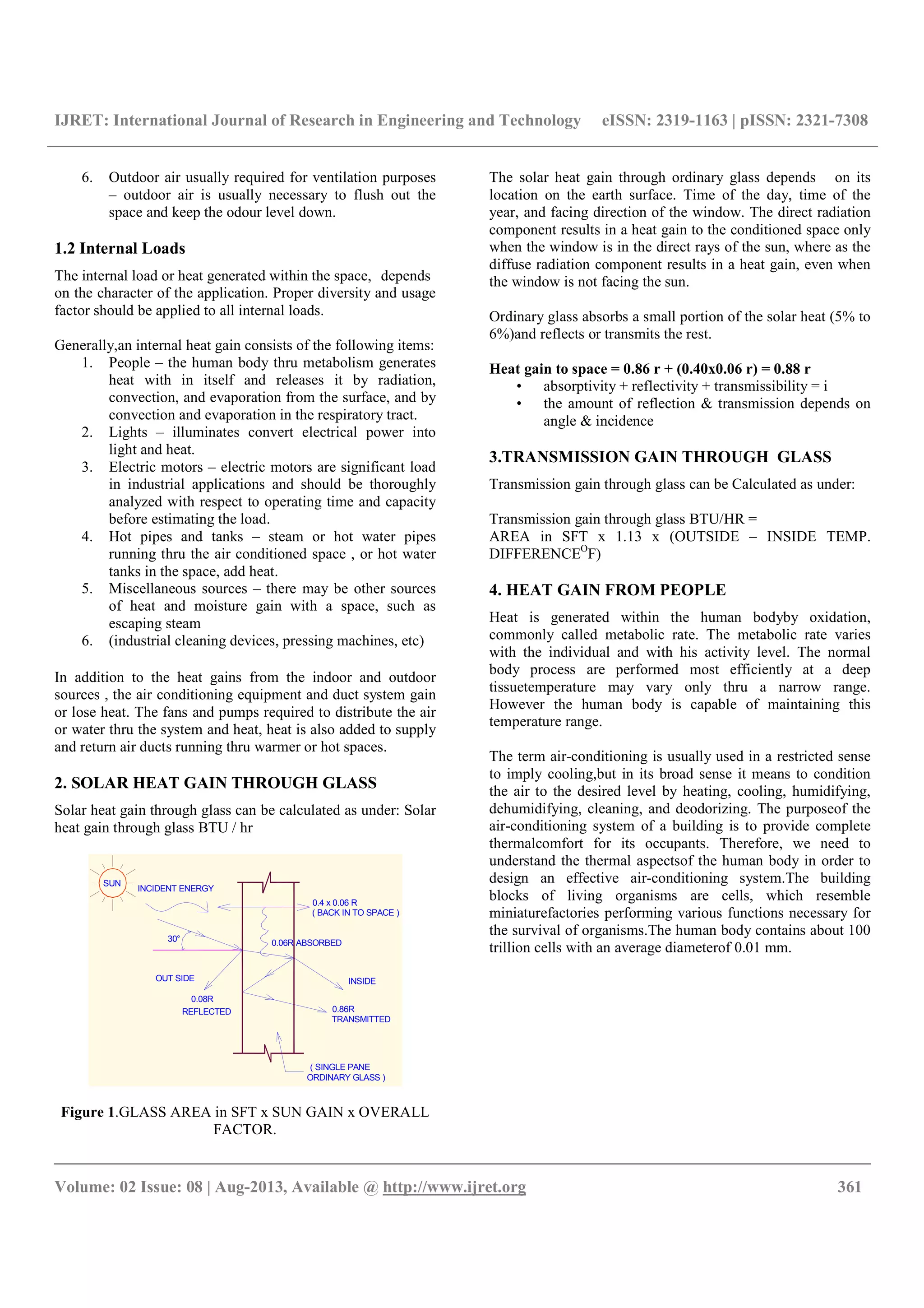
Solar heat gain through glass can be calculated as under: Solar
heat gain through glass BTU / hr
SUN
OUT SIDE
INCIDENT ENERGY
0.4 x 0.06 R
0.06R ABSORBED
INSIDE
30°
REFLECTED
0.08R
0.86R
TRANSMITTED
( SINGLE PANE
( BACK IN TO SPACE )
ORDINARY GLASS )
Figure 1.GLASS AREA in SFT x SUN GAIN x OVERALL
FACTOR.
The solar heat gain through ordinary glass depends on its
location on the earth surface. Time of the day, time of the
year, and facing direction of the window. The direct radiation
component results in a heat gain to the conditioned space only
when the window is in the direct rays of the sun, where as the
diffuse radiation component results in a heat gain, even when
the window is not facing the sun.
Ordinary glass absorbs a small portion of the solar heat (5% to
6%)and reflects or transmits the rest.
Heat gain to space = 0.86 r + (0.40x0.06 r) = 0.88 r
• absorptivity + reflectivity + transmissibility = i
• the amount of reflection & transmission depends on
angle & incidence
3.TRANSMISSION GAIN THROUGH GLASS
Transmission gain through glass can be Calculated as under:
Transmission gain through glass BTU/HR =
AREA in SFT x 1.13 x (OUTSIDE – INSIDE TEMP.
DIFFERENCEO
F)
4. HEAT GAIN FROM PEOPLE
Heat is generated within the human bodyby oxidation,
commonly called metabolic rate. The metabolic rate varies
with the individual and with his activity level. The normal
body process are performed most efficiently at a deep
tissuetemperature may vary only thru a narrow range.
However the human body is capable of maintaining this
temperature range.
The term air-conditioning is usually used in a restricted sense
to imply cooling,but in its broad sense it means to condition
the air to the desired level by heating, cooling, humidifying,
dehumidifying, cleaning, and deodorizing. The purposeof the
air-conditioning system of a building is to provide complete
thermalcomfort for its occupants. Therefore, we need to
understand the thermal aspectsof the human body in order to
design an effective air-conditioning system.The building
blocks of living organisms are cells, which resemble
miniaturefactories performing various functions necessary for
the survival of organisms.The human body contains about 100
trillion cells with an average diameterof 0.01 mm.
IJRET: International Journal of Research in Engineering and Technology eISSN: 2319-1163 | pISSN: 2321-7308
__________________________________________________________________________________________
Volume: 02 Issue: 08 | Aug-2013, Available @ http://www.ijret.org 362
Sl Level Location Area (sft) Inside Conditions, DB, RHOccupancy
FreshAir
(cfm)
Dehumidifiedair
qty (cfm)
Cooling
load(TR)
Capacity ofAHU's
Proposed
1 GF BMS 465 22Deg C, 55% 4 101 2104 4 4 2200 cfm / 5 TR
2 GF Lift lobby 885 24Deg C, 50% 7 194 2657 7.00 7 3750 cfm / 10 TR
3 GF Entrance Lobby 835 24Deg C, 50% 8 183 2532 7.00 7 3750 cfm / 10 TR
4 GF Society Room 1987 24Deg C, 50% 15 435 4651 12.00 12 3000cfm / 7.5 TR
1 1 Grid BF-2, 12 14500 24Deg C, 50% 190 3178 27656 68.00 68 30000cfm / 65 TR
2 1
Grid FJ-2, 12 +
Grid JP-7,12 15000 24Deg C, 50% 200 3281 21374 57.00 57 26000cfm/ 55 TR
3 2-6 Grid BF-2, 12 14500 24Deg C, 50% 210 3178 24117 63.00 315 30000cfm/ 65 TR
4 2-6
Grid FJ-2, 12 +
Grid JP-7,12 15000 24Deg C, 50% 220 3300 18362 52.00 260 26000cfm/ 55 TR
5 7 Grid BF-2, 12 14500 24Deg C, 50% 190 3178 24097 62.00 62 30000cfm/ 65 TR
6 7
Grid FJ-2, 12 +
Grid JP-7,12 15000 24Deg C, 50% 200 3281 18223 52.00 52 26000cfm/ 55 TR
Total PeakSummer Cooling Load (TR) 844
With diversity factorof0.8 675
Proposed Chillers : 220TR Nominal capacity chillers -4 Nos. (3w*+1s)
* Note : 4thChilleralso shall be working during peak summerto meet the building load. Hence, system is designed considering 4 chillers and 4 pumps working.
Total Load
(TR)
BASIS OFDESIGNFORAIRCONDITIONING SYSTEM FORGANGAHITECHCITY2-SOCIETY, HYDERABAD
5. EQUIPMENT SELECTION
After assessment of Air conditioning load, equipment must be
selected with enough capacity to offset this load. The air
supplied to the space must be of the proper conditions to
satisfy both the sensible and latent loads estimated.
5.1. The Major Equipment Involved In An Central
Air Conditioning System :
• Chillers
• Primary pumps
• Secondary pumps
• Air handling units
a) Air-Cooled Chillers
The Chillers are Energy Efficient and Robust in construction.
They are developed with state of art technology components.
The chillers are fitted with R-134a optimized BitzerCSH3
series Semi-hermetic Screw Compressors, High efficiency DX
Coolers and Aircooled Condensers. The latest generation High
Efficient Copper tubes are incorporated in the Coolers.
Electronic Expansion Valves and the new generation MCS
Magnum Controller lead to precise control of refrigerant flow
and chilled water temperature. Specially developed low noise
Bird Wing design fans are used for optimum air flow.
Acoustic enclosure for compressor can be offered as an
optional feature to reduce noise level. Special coatings on
aluminium condenser fins can also be offered for better
corrosion resistance required in coastal / industrial
environments
6. Air-Cooled Versus Water-Cooled Chillers
Operating Cost:
When compared to water-cooled chillers, air-cooled systems
that function without any condenser water pumps or water
cooling towers require lower initial installation and
maintenance costs. However, lower condensing temperature of
water-cooled chillers can offset this high installation cost.
b) Basic Chilled Water Pumping System
• Single Chiller, Single Constant Speed Pump
• 3-way valves for all Chilled Water Coils (or even more basic
– no valves – full flow) maintains constant flow.
• Control strategy: Enable chilled water pump when outside air
temperature is above
set point and at least 1 chilled water coil control valve is open
to coil. Enable chillerafter flow is proven. Chiller operates to
maintain leaving chilled water temperature atsetpoint. Coil
valves modulate to maintain comfortable space conditions.[7]
7. Basic Primary / Secondary Chilled Water Pumping
System
• Single Chiller, Single Constant Speed Primary Pump, bypass
loop with no valve, Variable Speed Secondary Pump.
• The primary pump pumps water through the chiller. The
secondary pump pulls water from the primary system and
pumps it to the coils.
• Add a Water Differential Pressure Transmitter near the end
of the piping run (in an accessible location).
• VFDs and pumps have minimum recommended operating
speeds,typically about 20%. Use 3-way valves for 1 or more
coils to ensurethat there is always this amount of water
flowing in the secondary loop. My recommendation is to use
3-way valves at units that are expected to have full occupancy
for the most hours and not atGymnasium or other units that
serve areas where significant operating time is at less than full
occupancy (partial / low load areas).
• Control strategy: Enable both primary and secondary chilled
water pumps when outside air temperature is above setpoint
and at least 1chilled water coil control valve is open to coil.
Modulate (vary) thespeed of the secondary pump VFD to
maintain a constant differentialpressure. Enable chiller after
flow is proven. Chiller operates tomaintain leaving chilled
water temperature at setpoint. Coil valvesmodulate to maintain
comfortable space conditions.
IJRET: International Journal of Research in Engineering and Technology eISSN: 2319-1163 | pISSN: 2321-7308
__________________________________________________________________________________________
Volume: 02 Issue: 08 | Aug-2013, Available @ http://www.ijret.org 363
8. VARIABLE VOLUME / VARIABLE SPEED
VARIABLE SPEED PRIMARY CHILLED WATER PUMP
CONTROLWITH TWO WAY VALVE DIRECT RETURN
SYSTEM
DESCRIPTION:
The volume of water supplied to the system is[4] varied in
response to the cooling load by the two-way zone valves. The
basis of variable speed pumping is to save pumping cost by
optimizing the pump motor horsepower input. The pump
produces only the flow and head required at any time. This is
performed by regulation of the pump speed/adjustable
frequency drive and modulation of a bypass valve through the
use of the Technologic™ Controller. The controller regulates
the pump speed and valve position in response to the system
load conditions and in order to protect the pumps and chillers.
Fig . VARIABLE SPEED CHILLED WATER PUMP
CONTROL VARIABLE SPEED PRIMARY SYSTEM WITH
BYPASS AT THE CHILLERS
Reduce Energy Consumption.
Utilizing the variable volume system (two-way terminal
control valves), the pumping energy can be reduced by more
than two-thirds that of a constant speed pumpingsystem riding
its pump curve.
The variable speed system responds to a differential pressure
sensor/transmitter, which is sensing across a terminal and two-
way valve. This allows for energysavings as the terminal
responds to a lighter load and the two-way valves control at a
lower flow position. This increased pressure drop signals the
controller to operate the pump(s) at a lower speed to maintain
its set point.
Applications that operate for a high percentage of time at part
load will utilize the variable speed, energy savings potential of
variable primary systems by loweringspeed, thus consuming
less energy during lighter loads. Those that operate at full load
but with lower that design return water temperature benefit in
a similar manner by slowing down the pumps to an adequate
rate, thus maintaining optimal return temperature, allowing the
chiller(s) to operate more efficiently.
C) Air Handling Apparatus
Air handling apparatus can be of three types
a) Built up apparatus where the casing for the conditioning
equipment is fabricated and installed at or near the job site
b) Fan coil equipment that is manufactured and shipped to the
job site, either completely or partially assembled; and
c) Self-containedequipment which is shipped to the job site
completely assembled.
IJRET: International Journal of Research in Engineering and Technology eISSN: 2319-1163 | pISSN: 2321-7308
__________________________________________________________________________________________
Volume: 02 Issue: 08 | Aug-2013, Available @ http://www.ijret.org 364
LOCATION
The location of the air handling apparatus directly influences
the economic and the sound level aspects of any system
9. ECONOMIC CONSIDERATION
The air handling apparatus should be centrally located to
obtain a minimum-first cost system. In a few instances,
however, it maybe be necessary to locate the
apparatus,refrigeration machine,and cooling tower in one area,
to achieve optimum system cost.
When the three components are grouped in one location, the
cost of extra ductwork is offset by the reduced piping cost. In
addition, when the complete system becomes large enough to
require more than one refrigeration machine, grouping the
mechanical equipment on more than one floor becomes
practical. This design is often used in large buildings.
The upper floor equipment handles approximately the top 20
to 30 floors , and the lower floor equipment is used for the
lower 20 to 30 floors.
General Arrangement of AHU 2 (30000 cfm)
10. RESULT:
1. Air balancing is done measuring the velocity of air using
digital anemometer thus by arriving volume of the flow
(flow=area x velocity), regulating volume control dampers in
the ducts and controlling collar dampes provided in the air
terminal.
2. Water balancing is done as per designed flow rate using
double regulating balancing value by taking differential
pressures across the valve to ensure water flow as per the
design.
3. Temperature and relative humidity is measured is all the
conditioned area and recorded that 23 Deg C temp and 55to 58
RH, using digital temperature & RH indicator.
4. Variable air volume thermostat is set for 23Deg c and
observed that air volume is getting reduced as the VAV
actuator will close the damper proportionately on achieving set
temperature of 23c. Similarly VAV actuator opens the damper
proportionately on increase of inside the cabin temperature.
11. SCOPE OF FUTURE WORK:
Building automation system consists of Start / stop manual
auto switches along with potential free function for
monitoring the manual peration status, can be provided for
those equipment whose start stop is controlled by building
automation system.
12.REFERENCES:
[1] ASHRAE 2003 , HVAC Applications optimizing the
design and control of chilled water plants.
[2] ASHRAE Hand book
[3] Carrier Hand book
[4] System design manual by carrier.
[5] Kirsner, W. 1996. “The demise of the primary-
secondary pumping paradigm for chilled water plant
design.” Heating/Piping/ Air Conditioning
[6] Paarporn, S. “Local pumping system.” ASHRAE
[7] Avery, G. 2001. “Improving the efficiency of chilled
water plants.” ASHRAE
[8] Taylor, S. 2002. “Degrading chilled water plant delta-T:
causes and mitigation.” ASHRAE Transactions,.
[9] ASHRAE. 2002. Optimizing the Design & Control of
Chilled Water Plants,

Design of air conditioning and ventilation system for a

  • 1.
    IJRET: International Journalof Research in Engineering and Technology eISSN: 2319-1163 | pISSN: 2321-7308 __________________________________________________________________________________________ Volume: 02 Issue: 08 | Aug-2013, Available @ http://www.ijret.org 360 DESIGN OF AIR CONDITIONING AND VENTILATION SYSTEM FOR A MULTI-STOREY OFFICE BUILDING G. Prasanthi1 , Sireesharevathi.D2 dr.smt.g.prasanthi@gmail.com, sireesharevathi@gmail.com Abstract This project consists of how the proposed centralized air conditioning and mechanical ventilation system is designed and its criterion for a new building in Hyderabad. It consists of seven floors and two basements having an area of 39000sft per floor. The two basement (lower and upper) and major part of ground floor shall be meant for offices with a total area of 273000sft. The main objective is to create a thermally controlled environment within the space of a building envelope such as office space, BMS room, society room, entrance lobby etc. and building mechanical ventilation namely basement ventilation, staircase pressurisation, lift well pressurisation, toilet exhaust etc. Design and planning of the above system shall meet the required below customer objectives, like econoical in cost,energy efficient,simple and flexible with respect to operation and maintenance. The tentative air conditioning load for the system shall be 800TR apprix. Air cooled screw chillers with secondary variable pumping system are proposed to make the system energy efficient. The proposed air conditioning plant shall be located on the sw side on the building terrace. keywords: chillers, variable air volume, air handling unit. -----------------------------------------------------------------------***----------------------------------------------------------------------- 1.INTRODUCTION Air conditioning systems are generally divided into four basic types determined by the method through which the final with in the space cooling and heating are attained, the air surrounding the occupant is the end medium which is conditioned. In some systems most of the thermal effect is radiant. The basic types are, 1. All – water systems, 2. All – air systems, 3. Air – water systems, 4. Heat pump. 5. Unitary refrigerant based systems. Existing vs. new structures:- There is a distinct difference between systems available for existing or new buildings. in exiting enclosures or structures heating and at times ventilation is already supplied. The additional system is cooling only, the adapting and integrating the existing heating ventilation into a year around cycle. The H07 building comprise of two basements,ground and 7th floors. The two basements (lower and upper) and major part of the ground floor shall be meant for car park and utility areas. The balance part of Ground Floor contains Entrance lobby, Society room, BMS room, office space. The upper floors (1st to 7th floor) shall be meant for offices. Each floor of office space is divided into areas known as left and right wings 1.1 Air Conditioning Load Estimate The air conditioning load is estimated to provide the basis for selecting the conditioning equipment. It must take into account the heat coming into the space from outdoors on a design day, as well as heat being generated within the space. A design day is defined as: 1. A day on which the dry – and wet bulb temperatures are peaking simultaneously, 2. A day when there is little or no have in the air to reduce the solar heat gain thru glass. 3. All of the internal loads are normal 4. The air vapour pressure – a higher vapour pressure surrounding conditioned space causes water vapour to flow thru the building materials. 5. The wind blowing against a side of the building – wind causes the outdoor air that is higher in temperature and moisture content to infiltrate thru the cracks around the doors and windows.
  • 2.
    IJRET: International Journalof Research in Engineering and Technology eISSN: 2319-1163 | pISSN: 2321-7308 __________________________________________________________________________________________ Volume: 02 Issue: 08 | Aug-2013, Available @ http://www.ijret.org 361 6. Outdoor air usually required for ventilation purposes – outdoor air is usually necessary to flush out the space and keep the odour level down. 1.2 Internal Loads The internal load or heat generated within the space, depends on the character of the application. Proper diversity and usage factor should be applied to all internal loads. Generally,an internal heat gain consists of the following items: 1. People – the human body thru metabolism generates heat with in itself and releases it by radiation, convection, and evaporation from the surface, and by convection and evaporation in the respiratory tract. 2. Lights – illuminates convert electrical power into light and heat. 3. Electric motors – electric motors are significant load in industrial applications and should be thoroughly analyzed with respect to operating time and capacity before estimating the load. 4. Hot pipes and tanks – steam or hot water pipes running thru the air conditioned space , or hot water tanks in the space, add heat. 5. Miscellaneous sources – there may be other sources of heat and moisture gain with a space, such as escaping steam 6. (industrial cleaning devices, pressing machines, etc) In addition to the heat gains from the indoor and outdoor sources , the air conditioning equipment and duct system gain or lose heat. The fans and pumps required to distribute the air or water thru the system and heat, heat is also added to supply and return air ducts running thru warmer or hot spaces. 2. SOLAR HEAT GAIN THROUGH GLASS Solar heat gain through glass can be calculated as under: Solar heat gain through glass BTU / hr SUN OUT SIDE INCIDENT ENERGY 0.4 x 0.06 R 0.06R ABSORBED INSIDE 30° REFLECTED 0.08R 0.86R TRANSMITTED ( SINGLE PANE ( BACK IN TO SPACE ) ORDINARY GLASS ) Figure 1.GLASS AREA in SFT x SUN GAIN x OVERALL FACTOR. The solar heat gain through ordinary glass depends on its location on the earth surface. Time of the day, time of the year, and facing direction of the window. The direct radiation component results in a heat gain to the conditioned space only when the window is in the direct rays of the sun, where as the diffuse radiation component results in a heat gain, even when the window is not facing the sun. Ordinary glass absorbs a small portion of the solar heat (5% to 6%)and reflects or transmits the rest. Heat gain to space = 0.86 r + (0.40x0.06 r) = 0.88 r • absorptivity + reflectivity + transmissibility = i • the amount of reflection & transmission depends on angle & incidence 3.TRANSMISSION GAIN THROUGH GLASS Transmission gain through glass can be Calculated as under: Transmission gain through glass BTU/HR = AREA in SFT x 1.13 x (OUTSIDE – INSIDE TEMP. DIFFERENCEO F) 4. HEAT GAIN FROM PEOPLE Heat is generated within the human bodyby oxidation, commonly called metabolic rate. The metabolic rate varies with the individual and with his activity level. The normal body process are performed most efficiently at a deep tissuetemperature may vary only thru a narrow range. However the human body is capable of maintaining this temperature range. The term air-conditioning is usually used in a restricted sense to imply cooling,but in its broad sense it means to condition the air to the desired level by heating, cooling, humidifying, dehumidifying, cleaning, and deodorizing. The purposeof the air-conditioning system of a building is to provide complete thermalcomfort for its occupants. Therefore, we need to understand the thermal aspectsof the human body in order to design an effective air-conditioning system.The building blocks of living organisms are cells, which resemble miniaturefactories performing various functions necessary for the survival of organisms.The human body contains about 100 trillion cells with an average diameterof 0.01 mm.
  • 3.
    IJRET: International Journalof Research in Engineering and Technology eISSN: 2319-1163 | pISSN: 2321-7308 __________________________________________________________________________________________ Volume: 02 Issue: 08 | Aug-2013, Available @ http://www.ijret.org 362 Sl Level Location Area (sft) Inside Conditions, DB, RHOccupancy FreshAir (cfm) Dehumidifiedair qty (cfm) Cooling load(TR) Capacity ofAHU's Proposed 1 GF BMS 465 22Deg C, 55% 4 101 2104 4 4 2200 cfm / 5 TR 2 GF Lift lobby 885 24Deg C, 50% 7 194 2657 7.00 7 3750 cfm / 10 TR 3 GF Entrance Lobby 835 24Deg C, 50% 8 183 2532 7.00 7 3750 cfm / 10 TR 4 GF Society Room 1987 24Deg C, 50% 15 435 4651 12.00 12 3000cfm / 7.5 TR 1 1 Grid BF-2, 12 14500 24Deg C, 50% 190 3178 27656 68.00 68 30000cfm / 65 TR 2 1 Grid FJ-2, 12 + Grid JP-7,12 15000 24Deg C, 50% 200 3281 21374 57.00 57 26000cfm/ 55 TR 3 2-6 Grid BF-2, 12 14500 24Deg C, 50% 210 3178 24117 63.00 315 30000cfm/ 65 TR 4 2-6 Grid FJ-2, 12 + Grid JP-7,12 15000 24Deg C, 50% 220 3300 18362 52.00 260 26000cfm/ 55 TR 5 7 Grid BF-2, 12 14500 24Deg C, 50% 190 3178 24097 62.00 62 30000cfm/ 65 TR 6 7 Grid FJ-2, 12 + Grid JP-7,12 15000 24Deg C, 50% 200 3281 18223 52.00 52 26000cfm/ 55 TR Total PeakSummer Cooling Load (TR) 844 With diversity factorof0.8 675 Proposed Chillers : 220TR Nominal capacity chillers -4 Nos. (3w*+1s) * Note : 4thChilleralso shall be working during peak summerto meet the building load. Hence, system is designed considering 4 chillers and 4 pumps working. Total Load (TR) BASIS OFDESIGNFORAIRCONDITIONING SYSTEM FORGANGAHITECHCITY2-SOCIETY, HYDERABAD 5. EQUIPMENT SELECTION After assessment of Air conditioning load, equipment must be selected with enough capacity to offset this load. The air supplied to the space must be of the proper conditions to satisfy both the sensible and latent loads estimated. 5.1. The Major Equipment Involved In An Central Air Conditioning System : • Chillers • Primary pumps • Secondary pumps • Air handling units a) Air-Cooled Chillers The Chillers are Energy Efficient and Robust in construction. They are developed with state of art technology components. The chillers are fitted with R-134a optimized BitzerCSH3 series Semi-hermetic Screw Compressors, High efficiency DX Coolers and Aircooled Condensers. The latest generation High Efficient Copper tubes are incorporated in the Coolers. Electronic Expansion Valves and the new generation MCS Magnum Controller lead to precise control of refrigerant flow and chilled water temperature. Specially developed low noise Bird Wing design fans are used for optimum air flow. Acoustic enclosure for compressor can be offered as an optional feature to reduce noise level. Special coatings on aluminium condenser fins can also be offered for better corrosion resistance required in coastal / industrial environments 6. Air-Cooled Versus Water-Cooled Chillers Operating Cost: When compared to water-cooled chillers, air-cooled systems that function without any condenser water pumps or water cooling towers require lower initial installation and maintenance costs. However, lower condensing temperature of water-cooled chillers can offset this high installation cost. b) Basic Chilled Water Pumping System • Single Chiller, Single Constant Speed Pump • 3-way valves for all Chilled Water Coils (or even more basic – no valves – full flow) maintains constant flow. • Control strategy: Enable chilled water pump when outside air temperature is above set point and at least 1 chilled water coil control valve is open to coil. Enable chillerafter flow is proven. Chiller operates to maintain leaving chilled water temperature atsetpoint. Coil valves modulate to maintain comfortable space conditions.[7] 7. Basic Primary / Secondary Chilled Water Pumping System • Single Chiller, Single Constant Speed Primary Pump, bypass loop with no valve, Variable Speed Secondary Pump. • The primary pump pumps water through the chiller. The secondary pump pulls water from the primary system and pumps it to the coils. • Add a Water Differential Pressure Transmitter near the end of the piping run (in an accessible location). • VFDs and pumps have minimum recommended operating speeds,typically about 20%. Use 3-way valves for 1 or more coils to ensurethat there is always this amount of water flowing in the secondary loop. My recommendation is to use 3-way valves at units that are expected to have full occupancy for the most hours and not atGymnasium or other units that serve areas where significant operating time is at less than full occupancy (partial / low load areas). • Control strategy: Enable both primary and secondary chilled water pumps when outside air temperature is above setpoint and at least 1chilled water coil control valve is open to coil. Modulate (vary) thespeed of the secondary pump VFD to maintain a constant differentialpressure. Enable chiller after flow is proven. Chiller operates tomaintain leaving chilled water temperature at setpoint. Coil valvesmodulate to maintain comfortable space conditions.
  • 4.
    IJRET: International Journalof Research in Engineering and Technology eISSN: 2319-1163 | pISSN: 2321-7308 __________________________________________________________________________________________ Volume: 02 Issue: 08 | Aug-2013, Available @ http://www.ijret.org 363 8. VARIABLE VOLUME / VARIABLE SPEED VARIABLE SPEED PRIMARY CHILLED WATER PUMP CONTROLWITH TWO WAY VALVE DIRECT RETURN SYSTEM DESCRIPTION: The volume of water supplied to the system is[4] varied in response to the cooling load by the two-way zone valves. The basis of variable speed pumping is to save pumping cost by optimizing the pump motor horsepower input. The pump produces only the flow and head required at any time. This is performed by regulation of the pump speed/adjustable frequency drive and modulation of a bypass valve through the use of the Technologic™ Controller. The controller regulates the pump speed and valve position in response to the system load conditions and in order to protect the pumps and chillers. Fig . VARIABLE SPEED CHILLED WATER PUMP CONTROL VARIABLE SPEED PRIMARY SYSTEM WITH BYPASS AT THE CHILLERS Reduce Energy Consumption. Utilizing the variable volume system (two-way terminal control valves), the pumping energy can be reduced by more than two-thirds that of a constant speed pumpingsystem riding its pump curve. The variable speed system responds to a differential pressure sensor/transmitter, which is sensing across a terminal and two- way valve. This allows for energysavings as the terminal responds to a lighter load and the two-way valves control at a lower flow position. This increased pressure drop signals the controller to operate the pump(s) at a lower speed to maintain its set point. Applications that operate for a high percentage of time at part load will utilize the variable speed, energy savings potential of variable primary systems by loweringspeed, thus consuming less energy during lighter loads. Those that operate at full load but with lower that design return water temperature benefit in a similar manner by slowing down the pumps to an adequate rate, thus maintaining optimal return temperature, allowing the chiller(s) to operate more efficiently. C) Air Handling Apparatus Air handling apparatus can be of three types a) Built up apparatus where the casing for the conditioning equipment is fabricated and installed at or near the job site b) Fan coil equipment that is manufactured and shipped to the job site, either completely or partially assembled; and c) Self-containedequipment which is shipped to the job site completely assembled.
  • 5.
    IJRET: International Journalof Research in Engineering and Technology eISSN: 2319-1163 | pISSN: 2321-7308 __________________________________________________________________________________________ Volume: 02 Issue: 08 | Aug-2013, Available @ http://www.ijret.org 364 LOCATION The location of the air handling apparatus directly influences the economic and the sound level aspects of any system 9. ECONOMIC CONSIDERATION The air handling apparatus should be centrally located to obtain a minimum-first cost system. In a few instances, however, it maybe be necessary to locate the apparatus,refrigeration machine,and cooling tower in one area, to achieve optimum system cost. When the three components are grouped in one location, the cost of extra ductwork is offset by the reduced piping cost. In addition, when the complete system becomes large enough to require more than one refrigeration machine, grouping the mechanical equipment on more than one floor becomes practical. This design is often used in large buildings. The upper floor equipment handles approximately the top 20 to 30 floors , and the lower floor equipment is used for the lower 20 to 30 floors. General Arrangement of AHU 2 (30000 cfm) 10. RESULT: 1. Air balancing is done measuring the velocity of air using digital anemometer thus by arriving volume of the flow (flow=area x velocity), regulating volume control dampers in the ducts and controlling collar dampes provided in the air terminal. 2. Water balancing is done as per designed flow rate using double regulating balancing value by taking differential pressures across the valve to ensure water flow as per the design. 3. Temperature and relative humidity is measured is all the conditioned area and recorded that 23 Deg C temp and 55to 58 RH, using digital temperature & RH indicator. 4. Variable air volume thermostat is set for 23Deg c and observed that air volume is getting reduced as the VAV actuator will close the damper proportionately on achieving set temperature of 23c. Similarly VAV actuator opens the damper proportionately on increase of inside the cabin temperature. 11. SCOPE OF FUTURE WORK: Building automation system consists of Start / stop manual auto switches along with potential free function for monitoring the manual peration status, can be provided for those equipment whose start stop is controlled by building automation system. 12.REFERENCES: [1] ASHRAE 2003 , HVAC Applications optimizing the design and control of chilled water plants. [2] ASHRAE Hand book [3] Carrier Hand book [4] System design manual by carrier. [5] Kirsner, W. 1996. “The demise of the primary- secondary pumping paradigm for chilled water plant design.” Heating/Piping/ Air Conditioning [6] Paarporn, S. “Local pumping system.” ASHRAE [7] Avery, G. 2001. “Improving the efficiency of chilled water plants.” ASHRAE [8] Taylor, S. 2002. “Degrading chilled water plant delta-T: causes and mitigation.” ASHRAE Transactions,. [9] ASHRAE. 2002. Optimizing the Design & Control of Chilled Water Plants,