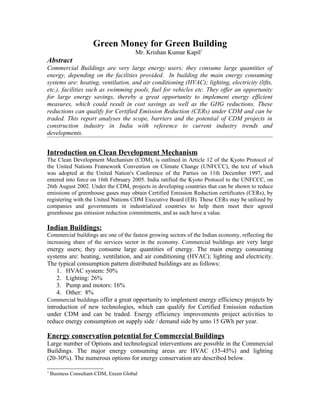
Green Money for Green Building
                                        Mr. Krishan Kumar Kapil1
Abstract
Commercial Buildings are very large energy users; they consume large quantities of
energy, depending on the facilities provided. In building the main energy consuming
systems are: heating, ventilation, and air conditioning (HVAC); lighting, electricity (lifts,
etc.), facilities such as swimming pools, fuel for vehicles etc. They offer an opportunity
for large energy savings, thereby a great opportunity to implement energy efficient
measures, which could result in cost savings as well as the GHG reductions. These
reductions can qualify for Certified Emission Reduction (CERs) under CDM and can be
traded. This report analyses the scope, barriers and the potential of CDM projects in
construction industry in India with reference to current industry trends and
developments.


Introduction on Clean Development Mechanism
The Clean Development Mechanism (CDM), is outlined in Article 12 of the Kyoto Protocol of
the United Nations Framework Convention on Climate Change (UNFCCC), the text of which
was adopted at the United Nation's Conference of the Parties on 11th December 1997, and
entered into force on 16th February 2005. India ratified the Kyoto Protocol to the UNFCCC, on
26th August 2002. Under the CDM, projects in developing countries that can be shown to reduce
emissions of greenhouse gases may obtain Certified Emission Reduction certificates (CERs), by
registering with the United Nations CDM Executive Board (EB). These CERs may be utilized by
companies and governments in industrialized countries to help them meet their agreed
greenhouse gas emission reduction commitments, and as such have a value.

Indian Buildings:
Commercial buildings are one of the fastest growing sectors of the Indian economy, reflecting the
increasing share of the services sector in the economy. Commercial buildings are very large
energy users; they consume large quantities of energy. The main energy consuming
systems are: heating, ventilation, and air conditioning (HVAC); lighting and electricity.
The typical consumption pattern distributed buildings are as follows:
    1. HVAC system: 50%
    2. Lighting: 26%
    3. Pump and motors: 16%
    4. Other: 8%
Commercial buildings offer a great opportunity to implement energy efficiency projects by
introduction of new technologies, which can qualify for Certified Emission reduction
under CDM and can be traded. Energy efficiency improvements project activities to
reduce energy consumption on supply side / demand side by unto 15 GWh per year.

Energy conservation potential for Commercial Buildings
Large number of Options and technological interventions are possible in the Commercial
Buildings. The major energy consuming areas are HVAC (35-45%) and lighting
(20-30%). The numerous options for energy conservation are described below.

1
    Business Consultant-CDM, Enzen Global
1.   Energy efficient building design
   2.   HVAC
   3.   Energy efficient and Day lighting
   4.   Motors and Pumps
   5.   Waste heat recovery/ Combined Heat and Power (CHP)
   6.   Power Factor Controls
   7.   Water conservation and recycling
   8.   Renewable Energy Technologies
   9.   Ground coupling Technologies

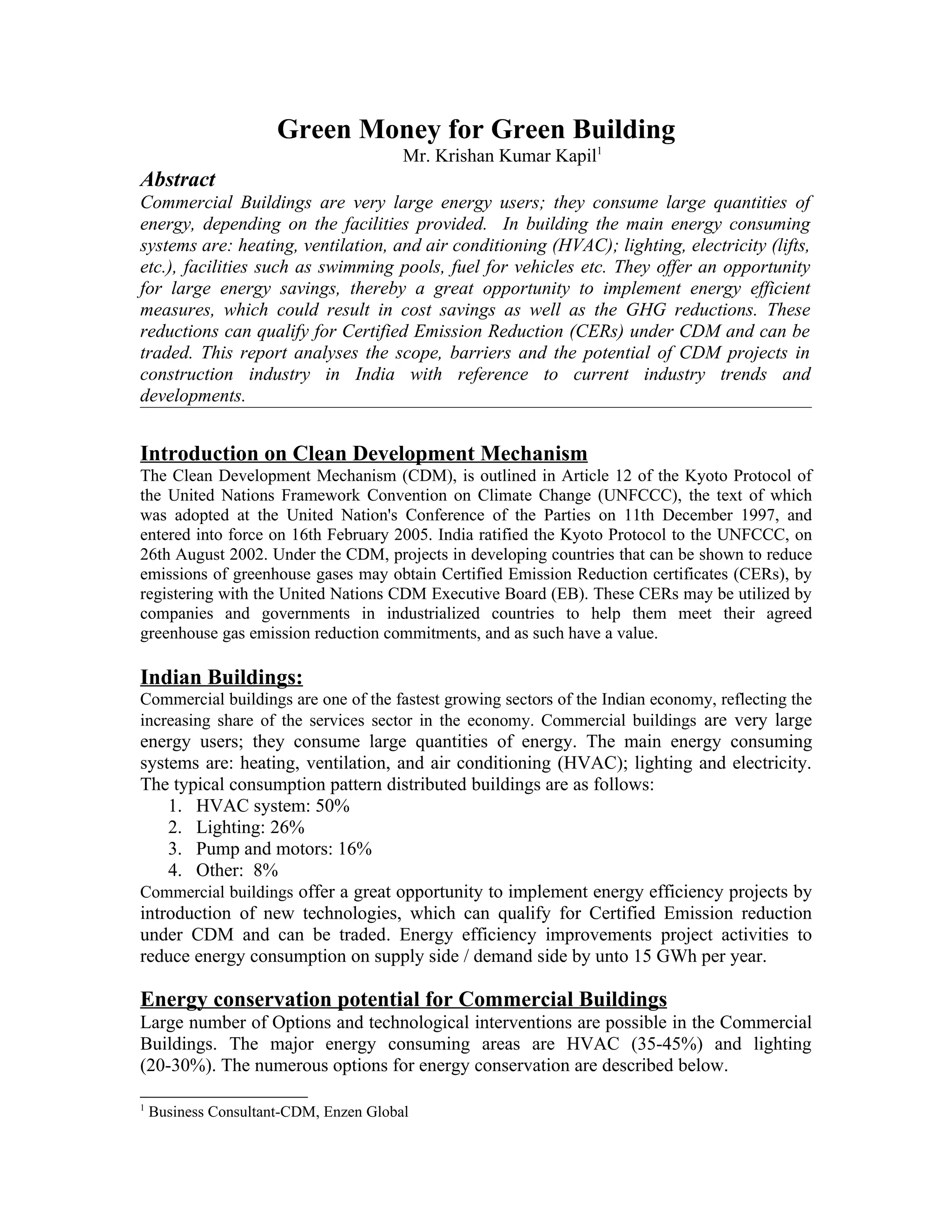
Building Design
There are six climatic zones in India and the building orientation as well as the baseline
for energy consumption will depend on the climatic zone. Energy efficient windows can
play an important role in energy savings. A significant reduction in energy demand is
possible if energy efficient glazing is combined with best orientation (for lighting),
opening area (for heat exchange) and building insulation (for increasing the resistance to
heat exchange) in the original design of the building.

                                       BUILDING DESIGN
 Compared to conventional buildings, green buildings consume less energy and water, preserve
 natural resources such as land and materials, and provide excellent indoor environmental quality
                           Features                                Merits
                           Proper selection of site design for Reduce water use by 70 to 80
 Landscaping               Rainwater retention and onsite water percent
                           purification systems
                           Maximizing natural light and natural Low-cost way to save energy
 Architectural design      ventilation                             and optimize productivity and
                                                                   comfort
                           Energy-efficient lighting combined Reduce energy consumption
                           with high-performance windows, by 40 to 50 %.
 Envelope efficiency       well-insulated walls and roofing,
                           heat avoiding paints etc

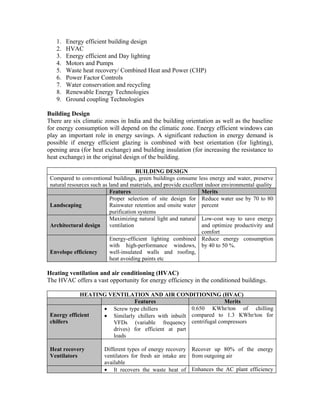
Heating ventilation and air conditioning (HVAC)
The HVAC offers a vast opportunity for energy efficiency in the conditioned buildings.

             HEATING VENTILATION AND AIR CONDITIONING (HVAC)
                              Features                          Merits
                   • Screw type chillers             0.650 KWhr/ton of chilling
 Energy efficient  • Similarly chillers with inbuilt compared to 1.3 KWhr/ton for
 chillers             VFDs (variable frequency centrifugal compressors
                      drives) for efficient at part
                      loads

 Heat recovery          Different types of energy recovery Recover up 80% of the energy
 Ventilators            ventilators for fresh air intake are from outgoing air
                        available
                        • It recovers the waste heat of Enhances the AC plant efficiency
refrigerant which otherwise is     by 5 to 10% and provides an
 Desuperheater             put in the atmosphere through      assured supply of hot water up to
                           condenser of the AC system         60 C
                       •   Available from 5 ton onwards
                           with a payback period of less
                           than one year.
                       •   Utilizes      the       constant   Can save up to 50% of the
 Ground coupled            temperature available              operating costs
 systems               •   Pay back of 1to 2 years
                       •   Suitable for both heating and
                           cooling
                 •         Based on the two stages
 IDEC technology           cooling of ambient air.            Best suited for hospitals etc where
 (Indirect       •         Systems can be employed for        100% fresh air is required.
 evaporative               fresh air requirements in
 cooling)                  conditioned space.


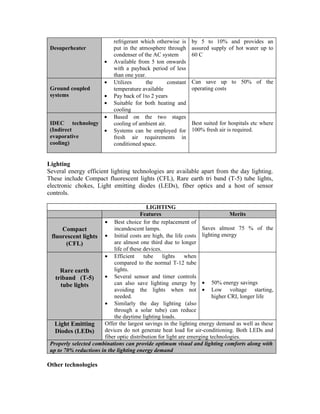
Lighting
Several energy efficient lighting technologies are available apart from the day lighting.
These include Compact fluorescent lights (CFL), Rare earth tri band (T-5) tube lights,
electronic chokes, Light emitting diodes (LEDs), fiber optics and a host of sensor
controls.

                                           LIGHTING
                                        Features                                Merits
                       • Best choice for the replacement of
       Compact              incandescent lamps.                     Saves almost 75 % of the
  fluorescent lights • Initial costs are high, the life costs lighting energy
        (CFL)               are almost one third due to longer
                            life of these devices.
                       • Efficient        tube     lights   when
                            compared to the normal T-12 tube
      Rare earth            lights.
    triband (T-5)      • Several sensor and timer controls
      tube lights           can also save lighting energy by • 50% energy savings
                            avoiding the lights when not • Low voltage starting,
                            needed.                                     higher CRI, longer life
                       • Similarly the day lighting (also
                            through a solar tube) can reduce
                            the daytime lighting loads.
    Light Emitting     Offer the largest savings in the lighting energy demand as well as these
    Diodes (LEDs)      devices do not generate heat load for air-conditioning. Both LEDs and
                       fiber optic distribution for light are emerging technologies.
 Properly selected combinations can provide optimum visual and lighting comforts along with
 up to 70% reductions in the lighting energy demand

Other technologies
There are several other areas of energy savings and CO2 emission reduction with
upcoming technologies. The use of variable frequency drives in motors and pumping,
energy efficient motors, recycling of water through the Root zone system, rain water
harvesting, solar water heating, solar electricity generation through Building integrated
Photovoltaic systems (BIPV) and several emerging technologies can reduce energy
consumption as well as help mitigate CO2 emissions and other environmental hazards.

GHG Savings Potential
The total specific energy consumption for conditioned buildings in India is high. Based
on the above interventions, a large amount of energy can be saved in Commercial
Building. The studies available indicate that 20-40% reduction is possible under existing
scenario. Even if we assume a saving of 20-25% on the conservation side, these amounts
to a reduction of 2000 to 6000 tons of CO2 per year per building. The total reduction
based on these estimates will be in the range of 8 to 10 Lakh tons per year in the country.

Barriers in executing energy efficient projects

Technical Barriers
The initial high costs of certain interventions do not allow the implementation of these
technologies. Although long-term benefits are for sure, there is reluctance in the upfront
investments. There is also the identification of prevailing practices concept for
additionality.

Technological and awareness barriers
There is lack of general awareness about the technologies and the technical complex
cities associated with CDM project identification. Added to these is the high transaction
costs associated with individual CDM project of this scale.

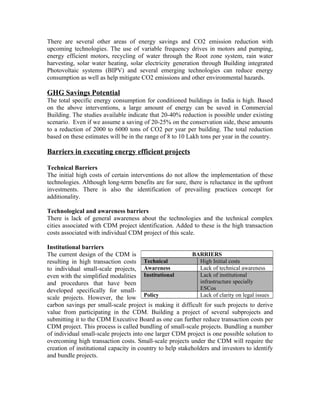
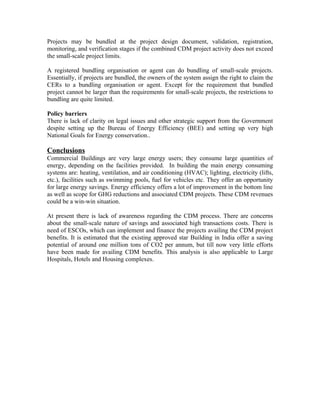
Institutional barriers
The current design of the CDM is                           BARRIERS
resulting in high transaction costs     Technical             High Initial costs
to individual small-scale projects, Awareness                 Lack of technical awareness
even with the simplified modalities Institutional             Lack of institutional
and procedures that have been                                 infrastructure specially
developed specifically for small-                             ESCos
scale projects. However, the low        Policy                Lack of clarity on legal issues
carbon savings per small-scale project is making it difficult for such projects to derive
value from participating in the CDM. Building a project of several subprojects and
submitting it to the CDM Executive Board as one can further reduce transaction costs per
CDM project. This process is called bundling of small-scale projects. Bundling a number
of individual small-scale projects into one larger CDM project is one possible solution to
overcoming high transaction costs. Small-scale projects under the CDM will require the
creation of institutional capacity in country to help stakeholders and investors to identify
and bundle projects.
Projects may be bundled at the project design document, validation, registration,
monitoring, and verification stages if the combined CDM project activity does not exceed
the small-scale project limits.

A registered bundling organisation or agent can do bundling of small-scale projects.
Essentially, if projects are bundled, the owners of the system assign the right to claim the
CERs to a bundling organisation or agent. Except for the requirement that bundled
project cannot be larger than the requirements for small-scale projects, the restrictions to
bundling are quite limited.

Policy barriers
There is lack of clarity on legal issues and other strategic support from the Government
despite setting up the Bureau of Energy Efficiency (BEE) and setting up very high
National Goals for Energy conservation..

Conclusions
Commercial Buildings are very large energy users; they consume large quantities of
energy, depending on the facilities provided. In building the main energy consuming
systems are: heating, ventilation, and air conditioning (HVAC); lighting, electricity (lifts,
etc.), facilities such as swimming pools, fuel for vehicles etc. They offer an opportunity
for large energy savings. Energy efficiency offers a lot of improvement in the bottom line
as well as scope for GHG reductions and associated CDM projects. These CDM revenues
could be a win-win situation.

At present there is lack of awareness regarding the CDM process. There are concerns
about the small-scale nature of savings and associated high transactions costs. There is
need of ESCOs, which can implement and finance the projects availing the CDM project
benefits. It is estimated that the existing approved star Building in India offer a saving
potential of around one million tons of CO2 per annum, but till now very little efforts
have been made for availing CDM benefits. This analysis is also applicable to Large
Hospitals, Hotels and Housing complexes.

Green Money For Green Building

  • 1.
    Green Money forGreen Building Mr. Krishan Kumar Kapil1 Abstract Commercial Buildings are very large energy users; they consume large quantities of energy, depending on the facilities provided. In building the main energy consuming systems are: heating, ventilation, and air conditioning (HVAC); lighting, electricity (lifts, etc.), facilities such as swimming pools, fuel for vehicles etc. They offer an opportunity for large energy savings, thereby a great opportunity to implement energy efficient measures, which could result in cost savings as well as the GHG reductions. These reductions can qualify for Certified Emission Reduction (CERs) under CDM and can be traded. This report analyses the scope, barriers and the potential of CDM projects in construction industry in India with reference to current industry trends and developments. Introduction on Clean Development Mechanism The Clean Development Mechanism (CDM), is outlined in Article 12 of the Kyoto Protocol of the United Nations Framework Convention on Climate Change (UNFCCC), the text of which was adopted at the United Nation's Conference of the Parties on 11th December 1997, and entered into force on 16th February 2005. India ratified the Kyoto Protocol to the UNFCCC, on 26th August 2002. Under the CDM, projects in developing countries that can be shown to reduce emissions of greenhouse gases may obtain Certified Emission Reduction certificates (CERs), by registering with the United Nations CDM Executive Board (EB). These CERs may be utilized by companies and governments in industrialized countries to help them meet their agreed greenhouse gas emission reduction commitments, and as such have a value. Indian Buildings: Commercial buildings are one of the fastest growing sectors of the Indian economy, reflecting the increasing share of the services sector in the economy. Commercial buildings are very large energy users; they consume large quantities of energy. The main energy consuming systems are: heating, ventilation, and air conditioning (HVAC); lighting and electricity. The typical consumption pattern distributed buildings are as follows: 1. HVAC system: 50% 2. Lighting: 26% 3. Pump and motors: 16% 4. Other: 8% Commercial buildings offer a great opportunity to implement energy efficiency projects by introduction of new technologies, which can qualify for Certified Emission reduction under CDM and can be traded. Energy efficiency improvements project activities to reduce energy consumption on supply side / demand side by unto 15 GWh per year. Energy conservation potential for Commercial Buildings Large number of Options and technological interventions are possible in the Commercial Buildings. The major energy consuming areas are HVAC (35-45%) and lighting (20-30%). The numerous options for energy conservation are described below. 1 Business Consultant-CDM, Enzen Global
  • 2.
    1. Energy efficient building design 2. HVAC 3. Energy efficient and Day lighting 4. Motors and Pumps 5. Waste heat recovery/ Combined Heat and Power (CHP) 6. Power Factor Controls 7. Water conservation and recycling 8. Renewable Energy Technologies 9. Ground coupling Technologies Building Design There are six climatic zones in India and the building orientation as well as the baseline for energy consumption will depend on the climatic zone. Energy efficient windows can play an important role in energy savings. A significant reduction in energy demand is possible if energy efficient glazing is combined with best orientation (for lighting), opening area (for heat exchange) and building insulation (for increasing the resistance to heat exchange) in the original design of the building. BUILDING DESIGN Compared to conventional buildings, green buildings consume less energy and water, preserve natural resources such as land and materials, and provide excellent indoor environmental quality Features Merits Proper selection of site design for Reduce water use by 70 to 80 Landscaping Rainwater retention and onsite water percent purification systems Maximizing natural light and natural Low-cost way to save energy Architectural design ventilation and optimize productivity and comfort Energy-efficient lighting combined Reduce energy consumption with high-performance windows, by 40 to 50 %. Envelope efficiency well-insulated walls and roofing, heat avoiding paints etc Heating ventilation and air conditioning (HVAC) The HVAC offers a vast opportunity for energy efficiency in the conditioned buildings. HEATING VENTILATION AND AIR CONDITIONING (HVAC) Features Merits • Screw type chillers 0.650 KWhr/ton of chilling Energy efficient • Similarly chillers with inbuilt compared to 1.3 KWhr/ton for chillers VFDs (variable frequency centrifugal compressors drives) for efficient at part loads Heat recovery Different types of energy recovery Recover up 80% of the energy Ventilators ventilators for fresh air intake are from outgoing air available • It recovers the waste heat of Enhances the AC plant efficiency
  • 3.
    refrigerant which otherwiseis by 5 to 10% and provides an Desuperheater put in the atmosphere through assured supply of hot water up to condenser of the AC system 60 C • Available from 5 ton onwards with a payback period of less than one year. • Utilizes the constant Can save up to 50% of the Ground coupled temperature available operating costs systems • Pay back of 1to 2 years • Suitable for both heating and cooling • Based on the two stages IDEC technology cooling of ambient air. Best suited for hospitals etc where (Indirect • Systems can be employed for 100% fresh air is required. evaporative fresh air requirements in cooling) conditioned space. Lighting Several energy efficient lighting technologies are available apart from the day lighting. These include Compact fluorescent lights (CFL), Rare earth tri band (T-5) tube lights, electronic chokes, Light emitting diodes (LEDs), fiber optics and a host of sensor controls. LIGHTING Features Merits • Best choice for the replacement of Compact incandescent lamps. Saves almost 75 % of the fluorescent lights • Initial costs are high, the life costs lighting energy (CFL) are almost one third due to longer life of these devices. • Efficient tube lights when compared to the normal T-12 tube Rare earth lights. triband (T-5) • Several sensor and timer controls tube lights can also save lighting energy by • 50% energy savings avoiding the lights when not • Low voltage starting, needed. higher CRI, longer life • Similarly the day lighting (also through a solar tube) can reduce the daytime lighting loads. Light Emitting Offer the largest savings in the lighting energy demand as well as these Diodes (LEDs) devices do not generate heat load for air-conditioning. Both LEDs and fiber optic distribution for light are emerging technologies. Properly selected combinations can provide optimum visual and lighting comforts along with up to 70% reductions in the lighting energy demand Other technologies
  • 4.
    There are severalother areas of energy savings and CO2 emission reduction with upcoming technologies. The use of variable frequency drives in motors and pumping, energy efficient motors, recycling of water through the Root zone system, rain water harvesting, solar water heating, solar electricity generation through Building integrated Photovoltaic systems (BIPV) and several emerging technologies can reduce energy consumption as well as help mitigate CO2 emissions and other environmental hazards. GHG Savings Potential The total specific energy consumption for conditioned buildings in India is high. Based on the above interventions, a large amount of energy can be saved in Commercial Building. The studies available indicate that 20-40% reduction is possible under existing scenario. Even if we assume a saving of 20-25% on the conservation side, these amounts to a reduction of 2000 to 6000 tons of CO2 per year per building. The total reduction based on these estimates will be in the range of 8 to 10 Lakh tons per year in the country. Barriers in executing energy efficient projects Technical Barriers The initial high costs of certain interventions do not allow the implementation of these technologies. Although long-term benefits are for sure, there is reluctance in the upfront investments. There is also the identification of prevailing practices concept for additionality. Technological and awareness barriers There is lack of general awareness about the technologies and the technical complex cities associated with CDM project identification. Added to these is the high transaction costs associated with individual CDM project of this scale. Institutional barriers The current design of the CDM is BARRIERS resulting in high transaction costs Technical High Initial costs to individual small-scale projects, Awareness Lack of technical awareness even with the simplified modalities Institutional Lack of institutional and procedures that have been infrastructure specially developed specifically for small- ESCos scale projects. However, the low Policy Lack of clarity on legal issues carbon savings per small-scale project is making it difficult for such projects to derive value from participating in the CDM. Building a project of several subprojects and submitting it to the CDM Executive Board as one can further reduce transaction costs per CDM project. This process is called bundling of small-scale projects. Bundling a number of individual small-scale projects into one larger CDM project is one possible solution to overcoming high transaction costs. Small-scale projects under the CDM will require the creation of institutional capacity in country to help stakeholders and investors to identify and bundle projects.
  • 5.
    Projects may bebundled at the project design document, validation, registration, monitoring, and verification stages if the combined CDM project activity does not exceed the small-scale project limits. A registered bundling organisation or agent can do bundling of small-scale projects. Essentially, if projects are bundled, the owners of the system assign the right to claim the CERs to a bundling organisation or agent. Except for the requirement that bundled project cannot be larger than the requirements for small-scale projects, the restrictions to bundling are quite limited. Policy barriers There is lack of clarity on legal issues and other strategic support from the Government despite setting up the Bureau of Energy Efficiency (BEE) and setting up very high National Goals for Energy conservation.. Conclusions Commercial Buildings are very large energy users; they consume large quantities of energy, depending on the facilities provided. In building the main energy consuming systems are: heating, ventilation, and air conditioning (HVAC); lighting, electricity (lifts, etc.), facilities such as swimming pools, fuel for vehicles etc. They offer an opportunity for large energy savings. Energy efficiency offers a lot of improvement in the bottom line as well as scope for GHG reductions and associated CDM projects. These CDM revenues could be a win-win situation. At present there is lack of awareness regarding the CDM process. There are concerns about the small-scale nature of savings and associated high transactions costs. There is need of ESCOs, which can implement and finance the projects availing the CDM project benefits. It is estimated that the existing approved star Building in India offer a saving potential of around one million tons of CO2 per annum, but till now very little efforts have been made for availing CDM benefits. This analysis is also applicable to Large Hospitals, Hotels and Housing complexes.