Building services systems in Sri Lanka
 AIR CONDITIONNING SYSTEM
INTRODUCTION
•Building is a structure that has a roof and walls and stands
permanently in one place.
•The primary function of the building is to provide shelter of
its occupants.
•But the building function cannot be limited to provide
shelter only.
•It should be suitable for occupant’s safe, comfortable &
livable environment.
•So the building should be design to provide an environment
where its occupants can feel comfortable life.
Building services are the systems installed in buildings to
make them comfortable, functional, efficient and safe.
1. Plumbing and drainage system
2. Electrical supply system
3. Heating, Ventilation and Air conditioning system
4. Fire Protection and Detection system
5. Vertical and Horizontal Transportation
6. Solar power system
7. Gas supply system
8. Information and Communication Technology
network
Air Conditioning System
• Air conditioning is a system for controlling the
humidity, ventilation and removing heat and
moisture from an occupied space, to improve the
comfortable condition of its occupants.
• Air conditioning is the science which deals with the
supply and maintaining desirable internal
atmospheric condition irrespective of external
condition.
Types of Air Conditioners
There are 03 types of air conditioners
1. Room Air Conditioning system
• Split Air Conditioning system
• Window air conditioning system
2. Package Air Conditioning System
• Water cooled condenser
• Air cooled condenser
3. Central Air conditioning System
• Direct expansion or DX central AC plant
• Chilled water central AC plant
1. Split Air Conditioning System
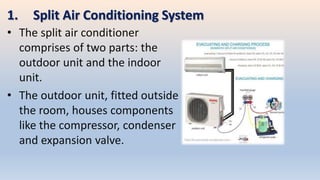
• The split air conditioner
comprises of two parts: the
outdoor unit and the indoor
unit.
• The outdoor unit, fitted outside
the room, houses components
like the compressor, condenser
and expansion valve.
• Split air conditioners are used for small rooms and
halls, usually in places where window air conditioners
cannot be installed. However, these days many people
prefer split air conditioner units even for places where
window air conditioners can be fitted.
• Types of Split Air Conditioning System
I. Wall mounted split AC
II. Floor mounted/Tower split AC
III. Ceiling mounted split AC
IV. Multi Split AC
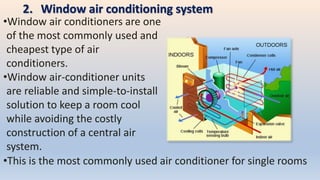
2. Window air conditioning system
•Window air conditioners are one
of the most commonly used and
cheapest type of air
conditioners.
•Window air-conditioner units
are reliable and simple-to-install
solution to keep a room cool
while avoiding the costly
construction of a central air
system.
•This is the most commonly used air conditioner for single rooms
3. Package Air Conditioning System
•The window and split air conditioners are usually used for
the small air conditioning capacities up to 5 tons.
•The packaged air conditioners are used for the cooling
capacities in between these two extremes
•These units are used commonly in places like restaurants,
telephone exchanges, homes, small halls, etc.
•There are 02 types in market Water Cooled Condenser AC, Air
Cooled Condenser.
4. Central Air conditioning System
•Central air conditioning is used for cooling big buildings,
houses, offices, entire hotels, gyms, movie theaters,
factories etc.
•If the whole building is to be air conditioned, HVAC
engineers find that putting individual units in each of
the rooms is very expensive making this a better option.
•Cooling big halls, malls, huge spaces, galleries etc. is
usually only feasible with central conditioning units
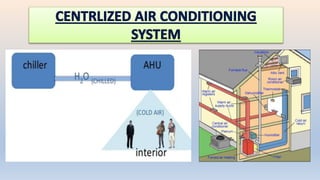
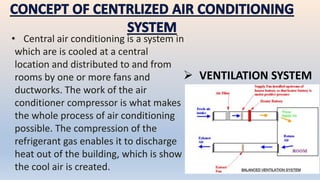
• Central air conditioning is a system in
which are is cooled at a central
location and distributed to and from
rooms by one or more fans and
ductworks. The work of the air
conditioner compressor is what makes
the whole process of air conditioning
possible. The compression of the
refrigerant gas enables it to discharge
heat out of the building, which is show
the cool air is created.
 VENTILATION SYSTEM
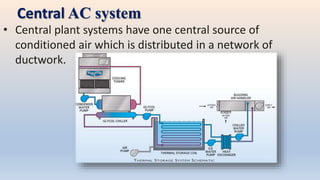
Central AC system
• Central plant systems have one central source of
conditioned air which is distributed in a network of
ductwork.
COMPONENTS OF A CENTRALIZED A/C
SYSTEM
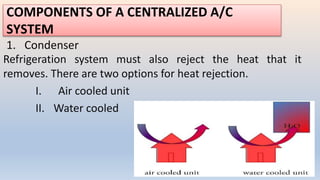
1. Condenser
Refrigeration system must also reject the heat that it
removes. There are two options for heat rejection.
I. Air cooled unit
II. Water cooled
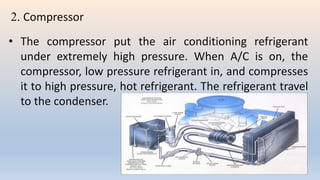
2. Compressor
• The compressor put the air conditioning refrigerant
under extremely high pressure. When A/C is on, the
compressor, low pressure refrigerant in, and compresses
it to high pressure, hot refrigerant. The refrigerant travel
to the condenser.
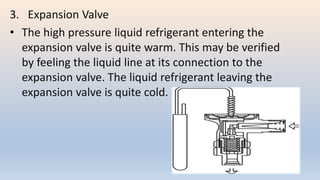
3. Expansion Valve
• The high pressure liquid refrigerant entering the
expansion valve is quite warm. This may be verified
by feeling the liquid line at its connection to the
expansion valve. The liquid refrigerant leaving the
expansion valve is quite cold.
4. Evaporator
The reason for refrigeration is to remove heat from
air, water or other substance. It is hear that the
liquid refrigerant is expanded and evaporated. It
acts as a heat exchanger that transfers heat from
the substance being cooled to a boiling
temperature.
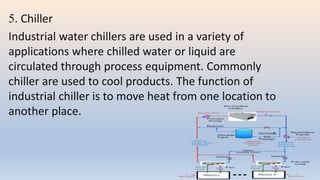
5. Chiller
Industrial water chillers are used in a variety of
applications where chilled water or liquid are
circulated through process equipment. Commonly
chiller are used to cool products. The function of
industrial chiller is to move heat from one location to
another place.
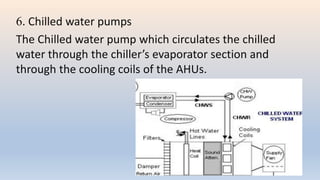
6. Chilled water pumps
The Chilled water pump which circulates the chilled
water through the chiller’s evaporator section and
through the cooling coils of the AHUs.
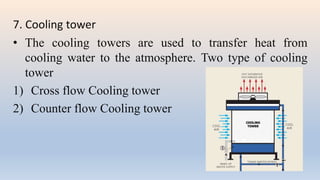
7. Cooling tower
• The cooling towers are used to transfer heat from
cooling water to the atmosphere. Two type of cooling
tower
1) Cross flow Cooling tower
2) Counter flow Cooling tower
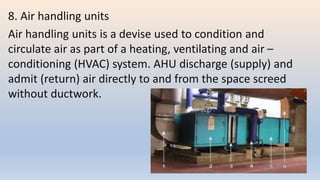
8. Air handling units
Air handling units is a devise used to condition and
circulate air as part of a heating, ventilating and air –
conditioning (HVAC) system. AHU discharge (supply) and
admit (return) air directly to and from the space screed
without ductwork.
9. Fan coil unit
Used to control the temperature in the space where it
is installed or serve multiple spaces. It is controlled
either by a manual on/off switch or by thermostat. Fan
coil units are more economical to install than ducted
or central heating systems with air handling units.
They can be noisy because the fan is within the same
space.
DESIGN PARAMETERS RELATED TO THE AIR
CONDITIONING SYSTEM
1) Heating - the addition of thermal energy in accordance with
maintain space or process conditions within response to thermal heat
loss
2) Cooling - the elimination of thermal energy to maintain space or
process conditions in response to thermal heat gain
3) Humidifying - the addition of water vapor to maintain space or
process moisture content
4) Dehumidifying - the elimination of water vapor to maintain space
or process moisture content
5) Cleaning - the process of disposing of particulate and bio-contaminants
from the conditioned space
6) Ventilating - the process of supplying appropriate quantities of fresh
outside air for maintaining air quality and building pressurization
7) Effectiveness - the process of achieving the desired thermal energy
transfer, humidity control, filtration, and delivery of ventilation air to the
breathing area of the occupied space in accordance with required needs
CONTINUING……
Mechanical engineer of Record will be responsible for
developing the fundamental information from the owner
and design team members.
 Basic load calculation
 Energy modeling
 Life cycle analysis
CONTINUING……
• To introduce energy efficient design and/ or retrofits to
commercial buildings, industrial facilities and large
scale housing schemes to enable designing,
construction and maintenance to be carried out under
minimal energy consumption without compromising
the building’s function, and/or the comfort and health
of occupants.
Code of practice for energy efficient buildings in
Sri Lanka
Implementation mechanism
• The code in the present form is basically to be used for
Commercial Buildings. Industrial buildings, Hotels and
large apartment complexes are to be brought in
subsequently. The method of implementation therefore is
expected to cover all above areas.
Calculation Procedures
• Cooling system design loads for the purpose of sizing
systems and equipment shall be determined in
accordance with the procedures described in the latest
edition of the ASHRAE Handbook 2004 or later or other
publications conforming to equal standards
Indoor Design Conditions
• The indoor conditions of an air-conditioned space
shall be designed for a dry bulb temperature of 25°
C ± 1.5° C and relative humidity of 55 % ± 5 %. The
combination of suitable high temperatures and
humidity may be used within the comfort zone for
energy saving purposes, provided that the
conditions mentioned herein are agreeable to the
occupants.
Outdoor Design Conditions
• Dry bulb temperatures of 31° C and wet bulb
temperatures of 27° C For computer aided designs,
data from Climatologic Tables from the Meteorological
Department of Sri Lanka may be used.
Ventilation and Exhaust
• Outdoor air ventilation rates shall comply with
ASHRAE Standard 62.1 2007 (Ventilation for
Acceptable Indoor Air Quality). It is also encouraged
to use CO2 monitors and controls for installations
with high and variable people occupancy. Outdoor air
quantities, however may exceed those shown in
Standard 62 ascribed to special occupancy or process
requirements or control of air contamination.
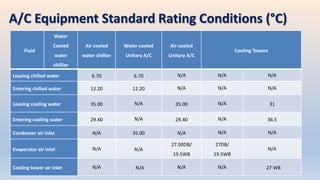
A/C Equipment Standard Rating Conditions (°C)
Fluid
Water
Cooled
water
chillier
Air cooled
water chillier
Water cooled
Unitary A/C
Air cooled
Unitary A/C
Cooling Towers
Leaving chilled water 6.70 6.70 N/A N/A N/A
Entering chilled water 12.20 12.20 N/A N/A N/A
Leaving cooling water 35.00 N/A 35.00 N/A 31
Entering cooling water 29.40 N/A 29.40 N/A 36.5
Condenser air inlet N/A 35.00 N/A N/A N/A
Evaporator air inlet N/A N/A
27.00DB/
19.5WB
27DB/
19.5WB
N/A
Cooling tower air inlet N/A N/A N/A N/A 27 WB
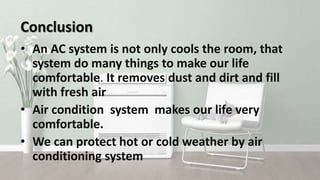
Conclusion
• An AC system is not only cools the room, that
system do many things to make our life
comfortable. It removes dust and dirt and fill
with fresh air
• Air condition system makes our life very
comfortable.
• We can protect hot or cold weather by air
conditioning system
Thank You

Building services systems in sri lanka ac

  • 1.
    Building services systemsin Sri Lanka  AIR CONDITIONNING SYSTEM
  • 2.
    INTRODUCTION •Building is astructure that has a roof and walls and stands permanently in one place. •The primary function of the building is to provide shelter of its occupants. •But the building function cannot be limited to provide shelter only. •It should be suitable for occupant’s safe, comfortable & livable environment. •So the building should be design to provide an environment where its occupants can feel comfortable life.
  • 3.
    Building services arethe systems installed in buildings to make them comfortable, functional, efficient and safe. 1. Plumbing and drainage system 2. Electrical supply system 3. Heating, Ventilation and Air conditioning system 4. Fire Protection and Detection system 5. Vertical and Horizontal Transportation 6. Solar power system 7. Gas supply system 8. Information and Communication Technology network
  • 4.
    Air Conditioning System •Air conditioning is a system for controlling the humidity, ventilation and removing heat and moisture from an occupied space, to improve the comfortable condition of its occupants. • Air conditioning is the science which deals with the supply and maintaining desirable internal atmospheric condition irrespective of external condition.
  • 5.
    Types of AirConditioners There are 03 types of air conditioners 1. Room Air Conditioning system • Split Air Conditioning system • Window air conditioning system 2. Package Air Conditioning System • Water cooled condenser • Air cooled condenser 3. Central Air conditioning System • Direct expansion or DX central AC plant • Chilled water central AC plant
  • 6.
    1. Split AirConditioning System • The split air conditioner comprises of two parts: the outdoor unit and the indoor unit. • The outdoor unit, fitted outside the room, houses components like the compressor, condenser and expansion valve.
  • 7.
    • Split airconditioners are used for small rooms and halls, usually in places where window air conditioners cannot be installed. However, these days many people prefer split air conditioner units even for places where window air conditioners can be fitted. • Types of Split Air Conditioning System I. Wall mounted split AC II. Floor mounted/Tower split AC III. Ceiling mounted split AC IV. Multi Split AC
  • 8.
    2. Window airconditioning system •Window air conditioners are one of the most commonly used and cheapest type of air conditioners. •Window air-conditioner units are reliable and simple-to-install solution to keep a room cool while avoiding the costly construction of a central air system. •This is the most commonly used air conditioner for single rooms
  • 9.
    3. Package AirConditioning System •The window and split air conditioners are usually used for the small air conditioning capacities up to 5 tons. •The packaged air conditioners are used for the cooling capacities in between these two extremes •These units are used commonly in places like restaurants, telephone exchanges, homes, small halls, etc. •There are 02 types in market Water Cooled Condenser AC, Air Cooled Condenser.
  • 10.
    4. Central Airconditioning System •Central air conditioning is used for cooling big buildings, houses, offices, entire hotels, gyms, movie theaters, factories etc. •If the whole building is to be air conditioned, HVAC engineers find that putting individual units in each of the rooms is very expensive making this a better option. •Cooling big halls, malls, huge spaces, galleries etc. is usually only feasible with central conditioning units
  • 12.
    • Central airconditioning is a system in which are is cooled at a central location and distributed to and from rooms by one or more fans and ductworks. The work of the air conditioner compressor is what makes the whole process of air conditioning possible. The compression of the refrigerant gas enables it to discharge heat out of the building, which is show the cool air is created.  VENTILATION SYSTEM
  • 13.
    Central AC system •Central plant systems have one central source of conditioned air which is distributed in a network of ductwork.
  • 14.
    COMPONENTS OF ACENTRALIZED A/C SYSTEM 1. Condenser Refrigeration system must also reject the heat that it removes. There are two options for heat rejection. I. Air cooled unit II. Water cooled
  • 15.
    2. Compressor • Thecompressor put the air conditioning refrigerant under extremely high pressure. When A/C is on, the compressor, low pressure refrigerant in, and compresses it to high pressure, hot refrigerant. The refrigerant travel to the condenser.
  • 16.
    3. Expansion Valve •The high pressure liquid refrigerant entering the expansion valve is quite warm. This may be verified by feeling the liquid line at its connection to the expansion valve. The liquid refrigerant leaving the expansion valve is quite cold.
  • 17.
    4. Evaporator The reasonfor refrigeration is to remove heat from air, water or other substance. It is hear that the liquid refrigerant is expanded and evaporated. It acts as a heat exchanger that transfers heat from the substance being cooled to a boiling temperature.
  • 18.
    5. Chiller Industrial waterchillers are used in a variety of applications where chilled water or liquid are circulated through process equipment. Commonly chiller are used to cool products. The function of industrial chiller is to move heat from one location to another place.
  • 19.
    6. Chilled waterpumps The Chilled water pump which circulates the chilled water through the chiller’s evaporator section and through the cooling coils of the AHUs.
  • 20.
    7. Cooling tower •The cooling towers are used to transfer heat from cooling water to the atmosphere. Two type of cooling tower 1) Cross flow Cooling tower 2) Counter flow Cooling tower
  • 21.
    8. Air handlingunits Air handling units is a devise used to condition and circulate air as part of a heating, ventilating and air – conditioning (HVAC) system. AHU discharge (supply) and admit (return) air directly to and from the space screed without ductwork.
  • 22.
    9. Fan coilunit Used to control the temperature in the space where it is installed or serve multiple spaces. It is controlled either by a manual on/off switch or by thermostat. Fan coil units are more economical to install than ducted or central heating systems with air handling units. They can be noisy because the fan is within the same space.
  • 23.
    DESIGN PARAMETERS RELATEDTO THE AIR CONDITIONING SYSTEM 1) Heating - the addition of thermal energy in accordance with maintain space or process conditions within response to thermal heat loss 2) Cooling - the elimination of thermal energy to maintain space or process conditions in response to thermal heat gain 3) Humidifying - the addition of water vapor to maintain space or process moisture content 4) Dehumidifying - the elimination of water vapor to maintain space or process moisture content
  • 24.
    5) Cleaning -the process of disposing of particulate and bio-contaminants from the conditioned space 6) Ventilating - the process of supplying appropriate quantities of fresh outside air for maintaining air quality and building pressurization 7) Effectiveness - the process of achieving the desired thermal energy transfer, humidity control, filtration, and delivery of ventilation air to the breathing area of the occupied space in accordance with required needs CONTINUING……
  • 25.
    Mechanical engineer ofRecord will be responsible for developing the fundamental information from the owner and design team members.  Basic load calculation  Energy modeling  Life cycle analysis CONTINUING……
  • 26.
    • To introduceenergy efficient design and/ or retrofits to commercial buildings, industrial facilities and large scale housing schemes to enable designing, construction and maintenance to be carried out under minimal energy consumption without compromising the building’s function, and/or the comfort and health of occupants. Code of practice for energy efficient buildings in Sri Lanka
  • 27.
    Implementation mechanism • Thecode in the present form is basically to be used for Commercial Buildings. Industrial buildings, Hotels and large apartment complexes are to be brought in subsequently. The method of implementation therefore is expected to cover all above areas. Calculation Procedures • Cooling system design loads for the purpose of sizing systems and equipment shall be determined in accordance with the procedures described in the latest edition of the ASHRAE Handbook 2004 or later or other publications conforming to equal standards
  • 28.
    Indoor Design Conditions •The indoor conditions of an air-conditioned space shall be designed for a dry bulb temperature of 25° C ± 1.5° C and relative humidity of 55 % ± 5 %. The combination of suitable high temperatures and humidity may be used within the comfort zone for energy saving purposes, provided that the conditions mentioned herein are agreeable to the occupants.
  • 29.
    Outdoor Design Conditions •Dry bulb temperatures of 31° C and wet bulb temperatures of 27° C For computer aided designs, data from Climatologic Tables from the Meteorological Department of Sri Lanka may be used.
  • 30.
    Ventilation and Exhaust •Outdoor air ventilation rates shall comply with ASHRAE Standard 62.1 2007 (Ventilation for Acceptable Indoor Air Quality). It is also encouraged to use CO2 monitors and controls for installations with high and variable people occupancy. Outdoor air quantities, however may exceed those shown in Standard 62 ascribed to special occupancy or process requirements or control of air contamination.
  • 31.
    A/C Equipment StandardRating Conditions (°C) Fluid Water Cooled water chillier Air cooled water chillier Water cooled Unitary A/C Air cooled Unitary A/C Cooling Towers Leaving chilled water 6.70 6.70 N/A N/A N/A Entering chilled water 12.20 12.20 N/A N/A N/A Leaving cooling water 35.00 N/A 35.00 N/A 31 Entering cooling water 29.40 N/A 29.40 N/A 36.5 Condenser air inlet N/A 35.00 N/A N/A N/A Evaporator air inlet N/A N/A 27.00DB/ 19.5WB 27DB/ 19.5WB N/A Cooling tower air inlet N/A N/A N/A N/A 27 WB
  • 32.
    Conclusion • An ACsystem is not only cools the room, that system do many things to make our life comfortable. It removes dust and dirt and fill with fresh air • Air condition system makes our life very comfortable. • We can protect hot or cold weather by air conditioning system
  • 33.