ENERGY AUDIT
PRESENTED BY
AGLAIA
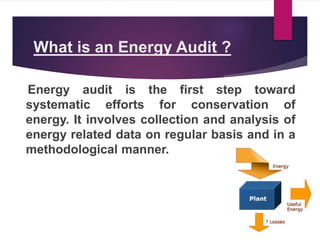
What is an Energy Audit ?
Energy audit is the first step toward
systematic efforts for conservation of
energy. It involves collection and analysis of
energy related data on regular basis and in a
methodological manner.
Objectives of Energy Audit
The Energy Audit provides the vital information base for
overall energy conservation program covering
essentially energy utilization analysis and evaluation of
energy conservation measures.
It aims at :-
 Identifying the quality and cost of various energy
inputs.
 Assessing present pattern of energy consumption in
different cost centers of operations.
 Relating energy inputs and production output.
 Identifying potential areas of thermal and electrical
energy economy.
 Highlighting wastage’s in major areas.
 Fixing of energy saving potential targets for individual
cost centers.
 Implementation of measures for energy conservation &
realization of savings.
The Role of an Energy Audit
 An energy audit identifies which areas in your
establishment unnecessarily consume too
much energy, where energy is being consumed
and assesses energy saving opportunities,
which is the most cost-effective to improve, so
you get to save money where it counts the
most.
 In the factory, doing an energy audit increases
awareness of energy issues among plant
personnel.
 An energy audit in effect gauges the
energy efficiency of your plant against
“best practices”.
 When used as a “baseline” for tracking
yearly progress against targets, an energy
audit becomes the best first step towards
saving money in the production plant.
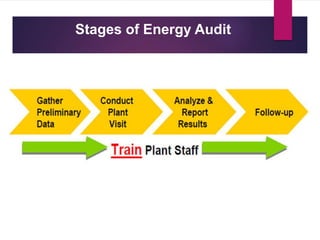
Stages of Energy Audit
Energy audit stages
Energy audit can be categorized into two types,
namely walk-through or preliminary and detail audit.
Walk-through or preliminary audit
Walk-through or preliminary audit comprises one
day or few days visit to a plant and the output is a
simple report based on observation and historical
data provided during the visit. The findings will be a
general comment based on rule-of-thumbs, energy
best practices or the manufacturer's data.
Preliminary energy audit
• Establish energy consumption in the organization
• Estimate the scope for saving
• Identify the most likely (and the easiest areas for
attention
• Identify immediate (especially no-/low-cost)
improvements/ savings
• Set a 'reference point‘
• Identify areas for more detailed study/measurement
• Preliminary energy audit uses existing, or easily
obtained data.
Detailed Energy Audit
 The detailed audit goes beyond quantitative estimates
of costs and savings. It includes engineering
recommendations and well-defined project, giving due
priorities.
 Approximately 95% of all energy is accounted for
during the detailed audit.
 The detailed energy audit is conducted after the
preliminary energy audit.
 Sophisticated instrumentation including flow meter,
flue gas analyzer, scanners and other advanced
instruments are used to compute energy efficiency.
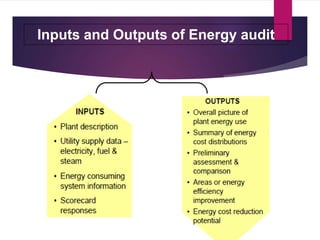
Inputs and Outputs of Energy audit
Contents of an Audit
 An energy audit assesses the effectiveness of
management structure for controlling energy use and
implementing changes.
 The energy audit report establishes the needs for
plant metering and monitoring, enabling the plant
manager to institutionalize the practice and hence,
save money for the years to come.
 The energy audit action plan lists the steps and sets
the preliminary budget for the energy management
program.
Steps for Energy Management and Energy audit….
 Analysis of energy use
 Identification of energy projects
 Cost benefit analysis
 Action plan to set implementation priority
1. Analysis of energy use
 Identifying where energy is used is useful because it
identifies which areas the audit should focus on and
raises awareness of energy use and cost.
 Analysis of energy use in the review of management
structures and procedures for controlling energy use.
 This is a good source data for allocating energy use.
The plant manager can also list all equipment used and
the corresponding operating hours.
 With this information, one can create spreadsheet
information and generate charts useful for analysis.
1. Analysis of energy use
Important points to be considered when collecting Site Load
Data:
 Operating hours - This can be gathered from plant personnel. It
is important to ensure the accuracy of this data because much
of the potential for energy savings lies on correct estimation of
the equipment’s operating hours.
 Duty cycle - Machines such as large electric motors have
varying loads and hence, different power requirements.
 Actual power consumed - For electric power users, this is
based on either 3-phase current/voltage readings or power
analyzer measurements (e.g., direct kW which incorporates
power factor). For fuel users, tank readings of monthly
consumption estimates and flow meters with tantalization can
be sources of measurement of air, water, steam, oil etc..
2. Identification of energy
projects
 Opportunities for energy savings can range from the
simplest, such as lighting retrofits, to the most
complex such as the installation of a cogeneration
plant.
 The important thing to remember is to focus on
major energy users and areas.
 Always apply the 80/20 rule, focus on opportunities
that provide 80% of the saving but require 20% input.
After the preliminary identification of opportunities,
spend more time on those which have shorter
payback periods.
3. Cost benefit analysis
 The identified energy conservation opportunities
should be analyzed in terms of the costs of
implementing the project versus the benefits that
can be gained.
 If you want to, say, install a heat plate exchanger to
recover waste heat, you need to calculate the total
cost of installation and compare that with the
savings you will derive from recovering waste heat.
 It makes sense to go on with the project if there is a
net positive benefit from the project.
4. Action plan to set implementation priority
 After passing the cost benefit test, an action plan
should be developed to ensure that the opportunities
identified are implemented.
 The action plan should include all the major steps for
implementing the opportunity as well as the people
responsible.
Conclusions
 Presently, the average annual energy consumption is
24 lakh units.
 The possible saving by implementing the proposed
measures are 5.98 lakh units of electricity & 5,040 kg
of LPG used in canteen which comes to about 25 %
reduction of annual energy bill, at a capital investment
of Rs. 163.15 Lakhs.

Energy audit

  • 1.
  • 2.
    What is anEnergy Audit ? Energy audit is the first step toward systematic efforts for conservation of energy. It involves collection and analysis of energy related data on regular basis and in a methodological manner.
  • 3.
    Objectives of EnergyAudit The Energy Audit provides the vital information base for overall energy conservation program covering essentially energy utilization analysis and evaluation of energy conservation measures. It aims at :-  Identifying the quality and cost of various energy inputs.  Assessing present pattern of energy consumption in different cost centers of operations.  Relating energy inputs and production output.
  • 4.
     Identifying potentialareas of thermal and electrical energy economy.  Highlighting wastage’s in major areas.  Fixing of energy saving potential targets for individual cost centers.  Implementation of measures for energy conservation & realization of savings.
  • 5.
    The Role ofan Energy Audit  An energy audit identifies which areas in your establishment unnecessarily consume too much energy, where energy is being consumed and assesses energy saving opportunities, which is the most cost-effective to improve, so you get to save money where it counts the most.  In the factory, doing an energy audit increases awareness of energy issues among plant personnel.
  • 6.
     An energyaudit in effect gauges the energy efficiency of your plant against “best practices”.  When used as a “baseline” for tracking yearly progress against targets, an energy audit becomes the best first step towards saving money in the production plant.
  • 7.
  • 8.
    Energy audit stages Energyaudit can be categorized into two types, namely walk-through or preliminary and detail audit. Walk-through or preliminary audit Walk-through or preliminary audit comprises one day or few days visit to a plant and the output is a simple report based on observation and historical data provided during the visit. The findings will be a general comment based on rule-of-thumbs, energy best practices or the manufacturer's data.
  • 9.
    Preliminary energy audit •Establish energy consumption in the organization • Estimate the scope for saving • Identify the most likely (and the easiest areas for attention • Identify immediate (especially no-/low-cost) improvements/ savings • Set a 'reference point‘ • Identify areas for more detailed study/measurement • Preliminary energy audit uses existing, or easily obtained data.
  • 10.
    Detailed Energy Audit The detailed audit goes beyond quantitative estimates of costs and savings. It includes engineering recommendations and well-defined project, giving due priorities.  Approximately 95% of all energy is accounted for during the detailed audit.  The detailed energy audit is conducted after the preliminary energy audit.  Sophisticated instrumentation including flow meter, flue gas analyzer, scanners and other advanced instruments are used to compute energy efficiency.
  • 11.
    Inputs and Outputsof Energy audit
  • 12.
    Contents of anAudit  An energy audit assesses the effectiveness of management structure for controlling energy use and implementing changes.  The energy audit report establishes the needs for plant metering and monitoring, enabling the plant manager to institutionalize the practice and hence, save money for the years to come.  The energy audit action plan lists the steps and sets the preliminary budget for the energy management program.
  • 13.
    Steps for EnergyManagement and Energy audit….  Analysis of energy use  Identification of energy projects  Cost benefit analysis  Action plan to set implementation priority
  • 14.
    1. Analysis ofenergy use  Identifying where energy is used is useful because it identifies which areas the audit should focus on and raises awareness of energy use and cost.  Analysis of energy use in the review of management structures and procedures for controlling energy use.  This is a good source data for allocating energy use. The plant manager can also list all equipment used and the corresponding operating hours.  With this information, one can create spreadsheet information and generate charts useful for analysis.
  • 15.
    1. Analysis ofenergy use Important points to be considered when collecting Site Load Data:  Operating hours - This can be gathered from plant personnel. It is important to ensure the accuracy of this data because much of the potential for energy savings lies on correct estimation of the equipment’s operating hours.  Duty cycle - Machines such as large electric motors have varying loads and hence, different power requirements.  Actual power consumed - For electric power users, this is based on either 3-phase current/voltage readings or power analyzer measurements (e.g., direct kW which incorporates power factor). For fuel users, tank readings of monthly consumption estimates and flow meters with tantalization can be sources of measurement of air, water, steam, oil etc..
  • 16.
    2. Identification ofenergy projects  Opportunities for energy savings can range from the simplest, such as lighting retrofits, to the most complex such as the installation of a cogeneration plant.  The important thing to remember is to focus on major energy users and areas.  Always apply the 80/20 rule, focus on opportunities that provide 80% of the saving but require 20% input. After the preliminary identification of opportunities, spend more time on those which have shorter payback periods.
  • 17.
    3. Cost benefitanalysis  The identified energy conservation opportunities should be analyzed in terms of the costs of implementing the project versus the benefits that can be gained.  If you want to, say, install a heat plate exchanger to recover waste heat, you need to calculate the total cost of installation and compare that with the savings you will derive from recovering waste heat.  It makes sense to go on with the project if there is a net positive benefit from the project.
  • 18.
    4. Action planto set implementation priority  After passing the cost benefit test, an action plan should be developed to ensure that the opportunities identified are implemented.  The action plan should include all the major steps for implementing the opportunity as well as the people responsible.
  • 19.
    Conclusions  Presently, theaverage annual energy consumption is 24 lakh units.  The possible saving by implementing the proposed measures are 5.98 lakh units of electricity & 5,040 kg of LPG used in canteen which comes to about 25 % reduction of annual energy bill, at a capital investment of Rs. 163.15 Lakhs.