Introduction to Energy Audit Methods
in Water Supply
                       Hotel Hilton Hanoi Opera
                              9th of March 2010
                            By: Pradeep Kumar
Energy Audit
“An energy audit is an assessment and analysis of energy
  flows in a process or system, aimed at reducing the
  amount of energy input into the system without negatively
  affecting the output(s).”
Objective
The main objective of an energy audit is to explore various
 possibilities for energy conservation;
Approach
An energy audit requires a thorough and detailed study of
 every aspect of the system, through the performance of
 various tests and measurements.
Steps in an Energy Audit
• Collect and analyze historical energy usage.
• Study pumping systems and their operational
  characteristics.
• Identify potential modifications that will reduce the
  energy usage and/or cost.
• Perform an engineering and economic analysis of
  potential modifications.
• Prepare a rank-ordered list of appropriate modifications.
• Prepare a report to document the analysis process and
  results.
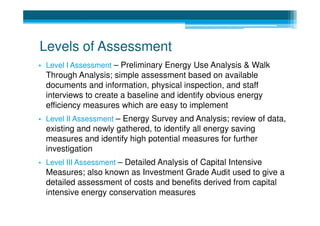
Levels of Assessment
• Level I Assessment – Preliminary Energy Use Analysis & Walk
  Through Analysis; simple assessment based on available
  documents and information, physical inspection, and staff
  interviews to create a baseline and identify obvious energy
  efficiency measures which are easy to implement
• Level II Assessment – Energy Survey and Analysis; review of data,
  existing and newly gathered, to identify all energy saving
  measures and identify high potential measures for further
  investigation
• Level III Assessment – Detailed Analysis of Capital Intensive
  Measures; also known as Investment Grade Audit used to give a
  detailed assessment of costs and benefits derived from capital
  intensive energy conservation measures
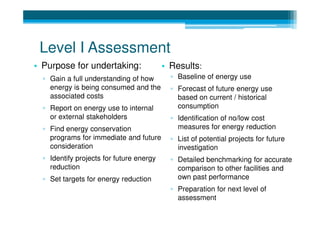
Level I Assessment
• Purpose for undertaking:                • Results:
  ▫ Gain a full understanding of how        ▫ Baseline of energy use
    energy is being consumed and the        ▫ Forecast of future energy use
    associated costs                          based on current / historical
  ▫ Report on energy use to internal          consumption
    or external stakeholders                ▫ Identification of no/low cost
  ▫ Find energy conservation                  measures for energy reduction
    programs for immediate and future       ▫ List of potential projects for future
    consideration                             investigation
  ▫ Identify projects for future energy     ▫ Detailed benchmarking for accurate
    reduction                                 comparison to other facilities and
  ▫ Set targets for energy reduction          own past performance
                                            ▫ Preparation for next level of
                                              assessment
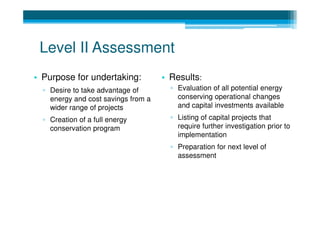
Level II Assessment
• Purpose for undertaking:           • Results:
  ▫ Desire to take advantage of        ▫ Evaluation of all potential energy
    energy and cost savings from a       conserving operational changes
    wider range of projects              and capital investments available
  ▫ Creation of a full energy          ▫ Listing of capital projects that
    conservation program                 require further investigation prior to
                                         implementation
                                       ▫ Preparation for next level of
                                         assessment
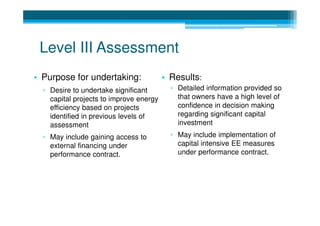
Level III Assessment
• Purpose for undertaking:               • Results:
  ▫ Desire to undertake significant        ▫ Detailed information provided so
    capital projects to improve energy       that owners have a high level of
    efficiency based on projects             confidence in decision making
    identified in previous levels of         regarding significant capital
    assessment                               investment
  ▫ May include gaining access to          ▫ May include implementation of
    external financing under                 capital intensive EE measures
    performance contract.                    under performance contract.
Method & Approach for Water Systems
• The audit involves carrying out various
  measurements and analysis of the following
  systems to assess losses and the potential for
  energy efficiency improvements:
 ▫ Pumps & Pumping Systems
 ▫ Electrical Systems
 ▫ Electric Drives
Measurement
• Data collection
  ▫   Specifications of pumps and motors
  ▫   Diagram of water distribution air network
  ▫   Water pressure required for the system
  ▫   Number of pumps in operation
  ▫   Design/specified water temperature required
• Water flow rate of pumps at various operating conditions
  ▫ Individual
  ▫ Parallel
• Water flow velocity in pipe lines
• Suction & discharge pressure of pump
Measurement
• Power consumption and motor electrical parameters
    ▫ During individual operation
    ▫ During parallel operation
    ▫ At various valve openings
•   Speed
•   Flow control methods
•   Pipe line status
•   Pressure drop in the line
•   Operating hours and pump schedule
•   Variations in flow requirement
Measurement
• User area operating schedule
• Measurement of water flows to the users
• Segregation of users based on operating hours
• Any modifications carried out in the pumps such as
  replacement of impeller, trimming of impeller, others
• Operation and maintenance practices
Data Analysis and Energy
Conservation Measures (ECMs)
• Full written description of each ECM to include:
  ▫ Existing conditions and data collection approach (snapshot,
    short-term, or long-term measurement of data)
  ▫ Recommendations. Include discussion of facility
    operations and maintenance procedures that will be
    affected by ECM installation and implementation.
• Baseline energy use:
  ▫ Summary of all utility bills
  ▫ Base year consumption and description of how established
Data Analysis and Energy
Conservation Measures (ECMs)
• Savings Calculations:
  ▫ Base year energy use and cost
  ▫ Post-retrofit energy use and cost
  ▫ Savings estimates including analysis methodology,
    supporting calculations, and assumptions used
  ▫ Operations and maintenance savings
  ▫ If manual calculations are employed, formulas,
    assumptions, and key data shall be stated.
Data Analysis and Energy
Conservation Measures (ECMs)
• Cost Estimate:
  ▫ Engineering/design costs
  ▫ Contractor/vendor estimates for labor, materials,
    equipment; etc
  ▫ Construction management fees
  ▫ Commissioning costs
  ▫ Other costs/fees
Data Analysis and Energy
Conservation Measures (ECMs)
• Auditors should consider the following while analyzing
  potential energy and water saving measures:
  ▫ Comfort and maintenance problems
  ▫ Energy use, loads, proper sizing, efficiencies and hours of
    operation
  ▫ Current operating condition
  ▫ Remaining useful life
  ▫ Feasibility of system replacement
  ▫ Customer's future plans for equipment replacement or pumping
    station renovations
  ▫ System operation and maintenance procedures that could be
    affected
  ▫ Hazardous materials and other environmental concerns
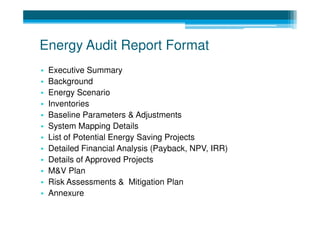
Energy Audit Report Format
•   Executive Summary
•   Background
•   Energy Scenario
•   Inventories
•   Baseline Parameters & Adjustments
•   System Mapping Details
•   List of Potential Energy Saving Projects
•   Detailed Financial Analysis (Payback, NPV, IRR)
•   Details of Approved Projects
•   M&V Plan
•   Risk Assessments & Mitigation Plan
•   Annexure
How is it different from an energy audit?
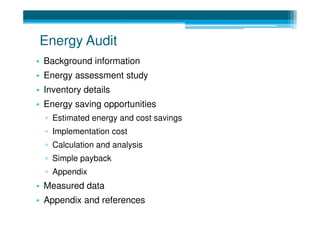
Energy Audit
• Background information
• Energy assessment study
• Inventory details
• Energy saving opportunities
  ▫ Estimated energy and cost savings
  ▫ Implementation cost
  ▫ Calculation and analysis
  ▫ Simple payback
  ▫ Appendix
• Measured data
• Appendix and references
Investment Grade Audit
• An investment grade audit is a technical and
  economic analysis of potential energy saving
  projects in a facility that:
 ▫ Provides information on current energy-consuming
   equipment operations
 ▫ Identifies technically and economically feasible energy
   efficiency improvements for existing equipment, and
 ▫ Provides the customer with sufficient information to
   judge the technical and economic feasibility of the
   recommended projects.
Technical Scope of Work, Performance Based Contracts
Scope of Work – IGA & Implementation
through performance based contract
1. Investment Grade Audit Phase:
 ▫ Propose detailed projections of energy and cost
   savings to be obtained as a result of the
   implementation of the recommended energy efficiency
   measures (EEMs).
 ▫ Establish energy consumption baseline.
 ▫ Conduct financial and technical risk analysis.
Scope of Work – IGA & Implementation
through performance based contract
2. Construction and Implementation Phase:
 ▫   Negotiate Energy Performance Contract based on
     IGA agreement to define implementation scope of
     work.
 ▫   Provide design services.
 ▫   Provide equipment procurement and purchasing.
 ▫   Provide construction and construction management
     services.
Scope of Work – IGA & Implementation
through performance based contract
3. Commissioning, Operation and Monitoring Phase
 ▫   Provide commissioning services.
 ▫   Perform periodic inspection of improvements.
 ▫   Perform routine maintenance of equipment.
 ▫   Develop project-specific measurement & verification
     plan.
 ▫   Provide staff training on routine maintenance and
     operation of systems.
 ▫   Provide monitoring, measurement, verification and
     reporting of performance and savings.
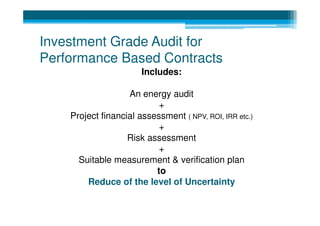
Investment Grade Audit for
Performance Based Contracts
                       Includes:

                   An energy audit
                           +
    Project financial assessment ( NPV, ROI, IRR etc.)
                           +
                   Risk assessment
                           +
      Suitable measurement & verification plan
                          to
        Reduce of the level of Uncertainty
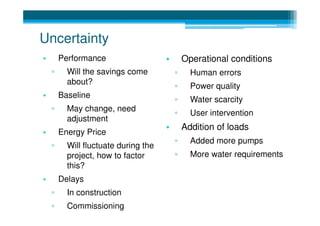
Uncertainty
•       Performance                   •       Operational conditions
    ▫     Will the savings come           ▫     Human errors
          about?
                                          ▫     Power quality
•       Baseline
                                          ▫     Water scarcity
    ▫     May change, need
                                          ▫     User intervention
          adjustment
                                      •       Addition of loads
•       Energy Price
                                          ▫     Added more pumps
    ▫     Will fluctuate during the
          project, how to factor          ▫     More water requirements
          this?
•       Delays
    ▫     In construction
    ▫     Commissioning
Uncertainty
•       Reported savings values are always estimates
        because you can't measure what isn't there.
•       Uncertainty in the savings value comes from:
    ▫     Uncertainty in performance
    ▫     Uncertainty and changes in usage
    ▫     Uncertainty introduced by estimates
    ▫     Unpredictability in future energy costs
    ▫     Uncertainty in carbon conversion factors
Uncertainty can be
         reduced but not eliminated…..
How to Reduce Uncertainty


  By Allocating Risk– A matrix that details the
  sharing of risk
Risk & Responsibility Matrix

 Risk Assessment
 •   Types of Risk
 •   Allocating Risk


 Responsibility Allocation
 •   Financial
 •   Operational (Usage)
 •   Performance
Risk & Responsibility
Type of Risk
1. Financial             3. Performance
  ▫ Energy Prices          ▫ Equipment Performance
  ▫ M&V Costs              ▫ Operations
  ▫ Interest Rates         ▫ Preventive Maintenance
  ▫ Construction Cost      ▫ Equipment Repair &
2. Operational               Replacement

  ▫ Operating Hours
  ▫ Loads
  ▫ Weather
  ▫ User Participation
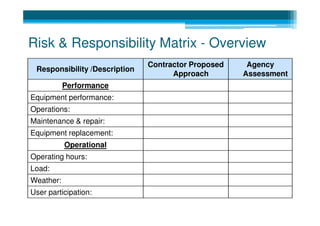
Risk & Responsibility Matrix - Overview
                               Contractor Proposed    Agency
 Responsibility /Description
                                     Approach        Assessment
           Performance
Equipment performance:
Operations:
Maintenance & repair:
Equipment replacement:
           Operational
Operating hours:
Load:
Weather:
User participation:
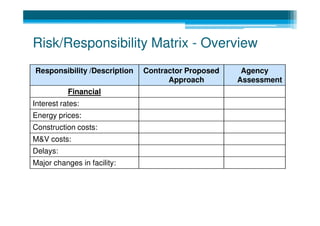
Risk/Responsibility Matrix - Overview
Responsibility /Description   Contractor Proposed    Agency
                                    Approach        Assessment
           Financial
Interest rates:
Energy prices:
Construction costs:
M&V costs:
Delays:
Major changes in facility:
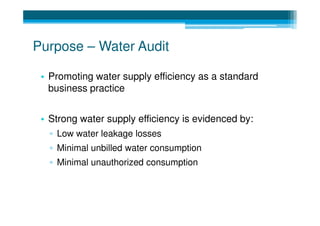
Purpose – Water Audit

 • Promoting water supply efficiency as a standard
   business practice


 • Strong water supply efficiency is evidenced by:
   ▫ Low water leakage losses
   ▫ Minimal unbilled water consumption
   ▫ Minimal unauthorized consumption
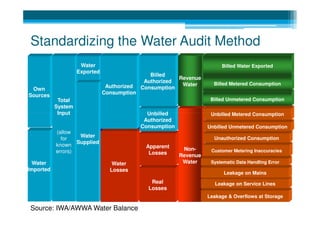
Standardizing the Water Audit Method
                     Water                                                Billed Water Exported
                    Exported
                                                Billed
                                                         Revenue
                                              Authorized               Billed Metered Consumption
                                Authorized                Water
 Own                            Authorized   Consumption
                               Consumption
Sources                        Consumption
            Total                                                     Billed Unmetered Consumption
            Total
           System
           System
            Input                              Unbilled               Unbilled Metered Consumption
            Input
                                              Authorized
                                             Consumption             Unbilled Unmetered Consumption
            (allow
           ( allow   Water
              for                                                      Unauthorized Consumption
              for   Supplied
           known                              Apparent
           known                                            Non-      Customer Metering Inaccuracies
           errors)                             Losses
           errors )                                        Revenue
  Water                           Water                     Water     Systematic Data Handling Error
                                  Water
Imported                         Losses
                                 Losses                                    Leakage on Mains
                                                Real                    Leakage on Service Lines
                                               Losses
                                                                     Leakage & Overflows at Storage

 Source: IWA/AWWA Water Balance
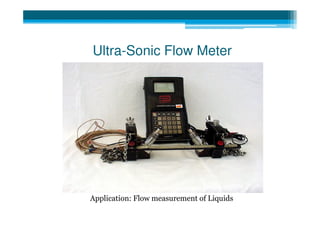
Ultra-Sonic Flow Meter


Application: Flow measurement of Liquids
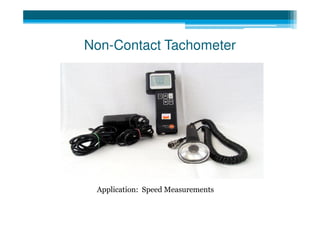
Non-Contact Tachometer


 Application: Speed Measurements
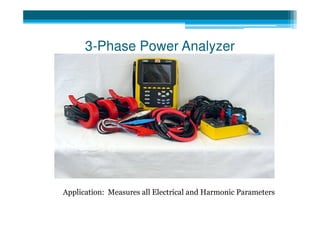
3-Phase Power Analyzer


Application: Measures all Electrical and Harmonic Parameters
Handheld Power Harmonic Analyzer


Application: Measures all Power and Harmonic Parameters
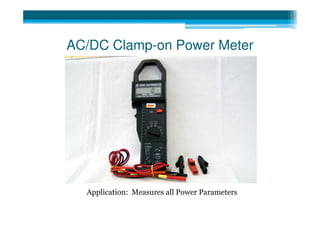
AC/DC Clamp-on Power Meter


  Application: Measures all Power Parameters
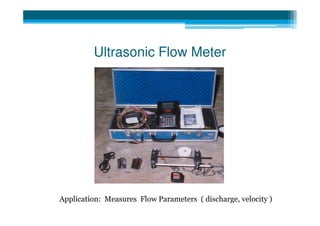
Ultrasonic Flow Meter


Application: Measures Flow Parameters ( discharge, velocity )
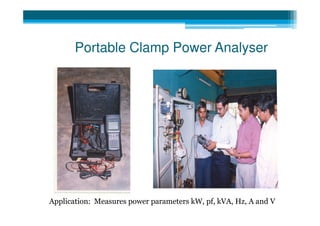
Portable Clamp Power Analyser


Application: Measures power parameters kW, pf, kVA, Hz, A and V
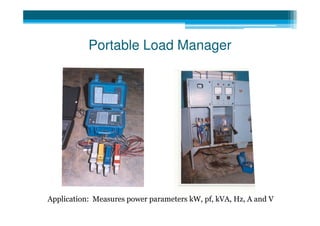
Portable Load Manager


Application: Measures power parameters kW, pf, kVA, Hz, A and V
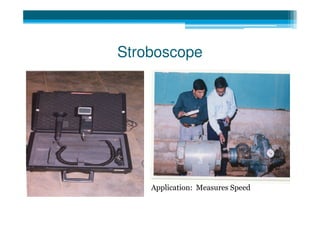
Stroboscope


    Application: Measures Speed
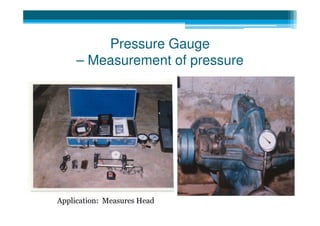
Pressure Gauge
     – Measurement of pressure


Application: Measures Head 200kW, 200 Hz
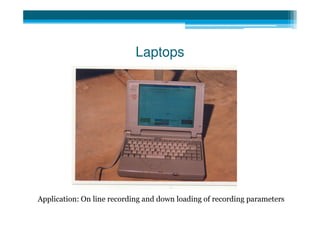
Laptops


Application: On line recording and down loading of recording parameters
For More Information:
                     Pradeep Kumar
                Senior Technical Specialist
              Alliance to Save Energy- India
          10/5, Rhenius Street, Richmond Town
                 Bangalore – 560025, India
                   Tel: + 91-80-22112072

              Email : pkumar@ase.org
           www.ase.org or www.watergy.org
Credits
• Indian Water Works Association (IWWA)
  http://www.iwwa.info/

• Federal Energy Management Program (FEMP)
  http://www1.eere.energy.gov/femp/

• The Energy and Resource Institute (TERI)
  http://www.teriin.org/

2: Introduction to Energy Audit Methods in Water Supply

  • 1.
    Introduction to EnergyAudit Methods in Water Supply Hotel Hilton Hanoi Opera 9th of March 2010 By: Pradeep Kumar
  • 2.
    Energy Audit “An energyaudit is an assessment and analysis of energy flows in a process or system, aimed at reducing the amount of energy input into the system without negatively affecting the output(s).” Objective The main objective of an energy audit is to explore various possibilities for energy conservation; Approach An energy audit requires a thorough and detailed study of every aspect of the system, through the performance of various tests and measurements.
  • 3.
    Steps in anEnergy Audit • Collect and analyze historical energy usage. • Study pumping systems and their operational characteristics. • Identify potential modifications that will reduce the energy usage and/or cost. • Perform an engineering and economic analysis of potential modifications. • Prepare a rank-ordered list of appropriate modifications. • Prepare a report to document the analysis process and results.
  • 4.
    Levels of Assessment •Level I Assessment – Preliminary Energy Use Analysis & Walk Through Analysis; simple assessment based on available documents and information, physical inspection, and staff interviews to create a baseline and identify obvious energy efficiency measures which are easy to implement • Level II Assessment – Energy Survey and Analysis; review of data, existing and newly gathered, to identify all energy saving measures and identify high potential measures for further investigation • Level III Assessment – Detailed Analysis of Capital Intensive Measures; also known as Investment Grade Audit used to give a detailed assessment of costs and benefits derived from capital intensive energy conservation measures
  • 5.
    Level I Assessment •Purpose for undertaking: • Results: ▫ Gain a full understanding of how ▫ Baseline of energy use energy is being consumed and the ▫ Forecast of future energy use associated costs based on current / historical ▫ Report on energy use to internal consumption or external stakeholders ▫ Identification of no/low cost ▫ Find energy conservation measures for energy reduction programs for immediate and future ▫ List of potential projects for future consideration investigation ▫ Identify projects for future energy ▫ Detailed benchmarking for accurate reduction comparison to other facilities and ▫ Set targets for energy reduction own past performance ▫ Preparation for next level of assessment
  • 6.
    Level II Assessment •Purpose for undertaking: • Results: ▫ Desire to take advantage of ▫ Evaluation of all potential energy energy and cost savings from a conserving operational changes wider range of projects and capital investments available ▫ Creation of a full energy ▫ Listing of capital projects that conservation program require further investigation prior to implementation ▫ Preparation for next level of assessment
  • 7.
    Level III Assessment •Purpose for undertaking: • Results: ▫ Desire to undertake significant ▫ Detailed information provided so capital projects to improve energy that owners have a high level of efficiency based on projects confidence in decision making identified in previous levels of regarding significant capital assessment investment ▫ May include gaining access to ▫ May include implementation of external financing under capital intensive EE measures performance contract. under performance contract.
  • 8.
    Method & Approachfor Water Systems • The audit involves carrying out various measurements and analysis of the following systems to assess losses and the potential for energy efficiency improvements: ▫ Pumps & Pumping Systems ▫ Electrical Systems ▫ Electric Drives
  • 9.
    Measurement • Data collection ▫ Specifications of pumps and motors ▫ Diagram of water distribution air network ▫ Water pressure required for the system ▫ Number of pumps in operation ▫ Design/specified water temperature required • Water flow rate of pumps at various operating conditions ▫ Individual ▫ Parallel • Water flow velocity in pipe lines • Suction & discharge pressure of pump
  • 10.
    Measurement • Power consumptionand motor electrical parameters ▫ During individual operation ▫ During parallel operation ▫ At various valve openings • Speed • Flow control methods • Pipe line status • Pressure drop in the line • Operating hours and pump schedule • Variations in flow requirement
  • 11.
    Measurement • User areaoperating schedule • Measurement of water flows to the users • Segregation of users based on operating hours • Any modifications carried out in the pumps such as replacement of impeller, trimming of impeller, others • Operation and maintenance practices
  • 12.
    Data Analysis andEnergy Conservation Measures (ECMs) • Full written description of each ECM to include: ▫ Existing conditions and data collection approach (snapshot, short-term, or long-term measurement of data) ▫ Recommendations. Include discussion of facility operations and maintenance procedures that will be affected by ECM installation and implementation. • Baseline energy use: ▫ Summary of all utility bills ▫ Base year consumption and description of how established
  • 13.
    Data Analysis andEnergy Conservation Measures (ECMs) • Savings Calculations: ▫ Base year energy use and cost ▫ Post-retrofit energy use and cost ▫ Savings estimates including analysis methodology, supporting calculations, and assumptions used ▫ Operations and maintenance savings ▫ If manual calculations are employed, formulas, assumptions, and key data shall be stated.
  • 14.
    Data Analysis andEnergy Conservation Measures (ECMs) • Cost Estimate: ▫ Engineering/design costs ▫ Contractor/vendor estimates for labor, materials, equipment; etc ▫ Construction management fees ▫ Commissioning costs ▫ Other costs/fees
  • 15.
    Data Analysis andEnergy Conservation Measures (ECMs) • Auditors should consider the following while analyzing potential energy and water saving measures: ▫ Comfort and maintenance problems ▫ Energy use, loads, proper sizing, efficiencies and hours of operation ▫ Current operating condition ▫ Remaining useful life ▫ Feasibility of system replacement ▫ Customer's future plans for equipment replacement or pumping station renovations ▫ System operation and maintenance procedures that could be affected ▫ Hazardous materials and other environmental concerns
  • 16.
    Energy Audit ReportFormat • Executive Summary • Background • Energy Scenario • Inventories • Baseline Parameters & Adjustments • System Mapping Details • List of Potential Energy Saving Projects • Detailed Financial Analysis (Payback, NPV, IRR) • Details of Approved Projects • M&V Plan • Risk Assessments & Mitigation Plan • Annexure
  • 18.
    How is itdifferent from an energy audit?
  • 19.
    Energy Audit • Backgroundinformation • Energy assessment study • Inventory details • Energy saving opportunities ▫ Estimated energy and cost savings ▫ Implementation cost ▫ Calculation and analysis ▫ Simple payback ▫ Appendix • Measured data • Appendix and references
  • 20.
    Investment Grade Audit •An investment grade audit is a technical and economic analysis of potential energy saving projects in a facility that: ▫ Provides information on current energy-consuming equipment operations ▫ Identifies technically and economically feasible energy efficiency improvements for existing equipment, and ▫ Provides the customer with sufficient information to judge the technical and economic feasibility of the recommended projects.
  • 21.
    Technical Scope ofWork, Performance Based Contracts
  • 22.
    Scope of Work– IGA & Implementation through performance based contract 1. Investment Grade Audit Phase: ▫ Propose detailed projections of energy and cost savings to be obtained as a result of the implementation of the recommended energy efficiency measures (EEMs). ▫ Establish energy consumption baseline. ▫ Conduct financial and technical risk analysis.
  • 23.
    Scope of Work– IGA & Implementation through performance based contract 2. Construction and Implementation Phase: ▫ Negotiate Energy Performance Contract based on IGA agreement to define implementation scope of work. ▫ Provide design services. ▫ Provide equipment procurement and purchasing. ▫ Provide construction and construction management services.
  • 24.
    Scope of Work– IGA & Implementation through performance based contract 3. Commissioning, Operation and Monitoring Phase ▫ Provide commissioning services. ▫ Perform periodic inspection of improvements. ▫ Perform routine maintenance of equipment. ▫ Develop project-specific measurement & verification plan. ▫ Provide staff training on routine maintenance and operation of systems. ▫ Provide monitoring, measurement, verification and reporting of performance and savings.
  • 25.
    Investment Grade Auditfor Performance Based Contracts Includes: An energy audit + Project financial assessment ( NPV, ROI, IRR etc.) + Risk assessment + Suitable measurement & verification plan to Reduce of the level of Uncertainty
  • 26.
    Uncertainty • Performance • Operational conditions ▫ Will the savings come ▫ Human errors about? ▫ Power quality • Baseline ▫ Water scarcity ▫ May change, need ▫ User intervention adjustment • Addition of loads • Energy Price ▫ Added more pumps ▫ Will fluctuate during the project, how to factor ▫ More water requirements this? • Delays ▫ In construction ▫ Commissioning
  • 27.
    Uncertainty • Reported savings values are always estimates because you can't measure what isn't there. • Uncertainty in the savings value comes from: ▫ Uncertainty in performance ▫ Uncertainty and changes in usage ▫ Uncertainty introduced by estimates ▫ Unpredictability in future energy costs ▫ Uncertainty in carbon conversion factors
  • 28.
    Uncertainty can be reduced but not eliminated…..
  • 29.
    How to ReduceUncertainty By Allocating Risk– A matrix that details the sharing of risk
  • 30.
    Risk & ResponsibilityMatrix Risk Assessment • Types of Risk • Allocating Risk Responsibility Allocation • Financial • Operational (Usage) • Performance
  • 31.
    Risk & Responsibility Typeof Risk 1. Financial 3. Performance ▫ Energy Prices ▫ Equipment Performance ▫ M&V Costs ▫ Operations ▫ Interest Rates ▫ Preventive Maintenance ▫ Construction Cost ▫ Equipment Repair & 2. Operational Replacement ▫ Operating Hours ▫ Loads ▫ Weather ▫ User Participation
  • 32.
    Risk & ResponsibilityMatrix - Overview Contractor Proposed Agency Responsibility /Description Approach Assessment Performance Equipment performance: Operations: Maintenance & repair: Equipment replacement: Operational Operating hours: Load: Weather: User participation:
  • 33.
    Risk/Responsibility Matrix -Overview Responsibility /Description Contractor Proposed Agency Approach Assessment Financial Interest rates: Energy prices: Construction costs: M&V costs: Delays: Major changes in facility:
  • 35.
    Purpose – WaterAudit • Promoting water supply efficiency as a standard business practice • Strong water supply efficiency is evidenced by: ▫ Low water leakage losses ▫ Minimal unbilled water consumption ▫ Minimal unauthorized consumption
  • 36.
    Standardizing the WaterAudit Method Water Billed Water Exported Exported Billed Revenue Authorized Billed Metered Consumption Authorized Water Own Authorized Consumption Consumption Sources Consumption Total Billed Unmetered Consumption Total System System Input Unbilled Unbilled Metered Consumption Input Authorized Consumption Unbilled Unmetered Consumption (allow ( allow Water for Unauthorized Consumption for Supplied known Apparent known Non- Customer Metering Inaccuracies errors) Losses errors ) Revenue Water Water Water Systematic Data Handling Error Water Imported Losses Losses Leakage on Mains Real Leakage on Service Lines Losses Leakage & Overflows at Storage Source: IWA/AWWA Water Balance
  • 38.
    Ultra-Sonic Flow Meter Application:Flow measurement of Liquids
  • 39.
  • 40.
    3-Phase Power Analyzer Application:Measures all Electrical and Harmonic Parameters
  • 41.
    Handheld Power HarmonicAnalyzer Application: Measures all Power and Harmonic Parameters
  • 42.
    AC/DC Clamp-on PowerMeter Application: Measures all Power Parameters
  • 43.
    Ultrasonic Flow Meter Application:Measures Flow Parameters ( discharge, velocity )
  • 44.
    Portable Clamp PowerAnalyser Application: Measures power parameters kW, pf, kVA, Hz, A and V
  • 45.
    Portable Load Manager Application:Measures power parameters kW, pf, kVA, Hz, A and V
  • 46.
    Stroboscope Application: Measures Speed
  • 47.
    Pressure Gauge – Measurement of pressure Application: Measures Head 200kW, 200 Hz
  • 48.
    Laptops Application: On linerecording and down loading of recording parameters
  • 49.
    For More Information: Pradeep Kumar Senior Technical Specialist Alliance to Save Energy- India 10/5, Rhenius Street, Richmond Town Bangalore – 560025, India Tel: + 91-80-22112072 Email : pkumar@ase.org www.ase.org or www.watergy.org
  • 50.
    Credits • Indian WaterWorks Association (IWWA) http://www.iwwa.info/ • Federal Energy Management Program (FEMP) http://www1.eere.energy.gov/femp/ • The Energy and Resource Institute (TERI) http://www.teriin.org/