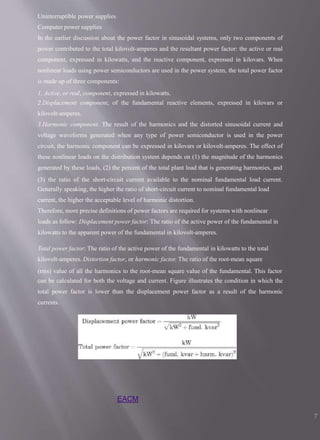
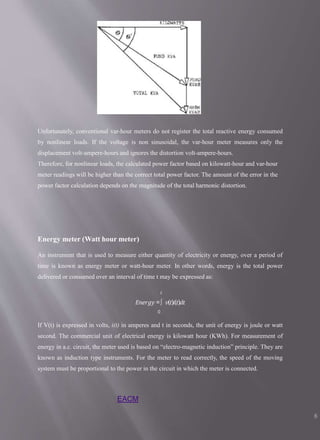
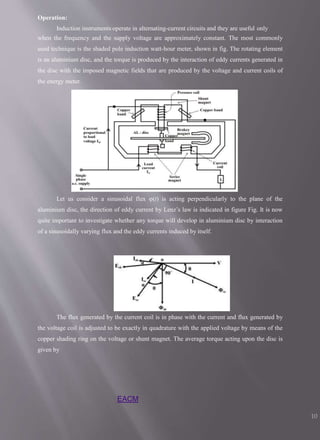
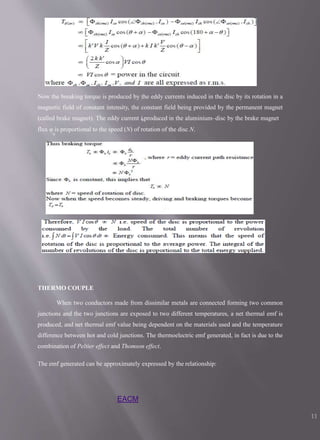
VIVEK VISWANADH
M.Tech(Ph.D)
Assistant Professor
Department of Electrical and Electronics Engineering
Vignan’s Institute of Information Technology(A)
UNIT-1:
BASIC PRINCIPLES OF ENERGY MANAGEMENT
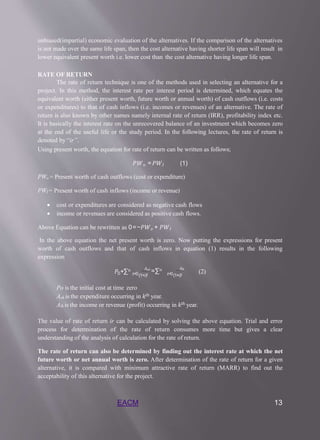
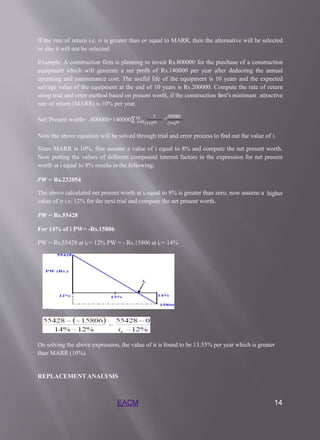
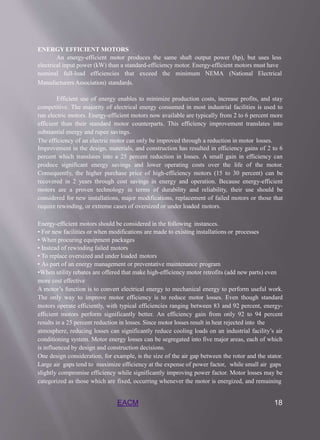
Energy Audit-Definition:
Energy Audit is the key to a systematic approach for decision-making in the area of
energy management. It attempts to balance the total energy inputs with its use, and serves to
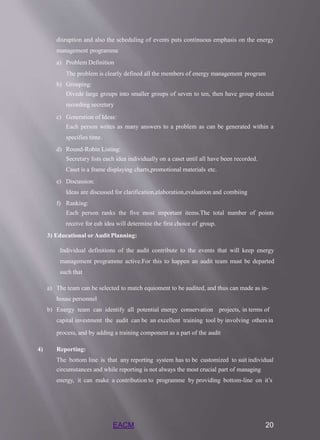
identify all the energy streams in a facility. It quantifies energy usage according to its discrete
functions. Industrial energy audit is an effective tool in defining and pursuing comprehensive
energy management programme.
As per the Energy Conservation Act, 2001, Energy Audit is defined as "the
verification, monitoring and analysis of use of energy including submission of technical
report containing recommendations for improving energy efficiency with cost benefit
analysis and an action plan to reduce energy consumption".
Need for Energy Audit
In any industry, the three top operating expenses are often found to be energy (both
electrical and thermal), labour and materials. If one were to relate to the manageability of the
cost or potential cost savings in each of the above components, energy would invariably
emerge as a top ranker, and thus energy management function constitutes a strategic area for
cost reduction.
Energy Audit will help to understand more about the ways energy and fuel are used in
any industry, and help in identifying the areas where waste can occur and where scope for
improvement exists.
The Energy Audit would give a positive orientation to the energy cost reduction,
preventive maintenance and quality control programmes which are vital for production and
utility activities. Such an audit programme will help to keep focus on variations which occur
in the energy costs, availability and reliability of supply of energy, decide on appropriate
energy mix, identify energy conservation technologies, retrofit for energy conservation
equipment etc.
In general, Energy Audit is the translation of conservation ideas into realities, by
lending technically feasible solutions with economic and other organizational considerations
within a specified time frame.
The primary objective of Energy Audit is to determine ways to reduce energy
consumption per unit of product output or to lower operating costs. Energy Audit provides a
2
"bench-mark" (Reference point) for managing energy in the organization and also provides
the basis for planning a more effective use of energy throughout the organization.
Objectives of Energy Audit:
The energy audit provides the vital information base for overall energy conservation
programme covering essentially energy utilization analysis and evaluation of energy
conservation measures.
It aims at:
i. Assessing present pattern of energy consumption in different cost centres of
operations.
ii. Relating energy inputs and production output
iii. Identifying potential areas of thermal and electrical energy economy.
iv. Highlighting wastage in major areas
v. Fixing of energy saving potential targets for individual cost centres
vi. Implementation of measures of energy conservation and realisation ofsavings.
The overall objectives of the Energy Audit are accomplished by:
i. Identifying areas of improvement and formulation of energy conservation measures
requiring no investment or marginal investment through system improvements and
optimisation of operations.
ii. Identifying areas requiring major investment by incorporation of modern energy
efficient equipment and up-gradation of existing equipment
3
Type of Energy Audit:
The type of Energy Audit to be performed depends on:
 Function and type of industry,
 Depth to which final audit is needed and
 Potential and magnitude of cost reduction desired.
Thus Energy Audit can be classified into the following two types.
i) Preliminary Energy Audit
ii) Detailed Energy Audit
4
Preliminary Energy Audit:
The preliminary audit or simple audit or walk through audit is the simplest and quickest type
of audit. It involves minimal interviews with site operating personnel, a brief review of
facility utility bills and other operating data, and a walk through of the facility to become
familiar with the building operation and to identify any glaring areas of energy waste or
inefficiency. Preliminary analysis made to asses building energy efficiency to identify not
only simple and low cost improvements but also a list of energy conservation measures to
orient the future detailed audit. This inspection is based on visual verifications, study of
installed equipment and operating data and detailed analysis of recorded energy consumption
collected during the benchmarking phase. Following activities are envisaged in the
preliminary energy audit.
• Establish energy consumption in the organization
• Estimate the scope for saving
• Identify the most likely (and the easiest areas for attention
• Identify immediate (especially no-/low-cost) improvements/ savings
• Set a 'reference point'
• Identify areas for more detailed study/measurement.
Preliminary energy audit uses existing, or easily obtained data. The plant data analysis is
useful in managing and analyzing the complex plant data to optimize process performance.
Typically, only major problem areas will be covered during this type of audit. Corrective
measures are briefly described, and quick estimates of implementation cost, potential
operating cost savings, and simple pay back periods are provided. This level of detail, while
not sufficient for reaching a final decision on implementing proposed measure, it is adequate
to prioritize energy efficient projects and to determine the need for a more detailed audit.
Detailed Energy Audit:
A comprehensive audit provides a detailed energy project implementation plan for a
facility, since it evaluates all major energy using systems. This type of audit offers the most
accurate estimate of energy savings and cost. It considers the interactive effects of all
projects, accounts for the energy use of all major equipment, and includes detailed energy
cost saving calculations and project cost. In a comprehensive audit, one of the key elements is
the energy balance. This is based on an inventory of energy using systems, assumptions of
current operating conditions and calculations of energy use. This estimated use is then
compared to utility bill charges. Detailed energy auditing is carried out in three phases: Phase
I, II and III.
Phase I - Pre Audit Phase
Phase II - Audit Phase
Phase III - Post Audit Phase
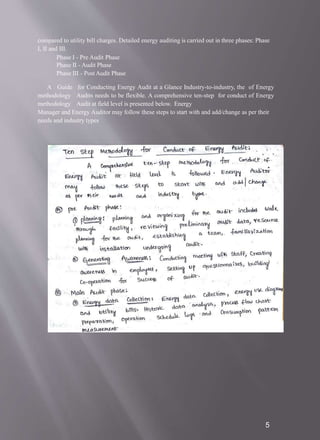
A Guide
methodology
methodology
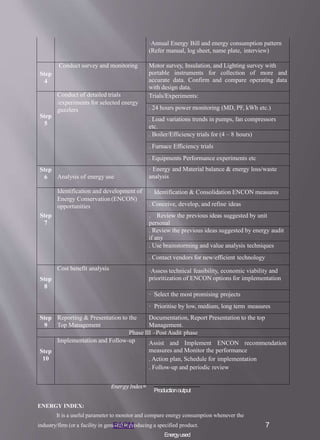
for Conducting Energy Audit at a Glance Industry-to-industry, the of Energy
Audits needs to be flexible. A comprehensive ten-step for conduct of Energy
Audit at field level is presented below. Energy
Manager and Energy Auditor may follow these steps to start with and add/change as per their
needs and industry types
5
Step
No. PLAN OF ACTION PURPOSE / RESULTS
Phase I –Pre Audit Phase
Step
1
· Plan and organise ·Resource planning, Establish/organize a Energy
audit team
· Walk through Audit · Organize Instruments & time frame
· Informal Interview with Energy
Manager, Production / Plant
Manager
· Macro Data collection (suitable to type of
industry.)
· Familiarization of process/plant activities
·First hand observation & Assessment of current level
operation and practices
Step
2
Conduct of brief meeting /
awareness programme with all
divisional heads and persons
concerned (2-3 hrs.)
· Building up cooperation
· Issue questionnaire for each department
· Orientation, awareness creation
Phase II –Audit Phase
Step
3
Primary data gathering, Process
Flow Diagram, & Energy Utility
Diagram
· Historic data analysis, Baseline data collection
· Prepare process flow charts
· All service utilities system diagram (Example: Single
line power distribution diagram, water, compressed air
& steam distribution.
· Design, operating data and schedule of operation
EACM 6
·Annual Energy Bill and energy consumption pattern
(Refer manual, log sheet, name plate, interview)
Step
4
Conduct survey and monitoring Motor survey, Insulation, and Lighting survey with
portable instruments for collection of more and
accurate data. Confirm and compare operating data
with design data.
Step
5
Conduct of detailed trials
/experiments for selected energy
guzzlers
Trials/Experiments:
. 24 hours power monitoring (MD, PF, kWh etc.)
. Load variations trends in pumps, fan compressors
etc.
. Boiler/Efficiency trials for (4 – 8 hours)
. Furnace Efficiency trials
. Equipments Performance experiments etc
Step
6 Analysis of energy use
· Energy and Material balance & energy loss/waste
analysis
Step
7
Identification and development of
Energy Conservation(ENCON)
opportunities
· Identification & Consolidation ENCON measures
. Conceive, develop, and refine ideas
. Review the previous ideas suggested by unit
personal
. Review the previous ideas suggested by energy audit
if any
. Use brainstorming and value analysis techniques
. Contact vendors for new/efficient technology
Step
8
Cost benefit analysis ·Assess technical feasibility, economic viability and
prioritization of ENCON options for implementation
· Select the most promising projects
· Prioritise by low, medium, long term measures
Step
9
Reporting & Presentation to the
Top Management
Documentation, Report Presentation to the top
Management.
Phase III –Post Audit phase
Step
10
Implementation and Follow-up Assist and Implement ENCON recommendation
measures and Monitor the performance
. Action plan, Schedule for implementation
. Follow-up and periodic review
𝐸𝑛𝑒𝑟𝑔𝑦 𝐼𝑛𝑑𝑒𝑥=
ENERGY INDEX:
It is a useful parameter to monitor and compare energy consumption whenever the
industry/firm (or a facility in general) is producing a specified product.
Energyused
Productionoutput
EACM 7
EACM 8
This may be calculated weekly/monthly/annually. For better monitoring, the total energy indices are
calculated. If there is any increase or decrease in the Energy Index, with the implementation of any
conservation scheme, the particular source can be identified and investigatedimmediately.
COST INDEX:
Another parameter which is useful in monitoring and assessing energy use of a facility is cost index. It
is defined as the ratio of the cost of energy to the production output. Any changes in energy
consumption which can be investigated and remedied are indicated by comparison of cost indices. The
trends and fluctuations are clearly visible with such comparisons.
PIE CHART:
This is a circular chart depicting the energy usage where the quantity of aparticular type is
represented as a segment of a circle. The size of the segment is proportional to the energy consumption
using a particular fuel relative to the fuel usage. The relevant conversion factors are used to rationalize
all the energy units to one particular unit.
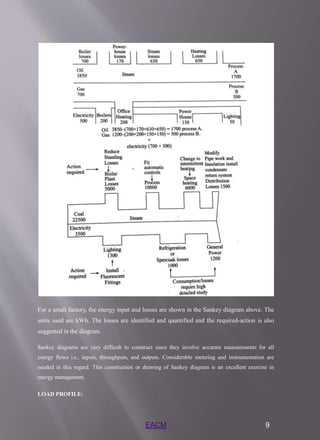
Sankey Diagrams:
All the energy flows in and out of a Facility arc represented by Sankey diagram, The
widths of the bands are directly proportional to energy production, utilization and losses. The
primary energy resources which in this case arc the gas, electricity and oil, represent the
energy inputs at the left-hand side of the sankey diagram. A typical Sankey diagram is shown
representing energy usage, MJ/hour.
For a small factory, the energy input and losses are shown in the Sankey diagram above. The
units used are kWh. The losses are identified and quantified and the required-action is also
suggested in the diagram.
Sankey diagrams are very difficult to construct since they involve accurate measurements for all
energy flows i.e., inputs, throughputs, and outputs. Considerable metering and instrumentation are
needed in this regard. This construction or drawing of Sankey diagram is an excellent exercise in
energy management.
LOAD PROFILE:
EACM 9
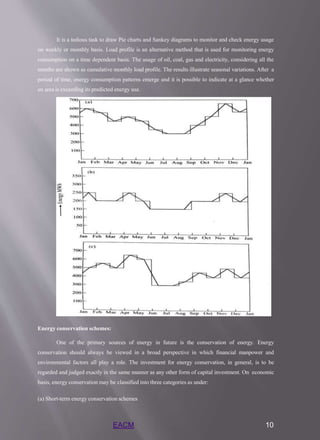
It is a tedious task to draw Pie charts and Sankey diagrams to monitor and check energy usage
on weekly or monthly basis. Load profile is an alternative method that is used for monitoring energy
consumption on a time dependent basis. The usage of oil, coal, gas and electricity, considering all the
months are shown as cumulative monthly load profile. The results illustrate seasonal variations. After a
period of time, energy consumption patterns emerge and it is possible to indicate at a glance whether
an area is exceeding its predicted energy use.
Energy conservation schemes:
One of the primary sources of energy in future is the conservation of energy. Energy
conservation should always be viewed in a broad perspective in which financial manpower and
environmental factors all play a role. The investment for energy conservation, in general, is to be
regarded and judged exactly in the same manner as any other form of capital investment. On economic
basis, energy conservation may be classified into three categories as under:
(a) Short-term energy conservation schemes
EACM 10
EACM 11
(b) Medium-term energy conservation schemes
(c) Long-term energy conservation schemes
Short-and medium-term schemes can achieve savings of 5 to 10%, the long-term schemes may
achieve a further savings of 10 to 15%.
(a)Short-term energy conservation schemes:
This group consists of tasks of tightening of operational control and improved housekeeping.
(i) Furnace efficiencies:
For good combustion, minimum excess air over stoichiometric air is to be maintained. A
continuous monitoring of oxygen level in flue gases is to be done. The oil burners should be
cleaned regularly and well maintained.
(ii) Heal exchangers:
In case of heat exchangers where there is a transfer of useful heat from product streams to feed
streams. The optimum cycles can be determined by continuous performance monitoring. An
improved heat recovery can be achieved by frequent cleaning.
(iii) Good housekeeping:
When natural light is available and sufficient, artificial light should be avoided. During the heating
season doors and windows should be closed as much as possible. Encouragement should be given
to staff to wear suitable clothing in the workingareas.
(iv) Electrical Power:
In most of the industries, electrical power is 'imported'. About 10 to 15% of electrical energy
costs can be reduced by adopting conservation measures. At locations whcrc natural air cooling is
sufficient, the usage of I.D. fans can be avoided. Gravity flow application can minimize pumping
costs of liquids.
(v)Steam usage—The majority of steam leaks should be repaired as soon as possible after they
occur. The quality as well as quantity of steam required should be optimized and a careful control
of the supply and distribution of steam is essential. The payback period for this type of schemes is
less than or equal to one year.
(b) Medium-term energy conservation schemes:
Considering a payback period of less than two years, considerable savings in energy
consumption are often available for quite modest outlays of capital. Some examples are given
below:
(i) Insulation: Improving insulation prevents the leakage of cold air into the room and also
thermal losses in the steam distribution system. Optimum thickness of insulation or critical
radius of insulation is to be evaluated based on the study under consideration. Due
consideration is to be given to economical thickness of insulation also.
(ii)
(iii)
(iv)
The temperature control and operational time of cooling/heating systems.
Whenever necessary, the air compressors are to be replaced.
The reliable measurement and control of energy parameters can be achieved by providing
adequate instrumentation at all places.
Certain processes of the industry need modification. For example, the uncontaminated
steam condensate may be used as boiler feed water. This results in heat recovery in the
condensate as well as in reduction of raw water amount and its treatment costs.
Considerable savings can be obtained by suitably adjusting the electrical power factor
correction.
The control and atomizing of steam in boilers and oil in furnaces is found to be in excess
of the optimum designed value. This optimal value when used results in energy
conservation.
(v)
(vi)
(vii)
(c) Long-term energy conservation schemes:
Further energy saving can be attained by adopting policies which require large amount
of capital expenditure. The return on capital for the long-term investment may not be as good
as that of the medium-term. Economical appraisal techniques are to be used to ensure the
economical viability of such schemes, involving certain modifications to the existing systems
or refurbishments. Some examples are:
(i) Heater modification: The installation of heating tubes, air pre-heaters or any other
suitable heat exchangers results in extraction of more heat from furnace flue gases.
Additional lagging (improved insulation) for storage tanks minimizes thermal energy
losses.
To obtain improved heat recovery, additional heat exchangers are to be provided in
the processing areas.
(ii)
(iii)
Example:
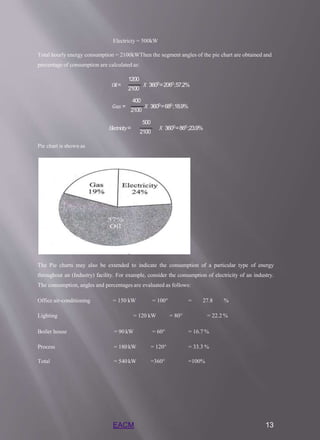
A company uses on an hourly basis, 4.32 x 10^9 J of oil, 11.72 x 10^3 therms of gas and 500 kW of
electricity. Draw a Pie chart for this company's energy usage. (To convert 1 therm to J/s divide by
29.31 x 10^-3)
Sol: All the units are first converted into a particular unit, namely kW, thus
4.32𝑋 109
𝑂𝑖𝑙= =1200𝑘𝑊
3600𝑋 103
11.72𝑋 103
𝐺𝑎𝑠 = =400𝑘𝑊
29.31𝑋 10−3
EACM 12
Electricty = 500kW
Total hourly energy consumption = 2100kWThen the segment angles of the pie chart are obtained and
percentage of consumption are calculated as:
2100
1200
𝑂𝑖𝑙= 𝑋 3600=2060;57.2%
2100
400
𝐺𝑎𝑠 = 𝑋 3600=680;18.9%
2100
500
𝐸𝑙𝑒𝑐𝑡𝑟𝑖𝑐𝑖𝑡𝑦= 𝑋 3600=860;23.9%
Pie chart is shown as
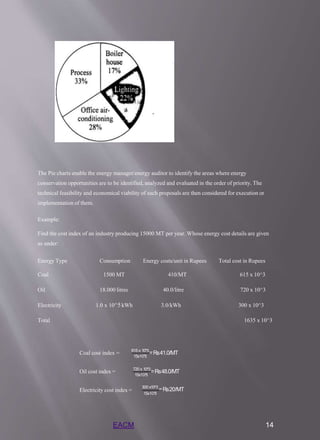
The Pie charts may also be extended to indicate the consumption of a particular type of energy
throughout an (Industry) facility. For example, consider the consumption of electricity of an industry.
The consumption, angles and percentages are evaluated as follows:
Office air-conditioning = 150 kW = 100° = 27.8 %
Lighting = 120 kW = 80° = 22.2 %
Boiler house = 90 kW = 60° = 16.7 %
Process = 180 kW = 120° = 33.3 %
Total = 540 kW =360° =100%
EACM 13
The Pie charts enable the energy manager/energy auditor to identify the areas where energy
conservation opportunities are to be identified, analyzed and evaluated in the order of priority. The
technical feasibility and economical viability of such proposals are then considered for execution or
implementation of them.
Example:
Find the cost index of an industry producing 15000 MT per year. Whose energy cost details are given
as under:
Energy Type Consumption Energy costs/unit in Rupees Total cost in Rupees
Coal 1500 MT 410/MT 615 x 10^3
Oil 18.000 litres 40.0/litre 720 x 10^3
Electricity 1.0 x 10^5kWh 3.0/kWh 300 x 10^3
Total 1635 x 10^3
15x10^
3
Coal cost index = 615 x 10^3
=Rs41.0/MT
Oil cost index =
15x10^
3
720 x 10^3
=Rs48.0/MT
Electricity cost index =
15x10^
3
300 x10^3
=Rs20/MT
EACM 14
Total cost index =Rs109 /MT
Example:
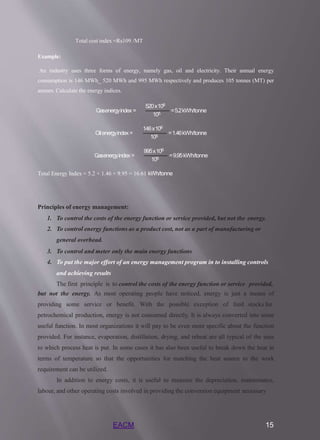
An industry uses three forms of energy, namely gas, oil and electricity. Their annual energy
consumption is 146 MWh_ 520 MWh and 995 MWh respectively and produces 105 tonnes (MT) per
annum. Calculate the energy indices.
Gasenergyindex =
520x106
105
=5.2kWh/tonne
Oilenergyindex=
146x106
105
=1.46kWh/tonne
Gasenergyindex =
995x106
105
=9.95kWh/tonne
EACM 15
Total Energy Index = 5.2 + 1.46 + 9.95 = 16.61 kWh/tonne
Principles of energy management:
1. To control the costs of the energy function or service provided, but not the energy.
2. To control energy functions as a product cost, not as a part of manufacturing or
general overhead.
3. To control and meter only the main energy functions
4. To put the major effort of an energy management program in to installing controls
and achieving results
The first principle is to control the costs of the energy function or service provided,
but not the energy. As most operating people have noticed, energy is just a means of
providing some service or benefit. With the possible exception of feed stocks for
petrochemical production, energy is not consumed directly. It is always converted into some
useful function. In most organizations it will pay to be even more specific about the function
provided. For instance, evaporation, distillation, drying, and reheat are all typical of the uses
to which process heat is put. In some cases it has also been useful to break down the heat in
terms of temperature so that the opportunities for matching the heat source to the work
requirement can be utilized.
In addition to energy costs, it is useful to measure the depreciation, maintenance,
labour, and other operating costs involved in providing the conversion equipment necessary
EACM 16
to deliver required services. These costs add as much as 50% to the fuel cost. It is the total
cost of these functions that must be managed and controlled, not the Btu of energy.
Second principle of energy management is to control energy functions as a product
cost, not as a part of manufacturing or general overhead. It is surprising how many
companies still lump all energy costs into one general or manufacturing overhead account
without identifying those products with the highest energy function cost. In most cases,
energy functions must become part of the standard cost system so that each function can be
assessed as to its specific impact on the product cost. The minimum theoretical energy
expenditure to produce a given product can usually be determined en route to establishing a
standard energy cost for that product. As in all production cost functions, the minimum
standard is often difficult to meet, but it can serve as an indicator of the size of the
opportunity. In comparing actual values with minimum values, four possible approaches can
be taken to reduce the variance, usually in this order:
1. An hourly or daily control system can be installed to keep the function cost at the
desired level.
2. Fuel requirements can be switched to a cheaper and more available form.
3. A change can be made to the process methodology to reduce the need for the function.
4. New equipment can be installed to reduce the cost of the function.
The starting point for reducing costs should be in achieving the minimum cost
possible with the present equipment and processes. Installing management control systems
can indicate what the lowest possible energy use is in a well-controlled situation. It is only at
that point when a change in process or equipment configuration should be considered. An
equipment change prior to actually minimizing the expenditure under the present system may
lead to over sizing new equipment or replacing equipment for unnecessary functions
The third principle is to control and meter only the main energy functions—the
roughly 20% that make up 80% of the costs. A few functions usually account for a majority
of the costs. It is important to focus controls on those that represent the meaningful costs and
aggregate the remaining items in a general category. Many manufacturing plants have only
one meter, that leading from the gas main or electric main into the plant from the outside
source. Regardless of the reasonableness of the standard cost established, the inability to
measure actual consumption against that standard will render such a system useless. Sub-
metering the main functions can provide the information not only to measure but to control
EACM 17
costs in a short time interval. The cost of metering and sub-metering is usually incidental to
the potential for realizing significant cost improvements in the main energy functions of a
production system.
The fourth principle is to put the major effort of an energy management program in
to installing controls and achieving results. It is common to find general knowledge about
how large amounts of energy could be saved in a plant. The missing ingredient is the
discipline necessary to achieve these potential savings. Each step in saving energy needs to be
monitored frequently enough by the manager or first-line supervisor to see noticeable
changes. Logging of important fuel usage or behavioural observations are almost always
necessary before any particular savings results can be realized. Therefore, it is critical that an
energy director or committee have the authority from the chief executive to install controls,
not just advise line management. Those energy managers who have achieved the largest cost
reductions actually install systems and controls; they do not just provide good advice.
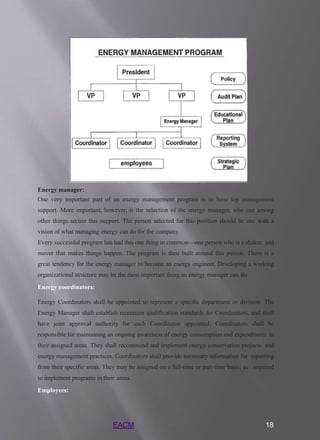
ORGANISATION STRUCTURE OF ENERGY MANAGEMENT PROGRAM:
The organizational chart for energy management program is shown in figure. It must be
adapted to fit into an existing structure for each organization. For example, the presidential
block may be the general manager, and VP blocks may be division managers, but the
fundamental principles are the same. The main feature of the chart is the location of the
energy manager. This position should be high enough in the organizational structure to have
access to key players in management, and to have knowledge of current events within the
company. For example, the timing for presenting energy projects can be critical. Funding
availability and other management priorities should be known and understood. The
organizational level of the energy manager is also indicative of the support management is
willing to give to the position.
Energy manager:
One very important part of an energy management program is to have top management
support. More important, however, is the selection of the energy manager, who can among
other things secure this support. The person selected for this position should be one with a
vision of what managing energy can do for the company.
Every successful program has had this one thing in common—one person who is a shaker and
mover that makes things happen. The program is then built around this person. There is a
great tendency for the energy manager to become an energy engineer. Developing a working
organizational structure may be the most important thing an energy manager can do.
Energy coordinators:
Energy Coordinators shall be appointed to represent a specific department or division. The
Energy Manager shall establish minimum qualification standards for Coordinators, and shall
have joint approval authority for each Coordinator appointed. Coordinators shall be
responsible for maintaining an ongoing awareness of energy consumption and expenditures in
their assigned areas. They shall recommend and implement energy conservation projects and
energy management practices. Coordinators shall provide necessary information for reporting
from their specific areas. They may be assigned on a full-time or part-time basis; as required
to implement programs in their areas.
Employees:
EACM 18
EACM 19
Employees are shown as a part of the organizational structure, and are perhaps the greatest
untapped resource in an energy management program. A structured method of soliciting their
ideas for more efficient use of energy will prove to be the most productive effort of the energy
management program. A good energy manager will devote 20% of total time working with
employees. Too many times employee involvement is limited to posters that say “Save
Energy.” Employees in manufacturing plants generally know more about the equipment than
anyone else in the facility because they operate it. They know how to make it run more
efficiently, but because there is no mechanism in place for them to have an input, their ideas
go unsolicited. An understanding of the psychology of motivation is necessary before an
employee involvement program can be successfully conducted.
1) Initiating:
A well written energy policy authorized by the management provides the energy
manager with the authority of being involved in business planning, new facility
location and planning. Selection of production equipment, purchase of measuring
equipment and energy reporting.
The above mentioned policy confuses with a procedures manual,in order to
have an effective policy it should contain the planning
a) Objectives:
In this statements relating to energy and most importantly that the organization
will incorporate energy efficiency into facilities with an equipment must be
emphasised along with life cost analysis.
b) Accountability:
In this segment it should define the organization structure and authority held by
energy manager,coordinators etc.
c) Reporting:
For a smooth flow of an organization,metering the energy use with skilled labour
and instrumentation is must.Hence reporting provides a legitimate reason for
cancelling funds from top management
2) Planning:
Planning is the most important part of energy management program,and for most
technical people is the least desirable.From a good plan one can shield from
EACM 20
disruption and also the scheduling of events puts continuous emphasis on the energy
management programme
a) Problem Definition
The problem is clearly defined all the members of energy management program
b) Grouping:
Divede large groups into smaller groups of seven to ten, then have group elected
recording secretary
c) Generation of Ideas:
Each person writes as many answers to a problem as can be generated within a
specifies time.
d) Round-Robin Listing:
Secretary lists each idea individually on a caset until all have been recorded.
Caset is a frame displaying charts,promotional materials etc.
e) Discussion:
Ideas are discussed for clarification,elaboration,evaluation and combiing
f) Ranking:
Each person ranks the five most important items.The total number of points
receive for eah idea will determine the first choice of group.
3) Educational or AuditPlanning:
Individual definitions of the audit contribute to the events that will keep energy
management programme active.For this to happen an audit team must be departed
such that
a) The team can be selected to match equioment to be audited, and thus can made as in-
house personnel
b) Energy team can identify all potential energy conservation projects, in terms of
capital investment the audit can be an excellent training tool by involving others in
process, and by adding a training component as a part of the audit
4) Reporting:
The bottom line is that any reporting system has to be customized to suit individual
circumstances and while reporting is not always the most crucial part of managing
energy, it can make a contribution to programme by providing bottom-line on it’s
EACM 21
effectiveness. By making report of requirement of energy policy, it simply require
combining production data and energy data to develop an energy index.
With all the above considered, the best way to report is to do it against an audit than
has been performed at facility.
QUALITIES AND FUNCTIONS OF AN ENERGY MANAGER:
Energy managers can come from a variety of backgrounds, since energy is a multi-
disciplinary specialty. It is difficult to lay down hard and fast rules about the qualities required
for an energy manager. Generally, the energy manager will be drawn from the existing
workforce. Since, he should be thoroughly familiar with the whole range of organizations
activities from input to output of the process and finance. The energy managers should have
the ability and open-mindedness to keep abreast of the latest developments in energy
efficiency technology. The energy manager may also be an external person, appointed,
considering his experience and expertise in the relative field of the process involved. There is
no precise blueprint for a successful energy manager and the job is also not clearly defined.
• The energy managers should have high visibility within the organization.
• They have more responsibility to get the job done with very less authority. They need
a good grasp of both the design aspects and nuts/bolts details of conservation
programmes i.e., they should have a thorough understanding of the company's
process, products, maintenance procedures and facilities.
• A good energy manager should be able to communicate clearly and persuasively with
lawyers, engineers, accountants, financial planners, public relation specialists,
government officials etc., in their own language.
• To have a continuous support of top management, the energy manager has to develop
and present his programme and investment with predictable returns instead of
unrecoverable costs.
• The energy manager should control and coordinate the conservation campaigns.
• He should control his area of responsibility very efficiently.
• He must be capable of directing all the personnel involved in consuming the supply
of energy for which he is responsible.
• He has to decide regarding investment in a particular project analyzing the costing
techniques.
EACM 22
The role of the energy manager discusses direct access to senior management and
their full support and commitment and answers the questions like:
(i)
(ii)
(iii)
Who should be appointed?
What benefits will an energy manager bring?
How does he fit into the company's structure?
An important concept to energy manager is efficiency. Losses some of which are
thermody-namically unavoidable and some are economically irretrievable, contribute to
inefficiency. The challenge to energy manager is to first identify those which he can do
something about, find how to do it, and then get the management agree to do it.
He needs a questioning mind and should possess the ability to command the support
of colleagues.
The terms of reference of the energy manager should be clearly defined i.e., whether
he has an authority within a service or production department or whether he acts only in an
advisory and coordinating role. Based on the type and size of the organization, the duties of
energy manager should include any/all of the following:
(i)
(ii)
(iii)
(iv)
(v)
(vi)
(vii)
(viii)
To generate interest in energy conservation and to sustain the same with new ideas
and activities and for lecturing training courses.
To ensure that the records and accounting system are maintained in consistent
units and are uniform.
To give technical advice on energy saving techniques and equipment.
To identify the sources of technical guidance.
To coordinate the efforts of all energy users and set realistic targets.
To maintain essential records of purchases, stock, consumption reviewing the
energy utili-zation performance periodically, watching the trends and to advice the
senior management.
To identify the source of energy wastage, quantify the wastage or losses in
financial terms and suggest practical recommendations to reduce these losses.
To identify areas requiring deep study, maintain records of such in-depth studies
and to review the progress.
(ix) To provide material of good energy practice to suit the needs of the organization.
(x) To give special advices, with due consideration to energy conservation, safety and
healthy aspects, to various departments of the organization.
EACM 23
(xi) To keep track of all the significant developments in the field of energy
conservation by maintaining contact with appropriate research organizations.
To advise the senior management on matters of energy with latest developments
in the global scenario.
(xii)
For a successful energy manager, the following points may be considered as guidelines:
1.Based on factual data prepared, think ahead, anticipating questions; the request for approval
of expenditure is to be made sufficiently in advance.
2. Learn how to say 'NO' in a diplomatic way and be aggressive.
3. Stick your neck out as energy is not a safe sell.
4. Be creative; put the action plan tasks on priority after identifying the needs.
5. Be a good and patient listener and establish a free thinking environment.
6. Prepare and develop implementation strategies.
7. Establish credibility through an accurate energy accounting system.
8. Be patient but demanding as efficient use of energy is an evolutionary process.
LANGUAGE OF THE ENERGY MANAGER:
It is essential to understand the language of the energy manager and how it is applied
to facilitate easy communication of energy conservation goals and to analyze the literature in
the field. For the better comparison of efficiencies of various fuels and the cost per unit
heating value, it is essential that the heating value of each fuel is expressed in proper units,
i.e., Btu, Kcal, KJ. The method of reducing the energy cost of the plant can be easily
understood and analyzed only when the energy contents of the plants processes is known. If
the energy is utilized efficiently, definitely there will be reduction in product costs and
increase in profits. This requires the preparation of the energy balance for the plant during a
given period. Energy managers need to make forecasts as to the availability of supplies, fuel
pricing and the future energy use of their building companies. Only after knowing all the
facts, engineering judgment can be made and conclusions drawn. Unfortunately, with energy
forecasting, not all the facts are known and many times conflicting data exist. For the
development of a good forecasting model, the energy manager should know past and present
consumption of energy and the pricing pattern.
EACM 24
Questionnaire-Check list for Top Management
Control of Energy
a) Name, Status and Qualification of person responsible for energy management
b) Energy consumption should be reviewed regularly and a detailed energy
consumption analysis undertaken.
c) Units of measurement and possible rationalization of energy data into one unit
other than money.
d) Metering facilities should be available for motoring fuels, keeping records and
budgeting
e) Fuel consumption should be compared with previous figures and management
should set targets.
f) Energy Education, information, energy recycling schemes, planned maintenance
and regular testing of energy plant
g) List of Energy Saving Projects in order of priority with costs and pay back
calculation.
h) Energy flow diagram
Sources of Energy:
a) Energy Sources used by the company i.e. solid fuels, gas, electricity, liquid fuels
others
b) List of Tariffs use
Use of energy:
a) Buildings should be considered with respect to insulation, Heating periods,
manuals or automatic Heating control of temperature and ventilation.
b) Storage Tanks: Heating, Insulation
c) Ares of High energy Consumption
d) Process: lagging of pipes and tanks, boiler and furnace efficiency testing,
condensate recovery, process temperature levels.
EACM
1
UNIT2:
LIGHTING
Existing Systems
The existing lighting systems consists of single and double florescent lighting units
mounted within a suspended ceiling grid. In some locations lighting level (Lux) readings are as
low as 115 Lux, close to the limits of acceptability. It is certainly less than ideal in relation to the
following factors:
1. Lamp Maintenance factor:
The florescent tubes have a life expectancy of 5000 hours however their output
decreases as they age by up to 50% within the first year. Fluorescent tubes should be
changed every year.
2. Flicker:
Some fluorescent tubes can flicker noticeably and produce an uneven light that may
have a strobe light effect and will bother some users. Once the flicking becomes obvious
to the eye, there is no choice but to replace the lamp. They also generate some
background noise and are some users can be sensitive to this. In addition the
overall Lux(illumination) levels are quite low and thus lighters and/or desk lamps are
used to supplement the light levels delivered at the working plane. This adds to the
overall electricity usage and costs.
3. Light Distribution and Uniformity:
The current diffusers in the lighting units are "CATII type" and were initially designed
to be used to reduce lighting reflection on monitor screens. Unfortunately this style of
fluorescent light diffuser panel can produce a gloomy environment if used on its own
and reduces the light distribution and uniformity.
These diffusers are open and hence dirt collects on the diffuser and lamp, which also
reduces the effectiveness of the lamp.
4. Current lamp efficiency:
The current lighting units mainly consist of single and/or double 1500mm long "T8" 58
watt fluorescent tubes. Due to the power units and chokes required to drive the lighting
units, the light fittings actually rate as 70watts each.
Criteria for Proposed Replacement units
1. Extensive research has been carried out by Property Services to find a suitable Light-
emitting diode lamps (LED) lighting unit to replace the current lights within the Whit field
Office complex.
2. To warrant replacement on the scale proposed on economic grounds it is necessary for the
scheme to have a payback period of between 5 and 10 years. For such a pay-back period to
be feasible it was necessary for any proposed new lighting units to be:
(i)
(ii)
(iii)
(iv)
(v)
(vi)
(vii)
Purchased a minimum cost.
Improve light output at the working plane but at a significant energy saving.
Simple to install so that they could be installed by Civic Wardens with
minimum disruption to staff.
Capable of installation without the need to carry out modification to the existing
wiring circuitry.
Capable of installation without the need to modify the ceiling grid.
Provide an even distribution and uniform light at the working plane.
Reduce lighting unit life costs (maintenance)
Trials have been undertaken within the Council's Offices using "off the shelf lighting units
obtained from leading lighting manufactures and suppliers. These manufactures also supplied
feasibility schemes together with costings, which were considered to determine the most
appropriate lighting unit and manufacturer.
DEFINITIONS
PLANE ANGLE: An angle formed by two straight lines in the same plane.
SOLIDANGLE: An angle having a value equal to the area on a sphere subtended by a surface,
divided by the square of the radius of that sphere. Solid angles are measured in steradians.
LIGHT: Radiant energy in form of waves which produces a sensation of vision upon the human
eye.
LUMINOUS FLUX: It is defined as the energy in the form of light waves radiated per second from
a luminous body. Its unit is lumen. It is denoted by ∅=𝑄
𝑡
LUMEN: Luminous flux emitted by a source of one candle power in a unit solid angle.
EACM
2
EACM
3
ILLUMINATION OR LUMINANCE: Luminous flux falling on unit area. Unit is lumens/m2 or lux.
The british unit is lm/ft2 or foot candle (fc).
LUX: Luminous flux per unit area. It is equal to one lumen per square metre.
LUMINOUS INTENSITY: It is the light emitting power of the lamp. The luminous flux emitted per
unit solid angle.
CANDLE POWER: Number of lumens emitted by the source per unit solid angle in a given
direction.
(Or)
The luminous intensity of a standard candle of surface area 1/6000,000 m2 at the temperature of
freezing platinum under a pressure of 101325 N/ m2 in a perpendicular direction is one candla.
LUMINOUS EFFICIENCY: It is the ratio of energy radiated as light to the total energy radiated.
Luminaire: Luminaire is a device that distributes filters or transforms the light emitted from one
or more lamps. The luminaire includes, all the parts necessary for fixing and protecting the
lamps, except the lamps themselves. In some cases, luminaires also include the necessary circuit
auxiliaries, together with the means for connecting them to the electric supply. The basic
physical principles used in optical luminaire are reflection, absorption, transmission and
refraction.
Ballast: A current limiting device, to counter negative resistance characteristics of any discharge
lamps. In case of fluorescent lamps, it aids the initial voltage build-up, required for starting.
Ignitors: These are used for starting high intensity Metal Halide and Sodium vapour lamps.
Illuminance: This is the quotient of the illuminous flux incident on an element of the surface at
a point of surface containing the point, by the area of that element. The lighting level produced
by a lighting installation is usually qualified by the illuminance produced on a specified plane. In
most cases, this plane is the major plane of the tasks in the interior and is commonly called the
working plane. The illuminance provided by an installation affects both the performance of the
tasks and the appearance of the space.
Luminous Efficacy (lm/W):
This is the ratio of luminous flux emitted by a lamp to the power consumed by the lamp. It is a
reflection of efficiency of energy conversion from electricity to light form.
Color Rendering Index (RI): Is a measure of the degree to which the colours of surfaces
illuminated by a given light source confirm to those of the same surfaces under a reference
illuminent; suitable allowance having been made for the state of Chromatic adaptation
SPACE-HEIGHT RATIO: Ratio of horizontal distance between the adjacent lamps and height of
their mountings. The space-height ratio should be taken up as 1.5 to get proper distribution of
light below the lamp on the working plane.
DEPRECIATION FACTOR: It gives a measure of reduction in the light output after the lamps have
deteriorated and the fittings have become dirty. Depreciation factor is used because an
installation gives only a fraction of the illumination it would give when perfectly clean.
MAINTENANCE FACTOR: It is the inverse of the depreciation factor.
COEFFICIENT OF UTILIZATION OR UTILIZATION FACTOR: This factor gives a measure of the
losses. The losses may be due to absorption of light by walls, floor, ceiling, equipment, furniture,
etc.
REFLECTION FACTOR: It is the ratio of the reflected light to the incident light.
BEAM FACTOR: It is the ratio of lumens in the form of a projection to the lamp lumens. It
takes into consideration the absorption of light by reflectors and front glass of the lamp. It lies
between 0.3 and 0.6
MEAN SPHERICAL CANDLE POWER (MSCP): It is the average of the candle powers in all
directions in all planes, given by MSCP= Total luminous flux in lumens/4𝜋
MEAN HEMISPHERICAL CANDLE POWER (MHSCP): It is the average of the candle powers in
all directions in all planes, given by MHSCP= Total luminous flux in lumens/2𝜋
MEAN HORIZONTAL CANDLE POWER (MHCP): It is the average of the candle powers in all
directions on horizontal plane which passes through the source.
Ruction factor= 𝑀
𝑆𝐶
𝑃
𝑀𝐻𝐶
𝑃
Lumens required from lamps=
𝑙
𝑢
𝑚
𝑒
𝑛
𝑠𝑜
𝑛𝑤
𝑜
𝑟
𝑘
𝑖
𝑛
𝑔𝑝
𝑙
𝑎
𝑛
𝑒
𝑢
𝑡
𝑖
𝑙
𝑖
𝑧
𝑎
𝑡
𝑖
𝑜
𝑛𝑓
𝑎
𝑐
𝑡
𝑜
𝑟
∗
𝑚
𝑎
𝑖
𝑛
𝑡
𝑒
𝑛
𝑎
𝑛
𝑐
𝑒𝑓
𝑎
𝑐
𝑡
𝑜
𝑟
GLARE: If the eye is exposed to a very bright source of light, the pupil or opening of the eye
contracts in order to reduce the amount of light admitted and prevents the damage of the
retina. This reduces the sensitivity of the eye to see perfectly other objects within the field of
the vision. This phenomenon is glare.
EACM
4
LUMINOUS EFFICIENCY
As shown in fig known as spectral distribution curve, suppose E is the energy radiated on a
wavelength of  ,and the sensitivity of the eye to colour at this wavelength is K  ,then the
energy content of the waves between  and  +d  is E d  , where d  where is an
infinitesimal increment in the wavelength. The visual effect of this energy will be 670 K  E d
.
Integrating between two finite wavelength, 1 and, 2 the visual effect will be
2
670 K Ed lm
1
The total energy radiated by all wavelengths of light is the energy input to the lamp.

E d Ws
0
Therefore luminous efficiency of a source of light is defined as
EACM
5
2 
lu min ous  (670 K E d )/( E d )
1 0
Polar Curve
In most lamps the luminous intensity is not the same in all directions. Suppose that the lamp is
held with its vertical and the luminous intensity is measured in all directions on a horizontal
plane, through the lamp. The curve of intensity in candle power against direction is plotted as
shown in Fig, which shows the horizontal polar curve of a gas-filled lamp with a horizontal
circular element. The drop in candle power along OA' is due to the break in the ring where the
current enters and leaves. The sensitivity of the eye to color at this wavelength is mean of the
candle power in this curve gives the mean horizontal candle power (MHCP), and is found by
taking the moan at the angular positions, 0, 10°, 20°, .... 350°. The luminous intensity (or candle
power) in any given direction is measured by theBunsen Photometer.
The mean spherical candle-power (MSCP) is the mean of the candle power in all
directions radiating from the lamp, and is the total flux divided by 4  . It would be
very difficult to measure the candle power in all directions and take the mean.
Reduction factor=MSCP/MHCP
EACM
6
Calculation of illumination level
The illumination at a point on a surface is defined as the luminous flux per unit area at that point,
the value being expressed as lumens per square meter or lumens per square foot. An illumination
of 1 lm/m 2
.
Suppose that a standard candle power of I cd is situated at O and the narrow cone is along the
horizontal direction, so that the luminous flux in this cone of solid angle S is S*I lumens. The
luminous intensity at any point on the cone is SI lumens per S steredians, or I lumens per
steradian. The illumination at any point of the cone, at a distance r from O is
Fig. Solid angle
lm/ area
area
SI
E 
Since the solid angle is S, the area a= Sr2
, so that the illumination is
r2
SI
Sr2

I
lm / area
E 
r2
I
The illumination is lux if r is in metres or
I
r2
fc if r is in feet. Thus, the illumination varies as
the inverse square of the distance from the diverging source, but the luminous intensity is
constant along a fixed direction. This it is known as the inverse square law and is widely used in
calculation of illumination.
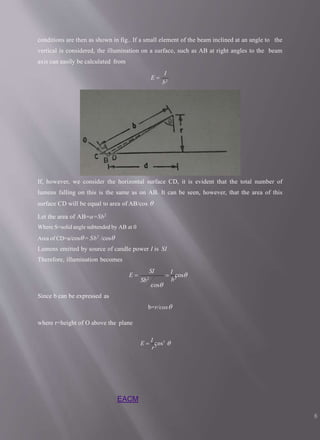
Illumination of an Inclined Surface to Beam
In the previous section it was assumed that the surface upon which light was falling was at
right angles to the axis of the beam, but in practice this is not usually the case,and the
EACM
7
conditions are then as shown in fig.. If a small element of the beam inclined at an angle to the
vertical is considered, the illumination on a surface, such as AB at right angles to the beam
axis can easily be calculated from
I
b2
E 
If, however, we consider the horizontal surface CD, it is evident that the total number of
lumens falling on this is the same as on AB. It can be seen, however, that the area of this
surface CD will be equal to area of AB/cos 
Let the area of AB=a=Sb2
Where S=solid angle subtended by AB at 0
Area of CD=a/cos = Sb2
/cos
Lumens emitted by source of candle power I is SI
Therefore, illumination becomes
cos
b2

I
cos
Sb2
SI
E 
Since b can be expressed as
b=r/cos
where r=height of O above the plane
r2
E 
I
cos3

EACM
8
TYPES OF LIGHTING SCHEMES:
1. Direct Lighting:
 The light falls directly on the object to be illuminated.
 It is most efficient but causes hard shadows and glare.
 The possibilities which will glare on eyes have to be eliminated while designing.
 A correct size of lamp with suitable fitting should be selected.
 The fittings are should to be cleaned regularly as the dirt if accumulated will decrease the
luminous intensity.
 It is used for industrial and general outdoor lighting.
2. Indirect Lighting
 The light does not fall directly on the object.
 Light is thrown to the ceiling for diffuse reflection from where it reaches the object.
 The ceiling acts as the light source and the glare is to minimum.
 The resulting illumination is softer and more diffused the shadows are less promiinent
and the appearance of room is much improved as compared to direct lighting.
 The requirement of the light is usually more than direct lighting.
 It is used for decoration of purposes in cinemas theatres, hotels etc
3. Semi - Direct Lighting :
 60% of the light is directed down wards and 40% projected upwards
 It is suitable to rooms with high ceilings where high level of uniformly distributed
illumination is desirable.
 Glare can be avoided by employing diffusing globes
 They improve the brightness towards the eye and efficiency of the system
4. Semi Indirect Lighting :
 60 to 90% of total light flux is thrown upwards to the cieling for diffuse reflection
and the rest i.e. 40 to 10% reaches the working plane directly.
EACM
9
 It gives soft shadows and it is glare free.
 It is used for indoor light purposes.
5. General Lighting:
 It produces equal illumination in all directions.
 It gives soft light with little shadows.
 Since quite large amount of light reach objects after reflection from walls and
ceiling, room decoration should be in light colours and kept in good condition.
 The mounting height should be much above eye level to avoid glare.
TYPES OF LAMPS
Incandescent Lamps
 Incandescent bulbs are the original form of electric lighting and have been in use for over
100 years.
 They are made in an extremely wide range of sizes, wattages, and voltages.
 Works on the principle of incandescence which is the emission of light caused by heating
the filament
 An incandescent bulb consists of a glass enclosure containing a tungsten filament.
 An electric current passes through the filament, heating it to a temperature that produces
light.
 They contain a stem or glass mount attached to the bulb's base which allows the electrical
contacts to run through the envelope without gas/air leaks.
 Small wires embedded in the stem support the filament and/or its lead wires.
 The enclosing glass enclosure contains either a vacuum or an inert gas to preserve and
protect the filament from evaporating.
EACM
10
Diagram showing the major parts of a modern incandescent light bulb.
1. Glass bulb
2. Inert gas
3. Tungsten filament
4. Contact wire (goes to foot)
5. Contact wire (goes to base)
6. Support wires
7. Glass mount/support
8. Base contact wire
9. Screw threads
10. Insulation
11. Electrical foot contact
Incandescent bulbs require no external regulating equipment, have a very low manufacturing
cost, and work well on either alternating current or direct current. They are also compatible with
control devices such as dimmers, timers, and photo sensors, and can be used both indoors and
outdoors. As a result, the incandescent lamp is widely used both in household and commercial
lighting, for portable lighting such as table lamps, car headlamps, and flashlights, and for
decorative and advertising lighting.
EACM
11
FLUORESCENT LAMP
These lamps are hot cathode low pressure mercury vapour lamp and are manufactured in form of
long glass tubes.
Construction:
 It consists of tube with two electrodes. They are coated with electron emissive material.
 It contains a small quantity of argon gas at a pressure of 2.5 mm of mercury and a few
drops of mercury.
 The inside surface of the tube is coated with a thin layer of fluorescent powder material
known as phosphor. The phosphor used for coating depends upon the color required.
 A starter is present in the circuit. It connects the electrodes directly across the supply at
the time all starting.
 A choke is connected in series with the electrodes. It provides a voltage impulse at the
time of starting and acts as ballast during running.
Working:
 When the supply is given, the full voltage appears across starter terminals as the
resistance of the electrodes is very less.
 As the starter is filled with argon gas, it ionises and glow appears inside the starter. So the
bimetallic strip in the starter is heated up and short circuits the starter. So maximum
current flows through the electrodes and choke.
 Due to flow of current, the electrodes get heated up and start emitting electrons.
Gradually, the potential across the starter falls to zero and cools down bimetallic strip
resulting in the opening of starter terminals.
 This sudden opening of the starter terminals results in abrupt change of current (di/dt) in
choke.
EACM
12
EACM
13
 Since electrons are already present in the discharge tube, this induced voltage is sufficient
to breakdown the long gap thus resulting in the flow of electrons between the electrodes.
 The electrons while accelerating, collide with argon and mercury vapour atoms. The
excited atoms of mercury give UV radiation.
 If this radiation is made to strike with phosphor material it produces re-emission of light
radiation of different wavelength and results illumination. This phenomenon of re-
emission is called flourescence and hence it is named as fluorescent tube.
 The average life of fluorescent lamp is 4000 - 5000 hours and its efficiency is about 40
lumen/watt. These lamps operate at low p.f. hence capacitor should be used.
Advantages:
 High luminous efficiency
 Long life
 Low running cost
 Low glare level
 Less heat output
Disadvantages:
 Stroboscopic effect
 Small wattage requiring large number of fittings.
 Magnetic hum associated with the choke causing disturbance
Stroboscopic effect:
Fluorescent lamps are provided with 50Hz or 60Hz ac current supply. When operating under the
frequencies the lamp crosses zero wave double the supply frequency, i.e, 100 times for 50Hz
frequency and 120 times for 60Hz frequency per second. Due to the persistence of vision our
eyes do not notice them. However if the light falls on the moving parts due to illusion, they may
appear to be either running slow, or in reverse direction or even may appear stationary. This
effect is called "Stroboscopic effect".
Methods to Avoid:
This pattern of illusions is not allowed in industries as this may lead to accidents. This is the
main reasons Fluorescent lamps are not preferred in industries. However this effect can be
avoided by:
 If the industry is supplied with three phase supply, adjacent lamps should be fed with
different phase so that the zero instants of the two lamps will not be same.
 If single phase supply is only available, then connection of two adjacent lamps are made
such that the two lamps are connected in parallel with the supply and in one lamp
connection a capacitor or condenser is kept in series with the choke. This makes a phase
shift thereby eliminating stroboscopic effect
SODIUM VAPOUR LAMPS
A sodium-vapor lamp is a gas-discharge lamp that uses sodium in an excited state to produce
light. A sodium vapour lamp is also a cold cathode low pressure lamp which gives luminous
output about three times higher other lamps.
Construction:
 It consists of an inner tube made of special glass to withstand high temperature of electric
discharge.
 It consists of two electrodes connected to a pin type base.
 The tube is filled with sodium and a small amount of neon at a pressure of 10 mm of Hg.
EACM
14
EACM
15
 Neon helps to start the discharge and the heat developed helps to vaporize sodium.
 The lamp operates at 300 °C. Any change in the operating temperature will affect the
light given by the lamp. So the U-shaped tube is enclosed in an outer double walled glass
tube.
 Before sealing the lamp, vacuum is created between the double walled glass tubes.
Working:
 When supply is given, the discharge is initiated through neon gas which produces reddish
light.
 When cold sodium is in solid state and hence the lamp cannot be started as sodium
vapour lamp.
 After sometime as the temperature gradually increases due to the discharge by neon gass,
the solid sodium turns into vapour giving yellowish light.
 If switched off, it can be restarted immediately.
 The luminous efficiency of lamp is 40-50 lumen/watt. The life is approximately 3000
hours
Advantages:
 Most of the radiation is on visible region hence the efficiency is good.
 Excitation level is achieved with low voltage and requires less energy compared to other
vapors.
Disadvantages:
 It gives monochromatic orange-yellow light which makes the object appear as grey.
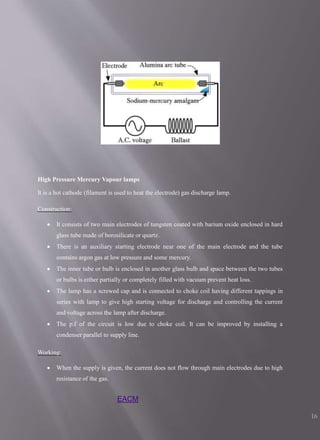
High Pressure Mercury Vapour lamps
It is a hot cathode (filament is used to heat the electrode) gas discharge lamp.
Construction:
 It consists of two main electrodes of tungsten coated with barium oxide enclosed in hard
glass tube made of borosilicate or quartz.
 There is an auxiliary starting electrode near one of the main electrode and the tube
contains argon gas at low pressure and some mercury.
 The inner tube or bulb is enclosed in another glass bulb and space between the two tubes
or bulbs is either partially or completely filled with vacuum prevent heat loss.
 The lamp has a screwed cap and is connected to choke coil having different tappings in
series with lamp to give high starting voltage for discharge and controlling the current
and voltage across the lamp after discharge.
 The p.f of the circuit is low due to choke coil. It can be improved by installing a
condenser parallel to supply line.
Working:
 When the supply is given, the current does not flow through main electrodes due to high
resistance of the gas.
EACM
16
EACM
17
 The current starts to flow between the main electrode and auxiliary electrode through
argon gas.
 The heat thus produced vaporize mercury which reduces the resistance between the
electrodes.
 Due to low resistance ionised path between two main electrodes the discharge shifts from
auxiliary electrode circuit to main electrodes.
 Mercury vapor lamp gives 2.5 times higher light than incandescent lamp for same power
consumption.
 The life is approximately 3000 hrs and it gives illumination bluish color.
 The efficiency of the lamp is 35-40 lumens per watt are specially used for high way
lighting, park lighting etc.
Advantages:
 The life of mercury vapor lamp is much higher than incandescent lamp.
Disadvantages:
 It takes about 4-6 minutes to give full brilliance.
 The original color of the object cannot be judged.
 It takes 6 A approximately on first switching ON and after six minutes if falls to 3 A.
 It cannot be used in any standard lamp holder as there are three pins in its cap.
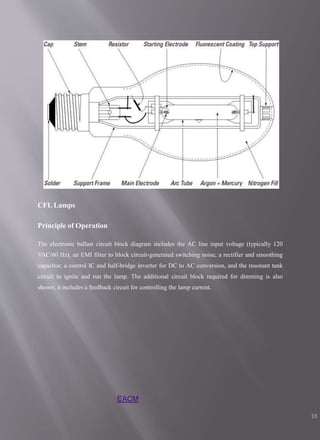
CFL Lamps
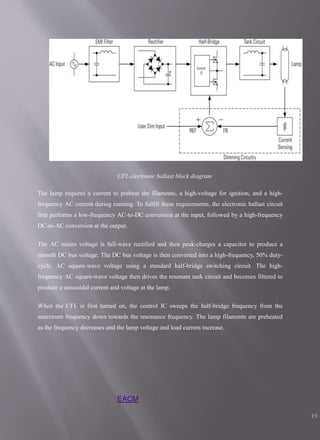
Principle of Operation
The electronic ballast circuit block diagram includes the AC line input voltage (typically 120
VAC/60 Hz), an EMI filter to block circuit-generated switching noise, a rectifier and smoothing
capacitor, a control IC and half-bridge inverter for DC to AC conversion, and the resonant tank
circuit to ignite and run the lamp. The additional circuit block required for dimming is also
shown; it includes a feedback circuit for controlling the lamp current.
EACM
18
CFL electronic ballast block diagram
The lamp requires a current to preheat the filaments, a high-voltage for ignition, and a high-
frequency AC current during running. To fulfill these requirements, the electronic ballast circuit
first performs a low-frequency AC-to-DC conversion at the input, followed by a high-frequency
DC-to-AC conversion at the output.
The AC mains voltage is full-wave rectified and then peak-charges a capacitor to produce a
smooth DC bus voltage. The DC bus voltage is then converted into a high-frequency, 50% duty-
cycle, AC square-wave voltage using a standard half-bridge switching circuit. The high-
frequency AC square-wave voltage then drives the resonant tank circuit and becomes filtered to
produce a sinusoidal current and voltage at the lamp.
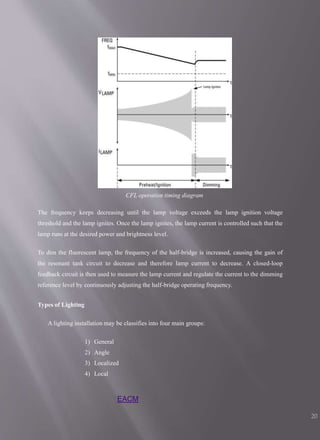
When the CFL is first turned on, the control IC sweeps the half-bridge frequency from the
maximum frequency down towards the resonance frequency. The lamp filaments are preheated
as the frequency decreases and the lamp voltage and load current increase.
EACM
19
CFL operation timing diagram
The frequency keeps decreasing until the lamp voltage exceeds the lamp ignition voltage
threshold and the lamp ignites. Once the lamp ignites, the lamp current is controlled such that the
lamp runs at the desired power and brightness level.
To dim the fluorescent lamp, the frequency of the half-bridge is increased, causing the gain of
the resonant tank circuit to decrease and therefore lamp current to decrease. A closed-loop
feedback circuit is then used to measure the lamp current and regulate the current to the dimming
reference level by continuously adjusting the half-bridge operating frequency.
Types of Lighting
A lighting installation may be classifies into four main groups:
1) General
2) Angle
3) Localized
4) Local
EACM
20
EACM
21
1) General Lighting
This is a system in which each part of an area is illuminated from a number of fittings in
different directions, resulting in a fairly uniform distribution of illumination throughout the
area. It is generally provided by a number of fittings symmetrically arranged over the area.
Adequate wall lighting is advisable to provide bright surroundings, if the light is concentrated
too much in a downward direction, or if the lamps are fitted too low, the walls will be less
lighted. The light from one fitting should overlap that of the next fitting, consequently
increase of the mounting height of the lamps enables them to serve a larger area and widens
the possible lamp spacing, Minimum/maximum illumination ratio in the area should be about
70 per cent if possible. A large proportion of the light received at a given point will reach that
point by reflection from the walls, especially if these are bright. Surfaces absorb some of the
light received by them, consequently the total amount of light received by a surface will
depend to some extent on the area of walls illuminated. This factor tends to reduce the
efficiency of a system of general lighting with an increase of fitting height. The degree to
which light received by the walls is reflected back depends on the nature and finish of the
wall surfaces. The utilization factor depends on this effect.
2) Angle Lighting
This may be necessary for purposes such as the provision of good lighting on vertical
surfaces, avoidance of shadows, or the creation of shadows for some specific purposes. It
may be affected by using a concentrated source of light, such as spotlight, or by using a wide
angle or parabolic reflector.
3) Localized Lighting
This may be adopted to give a relatively higher degree of illumination in the work area, with
appreciably less light in the surrounding area. Tubular fluorescent lamps are particularly
suitable for such purposes.
4) Local Lighting
This is frequently necessary to supplement general lighting where a very high degree of
illumination is needed over a small working area, such as the cutting tool of a lathe.
EACM
22
Electric Lighting Fittings (Luminaire):
In general, an electric lamp and its fitting (globe, reflector, etc.) should be regarded as in
integral whole, i.e., the lighting "unit" consists of the lamp and fitting, each designed to suit
the other and to give the desired distribution of light. There are five main groups of fittings as
given below: (1) Direct (2) Semi-direct (3) General (4) Semi-indirect (5) Indirect.
Direct Fittings:
These emit not less than the 70 percent of the total light flux of the lamp and fitting in the
lower hemisphere. The dispersive type reflectors are useful for industrial interiors where
highly polished materials are not worked. Direct light is cut off at an angle of 20 degrees
below the horizontal, maximum illumination being given on tie horizontal plane. If desired
the reflector may have a cover of clear to frosted glass. The height of the lamps should be
about two thirds of the lamp spacing, these fittings provide fair illumination on a vertical
plane.
The industrial diffusing fitting, with an enclosed diffusing bowl of opal glass, is suitable for
works and offices where there is risk of glare in direct or indirect light. Lamp consumption is
rather high with the diffusing fitting than with the standard disruptive reflector, but as the
ceiling receives more light, the appearance of the room may be improved.
The concentrating reflector is most useful for high mounting, such as high bay foundries, and
for overhead travelling cranes. Most of the light is concentrated into the 0 to 30 degrees
region, the cut-off angle being about 30 degrees. A clear or frosted dustproof cover glass may
be fitted
Semi Direct Fittings
These give between 50 and. 70 percent of the, total light flux in the lower hemisphere. The
fittings may be made of prismatic or of opal glass, or of glass and metal, and are suitable for
utility lighting of offices and shops.
General Lighting Fittings
EACM
23
Opal or prismatic varieties of glass are useful for the general lighting of shops, offices, and
similar interiors. They emit 40 to 45 per cent of the total light flux in either hemisphere. This
type allows more light to reach the ceiling than in the semi direct fitting. The spacing/height
ratio may be about 1.25 to 1. The surface brightness should not exceed 1 candle per sq. cm if
glare is to be avoided. This fitting gives a very pleasing effect with soft shadows.
Semi Indirect Fittings
These give 40 to 45 per cent of the total light flux in the upper hemisphere, and may be made
of opal, frosted, or prismatic glass, or glass and metal. They require a higher wattage than the
direct type of fittings, but give little shadow or risk of glare. Thr.:e fittings are very suitable
for high class utility lighting such as offices, board rooms, etc., having light coloured
ceilings.
Indirect Fittings
These emit not less than 70 per cent of their light in the upper hemisphere. With such fittings
it is essential that the ceilings and upper walls be of very light colour, in which case good
illumination, free from shadows, can be achieved. The fitting requires high wattage and
frequent cleaning and is not advised where an extremely high degree of illumination is
required. It is suitable for shops
Flood Lighting
Another application of illumination engineering is flooding of light overlarge surfaces in open
air. This is carried out by means of a projector/reflector for several purposes:
1. Aesthetic flood lighting—For enhancing the beauty of a buildingby night, e.g., churches,
towers and monuments.
2. Advertising — Flood lighting of commercial buildings.
3. Industrial — Flood lighting of railway yards, quarries, sports areas, etc. Arc lamps were
previously used in projection lanterns for flood lighting. Nowadays special lamps having
bunched filaments are used with projectors.
EACM
24
White Light LED
A light emitting diode (LED) is known to be one of the best optoelectronic devices out of the
lot. The device is capable of emitting a fairly narrow bandwidth of visible or invisible light when
its internal diode junction attains a forward electric current or voltage. The visible lights that an
LED emits are usually orange, red, yellow, or green. The invisible light includes the infrared
light. The biggest advantage of this device is its high power to light conversion efficiency. That
is, the efficiency is almost 50 times greater than a simple tungsten lamp. The response time of
the LED is also known to be very fast in the range of 0.1 microseconds when compared with 100
milliseconds for a tungsten lamp.
We know that a P-N junction can connect the absorbed light energy into its proportional electric
current. The same process is reversed here. That is, the P-N junction emits light when energy is
applied on it. This phenomenon is generally called electroluminance, which can be defined as the
emission of light from a semi-conductor under the influence of an electric field. The charge
carriers recombine in a forward P-N junction as the electrons cross from the N-region and
recombine with the holes existing in the P-region. Free electrons are in the conduction band of
energy levels, while holes are in the valence energy band. Thus the energy level of the holes will
be lesser than the energy levels of the electrons. Some part of the energy must be dissipated in
order to recombine the electrons and the holes. This energy is emitted in the form of heat and
light.
The electrons dissipate energy in the form of heat for silicon and germanium diodes. But in
Galium- Arsenide-phosphorous (GaAsP) and Galium-phosphorous (GaP) semiconductors, the
electrons dissipate energy by emitting photons. If the semiconductor is translucent, the junction
becomes the source of light as it is emitted, thus becoming a light emitting diode (LED). But
when the junction is reverse biased no light will be produced by the LED, and, on the contrary
the device may also get damaged.
The constructional diagram of a LED is shown below.
Advantages of LED’s
 Very low voltage and current are enough to drive the LED.
 Voltage range – 1 to 2 volts.
 Current – 5 to 20 milliamperes.
 Total power output will be less than 150 milliwatts.
 The response time is very less – only about 10 nanoseconds.
 The device does not need any heating and warm up time.
 Miniature in size and hence light weight.
 Have a rugged construction and hence can withstand shock and vibrations.
 An LED has a life span of more than 20 years.
Disadvantages
 A slight excess in voltage or current can damage the device.
 The device is known to have a much wider bandwidth compared to the laser.
 The temperature depends on the radiant output power and wavelength.
A mix of red, green and blue LEDs in one module according to the RGB colour model,
white light is produced by the proper mixture of red, green and blue light. The RGB white
method produces white light by combining the output from red, green and blue LEDs. This is an
additive colour method
Conducting Polymers:
Conductive polymers or, more precisely, intrinsically conducting polymers (ICPs) are organic polymers that
conduct electricity. Such compounds may have metallic conductivity or can be semiconductors. The biggest
advantage of conductive polymers is their process ability, mainly by dispersion. Conductive polymers are
generally not thermoplastics, i.e., they are not thermo formable. But, like insulating polymers, they are
EACM
25
organic materials. They can offer high electrical conductivity but do not show similar mechanical properties to
other commercially available polymers. The electrical properties can be fine-tuned using the methods of organic
synthesis and by advanced dispersion techniques.
Due to their poor processability, conductive polymers have few large-scale applications. They
have promise in antistatic materials and they have been incorporated into commercial displays
and batteries, but there have had limitations due to the manufacturing costs, material
inconsistencies, toxicity, poor solubility in solvents, and inability to directly melt process.
Literature suggests they are also promising in organic solar cells, printing electronic circuits,
organic light-emitting diodes, actuators, electro chromism, super capacitors, chemical sensors
and biosensors, flexible transparent displays, electromagnetic shielding and possibly replacement
for the popular transparent conductor indium tin oxide
Energy Conservation Measures:
1. Design, installation, and operation of effective lighting systems have complex
scientific,management, engineering, and architectural considerations. Of the many elements that
must be considered in providing an adequate visual environment of acceptable cost, energy
conservation is only one. Other elements that must be taken into account are the visual tasks to
be performed, the psychological state and perceptual skill of the observer, the design of task and
surrounding areas the availability of daylight, the level of illumination and the lighting system
quality with regard to spectral characteristics, glare, reflections and geometrical factors. These
complexities limit the degree to which simple guidelines for energy conservatior in lighting can
be applied in all cases. However, in most situations they are very useful in providing the
EACM
26
EACM
27
guidance necessary to achieve substantial savings in lighting energy and cost while also
providing an adequate visual environment.
2.In the design of new lighting systems modifying existing ones, the most efficient light sources
tha can provide the illumination required should be selected. As a general rule, the efficiencies of
some available lamp types rank according to the following list, with the most efficient given
first, (a) high pressure sodium vapour, (I)) fluorescent (c) mercury, and (d) incandescent. Many a
replacement of the existing low efficiency lamp types with lower voltage more efficient types
will result in reduced total costs and improved lighting. See Table for detailed example.
3.Maximum control over lighting systems can be accomplished by using switches to control the
turning off of unnecessary lighting. Large general areas should not be under the exclusive control
of a single switch, if turning off small portions would permit substantial energy savings when
they are not occupied. Lights should be turned off as a regular practice when buildings are not
occupied, such as after working hour’s or on weekends and holidays. When opportunities for
existing daylight exist, lights could be turned off. Occupants of buildings should be educated and
periodically reminded to adopt practices which will save lighting energy, such as turning off
lights when leaving a room.
Frequent switching on or off of a lamp shortens its life. Therefore, there is an optimum point
between energy cost savings and the cost of lamps and replacement labour. Variations in energy
prices, labour costs, and convenience influence the decision. However, under typical working
conditions the break-even point for fluorescent lamps is reached in five to ten minutes where
replacement costs are low and in 20 to 30 minutes where costs are high.
4.Proper luminaire placement in the design of new lighting systems and the removal of
unnecessary lamps in existing installations are examples of energy conservation measures.
Luminaires should be positioned to minimize glare and reflection, and work stations should be
oriented and grouped to utilize light most effectively. Daylight should be used when available,
maxi-mum switching control should be provided to the user, and light colours should be used on
walls, ceilings and floors. Tasks should be designed to Present high contrast to the observer.
5.Determination in the illumination level due to dirt accumulation in lighting equipment should
be prevented by adequate maintenance program-mes, cleaning lamps and luminaires, and
EACM
28
replacement of lamps. As a part of maintenance programs, periodic surveys of installed lighting
with respect to lamp positioning and illumination level should be conducted to take ad-vantage
of energy conservation opportunities as user requirements change. To summarize, a checklist to
reduce loss from lamps and devices would include the following points.
1. Is the highest efficiency lamp being used?
2. Is the highest powered lamp available being used?
3. Is the most efficient luminaire, consistent with good glare control, being used?
4.Have adequate provisions been made for maintaining and cleaning lighting equipment and
lamps.?
ADDITIONAL MATERIAL
PRINCIPLES OF LIGHT CONTROL
When light falls on a surface, depending upon the nature of the surface, some portion the energy
is reflected, some portion is transmitted through the medium of the surface and the rest is
absorbed. It is advantageous to direct the whole of the light output on to surface to be
illuminated, to diffuse the light in order to prevent glare or to change its color. The four general
methods of light control are:
I) Reflection
II) Refraction
III) Diffusion
IV) Absorption
Reflection can be used to change the direction of light through a large angle. Reflection is the
change in direction of a wavefront at an interface between two different media so that the
wavefront returns into the medium from which it originated. The reatio of reflected light energy
to the incident light energy is known as reflection factor. There are two types of reflection:
Specular reflection and Diffuse reflection
Specular reflection: The angle at which the wave is incident on the surface equals the angle at
which it is reflected. Mirrors exhibit specular reflection. For a smooth surface, reflected light
rays travel in the same direction. This is called specular reflection.
Diffuse reflection is when light hits an object and reflects in lots of different directions. This
happens when the surface is rough. Most of the things we see are because light from a source has
reflected off it.
For example, if you look at a bird, light has reflected off that bird and travelled in nearly all
directions. If some of that light enters your eyes, it hits the retina at the back of your eyes. An
electrical signal is passed to your brain, and your brain interprets the signals as an image.
Refraction: When light travels from one transparent medium to another having different density,
the light rays will deviate. Refraction is the change in direction of propagation of a wave due to
a change in its transmission medium. Angle of ray with the vertical in the dense medium is less
than that in the rare medium. When waves travel from a medium with a given refractive index
(the ratio of the velocity of light in a vacuum to its velocity in a specified medium) to a medium
with another at an oblique angle, the phase velocity of the wave changes and so the direction of
the wave changes at the boundary between the media.
EACM
29
Refraction is described by Snell's law, which states that for a given pair of media and a wave
with a single frequency, the ratio of the sines of the angle of incidence θ1 and angle of refraction
θ2 is equivalent to the ratio of phase velocities (v1 / v2) in the two media, or equivalently, to the
opposite ratio of the indices of refraction (n2 / n1)
= =
s
i
n
𝜃
1 𝑣
1 𝑛
1
s
i
n
𝜃
2 𝑣
2 𝑛
2
Diffusion: When light is reflected from a mirror, the angle of reflection equals the angle of
incidence. When light is reflected from a piece of plain white paper; however, the reflected beam
is scattered or diffused. Because the surface of the paper is not smooth, the reflected light is
broken up into many light beams that are reflected in all directions.
To prevent glare from a light source, a diffusing glass screen can be introduced between the
observer and light source or light may be reflected from a diffusing screen which may be a lamp
bulb enclosed in diffusing glass fitting. In diffused reflection, a ray of light is reflected in all
directions and therefore such surface appears luminous from all possible directions. The
diffusing glass employed is of two types: opal glass and frosted glass.
Absorption : For certain purposes such as color matching in dyeworks and in other industries, an
artificial light is required which approximates very closely to that of daylight . The ordinary
filament lamp has an excess radiation and this problem can be avoided by production of reflector
or screen which will absorb precisely the correct amount of the unwanted wavelengths without
interfering. The absorption may be carried out by using special bluish coloured for the bulb of an
ordinary filament lamp or by using an ordinary bulb in a fitting of special glass.
Neon Lamps
A neon lamp is a sealed glass tube filled with neon gas, which is one of the so-called "noble"
(inert or unreactive) gases on the far right of the Periodic Table. (There are minute quantities of
neon in the air around us: take a deep breath and you'll breathe in a volume of neon as big as an
orange pip!)
There are electrical terminals at either end of a neon tube. At one end, there's a negative terminal
("-ve", shown blue); at the other end there's a positive terminal ("+ve", shown green).
When the tube is switched off, it contains ordinary atoms of neon gas (brown circles).
EACM
30
Rig the terminals up to a high-voltage power supply (about 15,000 volts—because you need a lot
of "electrical force" to make things happen) and switch on, and you'll literally start pulling the
neon atoms apart. Some of the atoms will lose electrons to become positively charged ions (big
green dots). Being positively charged, these neon ions will tend to move toward the negative
electrical terminal.
The electrons the neon atoms lose (small blue dots) are negatively charged, so they hurtle the
opposite way toward the positive terminal at the other end of the tube.
In all this rushing about, atoms, ions, and electrons are constantly colliding with one another.
Those collisions generate a sudden smash of energy that excites the atoms and ions and makes
them give off photons of red light.
So many collisions happen with such rapidity that you get a constant buzzing of red light from
the tube. You also get quite a lot of energy given off as heat. If you've ever stood near a neon
light, you'll know they can get very hot. That's because the atoms are giving off quite a bit of
invisible infrared radiation (in other words, heat) as well as visible radiation (better known as red
light).
EACM
31
EACM
32
EACM
33
EACM
34
EACM
35
EACM
36
EACM
1
UNIT-3:
POWER FACTOR AND ENERGY INSTRUMENTS
Power Factor:
Traditionally, power factor has been defined as the ratio of the kilowatts of power divided by the
kilovolt-amperes drawn by a load or system, or the cosine of the electrical angle between the
kilowatts and kilovolt-amperes. However, this definition of power factor is valid only if the
voltages and currents are sinusoidal. When the voltages and/or currents are nonsinusoidal, the
power factor is reduced as a result of voltage and current harmonics in the system. Therefore, the
discussion of power factor will be considered for the two categories, i.e., systems in which the
voltages and currents are substantially sinusoidal and systems in which the voltages and currents
are non-sinusoidal as a result of nonlinear loads.
THE POWER FACTOR IN SINUSOIDAL SYSTEMS:
The line current drawn by induction motors, transformers, and other inductive devices consists of
two components: the magnetizing current and the power-producing current.
The magnetizing current is that current required to produce the magnetic flux in the machine.
This component of current creates a reactive power requirement that is measured in kilovolt-
amperes reactive (kilovars, kvar). The power-producing current is the current that reacts with the
magnetic flux to produce the output torque of the machine and to satisfy the equation
𝑻 =𝑲∅𝑰
Where
T = output torque
Φ = net flux in the air gap as a result of the magnetizing current
I = power-producing current
K = output coefficient for a particular machine
The power-producing current creates the load power requirement measured in kilowatts (kW).
The magnetizing current and magnetic flux are relatively constant at constant voltage. However,
the power-producing current is proportional to the load torque required.
The total line current drawn by an induction motor is the vector sum of the magnetizing current
and the power-producing current.
The vector relationship between the line current IL and the reactive component Ix and load
component Ip currents can be expressed by a vector diagram, as shown in Fig. where the line
current IL is the vector sum of two components. The power factor is then the cosine of the
electrical angle θ between the line current and phase voltage.
This vector relationship can also be expressed in terms of the components of the total kilovolt-
ampere input, as shown in Fig. Again, the power factor is the cosine of the angle θ between the
total kilovolt-ampere and kilowatt inputs to the motor. The kilovolt-ampere input to the motor
consists of two components: load power, i.e., kilowatts, and reactive power, i.e., kilovars.
The system power factor can be determined by a power factor meter reading or by the input
power (kW), line voltage, and line current readings. Thus,
Power factor = kW / kVA
Disadvantages of Low Power Factor:
A low power factor causes poor system efficiency. The total apparent power must be supplied by
the electric utility. With a low power factor, or a high-kilovar component, additional generating
losses occur throughout the system. Figures below illustrate the effect of the power factor on
generator and transformer capacity.
To discourage low-power factor loads, most utilities impose some form of penalty or charge in
their electric power rate structure for a low power factor.
When the power factor is improved by installing power capacitors or synchronous motors,
several savings are made:
EACM
2
1.A high power factor eliminates the utility penalty charge. This charge may be a separate charge
for a low power factor or an adjustment to the kilowatt demand charge
2. A high power factor reduces the load on transformers and distribution equipment.
3.A high power factor decreases the I2R losses in transformers, distribution cable, and other
equipment, resulting in a direct saving of kilowatt-hour power consumption.
4. A high power factor helps stabilize the system voltage.
Methods of Power Factor Improvement:
The more popular method of improving the power factor on low voltage distribution systems is
to use power capacitors to supply the leading reactive power required. The amount and location
of the corrective capacitance must be determined from a survey of the distribution system and
the source of the low-power factor loads.
In addition, the total initial cost and payback time of the capacitor installation must be
considered.
To reduce the system losses, the power factor correction capacitors should be electrically located
as close to the low-power factor loads as possible. In some cases, the capacitors can be located at
a particular power feeder. In other cases, with large-horsepower motors, the capacitors can be
connected as close to the motor terminals as possible. The power factor capacitors are connected
across the power lines in parallel with the low-power factor load.
The number of kilovars of capacitors required depends on the power factor without correction
and the desired corrected value of the power factor.
The power factor and kilovars without correction can be determined by measuring thepower
factor, line amperes, and line voltage at the point of correction. For a three-phase system,
EACM
3
The capacitive kilovars required to raise the system to the desired power factor can be calculated
as follows:
Another method of improving powerfactor is connecting a synchronous motor in parallel with
the system and operate it under over excitation condition.
Location of Capacitors:
The power factor correction capacitors should be connected as closely as possible to the low–
power factor load. This is very often determined by the nature and diversity of the load. Figure
illustrates typical points of installation of capacitors:
EACM
4
At the Motor Terminals:
Connecting the power capacitors to the motor terminals and switching the capacitors with the
motor load is a very effective method for correcting the power factor. The benefits of this type of
installation are the following: No extra switches or protective devices are required, and line
losses are reduced from the point of connection back to the power source. Corrective capacitance
is supplied only when the motor is operating. In addition, the correction capacitors can be sized
based on the motor nameplate information, as previously discussed.
If the capacitors are connected on the motor side of the overloads, it will be necessary to change
the overloads to retain proper overload protection of the motor. A word of caution: With certain
types of electric motor applications, this method of installation can result in damage to the
capacitors or motor or both.
EACM
5
EACM
6
Never connect the capacitors directly to the motor under any of the following conditions:
 The motor is part of an adjustable-frequency drive system.
 Solid-state starters are used.
 The motor is subject to repetitive switching, or plugging.
 A multispeed motor is used.
 A reversing motor is used.
 There is a possibility that the load may drive the motor (such as a high-inertia load).
In all these cases, self-excitation voltages or peak transient currents can cause damage to the
capacitor and motor. In these types of installations, the capacitors should be switched with a
contactor interlocked with the motor starter.
At the Main Terminal for a Multimotor Machine:
In the case of a machine or system with multiple motors, it is common practice to correct the
entire machine at the entry circuit to the machine. Depending on the loading and duty cycle of
the motors, it may be desirable to switch the capacitors with a contactor interlocked with the
motor starters. In this manner, the capacitors are connected only when the main motors of a
multimotor system are operating.
At the Distribution Center or Branch Feeder:
The location of the capacitors at the distribution center or branch feeder is probably most
practical when there is a diversity of small loads on the circuit that require power factor
correction. However, again, the capacitors should be located as close to the low–power factor
loads as possible in order to achieve the maximum benefit of the installation.
THE POWER FACTOR WITH NONLINEAR LOADS:
The growing use of power semiconductors has increased the complexity of system power factor
and its correction. These power semiconductors are used in equipment such as
Rectifiers (converters)
DC motor drive systems
Adjustable-frequency AC drive systems
Solid-state motor starters
Electric heating
Uninterruptible power supplies
Computer power supplies
In the earlier discussion about the power factor in sinusoidal systems, only two components of
power contributed to the total kilovolt-amperes and the resultant power factor: the active or real
component, expressed in kilowatts, and the reactive component, expressed in kilovars. When
nonlinear loads using power semiconductors are used in the power system, the total power factor
is made up of three components:
1. Active, or real, component, expressed in kilowatts.
2.Displacement component, of the fundamental reactive elements, expressed in kilovars or
kilovolt-amperes.
3.Harmonic component. The result of the harmonics and the distorted sinusoidal current and
voltage waveforms generated when any type of power semiconductor is used in the power
circuit, the harmonic component can be expressed in kilovars or kilovolt-amperes. The effect of
these nonlinear loads on the distribution system depends on (1) the magnitude of the harmonics
generated by these loads, (2) the percent of the total plant load that is generating harmonies, and
(3) the ratio of the short-circuit current available to the nominal fundamental load current.
Generally speaking, the higher the ratio of short-circuit current to nominal fundamental load
current, the higher the acceptable level of harmonic distortion.
Therefore, more precise definitions of power factors are required for systems with nonlinear
loads as follow: Displacement power factor: The ratio of the active power of the fundamental in
kilowatts to the apparent power of the fundamental in kilovolt-amperes.
Total power factor: The ratio of the active power of the fundamental in kilowatts to the total
kilovolt-amperes. Distortion factor, or harmonic factor. The ratio of the root-mean square
(rms) value of all the harmonics to the root-mean square value of the fundamental. This factor
can be calculated for both the voltage and current. Figure illustrates the condition in which the
total power factor is lower than the displacement power factor as a result of the harmonic
currents.
EACM
7
Unfortunately, conventional var-hour meters do not register the total reactive energy consumed
by nonlinear loads. If the voltage is non sinusoidal, the var-hour meter measures only the
displacement volt-ampere-hours and ignores the distortion volt-ampere-hours.
Therefore, for nonlinear loads, the calculated power factor based on kilowatt-hour and var-hour
meter readings will be higher than the correct total power factor. The amount of the error in the
power factor calculation depends on the magnitude of the total harmonic distortion.
Energy meter (Watt hour meter)
An instrument that is used to measure either quantity of electricity or energy, over a period of
time is known as energy meter or watt-hour meter. In other words, energy is the total power
delivered or consumed over an interval of time t may be expressed as:
𝑡
𝐸𝑛𝑒𝑟𝑔𝑦 =∫ 𝑣(𝑡)𝑖(𝑡)𝑑𝑡
0
If V(t) is expressed in volts, i(t) in amperes and t in seconds, the unit of energy is joule or watt
second. The commercial unit of electrical energy is kilowatt hour (KWh). For measurement of
energy in a.c. circuit, the meter used is based on “electro-magnetic induction” principle. They are
known as induction type instruments. For the meter to read correctly, the speed of the moving
system must be proportional to the power in the circuit in which the meter is connected.
EACM
8
EACM
9
Construction: Induction type energy meter essentially consists of following components (a)
Driving system (b) Moving system (c) Braking system and (d) Registering system.
Driving system: It consists of two electromagnets, called “shunt” magnet and “series” magnet,
of laminated construction. A coil having large number of turns of fine wire is wound on the
middle limb of the shunt magnet. This coil is known as “pressure or voltage” coil and is
connected across the supply mains. This voltage coil has many turns and is arranged to be as
highly inductive as possible. In other words, the voltage coil produces a high ratio of inductance
to resistance. This causes the current, and therefore the flux, to lag the supply voltage by nearly
90degrees. Adjustable copper shading rings are provided on the central limb of the shunt magnet
to make the phase angle displacement between magnetic field set up by shunt magnet and supply
voltage is approximately 90degrees. The copper shading bands are also called the power factor
compensator or compensating loop. The series electromagnet is energized by a coil, known as
“current” coil which is connected in series with the load so that it carry the load current. The flux
produced by this magnet is proportional to, and in phase with the load current.
Moving system: The moving system essentially consists of a light rotating aluminium disc mounted on a
vertical spindle or shaft. The shaft that supports the aluminium disk is connected by a gear arrangement to
the clock mechanism on the front of the meter to provide information that consumed energy by the load.
The time varying (sinusoidal) fluxes produced by shunt and series magnet induce eddy currents in the
aluminium disc. The interaction between these two magnetic fields and eddy currents set up a driving
torque in the disc. The number of rotations of the disk is therefore proportional to the energy consumed by
the load in a certain time interval and is commonly measured in killowatt-hours (Kwh).
Braking system: Damping of the disk is provided by a small permanent magnet, located
diametrically opposite to the a.c magnets. The disk passes between the magnet gaps. The
movement of rotating disc through the magnetic field crossing the air gap sets up eddy currents
in the disc that reacts with the magnetic field and exerts a braking torque. By changing the
position of the brake magnet or diverting some of the flux there form, the speed of the rotating
disc can be controlled.
Registering or Counting system: The registering or counting system essentially consists of gear
train, driven either by worm or pinion gear on the disc shaft, which turns pointers that indicate on
dials the number of times the disc has turned. The energy meter thus determines and adds
together or integrates all the instantaneous power values so that total energy used over a period is
thus known. Therefore, this type of meter is also called an “integrating” meter.
Operation:
Induction instruments operate in alternating-current circuits and they are useful only
when the frequency and the supply voltage are approximately constant. The most commonly
used technique is the shaded pole induction watt-hour meter, shown in fig. The rotating element
is an aluminium disc, and the torque is produced by the interaction of eddy currents generated in
the disc with the imposed magnetic fields that are produced by the voltage and current coils of
the energy meter.
Let us consider a sinusoidal flux φ(t) is acting perpendicularly to the plane of the
aluminium disc, the direction of eddy current by Lenz’s law is indicated in figure Fig. It is now
quite important to investigate whether any torque will develop in aluminium disc by interaction
of a sinusoidally varying flux and the eddy currents induced by itself.
The flux generated by the current coil is in phase with the current and flux generated by
the voltage coil is adjusted to be exactly in quadrature with the applied voltage by means of the
copper shading ring on the voltage or shunt magnet. The average torque acting upon the disc is
given by
EACM
10
Now the breaking torque is produced by the eddy currents induced in the disc by its rotation in a
magnetic field of constant intensity, the constant field being provided by the permanent magnet
(called brake magnet). The eddy current 𝑖𝑏produced in the aluminium–disc by the brake magnet
flux φ is proportional to the speed (N) of rotation of the disc N.
b
THERMO COUPLE
When two conductors made from dissimilar metals are connected forming two common
junctions and the two junctions are exposed to two different temperatures, a net thermal emf is
produced, and net thermal emf value being dependent on the materials used and the temperature
difference between hot and cold junctions. The thermoelectric emf generated, in fact is due to the
combination of Peltier effect and Thomson effect.
The emf generated can be approximately expressed by the relationship:
EACM
11
𝑒𝑜=𝐶1(𝑇1−𝑇2) +𝐶2(𝑇1
2
−𝑇2
2
)𝑢𝑉
𝐶1, 𝐶2are constants depending upon the type of materials. 𝑇1, 𝑇2are hot and cold junction
temperatures in K. For Copper/ Constantan thermocouple, C =62.1 and C =0.045.
1 2
Thermocouples are extensively used for measurement of temperature in industrial
situations. The major reasons behind their popularity are: (i) they are rugged and readings are
consistent, (ii) they can measure over a wide range of temperature, and (iii) their characteristics
are almost linear with an accuracy of about 0.05%. However, the major shortcoming of
thermocouples is low sensitivity compared to other temperature measuring devices (e.g. RTD,
Thermistor).
Laws of Thermo Couple:
The Peltier and Thompson effects explain the basic principles of thermoelectric emf
generation.
First Law (Law of homogeneous circuit):
A thermo electric current cannot be sustained in a circuit of a single homogeneous material
however varying in c.s. by the application of heat alone. The implication is that two different
materials are needed to form a thermocouple.
Second Law (Law of intermediate materials):
EACM
12
Insertion of an intermediate metal into a thermocouple circuit will not effect the net emf
provided the two junctions introduced by the intermediate metal are at identical temperature.
This means that there can be a measuring instrument, soldered or brazed between the two metals
in order to monitor the emf generated.
Third Law (Law of intermediate temperature):
If a thermocouple develops an e.m.f e1 when the junctions are at T1 and T2 and an e.m.f e2
when the junctions are at T2 and T3, it will develop an e.m.f e1 + e2 when the junctions are at T1
and T3.
It is imminent that the thermocouple output voltage will vary if the reference junction
temperature changes. So, for measurement of temperature, it is desirable that the cold junction of
the thermocouple should be maintained at a constant temperature. Ice bath can be used for this
purpose, but it is not practical solution for industrial situation. An alternative is to use a
thermostatically controlled constant temperature oven. In this case, a fixed voltage must be
EACM
13
added to the voltage generated by the thermocouple, to obtain the actual temperature. But the
most common case is where the reference junction is placed at ambient temperature.
DATA LOGGER
A data logger is an electronic instrument that records environmental parameters such as
temperature, relative humidity, wind speed and direction, light intensity, water level and water
quality over time. Typically, data loggers are compact, battery-powered devices that are
equipped with microprocessor input channels and data storage.
As the price of PC components dropped, data loggers became more affordable for a wider array
of applications. Before then, chart recorders were commonly used as well as manual
measurements. Both of these methods were labour intensive and time consuming so the advent
of standalone data loggers was welcomed. users of data loggers span from a single installation
for measure temperature to meteorological networks of hundreds of stations monitoring
temperature, relative humidity, barometric pressure, solar radiation, precipitation and wind speed
& direction.
A data logger is used to collect readings, or output, from sensors. These sensors could be
measuring industrial parameters such as pressure, flow and temperature or environmental
parameters such as water level, wind speed or solar radiation. Today there are sensors available
which can measure virtually any physical parameter.
The main components of Data loggers are,
Input channel:
The output from a sensor is inputted or connected to a data logger channel. A channel consists of
circuitry designed to 'channel' a sensor signal (typically a voltage or current) from the sensor to
the data logger processor. A single data logger can have a variety of channel types and from one
Physical
system
Sensor Input
Chann
el
A/D
converte
r
Micro
processo
r
Data
o/p port
Memory Power supply
EACM
14
EACM
15
to many channels (multi-channel data logger) - one channel is required for every sensor signal
output. For example, four sensors can be connected to a four channel data logger and eight
sensors to a eight channel logger. Typically, a multi-channel logger will have from four to 16
channels. Three types of channels are typically found on a multi-channel data logger, they are:
Analog channel, Digital channel, Serial digital interface.
Analog to Digital converter:
All sensor signals, analog, digital and SDI-12, must be in binary format in order for the data
logger to record them. Binary data format is not specific to data loggers but is the fundamental
data format used by virtually all computers.
Analog signals however need to be converted to binary data via an A/D converter (Analog to
Digital Converter). The amount of bits the A/D converter utilizes will determine the resolution to
which the signal can be recorded.
Microprocessor:
A processor is the logic circuitry that responds to and processes the basic instructions that drive a
computer or data logger. A microprocessor is a computer processor on a microchip. It's
sometimes called a logic chip. A microprocessor is designed to perform arithmetic and logic
operations that make use of small number-holding areas called registers. Typical microprocessor
operations include adding, subtracting, comparing two numbers, and fetching numbers from one
area to another. These operations are the result of a set of instructions that are part of the
microprocessor design. When a data logger is powered on, the microprocessor is designed to get
instruction from the operating system that is loaded in the data logger memory. The operating
system is "driving" the microprocessor and giving it instructions to perform. The operating
system of the microprocessor usually resides on an EEPROM chip.
Memory:
Two types of memory are used in data loggers:
RAM (Random Access Memory):
Unlike a PC's RAM which is used as a 'workshop area', a data logger can use RAM to store data
(readings from the input channel). RAM chips are inexpensive but must be battery backed up in
order to retain the data. RAM chips are downloaded via the serial port of a PC.
EEPROM (Electronically Erasable & Programmable Read Only Memory):
Developed for data loggers in the late 1980's EEPROM memory does not need to be backed up
by a battery. Many data loggers use EEPROM chips for both storing the operating system of the
EACM
16
microprocessor, as well as for data storage. An EEPROM chip can be programmed, read (stored
data) and erased via the serial port of a PC. Data loggers may also use PCMCIA data cards for
memory; these cards consist of EEPROM memory.
Power Supply
A feature that clearly distinguishes data loggers from PC's is the low power requirements of data
loggers. Data loggers are designed to operate in remote locations for long periods of time void of
main AC power. Most data loggers require a 12 VDC power source. Battery capacities are
measured in Milli-Amp hours (mAh) which determines the length of time that the battery can
provide power for a given load. Increased capacity requires greater battery size and weight.
Data Output Port (PC Communication Port or RS-232 Port)
Most data loggers communicate with a PC via a serial port, which allows data to be transmitted
in a series (one after the other). The RS-232 interface has been a standard for decades as an
electrical interface between data terminal equipment, such as a PC, and data communications
equipment employing serial binary data interchange, such as a data logger or modem. Data can
be sent in both directions, and many loggers use 9600 baud as a standard communication speed.
Since the RS-232 is so popular, many modems are available that can be connected to a data
logger to retrieve data remotely or to program the data logger.
Applications of Data logger:
 Weather station recording (such as wind speed / direction, temperature, relative
humidity, solar radiation)
 Hydro graphic recording (such as water level, water depth, water flow, water pH, water
conductivity).
 Soil moisture level recording.
 Gas pressure recording.
 Measure temperatures (humidity, etc.) of perishables during shipments.
 Measure variations in light intensity.
 Monitoring of relay status in railway signalling.
 Load profile recording for energy consumption management.
 Temperature, Humidity and Power use for Heating and Air conditioning efficiency
studies.
PYROMETER
The word is derived from pyros + metron. The methods under this are primarily thermal
radiation measurement. There are two distinct instruments. Under this category:
(i) Optical pyrometer
(ii) Total Radiation Pyrometer
Optical pyrometer:
 A target object whose temperature is to be measured is placed in front of the
pyrometer.
 A field lens will gather light coming from this target, and then it will be focused on to the
plane of a filament.
 The filament is run by a battery, a variable resistor, an ammeter.
 The radiation coming from the target is made to pass through an aperture so that straight
light does not enter the instrument.
 Then it passes through a gray filter which will, if necessary, reduce the brightness by a
known factor. Then it falls on the filament.
Fig. Schematic diagram of optical pyrometer
 The objective lens receives light which is coming, both from the target which has passed
through the gray filter, and then it also gets, receives radiation from the filament which is
run by the battery.
 By using the variable resistor, the current passing through the filament can be varied
thereby changing the brightness and temperature of the filament.
 Therefore, the amount of radiation which comes from the filament can be varied by
changing the variable resistor position.
EACM
17
 The red filter, along with the eye of the person who is looking at it, it has got a certain
response to the light which is falling on the retina, so the two together will help us in
finding out, or selecting a certain wavelength of operation for this instrument.
 The observer looks simultaneously at two things:
(i) the object whose temperature I want to measure
(ii) the filament whose brightness can be varied
 So the operator will have to adjust the resistance such that the two, the target and the
filament, appear equally bright, and which can be verified by making the proper
adjustment.
(i) If the temperature of the filament is very high, the filament appears bright in
red background, which appears to be dull.
(ii) If the temperature of the filament is too small, then it appears dark, looks like
a shadow in the background, which is brighter.
(iii)If the adjustment has been made properly then the brightness, the filament,
and the background are equally bright. There is no contrast between them.
The filament becomes invisible when a proper adjustment is done, and therefore, it has
vanished. Therefore, it is also called vanishing filament pyrometer.
Because the filament cannot appear at any temperature you want, it has got a limitation. If it goes
beyond some particular value, the filament will melt and you will have to replace the filament.
So the filament has a maximum temperature up to which it can go, and therefore, theoretically
the maximum brightness temperature I can measure using this filament is the maximum
temperature of the filament itself.
Therefore, if the target is at a temperature higher than the filament temperature, a gray filter
is used which will reduce the intensity by a factor which can be calibrated or known factor,
half or one-fourth or one-eighth, and so on, so that the intensity of light which is coming
from the target is equal to or less than the maximum, the intensity of the filament at the
maximum of the temperature.
Total Radiation Pyrometer:
EACM
18
Total radiation pyrometer accepts a controlled sample of total radiation and through
determination of the heating effect of the sample obtains a measure of temperature. All bodies
above absolute zero temperature radiate energy, not only do they radiate or emit energy, but they
also receive and absorb from other sources. It is known that all substances emit and absorb
radiant energy at a rate depending on the absolute temperature and physical properties of the
substance. According to Stefan – Boltzman law the net rate of exchange of energy between two
ideal radiators A and B is,
𝑞 =σ(𝑇4 − 𝑇4)
𝐴 𝐵
Fig. Total radiation pyrometer
In total radiation pyrometers, the radiation from the measured body is focused on some
sort of radiation detector which produces an electric signal.
Detectors may be classified as
1. thermal detectors
2. photon detectors
Thermal detectors are blackened elements designed to absorb a maximum of the incoming
radiation at all wavelengths. The absorbed radiation causes the temperature of the detector to rise
until equilibrium is reached with heat losses to the surroundings. The thermal detectors measure
this temperature using a resistance thermometer, thermistor or thermocouple.
In photon detectors, the incoming radiation frees electrons in the detector structure and
produces a measurable electrical effect. These events occur on an atomic or molecular time
scale and hence are faster than the thermal detectors. But photon detectors have a sensitivity
EACM
19
EACM
20
that varies with wavelength, thus incoming radiation of all wavelengths are not equally
treated.
LUX METER
Lux meters, sometimes called light meters, measure the intensity of illumination as distinguished
by the human eye. This value does not correlate to an objective value of energy radiated or
reflected, as different wavelengths within the visible spectrum are perceived with varying
sensitivity by the eye, and lux meters evaluate light intensity in consideration of this variable.
Measurement
The human eye distinguishes colors of light according to two complementary models of visual physiology.
Trichromatic theory states that each of the three types of cones in the eye are activated by a certain range of
wavelength: β cones perceive light within 400-500 nm, Υ cones between 450-630 nm, and ρ cones between 500-700
nm. Opponent process theory states that colours are perceived by rods and cones antagonistically: black vs. white,
blue vs. yellow, and red vs. green.
The result is an eye that perceives certain colors more accurately. More shades of green are
identified than any other color and this is the primary reason night vision equipment amplifies
green light reflection. Visible light intensity accounting for these inherent biological preferences
is known as luminous flux. Lux meters cannot compensate for individual visual deficiencies or
variances. Total power output is measured as radiant flux.
Operation
Most lux meters register brightness with an integrated photo detector. The photo detector is
positioned perpendicular to the light source for optimal exposure—many lux meters use an
articulated or tethered photo detector for this purpose. Readouts are presented to the user via
analog instrument or digital LCD. Digital types often include basic operator inputs. Many digital
types can save measurements and have an adjustable detection range.
Photo detectors composed of selenium or silicon determine brightness photo voltaically.
Generated current is proportional to the photons received. Silicon-based detectors need to
amplify the voltage generated by light exposure. Selenium-based detectors convert photons to a
high enough voltage that they be directly connected to a galvanometer, but have difficulty
determining lux measurements for light sources below 1,000 lumens.
Photo detectors that measure brightness via photo resistance are composed of a ceramic substrate
doped with cadmium sulfide. An electronic switching current is supplied to the cell and
resistance increases as more photons are detected to ultimately provide a proportional readout.
Legislation curtails the availability of cadmium devices in certain territories.
Correction
Photo detectors are sensitive to all colours of visible light, including wavelengths not identified
by the eye. Therefore, after exposure to a sample, photo detectors need to apply a correction
factor to readings. Different light sources require different correction factors. Many commercial
lux meters are preconfigured to register incandescent light, but have problems reading high
intensity discharge, metal halide, high pressure sodium, and cool white fluorescent lights. Meters
with preconfigured correction factors can provide accurate lux measurements for these sources.
More advanced light meters are tuned to particular light sources with optical filters and lenses,
removing correction factor uncertainty.
Configuration
Most lux meters are handheld devices and are easily transported to the job site. Articulated
and tethered photo detectors may require both hands to optimally position the photo detector
and the module, but they also provide measurement flexibility. Some handheld models may
include a stand or mounting structure, such as a tripod.
EACM
21
CLAMP METER OR TONG TESTER
Clamp meters are a very convenient testing instrument that permits current measurements on
a live conductor without circuit interruption. When making current measurements with the
ordinary multimeter, we need to cut wiring and connect the instrument to the circuit under
test as shown in Fig.1
Using the clamp meter, however, we can measure current by simply clamping on a conductor as
illustrated in Fig.2. One of the advantages of this method is that we can even measure a large
current without shutting off the circuit being tested.
Fig.1 Measurement using multimeter Fig.2 Measurement using clamp meter
Clamp on to a conductor just the same way as with AC current measurement using an AC
current clamp meter. In the case of DC clamp meters the reading is positive (+) when the current
is flowing from the upside to the underside of the clamp meter.
AC Clamp Meter
 AC clamp meters operate on the principle of current transformer (CT) used to pick up
magnetic flux generated as a result of current flowing through a conductor.
 The current flowing through the conductor is the primary current.
 A current proportional to the primary current is induced by electromagnetic induction in
the secondary side (winding) of the transformer which is connected to a measuring circuit
of the instrument.
EACM
22
 The current is converted into a proportional voltage by current-to-voltage conversion
circuit.
 The AC voltage is rectified to DC by a rectifier.
 An ADC (Analog to Digital Converter) circuits converts the analog data to digital data
DC Clamp Meter
Hall elements are used as a sensor to detect DC current because it is not possible to employ an
electromagnetic induction method as used for dedicated AC clamp meters.
Hall element is a semiconductor which generates a voltage (at the output terminal) proportional
to the product of bias current and magnetic field, when bias current is applied to the input
terminal.
A hall element is placed across a gap created by cutting off part of the transformer jaws.
When current flows in the conductor, a magnetic flux is produced, which is proportional to both
AC and DC primary currents in the transformer jaws.
The hall element detects the magnetic flux and produces an output voltage proportionally.
EACM
23
EACM
24
UNIT 4
INTRODUCTION
The pattern of demand for conventional energy sectorwise in India (in terms of energy
consumption as at present and as projected), is given in Table 3.1
in per cent
Table 3.1 The pattern of demand for conventional energy in percent
Year 1979-80 1984-85 1989-90 2000A.D
(Conventional)
2000A.D.
(Renewable also)
Household 15.70 13.20 14.24 22.00 36.50
Agriculture 9.40 9.80 10.36 5.60 4.25
Industry 38.20 36.40 55.00 39.00 32.10
Transport 32.30 31.40 16.80 25.60 20.4
Others 3.90 4.20 3.00 7.80 6.25
Total 100.00 100.0 100.00 100.00 100.00
The household sector is seen as having an increasing share in energy use, both as a result
of population increase as well as an increase in the standard of living.
Statistical data of home equipment purchased from the market has led to the ranking of
applia nces l is t ed in des cending order of energy use as shown in Table 3.2.
Table 3.2 Ranking of Appliances
Type of Appliance Percent Energy Use
Space conditioning (including Heating, cooling and 30
airconditioning)
Refrigeration 25
WaterHeating 15
Lighting 10
Cooking 7
Entertainment(T.V
.etc.) 5
EACM 1
EACM 2
Grinding 5
WashingandOthers 3
Wastage of energy is estimated to be approximately 30 per cent of the total residential energy
consumption. This is because of a poor knowledge of the energy utilization efficiency of the
appliances and their careless operation. Saving of energy can be achieved by using more
efficient appliances as well as by careful operation.
HEATING OF BUILDINGS
Heating of buildings is normally required to provide comfort to the occupants. Under normal
conditions, the average human body dissipates about 100 Js-1 and has a temperature of 37°C.
Of the above quantity of heat, about 45 per cent is dissipated by radiation, 30 per cent by
convection, and the remaining 25 per cent by evaporation. Radiation is governed by the tempera-
ture of the surrounding walls, convection by the air temperature, and evaporation by the
humidity of the air. It is obvious that energy conservation has to be achieved while keeping
comfort in mind.
The usual practice in producing comfort is to design a heating and humidity control installation to
maintain an indoor temperature of 19.0°C at 60 per cent relative humidity (9.3 moisture content
of air per m3 at 19.0°C). To prevent excessive evaporation from the body, temperature and
humidity arecontrolled.
There are various ways of producing heat. The relative costs of producing heat from electricity
and other fuels can be calculated on two criteria (a) J oriented and (b) kWh oriented. Tables
3.3(a) and 3.3(b) show the relative costs based on the abovecriteria.
It can be seen from both the tables that electrically produced heat appears to be costlier than
that produced from other sources.
In the choice of a particular type of heating installation, various aspects like aesthetic and
hygienic considerations must be taken into account, apart from the cost. Since we are mainly
interested in electric energy conservation, the advantages of electric heating are laid down-
below.
ADVANTANTAGES OF ELECTRIC HEATING
1. Cleanliness-freedom from ash, dust, grease; hence hygienic.
2. Easeofadaptationfor all purposes.
3. Very little maintenance isrequired
4. The regulation of heat is easy, simple and accurate and can be done
automatically
5. There are no products of combustion, therefore the surrounding air
is not contaminated
6. Since there is no flue gas, the space that would be occupied by a
chimney is saved.
EACM 3
EACM 4
TYPES OF APPLICATIONS OF ELECTRIC HEATING EQUIPMENT
The various methods of producing heat for general industrial work, heating of
buildings, and for welding may conveniently be classified as follows:
1. Direct Resistance Heating: A current is passed through the body to be heated.
e.g resistance welding, electrode- boiler type water heater.
2. Indirect resistance heating: A current is passed through a wire or High resistance
material forming a heating element and the heat loss so produced is transmitted by
radiation or convection to the body to be heated
e.g. ordinary domestic radiator, immersion water heater, resistance ovens, heat
treatment of metals
3. Direct Induction Heating: Currents induced by electromagnetic action in the body to be
heated, such as steel and other metals which produces a high temperature to melt the
metal
e.g. Induction furnace, eddy current heating
4. Indirect Induction Heating: Eddy currents are induced in the heating element by
electromagnetic action. The heat so produced is transmitted to the body to be by
radiation and convection, as in the indirect resistance method
e.g. Induction Ovens, Heat treatment of metals.
5. Dielectric Induction Heating: The electric losses set up in non metallic materials when
subjected to an alternating electric field isused forheating.
e.g. Same astitle.
6. Electric Arc: An arc drawn between two electrodes has a temperature between
3000°0 and 3500°C, e.g. arc furnace, arc welding
HEATREQUIREMENTANDHUMIDITY
The heat required to raise the temperature of the room at normal humidity can easily be
calculated by multiplying the specific heat of air and itsdensity.
Specific heat of air = 1.0J/g°C
Density of air at 19.0°C = 1.22 x10³ g/m3
Therefore the heat, required to raise the temperature of 1m3 of air through 1°C is 1.22 x 10³
J. This is a useful average figure although it varies slightly with variations of temperature and
humidity.
The outdoor temperature in winter can be assumed to be about 5.0°C and the relative
humidity 75 per cent. Under these conditions the outdoor air has a moisture content of 4.9 g
per m3.
In order to condition this air to an indoor temperature of 19°C and 60 per cent relative
humidity (9.3 g per rn3 moisture content), heat energy of (1.22 x 10³ J/m3 ° C) mo is t ur e
(4.4 g/m3) must be added to co nd it io n the air.
TRANSFER OF HEAT
Before we consider the various methods of producing heat electrically, it is ap pr o
pr ia t e t o briefly discuss t he different processes by which heat is t rans ferred
froma hot bodyto a cold body.
CONDUCTION
The rate of heat transfer by conduction depends on the temperature difference between
each sideofthe bodyT1 andT2 respectively, e.g. the temperaturesoneachsideof a wall ina buildingof
thermal conductivity k. Conduction of heat is an important consideration in connection with
refractory and heat insulating materials when these are used for preventingthe escape of heat to the
outside surroundings.
1 2
EACM 5
t
Heat dissipation by conduction =
k
(T  T ) W/m2 (3.1)
Where t = thickness of wall in in
T1and T2 = inside and outside temps. in Kelvin respectively
k = thermal conductivity in W/m°C
CONVECTION
Heat transfer by convection depends on the temperature of the hot body and the
temperature of the air surrounding it. Heat is dissipated by convection in immersion type water
heaters and in certain low temperature heating equipment for buildings.
Natural convection takes place according to thelaw:
Heat dissipation = 3.376 (T  T )1.25
W/m2 (3.2)
1 2
Where T1= temperature in Kelvin of the hotbody
= 273+ temp. in °C
T2 = temperature in Kelvin of the airmedia
= 273 + temp. in °C
The constants are subject to variations depending on the circumstances, e.g., the shape ofthe
heating surface, facilities for air circulation etc.
RADIATION
Heat istransmitted by radiation from a red-hot body to a low-temperature absorbing surface. It is
governed by Stefan's law ofradiation:
 
4

4

T  T
Heat dissipation = 5.72 x 10 1
  2
  W/m2
1000 1000  
Where T1= absolute temperature in Kelvin of the radiating surface
T2= absolute temperature in Kelvin of the absorbing surface
 = radiating efficiency, depending on disposition of heating elements
= 1 for single element or
= 0.5 to 0.8 for several elements side byside
 =emissivity
= 1 for black body or
= 0.9 for resistance heating element.
This formula is used to design high-temperature heating elements.
SPACE HEATING METHODS
Heat may be transmitted from a hot source to a lower temperature by radiation
(without heating the air between them), or by convection (caused by movement of the heated
air). All electric heaters used for space heating transmit heat by both methods to
some degree. Electric room or space heaters conveniently be divided into the following
types: (1) high temperature radiator, (2) panel heater, (3) low temperature convection
heaters, (4) thermal storage heater and (5) air conditioner.
HIGH TEMPERATURE RADIATOR
High temperature heaters comprise electric fins and radiators. They are made of wire-
wound elements which have a working temperature of about 900°C. Some, which have
polished reflectors may emit about 75 per cent of their total output as radiation and the
remainder by convection.
In the fire bar 40-50 per cent of the heat may be radiated. Convection air currents tend to
rise, and do not have the directional qualities of radiant heat. They can be reflected or refracted,
and can be blown in any desired direction.
EACM 6
The principal use of radiant heaters is intermittent heating, or in conjunction with a
convector. For intermittent use, a loading of 1500 W per 28.3 m2 of room space is convenient.
It is preferable to use two or more smaller heaters instead of a big one, in a large room,
to improve heat distribution and to use heaters with two elements which can be switched
on independently.
PANEL HEATERS
Panel heaters have resistance elements in heat resisting material which are in the
form of large panels. They are attached to the wall. Flood heaters are panels of up to 33
cm x 64 cm with a surface temperature of 205-260°C. They are usually at an angle to the
wall. They are mounted at about 2.3 inches from the floor. The hot air so produced rises up due to low
density and the cold air is pushed downwards and is heated up. They are suitable for buildings such as
schools and factories, having a high heat loss. A high proportion of the heat produced is
radiated and its direction can be controlled. Thermostatic control is available. The objection
is that heat rays striking downwards are uncomfortable to some people.
LOW TEMPERATURE CONVECTION HEATER
For rooms in continuous occupation, low temperature heating by convection is
preferred. If a definite temperature is to be maintained, it is necessary to calculate the heat loss
through walls, windows, floors and ceilings, adding to this the heat lost by air due to
ventilation, in order to arrive at the size of heaters needed. A temperature of approximately
20°C is to be maintained. Basically there are two types of convectors. (a) A metal tube about
50 mm in diameter inside which is mounted a spiral of resistance wire. Such tubes are made
in lengths of between 0.6 and 4.57 in and mounted in the room to be heated. The
temperature of the external surface is about 93.3°C and about 60 W per 0.3 m length of
tube is necessary to maintain this. About 90 percent of the heat transferred is by
convection. (b) A resistance wire operating at a low temperature inside a box provided
with suitable holes to allow air to pass through the box over the elements.
THERMAL STORAGE HEATERS
Thermal storage heaters consist of a large number of pipes through which hot
water is circulated. This hot water is circulated to the radiators present all over the
buildings. The water is heated up using an electrode boiler or an immersion heater in
the storage tank. The pipe and radiator system doesn’t differ from that of the well-
known central heating system employing coal or coke-fired boiler. In fact, many such
EACM 7
systems have been converted to electric operation by the immersion of an electric heater in the
storage tank. When electric heating is employed, the tank and piping must be lagged to prevent
loss of heat, which is usually not present in fuel fired systems. The efficiency of the system
reduces as lot of losses occur due to lack of lagging.
VENTILATION AND AIR CONDITIONING
Air is circulated through the building by the ventilating equipment after being Preheated and treated
for control of humidity. Ventilation heat loss in a building is a major factor during winter:
Table 3.4 below gives the number of air changes required per hour for ventilation purposes. It is
generally assumed that there is 1.5 times air changes (per volume of the room) by natural
ventilation.
Air conditioning has been defined as the simultaneous control of temperature, humidity, air
movement and control of air in a given space. In air conditioners air is circulated for
ventilation throughout the building mechanical1y by means of a fan, driven by an electric
motor. Variation of air quantity is carried out by a multi-speed motor. Heating is generally
carried out by passing the air over a resistance heater although a heat pump can be
employed. Air conditioning, however, involves cooling in summer and heating in winter.
Cooling is attained by a refrigeration process.
AIR CONDITIONERS
There are three types of air conditioners
1. Unitar y type
2. Ce nt r a l t yp e
3. Unitary-Central type
EACM 8
EACM 9
1. UNITARY TYPE
The window type air conditioner is an example of this type. It is a factory encased
self contained unit, with a compressor, a condenser, an evaporator, a filter and refrigerator
piping. It is made in capacities ranging from 1/2 to 2 tons, employing motors of upto 3
hp. These units are usually fitted with an attractive frontage on the inside. It is supported
on brackets and projects beyond t he Wall. These units are suitable for rooms that
have at least one wall exposed to the out since, as hot air from, the conditioning for large
premises costs about 50 to 100 per cent more than the central type, but it has the advantage of
flexible operation. The standby capacity required in the unitary type air conditioning need
not be high. In case of malfunction, the unit can immediately be replaced, whereas in the
central type air conditioning, this is not possible.
Also, very few structural modifications become necessary, i.e., only a wall opening of 6.4
cm X 3.4 cm is needed in the unitary type air conditioning. This type of air conditioning is
suitable where only a few rooms are to be airconditioned.
2. CENTRAL TYPE
In this type of air conditioning, the plant is situated at some central place, usually in the
basement, from where conditioned air is led through ducts to the rooms to be cooled. There
are return ducts to carry air from these rooms back to the central plant, where it is
dehumidified, cooled and recharged with fresh ventilating air. The advantages of this type
of air conditioning are high efficiency and robustness of the plant. This type of air conditioning
is especially suited to large buildings and rooms which do not have exposed walls. The main
disadvantage of this type of air conditioning is the absence of any individual room temperature
adjustments, ducting being costly and requiring a lot of space, and also the mixing of
odours, cigarette smoke and bacteria present in the return air from infected rooms, and
their redistribution to healthy rooms.
3. UNITARY CENTRAL TYPE.
In air conditioning only 15 per cent fresh air is required, the remaining 85 per
cent being re-circulated. This type of air conditioning employs both the above types with the central
pipe supplying 15 percent fresh air. All the disadvantages of central type are done away with. (i) There
will be no return air duct, no mixing of odours and no redistribution of bacteria, (ii) Thu
fresh air duct will be very much smaller in size (iii) The temperature of each space can be
controlled by a room unit. (iv) All fresh air introduced will displace a corresponding
quantity of air, which will escape through openings
In this type of air conditioning, each unit-cooler will be connected by means of lagged piping to
the central type air conditioner, carrying either refrigerant or chilled water. The piping should be
so placed that there is no direct exposure to the sun.
Window AirConditioner
The principle of the working of an air conditioner is the same as that of a water cooler. In
addition to a condenser fan, an air conditioner also has a blower, whose main job is to circulate
the cooled air in a room.
In small air conditioners, a double ended shaft motor is used. At one end, a blower is mounted
and at the other end a condenser fan is mounted. In large units, blower and fan may be driven by
separate motors.
It differs from that of a water cooler, shown chain-dotted in Fig. 3.1, on the following two
accounts. Firstly, the fan motor is connected at the input terminal A of the thermostat switch so
that the fan motor will continue to work even though the compressor motor is off due to operation
of the thermostat. Secondly, the fan motor is a double-speed motor in the case of the air
conditioner, to get "Cool Lo" and "Cool Hi" conditions whereas the fan motor in the water cooler is
EACM 10
EACM 11
a single-speed motor. The air cooled condenser and the condenser fan are at the rear of the unit.
Outside air is sucked in through side louvers in the unit cabinet. The fan directs air over the
condenser which consists of continuous copper tubing to which aluminium fans are fitted,
to increase heat transfer. Hot air is discharged to the atmosphere through the louvers at the
back of the unit.A centrifugal blower sucks air from the room to be cooled through a filter and
a evaporator coil, and delivers it to the upper compartment where this cooled air is mixed
with fresh air obtained through a damper door, and then delivered to the room through an
adjustable grill fixed on the upper part of the air conditioner.
The control panel of the air conditioner consists of (i) damper control, (ii)master control and
(iii) thermostat control. Fresh air intake is regulated by a damper door inside the cabinet.
When the damper control is in the vent-closed position, it closes the fresh air; when it is in
the fresh-air position, the damper opens s lightly and fresh a ir is fed. When it is in t
he exhaust posit ion, the output of the blower is discharged to the atmosphere. This is
done both to avoid suffocation and to remove smoke. When the master control knob is in
the 'off' position, none of the motors operate. In the 'fan' position only the fan motor is
working and the compressor motor is off. In the 'cool lo' position both the motors are
working but the fan motor runs at slow speed. In the 'cool hi' position, both the motors
are working and the fan motor runs at a high speed. A thermostat-sensing element is
usually located in the return air stream, near the filter. The thermostat control On the
panel adjusts the distance between the contests of the thermostat switch and hence
the temperature. Some room air conditioners contain an electric-heater element which can
be used to take the chill off a room in winter. This heater element is controlled by the
master control switch. When the fan and heater are turned on, warm air is blown into the
room through the air supply grills located at t he fro nt of t he a ir condit io ner. I f t
he fan motor fails, heat is not distr ibuted to the room, and a thermal switch
automatically cuts off the heater at about 121°C. The fan motor may be a capacitor motor or
a shaded pole, single phase, induction motor. Its speed reduction is obtained by connecting a
reactor in series.
HEAT PUMPS
Heat pumps can be used instead of resistance heating to conserve energy. Basically,
the heat pump is a device which utilizes heat acquired from a low temperature source
(outside environment in winter) and passes it into the building. It is a reversed
refrigeration process. In ordinary refrigeration, heat is abstracted from the cold storage
chamber by means of an electric motor driven compressor, converted to heat at a
higher temperature, and dispatched to the surrounding atmosphere by a radiator. In the
heat pump, a similar apparatus is used, but the heat is abstracted from the atmosphere
which may be a t qu i t e lo w t emp e r a t u r e . I t is t he n co nve r t ed , b y me a ns o f
a compressor, to heat at a higher temperature, to be dissipated inside the building by
radiators.
The amount of heat produced is 2 to 3 times corresponding to the electrical input, i.e.,2 to 3
times as much as would be produced by a resistance heater of the same input. This is called the
coefficient of performance of the heat pump (COP), which is essentially the first law
efficiency.
COP =
Q
 2 to3
V
(3.4)
where Q=Heat injected inside the building in J (1 = 4.186 J)
W=electrical energy input (Work input to the heat pump,J)
The second law efficiency of a heat pump is definedas

 1 
T 
= COP1 
T0 
<1 (3.5)
Where T0=ambient temperature of outside atmosphere inK
T1=Temperature inside the building in K
Under certain circumstances, the first law and second law efficiencies can differ dramatically.
For example a furnace providing hot air at 43 0
C to a house, when the outside air temperature
is 0 0
C , has second law efficiency=0.082 if its first law efficiency(COP) is 0.6. On the other
hand, for a power generator the first lawand second law efficiencies are nearly the same
INSULATION
This is a very important aspect for energy conservationin buildings. Generally buildings
should be well insulated in order to minimize heat losses.
t
EACM 12
U=Value ( J / m2 0
C h) (Compare with
k
ineq.3.1)
whichistheheattransfer coefficient of construction. It has relationship with the rate of heat loss of
a structure, and decreases inversely with respect to insulation thickness. In theory,
therefore it is possible to reduce heat losses to any chosen values by increasing the
thickness of insulation. The most important deterrent on this increase in thickness is capital
co s t , as insu la t ing materials are rather expensive. Thus, it is essential to fix an
economic limit for energy conservation. U-value can be converted to J/m2 °C per h by
multiplying the numerator and denominator of W/m2 °C 3600. Table 3.5 gives U-values of the
different parts of a building.
COOLING LOAD
The heating load calculation is made assuming steady-state heat transfer, which is the usual
procedure, and this gives a reasonably accurate estimate of the heat necessary to maintain indoor
conditions, when outside air conditions are stable. The transient nature of the heat loss due to the
variationofoutdoorair conditions isneglected. Theresultsobtained are normallyquiteadequate.
The cooling load, however, presents a much more complex problem because of the larger
number of variables involved, and also the transient nature of the heat gain must be considered.
The instantaneous heat gain into a given space is variable with the time of day, day of the
month, and season of the year, because of the transient nature of the solar radiation. There may be
an appreciable difference between the instantaneous heat gain to a space and the actual
instantaneous heat removal rate. The reason for this is the heat storage effect of a structure.
In an air conditioning design, it is important to differentiate between three related, but distinct,
heat flow rates, each of which varies with time, such as
1. Space heatgain
2. Space cooling load (heat removal rate)
3. Cooling coil load in central air conditioning system.
ELECTRIC WATER HEATING SYSTEMS
For domestic purposes, there are advantages in combining electrical heating with
some form of central heating (e.g., a small coke burning boiler). For maximum efficiency hot
EACM 13
water cisterns should be lagged with cork or some other material of low heat conductivity.
For central heating, it may be advisable to also lay the pi: earn purchase ac power, if
there is surplus during off-peak periods (late night), and a thermal storage system of hot
water enables such powers to he utilized and the heating effects of the power to be stored.
Table 3.6 gives the temperature of hot water required for various purposes, and also the hot
water storage temperatures.
Recommended storage temperatures
Soft water
Hard water
71.0
60.0
There are three types of electric hot water systems described below.
1. Immersion heaters
2. Self contained water heater (geyser)
3. Electrode boilers
IMMERSION HEATERS
These are principally for water heating, but special types are available for heating oil,
wax and bituministic materials. Immersion heaters have a high efficiency; loading is from
100 W to about 10 kW and banks of several large heaters be employed for industrial
purposes.
EACM 14
EACM 15
The tubular type has one, two, or three tubes or blades in which the elements of
nickel-chrome are embedded in refractory materials. These elements cannot be
replaced in the heater. The removable core type has sections of ceramic material wound
with the element wire in a tinned copper sheath, and has the advantage of replaceable
element. Loading may be upto 6.0 W/sq.cm. with 1.5 to 3.0 W for the removable core
type.
Horizontally fitted elements cause good circulation in the tank with little difference in
temperature between top and bottom. The element should be as low as possib1e, due to
the low heat conductivity of water, the water below the- heater will remain at a
comparatively low temperature. Vertically fitted elements with top entry, should be long
enough to reach the lower layers of the water for the same reason. This system gives less
circulation, but is quick in heat ing a vo lu me o f wat er.
Thermostatic control is convenient., and gives good results if the hot water system is
correctly planned and the surfaces well lagged. The thermostat for an immersion heater
consists of a tube and rod of different metals, which expand at different rates when heated,
the difference in movement at the free ends being used to operate the switch. The contacts
have a micro gap and are large, so that the arc is cooled below ignition temperature after
being extinguished, when the ac current wave passes through the zero value. A quick
break may be obtained by a magnet or a similar device.
SELFCONTAINEDWATERHEATERS
These are factory made vessels which contain a heating element and thermostat, and are
insulated for high efficiency. Heaters of 6.8,13.6 and 22.71 are suitable for sink
heaters;54.5,68,91.1 and larger sizes being good for general household purposes. Table 3.7
shows the approximate time required for the various heaters to raise the contents from room
temperature to 76.66 0
C . Standby losses may vary from about 4kWh per week for the 6.8
size, to about 16 kWh per week for the 91 1 size.
Table 3.7 Approximate Time Required
ELECTRODE BOILER
These are suitable for supplying large central heating systems. They have
capacities of 25-5000kW and voltages upto 11kV. Three-phase, small boilers of this type
have a large capacity. When alternating electric current is passed between electrodes, most of
the power is utilized in heating the water due to its resistance. The power used in electrolysis
may be as low as 0.1 per cent of the input. The resistivity of the water varies considerably
in different parts of the country, it maybe 50-100W per cube of the purer glacial and rainwater
supplies.
Various controlling and safety devices are fitted for the following purposes:
1. Switching on the current, usually by a time switch set to coincide with `off-peak' periods.
Usually the current is switched on when the electrodes are in the minimum current
position
2. Switching off by thermostat when the storage temperature has been reached, the
electrodes then being automatically returned to the minimum current position.
3. Starting the boiler if the temperature falls below the preset temperature before the
end of the `off-peak' load period.
4. Switching off, under minimum current conditions, at the end of the `off-peak' periods.
5. Switching off by remote control from the supply station to correspond with load conditions, in
an alternative method.
6. Safety switches to switch off if the water supply fails, if 'out of balance' of the three-phase loud
occurs,ifexcesscurrentflowsduetoinsulationfailure,ifthewatertemperatureexceedsa safevalue,orif
thereisa suddenlossof waterfromthesystem.In anyof theseeventsanalarmmaybesoundedandthe
electrodes moved to the minimum current position.To ensure this, the gear is so designed that the
EACM 16
main switchcannot be shut off untilthe pilot motor, or electrically operated water valves controlling
a hydraulic piston,havemovedtheelectrodestothestartingposition.
7. Alternativelythecontrolgearmaybedesignedsoastokeepthecurrentwithincertain limits, irrespective
ofthe water temperature.
Withelectrodeboilers,storageisusuallyeffected ina separatevessel, andprimarypumpscirculatethewater
betweenthelaggedboilerandlaggedtank,whilesecondary pumps circulate the water between the tankand
heatingradiators.
ELECTRIC ENERGY CONSERVATION METHODS
Conservation of electric energy in domestic buildings can be achieved in the following ways:
EACM 17
EACM 18
 Efficiency of various appliances varies a great deal. It is important that the type of appliance
used should be given adequateconsiderationas regards itsefficiency,beforeadoption.
 Heating appliances rn7 be used at the lowest acceptable level of heat emission.
 Allcooling systems should be maintained ina clean conditionand also kept ingoodworking
order.
 The use of heat emitting appliances could be minimized in areas where a cooling system is
inoperation.
 Appliances should be turned off when buildings are not occupied, provided this does not
affect the functionaluse ofthe building and appliances, suchas refrigerators.
 ON/OFF controls of water heaters and air conditioners must be adopted since these are
high current-drain devices.
 The thermostat and humidity control settings could be raised in summer, and lowered
in winter. For example, for summer cooling it is possible to save up to 15 per cent of
energy by having a thermostat temperature setting of 27°C, and 60 per cent relative
humility.
 Heat pumps could be used for space heating instead of electric heating.
 Fan speed regulators (resistance type) should be replaced by electronic regulators to mitigate
the lenses in the resistance.
 Chilled water systems should be considered for space cooling.
UNIT-6
PAYBACK PERIOD
Payback period in capital budgeting refers to the period of time required to recover the funds
expended in an investment. This method is considered as one of the simplest method of capital
budgeting. This is also referred to as the ‘back of the envelope’ calculation method. The payback
method simply measures how long (in years and/or in months) it takes to recover the initial
investment. Usually, the maximum acceptable payback period is determined by the management.
The normal rule that is followed is that if the payback period is less than the maximum
acceptable payback period, one should accept the project whereas if the payback period is greater
than the maximum acceptable payback period, one should reject the project. When there are two
competing projects, the project that has the lowest payback period should be chosen.
Paybackperiod= Cost ofInvestment
annual inflow
CostofInvestment−ACCIofloweryear
𝑝𝑎𝑦𝑏𝑎𝑐𝑘 𝑝𝑒𝑟𝑖𝑜𝑑 =𝑙𝑜𝑤𝑒𝑟𝑦𝑒𝑎𝑟+
ACCIofupperyear−ACCIofloweryear
where;ACCI−Annualaccumulatedcashinflow
Merits:
1. The payback method is widely used by large firms to evaluate small projects and by
small firms to evaluate most projects.
2. It is simple and intuitive, and considers cash flows rather than accounting profits.
3. It also gives implicit consideration to the timing of cash flows and is widely used as a
supplement to other methods such as NPV and IRR.
Demerits:
• One major weakness of the payback method is that the appropriate payback period is a
number subjectively determined by the management.
• It fails to consider the principle of wealth maximization because it is not based on
discounted cash flows, and thus provides no indication as to whether a project adds to
firm value or not.
• It also fails to fully consider the time value of money.
Ex 1: There are two alternatives for purchasing a concrete mixer. Both the alternatives have same
useful life. The cash flow details of alternatives are as follows; Alternative-1: Initial purchase
cost = Rs.3,00,000, Annual operating and maintenance cost = Rs.20,000, Expected salvage value
= Rs.1,25,000, Useful life = 5 years. Alternative-2: Initial purchase cost = Rs.2,00,000, Annual
EACM 1
operating and maintenance cost = Rs.35,000, Expected salvage value = Rs.70,000, Useful life = 5
years. Using present worth method, find out which alternative should be selected, if the rate of
interest is 10% per year.
Sol: Since both alternatives have the same life span i.e. 5years, the present worth of the
alternatives will be compared over a period of 5 years.
Alternative1:
The initial cost, P = Rs.3,00,000 (cash outflow), Annual operating and maintenance cost, A =
Rs.20,000 (cash outflow), Salvage value, F = Rs.1,25,000 (cash inflow).
Alternative2:
The initial cost, P = Rs.2,00,000 (cash outflow), Annual operating and maintenance cost, A =
Rs.35,000 (cash outflow), Salvage value, F = Rs.70,000 (cash inflow).
EACM 2
Comparing the equivalent present worth of both the alternatives, it is observed that Alternative-2
will be selected as it shows lower negative equivalent present worth compared to Alternative-1 at
the interest rate of 10% per year.
Ex2: Alternative-1: Initial purchase cost = Rs.300000, Annual operating and maintenance cost
= Rs.20000, Expected salvage value = Rs.125000, Useful life = 5 years. Alternative-2: Initial
purchase cost = Rs.200000, Annual operating and maintenance cost = Rs.35000, Expected
salvage value = Rs.70000, Useful life = 5 years. The annual revenue to be generated from
Alternative-1 and Alternative-2 are Rs.50000 and Rs.45000 respectively. Compute the equivalent
present worth of the alternatives at the rate of interest 10% per year and find out the economical
alternative.
Sol:
EACM 3
PW1 = - Rs.108663
Comparing the equivalent present worth of the both the alternatives, it is observed that
Alternative-1 will be selected as it shows lower cost compared to Alternative-2. The annual
revenue to be generated by the alternatives made the difference as compared to the outcome
obtained in Example-1.
Different life span alternatives:
In case of mutually exclusive alternatives, those have different life spans, the comparison is
generally made over the same number of years i.e. a common study period. This is because; the
comparison of the mutually exclusive alternatives over same period of time is required for
unbiased economic evaluation of the alternatives. If the comparison of the alternatives isnot
EACM 4
made over the same life span, then the cost alternative having shorter life span will result in
lower equivalent present worth i.e. lower cost than the cost alternative having longer life span.
The two approaches used for economic comparison of different life span alternatives are
as follows;
i) Comparison of mutually exclusive alternatives over a time period that is equal to least
common multiple (LCM) of the individual life spans
Comparison of mutually exclusive alternatives over a study period which is not
necessarily equal to the life span of any of thealternatives.
ii)
Ex3: The alternatives are from two different manufacturing companies for purchasing a machine.
The cash flow details of the alternatives are as follows; Alternative-1: Initial purchase price =
Rs.1000000, Annual operating cost = Rs.10000, Expected annual income = Rs.175000, Expected
salvage value = Rs.200000, Useful life = 10 years. Alternative-2: Initial purchase price =
Rs.700000, Annual operating cost = Rs.15000, Expected annual income = Rs.165000, Expected
salvage value = Rs.250000, Useful life = 5 years. Using present worth method, find out the most
economical alternative at the interest rate of 10% per year.
Sol: The alternatives have different life spans i.e. 10 years and 5 years. Thus the comparison will
be made over a time period equal to the least common multiple of the life spans of the
alternatives. In this case the least common multiple of the life spans is 10 years. Thus the cash
flow of Alternative-1 will be analyzed for one cycle (duration of 10 years) whereas the cash flow
of Alternative-2 will be analyzed for two cycles (duration of 5 years for each cycle). The cash
flow of the Alternative-2 for the second cycle will be exactly same as that in the first cycle.
𝑃𝑊1 =−1000000+(175000−10000)[
(1 +𝑖)𝑛−1
𝑖(1+𝑖)𝑛
1
] +200000[(1 +𝑖)𝑛]
EACM 5
𝑷 𝑾𝟐 =−𝟕𝟎𝟎𝟎𝟎𝟎+(𝟏𝟔𝟓𝟎𝟎𝟎−𝟏𝟓𝟎𝟎𝟎)[
(1 +𝑖)𝑛−1
𝑖(1+𝑖)𝑛
1
] +(700000−250000)[(1+𝑖)5]
1
+250000[(1+𝑖)10]
Thus from the comparison of equivalent present worth of the alternatives, it is evident that
Alternative-1 will be selected for purchase of the compression testing machine as it shows the
higher positive equivalent present worth.
RETURN ON INVESTMENT
Return on investment (ROI) is a measure that investigates the amount of additional
profits produced due to a certain investment. Businesses use this calculation to compare different
scenarios for investments to see which would produce the greatest profit and benefit for the
company.
However, this calculation can also be used to analyze the best scenario for other forms of
investment, such as if someone wishes to purchase a car, buy a computer, pay for college, etc.
The simplest form of the formula for ROI involves only two values: the cost of the investment
and the gain from the investment. The formula is as follows:
𝑅𝑂𝐼 (%) =Gain from Investment −Cost ofInvestment
×100
Cost of Investment
The ratio is multiplied by 100, making it a percent. This way, a person is able to see what
percentage of their investment has been gained back after a period of time. Some, however, prefer
to leave it in decimal form, or ratio form.
EACM 6
EACM 7
LIFE CYCLE COSTING ANALYSIS- LIGHTING
There is lack of awareness of the fact that the variable costs (operation costs), especially
the energy costs of a lighting installation during the whole life cycle, are mostly the largest part
of the total costs, and that proper maintenance plans can save a lot of energy during the operating
phase of the installation. Due to this lack of awareness in common practice, life cycle costs
(LCC) and maintenance plans are very seldom (rarely) put into practice. The calculations show
that the management of LCC in the design phase can change the evaluation of different lighting
solutions significantly. This adds weight to the energy aspects and thus influencing the final
decision of the client to more energy efficient lighting solutions.
Long term assessment of costs associated with “lighting and daylighting techniques Fontoynont
(2009)” has studied financial data leading to the comparison of costs of various daylighting and
lighting techniques over long time periods. The techniques are compared on the basis of
illumination delivered on the work plane per year. The selected daylighting techniques were:
roof monitors, façade windows, borrowed light windows, light wells, daylight guidance systems,
as well as off-grid lighting based on LEDs powered by photovoltaics. These solutions were
compared with electric lighting installations consisting of various sources: fluorescent lamps,
tungsten halogen lamps and LEDs
General results of the study were:
―Apertures (openings) in the envelope of the building are cost effective in directing light in the
peripheral spaces of a building, mainly if they are durable and require little maintenance.
―Daylighting systems aimed at bringing daylight deeply into a building are generally not cost
effective, unless they use ready-made industrial products with high optical performance and low
maintenance, and collect daylight directly from the building envelope.
―Tungsten halogen lamps, when used continuously for lighting, are very expensive and need to
be replaced by fluorescent lamps or LEDs.
―Depending on the evolution of performance and costs of LEDs and photovoltaic panels, there
could also be options to generalize lighting based on LEDs and possibly to supply them with
electricity generated directly from photovoltaic panels.
EACM 1
UNIT5
Depreciation
The term depreciation refers to fall in the value or utility of fixed assets which are used in
operations over the definite period of years. In other words, depreciation is the process of
spreading the cost of fixed assets over the number of years it is useful. The fall in value or utility
of fixed assets due to so many causes like wear and tear, decay, effluxion of time or
obsolescence, replacement, breakdown, fall in market value etc.
According to the Institute of Chartered Accountant of India, "Depreciation is the measure
of the wearing out, consumption or other loss of value of a depreciable asset arising from use,
effluxion of time or obsolescence (outdated) through technology and market changes.
Methods of Depreciation:
There are several methods for calculating depreciation, generally based on either the
passage of time or the level of activity (or use) of theasset.
Straight-line depreciation:
Straight-line depreciation is the simplest and most often used method. In this method, the
company estimates the salvage value (scrap value) of the asset at the end of the period during
which it will be used to generate revenues (useful life). (The salvage value is an estimate of the
value of the asset at the time it will be sold or disposed of; it may be zero or even negative.
Salvage value is also known as scrap value or residual value.) The company will then charge the
same amount to depreciation each year over that period, until the value shown for the asset has
reduced from the original cost to the salvage value.
The method is designed to reflect the consumption pattern of the asset, and is used when there is
no particular pattern to the manner in which the asset is to be used over time. Use of the straight-
line method is highly recommended, since it is the easiest depreciation method to calculate, and
so results in few calculation errors.
Under the straight-line method of depreciation, recognize depreciation expense evenly over the
estimated useful life of an asset. The straight-line calculation steps are:
1. Determine the initial cost of the asset that has been recognized as a fixed asset.
2. Subtract the estimated salvage value of the asset from the amount at which it is recorded
on the books.
3. Determine the estimated useful life of the asset. It is easiest to use a standard useful life
for each class of assets.
4. Divide the estimated useful life (in years) into 1 to arrive at the straight-line depreciation
rate.
5. Multiply the depreciation rate by the asset cost (less salvage value).
𝑎𝑛𝑛𝑢𝑎𝑙𝑑𝑒𝑝𝑟𝑒𝑐𝑖𝑎𝑡𝑖𝑜𝑛𝑒𝑥𝑝𝑒𝑛𝑠𝑒=𝑑𝑒𝑝𝑟𝑒𝑐𝑖𝑎𝑏𝑙𝑒𝑐𝑜𝑠𝑡∗𝑟𝑎𝑡𝑒𝑜𝑓 𝑑𝑒𝑝𝑟𝑒𝑐𝑖𝑎𝑡𝑖𝑜𝑛
Where;
𝑑𝑒𝑝𝑟𝑒𝑐𝑖𝑎𝑏𝑙𝑒𝑐𝑜𝑠𝑡=𝐶𝑜𝑠𝑡𝑜𝑓 𝑖𝑛𝑠𝑡𝑎𝑙𝑙𝑎𝑡𝑖𝑜𝑛−𝑅𝑒𝑠𝑖𝑑𝑢𝑎𝑙𝑣𝑎𝑙𝑢𝑒
1
𝑟𝑎𝑡𝑒𝑜𝑓 𝑑𝑒𝑝𝑟𝑒𝑐𝑖𝑎𝑡𝑖𝑜𝑛=
𝑈𝑠𝑒𝑓𝑢𝑙𝑙𝑖𝑓𝑒𝑜𝑓 𝑖𝑛𝑠𝑡𝑎𝑙𝑙𝑎𝑡𝑖𝑜𝑛(𝑦𝑒𝑎𝑟𝑠)
Hence; 𝑎𝑛𝑛𝑢𝑎𝑙𝑑𝑒𝑝𝑟𝑒𝑐𝑖𝑎𝑡𝑖𝑜𝑛𝑒𝑥𝑝𝑒𝑛𝑠𝑒=(𝐶𝑜𝑠𝑡 𝑜𝑓 𝑖𝑛𝑠𝑡𝑎𝑙𝑙𝑎𝑡𝑖𝑜𝑛−𝑅𝑒𝑠𝑖𝑑𝑢𝑎𝑙𝑣𝑎𝑙𝑢𝑒)
𝑈𝑠𝑒𝑓𝑢𝑙 𝑙𝑖𝑓𝑒𝑜𝑓 𝑖𝑛𝑠𝑡𝑎𝑙𝑙𝑎𝑡𝑖𝑜𝑛(𝑦𝑒𝑎𝑟𝑠)
For example, a vehicle that depreciates over 5 years is purchased at a cost of Rs17,000, and will
have a salvage value of Rs2000. Then this vehicle will depreciate at Rs3,000 per year, i.e. (17-
2)/5 = 3. This table illustrates the straight-line method of depreciation. Book value at the
beginning of the first year of depreciation is the original cost of the asset. At any time book value
equals original cost minus accumulated depreciation.
Book value = original cost − accumulated depreciation. Book value at the end of year
becomes book value at the beginning of next year. The asset is depreciated until the book value
equals scrap value.
EACM 2
Depreciation Expense Accumulated Depreciation at
year end
Book value at year end
Original cost (17000Rs.)
3000 3000 14000
3000 6000 11000
3000 9000 8000
3000 12000 5000
3000 15000 2000= salvage value
Double Declining Balance Method:
As the depreciation in straight-line depreciation method is uniform over its life-time,
which is not very appropriate, the double declining balance method calculates the annual
depreciation based on the book value of the previous year.
Suppose a business has an asset with Rs1,000 original cost, Rs100 salvage value, and 5 years of
useful life. First, the straight-line depreciation rate would be 1/5, i.e. 20% per year. Under the
double-declining-balance method, double that rate, i.e. 40% depreciation rate would be used. The
table below illustrates this:
Depreciation
rate
Depreciation
expense
Accumulated
depreciation
Book value at
end of year
original cost Rs1,000.00
40% 400.00 400.00 600.00
40% 240.00 640.00 360.00
40% 144.00 784.00 216.00
40% 86.40 870.40 129.60
129.60 - 100.00 29.60 900.00 scrap value 100.00
When using the double-declining-balance method, the salvage value is not considered in
determining the annual depreciation, but the book value of the asset being depreciated is never
brought below its salvage value, irrespective of the method used. Depreciation stops when either
the salvage value or the end of the asset's useful life is reached.
Since double-declining-balance depreciation does not always depreciate an asset fully by its end
of life, some methods also compute a straight-line depreciation each year, and apply the greater
of the two. This has the effect of converting from declining-balance depreciation to straight-line
depreciation at a midpoint in the asset's life.
With the declining balance method, one can find the depreciation rate that would allow exactly
for full depreciation by the end of the period, using the formula:
𝑅𝑒𝑠𝑖𝑑𝑢𝑎𝑙𝑣𝑎𝑙𝑢𝑒
DepreciationRate=√
𝑐𝑜𝑠𝑡𝑜𝑓 𝑖𝑛𝑠𝑡𝑎𝑙𝑙𝑎𝑡𝑖𝑜𝑛
where N is the estimated life of the asset (for example, in years).
Annuity depreciation:
Annuity depreciation methods are not based on time, but on a level of Annuity. This
could be miles driven for a vehicle, or a cycle count for a machine. When the asset is acquired,
its life is estimated in terms of this level of activity. Assume the vehicle above is estimated to go
50,000 miles in its lifetime. The per-mile depreciation rate is calculated as: (Rs17,000 cost -
Rs2,000 salvage) / 50,000 miles = Rs0.30 per mile. Each year, the depreciation expense is then
calculated by multiplying the number of miles driven by the per-mile depreciation rate.
Units-of-production depreciation method:
Under the units-of-production method, useful life of the asset is expressed in terms of the
total number of units expected to be produced:
𝑁
EACM 3
𝑑𝑒𝑝𝑟𝑒𝑐𝑖𝑎𝑏𝑙𝑒𝑐𝑜𝑠𝑡
𝐴𝑛𝑛𝑢𝑎𝑙 𝐷𝑒𝑝𝑟𝑒𝑐𝑖𝑎𝑡𝑖𝑜𝑛𝐸𝑥𝑝𝑒𝑛𝑠𝑒 =
𝐸𝑠𝑡𝑖𝑚𝑎𝑡𝑒𝑑𝑡𝑜𝑡𝑎𝑙𝑝𝑟𝑜𝑑𝑢𝑐𝑡𝑖𝑜𝑛
∗𝐴𝑐𝑡𝑢𝑎𝑙𝑃𝑟𝑜𝑑𝑢𝑐𝑡𝑖𝑜𝑛
Suppose, an asset has original cost Rs70,000, salvage value Rs10,000, and is expected to
produce 6,000 units.
Depreciation per unit = (Rs70,000−10,000) / 6,000 = Rs10
10 × actual production will give the depreciation cost of the current year.
The table below illustrates the units-of-production depreciation schedule of the asset.
EACM 4
Units of
production
Depreciation
cost per unit
Depreciation
expense
Accumulated
depreciation
Book value at
end of year
Rs70,000 (original cost)
1,000 10 10,000 10,000 60,000
1,100 10 11,000 21,000 49,000
1,200 10 12,000 33,000 37,000
1,300 10 13,000 46,000 24,000
1,400 10 14,000 60,000 10,000 (scrap value)
Depreciation stops when book value is equal to the scrap value of the asset. In the end, the sum
of accumulated depreciation and scrap value equals the original cost.
Sum-of-years-digits method:
Sum-of-years-digits is a depreciation method that results in a more accelerated write-off
than the straight line method, and typically also more accelerated than the declining balance
method. Under this method the annual depreciation is determined by multiplying the depreciable
cost by a schedule of fractions.
Sum of the years' digits method of depreciation is one of the accelerated depreciation techniques
which are based on the assumption that assets are generally more productive when they are new
and their productivity decreases as they become old. The formula to calculate depreciation under
SYD method is:
EACM 5
Annual Depreciation cost= 𝑑𝑒𝑝𝑟𝑒𝑐𝑖𝑎𝑏𝑙𝑒𝑐𝑜𝑠𝑡x (Remaining Useful Life/Sum of the Years' Digits)
Depreciable Base = Cost - Salvage Value
The sum of the digits can also be determined by using the formula (n2+n)/2 where n is
equal to the useful life of the asset in years.
Example: If an asset has original cost of Rs1000, a useful life of 5 years and a salvage value of
Rs100, compute its depreciation schedule.
First, determine years' digits. Since the asset has useful life of 5 years, the years' digits are: 5, 4,
3, 2, and 1.
Next, calculate the sum of the digits: 5+4+3+2+1=15
The example would be shown as (52+5)/2=15
Depreciation rates are as follows:
5/15 for the 1st year, 4/15 for the 2nd year, 3/15 for the 3rd year, 2/15 for the 4th year, and 1/15
for the 5th year.
Depreciable
base
Depreciation
rate
Depreciation
expense
Accumulated
depreciation
Book value at
end of year
Rs1,000 (original cost)
900 5/15 300 =(900 x 5/15) 300 700
900 4/15 240 =(900 x 4/15) 540 460
900 3/15 180 =(900 x 3/15) 720 280
900 2/15 120 =(900 x 2/15) 840 160
900 1/15 60 =(900 x 1/15) 900 100 (scrap value)
Sinking fund (SF) depreciation method:-
In this method it is assumed that money is deposited in a sinking fund over the useful life that
will enable to replace the asset at the end of its useful life. For this purpose, a fixed amount is set
aside every year/month from the revenue generated (profit obtained) and this fixed sum is
considered to earn interest at an interest rate compounded annually over the useful life of the
asset, so that the total amount accumulated at the end of useful life is equal to the total
depreciation amount (initial cost less salvage value of the asset).
Thus the annual depreciation in any year has two components.
1. fixed sum that is deposited into the sinking fund
2. the interest earned on the amount accumulated in sinking fund till the beginning of that
year.
For this purpose, first the uniform depreciation amount (i.e. fixed amount deposited in sinking
fund) at the end of each year is calculated by multiplying the total depreciation amount (i.e.
initial cost less salvage value) over the useful life by sinking fund factor.
𝑖
𝐴𝑛𝑛𝑢𝑎𝑙 𝑑𝑒𝑝𝑟𝑒𝑐𝑖𝑎𝑡𝑖𝑜𝑛=(𝑑𝑒𝑝𝑟𝑒𝑐𝑖𝑎𝑏𝑙𝑒𝑐𝑜𝑠𝑡)
(1 +𝑖)𝑛
Where i = interest rate per year
Depreciation amount for mth year = A(1 +𝑖)𝑚
After that the interest earned on the accumulated amount is calculated. The calculations are
shown below.
EACM 6
𝑘=0
Book Value after m years = 𝑃 −𝐴[∑𝑚 ((1 +𝑖)𝑘]
TIME VALUE OF MONEY
Time value of money quantifies the value of a rupee through time
Money has time value because of the following reasons:
1. Risk and Uncertainty: Future is always uncertain and risky. Outflow of cash is in our control as payments
are made by us. There is no certainty for future cash inflows. Cash inflow is dependent on our Creditor,
Bank etc. As an individual or firm is not certain about future cash receipts, it prefers receiving cash now.
2. Inflation: In an inflationary economy, the money received today, has more purchasing power than the
money to be received in future. In other words, a rupee today represents a greater real purchasing power
than a rupee a year hence.
3. Consumption: Individuals generally prefer current consumption to future consumption.
4. Investment opportunities: An investor can profitably employ a rupee received today, to give him a higher
value to be received tomorrow or after a certain period of time.
A rupee received today is worth more than a rupee receivedtomorrow
 This is because a rupee received today can be invested to earninterest
 The amount of interest earned depends on the rate of return that can be earned on the investment
EACM 7
 The basic types to calculate time value of money are as follows:
o Present value of a lump sum
o Future value of a lump sum
o Present value of cash flow streams
o future value of cash flow streams
o Present value of annuities
o future value of annuities
 Keep in mind that these forms can, should, and will be used in combination to solve more complex
TVM problems
 The following are simple rules that you should always use no matter what type of TVM problem you
are trying to solve:
o Stop and think: Make sure you understand what the problem is asking. You will
get the wrong answer if you are answering the wrong question.
o Draw a representative timeline and label the cash flows and time periods
appropriately.
o Write out the complete formula using symbols first and then substitute the actual
numbers to solve.
1. Present value of a lump sum:
 Present value calculations determine what the value of a cash flow received in the future would be
worth today (time 0)
 The process of finding a present value is called “discounting” (hint: it gets smaller)
 The interest rate used to discount cash flows is generally called the discount rate
PV = FVt / (1+r)t
Where PV=present value
FV=Future value
r = rate of return
t = time period
P) How much would Rs100 received five years from now be worth today if the current interest rate is 10%?
Draw a timeline
The arrow represents the flow of money and the numbers under the timeline represent the time period. Note
that time period zero is today.
PV = CFt / (1+r)t
PV = 100 / (1 + .1)5
PV = Rs62.09
2. Future value of a lump sum:
 The future value as the opposite of present value
 Future value determines the amount that a sum of money invested today will grow to in a given period
of time
 The process of finding a future value is called “compounding” (hint: it gets larger)
FVt = PV * (1+r)t
P) How much money will you have in 5 years if you invest Rs100 today at a 10% rate of return?
Draw a timeline
FVt = CF0 * (1+r)t
FV = Rs100 * (1+.1)5
FV = Rs161.05
3. Present value of a cash flow stream:
 A cash flow stream is a finite set of payments that an investor will receive or invest over time.
 The PV of the cash flow stream is equal to the sum of the present value of each of the individual cash
flows in the stream.
 The PV of a cash flow stream can also be found by taking the FV of the cash flow stream and
discounting the lump sum at the appropriate discount rate for the appropriate number of periods.
n
PV= Σ [CFt / (1+r)t ]
t=1
Where CF = Cash flow (the subscripts t and 0 mean at time t and at time zero,respectively)
EACM 8
EACM 9
P) Joe made an investment that will pay Rs100 the first year, Rs300 the second year, Rs500 the third year and
Rs1000 the fourth year. If the interest rate is ten percent, what is the present value of this cash flow stream?
Draw a timeline:
PV = [CF1/(1+r)1]+[CF2/(1+r)2]+[CF3/(1+r)3]+[CF4/(1+r)4]
PV = [100/(1+.1)1]+[Rs300/(1+.1)2]+[500/(1+.1)3]+[1000/(1.1)4]
PV = Rs90.91 + Rs247.93 + Rs375.66 + Rs683.01
PV = Rs1397.51
4. Future value of a cash flow stream:
 The future value of a cash flow stream is equal to the sum of the future values of the individual cash
flows.
 The FV of a cash flow stream can also be found by taking the PV of that same stream and findingthe
FV of that lump sum using the appropriate rate of return for the appropriate number of periods.
n
Σ [CFt * (1+r)n-t]
t=1
FV =
Assume Joe has the same cash flow stream from his investment but wants to know what it will be worth at the
end of the fourth year
Draw a timeline:
FV = [CF1*(1+r)n-1]+[CF2*(1+r)n-2]+[CF3*(1+r)n-3]+[CF4*(1+r)n-4]
FV = [Rs100*(1+.1)4-1]+[Rs300*(1+.1)4-2]+[Rs500*(1+.1)4-3] +[Rs1000*(1+.1)4-4]
FV = Rs133.10 + Rs363.00 + Rs550.00 + Rs1000
FV = Rs2046.10
5. Present value of an annuity: PVA = payment * {[1-(1+r)-t]/r}
 An annuity is a cash flow stream in which the cash flows are all equal and occur at regular
intervals.
EACM 10
 Note that annuities can be a fixed amount, an amount that grows at a constant rate over time, or an
amount that grows at various rates of growth over time. We will focus on fixed amounts.
P) Assume that Sally owns an investment that will pay her Rs100 each year for 20 years. The current interest
rate is 15%. What is the PV of this annuity?
Draw a timeline
PVAt = payment *{[1-(1+r)-t]/r}
PVA = Rs100 * {[1-(1+.15)-20]/.15}
PVA = Rs100 * 6.2593
PVA = Rs625.93
6. Future value of an annuity:
FVAt = payment * {[(1+r)t –1]/r}
P) Assume that Sally owns an investment that will pay her Rs100 each year for 20 years. The current interest
rate is 15%. What is the FV of this annuity?
Draw a timeline
FVAt = PMT * {[(1+r)t –1]/r}
FVA20 = Rs100 * {[(1+.15)20 –1]/.15
FVA20 = Rs100 *102.4436
FVA20 = Rs10,244.36
PRESENT WORTH ANALYSIS
One of the easiest ways to compare mutually exclusive alternatives is to resolve their
consequences to the present time. Present worth analysis is most frequently used to determine the
present value of future money receipts and disbursements. It would help us, for example to
determine a present worth of income producing property, like an oil well or an apartment house.
If the future income and cost are known, then using a suitable interest rate, the present worth of
the property may be calculated. This should provide a good estimate of the price at which the
property could be bought or sold.
In present worth analysis, careful consideration must be given to the time period covered
by the analysis. Usually the task to be accomplished has a time period associated with it. In that
case, the consequences of each alternative must be considered for this period of time which is
usually called the analysis period.
There are different analysis period situations that are encountered in economic analysis problems:
 Useful life of each alternative is same
 Useful lives of alternatives are different
Single payment present worth factor:
The single payment present worth factor is used to determine the present worth of a
known future worth (F) at the end of “n” years at a given interest rate ‘i’ per interest period. The
present worth (P), future worth (F) and the total interest period „n‟ years are shown in Fig. The
expression for the present worth (P) can be written as follows;
𝐹
𝑃 =
(1 +𝑖)𝑛
(1)
The uniform-series present worth factor is used to determine the present worth of a known
uniform series. Let A be the uniform annual amount at the end of each year, beginning from end
of year 1 till end of year n. The known A, unknown P, and the total interest period n years are
shown in Fig. The present worth (P) of the uniform series can be calculated by considering each
A of the uniform series as the future worth. Then by using the formula in equation (1), the
present worth of these future worth can be calculated and finally taking the sum of these present
worth values.
EACM 11
(2)
(3)
The expression in the bracket is a geometric sequence with first term equal to (1 + i)−1 and
common ratio equal to(1 + i)−1. Then the present worth (P) is calculated by taking the sum of the
first n terms of the geometric sequence (at i ≠ 0) and is given by;
(4)
The simplification of equation (4) results in the following the expression;
(1 +𝑖)𝑛−1
𝑖(1+𝑖)𝑛
𝑃 =𝐴 [ ] (5)
Thus if the value of A in the uniform series is known, then the present worth P at interest rate of
i(per year) can be calculated by equation (5).
Equal life span alternatives:
The comparison of mutually exclusive alternatives having equal life spans by present
worth method is simpler than those having different life spans. In case of equal life span
mutually exclusive alternatives, the future amounts are converted into the equivalent present
worth values and are added to the present worth occurring at time zero. Then the alternative that
exhibits maximum positive equivalent present worth or minimum negative equivalent present
worth is selected from the available alternatives.
Different life span alternatives:
In case of mutually exclusive alternatives that have different life spans, the comparison is
generally made over the same number of years i.e. a common study period. This is because; the
comparison of the mutually exclusive alternatives over same period of time is required for
EACM 12
EACM 13
unbiased(impartial) economic evaluation of the alternatives. If the comparison of the alternatives
is not made over the same life span, then the cost alternative having shorter life span will result in
lower equivalent present worth i.e. lower cost than the cost alternative having longer life span.
RATE OF RETURN
The rate of return technique is one of the methods used in selecting an alternative for a
project. In this method, the interest rate per interest period is determined, which equates the
equivalent worth (either present worth, future worth or annual worth) of cash outflows (i.e. costs
or expenditures) to that of cash inflows (i.e. incomes or revenues) of an alternative. The rate of
return is also known by other names namely internal rate of return (IRR), profitability index etc.
It is basically the interest rate on the unrecovered balance of an investment which becomes zero
at the end of the useful life or the study period. In the following lectures, the rate of return is
denoted by “ir”.
Using present worth, the equation for rate of return can be written as follows;
𝑃𝑊𝑜 =𝑃𝑊𝐼 (1)
PWo = Present worth of cash outflows (cost or expenditure)
PWI = Present worth of cash inflows (income or revenue)
 cost or expenditures are considered as negative cash flows
 income or revenues are considered as positive cash flows.
Above Equation can be rewritten as 0=−𝑃𝑊𝑜 + 𝑃𝑊𝐼
In the above equation the net present worth is zero. Now putting the expressions for present
worth of cash outflows and that of cash inflows in equation (1) results in the following
expression
0
𝑃 +∑𝑛 𝐴𝑜𝑡
=∑𝑛
𝑡=0(1+𝑖)𝑡 𝑡=0(1+𝑖)𝑡
𝐴𝐼𝑡
(2)
Po is the initial cost at time zero
Aok is the expenditure occurring in 𝑘𝑡ℎ year.
AIk is the income or revenue (profit) occurring in 𝑘𝑡ℎ year.
The value of rate of return ir can be calculated by solving the above equation. Trial and error
process for determination of the rate of return consumes more time but gives a clear
understanding of the analysis of calculation for the rate of return.
The rate of return can also be determined by finding out the interest rate at which the net
future worth or net annual worth is zero. After determination of the rate of return for a given
alternative, it is compared with minimum attractive rate of return (MARR) to find out the
acceptability of this alternative for the project.
If the rate of return i.e. ir is greater than or equal to MARR, then the alternative will be selected
or else it will not be selected.
Example: A construction firm is planning to invest Rs.800000 for the purchase of a construction
equipment which will generate a net profit of Rs.140000 per year after deducting the annual
operating and maintenance cost. The useful life of the equipment is 10 years and the expected
salvage value of the equipment at the end of 10 years is Rs.200000. Compute the rate of return
using trial and error method based on present worth, if the construction firm‟s minimum attractive
rate of return (MARR) is 10% per year.
Sol: Present worth= -800000+140000∑10 1
+200000
𝑘=0(1+𝑖)10 (1+𝑖)10
Now the above equation will be solved through trial and error process to find out the value of i.
Since MARR is 10%, first assume a value of i equal to 8% and compute the net present worth.
Now putting the values of different compound interest factors in the expression for net present
worth at i equal to 8% results in the following;
PW = Rs.232054
The above calculated net present worth at ir equal to 8% is greater than zero, now assume a higher
value of ir i.e. 12% for the next trial and compute the net present worth.
PW = Rs.55428
For 14% of i PW= -Rs.15806
PW = Rs.55428 at ir = 12% PW = - Rs.15806 at ir = 14%
On solving the above expression, the value of ir is found to be 13.55% per year which is greater
than MARR (10%).
REPLACEMENTANALYSIS
EACM 14
EACM 15
Replacement analysis is carried out when there is a need to replace or augment the
currently owned equipment (or any asset). There are various reasons that result in replacement of
a given equipment.
 One of the reasons is the reduction in the productivity of currently owned equipment.
This occurs due to physical deterioration of its different parts and there is decrease in
operating efficiency with age.
 Increase in operating and maintenance cost for the construction equipment due to
physical deterioration. This necessitates the replacement of the existing one with the new
alternative.
 If the production demands a change in the desired output from the equipment, then
there is requirement of augmenting the existing equipment for meeting the required
demand or replacing the equipment with the new one.
 Another reason for replacement of the existing equipment is obsolescence. Due to rapid
change in the technology, the new model with latest technology is more productive than
the currently owned equipment, although the currently owned equipment is still
operational and functions acceptably. Thus continuing with the existing equipment may
increase the production cost. The impact of rapid change in technology on productivity is
more for the equipment with more automated facility than the equipment with lesser
automation.
In replacement analysis, the existing (i.e. currently owned) asset is referred as defender
whereas the new alternatives are referred as challengers.
In this analysis the ‘outsider perspective’ is taken to establish the first cost of the
defender. This initial cost of the defender in replacement analysis is nothing but the estimated
market value from perspective of a neutral party. The current market value represents the
opportunity cost of keeping the defender i.e. if the defender is selected to continue in the service.
Sometimes, the defender is upgraded to make it competitive for comparison with the new
alternatives. The additional cost required to upgrade the defender is added to its market value to
establish the total investment for the defender. The revised annual operating and maintenance
cost, salvage value and remaining service life of the defender, which are different from the
original values, are estimated at the time of acquiring the asset.
The defender and challenger are compared over a study period. Generally the remaining
life of the defender is less than or equal to the estimated life of the challenger. When the
estimated lives of the defender and challenger are not equal, the duration of the study period has
to be appropriately selected for the replacement analysis. When the estimated lives of defender
and challenger are equal, annual worth method or present worth method may be used for
comparison between defender and the challengers.
Example1: A construction company has purchased a piece of construction equipment 3 years
ago at a cost of Rs.4000000. The estimated life and salvage value at the time of purchase were 12
years and Rs.850000 respectively. The annual operating and maintenance cost was Rs.150000.
The construction company is now considering replacement of the existing equipment with a new
model available in the market. Due to depreciation, the current book value of the existing
equipment is Rs.3055000. The current market value of the existing equipment is Rs.2950000. The
revised estimate of salvage value and remaining life are Rs.650000 and 8 years respectively. The
annual operating and maintenance cost is same as earlier i.e. Rs.150000. The initial cost of the
new model is Rs.3500000. The estimated life, salvage value and annual operating and
maintenance cost are 8 years, Rs.900000 and Rs.125000 respectively. Company’s MARR is 10%
per year. Find out whether the construction company should retain the ownership of the existing
equipment or replace it with the new model, if study period is taken as 8 years (considering equal
life of both defender and challenger).
Sol: For the replacement analysis the current revised estimates of the existing equipment will be
used.
For existing equipment (defender),
Current market value (P) = Rs.2950000, Salvage value (F) = Rs.650000, Annual operating and
maintenance cost (A) = Rs.150000, Study period (n) = 8 years.
For new model (challenger),
Initial cost (P) = Rs.3500000, Salvage value (F) = Rs.900000, Annual operating and maintenance
cost (A) = Rs.125000, Study period (n) = 8 years.
Now the equivalent uniform annual worth of both defender (i.e. the existing equipment) and
challenger (i.e. the new model) at MARR of 10% (i.e. i = 10%) are calculated as follows;
𝑷𝑾𝒅𝒆𝒇 =−𝟐𝟗𝟓𝟎𝟎𝟎𝟎 −𝟏𝟓𝟎𝟎𝟎𝟎[
𝑖(1+𝑖)𝑛
(1 +𝑖)𝑛 −1 1
] +650000
(1+𝑖)𝑛
𝑷𝑾𝒅𝒆𝒇 =−𝟐𝟗𝟓𝟎𝟎𝟎𝟎 −𝟏𝟓𝟎𝟎𝟎𝟎[
(1 +𝑖)8−1
𝑖(1+𝑖)8
1
] +650000
(1+𝑖)8
𝑷𝑾𝒅𝒆𝒇 =−𝟐𝟗𝟓𝟎𝟎𝟎𝟎 −𝟏𝟓𝟎𝟎𝟎𝟎[5.334] +650000[0.4665]
𝑷𝑾𝒅𝒆𝒇 = −𝟑𝟒𝟒𝟔𝟖𝟕𝟓
𝑷𝑾𝒄𝒉𝒂𝒍𝒍 =−𝟑𝟓𝟎𝟎𝟎𝟎𝟎 −𝟏𝟐𝟓𝟎𝟎𝟎[
(1 +𝑖)𝑛−1
𝑖(1+𝑖)𝑛
1
]+900000
(1+𝑖)𝑛
𝑷𝑾𝒄𝒉𝒂𝒍𝒍 =−𝟑𝟓𝟎𝟎𝟎𝟎𝟎 −𝟏𝟐𝟓𝟎𝟎𝟎[
(1 +𝑖)8−1
𝑖(1+𝑖)8
1
] +900000[
(1+𝑖)8]
EACM 16
𝑷𝑾𝒄𝒉𝒂𝒍𝒍 =−𝟑𝟓𝟎𝟎𝟎𝟎𝟎 −𝟏𝟐𝟓𝟎𝟎𝟎[5.334] +900000[0.4665]
EACM 17
𝑷𝑾𝒄𝒉𝒂𝒍𝒍 =−𝟑𝟕𝟒𝟔𝟗𝟎𝟎
From the above calculations, it is observed that equivalent uniform annual cost of the defender is
less than that of the challenger. Thus the construction company should continue in retaining the
ownership of the defender against the challenger with above details.
LIFE CYCLE COSTING ANALYSIS
 Life cycle cost is equal to sum of all the estimated costs associated with a product,
service or system over its life span starting from conceptual planning at the beginning to
schematic design, detailed design, construction or production, operation and maintenance
till its disposal at the end of the life span.
 The concept of life cycle costing lies in designing/producing the products, services or
systems with systematic identification of both recurring and nonrecurring costs during
various phases of their life cycle and estimating the cash flows during these phases over
the life cycle.
 The economic evaluation of an alternative on the basis of life cycle cost results in a
detailed analysis of the of both present and future costs and thus helps in taking the right
decision regarding the selection of the most economical alternative.
 The life span of a product, service or system depends on the different phases starting from
conceptual planning to its disposal. The end of life cycle may be governed by economic
requirement or by functional requirement and depends on specific product.
 The economic life of a product/system is normally shorter than its physical life. The
product/system may still be functional (over physical life) but may not be economical for
the entire life period and may be replaced.
 The life cycle cost increases, if the design changes are made during later stages of the life
cycle. The cost of design change increases with each stage of life cycle with lower cost
during the early stages. The flexibility in design changes during the early stages is more
as compared to that in the later stages of life cycle.
 Thus the potential for cost savings is more during the early stages of the life cycle and
thus the selection of the most economical alternative and the effective design procedure
during the design stage results in higher cost savings.
 Thus it is essential to have a detailed design of the product/system during the design stage
of life cycle and to avoid or minimize the design changes during production and
operation stages of life cycle to have a minimum impact on the life cycle cost of the
product/system.
The life cycle cost analysis is more useful for selecting the alternatives for products, services or
systems having longer life periods. The economic evaluation of alternatives using life cycle cost
analysis can be carried out by finding out the equivalent worth of the each alternative by
including all the cash flows occurring over various stages of life cycle by present worth analysis
and selecting the most economical alternative that results in minimum life cycle cost.
EACM 18
ENERGY EFFICIENT MOTORS
An energy-efficient motor produces the same shaft output power (hp), but uses less
electrical input power (kW) than a standard-efficiency motor. Energy-efficient motors must have
nominal full-load efficiencies that exceed the minimum NEMA (National Electrical
Manufacturers Association) standards.
Efficient use of energy enables to minimize production costs, increase profits, and stay
competitive. The majority of electrical energy consumed in most industrial facilities is used to
run electric motors. Energy-efficient motors now available are typically from 2 to 6 percent more
efficient than their standard motor counterparts. This efficiency improvement translates into
substantial energy and rupee savings.
The efficiency of an electric motor can only be improved through a reduction in motor losses.
Improvement in the design, materials, and construction has resulted in efficiency gains of 2 to 6
percent which translates into a 25 percent reduction in losses. A small gain in efficiency can
produce significant energy savings and lower operating costs over the life of the motor.
Consequently, the higher purchase price of high-efficiency motors (15 to 30 percent) can be
recovered in 2 years through cost savings in energy and operation. Because energy-efficient
motors are a proven technology in terms of durability and reliability, their use should be
considered for new installations, major modifications, replacement of failed motors or those that
require rewinding, or extreme cases of oversized or under loaded motors.
Energy-efficient motors should be considered in the following instances.
• For new facilities or when modifications are made to existing installations or processes
• When procuring equipment packages
• Instead of rewinding failed motors
• To replace oversized and under loaded motors
• As part of an energy management or preventative maintenance program
•When utility rebates are offered that make high-efficiency motor retrofits (add new parts) even
more cost effective
A motor’s function is to convert electrical energy to mechanical energy to perform useful work.
The only way to improve motor efficiency is to reduce motor losses. Even though standard
motors operate efficiently, with typical efficiencies ranging between 83 and 92 percent, energy-
efficient motors perform significantly better. An efficiency gain from only 92 to 94 percent
results in a 25 percent reduction in losses. Since motor losses result in heat rejected into the
atmosphere, reducing losses can significantly reduce cooling loads on an industrial facility’s air
conditioning system. Motor energy losses can be segregated into five major areas, each of which
is influenced by design and construction decisions.
One design consideration, for example, is the size of the air gap between the rotor and the stator.
Large air gaps tend to maximize efficiency at the expense of power factor, while small air gaps
slightly compromise efficiency while significantly improving power factor. Motor losses may be
categorized as those which are fixed, occurring whenever the motor is energized, and remaining
EACM 19
constant for a given voltage and speed, and those which are variable and increase with motor
load.
These losses are described below.
1. Core loss represents energy required to magnetize the core material (hysteresis) and
includes losses due to creation of eddy currents that flow in the core. Core losses are
decreased through the use of improved permeability electromagnetic (silicon) steel and
by lengthening the core to reduce magnetic flux densities. Eddy current losses are
decreased by using thinner steel laminations.
2. Windage and friction losses occur due to bearing friction and air resistance. Improved
bearing selection, air-flow, and fan design are employed to reduce these losses. In an
energy-efficient motor, loss minimization results in reduced cooling requirements so a
smaller fan can be used. Both core losses and windage and friction losses are independent
of motor load.
3. Stator Losses appear as heating due to current flow through the resistance of the stator
winding. This completely referred to as an 𝐼2𝑅 loss. 𝐼2𝑅 losses can be decreased by
modifying the stator slot design or by decreasing insulation thickness to increase the
volume of wire in the stator.
4. Rotor loss appears as 𝐼2𝑅 heating in the rotor winding. Rotor losses can be reduced by
increasing the size of the conductive bars and end rings to produce a lower resistance or
by reducing the electrical current
5. Stray load losses are the result of leakage fluxes induced by load currents. Both stray
load losses and stator, rotor 𝐼2𝑅 losses increases with the motor load.
Besides reducing operating costs and extending winding and bearing service lives, additional
benefits typically associated with using energy-efficient motors
 An extended warranty
 Extended lubrication cycles due to cooler operation
 Better tolerance to thermal stresses resulting from stalls or frequent starting
 The ability to operate in higher ambient temperatures
 Increased ability to handle overload conditions due to cooler operation and a 1.15 service
factor
 Fewer failures under conditions of impaired ventilation
 More resistance to abnormal operating conditions, such as under and over voltage or
phase unbalance.
 More tolerance to poorer voltage and current wave shapes.
 A slightly higher power factor in the 100 hp and lower size range, which reduces
distribution system losses and utility power factor penalty changes

Energy audit

  • 1.
    VIVEK VISWANADH M.Tech(Ph.D) Assistant Professor Departmentof Electrical and Electronics Engineering Vignan’s Institute of Information Technology(A)
  • 2.
    UNIT-1: BASIC PRINCIPLES OFENERGY MANAGEMENT Energy Audit-Definition: Energy Audit is the key to a systematic approach for decision-making in the area of energy management. It attempts to balance the total energy inputs with its use, and serves to identify all the energy streams in a facility. It quantifies energy usage according to its discrete functions. Industrial energy audit is an effective tool in defining and pursuing comprehensive energy management programme. As per the Energy Conservation Act, 2001, Energy Audit is defined as "the verification, monitoring and analysis of use of energy including submission of technical report containing recommendations for improving energy efficiency with cost benefit analysis and an action plan to reduce energy consumption". Need for Energy Audit In any industry, the three top operating expenses are often found to be energy (both electrical and thermal), labour and materials. If one were to relate to the manageability of the cost or potential cost savings in each of the above components, energy would invariably emerge as a top ranker, and thus energy management function constitutes a strategic area for cost reduction. Energy Audit will help to understand more about the ways energy and fuel are used in any industry, and help in identifying the areas where waste can occur and where scope for improvement exists. The Energy Audit would give a positive orientation to the energy cost reduction, preventive maintenance and quality control programmes which are vital for production and utility activities. Such an audit programme will help to keep focus on variations which occur in the energy costs, availability and reliability of supply of energy, decide on appropriate energy mix, identify energy conservation technologies, retrofit for energy conservation equipment etc. In general, Energy Audit is the translation of conservation ideas into realities, by lending technically feasible solutions with economic and other organizational considerations within a specified time frame. The primary objective of Energy Audit is to determine ways to reduce energy consumption per unit of product output or to lower operating costs. Energy Audit provides a 2
  • 3.
    "bench-mark" (Reference point)for managing energy in the organization and also provides the basis for planning a more effective use of energy throughout the organization. Objectives of Energy Audit: The energy audit provides the vital information base for overall energy conservation programme covering essentially energy utilization analysis and evaluation of energy conservation measures. It aims at: i. Assessing present pattern of energy consumption in different cost centres of operations. ii. Relating energy inputs and production output iii. Identifying potential areas of thermal and electrical energy economy. iv. Highlighting wastage in major areas v. Fixing of energy saving potential targets for individual cost centres vi. Implementation of measures of energy conservation and realisation ofsavings. The overall objectives of the Energy Audit are accomplished by: i. Identifying areas of improvement and formulation of energy conservation measures requiring no investment or marginal investment through system improvements and optimisation of operations. ii. Identifying areas requiring major investment by incorporation of modern energy efficient equipment and up-gradation of existing equipment 3 Type of Energy Audit: The type of Energy Audit to be performed depends on:  Function and type of industry,  Depth to which final audit is needed and  Potential and magnitude of cost reduction desired. Thus Energy Audit can be classified into the following two types. i) Preliminary Energy Audit ii) Detailed Energy Audit
  • 4.
    4 Preliminary Energy Audit: Thepreliminary audit or simple audit or walk through audit is the simplest and quickest type of audit. It involves minimal interviews with site operating personnel, a brief review of facility utility bills and other operating data, and a walk through of the facility to become familiar with the building operation and to identify any glaring areas of energy waste or inefficiency. Preliminary analysis made to asses building energy efficiency to identify not only simple and low cost improvements but also a list of energy conservation measures to orient the future detailed audit. This inspection is based on visual verifications, study of installed equipment and operating data and detailed analysis of recorded energy consumption collected during the benchmarking phase. Following activities are envisaged in the preliminary energy audit. • Establish energy consumption in the organization • Estimate the scope for saving • Identify the most likely (and the easiest areas for attention • Identify immediate (especially no-/low-cost) improvements/ savings • Set a 'reference point' • Identify areas for more detailed study/measurement. Preliminary energy audit uses existing, or easily obtained data. The plant data analysis is useful in managing and analyzing the complex plant data to optimize process performance. Typically, only major problem areas will be covered during this type of audit. Corrective measures are briefly described, and quick estimates of implementation cost, potential operating cost savings, and simple pay back periods are provided. This level of detail, while not sufficient for reaching a final decision on implementing proposed measure, it is adequate to prioritize energy efficient projects and to determine the need for a more detailed audit. Detailed Energy Audit: A comprehensive audit provides a detailed energy project implementation plan for a facility, since it evaluates all major energy using systems. This type of audit offers the most accurate estimate of energy savings and cost. It considers the interactive effects of all projects, accounts for the energy use of all major equipment, and includes detailed energy cost saving calculations and project cost. In a comprehensive audit, one of the key elements is the energy balance. This is based on an inventory of energy using systems, assumptions of current operating conditions and calculations of energy use. This estimated use is then
  • 5.
    compared to utilitybill charges. Detailed energy auditing is carried out in three phases: Phase I, II and III. Phase I - Pre Audit Phase Phase II - Audit Phase Phase III - Post Audit Phase A Guide methodology methodology for Conducting Energy Audit at a Glance Industry-to-industry, the of Energy Audits needs to be flexible. A comprehensive ten-step for conduct of Energy Audit at field level is presented below. Energy Manager and Energy Auditor may follow these steps to start with and add/change as per their needs and industry types 5
  • 6.
    Step No. PLAN OFACTION PURPOSE / RESULTS Phase I –Pre Audit Phase Step 1 · Plan and organise ·Resource planning, Establish/organize a Energy audit team · Walk through Audit · Organize Instruments & time frame · Informal Interview with Energy Manager, Production / Plant Manager · Macro Data collection (suitable to type of industry.) · Familiarization of process/plant activities ·First hand observation & Assessment of current level operation and practices Step 2 Conduct of brief meeting / awareness programme with all divisional heads and persons concerned (2-3 hrs.) · Building up cooperation · Issue questionnaire for each department · Orientation, awareness creation Phase II –Audit Phase Step 3 Primary data gathering, Process Flow Diagram, & Energy Utility Diagram · Historic data analysis, Baseline data collection · Prepare process flow charts · All service utilities system diagram (Example: Single line power distribution diagram, water, compressed air & steam distribution. · Design, operating data and schedule of operation EACM 6
  • 7.
    ·Annual Energy Billand energy consumption pattern (Refer manual, log sheet, name plate, interview) Step 4 Conduct survey and monitoring Motor survey, Insulation, and Lighting survey with portable instruments for collection of more and accurate data. Confirm and compare operating data with design data. Step 5 Conduct of detailed trials /experiments for selected energy guzzlers Trials/Experiments: . 24 hours power monitoring (MD, PF, kWh etc.) . Load variations trends in pumps, fan compressors etc. . Boiler/Efficiency trials for (4 – 8 hours) . Furnace Efficiency trials . Equipments Performance experiments etc Step 6 Analysis of energy use · Energy and Material balance & energy loss/waste analysis Step 7 Identification and development of Energy Conservation(ENCON) opportunities · Identification & Consolidation ENCON measures . Conceive, develop, and refine ideas . Review the previous ideas suggested by unit personal . Review the previous ideas suggested by energy audit if any . Use brainstorming and value analysis techniques . Contact vendors for new/efficient technology Step 8 Cost benefit analysis ·Assess technical feasibility, economic viability and prioritization of ENCON options for implementation · Select the most promising projects · Prioritise by low, medium, long term measures Step 9 Reporting & Presentation to the Top Management Documentation, Report Presentation to the top Management. Phase III –Post Audit phase Step 10 Implementation and Follow-up Assist and Implement ENCON recommendation measures and Monitor the performance . Action plan, Schedule for implementation . Follow-up and periodic review 𝐸𝑛𝑒𝑟𝑔𝑦 𝐼𝑛𝑑𝑒𝑥= ENERGY INDEX: It is a useful parameter to monitor and compare energy consumption whenever the industry/firm (or a facility in general) is producing a specified product. Energyused Productionoutput EACM 7
  • 8.
    EACM 8 This maybe calculated weekly/monthly/annually. For better monitoring, the total energy indices are calculated. If there is any increase or decrease in the Energy Index, with the implementation of any conservation scheme, the particular source can be identified and investigatedimmediately. COST INDEX: Another parameter which is useful in monitoring and assessing energy use of a facility is cost index. It is defined as the ratio of the cost of energy to the production output. Any changes in energy consumption which can be investigated and remedied are indicated by comparison of cost indices. The trends and fluctuations are clearly visible with such comparisons. PIE CHART: This is a circular chart depicting the energy usage where the quantity of aparticular type is represented as a segment of a circle. The size of the segment is proportional to the energy consumption using a particular fuel relative to the fuel usage. The relevant conversion factors are used to rationalize all the energy units to one particular unit. Sankey Diagrams: All the energy flows in and out of a Facility arc represented by Sankey diagram, The widths of the bands are directly proportional to energy production, utilization and losses. The primary energy resources which in this case arc the gas, electricity and oil, represent the energy inputs at the left-hand side of the sankey diagram. A typical Sankey diagram is shown representing energy usage, MJ/hour.
  • 9.
    For a smallfactory, the energy input and losses are shown in the Sankey diagram above. The units used are kWh. The losses are identified and quantified and the required-action is also suggested in the diagram. Sankey diagrams are very difficult to construct since they involve accurate measurements for all energy flows i.e., inputs, throughputs, and outputs. Considerable metering and instrumentation are needed in this regard. This construction or drawing of Sankey diagram is an excellent exercise in energy management. LOAD PROFILE: EACM 9
  • 10.
    It is atedious task to draw Pie charts and Sankey diagrams to monitor and check energy usage on weekly or monthly basis. Load profile is an alternative method that is used for monitoring energy consumption on a time dependent basis. The usage of oil, coal, gas and electricity, considering all the months are shown as cumulative monthly load profile. The results illustrate seasonal variations. After a period of time, energy consumption patterns emerge and it is possible to indicate at a glance whether an area is exceeding its predicted energy use. Energy conservation schemes: One of the primary sources of energy in future is the conservation of energy. Energy conservation should always be viewed in a broad perspective in which financial manpower and environmental factors all play a role. The investment for energy conservation, in general, is to be regarded and judged exactly in the same manner as any other form of capital investment. On economic basis, energy conservation may be classified into three categories as under: (a) Short-term energy conservation schemes EACM 10
  • 11.
    EACM 11 (b) Medium-termenergy conservation schemes (c) Long-term energy conservation schemes Short-and medium-term schemes can achieve savings of 5 to 10%, the long-term schemes may achieve a further savings of 10 to 15%. (a)Short-term energy conservation schemes: This group consists of tasks of tightening of operational control and improved housekeeping. (i) Furnace efficiencies: For good combustion, minimum excess air over stoichiometric air is to be maintained. A continuous monitoring of oxygen level in flue gases is to be done. The oil burners should be cleaned regularly and well maintained. (ii) Heal exchangers: In case of heat exchangers where there is a transfer of useful heat from product streams to feed streams. The optimum cycles can be determined by continuous performance monitoring. An improved heat recovery can be achieved by frequent cleaning. (iii) Good housekeeping: When natural light is available and sufficient, artificial light should be avoided. During the heating season doors and windows should be closed as much as possible. Encouragement should be given to staff to wear suitable clothing in the workingareas. (iv) Electrical Power: In most of the industries, electrical power is 'imported'. About 10 to 15% of electrical energy costs can be reduced by adopting conservation measures. At locations whcrc natural air cooling is sufficient, the usage of I.D. fans can be avoided. Gravity flow application can minimize pumping costs of liquids. (v)Steam usage—The majority of steam leaks should be repaired as soon as possible after they occur. The quality as well as quantity of steam required should be optimized and a careful control of the supply and distribution of steam is essential. The payback period for this type of schemes is less than or equal to one year. (b) Medium-term energy conservation schemes: Considering a payback period of less than two years, considerable savings in energy consumption are often available for quite modest outlays of capital. Some examples are given below: (i) Insulation: Improving insulation prevents the leakage of cold air into the room and also thermal losses in the steam distribution system. Optimum thickness of insulation or critical radius of insulation is to be evaluated based on the study under consideration. Due consideration is to be given to economical thickness of insulation also.
  • 12.
    (ii) (iii) (iv) The temperature controland operational time of cooling/heating systems. Whenever necessary, the air compressors are to be replaced. The reliable measurement and control of energy parameters can be achieved by providing adequate instrumentation at all places. Certain processes of the industry need modification. For example, the uncontaminated steam condensate may be used as boiler feed water. This results in heat recovery in the condensate as well as in reduction of raw water amount and its treatment costs. Considerable savings can be obtained by suitably adjusting the electrical power factor correction. The control and atomizing of steam in boilers and oil in furnaces is found to be in excess of the optimum designed value. This optimal value when used results in energy conservation. (v) (vi) (vii) (c) Long-term energy conservation schemes: Further energy saving can be attained by adopting policies which require large amount of capital expenditure. The return on capital for the long-term investment may not be as good as that of the medium-term. Economical appraisal techniques are to be used to ensure the economical viability of such schemes, involving certain modifications to the existing systems or refurbishments. Some examples are: (i) Heater modification: The installation of heating tubes, air pre-heaters or any other suitable heat exchangers results in extraction of more heat from furnace flue gases. Additional lagging (improved insulation) for storage tanks minimizes thermal energy losses. To obtain improved heat recovery, additional heat exchangers are to be provided in the processing areas. (ii) (iii) Example: A company uses on an hourly basis, 4.32 x 10^9 J of oil, 11.72 x 10^3 therms of gas and 500 kW of electricity. Draw a Pie chart for this company's energy usage. (To convert 1 therm to J/s divide by 29.31 x 10^-3) Sol: All the units are first converted into a particular unit, namely kW, thus 4.32𝑋 109 𝑂𝑖𝑙= =1200𝑘𝑊 3600𝑋 103 11.72𝑋 103 𝐺𝑎𝑠 = =400𝑘𝑊 29.31𝑋 10−3 EACM 12
  • 13.
    Electricty = 500kW Totalhourly energy consumption = 2100kWThen the segment angles of the pie chart are obtained and percentage of consumption are calculated as: 2100 1200 𝑂𝑖𝑙= 𝑋 3600=2060;57.2% 2100 400 𝐺𝑎𝑠 = 𝑋 3600=680;18.9% 2100 500 𝐸𝑙𝑒𝑐𝑡𝑟𝑖𝑐𝑖𝑡𝑦= 𝑋 3600=860;23.9% Pie chart is shown as The Pie charts may also be extended to indicate the consumption of a particular type of energy throughout an (Industry) facility. For example, consider the consumption of electricity of an industry. The consumption, angles and percentages are evaluated as follows: Office air-conditioning = 150 kW = 100° = 27.8 % Lighting = 120 kW = 80° = 22.2 % Boiler house = 90 kW = 60° = 16.7 % Process = 180 kW = 120° = 33.3 % Total = 540 kW =360° =100% EACM 13
  • 14.
    The Pie chartsenable the energy manager/energy auditor to identify the areas where energy conservation opportunities are to be identified, analyzed and evaluated in the order of priority. The technical feasibility and economical viability of such proposals are then considered for execution or implementation of them. Example: Find the cost index of an industry producing 15000 MT per year. Whose energy cost details are given as under: Energy Type Consumption Energy costs/unit in Rupees Total cost in Rupees Coal 1500 MT 410/MT 615 x 10^3 Oil 18.000 litres 40.0/litre 720 x 10^3 Electricity 1.0 x 10^5kWh 3.0/kWh 300 x 10^3 Total 1635 x 10^3 15x10^ 3 Coal cost index = 615 x 10^3 =Rs41.0/MT Oil cost index = 15x10^ 3 720 x 10^3 =Rs48.0/MT Electricity cost index = 15x10^ 3 300 x10^3 =Rs20/MT EACM 14
  • 15.
    Total cost index=Rs109 /MT Example: An industry uses three forms of energy, namely gas, oil and electricity. Their annual energy consumption is 146 MWh_ 520 MWh and 995 MWh respectively and produces 105 tonnes (MT) per annum. Calculate the energy indices. Gasenergyindex = 520x106 105 =5.2kWh/tonne Oilenergyindex= 146x106 105 =1.46kWh/tonne Gasenergyindex = 995x106 105 =9.95kWh/tonne EACM 15 Total Energy Index = 5.2 + 1.46 + 9.95 = 16.61 kWh/tonne Principles of energy management: 1. To control the costs of the energy function or service provided, but not the energy. 2. To control energy functions as a product cost, not as a part of manufacturing or general overhead. 3. To control and meter only the main energy functions 4. To put the major effort of an energy management program in to installing controls and achieving results The first principle is to control the costs of the energy function or service provided, but not the energy. As most operating people have noticed, energy is just a means of providing some service or benefit. With the possible exception of feed stocks for petrochemical production, energy is not consumed directly. It is always converted into some useful function. In most organizations it will pay to be even more specific about the function provided. For instance, evaporation, distillation, drying, and reheat are all typical of the uses to which process heat is put. In some cases it has also been useful to break down the heat in terms of temperature so that the opportunities for matching the heat source to the work requirement can be utilized. In addition to energy costs, it is useful to measure the depreciation, maintenance, labour, and other operating costs involved in providing the conversion equipment necessary
  • 16.
    EACM 16 to deliverrequired services. These costs add as much as 50% to the fuel cost. It is the total cost of these functions that must be managed and controlled, not the Btu of energy. Second principle of energy management is to control energy functions as a product cost, not as a part of manufacturing or general overhead. It is surprising how many companies still lump all energy costs into one general or manufacturing overhead account without identifying those products with the highest energy function cost. In most cases, energy functions must become part of the standard cost system so that each function can be assessed as to its specific impact on the product cost. The minimum theoretical energy expenditure to produce a given product can usually be determined en route to establishing a standard energy cost for that product. As in all production cost functions, the minimum standard is often difficult to meet, but it can serve as an indicator of the size of the opportunity. In comparing actual values with minimum values, four possible approaches can be taken to reduce the variance, usually in this order: 1. An hourly or daily control system can be installed to keep the function cost at the desired level. 2. Fuel requirements can be switched to a cheaper and more available form. 3. A change can be made to the process methodology to reduce the need for the function. 4. New equipment can be installed to reduce the cost of the function. The starting point for reducing costs should be in achieving the minimum cost possible with the present equipment and processes. Installing management control systems can indicate what the lowest possible energy use is in a well-controlled situation. It is only at that point when a change in process or equipment configuration should be considered. An equipment change prior to actually minimizing the expenditure under the present system may lead to over sizing new equipment or replacing equipment for unnecessary functions The third principle is to control and meter only the main energy functions—the roughly 20% that make up 80% of the costs. A few functions usually account for a majority of the costs. It is important to focus controls on those that represent the meaningful costs and aggregate the remaining items in a general category. Many manufacturing plants have only one meter, that leading from the gas main or electric main into the plant from the outside source. Regardless of the reasonableness of the standard cost established, the inability to measure actual consumption against that standard will render such a system useless. Sub- metering the main functions can provide the information not only to measure but to control
  • 17.
    EACM 17 costs ina short time interval. The cost of metering and sub-metering is usually incidental to the potential for realizing significant cost improvements in the main energy functions of a production system. The fourth principle is to put the major effort of an energy management program in to installing controls and achieving results. It is common to find general knowledge about how large amounts of energy could be saved in a plant. The missing ingredient is the discipline necessary to achieve these potential savings. Each step in saving energy needs to be monitored frequently enough by the manager or first-line supervisor to see noticeable changes. Logging of important fuel usage or behavioural observations are almost always necessary before any particular savings results can be realized. Therefore, it is critical that an energy director or committee have the authority from the chief executive to install controls, not just advise line management. Those energy managers who have achieved the largest cost reductions actually install systems and controls; they do not just provide good advice. ORGANISATION STRUCTURE OF ENERGY MANAGEMENT PROGRAM: The organizational chart for energy management program is shown in figure. It must be adapted to fit into an existing structure for each organization. For example, the presidential block may be the general manager, and VP blocks may be division managers, but the fundamental principles are the same. The main feature of the chart is the location of the energy manager. This position should be high enough in the organizational structure to have access to key players in management, and to have knowledge of current events within the company. For example, the timing for presenting energy projects can be critical. Funding availability and other management priorities should be known and understood. The organizational level of the energy manager is also indicative of the support management is willing to give to the position.
  • 18.
    Energy manager: One veryimportant part of an energy management program is to have top management support. More important, however, is the selection of the energy manager, who can among other things secure this support. The person selected for this position should be one with a vision of what managing energy can do for the company. Every successful program has had this one thing in common—one person who is a shaker and mover that makes things happen. The program is then built around this person. There is a great tendency for the energy manager to become an energy engineer. Developing a working organizational structure may be the most important thing an energy manager can do. Energy coordinators: Energy Coordinators shall be appointed to represent a specific department or division. The Energy Manager shall establish minimum qualification standards for Coordinators, and shall have joint approval authority for each Coordinator appointed. Coordinators shall be responsible for maintaining an ongoing awareness of energy consumption and expenditures in their assigned areas. They shall recommend and implement energy conservation projects and energy management practices. Coordinators shall provide necessary information for reporting from their specific areas. They may be assigned on a full-time or part-time basis; as required to implement programs in their areas. Employees: EACM 18
  • 19.
    EACM 19 Employees areshown as a part of the organizational structure, and are perhaps the greatest untapped resource in an energy management program. A structured method of soliciting their ideas for more efficient use of energy will prove to be the most productive effort of the energy management program. A good energy manager will devote 20% of total time working with employees. Too many times employee involvement is limited to posters that say “Save Energy.” Employees in manufacturing plants generally know more about the equipment than anyone else in the facility because they operate it. They know how to make it run more efficiently, but because there is no mechanism in place for them to have an input, their ideas go unsolicited. An understanding of the psychology of motivation is necessary before an employee involvement program can be successfully conducted. 1) Initiating: A well written energy policy authorized by the management provides the energy manager with the authority of being involved in business planning, new facility location and planning. Selection of production equipment, purchase of measuring equipment and energy reporting. The above mentioned policy confuses with a procedures manual,in order to have an effective policy it should contain the planning a) Objectives: In this statements relating to energy and most importantly that the organization will incorporate energy efficiency into facilities with an equipment must be emphasised along with life cost analysis. b) Accountability: In this segment it should define the organization structure and authority held by energy manager,coordinators etc. c) Reporting: For a smooth flow of an organization,metering the energy use with skilled labour and instrumentation is must.Hence reporting provides a legitimate reason for cancelling funds from top management 2) Planning: Planning is the most important part of energy management program,and for most technical people is the least desirable.From a good plan one can shield from
  • 20.
    EACM 20 disruption andalso the scheduling of events puts continuous emphasis on the energy management programme a) Problem Definition The problem is clearly defined all the members of energy management program b) Grouping: Divede large groups into smaller groups of seven to ten, then have group elected recording secretary c) Generation of Ideas: Each person writes as many answers to a problem as can be generated within a specifies time. d) Round-Robin Listing: Secretary lists each idea individually on a caset until all have been recorded. Caset is a frame displaying charts,promotional materials etc. e) Discussion: Ideas are discussed for clarification,elaboration,evaluation and combiing f) Ranking: Each person ranks the five most important items.The total number of points receive for eah idea will determine the first choice of group. 3) Educational or AuditPlanning: Individual definitions of the audit contribute to the events that will keep energy management programme active.For this to happen an audit team must be departed such that a) The team can be selected to match equioment to be audited, and thus can made as in- house personnel b) Energy team can identify all potential energy conservation projects, in terms of capital investment the audit can be an excellent training tool by involving others in process, and by adding a training component as a part of the audit 4) Reporting: The bottom line is that any reporting system has to be customized to suit individual circumstances and while reporting is not always the most crucial part of managing energy, it can make a contribution to programme by providing bottom-line on it’s
  • 21.
    EACM 21 effectiveness. Bymaking report of requirement of energy policy, it simply require combining production data and energy data to develop an energy index. With all the above considered, the best way to report is to do it against an audit than has been performed at facility. QUALITIES AND FUNCTIONS OF AN ENERGY MANAGER: Energy managers can come from a variety of backgrounds, since energy is a multi- disciplinary specialty. It is difficult to lay down hard and fast rules about the qualities required for an energy manager. Generally, the energy manager will be drawn from the existing workforce. Since, he should be thoroughly familiar with the whole range of organizations activities from input to output of the process and finance. The energy managers should have the ability and open-mindedness to keep abreast of the latest developments in energy efficiency technology. The energy manager may also be an external person, appointed, considering his experience and expertise in the relative field of the process involved. There is no precise blueprint for a successful energy manager and the job is also not clearly defined. • The energy managers should have high visibility within the organization. • They have more responsibility to get the job done with very less authority. They need a good grasp of both the design aspects and nuts/bolts details of conservation programmes i.e., they should have a thorough understanding of the company's process, products, maintenance procedures and facilities. • A good energy manager should be able to communicate clearly and persuasively with lawyers, engineers, accountants, financial planners, public relation specialists, government officials etc., in their own language. • To have a continuous support of top management, the energy manager has to develop and present his programme and investment with predictable returns instead of unrecoverable costs. • The energy manager should control and coordinate the conservation campaigns. • He should control his area of responsibility very efficiently. • He must be capable of directing all the personnel involved in consuming the supply of energy for which he is responsible. • He has to decide regarding investment in a particular project analyzing the costing techniques.
  • 22.
    EACM 22 The roleof the energy manager discusses direct access to senior management and their full support and commitment and answers the questions like: (i) (ii) (iii) Who should be appointed? What benefits will an energy manager bring? How does he fit into the company's structure? An important concept to energy manager is efficiency. Losses some of which are thermody-namically unavoidable and some are economically irretrievable, contribute to inefficiency. The challenge to energy manager is to first identify those which he can do something about, find how to do it, and then get the management agree to do it. He needs a questioning mind and should possess the ability to command the support of colleagues. The terms of reference of the energy manager should be clearly defined i.e., whether he has an authority within a service or production department or whether he acts only in an advisory and coordinating role. Based on the type and size of the organization, the duties of energy manager should include any/all of the following: (i) (ii) (iii) (iv) (v) (vi) (vii) (viii) To generate interest in energy conservation and to sustain the same with new ideas and activities and for lecturing training courses. To ensure that the records and accounting system are maintained in consistent units and are uniform. To give technical advice on energy saving techniques and equipment. To identify the sources of technical guidance. To coordinate the efforts of all energy users and set realistic targets. To maintain essential records of purchases, stock, consumption reviewing the energy utili-zation performance periodically, watching the trends and to advice the senior management. To identify the source of energy wastage, quantify the wastage or losses in financial terms and suggest practical recommendations to reduce these losses. To identify areas requiring deep study, maintain records of such in-depth studies and to review the progress. (ix) To provide material of good energy practice to suit the needs of the organization. (x) To give special advices, with due consideration to energy conservation, safety and healthy aspects, to various departments of the organization.

  • 23.
    EACM 23 (xi) Tokeep track of all the significant developments in the field of energy conservation by maintaining contact with appropriate research organizations. To advise the senior management on matters of energy with latest developments in the global scenario. (xii) For a successful energy manager, the following points may be considered as guidelines: 1.Based on factual data prepared, think ahead, anticipating questions; the request for approval of expenditure is to be made sufficiently in advance. 2. Learn how to say 'NO' in a diplomatic way and be aggressive. 3. Stick your neck out as energy is not a safe sell. 4. Be creative; put the action plan tasks on priority after identifying the needs. 5. Be a good and patient listener and establish a free thinking environment. 6. Prepare and develop implementation strategies. 7. Establish credibility through an accurate energy accounting system. 8. Be patient but demanding as efficient use of energy is an evolutionary process. LANGUAGE OF THE ENERGY MANAGER: It is essential to understand the language of the energy manager and how it is applied to facilitate easy communication of energy conservation goals and to analyze the literature in the field. For the better comparison of efficiencies of various fuels and the cost per unit heating value, it is essential that the heating value of each fuel is expressed in proper units, i.e., Btu, Kcal, KJ. The method of reducing the energy cost of the plant can be easily understood and analyzed only when the energy contents of the plants processes is known. If the energy is utilized efficiently, definitely there will be reduction in product costs and increase in profits. This requires the preparation of the energy balance for the plant during a given period. Energy managers need to make forecasts as to the availability of supplies, fuel pricing and the future energy use of their building companies. Only after knowing all the facts, engineering judgment can be made and conclusions drawn. Unfortunately, with energy forecasting, not all the facts are known and many times conflicting data exist. For the development of a good forecasting model, the energy manager should know past and present consumption of energy and the pricing pattern.
  • 24.
    EACM 24 Questionnaire-Check listfor Top Management Control of Energy a) Name, Status and Qualification of person responsible for energy management b) Energy consumption should be reviewed regularly and a detailed energy consumption analysis undertaken. c) Units of measurement and possible rationalization of energy data into one unit other than money. d) Metering facilities should be available for motoring fuels, keeping records and budgeting e) Fuel consumption should be compared with previous figures and management should set targets. f) Energy Education, information, energy recycling schemes, planned maintenance and regular testing of energy plant g) List of Energy Saving Projects in order of priority with costs and pay back calculation. h) Energy flow diagram Sources of Energy: a) Energy Sources used by the company i.e. solid fuels, gas, electricity, liquid fuels others b) List of Tariffs use Use of energy: a) Buildings should be considered with respect to insulation, Heating periods, manuals or automatic Heating control of temperature and ventilation. b) Storage Tanks: Heating, Insulation c) Ares of High energy Consumption d) Process: lagging of pipes and tanks, boiler and furnace efficiency testing, condensate recovery, process temperature levels.
  • 25.
    EACM 1 UNIT2: LIGHTING Existing Systems The existinglighting systems consists of single and double florescent lighting units mounted within a suspended ceiling grid. In some locations lighting level (Lux) readings are as low as 115 Lux, close to the limits of acceptability. It is certainly less than ideal in relation to the following factors: 1. Lamp Maintenance factor: The florescent tubes have a life expectancy of 5000 hours however their output decreases as they age by up to 50% within the first year. Fluorescent tubes should be changed every year. 2. Flicker: Some fluorescent tubes can flicker noticeably and produce an uneven light that may have a strobe light effect and will bother some users. Once the flicking becomes obvious to the eye, there is no choice but to replace the lamp. They also generate some background noise and are some users can be sensitive to this. In addition the overall Lux(illumination) levels are quite low and thus lighters and/or desk lamps are used to supplement the light levels delivered at the working plane. This adds to the overall electricity usage and costs. 3. Light Distribution and Uniformity: The current diffusers in the lighting units are "CATII type" and were initially designed to be used to reduce lighting reflection on monitor screens. Unfortunately this style of fluorescent light diffuser panel can produce a gloomy environment if used on its own and reduces the light distribution and uniformity. These diffusers are open and hence dirt collects on the diffuser and lamp, which also reduces the effectiveness of the lamp. 4. Current lamp efficiency: The current lighting units mainly consist of single and/or double 1500mm long "T8" 58 watt fluorescent tubes. Due to the power units and chokes required to drive the lighting units, the light fittings actually rate as 70watts each.
  • 26.
    Criteria for ProposedReplacement units 1. Extensive research has been carried out by Property Services to find a suitable Light- emitting diode lamps (LED) lighting unit to replace the current lights within the Whit field Office complex. 2. To warrant replacement on the scale proposed on economic grounds it is necessary for the scheme to have a payback period of between 5 and 10 years. For such a pay-back period to be feasible it was necessary for any proposed new lighting units to be: (i) (ii) (iii) (iv) (v) (vi) (vii) Purchased a minimum cost. Improve light output at the working plane but at a significant energy saving. Simple to install so that they could be installed by Civic Wardens with minimum disruption to staff. Capable of installation without the need to carry out modification to the existing wiring circuitry. Capable of installation without the need to modify the ceiling grid. Provide an even distribution and uniform light at the working plane. Reduce lighting unit life costs (maintenance) Trials have been undertaken within the Council's Offices using "off the shelf lighting units obtained from leading lighting manufactures and suppliers. These manufactures also supplied feasibility schemes together with costings, which were considered to determine the most appropriate lighting unit and manufacturer. DEFINITIONS PLANE ANGLE: An angle formed by two straight lines in the same plane. SOLIDANGLE: An angle having a value equal to the area on a sphere subtended by a surface, divided by the square of the radius of that sphere. Solid angles are measured in steradians. LIGHT: Radiant energy in form of waves which produces a sensation of vision upon the human eye. LUMINOUS FLUX: It is defined as the energy in the form of light waves radiated per second from a luminous body. Its unit is lumen. It is denoted by ∅=𝑄 𝑡 LUMEN: Luminous flux emitted by a source of one candle power in a unit solid angle. EACM 2
  • 27.
    EACM 3 ILLUMINATION OR LUMINANCE:Luminous flux falling on unit area. Unit is lumens/m2 or lux. The british unit is lm/ft2 or foot candle (fc). LUX: Luminous flux per unit area. It is equal to one lumen per square metre. LUMINOUS INTENSITY: It is the light emitting power of the lamp. The luminous flux emitted per unit solid angle. CANDLE POWER: Number of lumens emitted by the source per unit solid angle in a given direction. (Or) The luminous intensity of a standard candle of surface area 1/6000,000 m2 at the temperature of freezing platinum under a pressure of 101325 N/ m2 in a perpendicular direction is one candla. LUMINOUS EFFICIENCY: It is the ratio of energy radiated as light to the total energy radiated. Luminaire: Luminaire is a device that distributes filters or transforms the light emitted from one or more lamps. The luminaire includes, all the parts necessary for fixing and protecting the lamps, except the lamps themselves. In some cases, luminaires also include the necessary circuit auxiliaries, together with the means for connecting them to the electric supply. The basic physical principles used in optical luminaire are reflection, absorption, transmission and refraction. Ballast: A current limiting device, to counter negative resistance characteristics of any discharge lamps. In case of fluorescent lamps, it aids the initial voltage build-up, required for starting. Ignitors: These are used for starting high intensity Metal Halide and Sodium vapour lamps. Illuminance: This is the quotient of the illuminous flux incident on an element of the surface at a point of surface containing the point, by the area of that element. The lighting level produced by a lighting installation is usually qualified by the illuminance produced on a specified plane. In most cases, this plane is the major plane of the tasks in the interior and is commonly called the working plane. The illuminance provided by an installation affects both the performance of the tasks and the appearance of the space. Luminous Efficacy (lm/W): This is the ratio of luminous flux emitted by a lamp to the power consumed by the lamp. It is a reflection of efficiency of energy conversion from electricity to light form.
  • 28.
    Color Rendering Index(RI): Is a measure of the degree to which the colours of surfaces illuminated by a given light source confirm to those of the same surfaces under a reference illuminent; suitable allowance having been made for the state of Chromatic adaptation SPACE-HEIGHT RATIO: Ratio of horizontal distance between the adjacent lamps and height of their mountings. The space-height ratio should be taken up as 1.5 to get proper distribution of light below the lamp on the working plane. DEPRECIATION FACTOR: It gives a measure of reduction in the light output after the lamps have deteriorated and the fittings have become dirty. Depreciation factor is used because an installation gives only a fraction of the illumination it would give when perfectly clean. MAINTENANCE FACTOR: It is the inverse of the depreciation factor. COEFFICIENT OF UTILIZATION OR UTILIZATION FACTOR: This factor gives a measure of the losses. The losses may be due to absorption of light by walls, floor, ceiling, equipment, furniture, etc. REFLECTION FACTOR: It is the ratio of the reflected light to the incident light. BEAM FACTOR: It is the ratio of lumens in the form of a projection to the lamp lumens. It takes into consideration the absorption of light by reflectors and front glass of the lamp. It lies between 0.3 and 0.6 MEAN SPHERICAL CANDLE POWER (MSCP): It is the average of the candle powers in all directions in all planes, given by MSCP= Total luminous flux in lumens/4𝜋 MEAN HEMISPHERICAL CANDLE POWER (MHSCP): It is the average of the candle powers in all directions in all planes, given by MHSCP= Total luminous flux in lumens/2𝜋 MEAN HORIZONTAL CANDLE POWER (MHCP): It is the average of the candle powers in all directions on horizontal plane which passes through the source. Ruction factor= 𝑀 𝑆𝐶 𝑃 𝑀𝐻𝐶 𝑃 Lumens required from lamps= 𝑙 𝑢 𝑚 𝑒 𝑛 𝑠𝑜 𝑛𝑤 𝑜 𝑟 𝑘 𝑖 𝑛 𝑔𝑝 𝑙 𝑎 𝑛 𝑒 𝑢 𝑡 𝑖 𝑙 𝑖 𝑧 𝑎 𝑡 𝑖 𝑜 𝑛𝑓 𝑎 𝑐 𝑡 𝑜 𝑟 ∗ 𝑚 𝑎 𝑖 𝑛 𝑡 𝑒 𝑛 𝑎 𝑛 𝑐 𝑒𝑓 𝑎 𝑐 𝑡 𝑜 𝑟 GLARE: If the eye is exposed to a very bright source of light, the pupil or opening of the eye contracts in order to reduce the amount of light admitted and prevents the damage of the retina. This reduces the sensitivity of the eye to see perfectly other objects within the field of the vision. This phenomenon is glare. EACM 4
  • 29.
    LUMINOUS EFFICIENCY As shownin fig known as spectral distribution curve, suppose E is the energy radiated on a wavelength of  ,and the sensitivity of the eye to colour at this wavelength is K  ,then the energy content of the waves between  and  +d  is E d  , where d  where is an infinitesimal increment in the wavelength. The visual effect of this energy will be 670 K  E d . Integrating between two finite wavelength, 1 and, 2 the visual effect will be 2 670 K Ed lm 1 The total energy radiated by all wavelengths of light is the energy input to the lamp.  E d Ws 0 Therefore luminous efficiency of a source of light is defined as EACM 5
  • 30.
    2  lu minous  (670 K E d )/( E d ) 1 0 Polar Curve In most lamps the luminous intensity is not the same in all directions. Suppose that the lamp is held with its vertical and the luminous intensity is measured in all directions on a horizontal plane, through the lamp. The curve of intensity in candle power against direction is plotted as shown in Fig, which shows the horizontal polar curve of a gas-filled lamp with a horizontal circular element. The drop in candle power along OA' is due to the break in the ring where the current enters and leaves. The sensitivity of the eye to color at this wavelength is mean of the candle power in this curve gives the mean horizontal candle power (MHCP), and is found by taking the moan at the angular positions, 0, 10°, 20°, .... 350°. The luminous intensity (or candle power) in any given direction is measured by theBunsen Photometer. The mean spherical candle-power (MSCP) is the mean of the candle power in all directions radiating from the lamp, and is the total flux divided by 4  . It would be very difficult to measure the candle power in all directions and take the mean. Reduction factor=MSCP/MHCP EACM 6
  • 31.
    Calculation of illuminationlevel The illumination at a point on a surface is defined as the luminous flux per unit area at that point, the value being expressed as lumens per square meter or lumens per square foot. An illumination of 1 lm/m 2 . Suppose that a standard candle power of I cd is situated at O and the narrow cone is along the horizontal direction, so that the luminous flux in this cone of solid angle S is S*I lumens. The luminous intensity at any point on the cone is SI lumens per S steredians, or I lumens per steradian. The illumination at any point of the cone, at a distance r from O is Fig. Solid angle lm/ area area SI E  Since the solid angle is S, the area a= Sr2 , so that the illumination is r2 SI Sr2  I lm / area E  r2 I The illumination is lux if r is in metres or I r2 fc if r is in feet. Thus, the illumination varies as the inverse square of the distance from the diverging source, but the luminous intensity is constant along a fixed direction. This it is known as the inverse square law and is widely used in calculation of illumination. Illumination of an Inclined Surface to Beam In the previous section it was assumed that the surface upon which light was falling was at right angles to the axis of the beam, but in practice this is not usually the case,and the EACM 7
  • 32.
    conditions are thenas shown in fig.. If a small element of the beam inclined at an angle to the vertical is considered, the illumination on a surface, such as AB at right angles to the beam axis can easily be calculated from I b2 E  If, however, we consider the horizontal surface CD, it is evident that the total number of lumens falling on this is the same as on AB. It can be seen, however, that the area of this surface CD will be equal to area of AB/cos  Let the area of AB=a=Sb2 Where S=solid angle subtended by AB at 0 Area of CD=a/cos = Sb2 /cos Lumens emitted by source of candle power I is SI Therefore, illumination becomes cos b2  I cos Sb2 SI E  Since b can be expressed as b=r/cos where r=height of O above the plane r2 E  I cos3  EACM 8
  • 33.
    TYPES OF LIGHTINGSCHEMES: 1. Direct Lighting:  The light falls directly on the object to be illuminated.  It is most efficient but causes hard shadows and glare.  The possibilities which will glare on eyes have to be eliminated while designing.  A correct size of lamp with suitable fitting should be selected.  The fittings are should to be cleaned regularly as the dirt if accumulated will decrease the luminous intensity.  It is used for industrial and general outdoor lighting. 2. Indirect Lighting  The light does not fall directly on the object.  Light is thrown to the ceiling for diffuse reflection from where it reaches the object.  The ceiling acts as the light source and the glare is to minimum.  The resulting illumination is softer and more diffused the shadows are less promiinent and the appearance of room is much improved as compared to direct lighting.  The requirement of the light is usually more than direct lighting.  It is used for decoration of purposes in cinemas theatres, hotels etc 3. Semi - Direct Lighting :  60% of the light is directed down wards and 40% projected upwards  It is suitable to rooms with high ceilings where high level of uniformly distributed illumination is desirable.  Glare can be avoided by employing diffusing globes  They improve the brightness towards the eye and efficiency of the system 4. Semi Indirect Lighting :  60 to 90% of total light flux is thrown upwards to the cieling for diffuse reflection and the rest i.e. 40 to 10% reaches the working plane directly. EACM 9
  • 34.
     It givessoft shadows and it is glare free.  It is used for indoor light purposes. 5. General Lighting:  It produces equal illumination in all directions.  It gives soft light with little shadows.  Since quite large amount of light reach objects after reflection from walls and ceiling, room decoration should be in light colours and kept in good condition.  The mounting height should be much above eye level to avoid glare. TYPES OF LAMPS Incandescent Lamps  Incandescent bulbs are the original form of electric lighting and have been in use for over 100 years.  They are made in an extremely wide range of sizes, wattages, and voltages.  Works on the principle of incandescence which is the emission of light caused by heating the filament  An incandescent bulb consists of a glass enclosure containing a tungsten filament.  An electric current passes through the filament, heating it to a temperature that produces light.  They contain a stem or glass mount attached to the bulb's base which allows the electrical contacts to run through the envelope without gas/air leaks.  Small wires embedded in the stem support the filament and/or its lead wires.  The enclosing glass enclosure contains either a vacuum or an inert gas to preserve and protect the filament from evaporating. EACM 10
  • 35.
    Diagram showing themajor parts of a modern incandescent light bulb. 1. Glass bulb 2. Inert gas 3. Tungsten filament 4. Contact wire (goes to foot) 5. Contact wire (goes to base) 6. Support wires 7. Glass mount/support 8. Base contact wire 9. Screw threads 10. Insulation 11. Electrical foot contact Incandescent bulbs require no external regulating equipment, have a very low manufacturing cost, and work well on either alternating current or direct current. They are also compatible with control devices such as dimmers, timers, and photo sensors, and can be used both indoors and outdoors. As a result, the incandescent lamp is widely used both in household and commercial lighting, for portable lighting such as table lamps, car headlamps, and flashlights, and for decorative and advertising lighting. EACM 11
  • 36.
    FLUORESCENT LAMP These lampsare hot cathode low pressure mercury vapour lamp and are manufactured in form of long glass tubes. Construction:  It consists of tube with two electrodes. They are coated with electron emissive material.  It contains a small quantity of argon gas at a pressure of 2.5 mm of mercury and a few drops of mercury.  The inside surface of the tube is coated with a thin layer of fluorescent powder material known as phosphor. The phosphor used for coating depends upon the color required.  A starter is present in the circuit. It connects the electrodes directly across the supply at the time all starting.  A choke is connected in series with the electrodes. It provides a voltage impulse at the time of starting and acts as ballast during running. Working:  When the supply is given, the full voltage appears across starter terminals as the resistance of the electrodes is very less.  As the starter is filled with argon gas, it ionises and glow appears inside the starter. So the bimetallic strip in the starter is heated up and short circuits the starter. So maximum current flows through the electrodes and choke.  Due to flow of current, the electrodes get heated up and start emitting electrons. Gradually, the potential across the starter falls to zero and cools down bimetallic strip resulting in the opening of starter terminals.  This sudden opening of the starter terminals results in abrupt change of current (di/dt) in choke. EACM 12
  • 37.
    EACM 13  Since electronsare already present in the discharge tube, this induced voltage is sufficient to breakdown the long gap thus resulting in the flow of electrons between the electrodes.  The electrons while accelerating, collide with argon and mercury vapour atoms. The excited atoms of mercury give UV radiation.  If this radiation is made to strike with phosphor material it produces re-emission of light radiation of different wavelength and results illumination. This phenomenon of re- emission is called flourescence and hence it is named as fluorescent tube.  The average life of fluorescent lamp is 4000 - 5000 hours and its efficiency is about 40 lumen/watt. These lamps operate at low p.f. hence capacitor should be used. Advantages:  High luminous efficiency  Long life  Low running cost  Low glare level  Less heat output Disadvantages:  Stroboscopic effect  Small wattage requiring large number of fittings.  Magnetic hum associated with the choke causing disturbance Stroboscopic effect: Fluorescent lamps are provided with 50Hz or 60Hz ac current supply. When operating under the frequencies the lamp crosses zero wave double the supply frequency, i.e, 100 times for 50Hz frequency and 120 times for 60Hz frequency per second. Due to the persistence of vision our eyes do not notice them. However if the light falls on the moving parts due to illusion, they may appear to be either running slow, or in reverse direction or even may appear stationary. This effect is called "Stroboscopic effect".
  • 38.
    Methods to Avoid: Thispattern of illusions is not allowed in industries as this may lead to accidents. This is the main reasons Fluorescent lamps are not preferred in industries. However this effect can be avoided by:  If the industry is supplied with three phase supply, adjacent lamps should be fed with different phase so that the zero instants of the two lamps will not be same.  If single phase supply is only available, then connection of two adjacent lamps are made such that the two lamps are connected in parallel with the supply and in one lamp connection a capacitor or condenser is kept in series with the choke. This makes a phase shift thereby eliminating stroboscopic effect SODIUM VAPOUR LAMPS A sodium-vapor lamp is a gas-discharge lamp that uses sodium in an excited state to produce light. A sodium vapour lamp is also a cold cathode low pressure lamp which gives luminous output about three times higher other lamps. Construction:  It consists of an inner tube made of special glass to withstand high temperature of electric discharge.  It consists of two electrodes connected to a pin type base.  The tube is filled with sodium and a small amount of neon at a pressure of 10 mm of Hg. EACM 14
  • 39.
    EACM 15  Neon helpsto start the discharge and the heat developed helps to vaporize sodium.  The lamp operates at 300 °C. Any change in the operating temperature will affect the light given by the lamp. So the U-shaped tube is enclosed in an outer double walled glass tube.  Before sealing the lamp, vacuum is created between the double walled glass tubes. Working:  When supply is given, the discharge is initiated through neon gas which produces reddish light.  When cold sodium is in solid state and hence the lamp cannot be started as sodium vapour lamp.  After sometime as the temperature gradually increases due to the discharge by neon gass, the solid sodium turns into vapour giving yellowish light.  If switched off, it can be restarted immediately.  The luminous efficiency of lamp is 40-50 lumen/watt. The life is approximately 3000 hours Advantages:  Most of the radiation is on visible region hence the efficiency is good.  Excitation level is achieved with low voltage and requires less energy compared to other vapors. Disadvantages:  It gives monochromatic orange-yellow light which makes the object appear as grey.
  • 40.
    High Pressure MercuryVapour lamps It is a hot cathode (filament is used to heat the electrode) gas discharge lamp. Construction:  It consists of two main electrodes of tungsten coated with barium oxide enclosed in hard glass tube made of borosilicate or quartz.  There is an auxiliary starting electrode near one of the main electrode and the tube contains argon gas at low pressure and some mercury.  The inner tube or bulb is enclosed in another glass bulb and space between the two tubes or bulbs is either partially or completely filled with vacuum prevent heat loss.  The lamp has a screwed cap and is connected to choke coil having different tappings in series with lamp to give high starting voltage for discharge and controlling the current and voltage across the lamp after discharge.  The p.f of the circuit is low due to choke coil. It can be improved by installing a condenser parallel to supply line. Working:  When the supply is given, the current does not flow through main electrodes due to high resistance of the gas. EACM 16
  • 41.
    EACM 17  The currentstarts to flow between the main electrode and auxiliary electrode through argon gas.  The heat thus produced vaporize mercury which reduces the resistance between the electrodes.  Due to low resistance ionised path between two main electrodes the discharge shifts from auxiliary electrode circuit to main electrodes.  Mercury vapor lamp gives 2.5 times higher light than incandescent lamp for same power consumption.  The life is approximately 3000 hrs and it gives illumination bluish color.  The efficiency of the lamp is 35-40 lumens per watt are specially used for high way lighting, park lighting etc. Advantages:  The life of mercury vapor lamp is much higher than incandescent lamp. Disadvantages:  It takes about 4-6 minutes to give full brilliance.  The original color of the object cannot be judged.  It takes 6 A approximately on first switching ON and after six minutes if falls to 3 A.  It cannot be used in any standard lamp holder as there are three pins in its cap.
  • 42.
    CFL Lamps Principle ofOperation The electronic ballast circuit block diagram includes the AC line input voltage (typically 120 VAC/60 Hz), an EMI filter to block circuit-generated switching noise, a rectifier and smoothing capacitor, a control IC and half-bridge inverter for DC to AC conversion, and the resonant tank circuit to ignite and run the lamp. The additional circuit block required for dimming is also shown; it includes a feedback circuit for controlling the lamp current. EACM 18
  • 43.
    CFL electronic ballastblock diagram The lamp requires a current to preheat the filaments, a high-voltage for ignition, and a high- frequency AC current during running. To fulfill these requirements, the electronic ballast circuit first performs a low-frequency AC-to-DC conversion at the input, followed by a high-frequency DC-to-AC conversion at the output. The AC mains voltage is full-wave rectified and then peak-charges a capacitor to produce a smooth DC bus voltage. The DC bus voltage is then converted into a high-frequency, 50% duty- cycle, AC square-wave voltage using a standard half-bridge switching circuit. The high- frequency AC square-wave voltage then drives the resonant tank circuit and becomes filtered to produce a sinusoidal current and voltage at the lamp. When the CFL is first turned on, the control IC sweeps the half-bridge frequency from the maximum frequency down towards the resonance frequency. The lamp filaments are preheated as the frequency decreases and the lamp voltage and load current increase. EACM 19
  • 44.
    CFL operation timingdiagram The frequency keeps decreasing until the lamp voltage exceeds the lamp ignition voltage threshold and the lamp ignites. Once the lamp ignites, the lamp current is controlled such that the lamp runs at the desired power and brightness level. To dim the fluorescent lamp, the frequency of the half-bridge is increased, causing the gain of the resonant tank circuit to decrease and therefore lamp current to decrease. A closed-loop feedback circuit is then used to measure the lamp current and regulate the current to the dimming reference level by continuously adjusting the half-bridge operating frequency. Types of Lighting A lighting installation may be classifies into four main groups: 1) General 2) Angle 3) Localized 4) Local EACM 20
  • 45.
    EACM 21 1) General Lighting Thisis a system in which each part of an area is illuminated from a number of fittings in different directions, resulting in a fairly uniform distribution of illumination throughout the area. It is generally provided by a number of fittings symmetrically arranged over the area. Adequate wall lighting is advisable to provide bright surroundings, if the light is concentrated too much in a downward direction, or if the lamps are fitted too low, the walls will be less lighted. The light from one fitting should overlap that of the next fitting, consequently increase of the mounting height of the lamps enables them to serve a larger area and widens the possible lamp spacing, Minimum/maximum illumination ratio in the area should be about 70 per cent if possible. A large proportion of the light received at a given point will reach that point by reflection from the walls, especially if these are bright. Surfaces absorb some of the light received by them, consequently the total amount of light received by a surface will depend to some extent on the area of walls illuminated. This factor tends to reduce the efficiency of a system of general lighting with an increase of fitting height. The degree to which light received by the walls is reflected back depends on the nature and finish of the wall surfaces. The utilization factor depends on this effect. 2) Angle Lighting This may be necessary for purposes such as the provision of good lighting on vertical surfaces, avoidance of shadows, or the creation of shadows for some specific purposes. It may be affected by using a concentrated source of light, such as spotlight, or by using a wide angle or parabolic reflector. 3) Localized Lighting This may be adopted to give a relatively higher degree of illumination in the work area, with appreciably less light in the surrounding area. Tubular fluorescent lamps are particularly suitable for such purposes. 4) Local Lighting This is frequently necessary to supplement general lighting where a very high degree of illumination is needed over a small working area, such as the cutting tool of a lathe.
  • 46.
    EACM 22 Electric Lighting Fittings(Luminaire): In general, an electric lamp and its fitting (globe, reflector, etc.) should be regarded as in integral whole, i.e., the lighting "unit" consists of the lamp and fitting, each designed to suit the other and to give the desired distribution of light. There are five main groups of fittings as given below: (1) Direct (2) Semi-direct (3) General (4) Semi-indirect (5) Indirect. Direct Fittings: These emit not less than the 70 percent of the total light flux of the lamp and fitting in the lower hemisphere. The dispersive type reflectors are useful for industrial interiors where highly polished materials are not worked. Direct light is cut off at an angle of 20 degrees below the horizontal, maximum illumination being given on tie horizontal plane. If desired the reflector may have a cover of clear to frosted glass. The height of the lamps should be about two thirds of the lamp spacing, these fittings provide fair illumination on a vertical plane. The industrial diffusing fitting, with an enclosed diffusing bowl of opal glass, is suitable for works and offices where there is risk of glare in direct or indirect light. Lamp consumption is rather high with the diffusing fitting than with the standard disruptive reflector, but as the ceiling receives more light, the appearance of the room may be improved. The concentrating reflector is most useful for high mounting, such as high bay foundries, and for overhead travelling cranes. Most of the light is concentrated into the 0 to 30 degrees region, the cut-off angle being about 30 degrees. A clear or frosted dustproof cover glass may be fitted Semi Direct Fittings These give between 50 and. 70 percent of the, total light flux in the lower hemisphere. The fittings may be made of prismatic or of opal glass, or of glass and metal, and are suitable for utility lighting of offices and shops. General Lighting Fittings
  • 47.
    EACM 23 Opal or prismaticvarieties of glass are useful for the general lighting of shops, offices, and similar interiors. They emit 40 to 45 per cent of the total light flux in either hemisphere. This type allows more light to reach the ceiling than in the semi direct fitting. The spacing/height ratio may be about 1.25 to 1. The surface brightness should not exceed 1 candle per sq. cm if glare is to be avoided. This fitting gives a very pleasing effect with soft shadows. Semi Indirect Fittings These give 40 to 45 per cent of the total light flux in the upper hemisphere, and may be made of opal, frosted, or prismatic glass, or glass and metal. They require a higher wattage than the direct type of fittings, but give little shadow or risk of glare. Thr.:e fittings are very suitable for high class utility lighting such as offices, board rooms, etc., having light coloured ceilings. Indirect Fittings These emit not less than 70 per cent of their light in the upper hemisphere. With such fittings it is essential that the ceilings and upper walls be of very light colour, in which case good illumination, free from shadows, can be achieved. The fitting requires high wattage and frequent cleaning and is not advised where an extremely high degree of illumination is required. It is suitable for shops Flood Lighting Another application of illumination engineering is flooding of light overlarge surfaces in open air. This is carried out by means of a projector/reflector for several purposes: 1. Aesthetic flood lighting—For enhancing the beauty of a buildingby night, e.g., churches, towers and monuments. 2. Advertising — Flood lighting of commercial buildings. 3. Industrial — Flood lighting of railway yards, quarries, sports areas, etc. Arc lamps were previously used in projection lanterns for flood lighting. Nowadays special lamps having bunched filaments are used with projectors.
  • 48.
    EACM 24 White Light LED Alight emitting diode (LED) is known to be one of the best optoelectronic devices out of the lot. The device is capable of emitting a fairly narrow bandwidth of visible or invisible light when its internal diode junction attains a forward electric current or voltage. The visible lights that an LED emits are usually orange, red, yellow, or green. The invisible light includes the infrared light. The biggest advantage of this device is its high power to light conversion efficiency. That is, the efficiency is almost 50 times greater than a simple tungsten lamp. The response time of the LED is also known to be very fast in the range of 0.1 microseconds when compared with 100 milliseconds for a tungsten lamp. We know that a P-N junction can connect the absorbed light energy into its proportional electric current. The same process is reversed here. That is, the P-N junction emits light when energy is applied on it. This phenomenon is generally called electroluminance, which can be defined as the emission of light from a semi-conductor under the influence of an electric field. The charge carriers recombine in a forward P-N junction as the electrons cross from the N-region and recombine with the holes existing in the P-region. Free electrons are in the conduction band of energy levels, while holes are in the valence energy band. Thus the energy level of the holes will be lesser than the energy levels of the electrons. Some part of the energy must be dissipated in order to recombine the electrons and the holes. This energy is emitted in the form of heat and light. The electrons dissipate energy in the form of heat for silicon and germanium diodes. But in Galium- Arsenide-phosphorous (GaAsP) and Galium-phosphorous (GaP) semiconductors, the electrons dissipate energy by emitting photons. If the semiconductor is translucent, the junction becomes the source of light as it is emitted, thus becoming a light emitting diode (LED). But when the junction is reverse biased no light will be produced by the LED, and, on the contrary the device may also get damaged. The constructional diagram of a LED is shown below.
  • 49.
    Advantages of LED’s Very low voltage and current are enough to drive the LED.  Voltage range – 1 to 2 volts.  Current – 5 to 20 milliamperes.  Total power output will be less than 150 milliwatts.  The response time is very less – only about 10 nanoseconds.  The device does not need any heating and warm up time.  Miniature in size and hence light weight.  Have a rugged construction and hence can withstand shock and vibrations.  An LED has a life span of more than 20 years. Disadvantages  A slight excess in voltage or current can damage the device.  The device is known to have a much wider bandwidth compared to the laser.  The temperature depends on the radiant output power and wavelength. A mix of red, green and blue LEDs in one module according to the RGB colour model, white light is produced by the proper mixture of red, green and blue light. The RGB white method produces white light by combining the output from red, green and blue LEDs. This is an additive colour method Conducting Polymers: Conductive polymers or, more precisely, intrinsically conducting polymers (ICPs) are organic polymers that conduct electricity. Such compounds may have metallic conductivity or can be semiconductors. The biggest advantage of conductive polymers is their process ability, mainly by dispersion. Conductive polymers are generally not thermoplastics, i.e., they are not thermo formable. But, like insulating polymers, they are EACM 25
  • 50.
    organic materials. Theycan offer high electrical conductivity but do not show similar mechanical properties to other commercially available polymers. The electrical properties can be fine-tuned using the methods of organic synthesis and by advanced dispersion techniques. Due to their poor processability, conductive polymers have few large-scale applications. They have promise in antistatic materials and they have been incorporated into commercial displays and batteries, but there have had limitations due to the manufacturing costs, material inconsistencies, toxicity, poor solubility in solvents, and inability to directly melt process. Literature suggests they are also promising in organic solar cells, printing electronic circuits, organic light-emitting diodes, actuators, electro chromism, super capacitors, chemical sensors and biosensors, flexible transparent displays, electromagnetic shielding and possibly replacement for the popular transparent conductor indium tin oxide Energy Conservation Measures: 1. Design, installation, and operation of effective lighting systems have complex scientific,management, engineering, and architectural considerations. Of the many elements that must be considered in providing an adequate visual environment of acceptable cost, energy conservation is only one. Other elements that must be taken into account are the visual tasks to be performed, the psychological state and perceptual skill of the observer, the design of task and surrounding areas the availability of daylight, the level of illumination and the lighting system quality with regard to spectral characteristics, glare, reflections and geometrical factors. These complexities limit the degree to which simple guidelines for energy conservatior in lighting can be applied in all cases. However, in most situations they are very useful in providing the EACM 26
  • 51.
    EACM 27 guidance necessary toachieve substantial savings in lighting energy and cost while also providing an adequate visual environment. 2.In the design of new lighting systems modifying existing ones, the most efficient light sources tha can provide the illumination required should be selected. As a general rule, the efficiencies of some available lamp types rank according to the following list, with the most efficient given first, (a) high pressure sodium vapour, (I)) fluorescent (c) mercury, and (d) incandescent. Many a replacement of the existing low efficiency lamp types with lower voltage more efficient types will result in reduced total costs and improved lighting. See Table for detailed example. 3.Maximum control over lighting systems can be accomplished by using switches to control the turning off of unnecessary lighting. Large general areas should not be under the exclusive control of a single switch, if turning off small portions would permit substantial energy savings when they are not occupied. Lights should be turned off as a regular practice when buildings are not occupied, such as after working hour’s or on weekends and holidays. When opportunities for existing daylight exist, lights could be turned off. Occupants of buildings should be educated and periodically reminded to adopt practices which will save lighting energy, such as turning off lights when leaving a room. Frequent switching on or off of a lamp shortens its life. Therefore, there is an optimum point between energy cost savings and the cost of lamps and replacement labour. Variations in energy prices, labour costs, and convenience influence the decision. However, under typical working conditions the break-even point for fluorescent lamps is reached in five to ten minutes where replacement costs are low and in 20 to 30 minutes where costs are high. 4.Proper luminaire placement in the design of new lighting systems and the removal of unnecessary lamps in existing installations are examples of energy conservation measures. Luminaires should be positioned to minimize glare and reflection, and work stations should be oriented and grouped to utilize light most effectively. Daylight should be used when available, maxi-mum switching control should be provided to the user, and light colours should be used on walls, ceilings and floors. Tasks should be designed to Present high contrast to the observer. 5.Determination in the illumination level due to dirt accumulation in lighting equipment should be prevented by adequate maintenance program-mes, cleaning lamps and luminaires, and
  • 52.
    EACM 28 replacement of lamps.As a part of maintenance programs, periodic surveys of installed lighting with respect to lamp positioning and illumination level should be conducted to take ad-vantage of energy conservation opportunities as user requirements change. To summarize, a checklist to reduce loss from lamps and devices would include the following points. 1. Is the highest efficiency lamp being used? 2. Is the highest powered lamp available being used? 3. Is the most efficient luminaire, consistent with good glare control, being used? 4.Have adequate provisions been made for maintaining and cleaning lighting equipment and lamps.? ADDITIONAL MATERIAL PRINCIPLES OF LIGHT CONTROL When light falls on a surface, depending upon the nature of the surface, some portion the energy is reflected, some portion is transmitted through the medium of the surface and the rest is absorbed. It is advantageous to direct the whole of the light output on to surface to be illuminated, to diffuse the light in order to prevent glare or to change its color. The four general methods of light control are: I) Reflection II) Refraction III) Diffusion IV) Absorption Reflection can be used to change the direction of light through a large angle. Reflection is the change in direction of a wavefront at an interface between two different media so that the wavefront returns into the medium from which it originated. The reatio of reflected light energy to the incident light energy is known as reflection factor. There are two types of reflection: Specular reflection and Diffuse reflection Specular reflection: The angle at which the wave is incident on the surface equals the angle at which it is reflected. Mirrors exhibit specular reflection. For a smooth surface, reflected light rays travel in the same direction. This is called specular reflection.
  • 53.
    Diffuse reflection iswhen light hits an object and reflects in lots of different directions. This happens when the surface is rough. Most of the things we see are because light from a source has reflected off it. For example, if you look at a bird, light has reflected off that bird and travelled in nearly all directions. If some of that light enters your eyes, it hits the retina at the back of your eyes. An electrical signal is passed to your brain, and your brain interprets the signals as an image. Refraction: When light travels from one transparent medium to another having different density, the light rays will deviate. Refraction is the change in direction of propagation of a wave due to a change in its transmission medium. Angle of ray with the vertical in the dense medium is less than that in the rare medium. When waves travel from a medium with a given refractive index (the ratio of the velocity of light in a vacuum to its velocity in a specified medium) to a medium with another at an oblique angle, the phase velocity of the wave changes and so the direction of the wave changes at the boundary between the media. EACM 29
  • 54.
    Refraction is describedby Snell's law, which states that for a given pair of media and a wave with a single frequency, the ratio of the sines of the angle of incidence θ1 and angle of refraction θ2 is equivalent to the ratio of phase velocities (v1 / v2) in the two media, or equivalently, to the opposite ratio of the indices of refraction (n2 / n1) = = s i n 𝜃 1 𝑣 1 𝑛 1 s i n 𝜃 2 𝑣 2 𝑛 2 Diffusion: When light is reflected from a mirror, the angle of reflection equals the angle of incidence. When light is reflected from a piece of plain white paper; however, the reflected beam is scattered or diffused. Because the surface of the paper is not smooth, the reflected light is broken up into many light beams that are reflected in all directions. To prevent glare from a light source, a diffusing glass screen can be introduced between the observer and light source or light may be reflected from a diffusing screen which may be a lamp bulb enclosed in diffusing glass fitting. In diffused reflection, a ray of light is reflected in all directions and therefore such surface appears luminous from all possible directions. The diffusing glass employed is of two types: opal glass and frosted glass. Absorption : For certain purposes such as color matching in dyeworks and in other industries, an artificial light is required which approximates very closely to that of daylight . The ordinary filament lamp has an excess radiation and this problem can be avoided by production of reflector or screen which will absorb precisely the correct amount of the unwanted wavelengths without interfering. The absorption may be carried out by using special bluish coloured for the bulb of an ordinary filament lamp or by using an ordinary bulb in a fitting of special glass. Neon Lamps A neon lamp is a sealed glass tube filled with neon gas, which is one of the so-called "noble" (inert or unreactive) gases on the far right of the Periodic Table. (There are minute quantities of neon in the air around us: take a deep breath and you'll breathe in a volume of neon as big as an orange pip!) There are electrical terminals at either end of a neon tube. At one end, there's a negative terminal ("-ve", shown blue); at the other end there's a positive terminal ("+ve", shown green). When the tube is switched off, it contains ordinary atoms of neon gas (brown circles). EACM 30
  • 55.
    Rig the terminalsup to a high-voltage power supply (about 15,000 volts—because you need a lot of "electrical force" to make things happen) and switch on, and you'll literally start pulling the neon atoms apart. Some of the atoms will lose electrons to become positively charged ions (big green dots). Being positively charged, these neon ions will tend to move toward the negative electrical terminal. The electrons the neon atoms lose (small blue dots) are negatively charged, so they hurtle the opposite way toward the positive terminal at the other end of the tube. In all this rushing about, atoms, ions, and electrons are constantly colliding with one another. Those collisions generate a sudden smash of energy that excites the atoms and ions and makes them give off photons of red light. So many collisions happen with such rapidity that you get a constant buzzing of red light from the tube. You also get quite a lot of energy given off as heat. If you've ever stood near a neon light, you'll know they can get very hot. That's because the atoms are giving off quite a bit of invisible infrared radiation (in other words, heat) as well as visible radiation (better known as red light). EACM 31
  • 56.
  • 57.
  • 58.
  • 59.
  • 60.
  • 61.
    EACM 1 UNIT-3: POWER FACTOR ANDENERGY INSTRUMENTS Power Factor: Traditionally, power factor has been defined as the ratio of the kilowatts of power divided by the kilovolt-amperes drawn by a load or system, or the cosine of the electrical angle between the kilowatts and kilovolt-amperes. However, this definition of power factor is valid only if the voltages and currents are sinusoidal. When the voltages and/or currents are nonsinusoidal, the power factor is reduced as a result of voltage and current harmonics in the system. Therefore, the discussion of power factor will be considered for the two categories, i.e., systems in which the voltages and currents are substantially sinusoidal and systems in which the voltages and currents are non-sinusoidal as a result of nonlinear loads. THE POWER FACTOR IN SINUSOIDAL SYSTEMS: The line current drawn by induction motors, transformers, and other inductive devices consists of two components: the magnetizing current and the power-producing current. The magnetizing current is that current required to produce the magnetic flux in the machine. This component of current creates a reactive power requirement that is measured in kilovolt- amperes reactive (kilovars, kvar). The power-producing current is the current that reacts with the magnetic flux to produce the output torque of the machine and to satisfy the equation 𝑻 =𝑲∅𝑰 Where T = output torque Φ = net flux in the air gap as a result of the magnetizing current I = power-producing current K = output coefficient for a particular machine The power-producing current creates the load power requirement measured in kilowatts (kW). The magnetizing current and magnetic flux are relatively constant at constant voltage. However, the power-producing current is proportional to the load torque required. The total line current drawn by an induction motor is the vector sum of the magnetizing current and the power-producing current.
  • 62.
    The vector relationshipbetween the line current IL and the reactive component Ix and load component Ip currents can be expressed by a vector diagram, as shown in Fig. where the line current IL is the vector sum of two components. The power factor is then the cosine of the electrical angle θ between the line current and phase voltage. This vector relationship can also be expressed in terms of the components of the total kilovolt- ampere input, as shown in Fig. Again, the power factor is the cosine of the angle θ between the total kilovolt-ampere and kilowatt inputs to the motor. The kilovolt-ampere input to the motor consists of two components: load power, i.e., kilowatts, and reactive power, i.e., kilovars. The system power factor can be determined by a power factor meter reading or by the input power (kW), line voltage, and line current readings. Thus, Power factor = kW / kVA Disadvantages of Low Power Factor: A low power factor causes poor system efficiency. The total apparent power must be supplied by the electric utility. With a low power factor, or a high-kilovar component, additional generating losses occur throughout the system. Figures below illustrate the effect of the power factor on generator and transformer capacity. To discourage low-power factor loads, most utilities impose some form of penalty or charge in their electric power rate structure for a low power factor. When the power factor is improved by installing power capacitors or synchronous motors, several savings are made: EACM 2
  • 63.
    1.A high powerfactor eliminates the utility penalty charge. This charge may be a separate charge for a low power factor or an adjustment to the kilowatt demand charge 2. A high power factor reduces the load on transformers and distribution equipment. 3.A high power factor decreases the I2R losses in transformers, distribution cable, and other equipment, resulting in a direct saving of kilowatt-hour power consumption. 4. A high power factor helps stabilize the system voltage. Methods of Power Factor Improvement: The more popular method of improving the power factor on low voltage distribution systems is to use power capacitors to supply the leading reactive power required. The amount and location of the corrective capacitance must be determined from a survey of the distribution system and the source of the low-power factor loads. In addition, the total initial cost and payback time of the capacitor installation must be considered. To reduce the system losses, the power factor correction capacitors should be electrically located as close to the low-power factor loads as possible. In some cases, the capacitors can be located at a particular power feeder. In other cases, with large-horsepower motors, the capacitors can be connected as close to the motor terminals as possible. The power factor capacitors are connected across the power lines in parallel with the low-power factor load. The number of kilovars of capacitors required depends on the power factor without correction and the desired corrected value of the power factor. The power factor and kilovars without correction can be determined by measuring thepower factor, line amperes, and line voltage at the point of correction. For a three-phase system, EACM 3
  • 64.
    The capacitive kilovarsrequired to raise the system to the desired power factor can be calculated as follows: Another method of improving powerfactor is connecting a synchronous motor in parallel with the system and operate it under over excitation condition. Location of Capacitors: The power factor correction capacitors should be connected as closely as possible to the low– power factor load. This is very often determined by the nature and diversity of the load. Figure illustrates typical points of installation of capacitors: EACM 4
  • 65.
    At the MotorTerminals: Connecting the power capacitors to the motor terminals and switching the capacitors with the motor load is a very effective method for correcting the power factor. The benefits of this type of installation are the following: No extra switches or protective devices are required, and line losses are reduced from the point of connection back to the power source. Corrective capacitance is supplied only when the motor is operating. In addition, the correction capacitors can be sized based on the motor nameplate information, as previously discussed. If the capacitors are connected on the motor side of the overloads, it will be necessary to change the overloads to retain proper overload protection of the motor. A word of caution: With certain types of electric motor applications, this method of installation can result in damage to the capacitors or motor or both. EACM 5
  • 66.
    EACM 6 Never connect thecapacitors directly to the motor under any of the following conditions:  The motor is part of an adjustable-frequency drive system.  Solid-state starters are used.  The motor is subject to repetitive switching, or plugging.  A multispeed motor is used.  A reversing motor is used.  There is a possibility that the load may drive the motor (such as a high-inertia load). In all these cases, self-excitation voltages or peak transient currents can cause damage to the capacitor and motor. In these types of installations, the capacitors should be switched with a contactor interlocked with the motor starter. At the Main Terminal for a Multimotor Machine: In the case of a machine or system with multiple motors, it is common practice to correct the entire machine at the entry circuit to the machine. Depending on the loading and duty cycle of the motors, it may be desirable to switch the capacitors with a contactor interlocked with the motor starters. In this manner, the capacitors are connected only when the main motors of a multimotor system are operating. At the Distribution Center or Branch Feeder: The location of the capacitors at the distribution center or branch feeder is probably most practical when there is a diversity of small loads on the circuit that require power factor correction. However, again, the capacitors should be located as close to the low–power factor loads as possible in order to achieve the maximum benefit of the installation. THE POWER FACTOR WITH NONLINEAR LOADS: The growing use of power semiconductors has increased the complexity of system power factor and its correction. These power semiconductors are used in equipment such as Rectifiers (converters) DC motor drive systems Adjustable-frequency AC drive systems Solid-state motor starters Electric heating
  • 67.
    Uninterruptible power supplies Computerpower supplies In the earlier discussion about the power factor in sinusoidal systems, only two components of power contributed to the total kilovolt-amperes and the resultant power factor: the active or real component, expressed in kilowatts, and the reactive component, expressed in kilovars. When nonlinear loads using power semiconductors are used in the power system, the total power factor is made up of three components: 1. Active, or real, component, expressed in kilowatts. 2.Displacement component, of the fundamental reactive elements, expressed in kilovars or kilovolt-amperes. 3.Harmonic component. The result of the harmonics and the distorted sinusoidal current and voltage waveforms generated when any type of power semiconductor is used in the power circuit, the harmonic component can be expressed in kilovars or kilovolt-amperes. The effect of these nonlinear loads on the distribution system depends on (1) the magnitude of the harmonics generated by these loads, (2) the percent of the total plant load that is generating harmonies, and (3) the ratio of the short-circuit current available to the nominal fundamental load current. Generally speaking, the higher the ratio of short-circuit current to nominal fundamental load current, the higher the acceptable level of harmonic distortion. Therefore, more precise definitions of power factors are required for systems with nonlinear loads as follow: Displacement power factor: The ratio of the active power of the fundamental in kilowatts to the apparent power of the fundamental in kilovolt-amperes. Total power factor: The ratio of the active power of the fundamental in kilowatts to the total kilovolt-amperes. Distortion factor, or harmonic factor. The ratio of the root-mean square (rms) value of all the harmonics to the root-mean square value of the fundamental. This factor can be calculated for both the voltage and current. Figure illustrates the condition in which the total power factor is lower than the displacement power factor as a result of the harmonic currents. EACM 7
  • 68.
    Unfortunately, conventional var-hourmeters do not register the total reactive energy consumed by nonlinear loads. If the voltage is non sinusoidal, the var-hour meter measures only the displacement volt-ampere-hours and ignores the distortion volt-ampere-hours. Therefore, for nonlinear loads, the calculated power factor based on kilowatt-hour and var-hour meter readings will be higher than the correct total power factor. The amount of the error in the power factor calculation depends on the magnitude of the total harmonic distortion. Energy meter (Watt hour meter) An instrument that is used to measure either quantity of electricity or energy, over a period of time is known as energy meter or watt-hour meter. In other words, energy is the total power delivered or consumed over an interval of time t may be expressed as: 𝑡 𝐸𝑛𝑒𝑟𝑔𝑦 =∫ 𝑣(𝑡)𝑖(𝑡)𝑑𝑡 0 If V(t) is expressed in volts, i(t) in amperes and t in seconds, the unit of energy is joule or watt second. The commercial unit of electrical energy is kilowatt hour (KWh). For measurement of energy in a.c. circuit, the meter used is based on “electro-magnetic induction” principle. They are known as induction type instruments. For the meter to read correctly, the speed of the moving system must be proportional to the power in the circuit in which the meter is connected. EACM 8
  • 69.
    EACM 9 Construction: Induction typeenergy meter essentially consists of following components (a) Driving system (b) Moving system (c) Braking system and (d) Registering system. Driving system: It consists of two electromagnets, called “shunt” magnet and “series” magnet, of laminated construction. A coil having large number of turns of fine wire is wound on the middle limb of the shunt magnet. This coil is known as “pressure or voltage” coil and is connected across the supply mains. This voltage coil has many turns and is arranged to be as highly inductive as possible. In other words, the voltage coil produces a high ratio of inductance to resistance. This causes the current, and therefore the flux, to lag the supply voltage by nearly 90degrees. Adjustable copper shading rings are provided on the central limb of the shunt magnet to make the phase angle displacement between magnetic field set up by shunt magnet and supply voltage is approximately 90degrees. The copper shading bands are also called the power factor compensator or compensating loop. The series electromagnet is energized by a coil, known as “current” coil which is connected in series with the load so that it carry the load current. The flux produced by this magnet is proportional to, and in phase with the load current. Moving system: The moving system essentially consists of a light rotating aluminium disc mounted on a vertical spindle or shaft. The shaft that supports the aluminium disk is connected by a gear arrangement to the clock mechanism on the front of the meter to provide information that consumed energy by the load. The time varying (sinusoidal) fluxes produced by shunt and series magnet induce eddy currents in the aluminium disc. The interaction between these two magnetic fields and eddy currents set up a driving torque in the disc. The number of rotations of the disk is therefore proportional to the energy consumed by the load in a certain time interval and is commonly measured in killowatt-hours (Kwh). Braking system: Damping of the disk is provided by a small permanent magnet, located diametrically opposite to the a.c magnets. The disk passes between the magnet gaps. The movement of rotating disc through the magnetic field crossing the air gap sets up eddy currents in the disc that reacts with the magnetic field and exerts a braking torque. By changing the position of the brake magnet or diverting some of the flux there form, the speed of the rotating disc can be controlled. Registering or Counting system: The registering or counting system essentially consists of gear train, driven either by worm or pinion gear on the disc shaft, which turns pointers that indicate on dials the number of times the disc has turned. The energy meter thus determines and adds together or integrates all the instantaneous power values so that total energy used over a period is thus known. Therefore, this type of meter is also called an “integrating” meter.
  • 70.
    Operation: Induction instruments operatein alternating-current circuits and they are useful only when the frequency and the supply voltage are approximately constant. The most commonly used technique is the shaded pole induction watt-hour meter, shown in fig. The rotating element is an aluminium disc, and the torque is produced by the interaction of eddy currents generated in the disc with the imposed magnetic fields that are produced by the voltage and current coils of the energy meter. Let us consider a sinusoidal flux φ(t) is acting perpendicularly to the plane of the aluminium disc, the direction of eddy current by Lenz’s law is indicated in figure Fig. It is now quite important to investigate whether any torque will develop in aluminium disc by interaction of a sinusoidally varying flux and the eddy currents induced by itself. The flux generated by the current coil is in phase with the current and flux generated by the voltage coil is adjusted to be exactly in quadrature with the applied voltage by means of the copper shading ring on the voltage or shunt magnet. The average torque acting upon the disc is given by EACM 10
  • 71.
    Now the breakingtorque is produced by the eddy currents induced in the disc by its rotation in a magnetic field of constant intensity, the constant field being provided by the permanent magnet (called brake magnet). The eddy current 𝑖𝑏produced in the aluminium–disc by the brake magnet flux φ is proportional to the speed (N) of rotation of the disc N. b THERMO COUPLE When two conductors made from dissimilar metals are connected forming two common junctions and the two junctions are exposed to two different temperatures, a net thermal emf is produced, and net thermal emf value being dependent on the materials used and the temperature difference between hot and cold junctions. The thermoelectric emf generated, in fact is due to the combination of Peltier effect and Thomson effect. The emf generated can be approximately expressed by the relationship: EACM 11
  • 72.
    𝑒𝑜=𝐶1(𝑇1−𝑇2) +𝐶2(𝑇1 2 −𝑇2 2 )𝑢𝑉 𝐶1, 𝐶2areconstants depending upon the type of materials. 𝑇1, 𝑇2are hot and cold junction temperatures in K. For Copper/ Constantan thermocouple, C =62.1 and C =0.045. 1 2 Thermocouples are extensively used for measurement of temperature in industrial situations. The major reasons behind their popularity are: (i) they are rugged and readings are consistent, (ii) they can measure over a wide range of temperature, and (iii) their characteristics are almost linear with an accuracy of about 0.05%. However, the major shortcoming of thermocouples is low sensitivity compared to other temperature measuring devices (e.g. RTD, Thermistor). Laws of Thermo Couple: The Peltier and Thompson effects explain the basic principles of thermoelectric emf generation. First Law (Law of homogeneous circuit): A thermo electric current cannot be sustained in a circuit of a single homogeneous material however varying in c.s. by the application of heat alone. The implication is that two different materials are needed to form a thermocouple. Second Law (Law of intermediate materials): EACM 12
  • 73.
    Insertion of anintermediate metal into a thermocouple circuit will not effect the net emf provided the two junctions introduced by the intermediate metal are at identical temperature. This means that there can be a measuring instrument, soldered or brazed between the two metals in order to monitor the emf generated. Third Law (Law of intermediate temperature): If a thermocouple develops an e.m.f e1 when the junctions are at T1 and T2 and an e.m.f e2 when the junctions are at T2 and T3, it will develop an e.m.f e1 + e2 when the junctions are at T1 and T3. It is imminent that the thermocouple output voltage will vary if the reference junction temperature changes. So, for measurement of temperature, it is desirable that the cold junction of the thermocouple should be maintained at a constant temperature. Ice bath can be used for this purpose, but it is not practical solution for industrial situation. An alternative is to use a thermostatically controlled constant temperature oven. In this case, a fixed voltage must be EACM 13
  • 74.
    added to thevoltage generated by the thermocouple, to obtain the actual temperature. But the most common case is where the reference junction is placed at ambient temperature. DATA LOGGER A data logger is an electronic instrument that records environmental parameters such as temperature, relative humidity, wind speed and direction, light intensity, water level and water quality over time. Typically, data loggers are compact, battery-powered devices that are equipped with microprocessor input channels and data storage. As the price of PC components dropped, data loggers became more affordable for a wider array of applications. Before then, chart recorders were commonly used as well as manual measurements. Both of these methods were labour intensive and time consuming so the advent of standalone data loggers was welcomed. users of data loggers span from a single installation for measure temperature to meteorological networks of hundreds of stations monitoring temperature, relative humidity, barometric pressure, solar radiation, precipitation and wind speed & direction. A data logger is used to collect readings, or output, from sensors. These sensors could be measuring industrial parameters such as pressure, flow and temperature or environmental parameters such as water level, wind speed or solar radiation. Today there are sensors available which can measure virtually any physical parameter. The main components of Data loggers are, Input channel: The output from a sensor is inputted or connected to a data logger channel. A channel consists of circuitry designed to 'channel' a sensor signal (typically a voltage or current) from the sensor to the data logger processor. A single data logger can have a variety of channel types and from one Physical system Sensor Input Chann el A/D converte r Micro processo r Data o/p port Memory Power supply EACM 14
  • 75.
    EACM 15 to many channels(multi-channel data logger) - one channel is required for every sensor signal output. For example, four sensors can be connected to a four channel data logger and eight sensors to a eight channel logger. Typically, a multi-channel logger will have from four to 16 channels. Three types of channels are typically found on a multi-channel data logger, they are: Analog channel, Digital channel, Serial digital interface. Analog to Digital converter: All sensor signals, analog, digital and SDI-12, must be in binary format in order for the data logger to record them. Binary data format is not specific to data loggers but is the fundamental data format used by virtually all computers. Analog signals however need to be converted to binary data via an A/D converter (Analog to Digital Converter). The amount of bits the A/D converter utilizes will determine the resolution to which the signal can be recorded. Microprocessor: A processor is the logic circuitry that responds to and processes the basic instructions that drive a computer or data logger. A microprocessor is a computer processor on a microchip. It's sometimes called a logic chip. A microprocessor is designed to perform arithmetic and logic operations that make use of small number-holding areas called registers. Typical microprocessor operations include adding, subtracting, comparing two numbers, and fetching numbers from one area to another. These operations are the result of a set of instructions that are part of the microprocessor design. When a data logger is powered on, the microprocessor is designed to get instruction from the operating system that is loaded in the data logger memory. The operating system is "driving" the microprocessor and giving it instructions to perform. The operating system of the microprocessor usually resides on an EEPROM chip. Memory: Two types of memory are used in data loggers: RAM (Random Access Memory): Unlike a PC's RAM which is used as a 'workshop area', a data logger can use RAM to store data (readings from the input channel). RAM chips are inexpensive but must be battery backed up in order to retain the data. RAM chips are downloaded via the serial port of a PC. EEPROM (Electronically Erasable & Programmable Read Only Memory): Developed for data loggers in the late 1980's EEPROM memory does not need to be backed up by a battery. Many data loggers use EEPROM chips for both storing the operating system of the
  • 76.
    EACM 16 microprocessor, as wellas for data storage. An EEPROM chip can be programmed, read (stored data) and erased via the serial port of a PC. Data loggers may also use PCMCIA data cards for memory; these cards consist of EEPROM memory. Power Supply A feature that clearly distinguishes data loggers from PC's is the low power requirements of data loggers. Data loggers are designed to operate in remote locations for long periods of time void of main AC power. Most data loggers require a 12 VDC power source. Battery capacities are measured in Milli-Amp hours (mAh) which determines the length of time that the battery can provide power for a given load. Increased capacity requires greater battery size and weight. Data Output Port (PC Communication Port or RS-232 Port) Most data loggers communicate with a PC via a serial port, which allows data to be transmitted in a series (one after the other). The RS-232 interface has been a standard for decades as an electrical interface between data terminal equipment, such as a PC, and data communications equipment employing serial binary data interchange, such as a data logger or modem. Data can be sent in both directions, and many loggers use 9600 baud as a standard communication speed. Since the RS-232 is so popular, many modems are available that can be connected to a data logger to retrieve data remotely or to program the data logger. Applications of Data logger:  Weather station recording (such as wind speed / direction, temperature, relative humidity, solar radiation)  Hydro graphic recording (such as water level, water depth, water flow, water pH, water conductivity).  Soil moisture level recording.  Gas pressure recording.  Measure temperatures (humidity, etc.) of perishables during shipments.  Measure variations in light intensity.  Monitoring of relay status in railway signalling.  Load profile recording for energy consumption management.  Temperature, Humidity and Power use for Heating and Air conditioning efficiency studies. PYROMETER
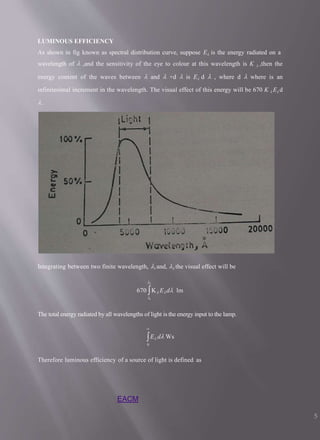
  • 77.
    The word isderived from pyros + metron. The methods under this are primarily thermal radiation measurement. There are two distinct instruments. Under this category: (i) Optical pyrometer (ii) Total Radiation Pyrometer Optical pyrometer:  A target object whose temperature is to be measured is placed in front of the pyrometer.  A field lens will gather light coming from this target, and then it will be focused on to the plane of a filament.  The filament is run by a battery, a variable resistor, an ammeter.  The radiation coming from the target is made to pass through an aperture so that straight light does not enter the instrument.  Then it passes through a gray filter which will, if necessary, reduce the brightness by a known factor. Then it falls on the filament. Fig. Schematic diagram of optical pyrometer  The objective lens receives light which is coming, both from the target which has passed through the gray filter, and then it also gets, receives radiation from the filament which is run by the battery.  By using the variable resistor, the current passing through the filament can be varied thereby changing the brightness and temperature of the filament.  Therefore, the amount of radiation which comes from the filament can be varied by changing the variable resistor position. EACM 17
  • 78.
     The redfilter, along with the eye of the person who is looking at it, it has got a certain response to the light which is falling on the retina, so the two together will help us in finding out, or selecting a certain wavelength of operation for this instrument.  The observer looks simultaneously at two things: (i) the object whose temperature I want to measure (ii) the filament whose brightness can be varied  So the operator will have to adjust the resistance such that the two, the target and the filament, appear equally bright, and which can be verified by making the proper adjustment. (i) If the temperature of the filament is very high, the filament appears bright in red background, which appears to be dull. (ii) If the temperature of the filament is too small, then it appears dark, looks like a shadow in the background, which is brighter. (iii)If the adjustment has been made properly then the brightness, the filament, and the background are equally bright. There is no contrast between them. The filament becomes invisible when a proper adjustment is done, and therefore, it has vanished. Therefore, it is also called vanishing filament pyrometer. Because the filament cannot appear at any temperature you want, it has got a limitation. If it goes beyond some particular value, the filament will melt and you will have to replace the filament. So the filament has a maximum temperature up to which it can go, and therefore, theoretically the maximum brightness temperature I can measure using this filament is the maximum temperature of the filament itself. Therefore, if the target is at a temperature higher than the filament temperature, a gray filter is used which will reduce the intensity by a factor which can be calibrated or known factor, half or one-fourth or one-eighth, and so on, so that the intensity of light which is coming from the target is equal to or less than the maximum, the intensity of the filament at the maximum of the temperature. Total Radiation Pyrometer: EACM 18
  • 79.
    Total radiation pyrometeraccepts a controlled sample of total radiation and through determination of the heating effect of the sample obtains a measure of temperature. All bodies above absolute zero temperature radiate energy, not only do they radiate or emit energy, but they also receive and absorb from other sources. It is known that all substances emit and absorb radiant energy at a rate depending on the absolute temperature and physical properties of the substance. According to Stefan – Boltzman law the net rate of exchange of energy between two ideal radiators A and B is, 𝑞 =σ(𝑇4 − 𝑇4) 𝐴 𝐵 Fig. Total radiation pyrometer In total radiation pyrometers, the radiation from the measured body is focused on some sort of radiation detector which produces an electric signal. Detectors may be classified as 1. thermal detectors 2. photon detectors Thermal detectors are blackened elements designed to absorb a maximum of the incoming radiation at all wavelengths. The absorbed radiation causes the temperature of the detector to rise until equilibrium is reached with heat losses to the surroundings. The thermal detectors measure this temperature using a resistance thermometer, thermistor or thermocouple. In photon detectors, the incoming radiation frees electrons in the detector structure and produces a measurable electrical effect. These events occur on an atomic or molecular time scale and hence are faster than the thermal detectors. But photon detectors have a sensitivity EACM 19
  • 80.
    EACM 20 that varies withwavelength, thus incoming radiation of all wavelengths are not equally treated. LUX METER Lux meters, sometimes called light meters, measure the intensity of illumination as distinguished by the human eye. This value does not correlate to an objective value of energy radiated or reflected, as different wavelengths within the visible spectrum are perceived with varying sensitivity by the eye, and lux meters evaluate light intensity in consideration of this variable. Measurement The human eye distinguishes colors of light according to two complementary models of visual physiology. Trichromatic theory states that each of the three types of cones in the eye are activated by a certain range of wavelength: β cones perceive light within 400-500 nm, Υ cones between 450-630 nm, and ρ cones between 500-700 nm. Opponent process theory states that colours are perceived by rods and cones antagonistically: black vs. white, blue vs. yellow, and red vs. green. The result is an eye that perceives certain colors more accurately. More shades of green are identified than any other color and this is the primary reason night vision equipment amplifies green light reflection. Visible light intensity accounting for these inherent biological preferences is known as luminous flux. Lux meters cannot compensate for individual visual deficiencies or variances. Total power output is measured as radiant flux. Operation Most lux meters register brightness with an integrated photo detector. The photo detector is positioned perpendicular to the light source for optimal exposure—many lux meters use an articulated or tethered photo detector for this purpose. Readouts are presented to the user via analog instrument or digital LCD. Digital types often include basic operator inputs. Many digital types can save measurements and have an adjustable detection range. Photo detectors composed of selenium or silicon determine brightness photo voltaically. Generated current is proportional to the photons received. Silicon-based detectors need to amplify the voltage generated by light exposure. Selenium-based detectors convert photons to a
  • 81.
    high enough voltagethat they be directly connected to a galvanometer, but have difficulty determining lux measurements for light sources below 1,000 lumens. Photo detectors that measure brightness via photo resistance are composed of a ceramic substrate doped with cadmium sulfide. An electronic switching current is supplied to the cell and resistance increases as more photons are detected to ultimately provide a proportional readout. Legislation curtails the availability of cadmium devices in certain territories. Correction Photo detectors are sensitive to all colours of visible light, including wavelengths not identified by the eye. Therefore, after exposure to a sample, photo detectors need to apply a correction factor to readings. Different light sources require different correction factors. Many commercial lux meters are preconfigured to register incandescent light, but have problems reading high intensity discharge, metal halide, high pressure sodium, and cool white fluorescent lights. Meters with preconfigured correction factors can provide accurate lux measurements for these sources. More advanced light meters are tuned to particular light sources with optical filters and lenses, removing correction factor uncertainty. Configuration Most lux meters are handheld devices and are easily transported to the job site. Articulated and tethered photo detectors may require both hands to optimally position the photo detector and the module, but they also provide measurement flexibility. Some handheld models may include a stand or mounting structure, such as a tripod. EACM 21
  • 82.
    CLAMP METER ORTONG TESTER Clamp meters are a very convenient testing instrument that permits current measurements on a live conductor without circuit interruption. When making current measurements with the ordinary multimeter, we need to cut wiring and connect the instrument to the circuit under test as shown in Fig.1 Using the clamp meter, however, we can measure current by simply clamping on a conductor as illustrated in Fig.2. One of the advantages of this method is that we can even measure a large current without shutting off the circuit being tested. Fig.1 Measurement using multimeter Fig.2 Measurement using clamp meter Clamp on to a conductor just the same way as with AC current measurement using an AC current clamp meter. In the case of DC clamp meters the reading is positive (+) when the current is flowing from the upside to the underside of the clamp meter. AC Clamp Meter  AC clamp meters operate on the principle of current transformer (CT) used to pick up magnetic flux generated as a result of current flowing through a conductor.  The current flowing through the conductor is the primary current.  A current proportional to the primary current is induced by electromagnetic induction in the secondary side (winding) of the transformer which is connected to a measuring circuit of the instrument. EACM 22
  • 83.
     The currentis converted into a proportional voltage by current-to-voltage conversion circuit.  The AC voltage is rectified to DC by a rectifier.  An ADC (Analog to Digital Converter) circuits converts the analog data to digital data DC Clamp Meter Hall elements are used as a sensor to detect DC current because it is not possible to employ an electromagnetic induction method as used for dedicated AC clamp meters. Hall element is a semiconductor which generates a voltage (at the output terminal) proportional to the product of bias current and magnetic field, when bias current is applied to the input terminal. A hall element is placed across a gap created by cutting off part of the transformer jaws. When current flows in the conductor, a magnetic flux is produced, which is proportional to both AC and DC primary currents in the transformer jaws. The hall element detects the magnetic flux and produces an output voltage proportionally. EACM 23
  • 84.
  • 85.
    UNIT 4 INTRODUCTION The patternof demand for conventional energy sectorwise in India (in terms of energy consumption as at present and as projected), is given in Table 3.1 in per cent Table 3.1 The pattern of demand for conventional energy in percent Year 1979-80 1984-85 1989-90 2000A.D (Conventional) 2000A.D. (Renewable also) Household 15.70 13.20 14.24 22.00 36.50 Agriculture 9.40 9.80 10.36 5.60 4.25 Industry 38.20 36.40 55.00 39.00 32.10 Transport 32.30 31.40 16.80 25.60 20.4 Others 3.90 4.20 3.00 7.80 6.25 Total 100.00 100.0 100.00 100.00 100.00 The household sector is seen as having an increasing share in energy use, both as a result of population increase as well as an increase in the standard of living. Statistical data of home equipment purchased from the market has led to the ranking of applia nces l is t ed in des cending order of energy use as shown in Table 3.2. Table 3.2 Ranking of Appliances Type of Appliance Percent Energy Use Space conditioning (including Heating, cooling and 30 airconditioning) Refrigeration 25 WaterHeating 15 Lighting 10 Cooking 7 Entertainment(T.V .etc.) 5 EACM 1
  • 86.
    EACM 2 Grinding 5 WashingandOthers3 Wastage of energy is estimated to be approximately 30 per cent of the total residential energy consumption. This is because of a poor knowledge of the energy utilization efficiency of the appliances and their careless operation. Saving of energy can be achieved by using more efficient appliances as well as by careful operation. HEATING OF BUILDINGS Heating of buildings is normally required to provide comfort to the occupants. Under normal conditions, the average human body dissipates about 100 Js-1 and has a temperature of 37°C. Of the above quantity of heat, about 45 per cent is dissipated by radiation, 30 per cent by convection, and the remaining 25 per cent by evaporation. Radiation is governed by the tempera- ture of the surrounding walls, convection by the air temperature, and evaporation by the humidity of the air. It is obvious that energy conservation has to be achieved while keeping comfort in mind. The usual practice in producing comfort is to design a heating and humidity control installation to maintain an indoor temperature of 19.0°C at 60 per cent relative humidity (9.3 moisture content of air per m3 at 19.0°C). To prevent excessive evaporation from the body, temperature and humidity arecontrolled. There are various ways of producing heat. The relative costs of producing heat from electricity and other fuels can be calculated on two criteria (a) J oriented and (b) kWh oriented. Tables 3.3(a) and 3.3(b) show the relative costs based on the abovecriteria. It can be seen from both the tables that electrically produced heat appears to be costlier than that produced from other sources.
  • 87.
    In the choiceof a particular type of heating installation, various aspects like aesthetic and hygienic considerations must be taken into account, apart from the cost. Since we are mainly interested in electric energy conservation, the advantages of electric heating are laid down- below. ADVANTANTAGES OF ELECTRIC HEATING 1. Cleanliness-freedom from ash, dust, grease; hence hygienic. 2. Easeofadaptationfor all purposes. 3. Very little maintenance isrequired 4. The regulation of heat is easy, simple and accurate and can be done automatically 5. There are no products of combustion, therefore the surrounding air is not contaminated 6. Since there is no flue gas, the space that would be occupied by a chimney is saved. EACM 3
  • 88.
    EACM 4 TYPES OFAPPLICATIONS OF ELECTRIC HEATING EQUIPMENT The various methods of producing heat for general industrial work, heating of buildings, and for welding may conveniently be classified as follows: 1. Direct Resistance Heating: A current is passed through the body to be heated. e.g resistance welding, electrode- boiler type water heater. 2. Indirect resistance heating: A current is passed through a wire or High resistance material forming a heating element and the heat loss so produced is transmitted by radiation or convection to the body to be heated e.g. ordinary domestic radiator, immersion water heater, resistance ovens, heat treatment of metals 3. Direct Induction Heating: Currents induced by electromagnetic action in the body to be heated, such as steel and other metals which produces a high temperature to melt the metal e.g. Induction furnace, eddy current heating 4. Indirect Induction Heating: Eddy currents are induced in the heating element by electromagnetic action. The heat so produced is transmitted to the body to be by radiation and convection, as in the indirect resistance method e.g. Induction Ovens, Heat treatment of metals. 5. Dielectric Induction Heating: The electric losses set up in non metallic materials when subjected to an alternating electric field isused forheating. e.g. Same astitle. 6. Electric Arc: An arc drawn between two electrodes has a temperature between 3000°0 and 3500°C, e.g. arc furnace, arc welding HEATREQUIREMENTANDHUMIDITY The heat required to raise the temperature of the room at normal humidity can easily be calculated by multiplying the specific heat of air and itsdensity. Specific heat of air = 1.0J/g°C Density of air at 19.0°C = 1.22 x10³ g/m3 Therefore the heat, required to raise the temperature of 1m3 of air through 1°C is 1.22 x 10³ J. This is a useful average figure although it varies slightly with variations of temperature and humidity. The outdoor temperature in winter can be assumed to be about 5.0°C and the relative humidity 75 per cent. Under these conditions the outdoor air has a moisture content of 4.9 g per m3.
  • 89.
    In order tocondition this air to an indoor temperature of 19°C and 60 per cent relative humidity (9.3 g per rn3 moisture content), heat energy of (1.22 x 10³ J/m3 ° C) mo is t ur e (4.4 g/m3) must be added to co nd it io n the air. TRANSFER OF HEAT Before we consider the various methods of producing heat electrically, it is ap pr o pr ia t e t o briefly discuss t he different processes by which heat is t rans ferred froma hot bodyto a cold body. CONDUCTION The rate of heat transfer by conduction depends on the temperature difference between each sideofthe bodyT1 andT2 respectively, e.g. the temperaturesoneachsideof a wall ina buildingof thermal conductivity k. Conduction of heat is an important consideration in connection with refractory and heat insulating materials when these are used for preventingthe escape of heat to the outside surroundings. 1 2 EACM 5 t Heat dissipation by conduction = k (T  T ) W/m2 (3.1) Where t = thickness of wall in in T1and T2 = inside and outside temps. in Kelvin respectively k = thermal conductivity in W/m°C CONVECTION Heat transfer by convection depends on the temperature of the hot body and the temperature of the air surrounding it. Heat is dissipated by convection in immersion type water heaters and in certain low temperature heating equipment for buildings. Natural convection takes place according to thelaw: Heat dissipation = 3.376 (T  T )1.25 W/m2 (3.2) 1 2 Where T1= temperature in Kelvin of the hotbody = 273+ temp. in °C T2 = temperature in Kelvin of the airmedia = 273 + temp. in °C
  • 90.
    The constants aresubject to variations depending on the circumstances, e.g., the shape ofthe heating surface, facilities for air circulation etc. RADIATION Heat istransmitted by radiation from a red-hot body to a low-temperature absorbing surface. It is governed by Stefan's law ofradiation:   4  4  T  T Heat dissipation = 5.72 x 10 1   2   W/m2 1000 1000   Where T1= absolute temperature in Kelvin of the radiating surface T2= absolute temperature in Kelvin of the absorbing surface  = radiating efficiency, depending on disposition of heating elements = 1 for single element or = 0.5 to 0.8 for several elements side byside  =emissivity = 1 for black body or = 0.9 for resistance heating element. This formula is used to design high-temperature heating elements. SPACE HEATING METHODS Heat may be transmitted from a hot source to a lower temperature by radiation (without heating the air between them), or by convection (caused by movement of the heated air). All electric heaters used for space heating transmit heat by both methods to some degree. Electric room or space heaters conveniently be divided into the following types: (1) high temperature radiator, (2) panel heater, (3) low temperature convection heaters, (4) thermal storage heater and (5) air conditioner. HIGH TEMPERATURE RADIATOR High temperature heaters comprise electric fins and radiators. They are made of wire- wound elements which have a working temperature of about 900°C. Some, which have polished reflectors may emit about 75 per cent of their total output as radiation and the remainder by convection. In the fire bar 40-50 per cent of the heat may be radiated. Convection air currents tend to rise, and do not have the directional qualities of radiant heat. They can be reflected or refracted, and can be blown in any desired direction. EACM 6
  • 91.
    The principal useof radiant heaters is intermittent heating, or in conjunction with a convector. For intermittent use, a loading of 1500 W per 28.3 m2 of room space is convenient. It is preferable to use two or more smaller heaters instead of a big one, in a large room, to improve heat distribution and to use heaters with two elements which can be switched on independently. PANEL HEATERS Panel heaters have resistance elements in heat resisting material which are in the form of large panels. They are attached to the wall. Flood heaters are panels of up to 33 cm x 64 cm with a surface temperature of 205-260°C. They are usually at an angle to the wall. They are mounted at about 2.3 inches from the floor. The hot air so produced rises up due to low density and the cold air is pushed downwards and is heated up. They are suitable for buildings such as schools and factories, having a high heat loss. A high proportion of the heat produced is radiated and its direction can be controlled. Thermostatic control is available. The objection is that heat rays striking downwards are uncomfortable to some people. LOW TEMPERATURE CONVECTION HEATER For rooms in continuous occupation, low temperature heating by convection is preferred. If a definite temperature is to be maintained, it is necessary to calculate the heat loss through walls, windows, floors and ceilings, adding to this the heat lost by air due to ventilation, in order to arrive at the size of heaters needed. A temperature of approximately 20°C is to be maintained. Basically there are two types of convectors. (a) A metal tube about 50 mm in diameter inside which is mounted a spiral of resistance wire. Such tubes are made in lengths of between 0.6 and 4.57 in and mounted in the room to be heated. The temperature of the external surface is about 93.3°C and about 60 W per 0.3 m length of tube is necessary to maintain this. About 90 percent of the heat transferred is by convection. (b) A resistance wire operating at a low temperature inside a box provided with suitable holes to allow air to pass through the box over the elements. THERMAL STORAGE HEATERS Thermal storage heaters consist of a large number of pipes through which hot water is circulated. This hot water is circulated to the radiators present all over the buildings. The water is heated up using an electrode boiler or an immersion heater in the storage tank. The pipe and radiator system doesn’t differ from that of the well- known central heating system employing coal or coke-fired boiler. In fact, many such EACM 7
  • 92.
    systems have beenconverted to electric operation by the immersion of an electric heater in the storage tank. When electric heating is employed, the tank and piping must be lagged to prevent loss of heat, which is usually not present in fuel fired systems. The efficiency of the system reduces as lot of losses occur due to lack of lagging. VENTILATION AND AIR CONDITIONING Air is circulated through the building by the ventilating equipment after being Preheated and treated for control of humidity. Ventilation heat loss in a building is a major factor during winter: Table 3.4 below gives the number of air changes required per hour for ventilation purposes. It is generally assumed that there is 1.5 times air changes (per volume of the room) by natural ventilation. Air conditioning has been defined as the simultaneous control of temperature, humidity, air movement and control of air in a given space. In air conditioners air is circulated for ventilation throughout the building mechanical1y by means of a fan, driven by an electric motor. Variation of air quantity is carried out by a multi-speed motor. Heating is generally carried out by passing the air over a resistance heater although a heat pump can be employed. Air conditioning, however, involves cooling in summer and heating in winter. Cooling is attained by a refrigeration process. AIR CONDITIONERS There are three types of air conditioners 1. Unitar y type 2. Ce nt r a l t yp e 3. Unitary-Central type EACM 8
  • 93.
    EACM 9 1. UNITARYTYPE The window type air conditioner is an example of this type. It is a factory encased self contained unit, with a compressor, a condenser, an evaporator, a filter and refrigerator piping. It is made in capacities ranging from 1/2 to 2 tons, employing motors of upto 3 hp. These units are usually fitted with an attractive frontage on the inside. It is supported on brackets and projects beyond t he Wall. These units are suitable for rooms that have at least one wall exposed to the out since, as hot air from, the conditioning for large premises costs about 50 to 100 per cent more than the central type, but it has the advantage of flexible operation. The standby capacity required in the unitary type air conditioning need not be high. In case of malfunction, the unit can immediately be replaced, whereas in the central type air conditioning, this is not possible. Also, very few structural modifications become necessary, i.e., only a wall opening of 6.4 cm X 3.4 cm is needed in the unitary type air conditioning. This type of air conditioning is suitable where only a few rooms are to be airconditioned. 2. CENTRAL TYPE In this type of air conditioning, the plant is situated at some central place, usually in the basement, from where conditioned air is led through ducts to the rooms to be cooled. There are return ducts to carry air from these rooms back to the central plant, where it is dehumidified, cooled and recharged with fresh ventilating air. The advantages of this type of air conditioning are high efficiency and robustness of the plant. This type of air conditioning is especially suited to large buildings and rooms which do not have exposed walls. The main disadvantage of this type of air conditioning is the absence of any individual room temperature adjustments, ducting being costly and requiring a lot of space, and also the mixing of odours, cigarette smoke and bacteria present in the return air from infected rooms, and their redistribution to healthy rooms. 3. UNITARY CENTRAL TYPE. In air conditioning only 15 per cent fresh air is required, the remaining 85 per cent being re-circulated. This type of air conditioning employs both the above types with the central pipe supplying 15 percent fresh air. All the disadvantages of central type are done away with. (i) There will be no return air duct, no mixing of odours and no redistribution of bacteria, (ii) Thu fresh air duct will be very much smaller in size (iii) The temperature of each space can be controlled by a room unit. (iv) All fresh air introduced will displace a corresponding quantity of air, which will escape through openings
  • 94.
    In this typeof air conditioning, each unit-cooler will be connected by means of lagged piping to the central type air conditioner, carrying either refrigerant or chilled water. The piping should be so placed that there is no direct exposure to the sun. Window AirConditioner The principle of the working of an air conditioner is the same as that of a water cooler. In addition to a condenser fan, an air conditioner also has a blower, whose main job is to circulate the cooled air in a room. In small air conditioners, a double ended shaft motor is used. At one end, a blower is mounted and at the other end a condenser fan is mounted. In large units, blower and fan may be driven by separate motors. It differs from that of a water cooler, shown chain-dotted in Fig. 3.1, on the following two accounts. Firstly, the fan motor is connected at the input terminal A of the thermostat switch so that the fan motor will continue to work even though the compressor motor is off due to operation of the thermostat. Secondly, the fan motor is a double-speed motor in the case of the air conditioner, to get "Cool Lo" and "Cool Hi" conditions whereas the fan motor in the water cooler is EACM 10
  • 95.
    EACM 11 a single-speedmotor. The air cooled condenser and the condenser fan are at the rear of the unit. Outside air is sucked in through side louvers in the unit cabinet. The fan directs air over the condenser which consists of continuous copper tubing to which aluminium fans are fitted, to increase heat transfer. Hot air is discharged to the atmosphere through the louvers at the back of the unit.A centrifugal blower sucks air from the room to be cooled through a filter and a evaporator coil, and delivers it to the upper compartment where this cooled air is mixed with fresh air obtained through a damper door, and then delivered to the room through an adjustable grill fixed on the upper part of the air conditioner. The control panel of the air conditioner consists of (i) damper control, (ii)master control and (iii) thermostat control. Fresh air intake is regulated by a damper door inside the cabinet. When the damper control is in the vent-closed position, it closes the fresh air; when it is in the fresh-air position, the damper opens s lightly and fresh a ir is fed. When it is in t he exhaust posit ion, the output of the blower is discharged to the atmosphere. This is done both to avoid suffocation and to remove smoke. When the master control knob is in the 'off' position, none of the motors operate. In the 'fan' position only the fan motor is working and the compressor motor is off. In the 'cool lo' position both the motors are working but the fan motor runs at slow speed. In the 'cool hi' position, both the motors are working and the fan motor runs at a high speed. A thermostat-sensing element is usually located in the return air stream, near the filter. The thermostat control On the panel adjusts the distance between the contests of the thermostat switch and hence the temperature. Some room air conditioners contain an electric-heater element which can be used to take the chill off a room in winter. This heater element is controlled by the master control switch. When the fan and heater are turned on, warm air is blown into the room through the air supply grills located at t he fro nt of t he a ir condit io ner. I f t he fan motor fails, heat is not distr ibuted to the room, and a thermal switch automatically cuts off the heater at about 121°C. The fan motor may be a capacitor motor or a shaded pole, single phase, induction motor. Its speed reduction is obtained by connecting a reactor in series. HEAT PUMPS Heat pumps can be used instead of resistance heating to conserve energy. Basically, the heat pump is a device which utilizes heat acquired from a low temperature source (outside environment in winter) and passes it into the building. It is a reversed refrigeration process. In ordinary refrigeration, heat is abstracted from the cold storage chamber by means of an electric motor driven compressor, converted to heat at a
  • 96.
    higher temperature, anddispatched to the surrounding atmosphere by a radiator. In the heat pump, a similar apparatus is used, but the heat is abstracted from the atmosphere which may be a t qu i t e lo w t emp e r a t u r e . I t is t he n co nve r t ed , b y me a ns o f a compressor, to heat at a higher temperature, to be dissipated inside the building by radiators. The amount of heat produced is 2 to 3 times corresponding to the electrical input, i.e.,2 to 3 times as much as would be produced by a resistance heater of the same input. This is called the coefficient of performance of the heat pump (COP), which is essentially the first law efficiency. COP = Q  2 to3 V (3.4) where Q=Heat injected inside the building in J (1 = 4.186 J) W=electrical energy input (Work input to the heat pump,J) The second law efficiency of a heat pump is definedas   1  T  = COP1  T0  <1 (3.5) Where T0=ambient temperature of outside atmosphere inK T1=Temperature inside the building in K Under certain circumstances, the first law and second law efficiencies can differ dramatically. For example a furnace providing hot air at 43 0 C to a house, when the outside air temperature is 0 0 C , has second law efficiency=0.082 if its first law efficiency(COP) is 0.6. On the other hand, for a power generator the first lawand second law efficiencies are nearly the same INSULATION This is a very important aspect for energy conservationin buildings. Generally buildings should be well insulated in order to minimize heat losses. t EACM 12 U=Value ( J / m2 0 C h) (Compare with k ineq.3.1) whichistheheattransfer coefficient of construction. It has relationship with the rate of heat loss of a structure, and decreases inversely with respect to insulation thickness. In theory,
  • 97.
    therefore it ispossible to reduce heat losses to any chosen values by increasing the thickness of insulation. The most important deterrent on this increase in thickness is capital co s t , as insu la t ing materials are rather expensive. Thus, it is essential to fix an economic limit for energy conservation. U-value can be converted to J/m2 °C per h by multiplying the numerator and denominator of W/m2 °C 3600. Table 3.5 gives U-values of the different parts of a building. COOLING LOAD The heating load calculation is made assuming steady-state heat transfer, which is the usual procedure, and this gives a reasonably accurate estimate of the heat necessary to maintain indoor conditions, when outside air conditions are stable. The transient nature of the heat loss due to the variationofoutdoorair conditions isneglected. Theresultsobtained are normallyquiteadequate. The cooling load, however, presents a much more complex problem because of the larger number of variables involved, and also the transient nature of the heat gain must be considered. The instantaneous heat gain into a given space is variable with the time of day, day of the month, and season of the year, because of the transient nature of the solar radiation. There may be an appreciable difference between the instantaneous heat gain to a space and the actual instantaneous heat removal rate. The reason for this is the heat storage effect of a structure. In an air conditioning design, it is important to differentiate between three related, but distinct, heat flow rates, each of which varies with time, such as 1. Space heatgain 2. Space cooling load (heat removal rate) 3. Cooling coil load in central air conditioning system. ELECTRIC WATER HEATING SYSTEMS For domestic purposes, there are advantages in combining electrical heating with some form of central heating (e.g., a small coke burning boiler). For maximum efficiency hot EACM 13
  • 98.
    water cisterns shouldbe lagged with cork or some other material of low heat conductivity. For central heating, it may be advisable to also lay the pi: earn purchase ac power, if there is surplus during off-peak periods (late night), and a thermal storage system of hot water enables such powers to he utilized and the heating effects of the power to be stored. Table 3.6 gives the temperature of hot water required for various purposes, and also the hot water storage temperatures. Recommended storage temperatures Soft water Hard water 71.0 60.0 There are three types of electric hot water systems described below. 1. Immersion heaters 2. Self contained water heater (geyser) 3. Electrode boilers IMMERSION HEATERS These are principally for water heating, but special types are available for heating oil, wax and bituministic materials. Immersion heaters have a high efficiency; loading is from 100 W to about 10 kW and banks of several large heaters be employed for industrial purposes. EACM 14
  • 99.
    EACM 15 The tubulartype has one, two, or three tubes or blades in which the elements of nickel-chrome are embedded in refractory materials. These elements cannot be replaced in the heater. The removable core type has sections of ceramic material wound with the element wire in a tinned copper sheath, and has the advantage of replaceable element. Loading may be upto 6.0 W/sq.cm. with 1.5 to 3.0 W for the removable core type. Horizontally fitted elements cause good circulation in the tank with little difference in temperature between top and bottom. The element should be as low as possib1e, due to the low heat conductivity of water, the water below the- heater will remain at a comparatively low temperature. Vertically fitted elements with top entry, should be long enough to reach the lower layers of the water for the same reason. This system gives less circulation, but is quick in heat ing a vo lu me o f wat er. Thermostatic control is convenient., and gives good results if the hot water system is correctly planned and the surfaces well lagged. The thermostat for an immersion heater consists of a tube and rod of different metals, which expand at different rates when heated, the difference in movement at the free ends being used to operate the switch. The contacts have a micro gap and are large, so that the arc is cooled below ignition temperature after being extinguished, when the ac current wave passes through the zero value. A quick break may be obtained by a magnet or a similar device. SELFCONTAINEDWATERHEATERS These are factory made vessels which contain a heating element and thermostat, and are insulated for high efficiency. Heaters of 6.8,13.6 and 22.71 are suitable for sink heaters;54.5,68,91.1 and larger sizes being good for general household purposes. Table 3.7 shows the approximate time required for the various heaters to raise the contents from room temperature to 76.66 0 C . Standby losses may vary from about 4kWh per week for the 6.8 size, to about 16 kWh per week for the 91 1 size. Table 3.7 Approximate Time Required
  • 100.
    ELECTRODE BOILER These aresuitable for supplying large central heating systems. They have capacities of 25-5000kW and voltages upto 11kV. Three-phase, small boilers of this type have a large capacity. When alternating electric current is passed between electrodes, most of the power is utilized in heating the water due to its resistance. The power used in electrolysis may be as low as 0.1 per cent of the input. The resistivity of the water varies considerably in different parts of the country, it maybe 50-100W per cube of the purer glacial and rainwater supplies. Various controlling and safety devices are fitted for the following purposes: 1. Switching on the current, usually by a time switch set to coincide with `off-peak' periods. Usually the current is switched on when the electrodes are in the minimum current position 2. Switching off by thermostat when the storage temperature has been reached, the electrodes then being automatically returned to the minimum current position. 3. Starting the boiler if the temperature falls below the preset temperature before the end of the `off-peak' load period. 4. Switching off, under minimum current conditions, at the end of the `off-peak' periods. 5. Switching off by remote control from the supply station to correspond with load conditions, in an alternative method. 6. Safety switches to switch off if the water supply fails, if 'out of balance' of the three-phase loud occurs,ifexcesscurrentflowsduetoinsulationfailure,ifthewatertemperatureexceedsa safevalue,orif thereisa suddenlossof waterfromthesystem.In anyof theseeventsanalarmmaybesoundedandthe electrodes moved to the minimum current position.To ensure this, the gear is so designed that the EACM 16
  • 101.
    main switchcannot beshut off untilthe pilot motor, or electrically operated water valves controlling a hydraulic piston,havemovedtheelectrodestothestartingposition. 7. Alternativelythecontrolgearmaybedesignedsoastokeepthecurrentwithincertain limits, irrespective ofthe water temperature. Withelectrodeboilers,storageisusuallyeffected ina separatevessel, andprimarypumpscirculatethewater betweenthelaggedboilerandlaggedtank,whilesecondary pumps circulate the water between the tankand heatingradiators. ELECTRIC ENERGY CONSERVATION METHODS Conservation of electric energy in domestic buildings can be achieved in the following ways: EACM 17
  • 102.
    EACM 18  Efficiencyof various appliances varies a great deal. It is important that the type of appliance used should be given adequateconsiderationas regards itsefficiency,beforeadoption.  Heating appliances rn7 be used at the lowest acceptable level of heat emission.  Allcooling systems should be maintained ina clean conditionand also kept ingoodworking order.  The use of heat emitting appliances could be minimized in areas where a cooling system is inoperation.  Appliances should be turned off when buildings are not occupied, provided this does not affect the functionaluse ofthe building and appliances, suchas refrigerators.  ON/OFF controls of water heaters and air conditioners must be adopted since these are high current-drain devices.  The thermostat and humidity control settings could be raised in summer, and lowered in winter. For example, for summer cooling it is possible to save up to 15 per cent of energy by having a thermostat temperature setting of 27°C, and 60 per cent relative humility.  Heat pumps could be used for space heating instead of electric heating.  Fan speed regulators (resistance type) should be replaced by electronic regulators to mitigate the lenses in the resistance.  Chilled water systems should be considered for space cooling.
  • 103.
    UNIT-6 PAYBACK PERIOD Payback periodin capital budgeting refers to the period of time required to recover the funds expended in an investment. This method is considered as one of the simplest method of capital budgeting. This is also referred to as the ‘back of the envelope’ calculation method. The payback method simply measures how long (in years and/or in months) it takes to recover the initial investment. Usually, the maximum acceptable payback period is determined by the management. The normal rule that is followed is that if the payback period is less than the maximum acceptable payback period, one should accept the project whereas if the payback period is greater than the maximum acceptable payback period, one should reject the project. When there are two competing projects, the project that has the lowest payback period should be chosen. Paybackperiod= Cost ofInvestment annual inflow CostofInvestment−ACCIofloweryear 𝑝𝑎𝑦𝑏𝑎𝑐𝑘 𝑝𝑒𝑟𝑖𝑜𝑑 =𝑙𝑜𝑤𝑒𝑟𝑦𝑒𝑎𝑟+ ACCIofupperyear−ACCIofloweryear where;ACCI−Annualaccumulatedcashinflow Merits: 1. The payback method is widely used by large firms to evaluate small projects and by small firms to evaluate most projects. 2. It is simple and intuitive, and considers cash flows rather than accounting profits. 3. It also gives implicit consideration to the timing of cash flows and is widely used as a supplement to other methods such as NPV and IRR. Demerits: • One major weakness of the payback method is that the appropriate payback period is a number subjectively determined by the management. • It fails to consider the principle of wealth maximization because it is not based on discounted cash flows, and thus provides no indication as to whether a project adds to firm value or not. • It also fails to fully consider the time value of money. Ex 1: There are two alternatives for purchasing a concrete mixer. Both the alternatives have same useful life. The cash flow details of alternatives are as follows; Alternative-1: Initial purchase cost = Rs.3,00,000, Annual operating and maintenance cost = Rs.20,000, Expected salvage value = Rs.1,25,000, Useful life = 5 years. Alternative-2: Initial purchase cost = Rs.2,00,000, Annual EACM 1
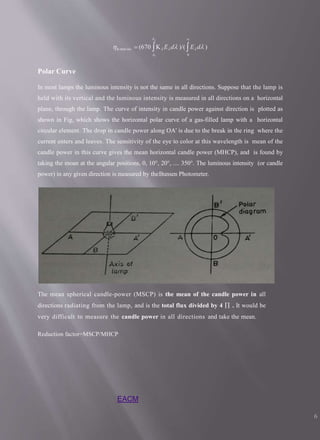
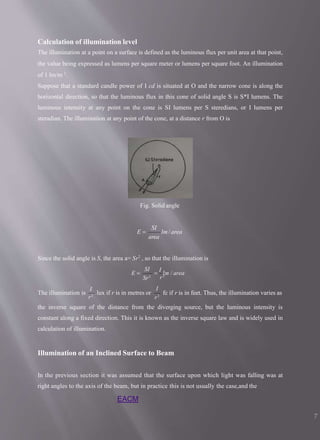
  • 104.
    operating and maintenancecost = Rs.35,000, Expected salvage value = Rs.70,000, Useful life = 5 years. Using present worth method, find out which alternative should be selected, if the rate of interest is 10% per year. Sol: Since both alternatives have the same life span i.e. 5years, the present worth of the alternatives will be compared over a period of 5 years. Alternative1: The initial cost, P = Rs.3,00,000 (cash outflow), Annual operating and maintenance cost, A = Rs.20,000 (cash outflow), Salvage value, F = Rs.1,25,000 (cash inflow). Alternative2: The initial cost, P = Rs.2,00,000 (cash outflow), Annual operating and maintenance cost, A = Rs.35,000 (cash outflow), Salvage value, F = Rs.70,000 (cash inflow). EACM 2
  • 105.
    Comparing the equivalentpresent worth of both the alternatives, it is observed that Alternative-2 will be selected as it shows lower negative equivalent present worth compared to Alternative-1 at the interest rate of 10% per year. Ex2: Alternative-1: Initial purchase cost = Rs.300000, Annual operating and maintenance cost = Rs.20000, Expected salvage value = Rs.125000, Useful life = 5 years. Alternative-2: Initial purchase cost = Rs.200000, Annual operating and maintenance cost = Rs.35000, Expected salvage value = Rs.70000, Useful life = 5 years. The annual revenue to be generated from Alternative-1 and Alternative-2 are Rs.50000 and Rs.45000 respectively. Compute the equivalent present worth of the alternatives at the rate of interest 10% per year and find out the economical alternative. Sol: EACM 3
  • 106.
    PW1 = -Rs.108663 Comparing the equivalent present worth of the both the alternatives, it is observed that Alternative-1 will be selected as it shows lower cost compared to Alternative-2. The annual revenue to be generated by the alternatives made the difference as compared to the outcome obtained in Example-1. Different life span alternatives: In case of mutually exclusive alternatives, those have different life spans, the comparison is generally made over the same number of years i.e. a common study period. This is because; the comparison of the mutually exclusive alternatives over same period of time is required for unbiased economic evaluation of the alternatives. If the comparison of the alternatives isnot EACM 4
  • 107.
    made over thesame life span, then the cost alternative having shorter life span will result in lower equivalent present worth i.e. lower cost than the cost alternative having longer life span. The two approaches used for economic comparison of different life span alternatives are as follows; i) Comparison of mutually exclusive alternatives over a time period that is equal to least common multiple (LCM) of the individual life spans Comparison of mutually exclusive alternatives over a study period which is not necessarily equal to the life span of any of thealternatives. ii) Ex3: The alternatives are from two different manufacturing companies for purchasing a machine. The cash flow details of the alternatives are as follows; Alternative-1: Initial purchase price = Rs.1000000, Annual operating cost = Rs.10000, Expected annual income = Rs.175000, Expected salvage value = Rs.200000, Useful life = 10 years. Alternative-2: Initial purchase price = Rs.700000, Annual operating cost = Rs.15000, Expected annual income = Rs.165000, Expected salvage value = Rs.250000, Useful life = 5 years. Using present worth method, find out the most economical alternative at the interest rate of 10% per year. Sol: The alternatives have different life spans i.e. 10 years and 5 years. Thus the comparison will be made over a time period equal to the least common multiple of the life spans of the alternatives. In this case the least common multiple of the life spans is 10 years. Thus the cash flow of Alternative-1 will be analyzed for one cycle (duration of 10 years) whereas the cash flow of Alternative-2 will be analyzed for two cycles (duration of 5 years for each cycle). The cash flow of the Alternative-2 for the second cycle will be exactly same as that in the first cycle. 𝑃𝑊1 =−1000000+(175000−10000)[ (1 +𝑖)𝑛−1 𝑖(1+𝑖)𝑛 1 ] +200000[(1 +𝑖)𝑛] EACM 5
  • 108.
    𝑷 𝑾𝟐 =−𝟕𝟎𝟎𝟎𝟎𝟎+(𝟏𝟔𝟓𝟎𝟎𝟎−𝟏𝟓𝟎𝟎𝟎)[ (1+𝑖)𝑛−1 𝑖(1+𝑖)𝑛 1 ] +(700000−250000)[(1+𝑖)5] 1 +250000[(1+𝑖)10] Thus from the comparison of equivalent present worth of the alternatives, it is evident that Alternative-1 will be selected for purchase of the compression testing machine as it shows the higher positive equivalent present worth. RETURN ON INVESTMENT Return on investment (ROI) is a measure that investigates the amount of additional profits produced due to a certain investment. Businesses use this calculation to compare different scenarios for investments to see which would produce the greatest profit and benefit for the company. However, this calculation can also be used to analyze the best scenario for other forms of investment, such as if someone wishes to purchase a car, buy a computer, pay for college, etc. The simplest form of the formula for ROI involves only two values: the cost of the investment and the gain from the investment. The formula is as follows: 𝑅𝑂𝐼 (%) =Gain from Investment −Cost ofInvestment ×100 Cost of Investment The ratio is multiplied by 100, making it a percent. This way, a person is able to see what percentage of their investment has been gained back after a period of time. Some, however, prefer to leave it in decimal form, or ratio form. EACM 6


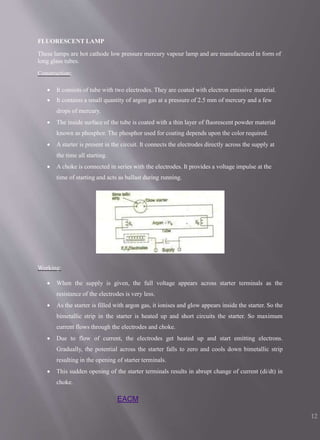
  • 109.
    EACM 7 LIFE CYCLECOSTING ANALYSIS- LIGHTING There is lack of awareness of the fact that the variable costs (operation costs), especially the energy costs of a lighting installation during the whole life cycle, are mostly the largest part of the total costs, and that proper maintenance plans can save a lot of energy during the operating phase of the installation. Due to this lack of awareness in common practice, life cycle costs (LCC) and maintenance plans are very seldom (rarely) put into practice. The calculations show that the management of LCC in the design phase can change the evaluation of different lighting solutions significantly. This adds weight to the energy aspects and thus influencing the final decision of the client to more energy efficient lighting solutions. Long term assessment of costs associated with “lighting and daylighting techniques Fontoynont (2009)” has studied financial data leading to the comparison of costs of various daylighting and lighting techniques over long time periods. The techniques are compared on the basis of illumination delivered on the work plane per year. The selected daylighting techniques were: roof monitors, façade windows, borrowed light windows, light wells, daylight guidance systems, as well as off-grid lighting based on LEDs powered by photovoltaics. These solutions were compared with electric lighting installations consisting of various sources: fluorescent lamps, tungsten halogen lamps and LEDs General results of the study were: ―Apertures (openings) in the envelope of the building are cost effective in directing light in the peripheral spaces of a building, mainly if they are durable and require little maintenance. ―Daylighting systems aimed at bringing daylight deeply into a building are generally not cost effective, unless they use ready-made industrial products with high optical performance and low maintenance, and collect daylight directly from the building envelope. ―Tungsten halogen lamps, when used continuously for lighting, are very expensive and need to be replaced by fluorescent lamps or LEDs. ―Depending on the evolution of performance and costs of LEDs and photovoltaic panels, there could also be options to generalize lighting based on LEDs and possibly to supply them with electricity generated directly from photovoltaic panels.
  • 110.
    EACM 1 UNIT5 Depreciation The termdepreciation refers to fall in the value or utility of fixed assets which are used in operations over the definite period of years. In other words, depreciation is the process of spreading the cost of fixed assets over the number of years it is useful. The fall in value or utility of fixed assets due to so many causes like wear and tear, decay, effluxion of time or obsolescence, replacement, breakdown, fall in market value etc. According to the Institute of Chartered Accountant of India, "Depreciation is the measure of the wearing out, consumption or other loss of value of a depreciable asset arising from use, effluxion of time or obsolescence (outdated) through technology and market changes. Methods of Depreciation: There are several methods for calculating depreciation, generally based on either the passage of time or the level of activity (or use) of theasset. Straight-line depreciation: Straight-line depreciation is the simplest and most often used method. In this method, the company estimates the salvage value (scrap value) of the asset at the end of the period during which it will be used to generate revenues (useful life). (The salvage value is an estimate of the value of the asset at the time it will be sold or disposed of; it may be zero or even negative. Salvage value is also known as scrap value or residual value.) The company will then charge the same amount to depreciation each year over that period, until the value shown for the asset has reduced from the original cost to the salvage value. The method is designed to reflect the consumption pattern of the asset, and is used when there is no particular pattern to the manner in which the asset is to be used over time. Use of the straight- line method is highly recommended, since it is the easiest depreciation method to calculate, and so results in few calculation errors. Under the straight-line method of depreciation, recognize depreciation expense evenly over the estimated useful life of an asset. The straight-line calculation steps are: 1. Determine the initial cost of the asset that has been recognized as a fixed asset. 2. Subtract the estimated salvage value of the asset from the amount at which it is recorded on the books. 3. Determine the estimated useful life of the asset. It is easiest to use a standard useful life for each class of assets. 4. Divide the estimated useful life (in years) into 1 to arrive at the straight-line depreciation rate. 5. Multiply the depreciation rate by the asset cost (less salvage value). 𝑎𝑛𝑛𝑢𝑎𝑙𝑑𝑒𝑝𝑟𝑒𝑐𝑖𝑎𝑡𝑖𝑜𝑛𝑒𝑥𝑝𝑒𝑛𝑠𝑒=𝑑𝑒𝑝𝑟𝑒𝑐𝑖𝑎𝑏𝑙𝑒𝑐𝑜𝑠𝑡∗𝑟𝑎𝑡𝑒𝑜𝑓 𝑑𝑒𝑝𝑟𝑒𝑐𝑖𝑎𝑡𝑖𝑜𝑛

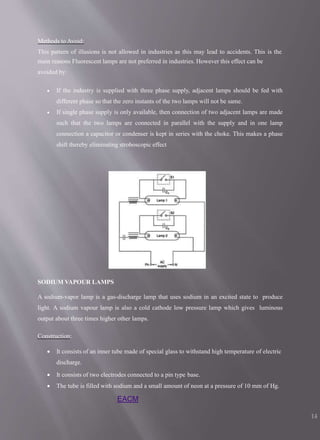
  • 111.
    Where; 𝑑𝑒𝑝𝑟𝑒𝑐𝑖𝑎𝑏𝑙𝑒𝑐𝑜𝑠𝑡=𝐶𝑜𝑠𝑡𝑜𝑓 𝑖𝑛𝑠𝑡𝑎𝑙𝑙𝑎𝑡𝑖𝑜𝑛−𝑅𝑒𝑠𝑖𝑑𝑢𝑎𝑙𝑣𝑎𝑙𝑢𝑒 1 𝑟𝑎𝑡𝑒𝑜𝑓 𝑑𝑒𝑝𝑟𝑒𝑐𝑖𝑎𝑡𝑖𝑜𝑛= 𝑈𝑠𝑒𝑓𝑢𝑙𝑙𝑖𝑓𝑒𝑜𝑓𝑖𝑛𝑠𝑡𝑎𝑙𝑙𝑎𝑡𝑖𝑜𝑛(𝑦𝑒𝑎𝑟𝑠) Hence; 𝑎𝑛𝑛𝑢𝑎𝑙𝑑𝑒𝑝𝑟𝑒𝑐𝑖𝑎𝑡𝑖𝑜𝑛𝑒𝑥𝑝𝑒𝑛𝑠𝑒=(𝐶𝑜𝑠𝑡 𝑜𝑓 𝑖𝑛𝑠𝑡𝑎𝑙𝑙𝑎𝑡𝑖𝑜𝑛−𝑅𝑒𝑠𝑖𝑑𝑢𝑎𝑙𝑣𝑎𝑙𝑢𝑒) 𝑈𝑠𝑒𝑓𝑢𝑙 𝑙𝑖𝑓𝑒𝑜𝑓 𝑖𝑛𝑠𝑡𝑎𝑙𝑙𝑎𝑡𝑖𝑜𝑛(𝑦𝑒𝑎𝑟𝑠) For example, a vehicle that depreciates over 5 years is purchased at a cost of Rs17,000, and will have a salvage value of Rs2000. Then this vehicle will depreciate at Rs3,000 per year, i.e. (17- 2)/5 = 3. This table illustrates the straight-line method of depreciation. Book value at the beginning of the first year of depreciation is the original cost of the asset. At any time book value equals original cost minus accumulated depreciation. Book value = original cost − accumulated depreciation. Book value at the end of year becomes book value at the beginning of next year. The asset is depreciated until the book value equals scrap value. EACM 2 Depreciation Expense Accumulated Depreciation at year end Book value at year end Original cost (17000Rs.) 3000 3000 14000 3000 6000 11000 3000 9000 8000 3000 12000 5000 3000 15000 2000= salvage value Double Declining Balance Method: As the depreciation in straight-line depreciation method is uniform over its life-time, which is not very appropriate, the double declining balance method calculates the annual depreciation based on the book value of the previous year. Suppose a business has an asset with Rs1,000 original cost, Rs100 salvage value, and 5 years of useful life. First, the straight-line depreciation rate would be 1/5, i.e. 20% per year. Under the double-declining-balance method, double that rate, i.e. 40% depreciation rate would be used. The table below illustrates this: Depreciation rate Depreciation expense Accumulated depreciation Book value at end of year original cost Rs1,000.00
  • 112.
    40% 400.00 400.00600.00 40% 240.00 640.00 360.00 40% 144.00 784.00 216.00 40% 86.40 870.40 129.60 129.60 - 100.00 29.60 900.00 scrap value 100.00 When using the double-declining-balance method, the salvage value is not considered in determining the annual depreciation, but the book value of the asset being depreciated is never brought below its salvage value, irrespective of the method used. Depreciation stops when either the salvage value or the end of the asset's useful life is reached. Since double-declining-balance depreciation does not always depreciate an asset fully by its end of life, some methods also compute a straight-line depreciation each year, and apply the greater of the two. This has the effect of converting from declining-balance depreciation to straight-line depreciation at a midpoint in the asset's life. With the declining balance method, one can find the depreciation rate that would allow exactly for full depreciation by the end of the period, using the formula: 𝑅𝑒𝑠𝑖𝑑𝑢𝑎𝑙𝑣𝑎𝑙𝑢𝑒 DepreciationRate=√ 𝑐𝑜𝑠𝑡𝑜𝑓 𝑖𝑛𝑠𝑡𝑎𝑙𝑙𝑎𝑡𝑖𝑜𝑛 where N is the estimated life of the asset (for example, in years). Annuity depreciation: Annuity depreciation methods are not based on time, but on a level of Annuity. This could be miles driven for a vehicle, or a cycle count for a machine. When the asset is acquired, its life is estimated in terms of this level of activity. Assume the vehicle above is estimated to go 50,000 miles in its lifetime. The per-mile depreciation rate is calculated as: (Rs17,000 cost - Rs2,000 salvage) / 50,000 miles = Rs0.30 per mile. Each year, the depreciation expense is then calculated by multiplying the number of miles driven by the per-mile depreciation rate. Units-of-production depreciation method: Under the units-of-production method, useful life of the asset is expressed in terms of the total number of units expected to be produced: 𝑁 EACM 3
  • 113.
    𝑑𝑒𝑝𝑟𝑒𝑐𝑖𝑎𝑏𝑙𝑒𝑐𝑜𝑠𝑡 𝐴𝑛𝑛𝑢𝑎𝑙 𝐷𝑒𝑝𝑟𝑒𝑐𝑖𝑎𝑡𝑖𝑜𝑛𝐸𝑥𝑝𝑒𝑛𝑠𝑒 = 𝐸𝑠𝑡𝑖𝑚𝑎𝑡𝑒𝑑𝑡𝑜𝑡𝑎𝑙𝑝𝑟𝑜𝑑𝑢𝑐𝑡𝑖𝑜𝑛 ∗𝐴𝑐𝑡𝑢𝑎𝑙𝑃𝑟𝑜𝑑𝑢𝑐𝑡𝑖𝑜𝑛 Suppose,an asset has original cost Rs70,000, salvage value Rs10,000, and is expected to produce 6,000 units. Depreciation per unit = (Rs70,000−10,000) / 6,000 = Rs10 10 × actual production will give the depreciation cost of the current year. The table below illustrates the units-of-production depreciation schedule of the asset. EACM 4 Units of production Depreciation cost per unit Depreciation expense Accumulated depreciation Book value at end of year Rs70,000 (original cost) 1,000 10 10,000 10,000 60,000 1,100 10 11,000 21,000 49,000 1,200 10 12,000 33,000 37,000 1,300 10 13,000 46,000 24,000 1,400 10 14,000 60,000 10,000 (scrap value) Depreciation stops when book value is equal to the scrap value of the asset. In the end, the sum of accumulated depreciation and scrap value equals the original cost. Sum-of-years-digits method: Sum-of-years-digits is a depreciation method that results in a more accelerated write-off than the straight line method, and typically also more accelerated than the declining balance method. Under this method the annual depreciation is determined by multiplying the depreciable cost by a schedule of fractions. Sum of the years' digits method of depreciation is one of the accelerated depreciation techniques which are based on the assumption that assets are generally more productive when they are new and their productivity decreases as they become old. The formula to calculate depreciation under SYD method is:
  • 114.
    EACM 5 Annual Depreciationcost= 𝑑𝑒𝑝𝑟𝑒𝑐𝑖𝑎𝑏𝑙𝑒𝑐𝑜𝑠𝑡x (Remaining Useful Life/Sum of the Years' Digits) Depreciable Base = Cost - Salvage Value The sum of the digits can also be determined by using the formula (n2+n)/2 where n is equal to the useful life of the asset in years. Example: If an asset has original cost of Rs1000, a useful life of 5 years and a salvage value of Rs100, compute its depreciation schedule. First, determine years' digits. Since the asset has useful life of 5 years, the years' digits are: 5, 4, 3, 2, and 1. Next, calculate the sum of the digits: 5+4+3+2+1=15 The example would be shown as (52+5)/2=15 Depreciation rates are as follows: 5/15 for the 1st year, 4/15 for the 2nd year, 3/15 for the 3rd year, 2/15 for the 4th year, and 1/15 for the 5th year. Depreciable base Depreciation rate Depreciation expense Accumulated depreciation Book value at end of year Rs1,000 (original cost) 900 5/15 300 =(900 x 5/15) 300 700 900 4/15 240 =(900 x 4/15) 540 460 900 3/15 180 =(900 x 3/15) 720 280 900 2/15 120 =(900 x 2/15) 840 160 900 1/15 60 =(900 x 1/15) 900 100 (scrap value) Sinking fund (SF) depreciation method:-
  • 115.
    In this methodit is assumed that money is deposited in a sinking fund over the useful life that will enable to replace the asset at the end of its useful life. For this purpose, a fixed amount is set aside every year/month from the revenue generated (profit obtained) and this fixed sum is considered to earn interest at an interest rate compounded annually over the useful life of the asset, so that the total amount accumulated at the end of useful life is equal to the total depreciation amount (initial cost less salvage value of the asset). Thus the annual depreciation in any year has two components. 1. fixed sum that is deposited into the sinking fund 2. the interest earned on the amount accumulated in sinking fund till the beginning of that year. For this purpose, first the uniform depreciation amount (i.e. fixed amount deposited in sinking fund) at the end of each year is calculated by multiplying the total depreciation amount (i.e. initial cost less salvage value) over the useful life by sinking fund factor. 𝑖 𝐴𝑛𝑛𝑢𝑎𝑙 𝑑𝑒𝑝𝑟𝑒𝑐𝑖𝑎𝑡𝑖𝑜𝑛=(𝑑𝑒𝑝𝑟𝑒𝑐𝑖𝑎𝑏𝑙𝑒𝑐𝑜𝑠𝑡) (1 +𝑖)𝑛 Where i = interest rate per year Depreciation amount for mth year = A(1 +𝑖)𝑚 After that the interest earned on the accumulated amount is calculated. The calculations are shown below. EACM 6 𝑘=0 Book Value after m years = 𝑃 −𝐴[∑𝑚 ((1 +𝑖)𝑘] TIME VALUE OF MONEY Time value of money quantifies the value of a rupee through time Money has time value because of the following reasons: 1. Risk and Uncertainty: Future is always uncertain and risky. Outflow of cash is in our control as payments are made by us. There is no certainty for future cash inflows. Cash inflow is dependent on our Creditor, Bank etc. As an individual or firm is not certain about future cash receipts, it prefers receiving cash now. 2. Inflation: In an inflationary economy, the money received today, has more purchasing power than the money to be received in future. In other words, a rupee today represents a greater real purchasing power than a rupee a year hence. 3. Consumption: Individuals generally prefer current consumption to future consumption. 4. Investment opportunities: An investor can profitably employ a rupee received today, to give him a higher value to be received tomorrow or after a certain period of time. A rupee received today is worth more than a rupee receivedtomorrow  This is because a rupee received today can be invested to earninterest  The amount of interest earned depends on the rate of return that can be earned on the investment
  • 116.
    EACM 7  Thebasic types to calculate time value of money are as follows: o Present value of a lump sum o Future value of a lump sum o Present value of cash flow streams o future value of cash flow streams o Present value of annuities o future value of annuities  Keep in mind that these forms can, should, and will be used in combination to solve more complex TVM problems  The following are simple rules that you should always use no matter what type of TVM problem you are trying to solve: o Stop and think: Make sure you understand what the problem is asking. You will get the wrong answer if you are answering the wrong question. o Draw a representative timeline and label the cash flows and time periods appropriately. o Write out the complete formula using symbols first and then substitute the actual numbers to solve. 1. Present value of a lump sum:  Present value calculations determine what the value of a cash flow received in the future would be worth today (time 0)  The process of finding a present value is called “discounting” (hint: it gets smaller)  The interest rate used to discount cash flows is generally called the discount rate PV = FVt / (1+r)t Where PV=present value FV=Future value r = rate of return t = time period P) How much would Rs100 received five years from now be worth today if the current interest rate is 10%? Draw a timeline
  • 117.
    The arrow representsthe flow of money and the numbers under the timeline represent the time period. Note that time period zero is today. PV = CFt / (1+r)t PV = 100 / (1 + .1)5 PV = Rs62.09 2. Future value of a lump sum:  The future value as the opposite of present value  Future value determines the amount that a sum of money invested today will grow to in a given period of time  The process of finding a future value is called “compounding” (hint: it gets larger) FVt = PV * (1+r)t P) How much money will you have in 5 years if you invest Rs100 today at a 10% rate of return? Draw a timeline FVt = CF0 * (1+r)t FV = Rs100 * (1+.1)5 FV = Rs161.05 3. Present value of a cash flow stream:  A cash flow stream is a finite set of payments that an investor will receive or invest over time.  The PV of the cash flow stream is equal to the sum of the present value of each of the individual cash flows in the stream.  The PV of a cash flow stream can also be found by taking the FV of the cash flow stream and discounting the lump sum at the appropriate discount rate for the appropriate number of periods. n PV= Σ [CFt / (1+r)t ] t=1 Where CF = Cash flow (the subscripts t and 0 mean at time t and at time zero,respectively) EACM 8
  • 118.
    EACM 9 P) Joemade an investment that will pay Rs100 the first year, Rs300 the second year, Rs500 the third year and Rs1000 the fourth year. If the interest rate is ten percent, what is the present value of this cash flow stream? Draw a timeline: PV = [CF1/(1+r)1]+[CF2/(1+r)2]+[CF3/(1+r)3]+[CF4/(1+r)4] PV = [100/(1+.1)1]+[Rs300/(1+.1)2]+[500/(1+.1)3]+[1000/(1.1)4] PV = Rs90.91 + Rs247.93 + Rs375.66 + Rs683.01 PV = Rs1397.51 4. Future value of a cash flow stream:  The future value of a cash flow stream is equal to the sum of the future values of the individual cash flows.  The FV of a cash flow stream can also be found by taking the PV of that same stream and findingthe FV of that lump sum using the appropriate rate of return for the appropriate number of periods. n Σ [CFt * (1+r)n-t] t=1 FV = Assume Joe has the same cash flow stream from his investment but wants to know what it will be worth at the end of the fourth year Draw a timeline: FV = [CF1*(1+r)n-1]+[CF2*(1+r)n-2]+[CF3*(1+r)n-3]+[CF4*(1+r)n-4] FV = [Rs100*(1+.1)4-1]+[Rs300*(1+.1)4-2]+[Rs500*(1+.1)4-3] +[Rs1000*(1+.1)4-4] FV = Rs133.10 + Rs363.00 + Rs550.00 + Rs1000 FV = Rs2046.10 5. Present value of an annuity: PVA = payment * {[1-(1+r)-t]/r}  An annuity is a cash flow stream in which the cash flows are all equal and occur at regular intervals.
  • 119.
    EACM 10  Notethat annuities can be a fixed amount, an amount that grows at a constant rate over time, or an amount that grows at various rates of growth over time. We will focus on fixed amounts. P) Assume that Sally owns an investment that will pay her Rs100 each year for 20 years. The current interest rate is 15%. What is the PV of this annuity? Draw a timeline PVAt = payment *{[1-(1+r)-t]/r} PVA = Rs100 * {[1-(1+.15)-20]/.15} PVA = Rs100 * 6.2593 PVA = Rs625.93 6. Future value of an annuity: FVAt = payment * {[(1+r)t –1]/r} P) Assume that Sally owns an investment that will pay her Rs100 each year for 20 years. The current interest rate is 15%. What is the FV of this annuity? Draw a timeline FVAt = PMT * {[(1+r)t –1]/r} FVA20 = Rs100 * {[(1+.15)20 –1]/.15 FVA20 = Rs100 *102.4436 FVA20 = Rs10,244.36 PRESENT WORTH ANALYSIS One of the easiest ways to compare mutually exclusive alternatives is to resolve their consequences to the present time. Present worth analysis is most frequently used to determine the present value of future money receipts and disbursements. It would help us, for example to determine a present worth of income producing property, like an oil well or an apartment house. If the future income and cost are known, then using a suitable interest rate, the present worth of the property may be calculated. This should provide a good estimate of the price at which the property could be bought or sold.
  • 120.
    In present worthanalysis, careful consideration must be given to the time period covered by the analysis. Usually the task to be accomplished has a time period associated with it. In that case, the consequences of each alternative must be considered for this period of time which is usually called the analysis period. There are different analysis period situations that are encountered in economic analysis problems:  Useful life of each alternative is same  Useful lives of alternatives are different Single payment present worth factor: The single payment present worth factor is used to determine the present worth of a known future worth (F) at the end of “n” years at a given interest rate ‘i’ per interest period. The present worth (P), future worth (F) and the total interest period „n‟ years are shown in Fig. The expression for the present worth (P) can be written as follows; 𝐹 𝑃 = (1 +𝑖)𝑛 (1) The uniform-series present worth factor is used to determine the present worth of a known uniform series. Let A be the uniform annual amount at the end of each year, beginning from end of year 1 till end of year n. The known A, unknown P, and the total interest period n years are shown in Fig. The present worth (P) of the uniform series can be calculated by considering each A of the uniform series as the future worth. Then by using the formula in equation (1), the present worth of these future worth can be calculated and finally taking the sum of these present worth values. EACM 11
  • 121.
    (2) (3) The expression inthe bracket is a geometric sequence with first term equal to (1 + i)−1 and common ratio equal to(1 + i)−1. Then the present worth (P) is calculated by taking the sum of the first n terms of the geometric sequence (at i ≠ 0) and is given by; (4) The simplification of equation (4) results in the following the expression; (1 +𝑖)𝑛−1 𝑖(1+𝑖)𝑛 𝑃 =𝐴 [ ] (5) Thus if the value of A in the uniform series is known, then the present worth P at interest rate of i(per year) can be calculated by equation (5). Equal life span alternatives: The comparison of mutually exclusive alternatives having equal life spans by present worth method is simpler than those having different life spans. In case of equal life span mutually exclusive alternatives, the future amounts are converted into the equivalent present worth values and are added to the present worth occurring at time zero. Then the alternative that exhibits maximum positive equivalent present worth or minimum negative equivalent present worth is selected from the available alternatives. Different life span alternatives: In case of mutually exclusive alternatives that have different life spans, the comparison is generally made over the same number of years i.e. a common study period. This is because; the comparison of the mutually exclusive alternatives over same period of time is required for EACM 12
  • 122.
    EACM 13 unbiased(impartial) economicevaluation of the alternatives. If the comparison of the alternatives is not made over the same life span, then the cost alternative having shorter life span will result in lower equivalent present worth i.e. lower cost than the cost alternative having longer life span. RATE OF RETURN The rate of return technique is one of the methods used in selecting an alternative for a project. In this method, the interest rate per interest period is determined, which equates the equivalent worth (either present worth, future worth or annual worth) of cash outflows (i.e. costs or expenditures) to that of cash inflows (i.e. incomes or revenues) of an alternative. The rate of return is also known by other names namely internal rate of return (IRR), profitability index etc. It is basically the interest rate on the unrecovered balance of an investment which becomes zero at the end of the useful life or the study period. In the following lectures, the rate of return is denoted by “ir”. Using present worth, the equation for rate of return can be written as follows; 𝑃𝑊𝑜 =𝑃𝑊𝐼 (1) PWo = Present worth of cash outflows (cost or expenditure) PWI = Present worth of cash inflows (income or revenue)  cost or expenditures are considered as negative cash flows  income or revenues are considered as positive cash flows. Above Equation can be rewritten as 0=−𝑃𝑊𝑜 + 𝑃𝑊𝐼 In the above equation the net present worth is zero. Now putting the expressions for present worth of cash outflows and that of cash inflows in equation (1) results in the following expression 0 𝑃 +∑𝑛 𝐴𝑜𝑡 =∑𝑛 𝑡=0(1+𝑖)𝑡 𝑡=0(1+𝑖)𝑡 𝐴𝐼𝑡 (2) Po is the initial cost at time zero Aok is the expenditure occurring in 𝑘𝑡ℎ year. AIk is the income or revenue (profit) occurring in 𝑘𝑡ℎ year. The value of rate of return ir can be calculated by solving the above equation. Trial and error process for determination of the rate of return consumes more time but gives a clear understanding of the analysis of calculation for the rate of return. The rate of return can also be determined by finding out the interest rate at which the net future worth or net annual worth is zero. After determination of the rate of return for a given alternative, it is compared with minimum attractive rate of return (MARR) to find out the acceptability of this alternative for the project.
  • 123.
    If the rateof return i.e. ir is greater than or equal to MARR, then the alternative will be selected or else it will not be selected. Example: A construction firm is planning to invest Rs.800000 for the purchase of a construction equipment which will generate a net profit of Rs.140000 per year after deducting the annual operating and maintenance cost. The useful life of the equipment is 10 years and the expected salvage value of the equipment at the end of 10 years is Rs.200000. Compute the rate of return using trial and error method based on present worth, if the construction firm‟s minimum attractive rate of return (MARR) is 10% per year. Sol: Present worth= -800000+140000∑10 1 +200000 𝑘=0(1+𝑖)10 (1+𝑖)10 Now the above equation will be solved through trial and error process to find out the value of i. Since MARR is 10%, first assume a value of i equal to 8% and compute the net present worth. Now putting the values of different compound interest factors in the expression for net present worth at i equal to 8% results in the following; PW = Rs.232054 The above calculated net present worth at ir equal to 8% is greater than zero, now assume a higher value of ir i.e. 12% for the next trial and compute the net present worth. PW = Rs.55428 For 14% of i PW= -Rs.15806 PW = Rs.55428 at ir = 12% PW = - Rs.15806 at ir = 14% On solving the above expression, the value of ir is found to be 13.55% per year which is greater than MARR (10%). REPLACEMENTANALYSIS EACM 14
  • 124.
    EACM 15 Replacement analysisis carried out when there is a need to replace or augment the currently owned equipment (or any asset). There are various reasons that result in replacement of a given equipment.  One of the reasons is the reduction in the productivity of currently owned equipment. This occurs due to physical deterioration of its different parts and there is decrease in operating efficiency with age.  Increase in operating and maintenance cost for the construction equipment due to physical deterioration. This necessitates the replacement of the existing one with the new alternative.  If the production demands a change in the desired output from the equipment, then there is requirement of augmenting the existing equipment for meeting the required demand or replacing the equipment with the new one.  Another reason for replacement of the existing equipment is obsolescence. Due to rapid change in the technology, the new model with latest technology is more productive than the currently owned equipment, although the currently owned equipment is still operational and functions acceptably. Thus continuing with the existing equipment may increase the production cost. The impact of rapid change in technology on productivity is more for the equipment with more automated facility than the equipment with lesser automation. In replacement analysis, the existing (i.e. currently owned) asset is referred as defender whereas the new alternatives are referred as challengers. In this analysis the ‘outsider perspective’ is taken to establish the first cost of the defender. This initial cost of the defender in replacement analysis is nothing but the estimated market value from perspective of a neutral party. The current market value represents the opportunity cost of keeping the defender i.e. if the defender is selected to continue in the service. Sometimes, the defender is upgraded to make it competitive for comparison with the new alternatives. The additional cost required to upgrade the defender is added to its market value to establish the total investment for the defender. The revised annual operating and maintenance cost, salvage value and remaining service life of the defender, which are different from the original values, are estimated at the time of acquiring the asset. The defender and challenger are compared over a study period. Generally the remaining life of the defender is less than or equal to the estimated life of the challenger. When the estimated lives of the defender and challenger are not equal, the duration of the study period has to be appropriately selected for the replacement analysis. When the estimated lives of defender and challenger are equal, annual worth method or present worth method may be used for comparison between defender and the challengers. Example1: A construction company has purchased a piece of construction equipment 3 years ago at a cost of Rs.4000000. The estimated life and salvage value at the time of purchase were 12 years and Rs.850000 respectively. The annual operating and maintenance cost was Rs.150000. The construction company is now considering replacement of the existing equipment with a new model available in the market. Due to depreciation, the current book value of the existing
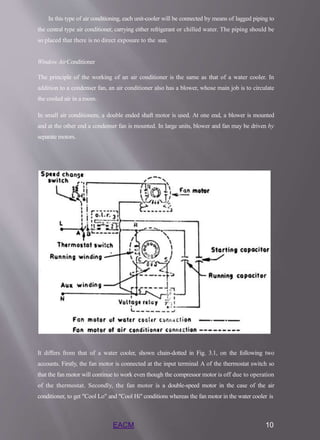

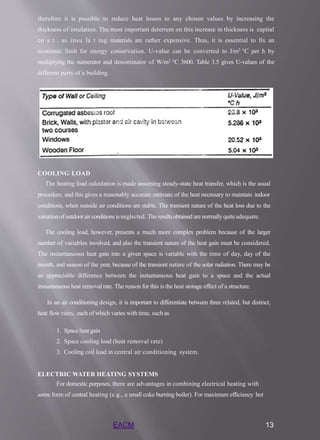
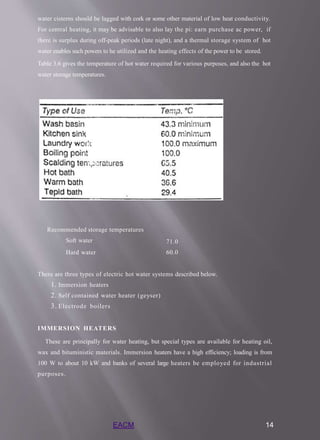
  • 125.
    equipment is Rs.3055000.The current market value of the existing equipment is Rs.2950000. The revised estimate of salvage value and remaining life are Rs.650000 and 8 years respectively. The annual operating and maintenance cost is same as earlier i.e. Rs.150000. The initial cost of the new model is Rs.3500000. The estimated life, salvage value and annual operating and maintenance cost are 8 years, Rs.900000 and Rs.125000 respectively. Company’s MARR is 10% per year. Find out whether the construction company should retain the ownership of the existing equipment or replace it with the new model, if study period is taken as 8 years (considering equal life of both defender and challenger). Sol: For the replacement analysis the current revised estimates of the existing equipment will be used. For existing equipment (defender), Current market value (P) = Rs.2950000, Salvage value (F) = Rs.650000, Annual operating and maintenance cost (A) = Rs.150000, Study period (n) = 8 years. For new model (challenger), Initial cost (P) = Rs.3500000, Salvage value (F) = Rs.900000, Annual operating and maintenance cost (A) = Rs.125000, Study period (n) = 8 years. Now the equivalent uniform annual worth of both defender (i.e. the existing equipment) and challenger (i.e. the new model) at MARR of 10% (i.e. i = 10%) are calculated as follows; 𝑷𝑾𝒅𝒆𝒇 =−𝟐𝟗𝟓𝟎𝟎𝟎𝟎 −𝟏𝟓𝟎𝟎𝟎𝟎[ 𝑖(1+𝑖)𝑛 (1 +𝑖)𝑛 −1 1 ] +650000 (1+𝑖)𝑛 𝑷𝑾𝒅𝒆𝒇 =−𝟐𝟗𝟓𝟎𝟎𝟎𝟎 −𝟏𝟓𝟎𝟎𝟎𝟎[ (1 +𝑖)8−1 𝑖(1+𝑖)8 1 ] +650000 (1+𝑖)8 𝑷𝑾𝒅𝒆𝒇 =−𝟐𝟗𝟓𝟎𝟎𝟎𝟎 −𝟏𝟓𝟎𝟎𝟎𝟎[5.334] +650000[0.4665] 𝑷𝑾𝒅𝒆𝒇 = −𝟑𝟒𝟒𝟔𝟖𝟕𝟓 𝑷𝑾𝒄𝒉𝒂𝒍𝒍 =−𝟑𝟓𝟎𝟎𝟎𝟎𝟎 −𝟏𝟐𝟓𝟎𝟎𝟎[ (1 +𝑖)𝑛−1 𝑖(1+𝑖)𝑛 1 ]+900000 (1+𝑖)𝑛 𝑷𝑾𝒄𝒉𝒂𝒍𝒍 =−𝟑𝟓𝟎𝟎𝟎𝟎𝟎 −𝟏𝟐𝟓𝟎𝟎𝟎[ (1 +𝑖)8−1 𝑖(1+𝑖)8 1 ] +900000[ (1+𝑖)8] EACM 16 𝑷𝑾𝒄𝒉𝒂𝒍𝒍 =−𝟑𝟓𝟎𝟎𝟎𝟎𝟎 −𝟏𝟐𝟓𝟎𝟎𝟎[5.334] +900000[0.4665]
  • 126.
    EACM 17 𝑷𝑾𝒄𝒉𝒂𝒍𝒍 =−𝟑𝟕𝟒𝟔𝟗𝟎𝟎 Fromthe above calculations, it is observed that equivalent uniform annual cost of the defender is less than that of the challenger. Thus the construction company should continue in retaining the ownership of the defender against the challenger with above details. LIFE CYCLE COSTING ANALYSIS  Life cycle cost is equal to sum of all the estimated costs associated with a product, service or system over its life span starting from conceptual planning at the beginning to schematic design, detailed design, construction or production, operation and maintenance till its disposal at the end of the life span.  The concept of life cycle costing lies in designing/producing the products, services or systems with systematic identification of both recurring and nonrecurring costs during various phases of their life cycle and estimating the cash flows during these phases over the life cycle.  The economic evaluation of an alternative on the basis of life cycle cost results in a detailed analysis of the of both present and future costs and thus helps in taking the right decision regarding the selection of the most economical alternative.  The life span of a product, service or system depends on the different phases starting from conceptual planning to its disposal. The end of life cycle may be governed by economic requirement or by functional requirement and depends on specific product.  The economic life of a product/system is normally shorter than its physical life. The product/system may still be functional (over physical life) but may not be economical for the entire life period and may be replaced.  The life cycle cost increases, if the design changes are made during later stages of the life cycle. The cost of design change increases with each stage of life cycle with lower cost during the early stages. The flexibility in design changes during the early stages is more as compared to that in the later stages of life cycle.  Thus the potential for cost savings is more during the early stages of the life cycle and thus the selection of the most economical alternative and the effective design procedure during the design stage results in higher cost savings.  Thus it is essential to have a detailed design of the product/system during the design stage of life cycle and to avoid or minimize the design changes during production and operation stages of life cycle to have a minimum impact on the life cycle cost of the product/system. The life cycle cost analysis is more useful for selecting the alternatives for products, services or systems having longer life periods. The economic evaluation of alternatives using life cycle cost analysis can be carried out by finding out the equivalent worth of the each alternative by including all the cash flows occurring over various stages of life cycle by present worth analysis and selecting the most economical alternative that results in minimum life cycle cost.
  • 127.
    EACM 18 ENERGY EFFICIENTMOTORS An energy-efficient motor produces the same shaft output power (hp), but uses less electrical input power (kW) than a standard-efficiency motor. Energy-efficient motors must have nominal full-load efficiencies that exceed the minimum NEMA (National Electrical Manufacturers Association) standards. Efficient use of energy enables to minimize production costs, increase profits, and stay competitive. The majority of electrical energy consumed in most industrial facilities is used to run electric motors. Energy-efficient motors now available are typically from 2 to 6 percent more efficient than their standard motor counterparts. This efficiency improvement translates into substantial energy and rupee savings. The efficiency of an electric motor can only be improved through a reduction in motor losses. Improvement in the design, materials, and construction has resulted in efficiency gains of 2 to 6 percent which translates into a 25 percent reduction in losses. A small gain in efficiency can produce significant energy savings and lower operating costs over the life of the motor. Consequently, the higher purchase price of high-efficiency motors (15 to 30 percent) can be recovered in 2 years through cost savings in energy and operation. Because energy-efficient motors are a proven technology in terms of durability and reliability, their use should be considered for new installations, major modifications, replacement of failed motors or those that require rewinding, or extreme cases of oversized or under loaded motors. Energy-efficient motors should be considered in the following instances. • For new facilities or when modifications are made to existing installations or processes • When procuring equipment packages • Instead of rewinding failed motors • To replace oversized and under loaded motors • As part of an energy management or preventative maintenance program •When utility rebates are offered that make high-efficiency motor retrofits (add new parts) even more cost effective A motor’s function is to convert electrical energy to mechanical energy to perform useful work. The only way to improve motor efficiency is to reduce motor losses. Even though standard motors operate efficiently, with typical efficiencies ranging between 83 and 92 percent, energy- efficient motors perform significantly better. An efficiency gain from only 92 to 94 percent results in a 25 percent reduction in losses. Since motor losses result in heat rejected into the atmosphere, reducing losses can significantly reduce cooling loads on an industrial facility’s air conditioning system. Motor energy losses can be segregated into five major areas, each of which is influenced by design and construction decisions. One design consideration, for example, is the size of the air gap between the rotor and the stator. Large air gaps tend to maximize efficiency at the expense of power factor, while small air gaps slightly compromise efficiency while significantly improving power factor. Motor losses may be categorized as those which are fixed, occurring whenever the motor is energized, and remaining
  • 128.
    EACM 19 constant fora given voltage and speed, and those which are variable and increase with motor load. These losses are described below. 1. Core loss represents energy required to magnetize the core material (hysteresis) and includes losses due to creation of eddy currents that flow in the core. Core losses are decreased through the use of improved permeability electromagnetic (silicon) steel and by lengthening the core to reduce magnetic flux densities. Eddy current losses are decreased by using thinner steel laminations. 2. Windage and friction losses occur due to bearing friction and air resistance. Improved bearing selection, air-flow, and fan design are employed to reduce these losses. In an energy-efficient motor, loss minimization results in reduced cooling requirements so a smaller fan can be used. Both core losses and windage and friction losses are independent of motor load. 3. Stator Losses appear as heating due to current flow through the resistance of the stator winding. This completely referred to as an 𝐼2𝑅 loss. 𝐼2𝑅 losses can be decreased by modifying the stator slot design or by decreasing insulation thickness to increase the volume of wire in the stator. 4. Rotor loss appears as 𝐼2𝑅 heating in the rotor winding. Rotor losses can be reduced by increasing the size of the conductive bars and end rings to produce a lower resistance or by reducing the electrical current 5. Stray load losses are the result of leakage fluxes induced by load currents. Both stray load losses and stator, rotor 𝐼2𝑅 losses increases with the motor load. Besides reducing operating costs and extending winding and bearing service lives, additional benefits typically associated with using energy-efficient motors  An extended warranty  Extended lubrication cycles due to cooler operation  Better tolerance to thermal stresses resulting from stalls or frequent starting  The ability to operate in higher ambient temperatures  Increased ability to handle overload conditions due to cooler operation and a 1.15 service factor  Fewer failures under conditions of impaired ventilation  More resistance to abnormal operating conditions, such as under and over voltage or phase unbalance.  More tolerance to poorer voltage and current wave shapes.  A slightly higher power factor in the 100 hp and lower size range, which reduces distribution system losses and utility power factor penalty changes