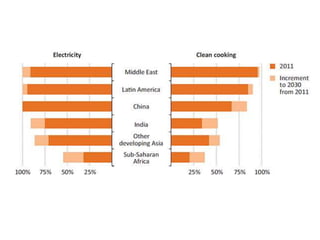
General Energy Use Problems &
Energy Audit
Presented By
Neetu Meena
Assistant Professor
Oriental University, Indore
• For Economic Development of any
country energy is needed
Introduction
Use of Energy
• Household
– Heating, cooling, cooking, lighting & appliances
• Transportation
– Fuels for car, trucks, planes, trains and ships
• Industrial Sector
– Factories, industries complexes, R&D division, Trades
etc
• Health education and welfare activities
– Administration, water supply sewage & trash disposal,
military forces, hospitals & schools
Increasing awareness
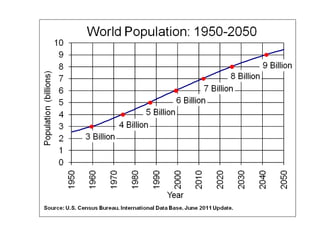
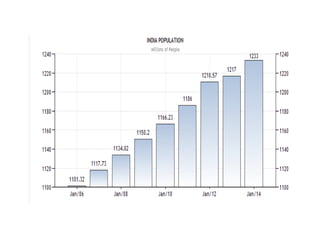
• Population increase
• Per head energy requirement is growing
Energy crises
• An energy crisis is any great bottleneck (or
price rise) in the supply of energy resources to
an economy.
or
• The energy crisis is the concern that the
world’s demands on the limited natural
resources that are used to power industrial
society are diminishing as the demand rises.
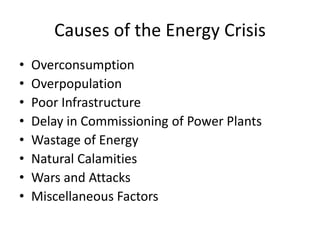
Causes of the Energy Crisis
• Overconsumption
• Overpopulation
• Poor Infrastructure
• Delay in Commissioning of Power Plants
• Wastage of Energy
• Natural Calamities
• Wars and Attacks
• Miscellaneous Factors
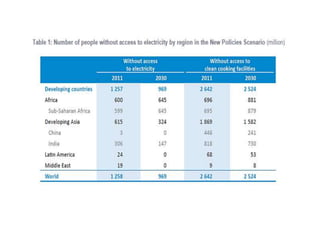
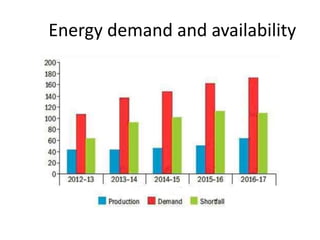
Energy demand and availability
Methods to mitigate Energy crises
• Energy Conservation: Can be result of several
process or developments such as productivity
increase or technological progress.
• Energy Efficiency: is achieved when energy
intensity in a specific product process or area of
production or consumption is reduced without
affecting output, consumption or comfort level.
• Promotion of energy efficiency will contribute to
energy conservation
Energy Strategy for Future
• Immediate term strategy
– Rationalizing the tariff structure
– Optimum utilization of existing assets
– Promoting R & D
• Medium term strategy
– Use of train for good movement instead of bus good movement
– Use of public transport rather than private
– Planning of new & renewable plants
• Long term strategy
– Implementation of new & renewable plants
– Deregulation
– privatization
Energy Scenario
World energy scenario
• The production of electricity in 2009 was 20,053TWh.
• Sources of electricity were fossil fuels 67%, renewable energy
16% (mainly hydroelectric, wind, solar and biomass), and
nuclear power 13%, and other sources were 3%.
• The majority of fossil fuel usage for the generation of
electricity was coal and gas.
• Oil was 5.5%, as it is the most expensive common commodity
used to produce electrical energy.
• Ninety-two percent of renewable energy was hydroelectric
followed by wind at 6% and geothermal at 1.8%.
• Solar photovoltaic was 0.06%, and solar thermal was 0.004%
• The electricity sector in India had an installed capacity of 210.951
GW as of December 2012. the world's fifth largest.
• Non Renewable Power Plants constitute 88.55% of the installed
capacity and 11.45% of Renewable Capacity.
• The per capita average annual domestic electricity consumption in
India in 2009 was 96 kWh in rural areas and 288 kWh in urban
areas for those with access to electricity, in contrast to the
worldwide per capita annual average of 2600 kWh and 6200 kWh
in the European Union.
• The International Energy Agency estimates India will add between
600 GW to 1200 GW of additional new power generation capacity
before 2050.
• The Government pegs the national T&D losses at around 24% for
the year 2011 & has set a target of reducing it to 17.1% by 2017 &
to 14.1% by 2022. A case study in Kerala estimated that replacing
faulty meters could reduce distribution losses from 34% to 29%.
India Energy Scenario
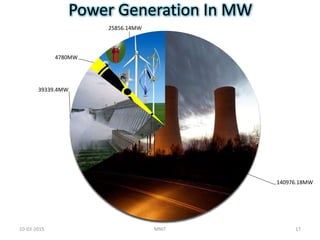
Power Generation In MW
14-03-2015 MNIT 17
140976.18MW
39339.4MW
4780MW
25856.14MW
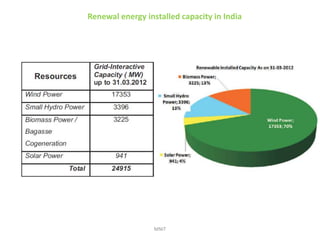
Renewal energy installed capacity in India
MNIT
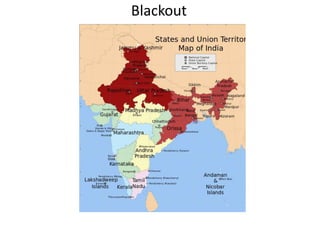
Blackout
Energy Audit
Energy Audit
• Energy conservation tool
• Energy Audit is the key to a systematic approach
for decision-making in the area of energy
management.
• By Wikipedia
“ Is an inspection, survey and Analysis of energy
flow for energy conservation in a building process
or system to reduce the amount of energy input
into the system without negatively affecting the
output”
• As per the Energy Conservation Act, 2001,
Energy Audit is
“the verification, monitoring and analysis of use
of energy including submission of technical
report containing recommendations for
improving energy efficiency with cost benefit
analysis and an action plan to reduce energy
consumption”
What is the need of Energy Audit
• The three top operating expenses are energy, labour
and materials.
• Energy would emerge as a top ranker for cost
reduction
• Primary objective of Energy Audit is to determine ways
to reduce energy consumption per unit of product
output or to lower operating costs
• Energy Audit provides a “ bench-mark” (Reference
point) for managing energy in the organization
Types of Energy Audits
1. Preliminary Energy Audit
2. Targeted Energy Audit
3. Detailed Energy Audit
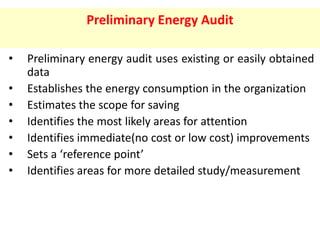
Preliminary Energy Audit
• Preliminary energy audit uses existing or easily obtained
data
• Establishes the energy consumption in the organization
• Estimates the scope for saving
• Identifies the most likely areas for attention
• Identifies immediate(no cost or low cost) improvements
• Sets a ‘reference point’
• Identifies areas for more detailed study/measurement
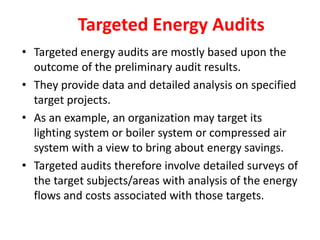
Targeted Energy Audits
• Targeted energy audits are mostly based upon the
outcome of the preliminary audit results.
• They provide data and detailed analysis on specified
target projects.
• As an example, an organization may target its
lighting system or boiler system or compressed air
system with a view to bring about energy savings.
• Targeted audits therefore involve detailed surveys of
the target subjects/areas with analysis of the energy
flows and costs associated with those targets.
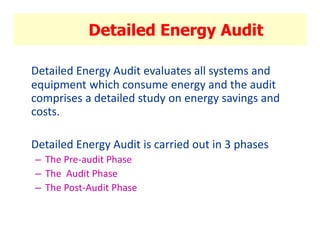
Detailed Energy Audit
Detailed Energy Audit evaluates all systems and
equipment which consume energy and the audit
comprises a detailed study on energy savings and
costs.
Detailed Energy Audit is carried out in 3 phases
– The Pre-audit Phase
– The Audit Phase
– The Post-Audit Phase
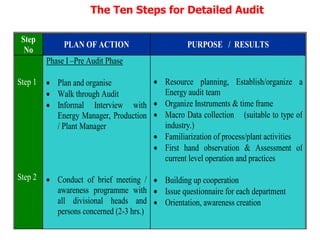
The Ten Steps for Detailed Audit
Step
No
PLAN OF ACTION PURPOSE / RESULTS
Step 1
Step 2
Phase I –Pre Audit Phase
 Plan and organise
 Walk through Audit
 Informal Interview with
Energy Manager, Production
/ Plant Manager
 Conduct of brief meeting /
awareness programme with
all divisional heads and
persons concerned (2-3 hrs.)
 Resource planning, Establish/organize a
Energy audit team
 Organize Instruments & time frame
 Macro Data collection (suitable to type of
industry.)
 Familiarization of process/plant activities
 First hand observation & Assessment of
current level operation and practices
 Building up cooperation
 Issue questionnaire for each department
 Orientation, awareness creation
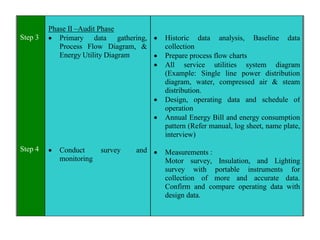
Step 3
Step 4
Phase II –Audit Phase
 Primary data gathering,
Process Flow Diagram, &
Energy Utility Diagram
 Conduct survey and
monitoring
 Historic data analysis, Baseline data
collection
 Prepare process flow charts
 All service utilities system diagram
(Example: Single line power distribution
diagram, water, compressed air & steam
distribution.
 Design, operating data and schedule of
operation
 Annual Energy Bill and energy consumption
pattern (Refer manual, log sheet, name plate,
interview)
 Measurements :
Motor survey, Insulation, and Lighting
survey with portable instruments for
collection of more and accurate data.
Confirm and compare operating data with
design data.
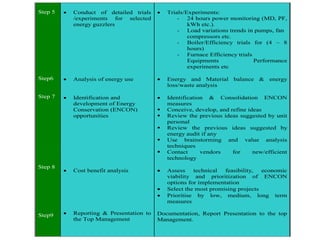
Step 5
Step6
Step 7
Step 8
Step9
 Conduct of detailed trials
/experiments for selected
energy guzzlers
 Analysis of energy use
 Identification and
development of Energy
Conservation (ENCON)
opportunities
 Cost benefit analysis
 Reporting & Presentation to
the Top Management
 Trials/Experiments:
- 24 hours power monitoring (MD, PF,
kWh etc.).
- Load variations trends in pumps, fan
compressors etc.
- Boiler/Efficiency trials for (4 – 8
hours)
- Furnace Efficiency trials
Equipments Performance
experiments etc
 Energy and Material balance & energy
loss/waste analysis
 Identification & Consolidation ENCON
measures
Conceive, develop, and refine ideas
Review the previous ideas suggested by unit
personal
Review the previous ideas suggested by
energy audit if any
Use brainstorming and value analysis
techniques
Contact vendors for new/efficient
technology
 Assess technical feasibility, economic
viability and prioritization of ENCON
options for implementation
 Select the most promising projects
 Prioritise by low, medium, long term
measures
Documentation, Report Presentation to the top
Management.
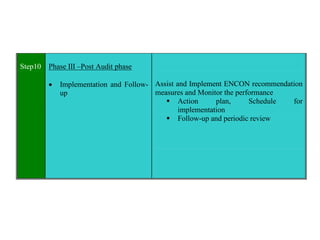
Step10 Phase III –Post Audit phase
 Implementation and Follow-
up
Assist and Implement ENCON recommendation
measures and Monitor the performance
Action plan, Schedule for
implementation
Follow-up and periodic review
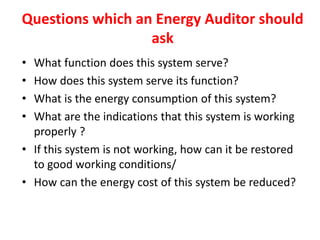
Questions which an Energy Auditor should
ask
• What function does this system serve?
• How does this system serve its function?
• What is the energy consumption of this system?
• What are the indications that this system is working
properly ?
• If this system is not working, how can it be restored
to good working conditions/
• How can the energy cost of this system be reduced?
DETAILED ENERGY AUDIT
A TYPICAL INDUSTRIAL FORMAT
Energy Audit Team
Executive Summary –Scope & Purpose
Energy Audit Options & Recommendations
1.0 Introduction about the plant
1.1 General Plant details and descriptions
1.2 Component of production cost (Raw materials, energy, chemicals,
manpower, overhead, others)
1.3 Major Energy use and Areas
2.0 Production Process Description
2.1 Brief description of manufacturing process
2.2 Process flow diagram and Major Unit operations
2.3 Major Raw material Inputs, Quantity and Costs
3.0 Energy and Utility System Description
3.1 List of Utilities
3.2 Brief Description of each utility
3.2.1 Electricity
3.2.2 Steam
3.2.3 Water
3.2.4 Compressed air
3.2.5 Chilled water
3.2.6 Cooling water
4.0 Detailed Process flow diagram and Energy& Material balance
4.1 Flow chart showing flow rate, temperature, pressures of all input-
Output streams
4Water balance for entire industry
5.0 Energy efficiency in utility and process systems
5.1 Specific Energy consumption
5.2 Boiler efficiency assessment
5.3 Thermic Fluid Heater performance assessments
5.4 Furnace efficiency Analysis
5.5 Cooling water system performance assessment
5.6 DG set performance assessment
5.7 Refrigeration system performance
5.8 Compressed air system performance
5.9 Electric motor load analysis
5.10 Lighting system
6.0 Energy Conservation Options & Recommendations
6.1 List of options in terms of no cost, low cost, medium cost and high cost, annual energy
savings and payback
6.2 Implementation plan for energy saving measures/Projects
ANNEXURE
Al. List of instruments
A2. List of Vendors and Other Technical details
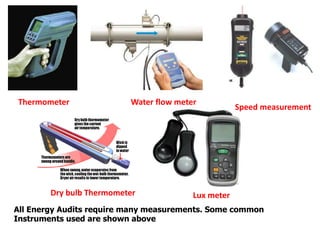
All Energy Audits require many measurements. Some common
Instruments used are shown above
Thermometer Water flow meter
Speed measurement
Lux meterDry bulb Thermometer
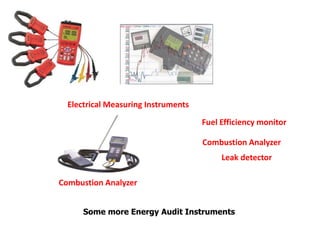
Some more Energy Audit Instruments
Combustion Analyzer
Electrical Measuring Instruments
Fuel Efficiency monitor
Combustion Analyzer
Leak detector
How Instrumentation Contributes to
Cost Reduction
• Energy flow is invisible
• Instruments help to generate accurate and real
time information
• Bring to light operational lapses or inadequacies
• Trigger steps to correct these lapses, leading to
optimization and savings
• Provide sound basis for management decisions on
strategy, targets, investments etc
• Implementation of these decisions leads to even
bigger savings
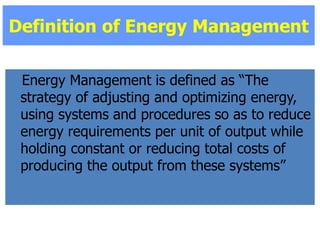
Definition of Energy Management
Energy Management is defined as “The
strategy of adjusting and optimizing energy,
using systems and procedures so as to reduce
energy requirements per unit of output while
holding constant or reducing total costs of
producing the output from these systems”
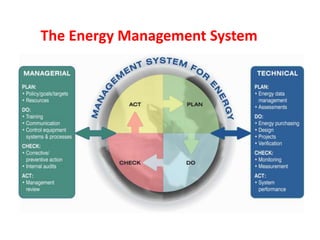
The Energy Management System
The Objectives of Energy Management
1. To achieve and maintain optimum energy
procurement and utilization, throughout the
organization
2. To minimize energy costs / waste without affecting
production & quality
3. To minimize environmental effects.
Energy Management Objectives Clarified
The basic objective of any Energy Management
System is to answer five simple questions:
• How much energy is consumed
• How is the energy consumed
• Where is the energy consumed
• When is the energy consumed
• What is the quality of the energy consumed
In order to address these queries Energy Audits are
conducted.
EM is strikingly similar to FINANCIAL management:
• Identify goals;
• Select the investments needed to reach the goals
• Establish strategy for goal attainment
• Start early, if only with small efforts
• Maintain regular contributions over time
• Keep track of earnings
• Defeat risk through reinvestment and diversification
of earnings.
Energy and Financial Management
Initial Effort (First two years)
– 5-15% cost savings
Long-Term Effort
– 25% or higher cost savings
Energy Management Benefits
Monitoring & Targeting ( M&T)
 M&T is primarily a management technique that uses
energy information as a basis to eliminate wastage,
reduce and control the current level of energy use,
and improve the existing operating practices .
Monitoring: Establishes the existing pattern of energy
consumption.
Targeting: Identifies the energy consumption level that is
desirable, as a management goal to work toward energy
conservation.
5% to 20% reduction in annual energy cost
Elements of Monitoring & Targeting System
 Recording : Measuring and recording energy consumption
 Analyzing :Correlating energy consumption to a measured output, such as
production quantity
 Comparing : Comparing energy consumption to an appropriate standard
or benchmark
 Setting Targets : Setting targets to reduce or control energy consumption
 Monitoring: Comparing energy consumption to the set target on a regular
basis
 Reporting : Reporting the results including any variances from the targets
which have been set
 Controlling : Implementing management measures to correct any
variances that may have occurred
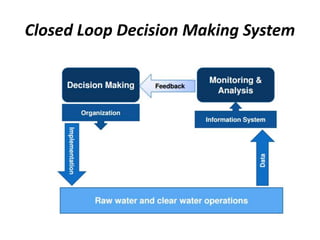
Closed Loop Decision Making System
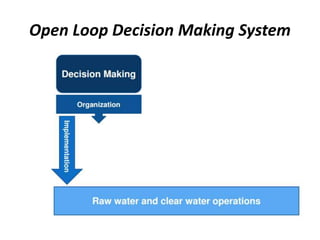
Open Loop Decision Making System
Energy Accounting
• Energy accounting is a process for recording,
tracking, and reporting the amount and costs
of the various consumable utilities used by
commercial-scale facilities.
“You cannot manage what you cannot measure”
Benefits of Accounting
• An energy accounting system can assist municipalities in
exposing excessive costs and identifying opportunities for
saving money:
– Find billing errors
– Account for usage
– Spot cost trends
– Track cost & usage fluctuations
– Allow comparisons
– Establish utilities budgets quickly and efficiently
– Provide a basis for troubleshooting high usage/costs
– Justify capital expenditures
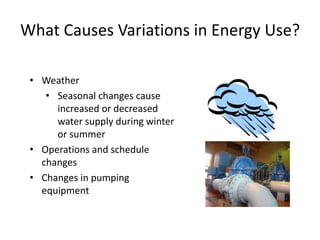
What Causes Variations in Energy Use?
• Weather
• Seasonal changes cause
increased or decreased
water supply during winter
or summer
• Operations and schedule
changes
• Changes in pumping
equipment
Tools of Energy Management
• Energy Audit
• Energy monitoring
• Targeting
• Accounting
•Designate an Energy Management Coordinator
•Establish the Energy Management Team
•Evaluate cost saving opportunities
•Prioritize implementation
•Evaluate success (e.g. benchmarking) and promote
Starting Your Energy Action Plan
• A single person
• Dynamic
• Goal oriented
• Good manager
• Wears other hats
Energy Management Coordinator
• Architect of the “Energy Action Plan”
• Provide effective energy reporting and
analysis (energy accounting)
• Secure management commitment
• Establish “cost center” mentality
• Establish energy cost/usage standards
• Provide EM training
• Set EM objectives (defined goals)
GOALS OF THE EMC
• Reduce electric cost per unit of production by
10% the first year and 5% in the second
• Within 2 years all tenants will be separately
metered
• Facility will have a contingency plan for gas
curtailment by end of first year
• All boilers will be examined for waste heat
recovery potential the first year
EXAMPLE ENERGY MANGEMENT
GOALS
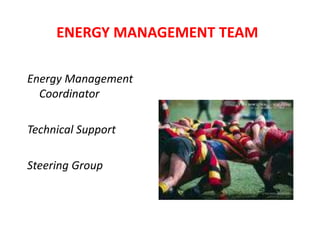
Energy Management
Coordinator
Technical Support
Steering Group
ENERGY MANAGEMENT TEAM
• Several people
• Part-time duty
• Strong technical background
• Able to provide technical support and
update knowledge on new technologies
• May include consultants and vendors
TECHNICAL SUPPORT
• Several people
• Part-time duty
• Guides activities
• Aids in communication
• From various departments
–Personnel department
–Production workers
STEERING GROUP
Language of energy manager
• What needs to be done?
• Who will do it?
• When it will be carried out and completed?
• What resources are required?
• How much finance is to be budgeted?
Questionnaire
• How much energy we are consuming?
• Where is the energy consumed?
• How efficiently is the energy consumed?
• Can there be improvements in energy use?
Check list for top management
• Determine major factor of energy
consumption
• Determine major factor contributing to over
all energy usage in a specific area
• Discover technique for energy savings
• Provide guidance
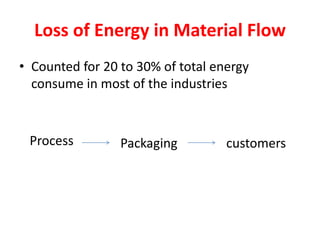
Loss of Energy in Material Flow
• Counted for 20 to 30% of total energy
consume in most of the industries
Process Packaging customers
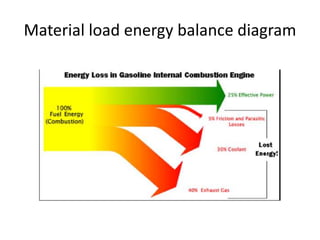
Material load energy balance diagram
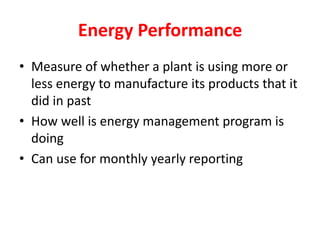
Energy Performance
• Measure of whether a plant is using more or
less energy to manufacture its products that it
did in past
• How well is energy management program is
doing
• Can use for monthly yearly reporting
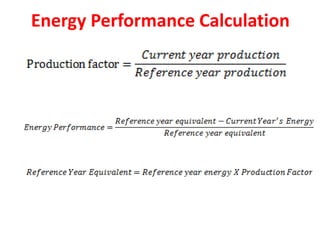
Energy Performance Calculation
Maximizing system efficiency
• Leakage elimination if exist
• Maximizing recovery
• Use of energy efficient equipment
Optimising the Input Energy
Requirements
• Periodic review or maintenance of equipment
– Insulation
– Repair parts if needed
• Identify potential for heat exchanger
networking and process integration
• Minimizing the wastage
Energy conservation policy
• Conservation Act 2001,
•Enacted on 1st October 2001.
•Become effective from 1st March
2002.
•Objective of providing necessary
legal framework for promoting
energy conservation measures in
the country.
•Bureau of Energy Efficiency(BEE)
operationalized from 1st March2002.
Energy conservation ACT 2001
70
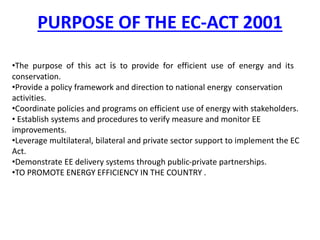
PURPOSE OF THE EC-ACT 2001
•The purpose of this act is to provide for efficient use of energy and its
conservation.
•Provide a policy framework and direction to national energy conservation
activities.
•Coordinate policies and programs on efficient use of energy with stakeholders.
• Establish systems and procedures to verify measure and monitor EE
improvements.
•Leverage multilateral, bilateral and private sector support to implement the EC
Act.
•Demonstrate EE delivery systems through public-private partnerships.
•TO PROMOTE ENERGY EFFICIENCY IN THE COUNTRY .
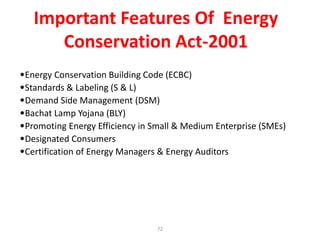
•Energy Conservation Building Code (ECBC)
•Standards & Labeling (S & L)
•Demand Side Management (DSM)
•Bachat Lamp Yojana (BLY)
•Promoting Energy Efficiency in Small & Medium Enterprise (SMEs)
•Designated Consumers
•Certification of Energy Managers & Energy Auditors
Important Features Of Energy
Conservation Act-2001
72

1. general energy use problems & energy audit

  • 1.
    General Energy UseProblems & Energy Audit Presented By Neetu Meena Assistant Professor Oriental University, Indore
  • 2.
    • For EconomicDevelopment of any country energy is needed Introduction
  • 3.
    Use of Energy •Household – Heating, cooling, cooking, lighting & appliances • Transportation – Fuels for car, trucks, planes, trains and ships • Industrial Sector – Factories, industries complexes, R&D division, Trades etc • Health education and welfare activities – Administration, water supply sewage & trash disposal, military forces, hospitals & schools
  • 4.
    Increasing awareness • Populationincrease • Per head energy requirement is growing
  • 7.
    Energy crises • Anenergy crisis is any great bottleneck (or price rise) in the supply of energy resources to an economy. or • The energy crisis is the concern that the world’s demands on the limited natural resources that are used to power industrial society are diminishing as the demand rises.
  • 10.
    Causes of theEnergy Crisis • Overconsumption • Overpopulation • Poor Infrastructure • Delay in Commissioning of Power Plants • Wastage of Energy • Natural Calamities • Wars and Attacks • Miscellaneous Factors
  • 11.
    Energy demand andavailability
  • 12.
    Methods to mitigateEnergy crises • Energy Conservation: Can be result of several process or developments such as productivity increase or technological progress. • Energy Efficiency: is achieved when energy intensity in a specific product process or area of production or consumption is reduced without affecting output, consumption or comfort level. • Promotion of energy efficiency will contribute to energy conservation
  • 13.
    Energy Strategy forFuture • Immediate term strategy – Rationalizing the tariff structure – Optimum utilization of existing assets – Promoting R & D • Medium term strategy – Use of train for good movement instead of bus good movement – Use of public transport rather than private – Planning of new & renewable plants • Long term strategy – Implementation of new & renewable plants – Deregulation – privatization
  • 14.
  • 15.
    World energy scenario •The production of electricity in 2009 was 20,053TWh. • Sources of electricity were fossil fuels 67%, renewable energy 16% (mainly hydroelectric, wind, solar and biomass), and nuclear power 13%, and other sources were 3%. • The majority of fossil fuel usage for the generation of electricity was coal and gas. • Oil was 5.5%, as it is the most expensive common commodity used to produce electrical energy. • Ninety-two percent of renewable energy was hydroelectric followed by wind at 6% and geothermal at 1.8%. • Solar photovoltaic was 0.06%, and solar thermal was 0.004%
  • 16.
    • The electricitysector in India had an installed capacity of 210.951 GW as of December 2012. the world's fifth largest. • Non Renewable Power Plants constitute 88.55% of the installed capacity and 11.45% of Renewable Capacity. • The per capita average annual domestic electricity consumption in India in 2009 was 96 kWh in rural areas and 288 kWh in urban areas for those with access to electricity, in contrast to the worldwide per capita annual average of 2600 kWh and 6200 kWh in the European Union. • The International Energy Agency estimates India will add between 600 GW to 1200 GW of additional new power generation capacity before 2050. • The Government pegs the national T&D losses at around 24% for the year 2011 & has set a target of reducing it to 17.1% by 2017 & to 14.1% by 2022. A case study in Kerala estimated that replacing faulty meters could reduce distribution losses from 34% to 29%. India Energy Scenario
  • 17.
    Power Generation InMW 14-03-2015 MNIT 17 140976.18MW 39339.4MW 4780MW 25856.14MW
  • 18.
    Renewal energy installedcapacity in India MNIT
  • 19.
  • 20.
  • 21.
    Energy Audit • Energyconservation tool • Energy Audit is the key to a systematic approach for decision-making in the area of energy management. • By Wikipedia “ Is an inspection, survey and Analysis of energy flow for energy conservation in a building process or system to reduce the amount of energy input into the system without negatively affecting the output”
  • 22.
    • As perthe Energy Conservation Act, 2001, Energy Audit is “the verification, monitoring and analysis of use of energy including submission of technical report containing recommendations for improving energy efficiency with cost benefit analysis and an action plan to reduce energy consumption”
  • 23.
    What is theneed of Energy Audit • The three top operating expenses are energy, labour and materials. • Energy would emerge as a top ranker for cost reduction • Primary objective of Energy Audit is to determine ways to reduce energy consumption per unit of product output or to lower operating costs • Energy Audit provides a “ bench-mark” (Reference point) for managing energy in the organization
  • 24.
    Types of EnergyAudits 1. Preliminary Energy Audit 2. Targeted Energy Audit 3. Detailed Energy Audit
  • 25.
    Preliminary Energy Audit •Preliminary energy audit uses existing or easily obtained data • Establishes the energy consumption in the organization • Estimates the scope for saving • Identifies the most likely areas for attention • Identifies immediate(no cost or low cost) improvements • Sets a ‘reference point’ • Identifies areas for more detailed study/measurement
  • 26.
    Targeted Energy Audits •Targeted energy audits are mostly based upon the outcome of the preliminary audit results. • They provide data and detailed analysis on specified target projects. • As an example, an organization may target its lighting system or boiler system or compressed air system with a view to bring about energy savings. • Targeted audits therefore involve detailed surveys of the target subjects/areas with analysis of the energy flows and costs associated with those targets.
  • 27.
    Detailed Energy Audit DetailedEnergy Audit evaluates all systems and equipment which consume energy and the audit comprises a detailed study on energy savings and costs. Detailed Energy Audit is carried out in 3 phases – The Pre-audit Phase – The Audit Phase – The Post-Audit Phase
  • 28.
    The Ten Stepsfor Detailed Audit Step No PLAN OF ACTION PURPOSE / RESULTS Step 1 Step 2 Phase I –Pre Audit Phase  Plan and organise  Walk through Audit  Informal Interview with Energy Manager, Production / Plant Manager  Conduct of brief meeting / awareness programme with all divisional heads and persons concerned (2-3 hrs.)  Resource planning, Establish/organize a Energy audit team  Organize Instruments & time frame  Macro Data collection (suitable to type of industry.)  Familiarization of process/plant activities  First hand observation & Assessment of current level operation and practices  Building up cooperation  Issue questionnaire for each department  Orientation, awareness creation
  • 29.
    Step 3 Step 4 PhaseII –Audit Phase  Primary data gathering, Process Flow Diagram, & Energy Utility Diagram  Conduct survey and monitoring  Historic data analysis, Baseline data collection  Prepare process flow charts  All service utilities system diagram (Example: Single line power distribution diagram, water, compressed air & steam distribution.  Design, operating data and schedule of operation  Annual Energy Bill and energy consumption pattern (Refer manual, log sheet, name plate, interview)  Measurements : Motor survey, Insulation, and Lighting survey with portable instruments for collection of more and accurate data. Confirm and compare operating data with design data.
  • 30.
    Step 5 Step6 Step 7 Step8 Step9  Conduct of detailed trials /experiments for selected energy guzzlers  Analysis of energy use  Identification and development of Energy Conservation (ENCON) opportunities  Cost benefit analysis  Reporting & Presentation to the Top Management  Trials/Experiments: - 24 hours power monitoring (MD, PF, kWh etc.). - Load variations trends in pumps, fan compressors etc. - Boiler/Efficiency trials for (4 – 8 hours) - Furnace Efficiency trials Equipments Performance experiments etc  Energy and Material balance & energy loss/waste analysis  Identification & Consolidation ENCON measures Conceive, develop, and refine ideas Review the previous ideas suggested by unit personal Review the previous ideas suggested by energy audit if any Use brainstorming and value analysis techniques Contact vendors for new/efficient technology  Assess technical feasibility, economic viability and prioritization of ENCON options for implementation  Select the most promising projects  Prioritise by low, medium, long term measures Documentation, Report Presentation to the top Management.
  • 31.
    Step10 Phase III–Post Audit phase  Implementation and Follow- up Assist and Implement ENCON recommendation measures and Monitor the performance Action plan, Schedule for implementation Follow-up and periodic review
  • 32.
    Questions which anEnergy Auditor should ask • What function does this system serve? • How does this system serve its function? • What is the energy consumption of this system? • What are the indications that this system is working properly ? • If this system is not working, how can it be restored to good working conditions/ • How can the energy cost of this system be reduced?
  • 33.
    DETAILED ENERGY AUDIT ATYPICAL INDUSTRIAL FORMAT Energy Audit Team Executive Summary –Scope & Purpose Energy Audit Options & Recommendations 1.0 Introduction about the plant 1.1 General Plant details and descriptions 1.2 Component of production cost (Raw materials, energy, chemicals, manpower, overhead, others) 1.3 Major Energy use and Areas 2.0 Production Process Description 2.1 Brief description of manufacturing process 2.2 Process flow diagram and Major Unit operations 2.3 Major Raw material Inputs, Quantity and Costs 3.0 Energy and Utility System Description 3.1 List of Utilities 3.2 Brief Description of each utility 3.2.1 Electricity 3.2.2 Steam 3.2.3 Water 3.2.4 Compressed air 3.2.5 Chilled water 3.2.6 Cooling water
  • 34.
    4.0 Detailed Processflow diagram and Energy& Material balance 4.1 Flow chart showing flow rate, temperature, pressures of all input- Output streams 4Water balance for entire industry 5.0 Energy efficiency in utility and process systems 5.1 Specific Energy consumption 5.2 Boiler efficiency assessment 5.3 Thermic Fluid Heater performance assessments 5.4 Furnace efficiency Analysis 5.5 Cooling water system performance assessment 5.6 DG set performance assessment 5.7 Refrigeration system performance 5.8 Compressed air system performance 5.9 Electric motor load analysis 5.10 Lighting system 6.0 Energy Conservation Options & Recommendations 6.1 List of options in terms of no cost, low cost, medium cost and high cost, annual energy savings and payback 6.2 Implementation plan for energy saving measures/Projects ANNEXURE Al. List of instruments A2. List of Vendors and Other Technical details
  • 35.
    All Energy Auditsrequire many measurements. Some common Instruments used are shown above Thermometer Water flow meter Speed measurement Lux meterDry bulb Thermometer
  • 36.
    Some more EnergyAudit Instruments Combustion Analyzer Electrical Measuring Instruments Fuel Efficiency monitor Combustion Analyzer Leak detector
  • 37.
    How Instrumentation Contributesto Cost Reduction • Energy flow is invisible • Instruments help to generate accurate and real time information • Bring to light operational lapses or inadequacies • Trigger steps to correct these lapses, leading to optimization and savings • Provide sound basis for management decisions on strategy, targets, investments etc • Implementation of these decisions leads to even bigger savings
  • 39.
    Definition of EnergyManagement Energy Management is defined as “The strategy of adjusting and optimizing energy, using systems and procedures so as to reduce energy requirements per unit of output while holding constant or reducing total costs of producing the output from these systems”
  • 40.
  • 41.
    The Objectives ofEnergy Management 1. To achieve and maintain optimum energy procurement and utilization, throughout the organization 2. To minimize energy costs / waste without affecting production & quality 3. To minimize environmental effects.
  • 42.
    Energy Management ObjectivesClarified The basic objective of any Energy Management System is to answer five simple questions: • How much energy is consumed • How is the energy consumed • Where is the energy consumed • When is the energy consumed • What is the quality of the energy consumed In order to address these queries Energy Audits are conducted.
  • 43.
    EM is strikinglysimilar to FINANCIAL management: • Identify goals; • Select the investments needed to reach the goals • Establish strategy for goal attainment • Start early, if only with small efforts • Maintain regular contributions over time • Keep track of earnings • Defeat risk through reinvestment and diversification of earnings. Energy and Financial Management
  • 44.
    Initial Effort (Firsttwo years) – 5-15% cost savings Long-Term Effort – 25% or higher cost savings Energy Management Benefits
  • 45.
    Monitoring & Targeting( M&T)  M&T is primarily a management technique that uses energy information as a basis to eliminate wastage, reduce and control the current level of energy use, and improve the existing operating practices . Monitoring: Establishes the existing pattern of energy consumption. Targeting: Identifies the energy consumption level that is desirable, as a management goal to work toward energy conservation. 5% to 20% reduction in annual energy cost
  • 46.
    Elements of Monitoring& Targeting System  Recording : Measuring and recording energy consumption  Analyzing :Correlating energy consumption to a measured output, such as production quantity  Comparing : Comparing energy consumption to an appropriate standard or benchmark  Setting Targets : Setting targets to reduce or control energy consumption  Monitoring: Comparing energy consumption to the set target on a regular basis  Reporting : Reporting the results including any variances from the targets which have been set  Controlling : Implementing management measures to correct any variances that may have occurred
  • 47.
    Closed Loop DecisionMaking System
  • 48.
    Open Loop DecisionMaking System
  • 49.
    Energy Accounting • Energyaccounting is a process for recording, tracking, and reporting the amount and costs of the various consumable utilities used by commercial-scale facilities. “You cannot manage what you cannot measure”
  • 50.
    Benefits of Accounting •An energy accounting system can assist municipalities in exposing excessive costs and identifying opportunities for saving money: – Find billing errors – Account for usage – Spot cost trends – Track cost & usage fluctuations – Allow comparisons – Establish utilities budgets quickly and efficiently – Provide a basis for troubleshooting high usage/costs – Justify capital expenditures
  • 51.
    What Causes Variationsin Energy Use? • Weather • Seasonal changes cause increased or decreased water supply during winter or summer • Operations and schedule changes • Changes in pumping equipment
  • 52.
    Tools of EnergyManagement • Energy Audit • Energy monitoring • Targeting • Accounting
  • 53.
    •Designate an EnergyManagement Coordinator •Establish the Energy Management Team •Evaluate cost saving opportunities •Prioritize implementation •Evaluate success (e.g. benchmarking) and promote Starting Your Energy Action Plan
  • 54.
    • A singleperson • Dynamic • Goal oriented • Good manager • Wears other hats Energy Management Coordinator
  • 55.
    • Architect ofthe “Energy Action Plan” • Provide effective energy reporting and analysis (energy accounting) • Secure management commitment • Establish “cost center” mentality • Establish energy cost/usage standards • Provide EM training • Set EM objectives (defined goals) GOALS OF THE EMC
  • 56.
    • Reduce electriccost per unit of production by 10% the first year and 5% in the second • Within 2 years all tenants will be separately metered • Facility will have a contingency plan for gas curtailment by end of first year • All boilers will be examined for waste heat recovery potential the first year EXAMPLE ENERGY MANGEMENT GOALS
  • 57.
  • 58.
    • Several people •Part-time duty • Strong technical background • Able to provide technical support and update knowledge on new technologies • May include consultants and vendors TECHNICAL SUPPORT
  • 59.
    • Several people •Part-time duty • Guides activities • Aids in communication • From various departments –Personnel department –Production workers STEERING GROUP
  • 60.
    Language of energymanager • What needs to be done? • Who will do it? • When it will be carried out and completed? • What resources are required? • How much finance is to be budgeted?
  • 61.
    Questionnaire • How muchenergy we are consuming? • Where is the energy consumed? • How efficiently is the energy consumed? • Can there be improvements in energy use?
  • 62.
    Check list fortop management • Determine major factor of energy consumption • Determine major factor contributing to over all energy usage in a specific area • Discover technique for energy savings • Provide guidance
  • 63.
    Loss of Energyin Material Flow • Counted for 20 to 30% of total energy consume in most of the industries Process Packaging customers
  • 64.
    Material load energybalance diagram
  • 65.
    Energy Performance • Measureof whether a plant is using more or less energy to manufacture its products that it did in past • How well is energy management program is doing • Can use for monthly yearly reporting
  • 66.
  • 67.
    Maximizing system efficiency •Leakage elimination if exist • Maximizing recovery • Use of energy efficient equipment
  • 68.
    Optimising the InputEnergy Requirements • Periodic review or maintenance of equipment – Insulation – Repair parts if needed • Identify potential for heat exchanger networking and process integration • Minimizing the wastage
  • 69.
    Energy conservation policy •Conservation Act 2001,
  • 70.
    •Enacted on 1stOctober 2001. •Become effective from 1st March 2002. •Objective of providing necessary legal framework for promoting energy conservation measures in the country. •Bureau of Energy Efficiency(BEE) operationalized from 1st March2002. Energy conservation ACT 2001 70
  • 71.
    PURPOSE OF THEEC-ACT 2001 •The purpose of this act is to provide for efficient use of energy and its conservation. •Provide a policy framework and direction to national energy conservation activities. •Coordinate policies and programs on efficient use of energy with stakeholders. • Establish systems and procedures to verify measure and monitor EE improvements. •Leverage multilateral, bilateral and private sector support to implement the EC Act. •Demonstrate EE delivery systems through public-private partnerships. •TO PROMOTE ENERGY EFFICIENCY IN THE COUNTRY .
  • 72.
    •Energy Conservation BuildingCode (ECBC) •Standards & Labeling (S & L) •Demand Side Management (DSM) •Bachat Lamp Yojana (BLY) •Promoting Energy Efficiency in Small & Medium Enterprise (SMEs) •Designated Consumers •Certification of Energy Managers & Energy Auditors Important Features Of Energy Conservation Act-2001 72