Ved Prakash Verma
Lecturer, Electrical Engineering Department
Atal Bihari Vajpayee Govt. Institute of Engineering &
Technology Pragatinagar Shimla-171202(HP)
 The energy audit is the key for decision-making in
the area of energy management.
 As per India Energy Conservation Act 2001, the
energy audit is defined as the verification,
monitoring and analysis of use of energy including
submission of technical report containing
recommendations for improving energy efficiency
with cost benefit analysis and an action plan to
reduce energy consumption.
OR
 Energy audit is an inspection, survey and analysis of
energy flows for energy conservation to reduce the
amount of energy input into the system without
negatively affecting the output.
 Primary need of energy audit is to determine ways
to reduce energy consumption per unit of product
output or to lower operating cost.
 To reduce the operating expense on top three
categories of any industry or organization i.e.
energy (electrical and thermal), labour and
materials.
 As energy would be top ranker for cost reduction,
which can be technically achieved by energy audit.
 To develop a “bench-mark” or reference point for
managing energy in any industry or organization.
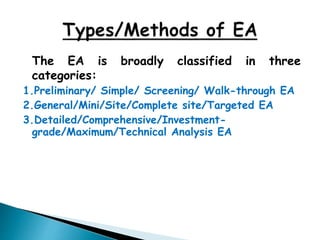
The EA is broadly classified in three
categories:
1.Preliminary/ Simple/ Screening/ Walk-through EA
2.General/Mini/Site/Complete site/Targeted EA
3.Detailed/Comprehensive/Investment-
grade/Maximum/Technical Analysis EA
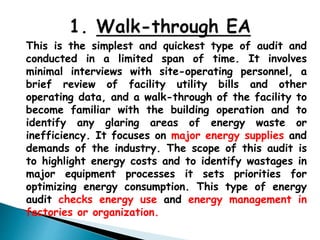
This is the simplest and quickest type of audit and
conducted in a limited span of time. It involves
minimal interviews with site-operating personnel, a
brief review of facility utility bills and other
operating data, and a walk-through of the facility to
become familiar with the building operation and to
identify any glaring areas of energy waste or
inefficiency. It focuses on major energy supplies and
demands of the industry. The scope of this audit is
to highlight energy costs and to identify wastages in
major equipment processes it sets priorities for
optimizing energy consumption. This type of energy
audit checks energy use and energy management in
factories or organization.
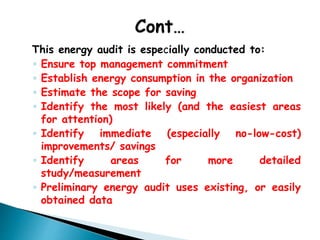
This energy audit is especially conducted to:
◦ Ensure top management commitment
◦ Establish energy consumption in the organization
◦ Estimate the scope for saving
◦ Identify the most likely (and the easiest areas
for attention)
◦ Identify immediate (especially no-low-cost)
improvements/ savings
◦ Identify areas for more detailed
study/measurement
◦ Preliminary energy audit uses existing, or easily
obtained data
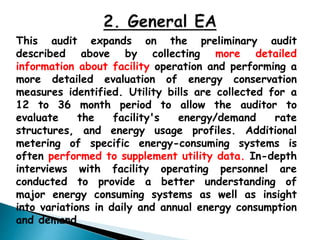
This audit expands on the preliminary audit
described above by collecting more detailed
information about facility operation and performing a
more detailed evaluation of energy conservation
measures identified. Utility bills are collected for a
12 to 36 month period to allow the auditor to
evaluate the facility's energy/demand rate
structures, and energy usage profiles. Additional
metering of specific energy-consuming systems is
often performed to supplement utility data. In-depth
interviews with facility operating personnel are
conducted to provide a better understanding of
major energy consuming systems as well as insight
into variations in daily and annual energy consumption
and demand
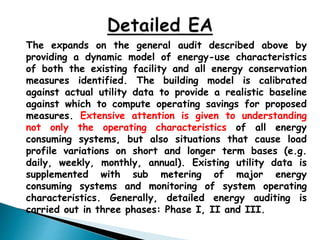
The expands on the general audit described above by
providing a dynamic model of energy-use characteristics
of both the existing facility and all energy conservation
measures identified. The building model is calibrated
against actual utility data to provide a realistic baseline
against which to compute operating savings for proposed
measures. Extensive attention is given to understanding
not only the operating characteristics of all energy
consuming systems, but also situations that cause load
profile variations on short and longer term bases (e.g.
daily, weekly, monthly, annual). Existing utility data is
supplemented with sub metering of major energy
consuming systems and monitoring of system operating
characteristics. Generally, detailed energy auditing is
carried out in three phases: Phase I, II and III.
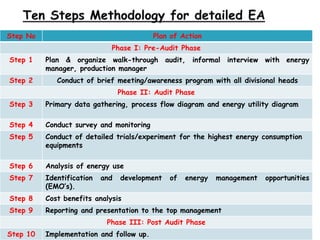
Step No Plan of Action
Phase I: Pre-Audit Phase
Step 1 Plan & organize walk-through audit, informal interview with energy
manager, production manager
Step 2 Conduct of brief meeting/awareness program with all divisional heads
Phase II: Audit Phase
Step 3 Primary data gathering, process flow diagram and energy utility diagram
Step 4 Conduct survey and monitoring
Step 5 Conduct of detailed trials/experiment for the highest energy consumption
equipments
Step 6 Analysis of energy use
Step 7 Identification and development of energy management opportunities
(EMO’s).
Step 8 Cost benefits analysis
Step 9 Reporting and presentation to the top management
Phase III: Post Audit Phase
Step 10 Implementation and follow up.
Any Questions????

Energy audit ppt

  • 1.
    Ved Prakash Verma Lecturer,Electrical Engineering Department Atal Bihari Vajpayee Govt. Institute of Engineering & Technology Pragatinagar Shimla-171202(HP)
  • 2.
     The energyaudit is the key for decision-making in the area of energy management.  As per India Energy Conservation Act 2001, the energy audit is defined as the verification, monitoring and analysis of use of energy including submission of technical report containing recommendations for improving energy efficiency with cost benefit analysis and an action plan to reduce energy consumption. OR  Energy audit is an inspection, survey and analysis of energy flows for energy conservation to reduce the amount of energy input into the system without negatively affecting the output.
  • 3.
     Primary needof energy audit is to determine ways to reduce energy consumption per unit of product output or to lower operating cost.  To reduce the operating expense on top three categories of any industry or organization i.e. energy (electrical and thermal), labour and materials.  As energy would be top ranker for cost reduction, which can be technically achieved by energy audit.  To develop a “bench-mark” or reference point for managing energy in any industry or organization.
  • 4.
    The EA isbroadly classified in three categories: 1.Preliminary/ Simple/ Screening/ Walk-through EA 2.General/Mini/Site/Complete site/Targeted EA 3.Detailed/Comprehensive/Investment- grade/Maximum/Technical Analysis EA
  • 5.
    This is thesimplest and quickest type of audit and conducted in a limited span of time. It involves minimal interviews with site-operating personnel, a brief review of facility utility bills and other operating data, and a walk-through of the facility to become familiar with the building operation and to identify any glaring areas of energy waste or inefficiency. It focuses on major energy supplies and demands of the industry. The scope of this audit is to highlight energy costs and to identify wastages in major equipment processes it sets priorities for optimizing energy consumption. This type of energy audit checks energy use and energy management in factories or organization.
  • 6.
    This energy auditis especially conducted to: ◦ Ensure top management commitment ◦ Establish energy consumption in the organization ◦ Estimate the scope for saving ◦ Identify the most likely (and the easiest areas for attention) ◦ Identify immediate (especially no-low-cost) improvements/ savings ◦ Identify areas for more detailed study/measurement ◦ Preliminary energy audit uses existing, or easily obtained data
  • 7.
    This audit expandson the preliminary audit described above by collecting more detailed information about facility operation and performing a more detailed evaluation of energy conservation measures identified. Utility bills are collected for a 12 to 36 month period to allow the auditor to evaluate the facility's energy/demand rate structures, and energy usage profiles. Additional metering of specific energy-consuming systems is often performed to supplement utility data. In-depth interviews with facility operating personnel are conducted to provide a better understanding of major energy consuming systems as well as insight into variations in daily and annual energy consumption and demand
  • 8.
    The expands onthe general audit described above by providing a dynamic model of energy-use characteristics of both the existing facility and all energy conservation measures identified. The building model is calibrated against actual utility data to provide a realistic baseline against which to compute operating savings for proposed measures. Extensive attention is given to understanding not only the operating characteristics of all energy consuming systems, but also situations that cause load profile variations on short and longer term bases (e.g. daily, weekly, monthly, annual). Existing utility data is supplemented with sub metering of major energy consuming systems and monitoring of system operating characteristics. Generally, detailed energy auditing is carried out in three phases: Phase I, II and III.
  • 9.
    Step No Planof Action Phase I: Pre-Audit Phase Step 1 Plan & organize walk-through audit, informal interview with energy manager, production manager Step 2 Conduct of brief meeting/awareness program with all divisional heads Phase II: Audit Phase Step 3 Primary data gathering, process flow diagram and energy utility diagram Step 4 Conduct survey and monitoring Step 5 Conduct of detailed trials/experiment for the highest energy consumption equipments Step 6 Analysis of energy use Step 7 Identification and development of energy management opportunities (EMO’s). Step 8 Cost benefits analysis Step 9 Reporting and presentation to the top management Phase III: Post Audit Phase Step 10 Implementation and follow up.
  • 10.