Basic Endoscopic Equipment
1
The modern era of endoscopy began with the development of
fibreoptic instruments in the 1960s. For most purposes these are
being supplanted by video chip endoscopes in the 1990s. Details
of instruments for specific purposes, accessories and precise
methods for management are outlined in other chapters. This
chapter serves to introduce the true beginner to some principles
which are common to all endoscopes and procedures.
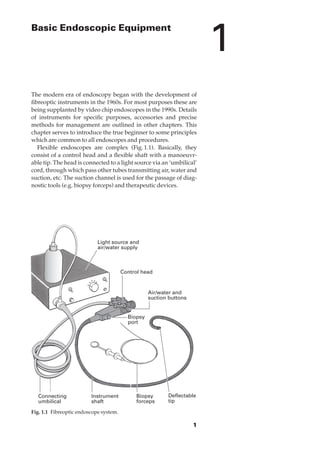
Flexible endoscopes are complex (Fig.·1.1). Basically, they
consist of a control head and a flexible shaft with a manoeuvr-
able tip. The head is connected to a light source via an ‘umbilical’
cord, through which pass other tubes transmitting air, water and
suction, etc. The suction channel is used for the passage of diag-
nostic tools (e.g. biopsy forceps) and therapeutic devices.
1
Connecting
umbilical
Air/water and
suction buttons
Biopsy
port
Control head
Light source and
air/water supply
Instrument
shaft
Biopsy
forceps
Deflectable
tip
Fig. 1.10Fibreoptic endoscope system.
Chapter 12
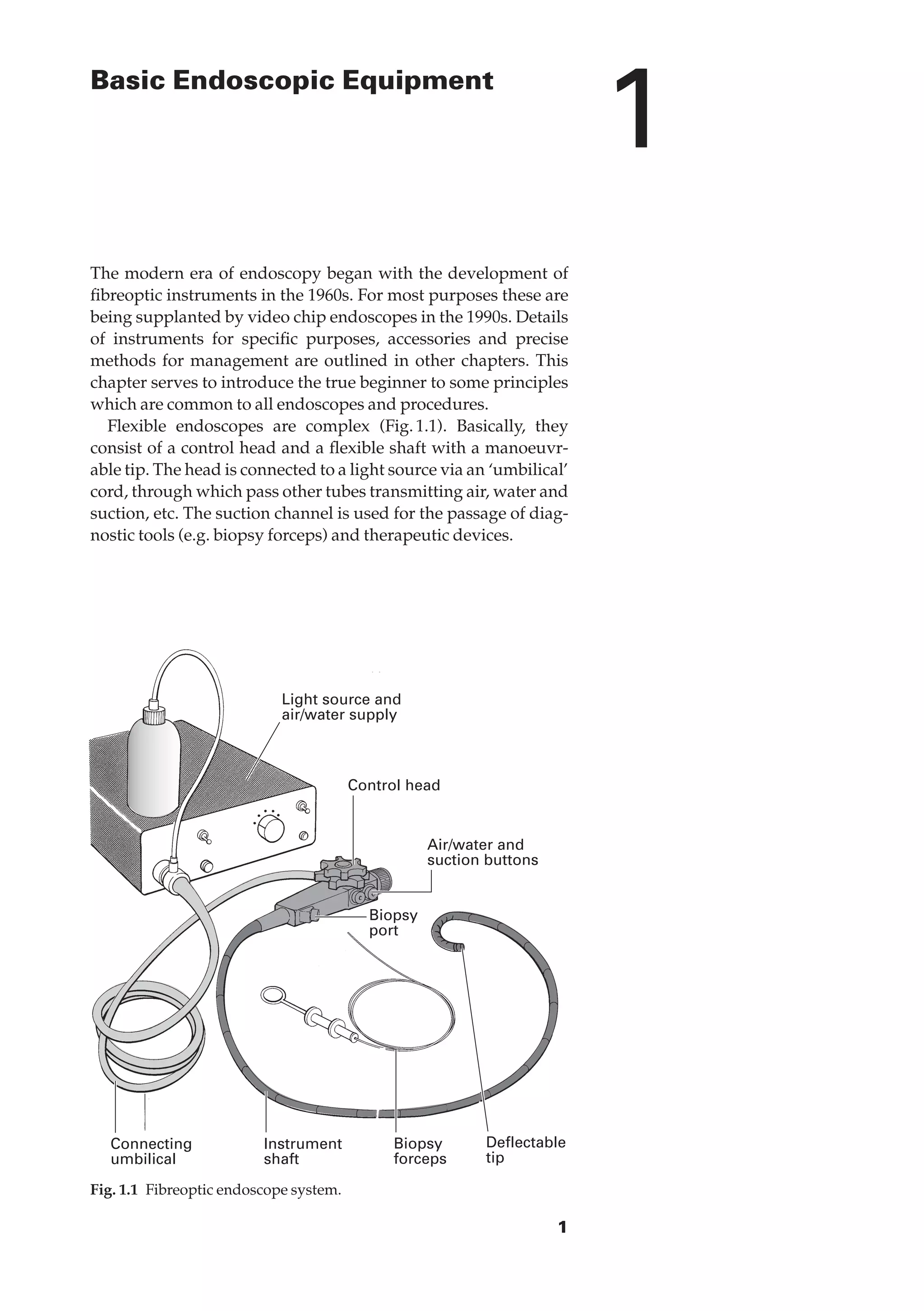
Fig. 1.20Total internal reflection of
light down a glass fibre.
Fig. 1.30Fibre bundle showing the
‘packing fraction’ or dead space
between fibres.
Fibreoptic instruments and video-endoscopes
Fibreoptic instruments
These are based on optical viewing bundles, well described as a
‘highly flexible piece of illuminated spaghetti’. The viewing
bundle of a standard fibre-endoscope is 2–3·mm in diameter and
contains 20·000–40·000 fine glass fibres, each close to 10·µm in
diameter. Light focused onto the face of each fibre is transmitted
by repeated internal reflections (Fig.·1.2). Faithful transmission
of an image depends upon the spatial orientation of the individ-
ual fibres being the same at both ends of the bundle (a ‘coherent’
bundle). Each individual glass fibre is coated with glass of a
lower optical densit to prevent leakage of light from within the
fibre, since the coating does not transmit light. This coating and
the space between the fibres causes a dark ‘packing fraction’,
which is responsible for the fine mesh frequently apparent in the
fibreoptic image (Fig.·1.3). For this reason, the image quality of a
fibreoptic bundle, though excellent, can never equal that of a
rigid lens system. However, fibreoptic bundles are extremely
flexible, and an image can be transmitted even when tied in a
knot. In most modern instruments the distal lens which focuses
the image onto the bundle is fixed, and a pin-hole aperture gives
a depth of focus from 10–15·cm down to about 3·mm. The image
reconstructed at the top of the bundle is transmitted to the eye
via a focusing lens, adjustable to compensate for individual
differences in refraction.
Video-endoscopes
These are mechanically similar to fibre-endoscopes, with a
charged couple device (CCD) ‘chip’ and supporting electronics
mounted at the tip, to and fro wiring replacing the optical
bundle and further electronics and switches occupying the site
of the ocular lens on the upper part of the control head. Remov-
ing any need to hold the instrument close to the endoscopist’s
eye has hygienic advantages (avoidance of splash contamina-
tion) and also gives the opportunity for radical changes of
instrument design and handling techniques in the future.
The subtleties of different CCD systems in design and perfor-
mance are beyond the scope of this book. However, in essence, a
CCD chip is an array of 33·000–100·000 individual photo cells
(known as picture elements or pixels) receiving photons
reflected back from the mucosal surface and producing electrons
in proportion to the light received. In common with all other
television systems the individual receptors of the CCD respond
only to degrees of light and dark, and not to colour. ‘Colour’
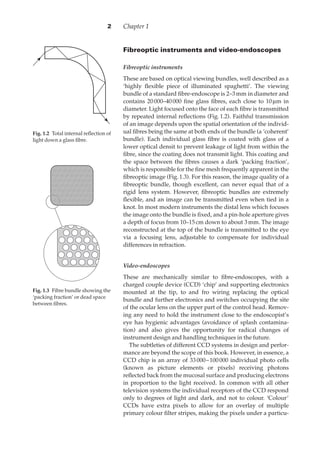
CCDs have extra pixels to allow for an overlay of multiple
primary colour filter stripes, making the pixels under a particu-
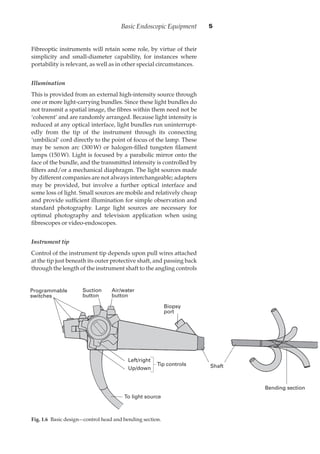
lar stripe respond only to light of that particular colour (Fig.·1.4).
‘Black and white’ (or, more correctly, sequential system) CCDs
can be made smaller, or potentially of higher resolution, by the
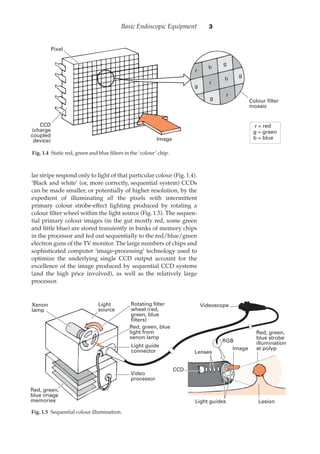
expedient of illuminating all the pixels with intermittent
primary colour strobe-effect lighting produced by rotating a
colour filter wheel within the light source (Fig.·1.5). The sequen-
tial primary colour images (in the gut mostly red, some green
and little blue) are stored transiently in banks of memory chips
in the processor and fed out sequentially to the red/blue/green
electron guns of the TV monitor. The large numbers of chips and
sophisticated computer ‘image-processing’ technology used to
optimize the underlying single CCD output account for the
excellence of the image produced by sequential CCD systems
(and the high price involved), as well as the relatively large
processor.
Basic Endoscopic Equipment 3
Fig. 1.40Static red, green and blue filters in the ‘colour’ chip.
Colour filter
mosaic
r = red
g = green
b = blue
r
r
b
b
g
g
r
g
g
Pixel
CCD
(charge
coupled
device) Image
Xenon
lamp
Light
source
Light guide
connector
Video
processor
Red, green,
blue image
memories
CCD
Lenses
Light guides Lesion
Red, green,
blue strobe
illumination
at polyp
Rotating filter
wheel (red,
green, blue
filters)
Videoscope
Red, green, blue
light from
xenon lamp
Image
RGB
Fig. 1.50Sequential colour illumination.
Video-endoscope or fibre-endoscope?
The screen-image quality of present video-endoscopes equals
that of present fibrescopes in both colour and resolution. Video-
endoscopy scores greatly by the fact that everyone can view the
image simultaneously, with a clarity previously restricted to the
endoscopist alone (teaching side-arms and add-on television
cameras introduce optical interference and reduce quality).
Whereas optical fibre technology is near its maximum theoreti-
cal performance (since below the 6–8·µm fibre diameter
approached in modern bundles there is massive loss of light
transmission), there is no reason why the 10·µm pixel size of
present CCDs should not be reduced to around 1·µm. This means
that future CCDs can be smaller, but also that the greatly
increased numbers of pixels will increase resolution and allow
the use of high-definition TV monitors. The objection that video-
endoscopes introduce ‘artificial colour’ values is untenable
since: (i) they can be shown in technical studies to give a remark-
ably faithful rendering of test charts; (ii) the visual assessment of
lesions depends little on absolute colour values; and (iii) there is
the inescapable fact that individual perception of colour varies
significantly — the extreme example being colour blindness. In
terms of hard-copy imaging there is also a clear advantage in
employing only the ocular lens system at the instrument tip
without the degrading effects of transmission down an optical
bundle and through a secondary lens system. Of crucial impor-
tance is the fact that the digital signal simplifies image recording
and manipulation, and opens the way for new methods of image
enhancement, transmission and analysis.
For the fibre-endoscopist, the mechanical transition to han-
dling video-endoscopes whilst viewing the TV monitor is mas-
tered in a few minutes. Thereafter, most endoscopists tend to
work this way instinctively, even with fibre-endoscopes if a
video camera attachment is available. The ease of stance,
brighter view and the natural visual field (combining a macular
view of the image and peripheral view of the patient and the
endoscopy room) make video-endoscopes extremely relaxing to
use, and facilitates communication with patients and assistants.
The mechanical manipulation of endoscope controls and subtle
management of its shaft, including de-looping or rotatory move-
ments, are also significantly easier with video-endoscopes, since
the manipulating left hand can move freely without relationship
to the endoscopist’s eye. Although in individual practice no user
of fibre-endoscopes need feel disadvantaged, the bonus for
larger institutions or teaching hospitals of the shared view,
including the ability for experienced endoscopists to see pre-
cisely the same image as obtained by an apprentice, scores
highly in favour of using video-endoscopes.
For these many reasons, video-endoscopes have taken over
a majority position in gastrointestinal (GI) endoscopic units.
Chapter 14
Fibreoptic instruments will retain some role, by virtue of their
simplicity and small-diameter capability, for instances where
portability is relevant, as well as in other special circumstances.
Illumination
This is provided from an external high-intensity source through
one or more light-carrying bundles. Since these light bundles do
not transmit a spatial image, the fibres within them need not be
‘coherent’ and are randomly arranged. Because light intensity is
reduced at any optical interface, light bundles run uninterrupt-
edly from the tip of the instrument through its connecting
‘umbilical’ cord directly to the point of focus of the lamp. These
may be xenon arc (300·W) or halogen-filled tungsten filament
lamps (150·W). Light is focused by a parabolic mirror onto the
face of the bundle, and the transmitted intensity is controlled by
filters and/or a mechanical diaphragm. The light sources made
by different companies are not always interchangeable; adapters
may be provided, but involve a further optical interface and
some loss of light. Small sources are mobile and relatively cheap
and provide sufficient illumination for simple observation and
standard photography. Large light sources are necessary for
optimal photography and television application when using
fibrescopes or video-endoscopes.
Instrument tip
Control of the instrument tip depends upon pull wires attached
at the tip just beneath its outer protective shaft, and passing back
through the length of the instrument shaft to the angling controls
Basic Endoscopic Equipment 5
Air/water
button
Suction
button
Biopsy
port
Shaft
To light source
Left/right
Up/down
Tip controls
Bending section
Programmable
switches
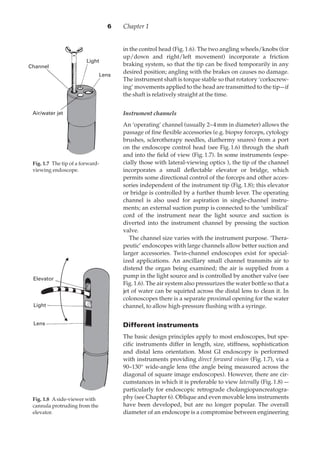
Fig. 1.60Basic design—control head and bending section.
Chapter 16
in the control head (Fig.·1.6). The two angling wheels/knobs (for
up/down and right/left movement) incorporate a friction
braking system, so that the tip can be fixed temporarily in any
desired position; angling with the brakes on causes no damage.
The instrument shaft is torque stable so that rotatory ‘corkscrew-
ing’ movements applied to the head are transmitted to the tip—if
the shaft is relatively straight at the time.
Instrument channels
An ‘operating’ channel (usually 2–4·mm in diameter) allows the
passage of fine flexible accessories (e.g. biopsy forceps, cytology
brushes, sclerotherapy needles, diathermy snares) from a port
on the endoscope control head (see Fig.·1.6) through the shaft
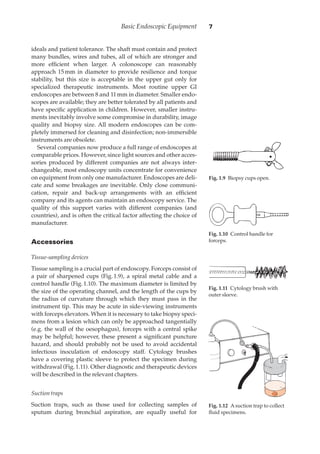
and into the field of view (Fig.·1.7). In some instruments (espe-
cially those with lateral-viewing optics ), the tip of the channel
incorporates a small deflectable elevator or bridge, which
permits some directional control of the forceps and other acces-
sories independent of the instrument tip (Fig.·1.8); this elevator
or bridge is controlled by a further thumb lever. The operating
channel is also used for aspiration in single-channel instru-
ments; an external suction pump is connected to the ‘umbilical’
cord of the instrument near the light source and suction is
diverted into the instrument channel by pressing the suction
valve.
The channel size varies with the instrument purpose. ‘Thera-
peutic’ endoscopes with large channels allow better suction and
larger accessories. Twin-channel endoscopes exist for special-
ized applications. An ancillary small channel transmits air to
distend the organ being examined; the air is supplied from a
pump in the light source and is controlled by another valve (see
Fig.·1.6). The air system also pressurizes the water bottle so that a
jet of water can be squirted across the distal lens to clean it. In
colonoscopes there is a separate proximal opening for the water
channel, to allow high-pressure flushing with a syringe.
Different instruments
The basic design principles apply to most endoscopes, but spe-
cific instruments differ in length, size, stiffness, sophistication
and distal lens orientation. Most GI endoscopy is performed
with instruments providing direct forward vision (Fig.·1.7), via a
90–130° wide-angle lens (the angle being measured across the
diagonal of square image endoscopes). However, there are cir-
cumstances in which it is preferable to view laterally (Fig.·1.8) —
particularly for endoscopic retrograde cholangiopancreatogra-
phy (see Chapter 6). Oblique and even movable lens instruments
have been developed, but are no longer popular. The overall
diameter of an endoscope is a compromise between engineering
Light
Lens
Air/water jet
Channel
Fig. 1.70The tip of a forward-
viewing endoscope.
Elevator
Light
Lens
Fig. 1.80Aside-viewer with
cannula protruding from the
elevator.
ideals and patient tolerance. The shaft must contain and protect
many bundles, wires and tubes, all of which are stronger and
more efficient when larger. A colonoscope can reasonably
approach 15·mm in diameter to provide resilience and torque
stability, but this size is acceptable in the upper gut only for
specialized therapeutic instruments. Most routine upper GI
endoscopes are between 8 and 11·mm in diameter. Smaller endo-
scopes are available; they are better tolerated by all patients and
have specific application in children. However, smaller instru-
ments inevitably involve some compromise in durability, image
quality and biopsy size. All modern endoscopes can be com-
pletely immersed for cleaning and disinfection; non-immersible
instruments are obsolete.
Several companies now produce a full range of endoscopes at
comparable prices. However, since light sources and other acces-
sories produced by different companies are not always inter-
changeable, most endoscopy units concentrate for convenience
on equipment from only one manufacturer. Endoscopes are deli-
cate and some breakages are inevitable. Only close communi-
cation, repair and back-up arrangements with an efficient
company and its agents can maintain an endoscopy service. The
quality of this support varies with different companies (and
countries), and is often the critical factor affecting the choice of
manufacturer.
Accessories
Tissue-sampling devices
Tissue sampling is a crucial part of endoscopy. Forceps consist of
a pair of sharpened cups (Fig.·1.9), a spiral metal cable and a
control handle (Fig.·1.10). The maximum diameter is limited by
the size of the operating channel, and the length of the cups by
the radius of curvature through which they must pass in the
instrument tip. This may be acute in side-viewing instruments
with forceps elevators. When it is necessary to take biopsy speci-
mens from a lesion which can only be approached tangentially
(e.g. the wall of the oesophagus), forceps with a central spike
may be helpful; however, these present a significant puncture
hazard, and should probably not be used to avoid accidental
infectious inoculation of endoscopy staff. Cytology brushes
have a covering plastic sleeve to protect the specimen during
withdrawal (Fig.·1.11). Other diagnostic and therapeutic devices
will be described in the relevant chapters.
Suction traps
Suction traps, such as those used for collecting samples of
sputum during bronchial aspiration, are equally useful for
Basic Endoscopic Equipment 7
Fig. 1.90Biopsy cups open.
Fig. 1.100Control handle for
forceps.
Fig. 1.110Cytology brush with
outer sleeve.
Fig. 1.120Asuction trap to collect
fluid specimens.
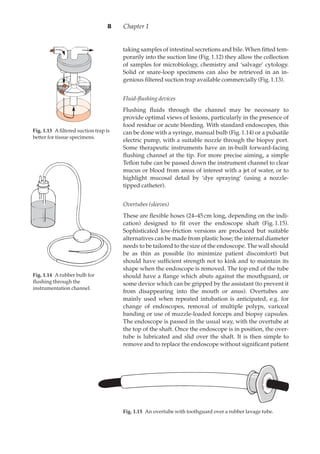
taking samples of intestinal secretions and bile. When fitted tem-
porarily into the suction line (Fig.·1.12) they allow the collection
of samples for microbiology, chemistry and ‘salvage’ cytology.
Solid or snare-loop specimens can also be retrieved in an in-
genious filtered suction trap available commercially (Fig.·1.13).
Fluid-flushing devices
Flushing fluids through the channel may be necessary to
provide optimal views of lesions, particularly in the presence of
food residue or acute bleeding. With standard endoscopes, this
can be done with a syringe, manual bulb (Fig.·1.14) or a pulsatile
electric pump, with a suitable nozzle through the biopsy port.
Some therapeutic instruments have an in-built forward-facing
flushing channel at the tip. For more precise aiming, a simple
Teflon tube can be passed down the instrument channel to clear
mucus or blood from areas of interest with a jet of water, or to
highlight mucosal detail by ‘dye spraying’ (using a nozzle-
tipped catheter).
Overtubes (sleeves)
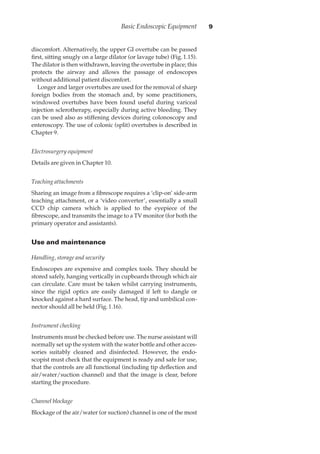
These are flexible hoses (24–45·cm long, depending on the indi-
cation) designed to fit over the endoscope shaft (Fig.·1.15).
Sophisticated low-friction versions are produced but suitable
alternatives can be made from plastic hose; the internal diameter
needs to be tailored to the size of the endoscope. The wall should
be as thin as possible (to minimize patient discomfort) but
should have sufficient strength not to kink and to maintain its
shape when the endoscope is removed. The top end of the tube
should have a flange which abuts against the mouthguard, or
some device which can be gripped by the assistant (to prevent it
from disappearing into the mouth or anus). Overtubes are
mainly used when repeated intubation is anticipated, e.g. for
change of endoscopes, removal of multiple polyps, variceal
banding or use of muzzle-loaded forceps and biopsy capsules.
The endoscope is passed in the usual way, with the overtube at
the top of the shaft. Once the endoscope is in position, the over-
tube is lubricated and slid over the shaft. It is then simple to
remove and to replace the endoscope without significant patient
Chapter 18
Fig. 1.130Afiltered suction trap is
better for tissue specimens.
Fig. 1.140Arubber bulb for
flushing through the
instrumentation channel.
Fig. 1.150An overtube with toothguard over a rubber lavage tube.
discomfort. Alternatively, the upper GI overtube can be passed
first, sitting snugly on a large dilator (or lavage tube) (Fig.·1.15).
The dilator is then withdrawn, leaving the overtube in place; this
protects the airway and allows the passage of endoscopes
without additional patient discomfort.
Longer and larger overtubes are used for the removal of sharp
foreign bodies from the stomach and, by some practitioners,
windowed overtubes have been found useful during variceal
injection sclerotherapy, especially during active bleeding. They
can be used also as stiffening devices during colonoscopy and
enteroscopy. The use of colonic (split) overtubes is described in
Chapter 9.
Electrosurgery equipment
Details are given in Chapter 10.
Teaching attachments
Sharing an image from a fibrescope requires a ‘clip-on’ side-arm
teaching attachment, or a ‘video converter’, essentially a small
CCD chip camera which is applied to the eyepiece of the
fibrescope, and transmits the image to a TV monitor (for both the
primary operator and assistants).
Use and maintenance
Handling, storage and security
Endoscopes are expensive and complex tools. They should be
stored safely, hanging vertically in cupboards through which air
can circulate. Care must be taken whilst carrying instruments,
since the rigid optics are easily damaged if left to dangle or
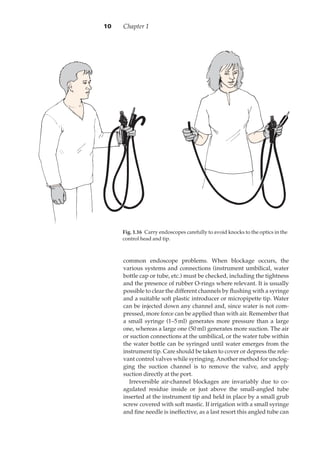
knocked against a hard surface. The head, tip and umbilical con-
nector should all be held (Fig.·1.16).
Instrument checking
Instruments must be checked before use. The nurse assistant will
normally set up the system with the water bottle and other acces-
sories suitably cleaned and disinfected. However, the endo-
scopist must check that the equipment is ready and safe for use,
that the controls are all functional (including tip deflection and
air/water/suction channel) and that the image is clear, before
starting the procedure.
Channel blockage
Blockage of the air/water (or suction) channel is one of the most
Basic Endoscopic Equipment 9
common endoscope problems. When blockage occurs, the
various systems and connections (instrument umbilical, water
bottle cap or tube, etc.) must be checked, including the tightness
and the presence of rubber O-rings where relevant. It is usually
possible to clear the different channels by flushing with a syringe
and a suitable soft plastic introducer or micropipette tip. Water
can be injected down any channel and, since water is not com-
pressed, more force can be applied than with air. Remember that
a small syringe (1–5·ml) generates more pressure than a large
one, whereas a large one (50·ml) generates more suction. The air
or suction connections at the umbilical, or the water tube within
the water bottle can be syringed until water emerges from the
instrument tip. Care should be taken to cover or depress the rele-
vant control valves while syringing.Another method for unclog-
ging the suction channel is to remove the valve, and apply
suction directly at the port.
Irreversible air-channel blockages are invariably due to co-
agulated residue inside or just above the small-angled tube
inserted at the instrument tip and held in place by a small grub
screw covered with soft mastic. If irrigation with a small syringe
and fine needle is ineffective, as a last resort this angled tube can
Chapter 110
Fig. 1.160Carry endoscopes carefully to avoid knocks to the optics in the
control head and tip.
be removed with a very small screwdriver and cleaned with a
fine wire. The best way to avoid such blockages is to insist on
scrupulous cleaning regimens (see Chapter 3).
Maintenance
The life of an endoscope is almost completely determined by the
quality of maintenance. Details of cleaning and disinfection are
given in Chapter 3. Close collaboration with hospital bioengi-
neering departments and servicing engineers is essential, but
most of the important work is done in the unit by the GI staff—
for example regular ‘leakage testing’ of immersible endoscopes.
It is important to maintain complex accessories (e.g. electrosur-
gical equipment) in a safe condition, properly calibrated and
adjusted. Repairs and maintenance must be properly docu-
mented. A case can be made for returning some instruments to
the manufacturers for detailed inspection and ‘tightening up’
from time to time. Some large endoscopy units may find it cost-
effective to employ their own biomedical technician.
Further reading
Sivak M. Gastroenterologic Endoscopy. Philadelphia: WB Saunders, 1987.
Zuccaro G. Video endoscopy and the charge-coupled device. In Sivak M,
ed. Gastrointestinal Endoscopy Clinics of North America, Vol. 2(2).
Philadelphia: WB Saunders, 1992.
Basic Endoscopic Equipment 11

Endoscopy chapter

  • 1.
    Basic Endoscopic Equipment 1 Themodern era of endoscopy began with the development of fibreoptic instruments in the 1960s. For most purposes these are being supplanted by video chip endoscopes in the 1990s. Details of instruments for specific purposes, accessories and precise methods for management are outlined in other chapters. This chapter serves to introduce the true beginner to some principles which are common to all endoscopes and procedures. Flexible endoscopes are complex (Fig.·1.1). Basically, they consist of a control head and a flexible shaft with a manoeuvr- able tip. The head is connected to a light source via an ‘umbilical’ cord, through which pass other tubes transmitting air, water and suction, etc. The suction channel is used for the passage of diag- nostic tools (e.g. biopsy forceps) and therapeutic devices. 1 Connecting umbilical Air/water and suction buttons Biopsy port Control head Light source and air/water supply Instrument shaft Biopsy forceps Deflectable tip Fig. 1.10Fibreoptic endoscope system.
  • 2.
    Chapter 12 Fig. 1.20Totalinternal reflection of light down a glass fibre. Fig. 1.30Fibre bundle showing the ‘packing fraction’ or dead space between fibres. Fibreoptic instruments and video-endoscopes Fibreoptic instruments These are based on optical viewing bundles, well described as a ‘highly flexible piece of illuminated spaghetti’. The viewing bundle of a standard fibre-endoscope is 2–3·mm in diameter and contains 20·000–40·000 fine glass fibres, each close to 10·µm in diameter. Light focused onto the face of each fibre is transmitted by repeated internal reflections (Fig.·1.2). Faithful transmission of an image depends upon the spatial orientation of the individ- ual fibres being the same at both ends of the bundle (a ‘coherent’ bundle). Each individual glass fibre is coated with glass of a lower optical densit to prevent leakage of light from within the fibre, since the coating does not transmit light. This coating and the space between the fibres causes a dark ‘packing fraction’, which is responsible for the fine mesh frequently apparent in the fibreoptic image (Fig.·1.3). For this reason, the image quality of a fibreoptic bundle, though excellent, can never equal that of a rigid lens system. However, fibreoptic bundles are extremely flexible, and an image can be transmitted even when tied in a knot. In most modern instruments the distal lens which focuses the image onto the bundle is fixed, and a pin-hole aperture gives a depth of focus from 10–15·cm down to about 3·mm. The image reconstructed at the top of the bundle is transmitted to the eye via a focusing lens, adjustable to compensate for individual differences in refraction. Video-endoscopes These are mechanically similar to fibre-endoscopes, with a charged couple device (CCD) ‘chip’ and supporting electronics mounted at the tip, to and fro wiring replacing the optical bundle and further electronics and switches occupying the site of the ocular lens on the upper part of the control head. Remov- ing any need to hold the instrument close to the endoscopist’s eye has hygienic advantages (avoidance of splash contamina- tion) and also gives the opportunity for radical changes of instrument design and handling techniques in the future. The subtleties of different CCD systems in design and perfor- mance are beyond the scope of this book. However, in essence, a CCD chip is an array of 33·000–100·000 individual photo cells (known as picture elements or pixels) receiving photons reflected back from the mucosal surface and producing electrons in proportion to the light received. In common with all other television systems the individual receptors of the CCD respond only to degrees of light and dark, and not to colour. ‘Colour’ CCDs have extra pixels to allow for an overlay of multiple primary colour filter stripes, making the pixels under a particu-
  • 3.
    lar stripe respondonly to light of that particular colour (Fig.·1.4). ‘Black and white’ (or, more correctly, sequential system) CCDs can be made smaller, or potentially of higher resolution, by the expedient of illuminating all the pixels with intermittent primary colour strobe-effect lighting produced by rotating a colour filter wheel within the light source (Fig.·1.5). The sequen- tial primary colour images (in the gut mostly red, some green and little blue) are stored transiently in banks of memory chips in the processor and fed out sequentially to the red/blue/green electron guns of the TV monitor. The large numbers of chips and sophisticated computer ‘image-processing’ technology used to optimize the underlying single CCD output account for the excellence of the image produced by sequential CCD systems (and the high price involved), as well as the relatively large processor. Basic Endoscopic Equipment 3 Fig. 1.40Static red, green and blue filters in the ‘colour’ chip. Colour filter mosaic r = red g = green b = blue r r b b g g r g g Pixel CCD (charge coupled device) Image Xenon lamp Light source Light guide connector Video processor Red, green, blue image memories CCD Lenses Light guides Lesion Red, green, blue strobe illumination at polyp Rotating filter wheel (red, green, blue filters) Videoscope Red, green, blue light from xenon lamp Image RGB Fig. 1.50Sequential colour illumination.
  • 4.
    Video-endoscope or fibre-endoscope? Thescreen-image quality of present video-endoscopes equals that of present fibrescopes in both colour and resolution. Video- endoscopy scores greatly by the fact that everyone can view the image simultaneously, with a clarity previously restricted to the endoscopist alone (teaching side-arms and add-on television cameras introduce optical interference and reduce quality). Whereas optical fibre technology is near its maximum theoreti- cal performance (since below the 6–8·µm fibre diameter approached in modern bundles there is massive loss of light transmission), there is no reason why the 10·µm pixel size of present CCDs should not be reduced to around 1·µm. This means that future CCDs can be smaller, but also that the greatly increased numbers of pixels will increase resolution and allow the use of high-definition TV monitors. The objection that video- endoscopes introduce ‘artificial colour’ values is untenable since: (i) they can be shown in technical studies to give a remark- ably faithful rendering of test charts; (ii) the visual assessment of lesions depends little on absolute colour values; and (iii) there is the inescapable fact that individual perception of colour varies significantly — the extreme example being colour blindness. In terms of hard-copy imaging there is also a clear advantage in employing only the ocular lens system at the instrument tip without the degrading effects of transmission down an optical bundle and through a secondary lens system. Of crucial impor- tance is the fact that the digital signal simplifies image recording and manipulation, and opens the way for new methods of image enhancement, transmission and analysis. For the fibre-endoscopist, the mechanical transition to han- dling video-endoscopes whilst viewing the TV monitor is mas- tered in a few minutes. Thereafter, most endoscopists tend to work this way instinctively, even with fibre-endoscopes if a video camera attachment is available. The ease of stance, brighter view and the natural visual field (combining a macular view of the image and peripheral view of the patient and the endoscopy room) make video-endoscopes extremely relaxing to use, and facilitates communication with patients and assistants. The mechanical manipulation of endoscope controls and subtle management of its shaft, including de-looping or rotatory move- ments, are also significantly easier with video-endoscopes, since the manipulating left hand can move freely without relationship to the endoscopist’s eye. Although in individual practice no user of fibre-endoscopes need feel disadvantaged, the bonus for larger institutions or teaching hospitals of the shared view, including the ability for experienced endoscopists to see pre- cisely the same image as obtained by an apprentice, scores highly in favour of using video-endoscopes. For these many reasons, video-endoscopes have taken over a majority position in gastrointestinal (GI) endoscopic units. Chapter 14
  • 5.
    Fibreoptic instruments willretain some role, by virtue of their simplicity and small-diameter capability, for instances where portability is relevant, as well as in other special circumstances. Illumination This is provided from an external high-intensity source through one or more light-carrying bundles. Since these light bundles do not transmit a spatial image, the fibres within them need not be ‘coherent’ and are randomly arranged. Because light intensity is reduced at any optical interface, light bundles run uninterrupt- edly from the tip of the instrument through its connecting ‘umbilical’ cord directly to the point of focus of the lamp. These may be xenon arc (300·W) or halogen-filled tungsten filament lamps (150·W). Light is focused by a parabolic mirror onto the face of the bundle, and the transmitted intensity is controlled by filters and/or a mechanical diaphragm. The light sources made by different companies are not always interchangeable; adapters may be provided, but involve a further optical interface and some loss of light. Small sources are mobile and relatively cheap and provide sufficient illumination for simple observation and standard photography. Large light sources are necessary for optimal photography and television application when using fibrescopes or video-endoscopes. Instrument tip Control of the instrument tip depends upon pull wires attached at the tip just beneath its outer protective shaft, and passing back through the length of the instrument shaft to the angling controls Basic Endoscopic Equipment 5 Air/water button Suction button Biopsy port Shaft To light source Left/right Up/down Tip controls Bending section Programmable switches Fig. 1.60Basic design—control head and bending section.
  • 6.
    Chapter 16 in thecontrol head (Fig.·1.6). The two angling wheels/knobs (for up/down and right/left movement) incorporate a friction braking system, so that the tip can be fixed temporarily in any desired position; angling with the brakes on causes no damage. The instrument shaft is torque stable so that rotatory ‘corkscrew- ing’ movements applied to the head are transmitted to the tip—if the shaft is relatively straight at the time. Instrument channels An ‘operating’ channel (usually 2–4·mm in diameter) allows the passage of fine flexible accessories (e.g. biopsy forceps, cytology brushes, sclerotherapy needles, diathermy snares) from a port on the endoscope control head (see Fig.·1.6) through the shaft and into the field of view (Fig.·1.7). In some instruments (espe- cially those with lateral-viewing optics ), the tip of the channel incorporates a small deflectable elevator or bridge, which permits some directional control of the forceps and other acces- sories independent of the instrument tip (Fig.·1.8); this elevator or bridge is controlled by a further thumb lever. The operating channel is also used for aspiration in single-channel instru- ments; an external suction pump is connected to the ‘umbilical’ cord of the instrument near the light source and suction is diverted into the instrument channel by pressing the suction valve. The channel size varies with the instrument purpose. ‘Thera- peutic’ endoscopes with large channels allow better suction and larger accessories. Twin-channel endoscopes exist for special- ized applications. An ancillary small channel transmits air to distend the organ being examined; the air is supplied from a pump in the light source and is controlled by another valve (see Fig.·1.6). The air system also pressurizes the water bottle so that a jet of water can be squirted across the distal lens to clean it. In colonoscopes there is a separate proximal opening for the water channel, to allow high-pressure flushing with a syringe. Different instruments The basic design principles apply to most endoscopes, but spe- cific instruments differ in length, size, stiffness, sophistication and distal lens orientation. Most GI endoscopy is performed with instruments providing direct forward vision (Fig.·1.7), via a 90–130° wide-angle lens (the angle being measured across the diagonal of square image endoscopes). However, there are cir- cumstances in which it is preferable to view laterally (Fig.·1.8) — particularly for endoscopic retrograde cholangiopancreatogra- phy (see Chapter 6). Oblique and even movable lens instruments have been developed, but are no longer popular. The overall diameter of an endoscope is a compromise between engineering Light Lens Air/water jet Channel Fig. 1.70The tip of a forward- viewing endoscope. Elevator Light Lens Fig. 1.80Aside-viewer with cannula protruding from the elevator.
  • 7.
    ideals and patienttolerance. The shaft must contain and protect many bundles, wires and tubes, all of which are stronger and more efficient when larger. A colonoscope can reasonably approach 15·mm in diameter to provide resilience and torque stability, but this size is acceptable in the upper gut only for specialized therapeutic instruments. Most routine upper GI endoscopes are between 8 and 11·mm in diameter. Smaller endo- scopes are available; they are better tolerated by all patients and have specific application in children. However, smaller instru- ments inevitably involve some compromise in durability, image quality and biopsy size. All modern endoscopes can be com- pletely immersed for cleaning and disinfection; non-immersible instruments are obsolete. Several companies now produce a full range of endoscopes at comparable prices. However, since light sources and other acces- sories produced by different companies are not always inter- changeable, most endoscopy units concentrate for convenience on equipment from only one manufacturer. Endoscopes are deli- cate and some breakages are inevitable. Only close communi- cation, repair and back-up arrangements with an efficient company and its agents can maintain an endoscopy service. The quality of this support varies with different companies (and countries), and is often the critical factor affecting the choice of manufacturer. Accessories Tissue-sampling devices Tissue sampling is a crucial part of endoscopy. Forceps consist of a pair of sharpened cups (Fig.·1.9), a spiral metal cable and a control handle (Fig.·1.10). The maximum diameter is limited by the size of the operating channel, and the length of the cups by the radius of curvature through which they must pass in the instrument tip. This may be acute in side-viewing instruments with forceps elevators. When it is necessary to take biopsy speci- mens from a lesion which can only be approached tangentially (e.g. the wall of the oesophagus), forceps with a central spike may be helpful; however, these present a significant puncture hazard, and should probably not be used to avoid accidental infectious inoculation of endoscopy staff. Cytology brushes have a covering plastic sleeve to protect the specimen during withdrawal (Fig.·1.11). Other diagnostic and therapeutic devices will be described in the relevant chapters. Suction traps Suction traps, such as those used for collecting samples of sputum during bronchial aspiration, are equally useful for Basic Endoscopic Equipment 7 Fig. 1.90Biopsy cups open. Fig. 1.100Control handle for forceps. Fig. 1.110Cytology brush with outer sleeve. Fig. 1.120Asuction trap to collect fluid specimens.
  • 8.
    taking samples ofintestinal secretions and bile. When fitted tem- porarily into the suction line (Fig.·1.12) they allow the collection of samples for microbiology, chemistry and ‘salvage’ cytology. Solid or snare-loop specimens can also be retrieved in an in- genious filtered suction trap available commercially (Fig.·1.13). Fluid-flushing devices Flushing fluids through the channel may be necessary to provide optimal views of lesions, particularly in the presence of food residue or acute bleeding. With standard endoscopes, this can be done with a syringe, manual bulb (Fig.·1.14) or a pulsatile electric pump, with a suitable nozzle through the biopsy port. Some therapeutic instruments have an in-built forward-facing flushing channel at the tip. For more precise aiming, a simple Teflon tube can be passed down the instrument channel to clear mucus or blood from areas of interest with a jet of water, or to highlight mucosal detail by ‘dye spraying’ (using a nozzle- tipped catheter). Overtubes (sleeves) These are flexible hoses (24–45·cm long, depending on the indi- cation) designed to fit over the endoscope shaft (Fig.·1.15). Sophisticated low-friction versions are produced but suitable alternatives can be made from plastic hose; the internal diameter needs to be tailored to the size of the endoscope. The wall should be as thin as possible (to minimize patient discomfort) but should have sufficient strength not to kink and to maintain its shape when the endoscope is removed. The top end of the tube should have a flange which abuts against the mouthguard, or some device which can be gripped by the assistant (to prevent it from disappearing into the mouth or anus). Overtubes are mainly used when repeated intubation is anticipated, e.g. for change of endoscopes, removal of multiple polyps, variceal banding or use of muzzle-loaded forceps and biopsy capsules. The endoscope is passed in the usual way, with the overtube at the top of the shaft. Once the endoscope is in position, the over- tube is lubricated and slid over the shaft. It is then simple to remove and to replace the endoscope without significant patient Chapter 18 Fig. 1.130Afiltered suction trap is better for tissue specimens. Fig. 1.140Arubber bulb for flushing through the instrumentation channel. Fig. 1.150An overtube with toothguard over a rubber lavage tube.
  • 9.
    discomfort. Alternatively, theupper GI overtube can be passed first, sitting snugly on a large dilator (or lavage tube) (Fig.·1.15). The dilator is then withdrawn, leaving the overtube in place; this protects the airway and allows the passage of endoscopes without additional patient discomfort. Longer and larger overtubes are used for the removal of sharp foreign bodies from the stomach and, by some practitioners, windowed overtubes have been found useful during variceal injection sclerotherapy, especially during active bleeding. They can be used also as stiffening devices during colonoscopy and enteroscopy. The use of colonic (split) overtubes is described in Chapter 9. Electrosurgery equipment Details are given in Chapter 10. Teaching attachments Sharing an image from a fibrescope requires a ‘clip-on’ side-arm teaching attachment, or a ‘video converter’, essentially a small CCD chip camera which is applied to the eyepiece of the fibrescope, and transmits the image to a TV monitor (for both the primary operator and assistants). Use and maintenance Handling, storage and security Endoscopes are expensive and complex tools. They should be stored safely, hanging vertically in cupboards through which air can circulate. Care must be taken whilst carrying instruments, since the rigid optics are easily damaged if left to dangle or knocked against a hard surface. The head, tip and umbilical con- nector should all be held (Fig.·1.16). Instrument checking Instruments must be checked before use. The nurse assistant will normally set up the system with the water bottle and other acces- sories suitably cleaned and disinfected. However, the endo- scopist must check that the equipment is ready and safe for use, that the controls are all functional (including tip deflection and air/water/suction channel) and that the image is clear, before starting the procedure. Channel blockage Blockage of the air/water (or suction) channel is one of the most Basic Endoscopic Equipment 9
  • 10.
    common endoscope problems.When blockage occurs, the various systems and connections (instrument umbilical, water bottle cap or tube, etc.) must be checked, including the tightness and the presence of rubber O-rings where relevant. It is usually possible to clear the different channels by flushing with a syringe and a suitable soft plastic introducer or micropipette tip. Water can be injected down any channel and, since water is not com- pressed, more force can be applied than with air. Remember that a small syringe (1–5·ml) generates more pressure than a large one, whereas a large one (50·ml) generates more suction. The air or suction connections at the umbilical, or the water tube within the water bottle can be syringed until water emerges from the instrument tip. Care should be taken to cover or depress the rele- vant control valves while syringing.Another method for unclog- ging the suction channel is to remove the valve, and apply suction directly at the port. Irreversible air-channel blockages are invariably due to co- agulated residue inside or just above the small-angled tube inserted at the instrument tip and held in place by a small grub screw covered with soft mastic. If irrigation with a small syringe and fine needle is ineffective, as a last resort this angled tube can Chapter 110 Fig. 1.160Carry endoscopes carefully to avoid knocks to the optics in the control head and tip.
  • 11.
    be removed witha very small screwdriver and cleaned with a fine wire. The best way to avoid such blockages is to insist on scrupulous cleaning regimens (see Chapter 3). Maintenance The life of an endoscope is almost completely determined by the quality of maintenance. Details of cleaning and disinfection are given in Chapter 3. Close collaboration with hospital bioengi- neering departments and servicing engineers is essential, but most of the important work is done in the unit by the GI staff— for example regular ‘leakage testing’ of immersible endoscopes. It is important to maintain complex accessories (e.g. electrosur- gical equipment) in a safe condition, properly calibrated and adjusted. Repairs and maintenance must be properly docu- mented. A case can be made for returning some instruments to the manufacturers for detailed inspection and ‘tightening up’ from time to time. Some large endoscopy units may find it cost- effective to employ their own biomedical technician. Further reading Sivak M. Gastroenterologic Endoscopy. Philadelphia: WB Saunders, 1987. Zuccaro G. Video endoscopy and the charge-coupled device. In Sivak M, ed. Gastrointestinal Endoscopy Clinics of North America, Vol. 2(2). Philadelphia: WB Saunders, 1992. Basic Endoscopic Equipment 11