Page 1
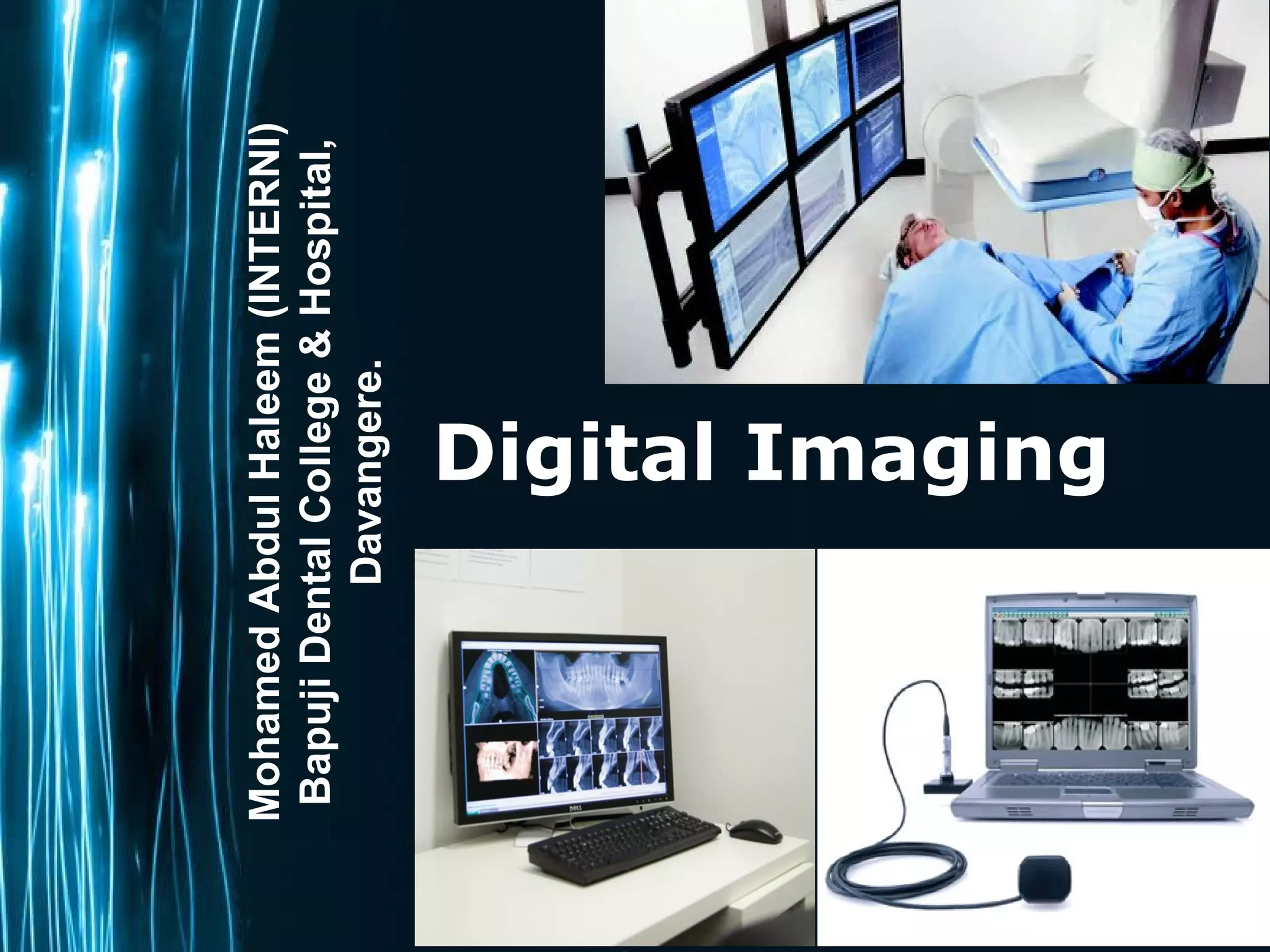
Digital Imaging
MohamedAbdulHaleem(INTERNI)
BapujiDentalCollege&Hospital,
Davangere.
Page 2
CONTENTS
 Introduction
 Formation of digital images
 CHARGE-COUPLED DEVICE (CCD)
 COMPLEMENTARY METAL OXIDE
SEMICONDUCTORS (CMOS)
 Digital Subtraction Radiography (DSR)
 PHOTOSTIMULABLE PHOSPHOR PLATES
(PSP)
Page 3
Introduction
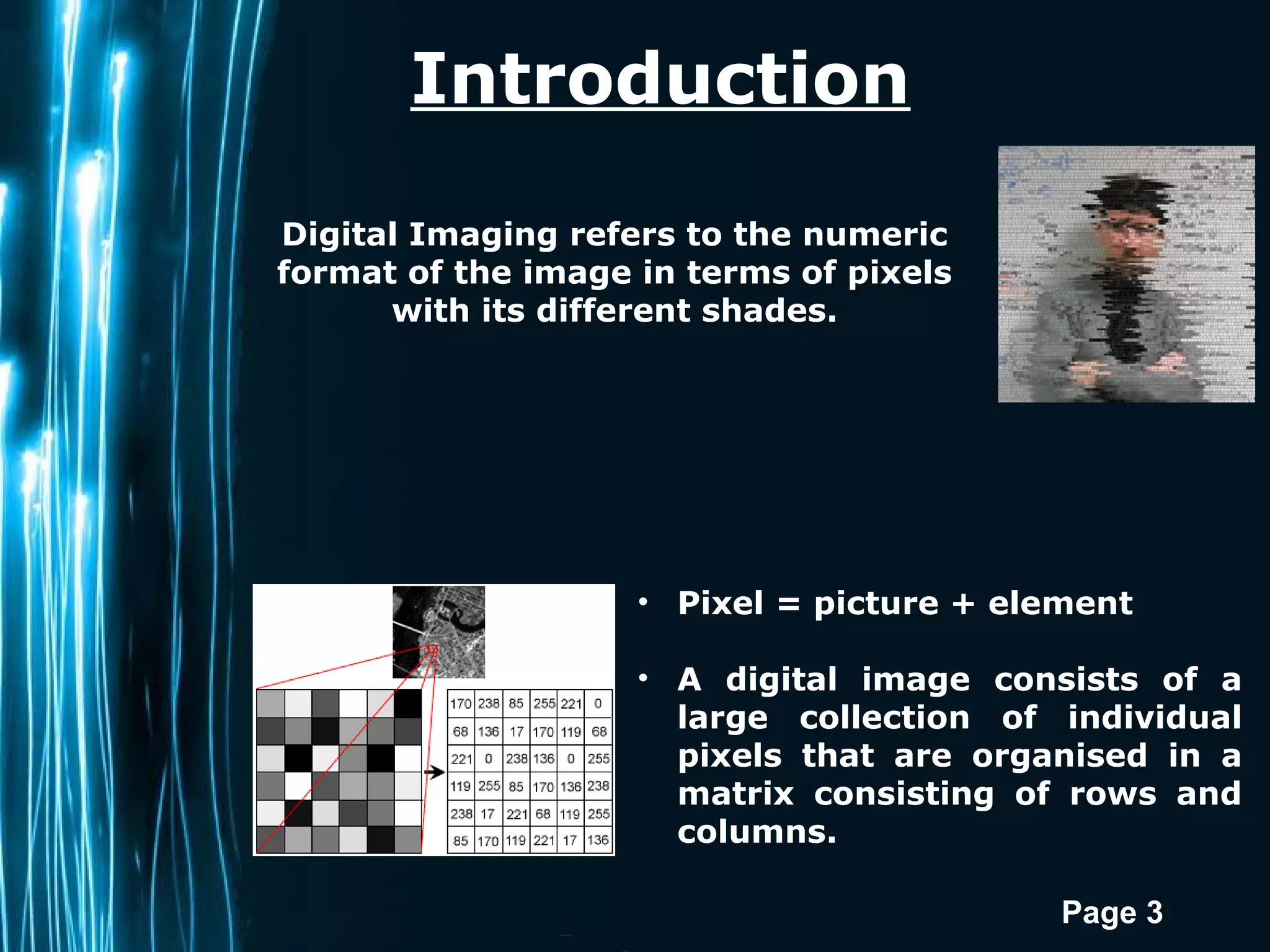
Digital Imaging refers to the numeric
format of the image in terms of pixels
with its different shades.
• Pixel = picture + element
• A digital image consists of a
large collection of individual
pixels that are organised in a
matrix consisting of rows and
columns.
Page 4
Formation of digital
images
• The formation of digital images involves several steps,
beginning with analog processing.
• Each pixel ---consists of individual electronic detector ---
absorb x-ray --- generate small voltage proportional to
the amount of x-ray absorbed by each individual pixels
within the detector.
• The voltage fluctuation at each pixel is therefore known
as “analog signal”
• Conversion of the analog signal into an usefull digital
image is done through a process called “Analog to
Digital Conversion (ADC)”
Page 5
ADC --- SAMPLING --- QUANTIZISING
• In order to view the image, the computer
organizes the pixels in their proper location and
gives them a grey shade that corresponds to
the number that was assinged during
quantization step.
Page 6
• Various receptors that are used to absorbs the
x-ray from the source were developed over the
period times which includes…
• Each has their own credits and limitations in
producing the final digital images
 DSR  PSP
 CMOS CCD
Page 7
CHARGE-COUPLED DEVICE
(CCD)
• Made up of thin layer of silicon.
• When exposed to radiation--- covalent
bonds between the silicon atoms are
broken--- prduce electron-hole pairs which
are proportional to amount of exposure.
• Electrons are then attracted towards the
positive site in the device creating a “charge
packets”
Page 8
• The image is read by
transferring each
rows of pixel charges
in a “bucket brigade”
fashion.
• Each packet corresponds to one pixel.
• As the charge reaches the end of its
row--- transferred to the amplifier---
then transmitted as a voltage to ADC
Page 9
COMPLEMENTARY METAL OXIDE
SEMICONDUCTORS (CMOS)
• As same as that of CCD with few difference
such as…
• It is made of silicon based semi-
conductor
• Unlike CCD, each pixels are
connected individually to a
transistor.
• These are less expensive than CCD
Page 10
Digital Subtraction
Radiography (DSR)
Two images( base line and follow up
image) of the same object registered ---
image intensities of corresponding pixels
are subtracted --- a uniform difference
image is produced.
 Projection geometry of both two images should be same to
avoid errors in distinguishing the actual changes.
Brighter area --- changes represent gain
Darker are --- changes represent loss.
Page 11
PHOTOSTIMULABLE
PHOSPHOR PLATES
(PSP)
• Made of…. barium + iodine + chlorine/bromine….
Which forms a crystal lattice.
• Europium (Eu+2) when added forms imperfection in the
lattice.
• Eu+2 --- when exposed to sufficient radiation ---
valence electron in Eu+2 absorbs energy --- move into
the near by halogen vacancies (F-Centers) --- trapped
there in a metastatic state --- which represents the
latent image.
Page 12
• Number of electrons trapped is proportional to the amount
of exposure.
PSP IMAGE PROSESSING:
 When stimulated by red
light(600 nm)--- barium
fluorohalide releases the
trapped electron --- electron
returns to Eu+3 ion ---
energy is released in green
spectrum (300-500nm)
 Lights from PSP --- conducted by fiberoptics to a
photomultiplier tube
Page 13
Digital image
obtained
Lights from PSP --- conducted by fiberoptics --- to a
photomultiplier tube
Quantified by
ADC
Converts light into electrical
energy
Is inbuilt with red filter that
selectively remove the
stimulating red light.
Prevent distortion in the final
image
Page 14
Specialized Radiographic
Techniques
 COMPUTED TOMOGRAPHY
(CT)
 CONE-BEAM COMPUTED
TOMOGRAPHY (CBCT)
 MAGNETIC RESONANCE
IMAGING (MRI)
Page 15
COMPUTED TOMOGRAPHY (CT)
Invented by Godfrey Hounsfield
and Allan Cormack
(Noble Price in medicine = 1979)
Tomography --- which means
thin layer radiography
Page 16
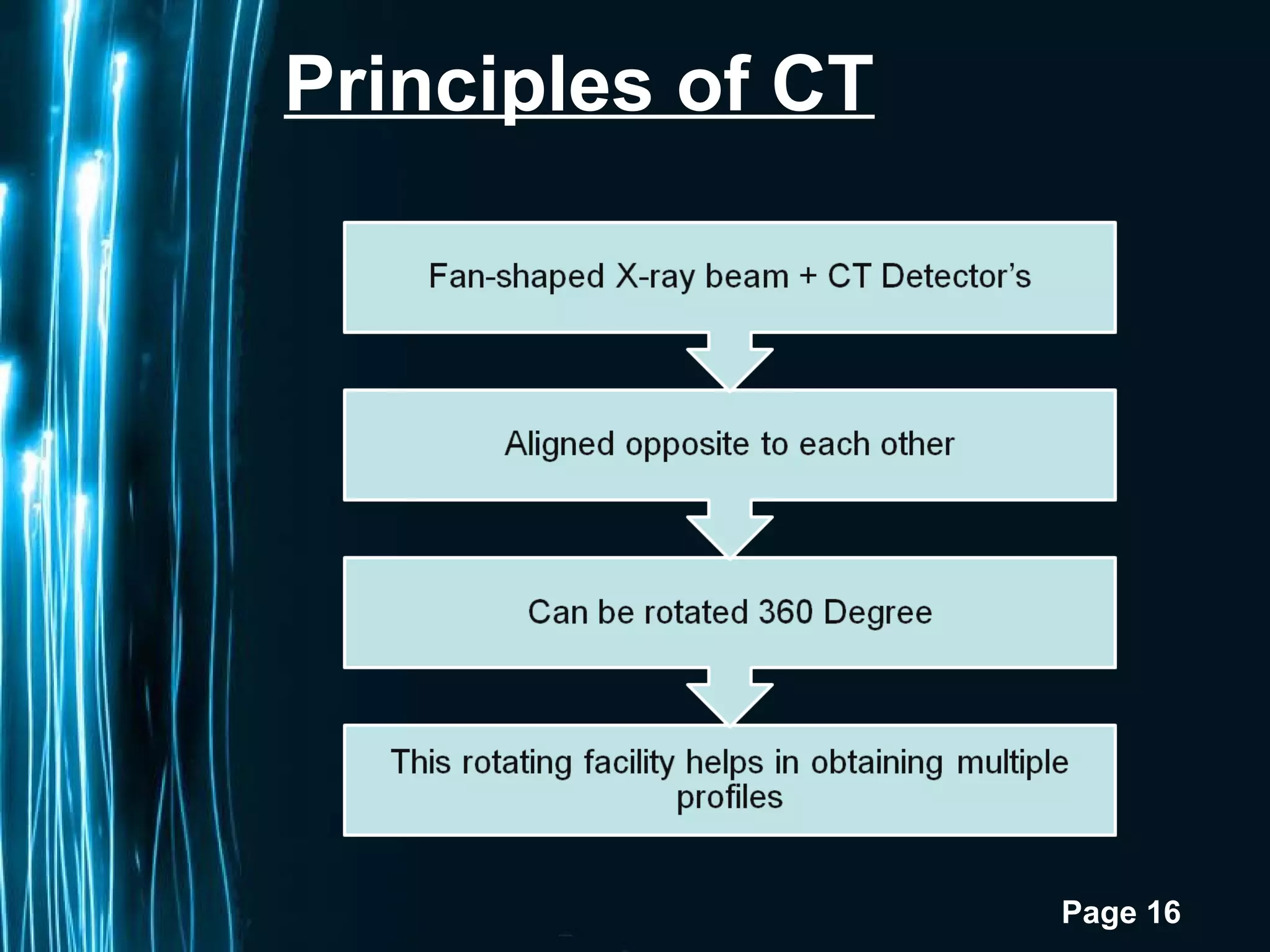
Principles of CT
Page 17
X-ray beams are collected in a grid like
pattern called “Matrix”
Made of array of pixels
Each pixel represent a calculation that denote the
actual attenuation of the X-ray beam by the
constituents of the body
A number (CT number / Hounsfield unit) is
designated for each pixel corresponding to the
degree of attenuation to the x-ray beam
Page 18
• Calibration of the Hounsfield units are inbuilt
within the CT machine which differs
according to the manufacturer’s.
• Most moniter may display only 256 gray-
scales to which the human eyes can
percieve only 64 shades of gray.
Page 19
ADVANTAGES OF CT
• Multiplanar imaging
• Greater geometric precision
• Manipulation of the acquired image (able to change
contrast and brightness)
• Soft tissue imaging
• Ability to distinguish objects of different density (such
as air, fat, water, CSF, muscle and cortical bones)
Page 20
DISADVANTAGES OF CT
• Expensive
• High radiation dosage to patient
• Chances of artifacts
ENDODONTIC USES OF CT
• Evaluate the presence and extent of the lesion
• Detection in displacement of the fracture segments
Page 21
CONE-BEAM COMPUTED
TOMOGRAPHY (CBCT)
Since CT scanners are expensive and offers a high
dosage of radiation, CBCT were invented as it costs
lesser as well as offers lower radiation exposure to the
patient than that of CT scanners.
Page 22
FUNDAMENTALS OF CBCT
Uses cone-shaped X-ray beam
This serious of 2D images are Combined to
generate an accurate 3D images (Projection
Data)
Produces a “serious of 2D images (Basis Projection)” using
2D detectors
Page 23
ADVANTAGES OF CBCT
• Lower radiation than CT
• Lower scanning time, space and cost than CT
• Greater hard tissue definition than CT
• Interactive display module (zooming is able)
DISADVANTAGES OF CBCT
• Lesser soft tissue discrimination than CT
• Scattering is more than CT
• Chances of artifacts
Page 24
 Pre, Intra and Post-operative
assessment
 Diagnosis of root resorption
and identification between its
type
 Diagnosis of root
fracture
 Diagnosis of dentoalveolar
fracture
Page 25
ENDODONTIC USES OF CBCT
 Root canal morphology:
Precisely determine root curvature
Definitely identify accessory canals
 Periapical pathosis:
Uses in cases were the lesions are superimposed
by anatomical structures
Can support diagnosis of ‘lesions of non-endodontic
origin’
Determines the extent of the lesion and its effect on
surrounding structures
Page 26
MAGNETIC RESONANCE
IMAGING (MRI)
MRI --- uses strong magnetic fields + radio waves
--- form images of the body.
Page 27
Human body consists of nearly 70%
water (H2O)
Water has hydrogen molecules in it
Hydrogen atom has only a single
proton within its nucleus
Proton has a positive charge and also
spin on its own
Page 28
Hence has a magnetic property i.e. has
both north and south poles
Now an external magnetic field is
applied
All hapazaradly aligned proton align
them self towards the direction of
external magnetic field
Then a radiofrequency wave is applied
Page 29
This enforces the protons to turn away
from the direction of the external
magnetic field
Sudden stoppage of the
radiofrequency wave
Protons tends to return back again to
the direction of the external magnetic
field
This results in the release of energy in
the form of photons
Page 30
Photons detected by the specialized
detectors
“MRI image” constructed on computer
The amount of photons emitted is proportional
to the concentration of the hydrogen atoms
within the tissue
The images can be taken in all the planes by
altering the direction of the external magnetic
field towards the plane of interest
Page 31
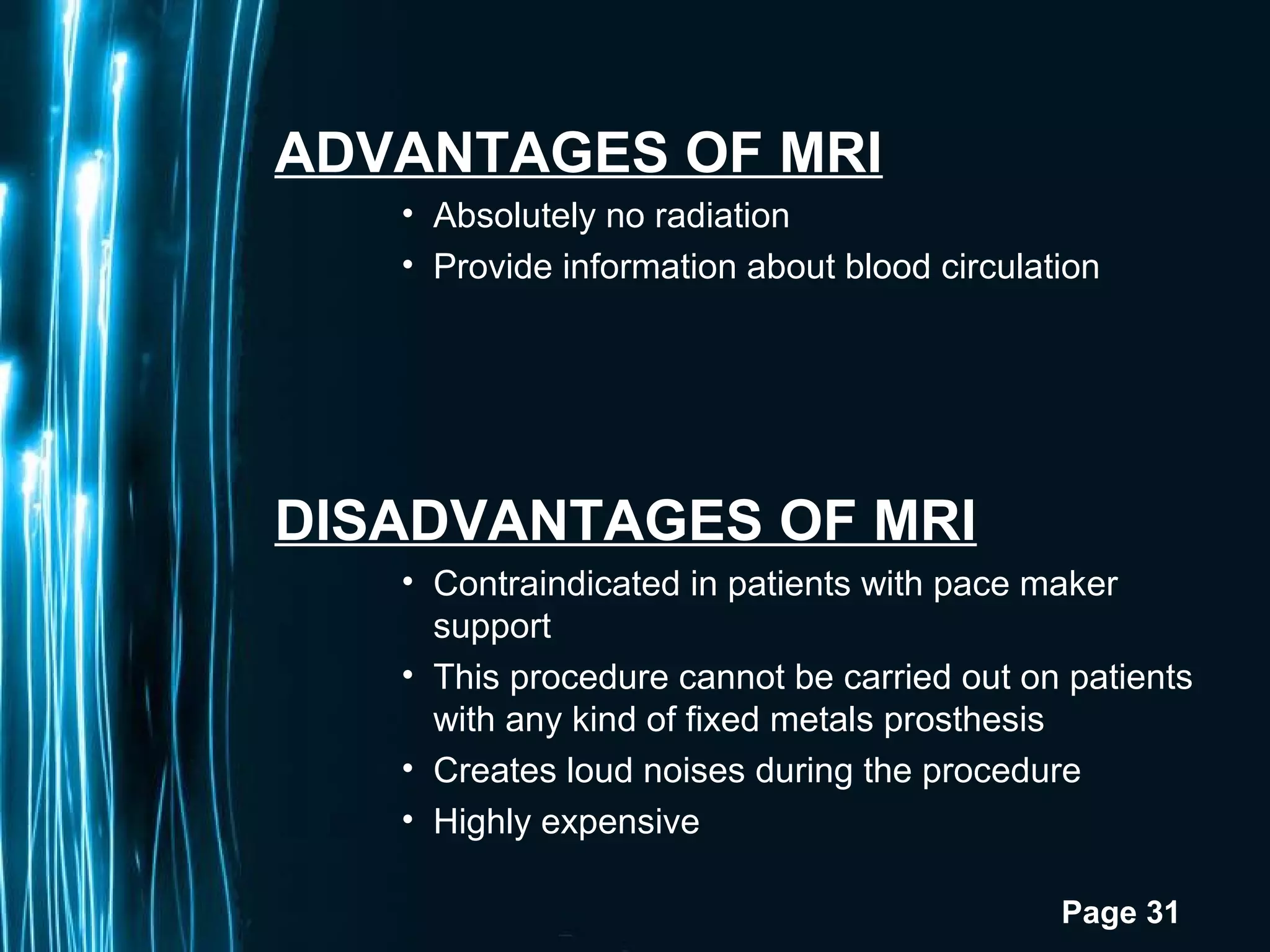
ADVANTAGES OF MRI
• Absolutely no radiation
• Provide information about blood circulation
DISADVANTAGES OF MRI
• Contraindicated in patients with pace maker
support
• This procedure cannot be carried out on patients
with any kind of fixed metals prosthesis
• Creates loud noises during the procedure
• Highly expensive
Page 32
References
• Textbook of white and pharoah, oral radiology
• Textbook of oral medicine, oral diagnosis and oral
radiology – 2nd
Edition – Ravikumar ongole, Praveen
BN – Pg no: 760 - 779

Digital Imaging

  • 1.
  • 2.
    Page 2 CONTENTS  Introduction Formation of digital images  CHARGE-COUPLED DEVICE (CCD)  COMPLEMENTARY METAL OXIDE SEMICONDUCTORS (CMOS)  Digital Subtraction Radiography (DSR)  PHOTOSTIMULABLE PHOSPHOR PLATES (PSP)
  • 3.
    Page 3 Introduction Digital Imagingrefers to the numeric format of the image in terms of pixels with its different shades. • Pixel = picture + element • A digital image consists of a large collection of individual pixels that are organised in a matrix consisting of rows and columns.
  • 4.
    Page 4 Formation ofdigital images • The formation of digital images involves several steps, beginning with analog processing. • Each pixel ---consists of individual electronic detector --- absorb x-ray --- generate small voltage proportional to the amount of x-ray absorbed by each individual pixels within the detector. • The voltage fluctuation at each pixel is therefore known as “analog signal” • Conversion of the analog signal into an usefull digital image is done through a process called “Analog to Digital Conversion (ADC)”
  • 5.
    Page 5 ADC ---SAMPLING --- QUANTIZISING • In order to view the image, the computer organizes the pixels in their proper location and gives them a grey shade that corresponds to the number that was assinged during quantization step.
  • 6.
    Page 6 • Variousreceptors that are used to absorbs the x-ray from the source were developed over the period times which includes… • Each has their own credits and limitations in producing the final digital images  DSR  PSP  CMOS CCD
  • 7.
    Page 7 CHARGE-COUPLED DEVICE (CCD) •Made up of thin layer of silicon. • When exposed to radiation--- covalent bonds between the silicon atoms are broken--- prduce electron-hole pairs which are proportional to amount of exposure. • Electrons are then attracted towards the positive site in the device creating a “charge packets”
  • 8.
    Page 8 • Theimage is read by transferring each rows of pixel charges in a “bucket brigade” fashion. • Each packet corresponds to one pixel. • As the charge reaches the end of its row--- transferred to the amplifier--- then transmitted as a voltage to ADC
  • 9.
    Page 9 COMPLEMENTARY METALOXIDE SEMICONDUCTORS (CMOS) • As same as that of CCD with few difference such as… • It is made of silicon based semi- conductor • Unlike CCD, each pixels are connected individually to a transistor. • These are less expensive than CCD
  • 10.
    Page 10 Digital Subtraction Radiography(DSR) Two images( base line and follow up image) of the same object registered --- image intensities of corresponding pixels are subtracted --- a uniform difference image is produced.  Projection geometry of both two images should be same to avoid errors in distinguishing the actual changes. Brighter area --- changes represent gain Darker are --- changes represent loss.
  • 11.
    Page 11 PHOTOSTIMULABLE PHOSPHOR PLATES (PSP) •Made of…. barium + iodine + chlorine/bromine…. Which forms a crystal lattice. • Europium (Eu+2) when added forms imperfection in the lattice. • Eu+2 --- when exposed to sufficient radiation --- valence electron in Eu+2 absorbs energy --- move into the near by halogen vacancies (F-Centers) --- trapped there in a metastatic state --- which represents the latent image.
  • 12.
    Page 12 • Numberof electrons trapped is proportional to the amount of exposure. PSP IMAGE PROSESSING:  When stimulated by red light(600 nm)--- barium fluorohalide releases the trapped electron --- electron returns to Eu+3 ion --- energy is released in green spectrum (300-500nm)  Lights from PSP --- conducted by fiberoptics to a photomultiplier tube
  • 13.
    Page 13 Digital image obtained Lightsfrom PSP --- conducted by fiberoptics --- to a photomultiplier tube Quantified by ADC Converts light into electrical energy Is inbuilt with red filter that selectively remove the stimulating red light. Prevent distortion in the final image
  • 14.
    Page 14 Specialized Radiographic Techniques COMPUTED TOMOGRAPHY (CT)  CONE-BEAM COMPUTED TOMOGRAPHY (CBCT)  MAGNETIC RESONANCE IMAGING (MRI)
  • 15.
    Page 15 COMPUTED TOMOGRAPHY(CT) Invented by Godfrey Hounsfield and Allan Cormack (Noble Price in medicine = 1979) Tomography --- which means thin layer radiography
  • 16.
  • 17.
    Page 17 X-ray beamsare collected in a grid like pattern called “Matrix” Made of array of pixels Each pixel represent a calculation that denote the actual attenuation of the X-ray beam by the constituents of the body A number (CT number / Hounsfield unit) is designated for each pixel corresponding to the degree of attenuation to the x-ray beam
  • 18.
    Page 18 • Calibrationof the Hounsfield units are inbuilt within the CT machine which differs according to the manufacturer’s. • Most moniter may display only 256 gray- scales to which the human eyes can percieve only 64 shades of gray.
  • 19.
    Page 19 ADVANTAGES OFCT • Multiplanar imaging • Greater geometric precision • Manipulation of the acquired image (able to change contrast and brightness) • Soft tissue imaging • Ability to distinguish objects of different density (such as air, fat, water, CSF, muscle and cortical bones)
  • 20.
    Page 20 DISADVANTAGES OFCT • Expensive • High radiation dosage to patient • Chances of artifacts ENDODONTIC USES OF CT • Evaluate the presence and extent of the lesion • Detection in displacement of the fracture segments
  • 21.
    Page 21 CONE-BEAM COMPUTED TOMOGRAPHY(CBCT) Since CT scanners are expensive and offers a high dosage of radiation, CBCT were invented as it costs lesser as well as offers lower radiation exposure to the patient than that of CT scanners.
  • 22.
    Page 22 FUNDAMENTALS OFCBCT Uses cone-shaped X-ray beam This serious of 2D images are Combined to generate an accurate 3D images (Projection Data) Produces a “serious of 2D images (Basis Projection)” using 2D detectors
  • 23.
    Page 23 ADVANTAGES OFCBCT • Lower radiation than CT • Lower scanning time, space and cost than CT • Greater hard tissue definition than CT • Interactive display module (zooming is able) DISADVANTAGES OF CBCT • Lesser soft tissue discrimination than CT • Scattering is more than CT • Chances of artifacts
  • 24.
    Page 24  Pre,Intra and Post-operative assessment  Diagnosis of root resorption and identification between its type  Diagnosis of root fracture  Diagnosis of dentoalveolar fracture
  • 25.
    Page 25 ENDODONTIC USESOF CBCT  Root canal morphology: Precisely determine root curvature Definitely identify accessory canals  Periapical pathosis: Uses in cases were the lesions are superimposed by anatomical structures Can support diagnosis of ‘lesions of non-endodontic origin’ Determines the extent of the lesion and its effect on surrounding structures
  • 26.
    Page 26 MAGNETIC RESONANCE IMAGING(MRI) MRI --- uses strong magnetic fields + radio waves --- form images of the body.
  • 27.
    Page 27 Human bodyconsists of nearly 70% water (H2O) Water has hydrogen molecules in it Hydrogen atom has only a single proton within its nucleus Proton has a positive charge and also spin on its own
  • 28.
    Page 28 Hence hasa magnetic property i.e. has both north and south poles Now an external magnetic field is applied All hapazaradly aligned proton align them self towards the direction of external magnetic field Then a radiofrequency wave is applied
  • 29.
    Page 29 This enforcesthe protons to turn away from the direction of the external magnetic field Sudden stoppage of the radiofrequency wave Protons tends to return back again to the direction of the external magnetic field This results in the release of energy in the form of photons
  • 30.
    Page 30 Photons detectedby the specialized detectors “MRI image” constructed on computer The amount of photons emitted is proportional to the concentration of the hydrogen atoms within the tissue The images can be taken in all the planes by altering the direction of the external magnetic field towards the plane of interest
  • 31.
    Page 31 ADVANTAGES OFMRI • Absolutely no radiation • Provide information about blood circulation DISADVANTAGES OF MRI • Contraindicated in patients with pace maker support • This procedure cannot be carried out on patients with any kind of fixed metals prosthesis • Creates loud noises during the procedure • Highly expensive
  • 32.
    Page 32 References • Textbookof white and pharoah, oral radiology • Textbook of oral medicine, oral diagnosis and oral radiology – 2nd Edition – Ravikumar ongole, Praveen BN – Pg no: 760 - 779