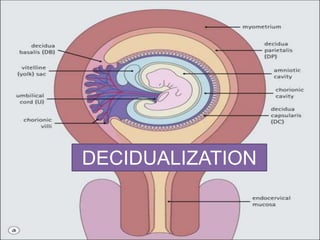
DECIDUALIZATION
Fertilization
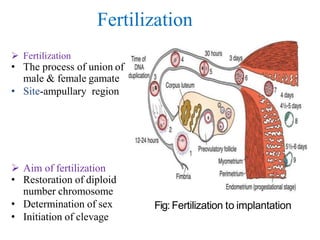
 Fertilization
• The process of union of
male & female gamate
• Site-ampullary region
 Aim of fertilization
• Restoration of diploid
number chromosome
• Determination of sex
• Initiation of clevage
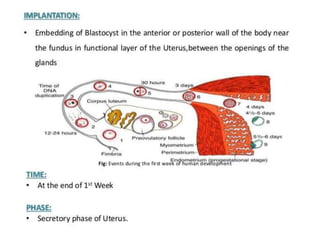
Fig: Fertilization to implantation
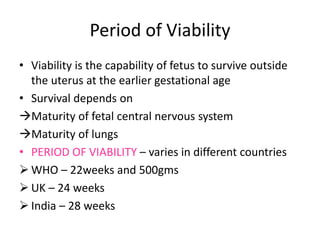
Period of Viability
• Viability is the capability of fetus to survive outside
the uterus at the earlier gestational age
• Survival depends on
Maturity of fetal central nervous system
Maturity of lungs
• PERIOD OF VIABILITY – varies in different countries
 WHO – 22weeks and 500gms
 UK – 24 weeks
 India – 28 weeks
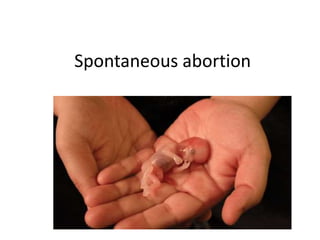
Spontaneous abortion
Definition
• Clinically recognised pregnancy loss before 20th
week of gestation
• Expulsion or extraction of an embryo or fetus
weighing 500gm or less(WHO)
• Synonymous with MISCARRIAGE
• Latin :aboriri: to miscarry
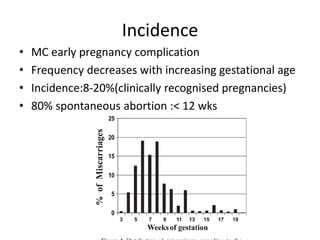
Incidence
• MC early pregnancy complication
• Frequency decreases with increasing gestational age
• Incidence:8-20%(clinically recognised pregnancies)
• 80% spontaneous abortion :< 12 wks
Risk factors
• Advanced maternal age
• Previous spontaneous abortion
• Medications & substances (smoking)
• Mechanisms responsible for abortion: not
apparent
• Death of fetus precedes spont. expulsion,
finding cause involves ascertaining the cause
of fetal death
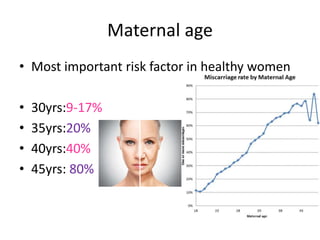
Maternal age
• Most important risk factor in healthy women
• 30yrs:9-17%
• 35yrs:20%
• 40yrs:40%
• 45yrs: 80%
Previous spontaneous abortion
• Previous successful pregnancy: 5% risk
• 1 miscarriage: 20%
• 2 consecutive miscarriages:28%
• ≥3 consecutive miscarriages:43%
Medications or substances
• Heavy smoking(>10 cigarettes/day) : vasoconstrictive &
antimetabolic effects of tobacco smoke
• Moderate to high alcohol consumption(>3 drinks/week)
• NSAIDS use(acetaminophen) :abnormal implantation &
pregnancy failure due to antiprostaglandin effect
Other factors
• Low plasma folate levels(≤2.19ng/ml): no
specific evidence to support
• Extremes of maternal weight: prepregnancy
BMI<18.5 OR >25kg/m2
• Maternal fever:100°F(37.8°C), no evidence to
support
Etiology
• Fetal
• Maternal
• unexplained
Etiology
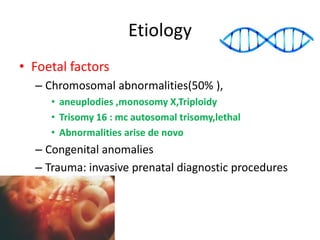
• Foetal factors
– Chromosomal abnormalities(50% ),
• aneuplodies ,monosomy X,Triploidy
• Trisomy 16 : mc autosomal trisomy,lethal
• Abnormalities arise de novo
– Congenital anomalies
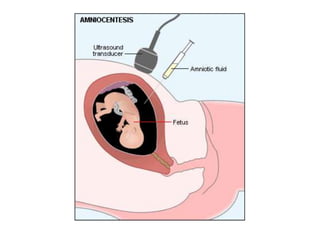
– Trauma: invasive prenatal diagnostic procedures
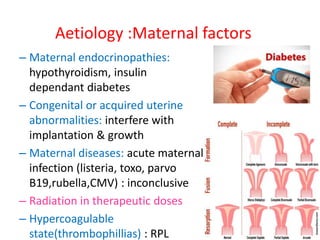
Aetiology :Maternal factors
– Maternal endocrinopathies:
hypothyroidism, insulin
dependant diabetes
– Congenital or acquired uterine
abnormalities: interfere with
implantation & growth
– Maternal diseases: acute maternal
infection (listeria, toxo, parvo
B19,rubella,CMV) : inconclusive
– Radiation in therapeutic doses
– Hypercoagulable
state(thrombophillias) : RPL
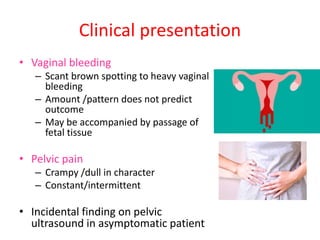
Clinical presentation
• Vaginal bleeding
– Scant brown spotting to heavy vaginal
bleeding
– Amount /pattern does not predict
outcome
– May be accompanied by passage of
fetal tissue
• Pelvic pain
– Crampy /dull in character
– Constant/intermittent
• Incidental finding on pelvic
ultrasound in asymptomatic patient
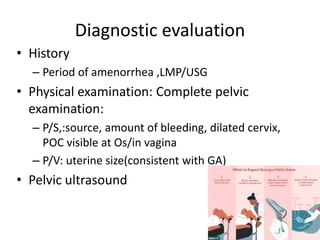
Diagnostic evaluation
• History
– Period of amenorrhea ,LMP/USG
• Physical examination: Complete pelvic
examination:
– P/S,:source, amount of bleeding, dilated cervix,
POC visible at Os/in vagina
– P/V: uterine size(consistent with GA)
• Pelvic ultrasound
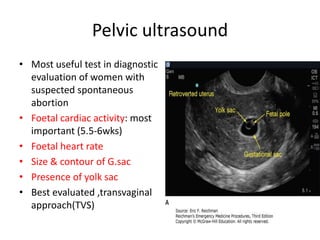
Pelvic ultrasound
• Most useful test in diagnostic
evaluation of women with
suspected spontaneous
abortion
• Foetal cardiac activity: most
important (5.5-6wks)
• Foetal heart rate
• Size & contour of G.sac
• Presence of yolk sac
• Best evaluated ,transvaginal
approach(TVS)
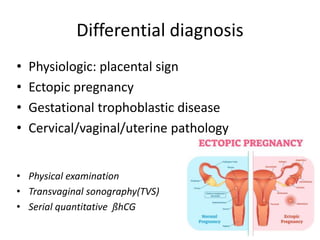
Differential diagnosis
• Physiologic: placental sign
• Ectopic pregnancy
• Gestational trophoblastic disease
• Cervical/vaginal/uterine pathology
• Physical examination
• Transvaginal sonography(TVS)
• Serial quantitative ßhCG
Post diagnostic classification
• Based upon the location of POC
• Degree of cervical dilatation(pelvic exam)
• Pelvic ultrasound
• Categorization impacts clinical management
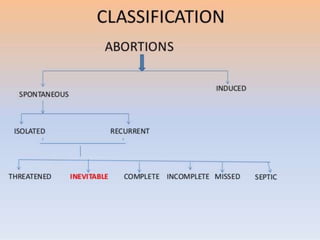
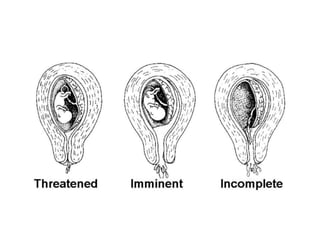
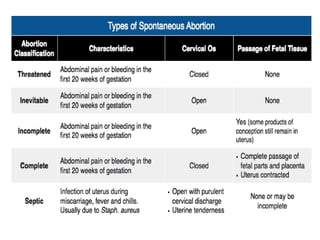
– Threatened
– Inevitable
– Incomplete/complete
– Missed
Threatened abortion
• Vaginal bleeding has occurred
• The cervical os is closed
• Managed expectantly: until symptoms resolve
or progresses
Threatened abortion:
• Expectant
• Progestin treatment: most promising, efficacy
not established
• Bed rest
• Avoid vigorous activity
• Avoid heavy lifting
• Avoid sexual intercourse
Threatened abortion :
• Counsel about risk of miscarriage
• Return to hospital in case of additional vaginal
bleeding, pelvic cramping or passage of tissue from
vagina
• Repeat pelvic USG until a viable pregnancy is
confirmed or excluded
• Viable pregnancy, resolved symptoms: prenatal care
• If symptoms continue: monitor for progression to
inevitable, incomplete, or complete abortion
Inevitable abortion
• Vaginal bleeding, typically accompanied by
crampy pelvic pain
• Dilated cervix( internal os)
• Products of conception felt or visualised
through the internal os
Incomplete abortion
• Vaginal bleeding and/or pain present
• Cervix is dilated
• Products of conception partially expelled out
• Uterine size less than period of amenorrhea
Missed abortion
• Non viable intrauterine pregnancy
• Cervical os is closed
• POC not expelled
Complete abortion
• POC expelled completely from uterus &
cervix
• Cervical os is closed
• Uterus small in size (GA)
• Resolved or minimal vaginal bleeding & pain
• Aim of t/t: ensure that bleeding is not
excessive & all POC have expelled
• Theoretically does not need treatment
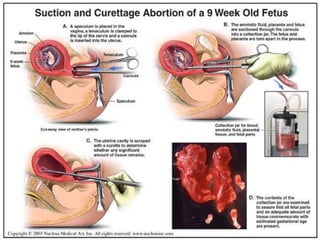
Management
• Complete evacuation of uterine contents(POC)
• Surgical methods: suction evacuation/suction
curettage/dilation & evacuation
• Medical methods: Misoprostol,mifepristone
• All have similar efficacy
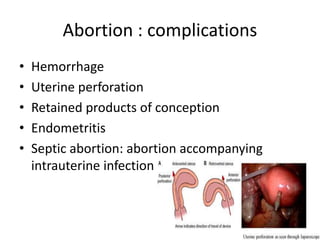
Abortion : complications
• Hemorrhage
• Uterine perforation
• Retained products of conception
• Endometritis
• Septic abortion: abortion accompanying
intrauterine infection
Prevention of spont.abortion
• Preconception & prenatal counseling
• Routine screening & optimal disease
control(diabetes, thyroid, thrombophilia)
• Correction of uterine structural
anomalies(septum, submucosal myoma,
intrauterine adhesions) prior to pregnancy
• Avoiding exposure to teratogen or infections
• Modifiable risk factors
• Clinically recognised pregnany losses <20 wks
gestation
• Most common complication of early
pregnancy
• Advanced maternal age, previous
spontaneous abortion, maternal smoking: risk
factors
• Mostly due to fetal structural/chromosomal
abnormalities
• Present with menstrual delay, vaginal
bleeding& pelvic pain
• D/D: uterine or other genital tract bleeding in
viable pregnancy, ectopic,& GTD
• Pelvic examination & pelvic ultrasound: key
elements for diagnosis
• Spontaneous abortion diagnosed based on
USG criteria
• Categorised as threatened/incomplete/missed
• Preconceptual & prenatal counseling & care
regarding modifiable aetiologies ,risk factors
are most imp intervention
• Normal menstrual cycle resumes in 4-6 weeks
• hCG returns to normal 2-4wks
Thank you for your patient listening !

ABORTION

  • 1.
  • 3.
    Fertilization  Fertilization • Theprocess of union of male & female gamate • Site-ampullary region  Aim of fertilization • Restoration of diploid number chromosome • Determination of sex • Initiation of clevage Fig: Fertilization to implantation
  • 18.
    Period of Viability •Viability is the capability of fetus to survive outside the uterus at the earlier gestational age • Survival depends on Maturity of fetal central nervous system Maturity of lungs • PERIOD OF VIABILITY – varies in different countries  WHO – 22weeks and 500gms  UK – 24 weeks  India – 28 weeks
  • 20.
  • 21.
    Definition • Clinically recognisedpregnancy loss before 20th week of gestation • Expulsion or extraction of an embryo or fetus weighing 500gm or less(WHO) • Synonymous with MISCARRIAGE • Latin :aboriri: to miscarry
  • 22.
    Incidence • MC earlypregnancy complication • Frequency decreases with increasing gestational age • Incidence:8-20%(clinically recognised pregnancies) • 80% spontaneous abortion :< 12 wks
  • 23.
    Risk factors • Advancedmaternal age • Previous spontaneous abortion • Medications & substances (smoking) • Mechanisms responsible for abortion: not apparent • Death of fetus precedes spont. expulsion, finding cause involves ascertaining the cause of fetal death
  • 24.
    Maternal age • Mostimportant risk factor in healthy women • 30yrs:9-17% • 35yrs:20% • 40yrs:40% • 45yrs: 80%
  • 25.
    Previous spontaneous abortion •Previous successful pregnancy: 5% risk • 1 miscarriage: 20% • 2 consecutive miscarriages:28% • ≥3 consecutive miscarriages:43%
  • 26.
    Medications or substances •Heavy smoking(>10 cigarettes/day) : vasoconstrictive & antimetabolic effects of tobacco smoke • Moderate to high alcohol consumption(>3 drinks/week) • NSAIDS use(acetaminophen) :abnormal implantation & pregnancy failure due to antiprostaglandin effect
  • 27.
    Other factors • Lowplasma folate levels(≤2.19ng/ml): no specific evidence to support • Extremes of maternal weight: prepregnancy BMI<18.5 OR >25kg/m2 • Maternal fever:100°F(37.8°C), no evidence to support
  • 28.
  • 29.
    Etiology • Foetal factors –Chromosomal abnormalities(50% ), • aneuplodies ,monosomy X,Triploidy • Trisomy 16 : mc autosomal trisomy,lethal • Abnormalities arise de novo – Congenital anomalies – Trauma: invasive prenatal diagnostic procedures
  • 31.
    Aetiology :Maternal factors –Maternal endocrinopathies: hypothyroidism, insulin dependant diabetes – Congenital or acquired uterine abnormalities: interfere with implantation & growth – Maternal diseases: acute maternal infection (listeria, toxo, parvo B19,rubella,CMV) : inconclusive – Radiation in therapeutic doses – Hypercoagulable state(thrombophillias) : RPL
  • 32.
    Clinical presentation • Vaginalbleeding – Scant brown spotting to heavy vaginal bleeding – Amount /pattern does not predict outcome – May be accompanied by passage of fetal tissue • Pelvic pain – Crampy /dull in character – Constant/intermittent • Incidental finding on pelvic ultrasound in asymptomatic patient
  • 33.
    Diagnostic evaluation • History –Period of amenorrhea ,LMP/USG • Physical examination: Complete pelvic examination: – P/S,:source, amount of bleeding, dilated cervix, POC visible at Os/in vagina – P/V: uterine size(consistent with GA) • Pelvic ultrasound
  • 34.
    Pelvic ultrasound • Mostuseful test in diagnostic evaluation of women with suspected spontaneous abortion • Foetal cardiac activity: most important (5.5-6wks) • Foetal heart rate • Size & contour of G.sac • Presence of yolk sac • Best evaluated ,transvaginal approach(TVS)
  • 35.
    Differential diagnosis • Physiologic:placental sign • Ectopic pregnancy • Gestational trophoblastic disease • Cervical/vaginal/uterine pathology • Physical examination • Transvaginal sonography(TVS) • Serial quantitative ßhCG
  • 36.
    Post diagnostic classification •Based upon the location of POC • Degree of cervical dilatation(pelvic exam) • Pelvic ultrasound • Categorization impacts clinical management – Threatened – Inevitable – Incomplete/complete – Missed
  • 39.
    Threatened abortion • Vaginalbleeding has occurred • The cervical os is closed • Managed expectantly: until symptoms resolve or progresses
  • 40.
    Threatened abortion: • Expectant •Progestin treatment: most promising, efficacy not established • Bed rest • Avoid vigorous activity • Avoid heavy lifting • Avoid sexual intercourse
  • 41.
    Threatened abortion : •Counsel about risk of miscarriage • Return to hospital in case of additional vaginal bleeding, pelvic cramping or passage of tissue from vagina • Repeat pelvic USG until a viable pregnancy is confirmed or excluded • Viable pregnancy, resolved symptoms: prenatal care • If symptoms continue: monitor for progression to inevitable, incomplete, or complete abortion
  • 42.
    Inevitable abortion • Vaginalbleeding, typically accompanied by crampy pelvic pain • Dilated cervix( internal os) • Products of conception felt or visualised through the internal os
  • 43.
    Incomplete abortion • Vaginalbleeding and/or pain present • Cervix is dilated • Products of conception partially expelled out • Uterine size less than period of amenorrhea
  • 44.
    Missed abortion • Nonviable intrauterine pregnancy • Cervical os is closed • POC not expelled
  • 45.
    Complete abortion • POCexpelled completely from uterus & cervix • Cervical os is closed • Uterus small in size (GA) • Resolved or minimal vaginal bleeding & pain • Aim of t/t: ensure that bleeding is not excessive & all POC have expelled • Theoretically does not need treatment
  • 46.
    Management • Complete evacuationof uterine contents(POC) • Surgical methods: suction evacuation/suction curettage/dilation & evacuation • Medical methods: Misoprostol,mifepristone • All have similar efficacy
  • 48.
    Abortion : complications •Hemorrhage • Uterine perforation • Retained products of conception • Endometritis • Septic abortion: abortion accompanying intrauterine infection
  • 49.
    Prevention of spont.abortion •Preconception & prenatal counseling • Routine screening & optimal disease control(diabetes, thyroid, thrombophilia) • Correction of uterine structural anomalies(septum, submucosal myoma, intrauterine adhesions) prior to pregnancy • Avoiding exposure to teratogen or infections • Modifiable risk factors
  • 50.
    • Clinically recognisedpregnany losses <20 wks gestation • Most common complication of early pregnancy • Advanced maternal age, previous spontaneous abortion, maternal smoking: risk factors • Mostly due to fetal structural/chromosomal abnormalities
  • 51.
    • Present withmenstrual delay, vaginal bleeding& pelvic pain • D/D: uterine or other genital tract bleeding in viable pregnancy, ectopic,& GTD • Pelvic examination & pelvic ultrasound: key elements for diagnosis • Spontaneous abortion diagnosed based on USG criteria • Categorised as threatened/incomplete/missed
  • 52.
    • Preconceptual &prenatal counseling & care regarding modifiable aetiologies ,risk factors are most imp intervention • Normal menstrual cycle resumes in 4-6 weeks • hCG returns to normal 2-4wks
  • 53.
    Thank you foryour patient listening !

Editor's Notes

  • #36 Cyclical bleeding till 12 weeks of pregnancy – this happens until the decidual space is obliterated by fusion of decidua vera and decidua capsularis