CASE SUMMARY
• 18 years , primi presented in ER with complain
of amenorrhoea for 3 months followed by PV
bleeding for 2 days with passage of grape like
vesicles ,on examination uterus 24 weeks size
and vitals stable and hemoglobin 8gm /dl %.
• WHAT COULD BE THE DIAGNOSIS?
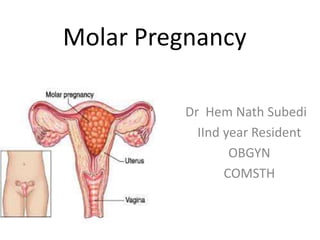
Molar Pregnancy
Dr Hem Nath Subedi
IInd year Resident
OBGYN
COMSTH
CONTENTS
• DEFINITION
• INCIDENCE
• TYPES
• CLINICAL FEATURES
• INVESTIGATIONS
• DIAGNOSIS
• MANAGEMENT
• COMPLICATIONS
DEFINITION
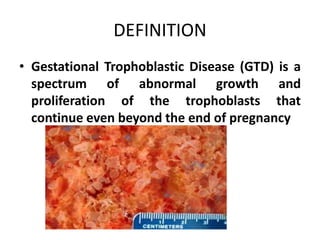
• Gestational Trophoblastic Disease (GTD) is a
spectrum of abnormal growth and
proliferation of the trophoblasts that
continue even beyond the end of pregnancy
INCIDENCE
• The reported incidence of GTD varies widely
worldwide, from a low of 23 per 100,000
pregnancies (Paraguay) to a high of 1,299 per
100,000 pregnancies (Indonesia).
• The malignant potential of GTD is also higher
in South Asia (10-15%) compared to western
countries (2-4%)
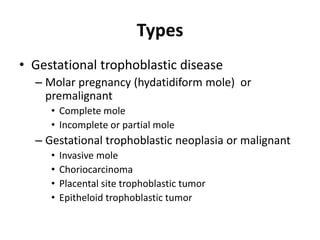
Types
• Gestational trophoblastic disease
– Molar pregnancy (hydatidiform mole) or
premalignant
• Complete mole
• Incomplete or partial mole
– Gestational trophoblastic neoplasia or malignant
• Invasive mole
• Choriocarcinoma
• Placental site trophoblastic tumor
• Epitheloid trophoblastic tumor
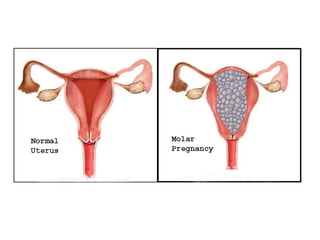
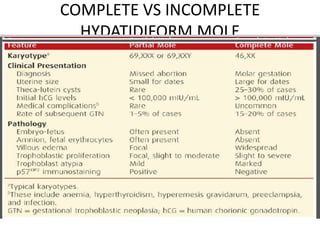
COMPLETE VS INCOMPLETE
HYDATIDIFORM MOLE
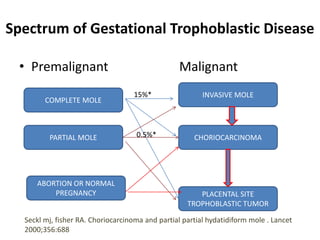
Spectrum of Gestational Trophoblastic Disease
• Premalignant Malignant
COMPLETE MOLE
INVASIVE MOLE
PARTIAL MOLE CHORIOCARCINOMA
PLACENTAL SITE
TROPHOBLASTIC TUMOR
ABORTION OR NORMAL
PREGNANCY
15%*
0.5%*
Seckl mj, fisher RA. Choriocarcinoma and partial partial hydatidiform mole . Lancet
2000;356:688
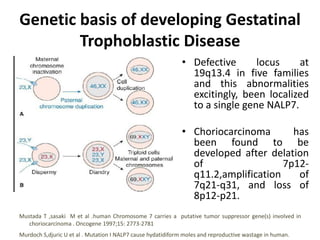
Genetic basis of developing Gestatinal
Trophoblastic Disease
• Defective locus at
19q13.4 in five families
and this abnormalities
excitingly, been localized
to a single gene NALP7.
• Choriocarcinoma has
been found to be
developed after delation
of 7p12-
q11.2,amplification of
7q21-q31, and loss of
8p12-p21.
Murdoch S,djuric U et al . Mutation I NALP7 cause hydatidiform moles and reproductive wastage in human.
Mustada T ,sasaki M et al .human Chromosome 7 carries a putative tumor suppressor gene(s) involved in
choriocarcinoma . Oncogene 1997;15: 2773-2781
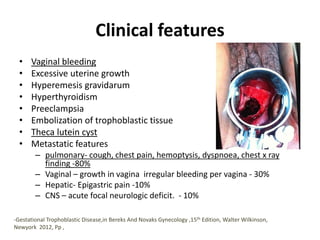
Clinical features
• Vaginal bleeding
• Excessive uterine growth
• Hyperemesis gravidarum
• Hyperthyroidism
• Preeclampsia
• Embolization of trophoblastic tissue
• Theca lutein cyst
• Metastatic features
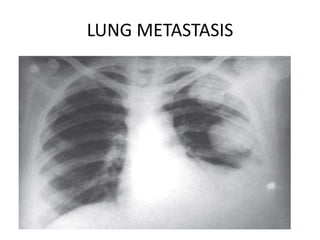
– pulmonary- cough, chest pain, hemoptysis, dyspnoea, chest x ray
finding -80%
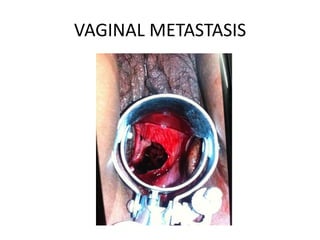
– Vaginal – growth in vagina irregular bleeding per vagina - 30%
– Hepatic- Epigastric pain -10%
– CNS – acute focal neurologic deficit. - 10%
-Gestational Trophoblastic Disease,in Bereks And Novaks Gynecology ,15th Edition, Walter Wilkinson,
Newyork 2012, Pp ,
VAGINAL METASTASIS
LUNG METASTASIS
Diagnosis
• Clinical features
• History
• Physical examination
• Investigation
– Lab investigation – Beta-hCG, LFT, RFT, CBC, urine R/E
– USG abdomen and pelvis
– Chest x ray
– CT scan
– Histopathological examination
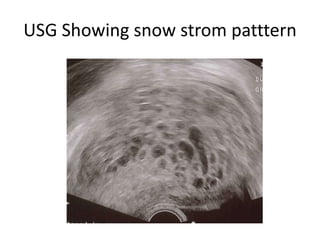
USG Showing snow strom patttern
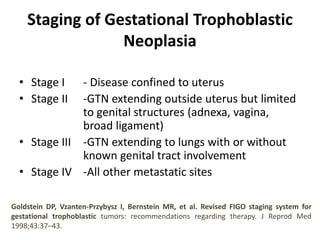
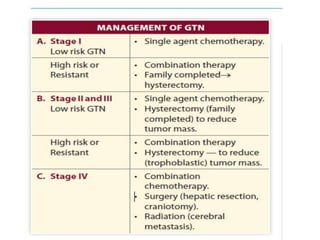
Staging of Gestational Trophoblastic
Neoplasia
• Stage I - Disease confined to uterus
• Stage II -GTN extending outside uterus but limited
to genital structures (adnexa, vagina,
broad ligament)
• Stage III -GTN extending to lungs with or without
known genital tract involvement
• Stage IV -All other metastatic sites
Goldstein DP, Vzanten-Przybysz I, Bernstein MR, et al. Revised FIGO staging system for
gestational trophoblastic tumors: recommendations regarding therapy. J Reprod Med
1998;43:37–43.
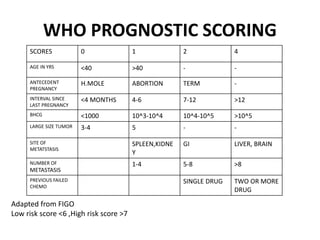
WHO PROGNOSTIC SCORING
SCORES 0 1 2 4
AGE IN YRS <40 >40 - -
ANTECEDENT
PREGNANCY
H.MOLE ABORTION TERM -
INTERVAL SINCE
LAST PREGNANCY
<4 MONTHS 4-6 7-12 >12
BHCG <1000 10^3-10^4 10^4-10^5 >10^5
LARGE SIZE TUMOR 3-4 5 - -
SITE OF
METATSTASIS
SPLEEN,KIDNE
Y
GI LIVER, BRAIN
NUMBER OF
METASTASIS
1-4 5-8 >8
PREVIOUS FAILED
CHEMO
SINGLE DRUG TWO OR MORE
DRUG
Adapted from FIGO
Low risk score <6 ,High risk score >7
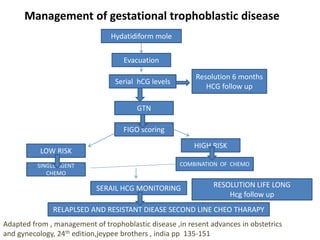
Management of gestational trophoblastic disease
Hydatidiform mole
Evacuation
Serial hCG levels
FIGO scoring
GTN
LOW RISK
SINGLE AGENT
CHEMO
HIGH RISK
COMBINATION OF CHEMO
SERAIL HCG MONITORING
RELAPLSED AND RESISTANT DIEASE SECOND LINE CHEO THARAPY
Resolution 6 months
HCG follow up
RESOLUTION LIFE LONG
Hcg follow up
Adapted from , management of trophoblastic disease ,in resent advances in obstetrics
and gynecology, 24th edition,jeypee brothers , india pp 135-151
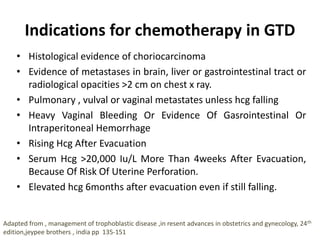
Indications for chemotherapy in GTD
• Histological evidence of choriocarcinoma
• Evidence of metastases in brain, liver or gastrointestinal tract or
radiological opacities >2 cm on chest x ray.
• Pulmonary , vulval or vaginal metastates unless hcg falling
• Heavy Vaginal Bleeding Or Evidence Of Gasrointestinal Or
Intraperitoneal Hemorrhage
• Rising Hcg After Evacuation
• Serum Hcg >20,000 Iu/L More Than 4weeks After Evacuation,
Because Of Risk Of Uterine Perforation.
• Elevated hcg 6months after evacuation even if still falling.
Adapted from , management of trophoblastic disease ,in resent advances in obstetrics and gynecology, 24th
edition,jeypee brothers , india pp 135-151
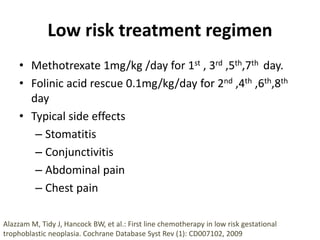
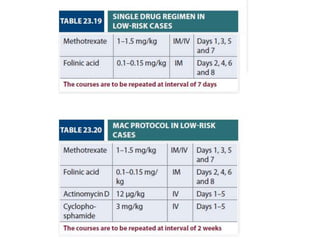
Low risk treatment regimen
• Methotrexate 1mg/kg /day for 1st , 3rd ,5th,7th day.
• Folinic acid rescue 0.1mg/kg/day for 2nd ,4th ,6th,8th
day
• Typical side effects
– Stomatitis
– Conjunctivitis
– Abdominal pain
– Chest pain
Alazzam M, Tidy J, Hancock BW, et al.: First line chemotherapy in low risk gestational
trophoblastic neoplasia. Cochrane Database Syst Rev (1): CD007102, 2009
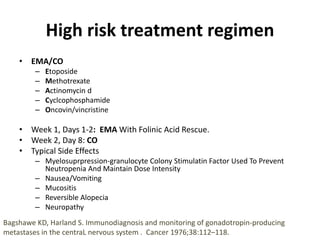
High risk treatment regimen
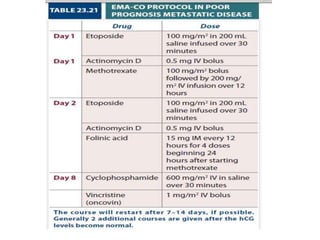
• EMA/CO
– Etoposide
– Methotrexate
– Actinomycin d
– Cyclcophosphamide
– Oncovin/vincristine
• Week 1, Days 1-2: EMA With Folinic Acid Rescue.
• Week 2, Day 8: CO
• Typical Side Effects
– Myelosuprpression-granulocyte Colony Stimulatin Factor Used To Prevent
Neutropenia And Maintain Dose Intensity
– Nausea/Vomiting
– Mucositis
– Reversible Alopecia
– Neuropathy
Bagshawe KD, Harland S. Immunodiagnosis and monitoring of gonadotropin-producing
metastases in the centraL nervous system . Cancer 1976;38:112–118.
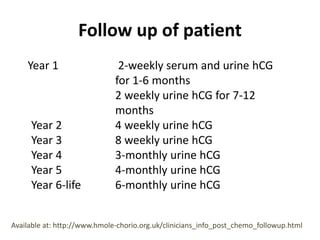
Follow up of patient
Year 1 2-weekly serum and urine hCG
for 1-6 months
2 weekly urine hCG for 7-12
months
Year 2 4 weekly urine hCG
Year 3 8 weekly urine hCG
Year 4 3-monthly urine hCG
Year 5 4-monthly urine hCG
Year 6-life 6-monthly urine hCG
Available at: http://www.hmole-chorio.org.uk/clinicians_info_post_chemo_followup.html
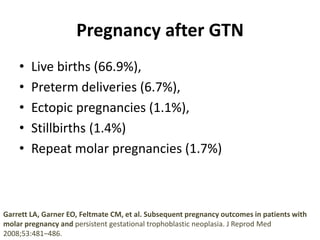
Pregnancy after GTN
• Live births (66.9%),
• Preterm deliveries (6.7%),
• Ectopic pregnancies (1.1%),
• Stillbirths (1.4%)
• Repeat molar pregnancies (1.7%)
Garrett LA, Garner EO, Feltmate CM, et al. Subsequent pregnancy outcomes in patients with
molar pregnancy and persistent gestational trophoblastic neoplasia. J Reprod Med
2008;53:481–486.
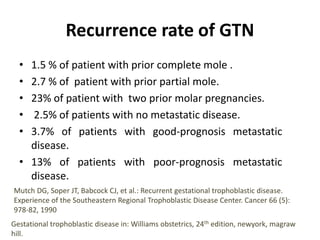
Recurrence rate of GTN
• 1.5 % of patient with prior complete mole .
• 2.7 % of patient with prior partial mole.
• 23% of patient with two prior molar pregnancies.
• 2.5% of patients with no metastatic disease.
• 3.7% of patients with good-prognosis metastatic
disease.
• 13% of patients with poor-prognosis metastatic
disease.
Mutch DG, Soper JT, Babcock CJ, et al.: Recurrent gestational trophoblastic disease.
Experience of the Southeastern Regional Trophoblastic Disease Center. Cancer 66 (5):
978-82, 1990
Gestational trophoblastic disease in: Williams obstetrics, 24th edition, newyork, magraw
hill.
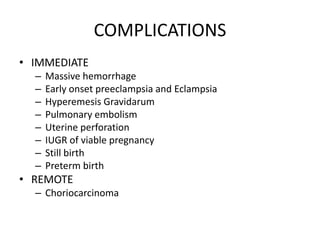
COMPLICATIONS
• IMMEDIATE
– Massive hemorrhage
– Early onset preeclampsia and Eclampsia
– Hyperemesis Gravidarum
– Pulmonary embolism
– Uterine perforation
– IUGR of viable pregnancy
– Still birth
– Preterm birth
• REMOTE
– Choriocarcinoma
Questions
• Define types of molar pregnancy and write
difference between complete hydatidiform
mole and partial mole?
• What are the clinical features of molar
pregnancy how will you manage a case of
molar pregnancy?
• Write complications of molar pregnancy.

Molar pregnancy

  • 1.
    CASE SUMMARY • 18years , primi presented in ER with complain of amenorrhoea for 3 months followed by PV bleeding for 2 days with passage of grape like vesicles ,on examination uterus 24 weeks size and vitals stable and hemoglobin 8gm /dl %. • WHAT COULD BE THE DIAGNOSIS?
  • 2.
    Molar Pregnancy Dr HemNath Subedi IInd year Resident OBGYN COMSTH
  • 4.
    CONTENTS • DEFINITION • INCIDENCE •TYPES • CLINICAL FEATURES • INVESTIGATIONS • DIAGNOSIS • MANAGEMENT • COMPLICATIONS
  • 5.
    DEFINITION • Gestational TrophoblasticDisease (GTD) is a spectrum of abnormal growth and proliferation of the trophoblasts that continue even beyond the end of pregnancy
  • 6.
    INCIDENCE • The reportedincidence of GTD varies widely worldwide, from a low of 23 per 100,000 pregnancies (Paraguay) to a high of 1,299 per 100,000 pregnancies (Indonesia). • The malignant potential of GTD is also higher in South Asia (10-15%) compared to western countries (2-4%)
  • 7.
    Types • Gestational trophoblasticdisease – Molar pregnancy (hydatidiform mole) or premalignant • Complete mole • Incomplete or partial mole – Gestational trophoblastic neoplasia or malignant • Invasive mole • Choriocarcinoma • Placental site trophoblastic tumor • Epitheloid trophoblastic tumor
  • 8.
  • 9.
    Spectrum of GestationalTrophoblastic Disease • Premalignant Malignant COMPLETE MOLE INVASIVE MOLE PARTIAL MOLE CHORIOCARCINOMA PLACENTAL SITE TROPHOBLASTIC TUMOR ABORTION OR NORMAL PREGNANCY 15%* 0.5%* Seckl mj, fisher RA. Choriocarcinoma and partial partial hydatidiform mole . Lancet 2000;356:688
  • 10.
    Genetic basis ofdeveloping Gestatinal Trophoblastic Disease • Defective locus at 19q13.4 in five families and this abnormalities excitingly, been localized to a single gene NALP7. • Choriocarcinoma has been found to be developed after delation of 7p12- q11.2,amplification of 7q21-q31, and loss of 8p12-p21. Murdoch S,djuric U et al . Mutation I NALP7 cause hydatidiform moles and reproductive wastage in human. Mustada T ,sasaki M et al .human Chromosome 7 carries a putative tumor suppressor gene(s) involved in choriocarcinoma . Oncogene 1997;15: 2773-2781
  • 11.
    Clinical features • Vaginalbleeding • Excessive uterine growth • Hyperemesis gravidarum • Hyperthyroidism • Preeclampsia • Embolization of trophoblastic tissue • Theca lutein cyst • Metastatic features – pulmonary- cough, chest pain, hemoptysis, dyspnoea, chest x ray finding -80% – Vaginal – growth in vagina irregular bleeding per vagina - 30% – Hepatic- Epigastric pain -10% – CNS – acute focal neurologic deficit. - 10% -Gestational Trophoblastic Disease,in Bereks And Novaks Gynecology ,15th Edition, Walter Wilkinson, Newyork 2012, Pp ,
  • 12.
  • 13.
  • 14.
    Diagnosis • Clinical features •History • Physical examination • Investigation – Lab investigation – Beta-hCG, LFT, RFT, CBC, urine R/E – USG abdomen and pelvis – Chest x ray – CT scan – Histopathological examination
  • 15.
    USG Showing snowstrom patttern
  • 16.
    Staging of GestationalTrophoblastic Neoplasia • Stage I - Disease confined to uterus • Stage II -GTN extending outside uterus but limited to genital structures (adnexa, vagina, broad ligament) • Stage III -GTN extending to lungs with or without known genital tract involvement • Stage IV -All other metastatic sites Goldstein DP, Vzanten-Przybysz I, Bernstein MR, et al. Revised FIGO staging system for gestational trophoblastic tumors: recommendations regarding therapy. J Reprod Med 1998;43:37–43.
  • 17.
    WHO PROGNOSTIC SCORING SCORES0 1 2 4 AGE IN YRS <40 >40 - - ANTECEDENT PREGNANCY H.MOLE ABORTION TERM - INTERVAL SINCE LAST PREGNANCY <4 MONTHS 4-6 7-12 >12 BHCG <1000 10^3-10^4 10^4-10^5 >10^5 LARGE SIZE TUMOR 3-4 5 - - SITE OF METATSTASIS SPLEEN,KIDNE Y GI LIVER, BRAIN NUMBER OF METASTASIS 1-4 5-8 >8 PREVIOUS FAILED CHEMO SINGLE DRUG TWO OR MORE DRUG Adapted from FIGO Low risk score <6 ,High risk score >7
  • 18.
    Management of gestationaltrophoblastic disease Hydatidiform mole Evacuation Serial hCG levels FIGO scoring GTN LOW RISK SINGLE AGENT CHEMO HIGH RISK COMBINATION OF CHEMO SERAIL HCG MONITORING RELAPLSED AND RESISTANT DIEASE SECOND LINE CHEO THARAPY Resolution 6 months HCG follow up RESOLUTION LIFE LONG Hcg follow up Adapted from , management of trophoblastic disease ,in resent advances in obstetrics and gynecology, 24th edition,jeypee brothers , india pp 135-151
  • 20.
    Indications for chemotherapyin GTD • Histological evidence of choriocarcinoma • Evidence of metastases in brain, liver or gastrointestinal tract or radiological opacities >2 cm on chest x ray. • Pulmonary , vulval or vaginal metastates unless hcg falling • Heavy Vaginal Bleeding Or Evidence Of Gasrointestinal Or Intraperitoneal Hemorrhage • Rising Hcg After Evacuation • Serum Hcg >20,000 Iu/L More Than 4weeks After Evacuation, Because Of Risk Of Uterine Perforation. • Elevated hcg 6months after evacuation even if still falling. Adapted from , management of trophoblastic disease ,in resent advances in obstetrics and gynecology, 24th edition,jeypee brothers , india pp 135-151
  • 21.
    Low risk treatmentregimen • Methotrexate 1mg/kg /day for 1st , 3rd ,5th,7th day. • Folinic acid rescue 0.1mg/kg/day for 2nd ,4th ,6th,8th day • Typical side effects – Stomatitis – Conjunctivitis – Abdominal pain – Chest pain Alazzam M, Tidy J, Hancock BW, et al.: First line chemotherapy in low risk gestational trophoblastic neoplasia. Cochrane Database Syst Rev (1): CD007102, 2009
  • 24.
    High risk treatmentregimen • EMA/CO – Etoposide – Methotrexate – Actinomycin d – Cyclcophosphamide – Oncovin/vincristine • Week 1, Days 1-2: EMA With Folinic Acid Rescue. • Week 2, Day 8: CO • Typical Side Effects – Myelosuprpression-granulocyte Colony Stimulatin Factor Used To Prevent Neutropenia And Maintain Dose Intensity – Nausea/Vomiting – Mucositis – Reversible Alopecia – Neuropathy Bagshawe KD, Harland S. Immunodiagnosis and monitoring of gonadotropin-producing metastases in the centraL nervous system . Cancer 1976;38:112–118.
  • 25.
    Follow up ofpatient Year 1 2-weekly serum and urine hCG for 1-6 months 2 weekly urine hCG for 7-12 months Year 2 4 weekly urine hCG Year 3 8 weekly urine hCG Year 4 3-monthly urine hCG Year 5 4-monthly urine hCG Year 6-life 6-monthly urine hCG Available at: http://www.hmole-chorio.org.uk/clinicians_info_post_chemo_followup.html
  • 26.
    Pregnancy after GTN •Live births (66.9%), • Preterm deliveries (6.7%), • Ectopic pregnancies (1.1%), • Stillbirths (1.4%) • Repeat molar pregnancies (1.7%) Garrett LA, Garner EO, Feltmate CM, et al. Subsequent pregnancy outcomes in patients with molar pregnancy and persistent gestational trophoblastic neoplasia. J Reprod Med 2008;53:481–486.
  • 27.
    Recurrence rate ofGTN • 1.5 % of patient with prior complete mole . • 2.7 % of patient with prior partial mole. • 23% of patient with two prior molar pregnancies. • 2.5% of patients with no metastatic disease. • 3.7% of patients with good-prognosis metastatic disease. • 13% of patients with poor-prognosis metastatic disease. Mutch DG, Soper JT, Babcock CJ, et al.: Recurrent gestational trophoblastic disease. Experience of the Southeastern Regional Trophoblastic Disease Center. Cancer 66 (5): 978-82, 1990 Gestational trophoblastic disease in: Williams obstetrics, 24th edition, newyork, magraw hill.
  • 28.
    COMPLICATIONS • IMMEDIATE – Massivehemorrhage – Early onset preeclampsia and Eclampsia – Hyperemesis Gravidarum – Pulmonary embolism – Uterine perforation – IUGR of viable pregnancy – Still birth – Preterm birth • REMOTE – Choriocarcinoma
  • 29.
    Questions • Define typesof molar pregnancy and write difference between complete hydatidiform mole and partial mole? • What are the clinical features of molar pregnancy how will you manage a case of molar pregnancy? • Write complications of molar pregnancy.