ENCRYPTION
Presented To:
Sir. Anwar Rashad
Presented By:
Adnan Malak
Date:
07 January, 2016.
• What is Encryption.
• Types of Encryption.
• Keys use in Encryption.
• Comparison.
• Which One is better .
• Why we use ?
• Application
• Conclusion.
Agenda:
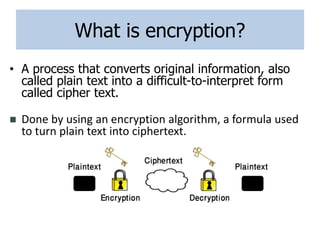
What is encryption?
• A process that converts original information, also
called plain text into a difficult-to-interpret form
called cipher text.
 Done by using an encryption algorithm, a formula used
to turn plain text into ciphertext.
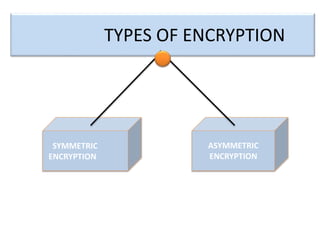
TYPES OF ENCRYPTION
ASYMMETRIC
ENCRYPTION
SYMMETRIC
ENCRYPTION
SYMMETRIC ENCRYPTION
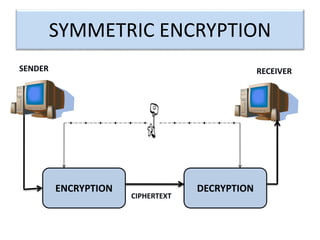
• Also known as secret key. Sender & receiver
uses same key & an encryption/decryption
algorithm to encrypt/decrypt data. i.e. the key
is shared.
SYMMETRIC ENCRYPTION
ENCRYPTION DECRYPTION
CIPHERTEXT
SENDER RECEIVER
SECRET KEY
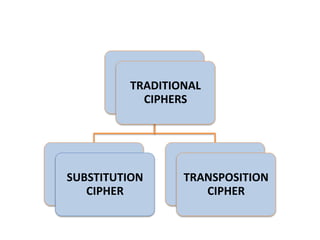
TRADITIONAL
CIPHERS
SUBSTITUTION
CIPHER
TRANSPOSITION
CIPHER
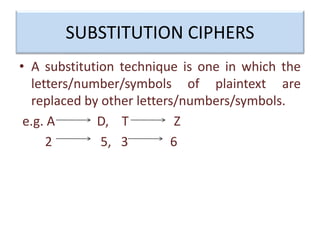
SUBSTITUTION CIPHERS
• A substitution technique is one in which the
letters/number/symbols of plaintext are
replaced by other letters/numbers/symbols.
e.g. A D, T Z
2 5, 3 6
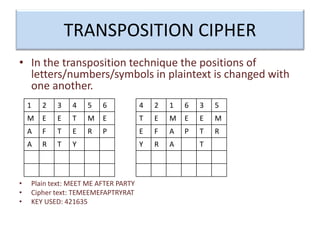
TRANSPOSITION CIPHER
• In the transposition technique the positions of
letters/numbers/symbols in plaintext is changed with
one another.
• Plain text: MEET ME AFTER PARTY
• Cipher text: TEMEEMEFAPTRYRAT
• KEY USED: 421635
1 2 3 4 5 6
M E E T M E
A F T E R P
A R T Y
4 2 1 6 3 5
T E M E E M
E F A P T R
Y R A T
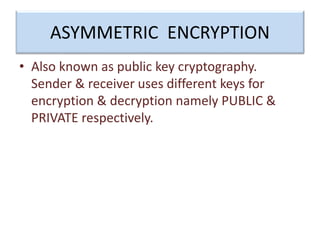
ASYMMETRIC ENCRYPTION
• Also known as public key cryptography.
Sender & receiver uses different keys for
encryption & decryption namely PUBLIC &
PRIVATE respectively.
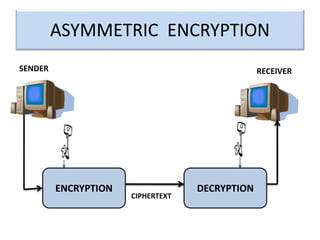
ASYMMETRIC ENCRYPTION
ENCRYPTION DECRYPTION
CIPHERTEXT
SENDER RECEIVER
PUBLIC KEY PRIVATE KEY
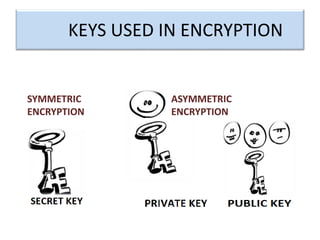
KEYS USED IN ENCRYPTION
SYMMETRIC
ENCRYPTION
ASYMMETRIC
ENCRYPTION
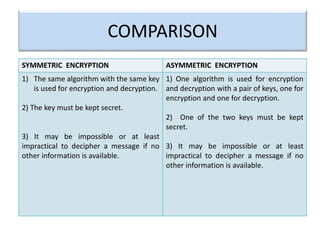
COMPARISON
SYMMETRIC ENCRYPTION ASYMMETRIC ENCRYPTION
1) The same algorithm with the same key
is used for encryption and decryption.
2) The key must be kept secret.
3) It may be impossible or at least
impractical to decipher a message if no
other information is available.
1) One algorithm is used for encryption
and decryption with a pair of keys, one for
encryption and one for decryption.
2) One of the two keys must be kept
secret.
3) It may be impossible or at least
impractical to decipher a message if no
other information is available.
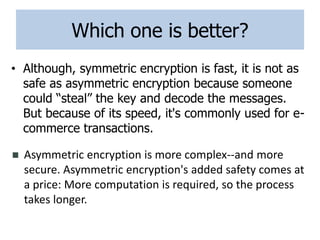
Which one is better?
• Although, symmetric encryption is fast, it is not as
safe as asymmetric encryption because someone
could “steal” the key and decode the messages.
But because of its speed, it's commonly used for e-
commerce transactions.
 Asymmetric encryption is more complex--and more
secure. Asymmetric encryption's added safety comes at
a price: More computation is required, so the process
takes longer.
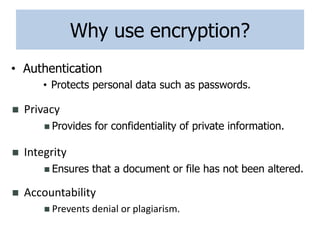
Why use encryption?
• Authentication
• Protects personal data such as passwords.
 Privacy
 Provides for confidentiality of private information.
 Accountability
 Prevents denial or plagiarism.
 Integrity
 Ensures that a document or file has not been altered.
APPLICATIONS
• Defense services
• Secure data manipulation
• E –commerce
• Business transactions
• Internet payment systems
• User identification systems
• Access control
• Data security
CONCLUSION
• By using of encryption techniques a fair unit of
confidentiality, authentication, integrity,
access control and availability of data is
maintained.
Thank
You

Encryption

  • 1.
    ENCRYPTION Presented To: Sir. AnwarRashad Presented By: Adnan Malak Date: 07 January, 2016.
  • 2.
    • What isEncryption. • Types of Encryption. • Keys use in Encryption. • Comparison. • Which One is better . • Why we use ? • Application • Conclusion. Agenda:
  • 3.
    What is encryption? •A process that converts original information, also called plain text into a difficult-to-interpret form called cipher text.  Done by using an encryption algorithm, a formula used to turn plain text into ciphertext.
  • 4.
  • 5.
    SYMMETRIC ENCRYPTION • Alsoknown as secret key. Sender & receiver uses same key & an encryption/decryption algorithm to encrypt/decrypt data. i.e. the key is shared.
  • 6.
  • 7.
  • 8.
    SUBSTITUTION CIPHERS • Asubstitution technique is one in which the letters/number/symbols of plaintext are replaced by other letters/numbers/symbols. e.g. A D, T Z 2 5, 3 6
  • 9.
    TRANSPOSITION CIPHER • Inthe transposition technique the positions of letters/numbers/symbols in plaintext is changed with one another. • Plain text: MEET ME AFTER PARTY • Cipher text: TEMEEMEFAPTRYRAT • KEY USED: 421635 1 2 3 4 5 6 M E E T M E A F T E R P A R T Y 4 2 1 6 3 5 T E M E E M E F A P T R Y R A T
  • 10.
    ASYMMETRIC ENCRYPTION • Alsoknown as public key cryptography. Sender & receiver uses different keys for encryption & decryption namely PUBLIC & PRIVATE respectively.
  • 11.
  • 12.
    KEYS USED INENCRYPTION SYMMETRIC ENCRYPTION ASYMMETRIC ENCRYPTION
  • 13.
    COMPARISON SYMMETRIC ENCRYPTION ASYMMETRICENCRYPTION 1) The same algorithm with the same key is used for encryption and decryption. 2) The key must be kept secret. 3) It may be impossible or at least impractical to decipher a message if no other information is available. 1) One algorithm is used for encryption and decryption with a pair of keys, one for encryption and one for decryption. 2) One of the two keys must be kept secret. 3) It may be impossible or at least impractical to decipher a message if no other information is available.
  • 14.
    Which one isbetter? • Although, symmetric encryption is fast, it is not as safe as asymmetric encryption because someone could “steal” the key and decode the messages. But because of its speed, it's commonly used for e- commerce transactions.  Asymmetric encryption is more complex--and more secure. Asymmetric encryption's added safety comes at a price: More computation is required, so the process takes longer.
  • 15.
    Why use encryption? •Authentication • Protects personal data such as passwords.  Privacy  Provides for confidentiality of private information.  Accountability  Prevents denial or plagiarism.  Integrity  Ensures that a document or file has not been altered.
  • 16.
    APPLICATIONS • Defense services •Secure data manipulation • E –commerce • Business transactions • Internet payment systems • User identification systems • Access control • Data security
  • 17.
    CONCLUSION • By usingof encryption techniques a fair unit of confidentiality, authentication, integrity, access control and availability of data is maintained.
  • 18.

Editor's Notes

  • #2 This template can be used as a starter file for presenting training materials in a group setting. Sections Right-click on a slide to add sections. Sections can help to organize your slides or facilitate collaboration between multiple authors. Notes Use the Notes section for delivery notes or to provide additional details for the audience. View these notes in Presentation View during your presentation. Keep in mind the font size (important for accessibility, visibility, videotaping, and online production) Coordinated colors Pay particular attention to the graphs, charts, and text boxes. Consider that attendees will print in black and white or grayscale. Run a test print to make sure your colors work when printed in pure black and white and grayscale. Graphics, tables, and graphs Keep it simple: If possible, use consistent, non-distracting styles and colors. Label all graphs and tables.
  • #19 Use a section header for each of the topics, so there is a clear transition to the audience.