SECURITY 
SECURITY THREATS 
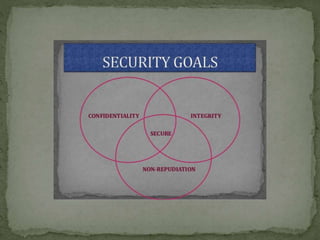
SECURITY GOALS 
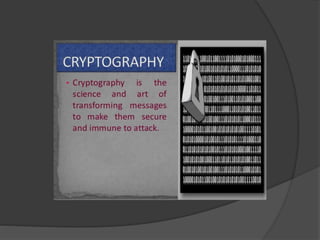
WHAT IS CRYPTOGRAPHY 
BASIC TERMS 
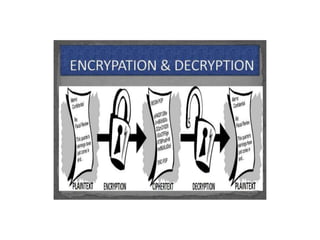
ENCRYPTION & DECRYPTION 
CATEGORIES OF CRYPTOGRAPHY 
COMPARISON 
CONCLUSION
SECURITY??? 
Network security is an over arching term.
1. Passive threats 
2. Active threats
 PLAIN TEXT 
 CIPHER TEXT 
 CIPHER 
 ENCRIPTION & DECRYPTION 
 KEYS
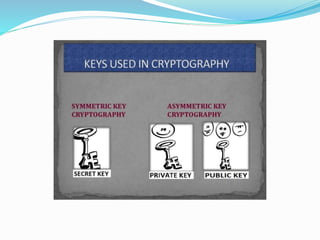
A. Symmetric cryptography 
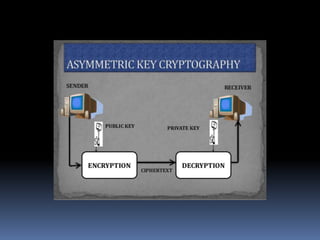
B. Asymmetric cryptography
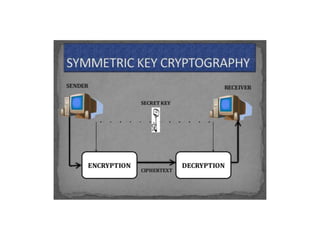
SYMMETRIC KEY CRYPTOGRAPHY 
o also known as secret key cryptography. 
o Sender & receiver uses same key for 
encryption & decryption namely public key
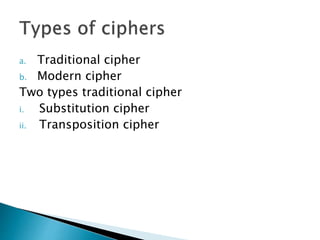
a. Traditional cipher 
b. Modern cipher 
Two types traditional cipher 
i. Substitution cipher 
ii. Transposition cipher
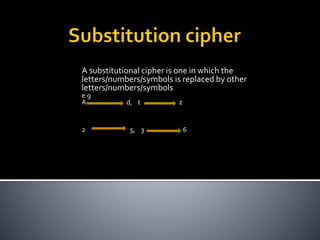
A substitutional cipher is one in which the 
letters/numbers/symbols is replaced by other 
letters/numbers/symbols 
e.g 
A d, t z 
2 5, 3 6
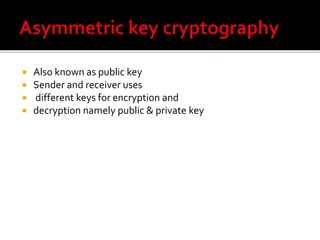
 Also known as public key 
 Sender and receiver uses 
 different keys for encryption and 
 decryption namely public & private key
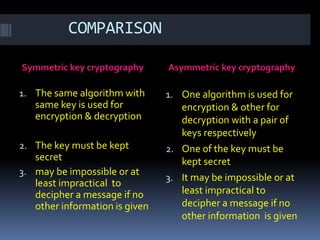
COMPARISON 
Symmetric key cryptography Asymmetric key cryptography 
1. The same algorithm with 
same key is used for 
encryption & decryption 
2. The key must be kept 
secret 
3. may be impossible or at 
least impractical to 
decipher a message if no 
other information is given 
1. One algorithm is used for 
encryption & other for 
decryption with a pair of 
keys respectively 
2. One of the key must be 
kept secret 
3. It may be impossible or at 
least impractical to 
decipher a message if no 
other information is given
• Defense services 
• Secure data manipulation 
• Business transactions 
• Internet payment systems 
• User identification systems 
• Acess control 
• Data security
 By using of encryption techniques ,a fair unit of 
confidentiality,authentication,integrity,acess control and 
availability of data is maintained
thanks

Ccn

  • 2.
    SECURITY SECURITY THREATS SECURITY GOALS WHAT IS CRYPTOGRAPHY BASIC TERMS ENCRYPTION & DECRYPTION CATEGORIES OF CRYPTOGRAPHY COMPARISON CONCLUSION
  • 3.
    SECURITY??? Network securityis an over arching term.
  • 4.
    1. Passive threats 2. Active threats
  • 7.
     PLAIN TEXT  CIPHER TEXT  CIPHER  ENCRIPTION & DECRYPTION  KEYS
  • 9.
    A. Symmetric cryptography B. Asymmetric cryptography
  • 10.
    SYMMETRIC KEY CRYPTOGRAPHY o also known as secret key cryptography. o Sender & receiver uses same key for encryption & decryption namely public key
  • 12.
    a. Traditional cipher b. Modern cipher Two types traditional cipher i. Substitution cipher ii. Transposition cipher
  • 13.
    A substitutional cipheris one in which the letters/numbers/symbols is replaced by other letters/numbers/symbols e.g A d, t z 2 5, 3 6
  • 15.
     Also knownas public key  Sender and receiver uses  different keys for encryption and  decryption namely public & private key
  • 18.
    COMPARISON Symmetric keycryptography Asymmetric key cryptography 1. The same algorithm with same key is used for encryption & decryption 2. The key must be kept secret 3. may be impossible or at least impractical to decipher a message if no other information is given 1. One algorithm is used for encryption & other for decryption with a pair of keys respectively 2. One of the key must be kept secret 3. It may be impossible or at least impractical to decipher a message if no other information is given
  • 19.
    • Defense services • Secure data manipulation • Business transactions • Internet payment systems • User identification systems • Acess control • Data security
  • 20.
     By usingof encryption techniques ,a fair unit of confidentiality,authentication,integrity,acess control and availability of data is maintained
  • 21.