Presentation: Fundamentals Of Mechatronics
Topic: ENCODERs
Presented To: Engr. Hafiz Khurrum Ali
Presented By: Ahmad Abbas 07-MCT-24 M. Umair Mirza 07-MCT-26 Abdul Rahman 07-MCT-36
SENSOR A device that  produces a measurable response to a change in a physical condition CHOOSING A SENSOR Accuracy Calibration Cost Environmental Range Repeatbility Resolution
TYPES OF SENSORS Acceleration Angular/Linear position Chemical/Gas concentration Humidity Flow rate Force Magnetic field Sound
ENCODER A device used to  change a signal or data to a code
BASIC PRINCIPLE
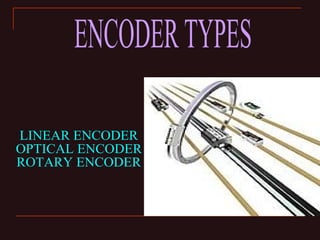
ENCODER TYPES LINEAR ENCODER OPTICAL ENCODER ROTARY ENCODER
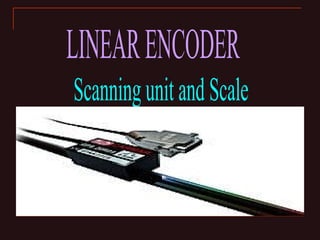
LINEAR ENCODER Scanning unit and Scale
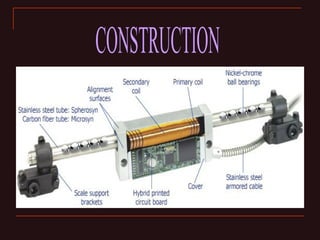
CONSTRUCTION
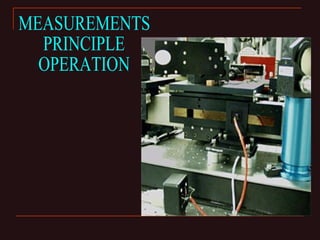
MEASUREMENTS PRINCIPLE OPERATION
 
TYPES OF LINEAR ENCODER ABSOLUTE LINEAR ENCODER INCREMENTAL LINEAR ENCODER
VERSIONS ENCLOSED LINEAR ENCODER EXPOSED LINEAR ENCODER METAL BASE LINEAR ENCODER
ENCLOSED LINEAR ENCODER USES
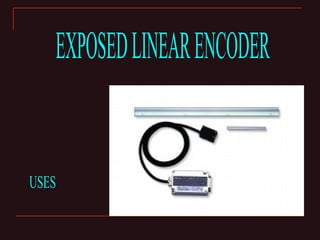
EXPOSED LINEAR ENCODER USES
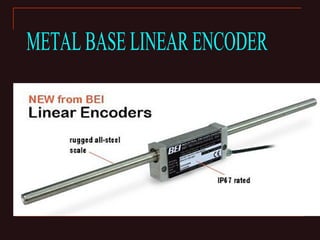
METAL BASE LINEAR ENCODER
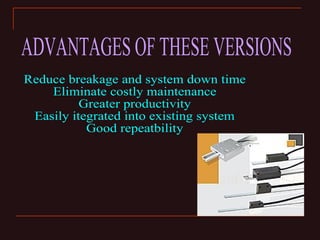
ADVANTAGES OF THESE VERSIONS Reduce breakage and system down time Eliminate costly maintenance Greater productivity Easily itegrated into existing system Good repeatbility
APPLICATIONS Machine control Automatic process Pick and place operations
 
OPTICAL ENCODER
Optical Encoder: Optical Encoder is a electro-mechanical device  and is a digital position measuring device.
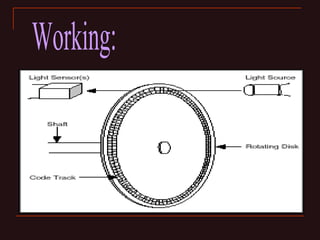
Principle: Its work on a principle of looking at  pattern of alternating black and white segments.
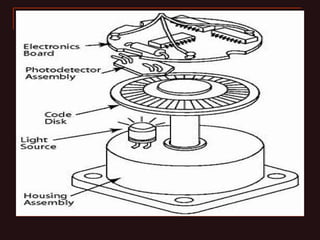
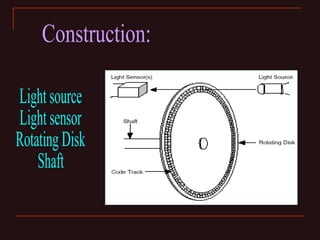
Construction: Light source Light sensor Rotating Disk Shaft
Working:
Types: Regular Encoder Quadrature Encoder
Regular Encoder: It count number of transition but  cannot tell the direction.
Quadrature Encoder: It uses two staggered pattern and tell which way the thing is turning.
Sensors used by Optical Encoder. Reflective Sensor  Break Beam Sensor
Break Beam Sensor: More accurate but require precise mechanical allignment
Reflective Sensor Consist of LED and Photosensor
Models:


Specification: Temperature  0 to 60 degree Speed 600 RPM Weight 400 gms
Applications: N.C Machines Digital liquid level Neutron and X-Ray spectrometer
ROTARY ENCODER
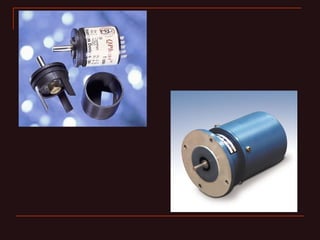
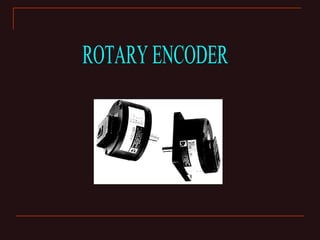
Rotary Encoder: *  Electromechanical Device *  Convert position in to digital  or analog code.
Types of Encoder: Absolute Incremental (relative)
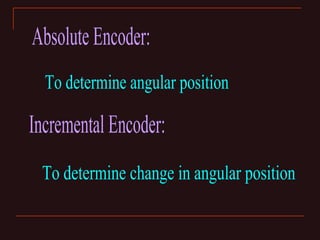
Absolute Encoder: To determine angular position Incremental Encoder: To determine change in angular position
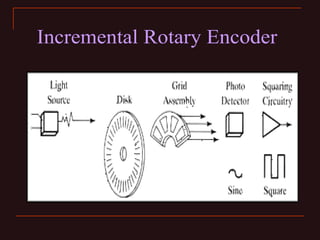
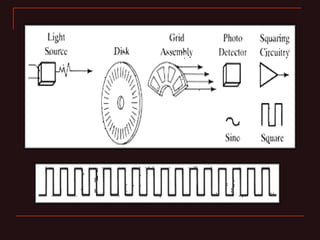
Incremental Rotary Encoder
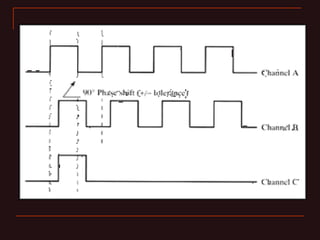
Consist two pulses Second pulse used to determine the direction of rotation of encoder wheel First pulse gave information of incremental and direction of rotation information
 
 
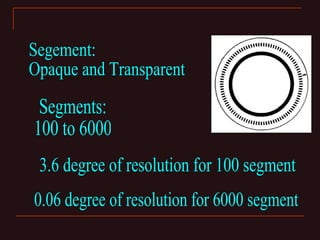
Segments: 100 to 6000 3.6 degree of resolution for 100 segment 0.06 degree of resolution for 6000 segment Segement: Opaque and Transparent
 
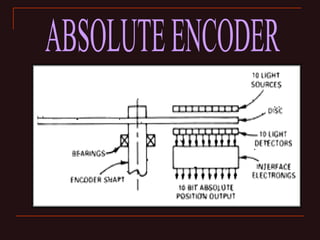
ABSOLUTE ENCODER
* Concentric Circles * Opaque and  Transparent segment 512 segments in outermost ring of  whose has 10 rings
Difference between  Incremental and Absolute
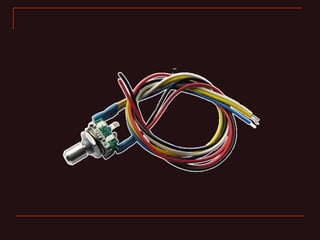
Models


Applications: Robotics Photographic lenses Computer Input device e.g TrackBalls Radar plateform
Thanks!!!!!!!!!!

Encoder