Submitted To: Engr.Hafiz Khuram Ali   Submitted By: M. Faheem Asif  07-MCT-22 Sultan Fateh Ali Khan  07-MCT-27 AHSAN ULLAH SHAH  07-MCT37 FUNDAMENTALS OF MECHATRONICS
How Power Steering works Topic of Presentation:
Objective: Study of Mechatronics viewing Power Steering. What is Mechatronics and its role in Power Steering.
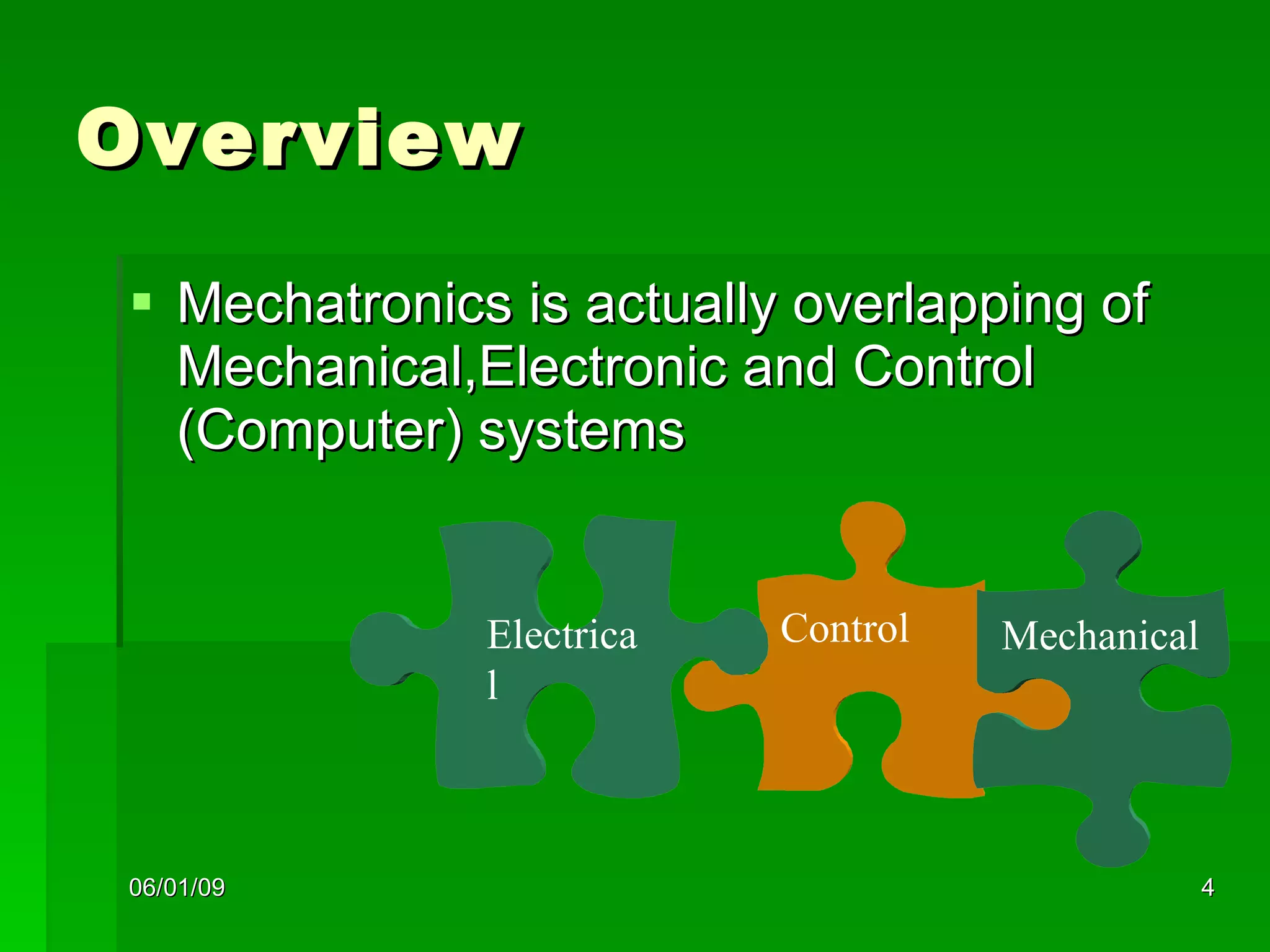
Overview  Mechatronics is actually overlapping of Mechanical,Electronic and Control (Computer) systems Control Mechanical Electrical
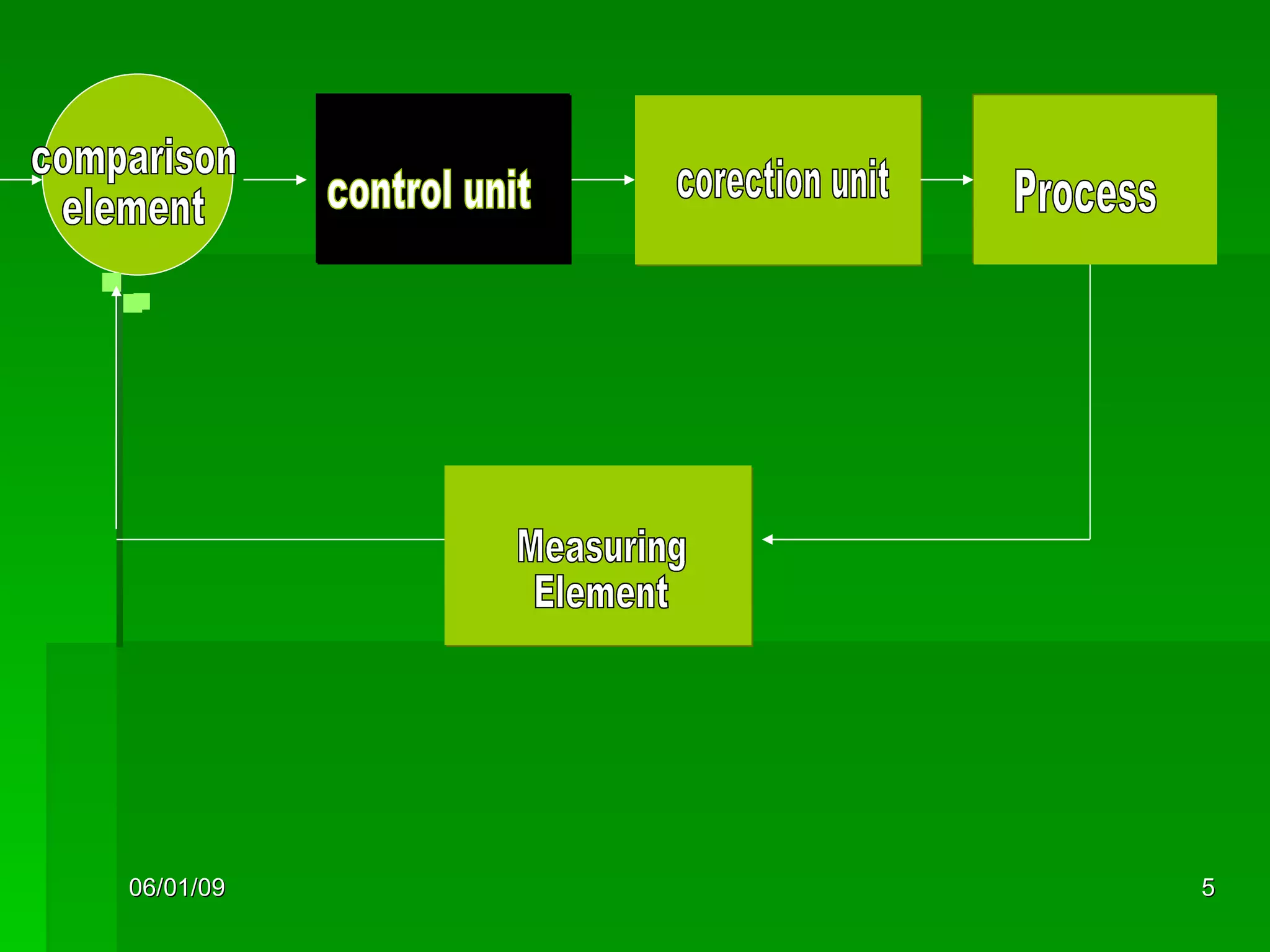
control unit corection unit comparison element Process Measuring  Element
 
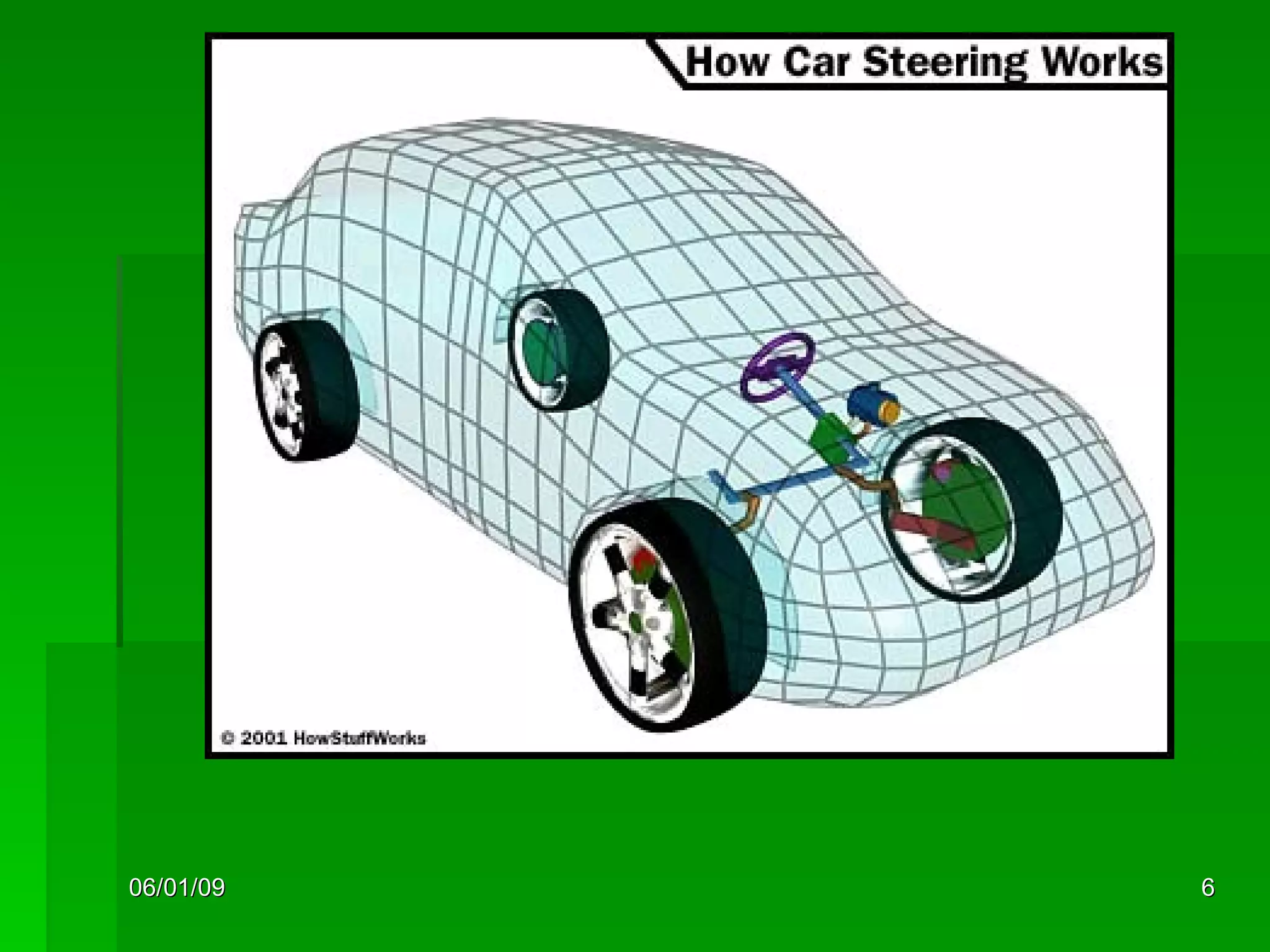
What is Power Steering? You know that when you turn the steering wheel in your car, the wheels turn. Cause and effect, right? But a lot of interesting stuff goes on between the steering wheel and the tires to make this happen We'll see how the most common types of car steering systems work. Then we'll examine power steering and find out about some interesting future developments in steering systems  Power steering  is a system for reducing the steering effort on cars by using an external power source to assist in turning the wheels.
History of Power Steering
Types of Power Steering: There are many types of Power Steering like Hydraulic Power Steering. Electrohydraulic Power Steering. Electric Power steering.
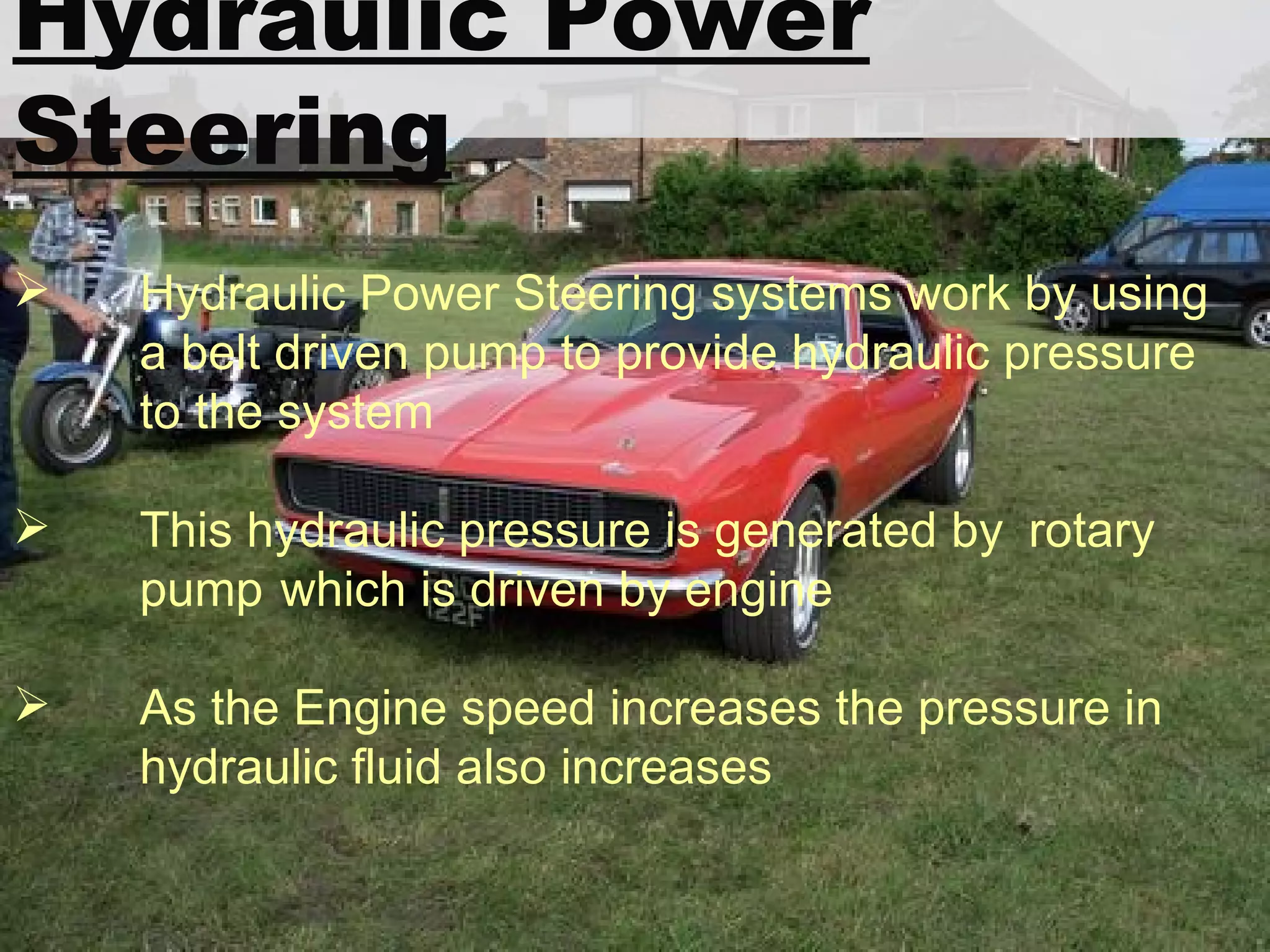
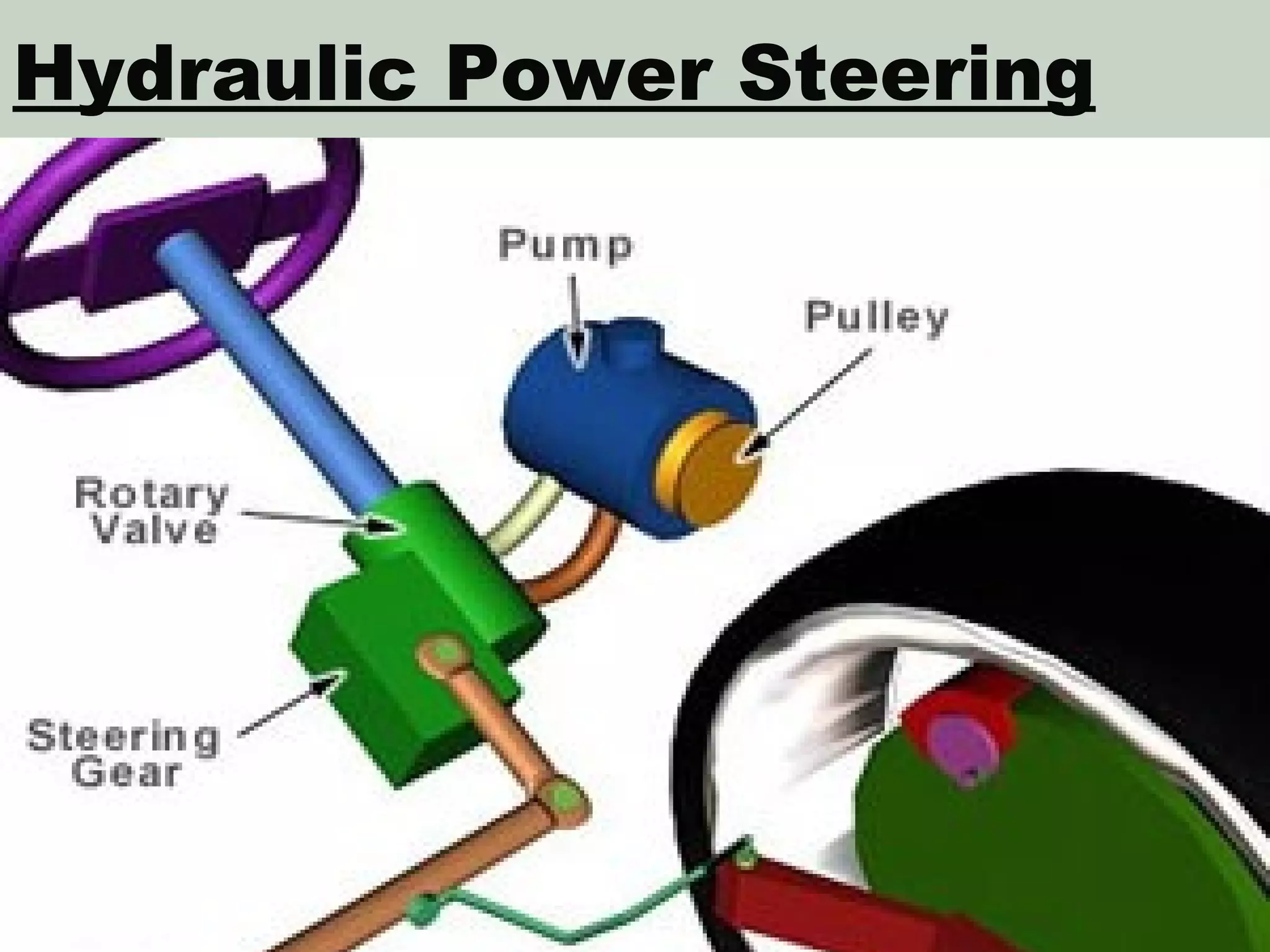
Hydraulic Power Steering Hydraulic Power Steering systems work by using  a belt driven pump to provide hydraulic pressure  to the system  This hydraulic pressure is generated by  rotary  pump  which is driven by engine As the Engine speed increases the pressure in  hydraulic fluid also increases
Hydraulic Power Steering
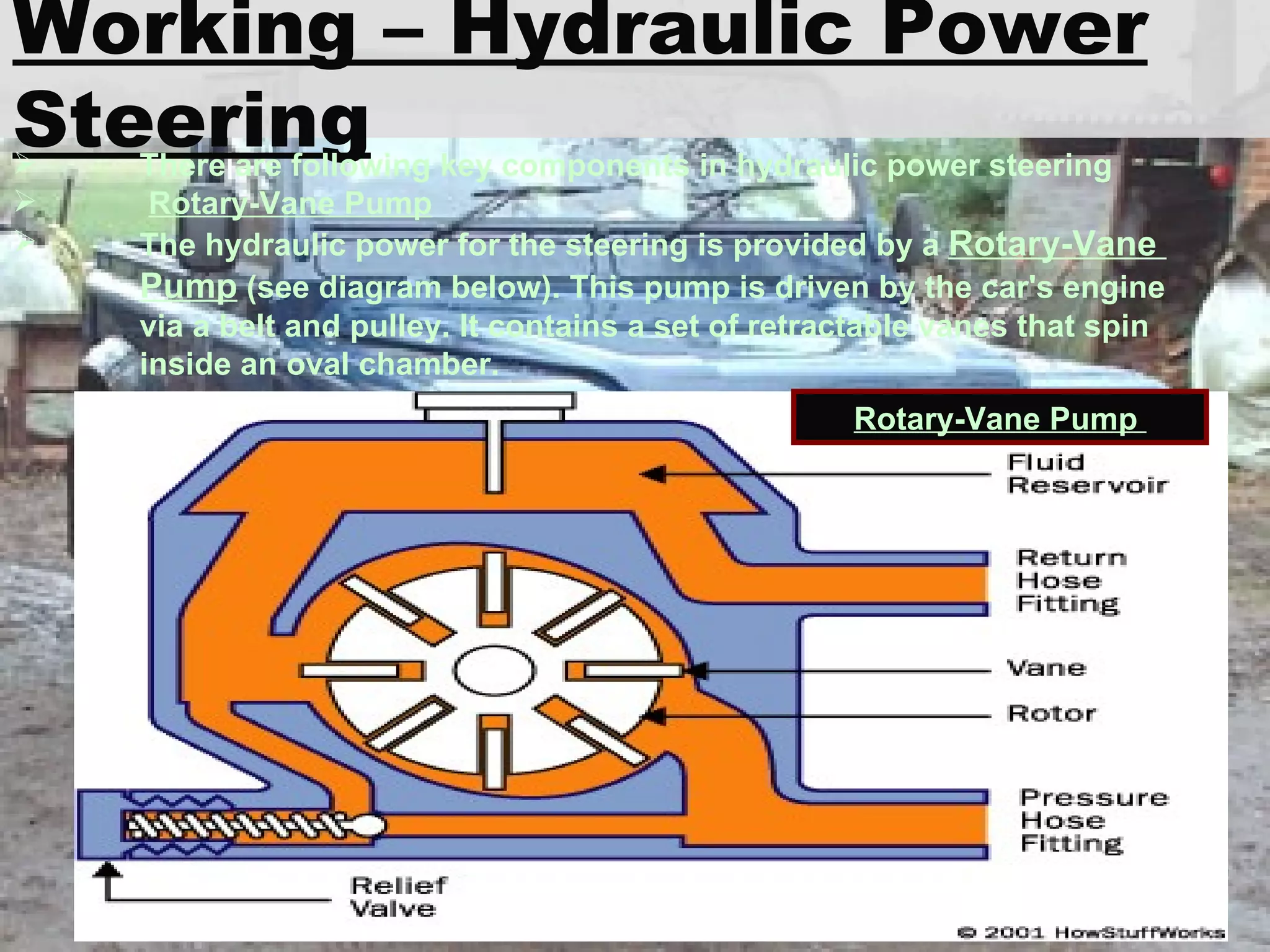
Working – Hydraulic Power Steering There are following key components in hydraulic power steering   Rotary-Vane Pump   The hydraulic power for the steering is provided by a  Rotary-Vane  Pump  (see diagram below). This pump is driven by the car's engine  via a belt and pulley. It contains a set of retractable vanes that spin  inside an oval chamber.   Rotary-Vane Pump
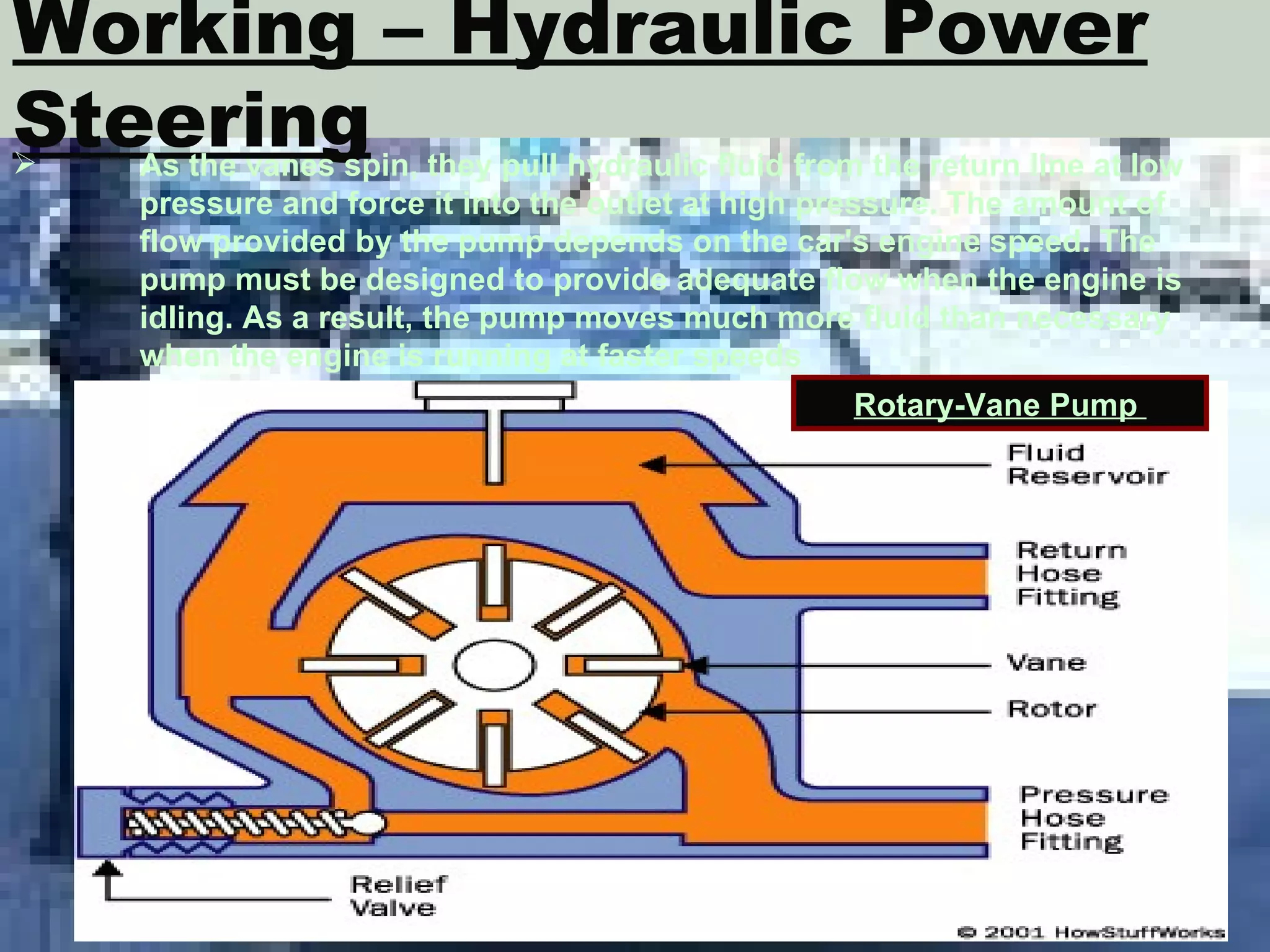
Working – Hydraulic Power Steering As the vanes spin, they pull hydraulic fluid from the return line at low  pressure and force it into the outlet at high pressure. The amount of  flow provided by the pump depends on the car's engine speed. The  pump must be designed to provide adequate flow when the engine is  idling. As a result, the pump moves much more fluid than necessary  when the engine is running at faster speeds   Rotary-Vane Pump
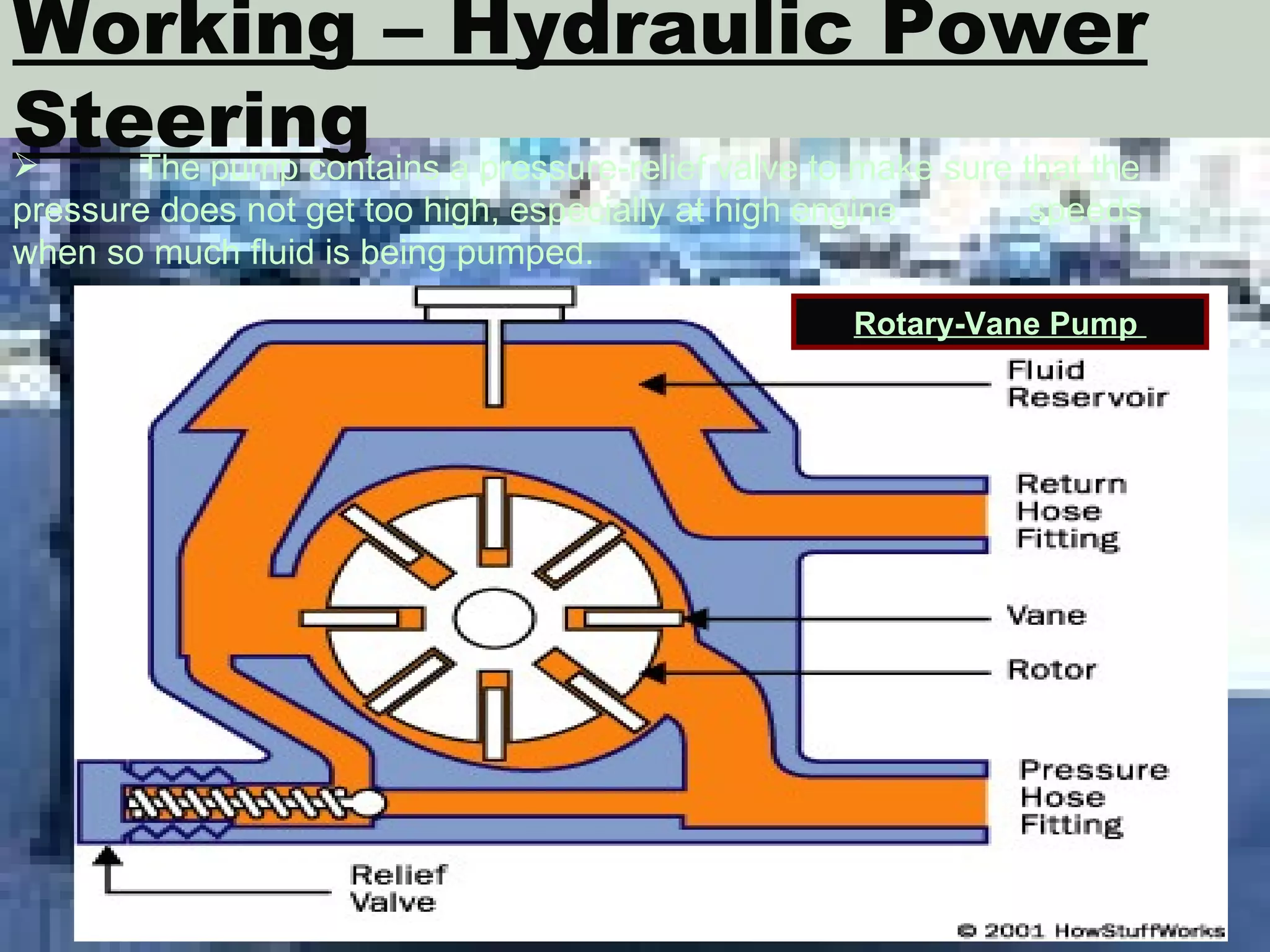
Working – Hydraulic Power Steering The pump contains a pressure-relief valve to make sure that the  pressure does not get too high, especially at high engine  speeds when so much fluid is being pumped.  Rotary-Vane Pump
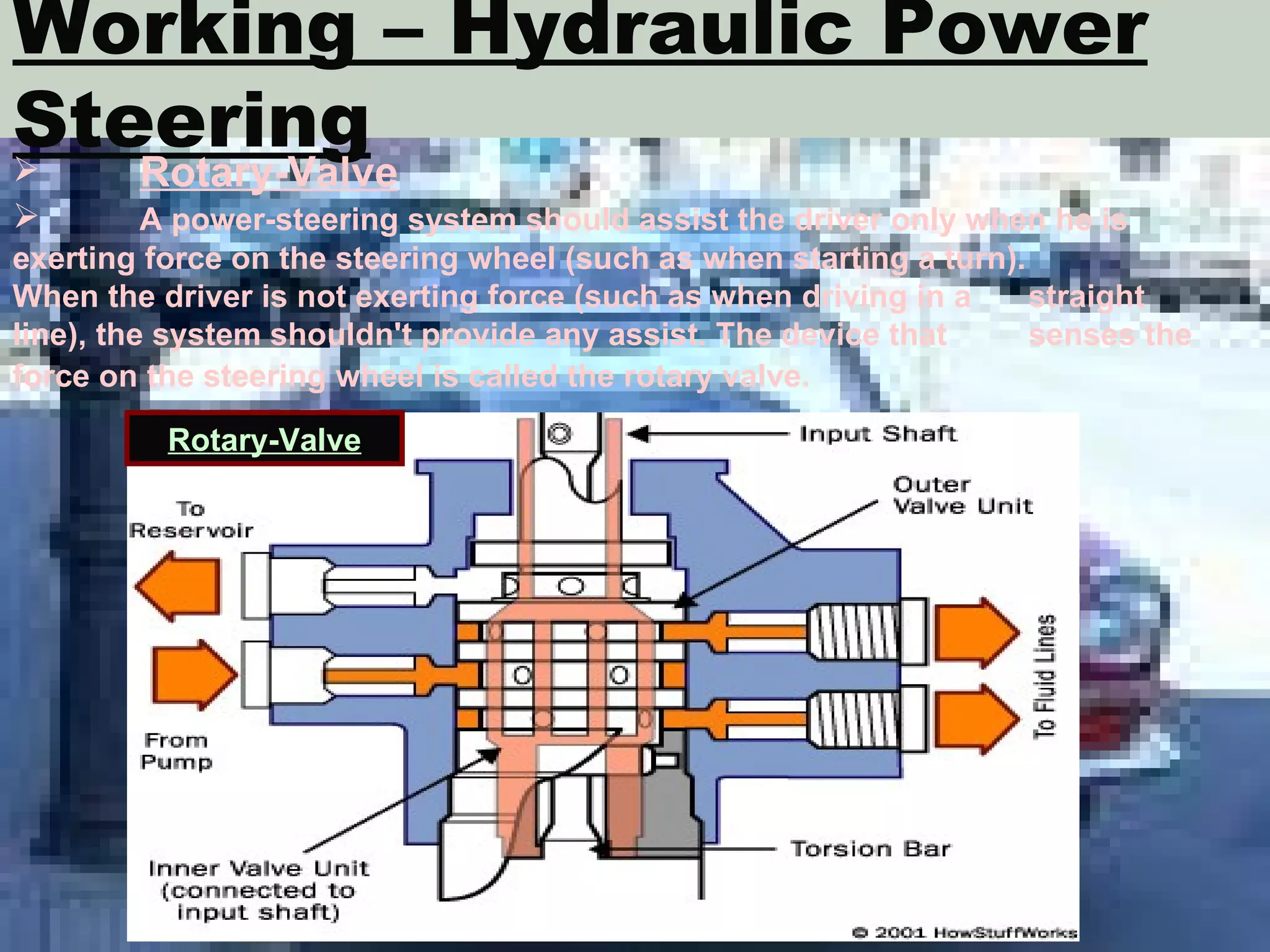
Working – Hydraulic Power Steering Rotary-Valve A power-steering system should assist the driver only when he is  exerting force on the steering wheel (such as when starting a turn).  When the driver is not exerting force (such as when driving in a  straight line), the system shouldn't provide any assist. The device that  senses the force on the steering wheel is called the rotary valve.   Rotary-Valve
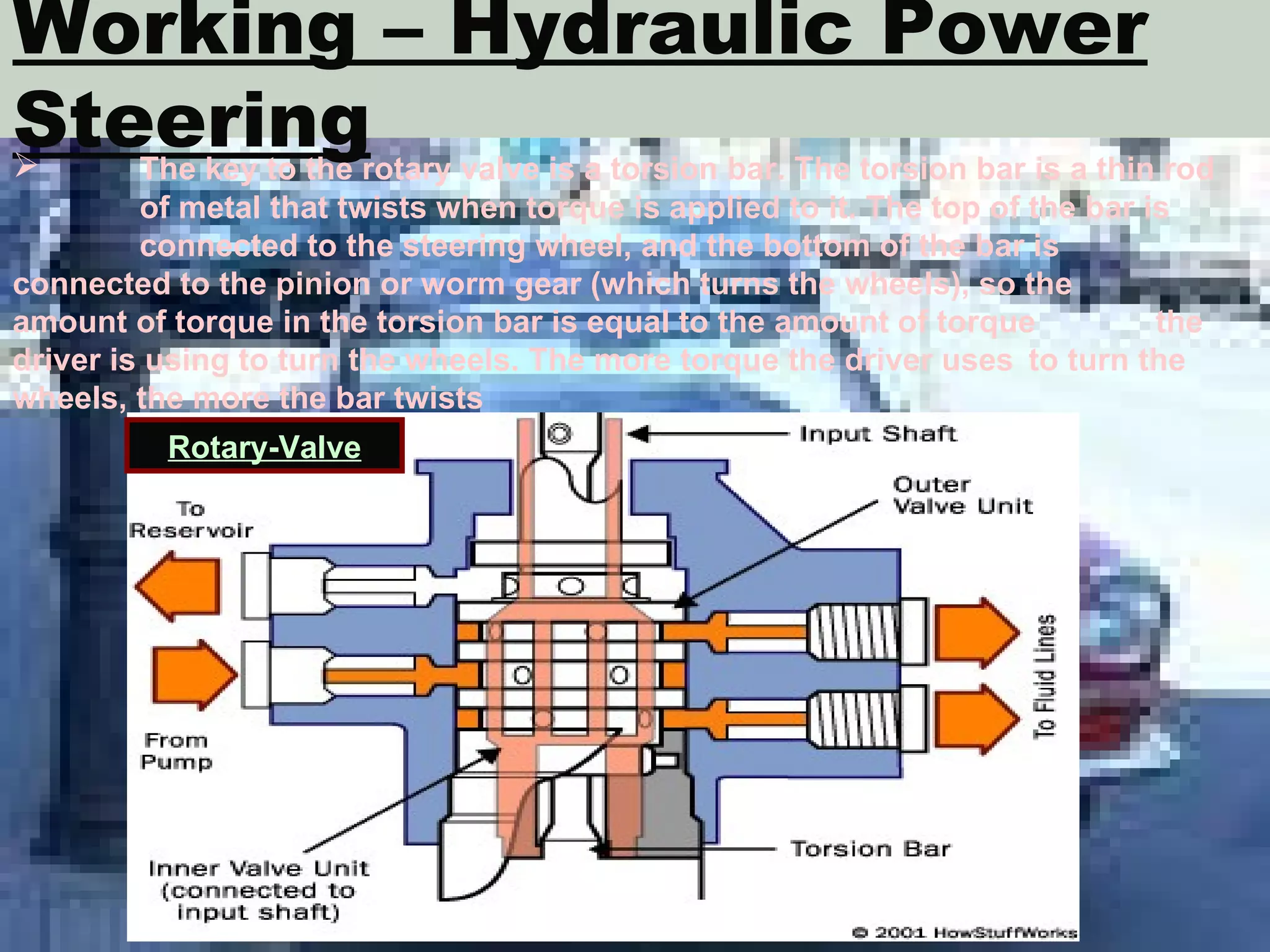
Working – Hydraulic Power Steering The key to the rotary valve is a torsion bar. The torsion bar is a thin rod  of metal that twists when torque is applied to it. The top of the bar is  connected to the steering wheel, and the bottom of the bar is  connected to the pinion or worm gear (which turns the wheels), so the  amount of torque in the torsion bar is equal to the amount of torque  the driver is using to turn the wheels. The more torque the driver uses  to turn the wheels, the more the bar twists   Rotary-Valve
Advantages – Hydraulic Power Steering Hydraulic power system (HPS) has no steering wheel  torque as compared to mechanical system In HPS no freezing of steering systems is caused by  dried up grease and corrosion in the steering tube of  the motor
Disadvantages – Hydraulic Power Steering Hydraulic Power Steering systems are less  efficienct in following areas as compared to  most modern Electric Power steering  systems:- Engine efficiency  Space efficiency  Environmental compatibility
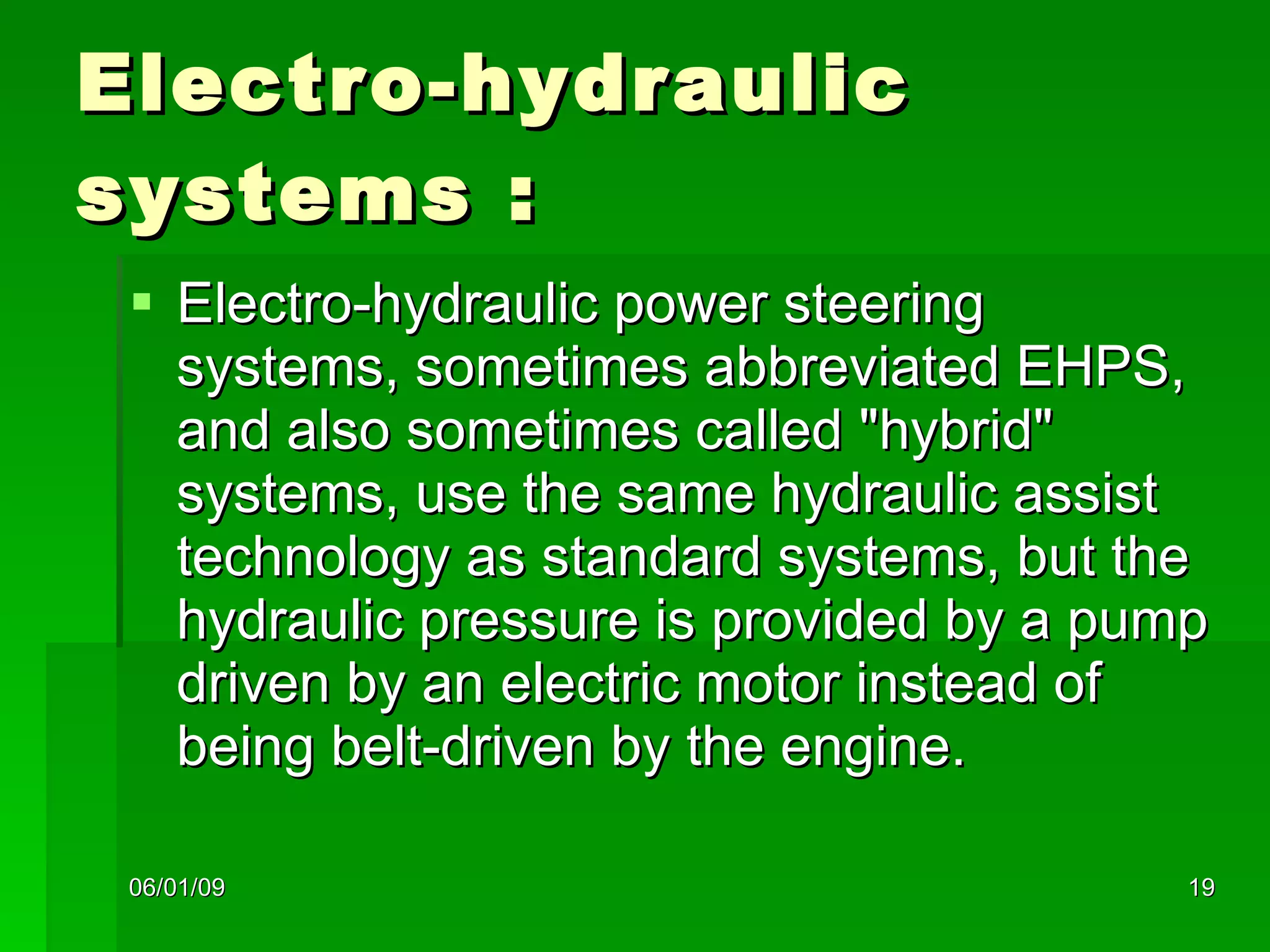
Electro-hydraulic systems : Electro-hydraulic power steering systems, sometimes abbreviated EHPS, and also sometimes called "hybrid" systems, use the same hydraulic assist technology as standard systems, but the hydraulic pressure is provided by a pump driven by an electric motor instead of being belt-driven by the engine.
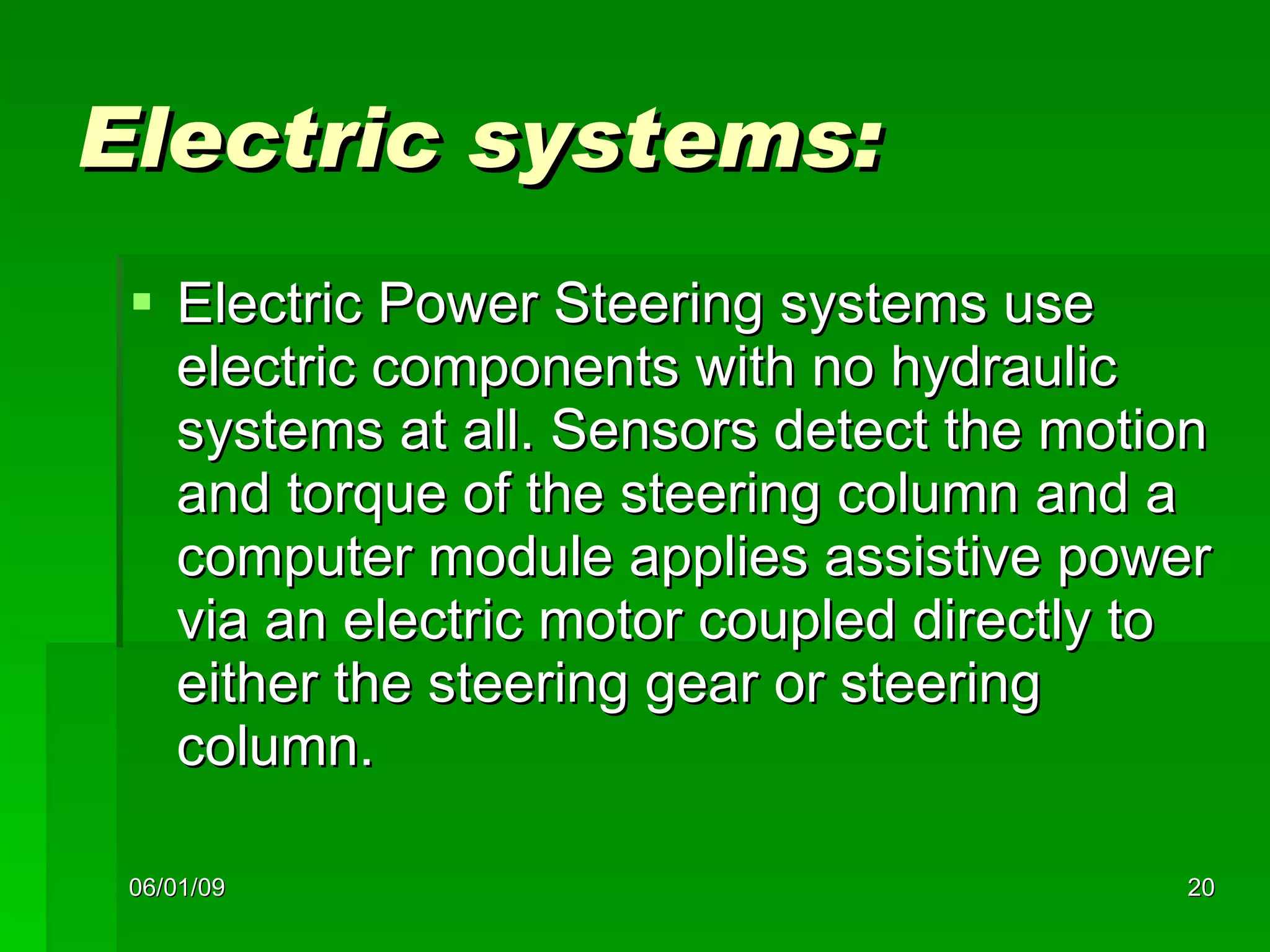
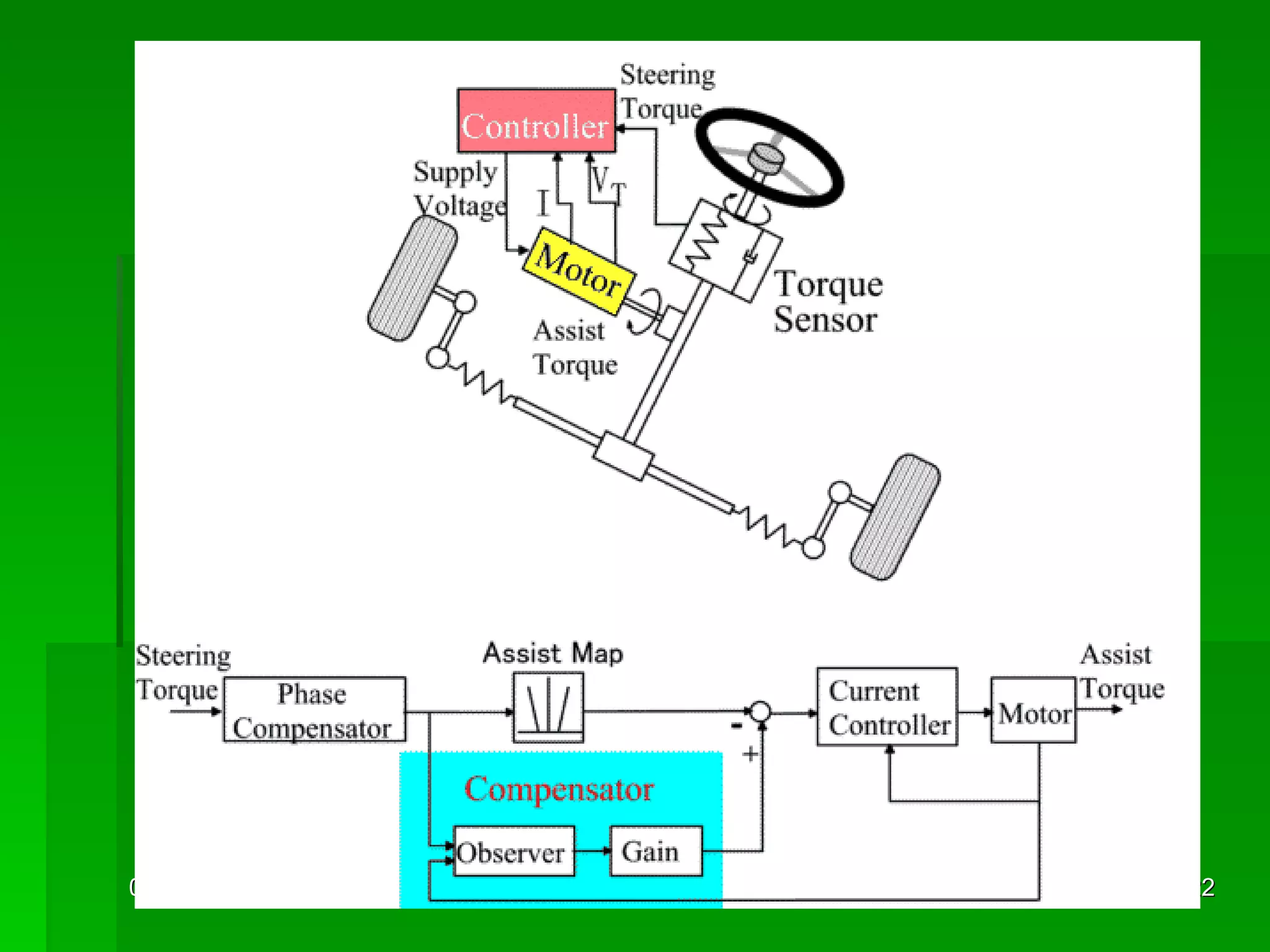
Electric systems: Electric Power Steering systems use electric components with no hydraulic systems at all. Sensors detect the motion and torque of the steering column and a computer module applies assistive power via an electric motor coupled directly to either the steering gear or steering column.
EPS or Electronic Power Steering
 
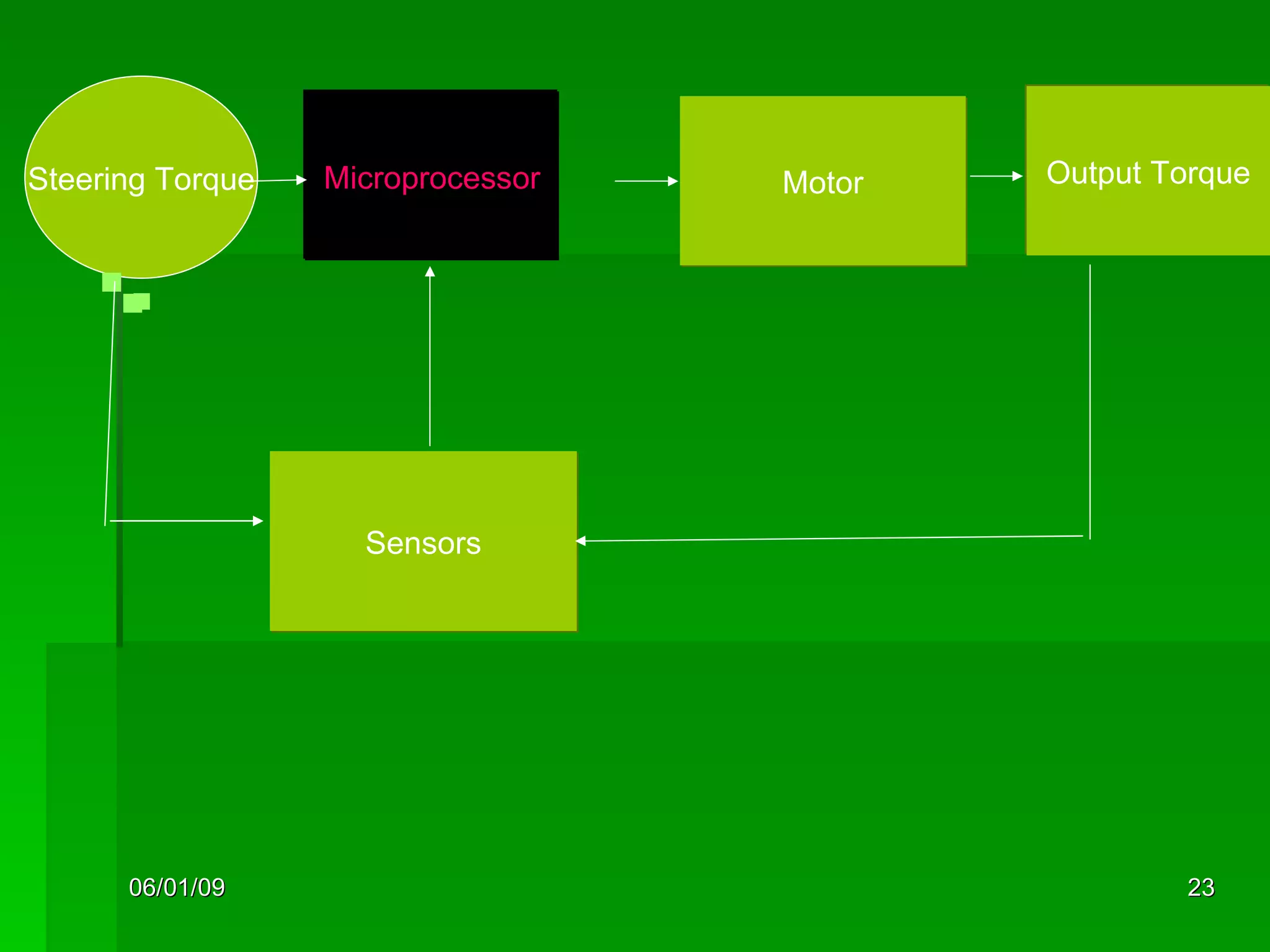
Microprocessor Motor Sensors Output Torque Steering Torque
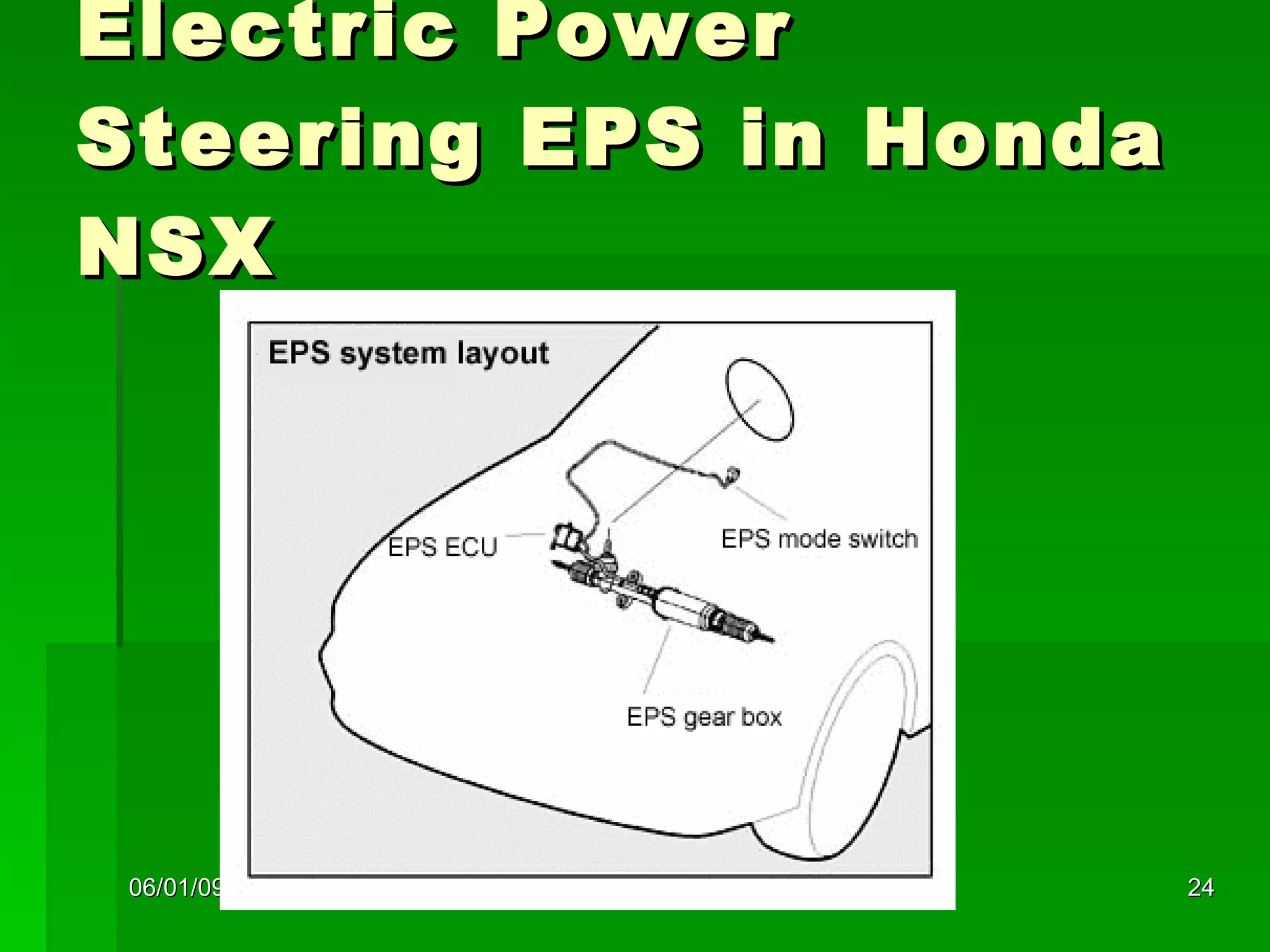
Electric Power Steering EPS in Honda NSX
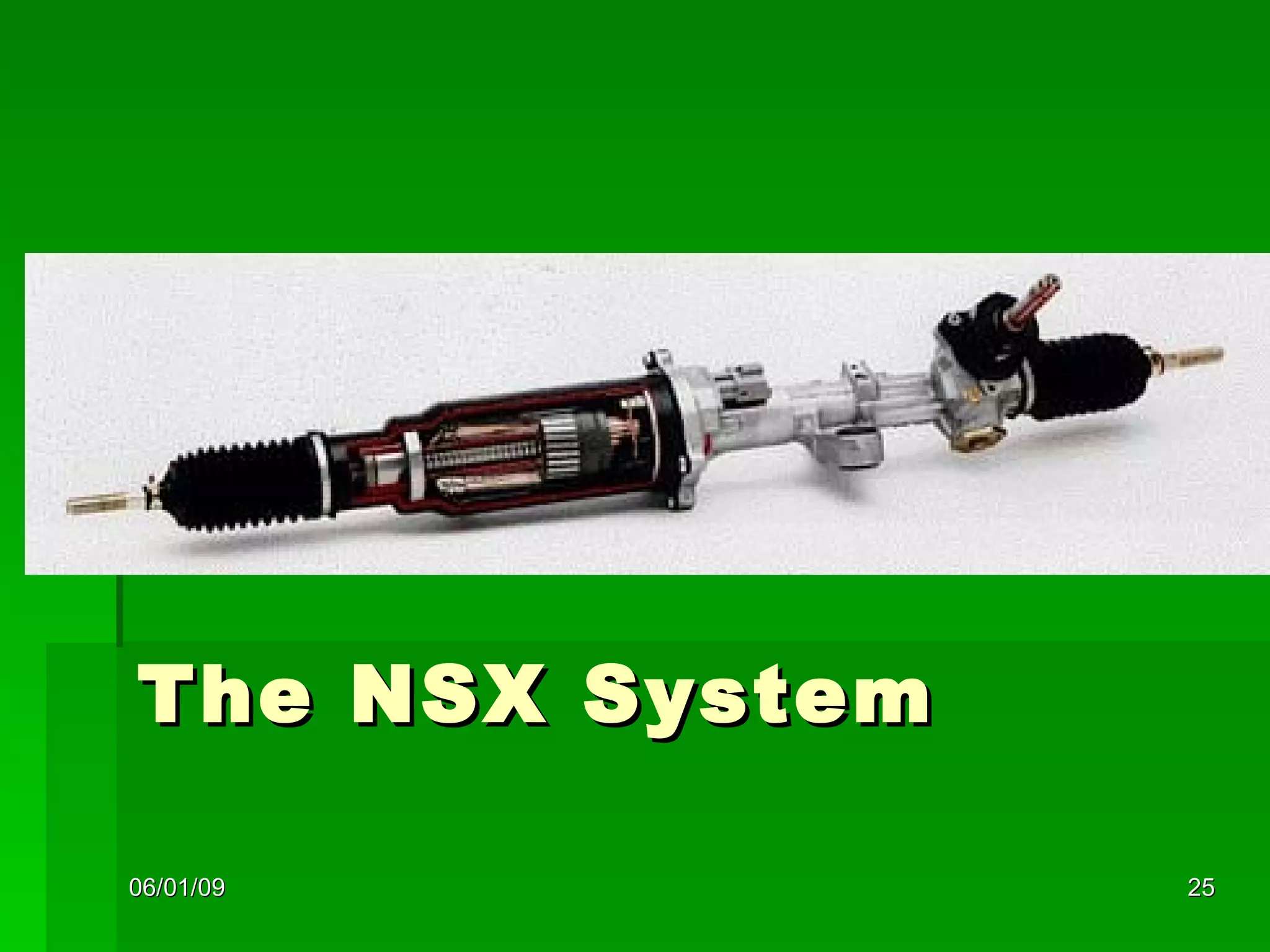
The NSX System
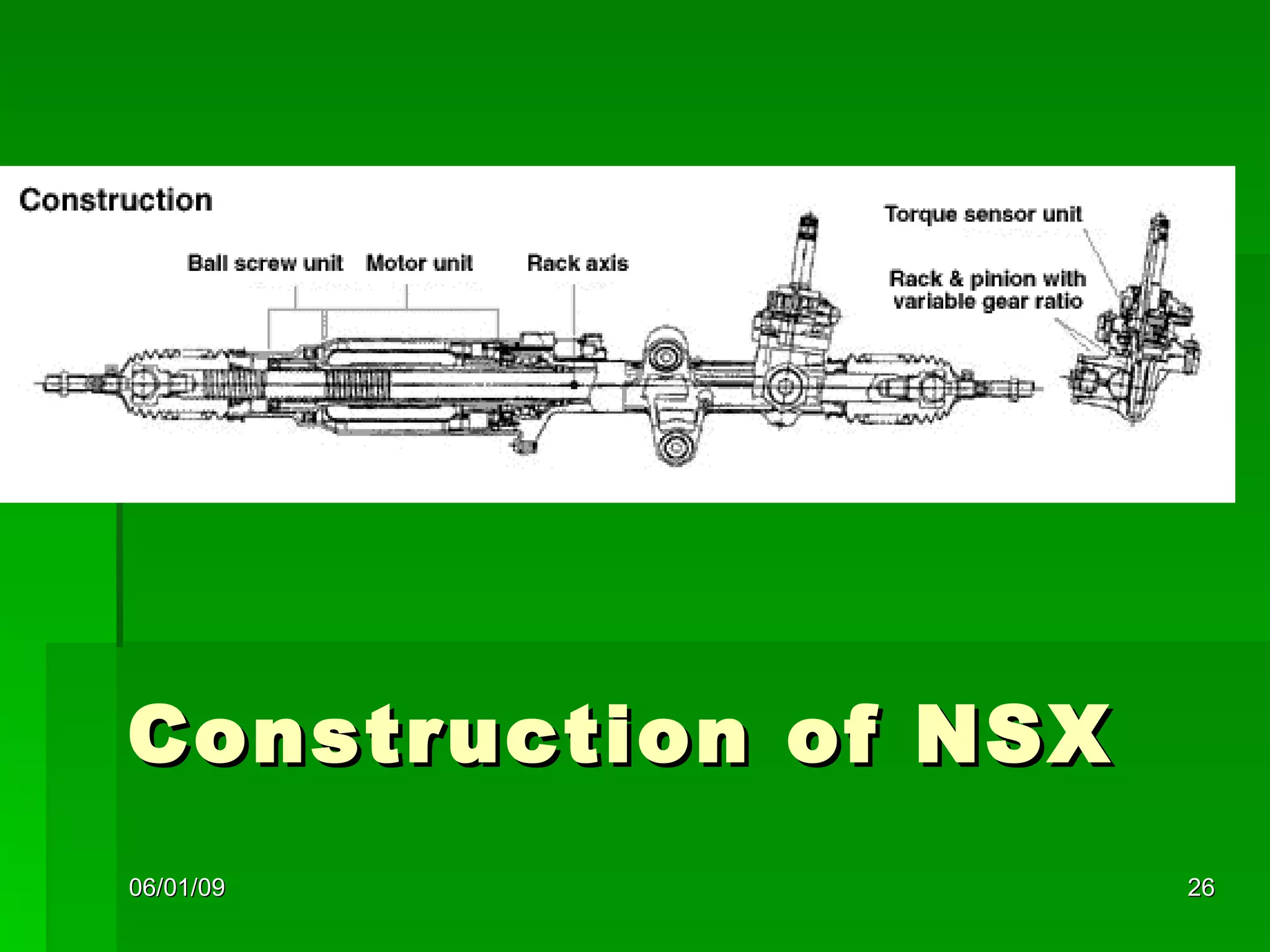
Construction of NSX
Basic Working The NSX system consists of a rack-and-pinion steering gear with an electric motor installed concentrically around the rack  Transmission of Motor power through a recirculating ball drive mechanism  Steering sensors are located on the input shaft and consist of: Torque sensor  & rotation sensor
An "interface" circuit digitise the signals from the torque sensor and rotation sensor into signals the control electronics can process. Inputs from the “steering sensor” & “vehicle's speed sensor” are sent to  microprocessor control unit. The sensor inputs are then compared to determine power  required according to a preprogrammed "force map". The control unit then sends out the appropriate command to the "power unit" which then supplies the electric motor with current.
The Microprocessor Control Unit
Operating modes of EPS:  “Normal Mode"  “Return Mode“ “Damper Mode"
Basic Features: (1) It's compact and light and (2) it's not parasitic (robbing power from the engine) since it only draws electric power on demand. But it also provides precise control and is easy to vary the amount of assistance with an electric unit. Plus it's simpler to install (especially in a mid- or rear-engined car), there are no hydraulic lines to break, and it's quieter
Advantages: Constant Feed-back  Less Consumption of power Different operating modes Self-diagnosing faults by monitoring the system's inputs and outputs
Disadvantages One of the disadvantage of EPS is that it cannot be used in big vehicles. It reduces the feel of steering. Electronic components failure can occur.
Thanks a lot

Power Stearing

  • 1.
    Submitted To: Engr.HafizKhuram Ali Submitted By: M. Faheem Asif 07-MCT-22 Sultan Fateh Ali Khan 07-MCT-27 AHSAN ULLAH SHAH 07-MCT37 FUNDAMENTALS OF MECHATRONICS
  • 2.
    How Power Steeringworks Topic of Presentation:
  • 3.
    Objective: Study ofMechatronics viewing Power Steering. What is Mechatronics and its role in Power Steering.
  • 4.
    Overview Mechatronicsis actually overlapping of Mechanical,Electronic and Control (Computer) systems Control Mechanical Electrical
  • 5.
    control unit corectionunit comparison element Process Measuring Element
  • 6.
  • 7.
    What is PowerSteering? You know that when you turn the steering wheel in your car, the wheels turn. Cause and effect, right? But a lot of interesting stuff goes on between the steering wheel and the tires to make this happen We'll see how the most common types of car steering systems work. Then we'll examine power steering and find out about some interesting future developments in steering systems Power steering is a system for reducing the steering effort on cars by using an external power source to assist in turning the wheels.
  • 8.
  • 9.
    Types of PowerSteering: There are many types of Power Steering like Hydraulic Power Steering. Electrohydraulic Power Steering. Electric Power steering.
  • 10.
    Hydraulic Power SteeringHydraulic Power Steering systems work by using a belt driven pump to provide hydraulic pressure to the system This hydraulic pressure is generated by rotary pump which is driven by engine As the Engine speed increases the pressure in hydraulic fluid also increases
  • 11.
  • 12.
    Working – HydraulicPower Steering There are following key components in hydraulic power steering Rotary-Vane Pump The hydraulic power for the steering is provided by a Rotary-Vane Pump (see diagram below). This pump is driven by the car's engine via a belt and pulley. It contains a set of retractable vanes that spin inside an oval chamber. Rotary-Vane Pump
  • 13.
    Working – HydraulicPower Steering As the vanes spin, they pull hydraulic fluid from the return line at low pressure and force it into the outlet at high pressure. The amount of flow provided by the pump depends on the car's engine speed. The pump must be designed to provide adequate flow when the engine is idling. As a result, the pump moves much more fluid than necessary when the engine is running at faster speeds Rotary-Vane Pump
  • 14.
    Working – HydraulicPower Steering The pump contains a pressure-relief valve to make sure that the pressure does not get too high, especially at high engine speeds when so much fluid is being pumped. Rotary-Vane Pump
  • 15.
    Working – HydraulicPower Steering Rotary-Valve A power-steering system should assist the driver only when he is exerting force on the steering wheel (such as when starting a turn). When the driver is not exerting force (such as when driving in a straight line), the system shouldn't provide any assist. The device that senses the force on the steering wheel is called the rotary valve. Rotary-Valve
  • 16.
    Working – HydraulicPower Steering The key to the rotary valve is a torsion bar. The torsion bar is a thin rod of metal that twists when torque is applied to it. The top of the bar is connected to the steering wheel, and the bottom of the bar is connected to the pinion or worm gear (which turns the wheels), so the amount of torque in the torsion bar is equal to the amount of torque the driver is using to turn the wheels. The more torque the driver uses to turn the wheels, the more the bar twists Rotary-Valve
  • 17.
    Advantages – HydraulicPower Steering Hydraulic power system (HPS) has no steering wheel torque as compared to mechanical system In HPS no freezing of steering systems is caused by dried up grease and corrosion in the steering tube of the motor
  • 18.
    Disadvantages – HydraulicPower Steering Hydraulic Power Steering systems are less efficienct in following areas as compared to most modern Electric Power steering systems:- Engine efficiency Space efficiency Environmental compatibility
  • 19.
    Electro-hydraulic systems :Electro-hydraulic power steering systems, sometimes abbreviated EHPS, and also sometimes called "hybrid" systems, use the same hydraulic assist technology as standard systems, but the hydraulic pressure is provided by a pump driven by an electric motor instead of being belt-driven by the engine.
  • 20.
    Electric systems: ElectricPower Steering systems use electric components with no hydraulic systems at all. Sensors detect the motion and torque of the steering column and a computer module applies assistive power via an electric motor coupled directly to either the steering gear or steering column.
  • 21.
    EPS or ElectronicPower Steering
  • 22.
  • 23.
    Microprocessor Motor SensorsOutput Torque Steering Torque
  • 24.
    Electric Power SteeringEPS in Honda NSX
  • 25.
  • 26.
  • 27.
    Basic Working TheNSX system consists of a rack-and-pinion steering gear with an electric motor installed concentrically around the rack Transmission of Motor power through a recirculating ball drive mechanism Steering sensors are located on the input shaft and consist of: Torque sensor & rotation sensor
  • 28.
    An "interface" circuitdigitise the signals from the torque sensor and rotation sensor into signals the control electronics can process. Inputs from the “steering sensor” & “vehicle's speed sensor” are sent to microprocessor control unit. The sensor inputs are then compared to determine power required according to a preprogrammed "force map". The control unit then sends out the appropriate command to the "power unit" which then supplies the electric motor with current.
  • 29.
  • 30.
    Operating modes ofEPS: “Normal Mode" “Return Mode“ “Damper Mode"
  • 31.
    Basic Features: (1)It's compact and light and (2) it's not parasitic (robbing power from the engine) since it only draws electric power on demand. But it also provides precise control and is easy to vary the amount of assistance with an electric unit. Plus it's simpler to install (especially in a mid- or rear-engined car), there are no hydraulic lines to break, and it's quieter
  • 32.
    Advantages: Constant Feed-back Less Consumption of power Different operating modes Self-diagnosing faults by monitoring the system's inputs and outputs
  • 33.
    Disadvantages One ofthe disadvantage of EPS is that it cannot be used in big vehicles. It reduces the feel of steering. Electronic components failure can occur.
  • 34.