Engineering as Social Experimentation M. SHOAIB SIDDIQUE  07-MCT-31 M. ASAD IRSHAD  07-MCT-54
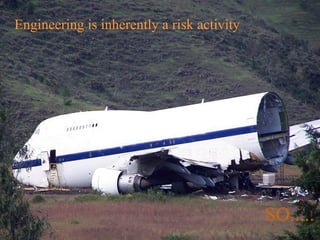
Engineering is inherently a risk activity SO.....
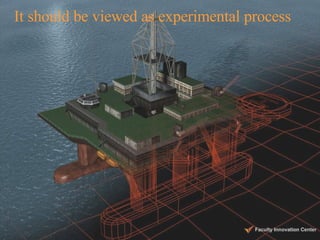
It should be viewed as experimental process
Involving people
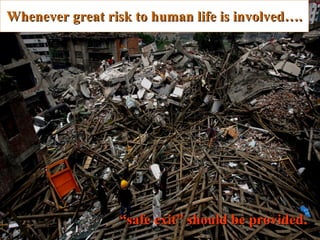
Whenever great risk to human life is involved…. “ safe exit” should be provided .
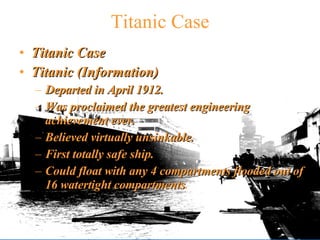
Titanic Case Titanic Case Titanic (Information) Departed in April 1912. Was proclaimed the greatest engineering achievement ever. Believed virtually unsinkable. First totally safe ship. Could float with any 4 compartments flooded out of 16 watertight compartments .
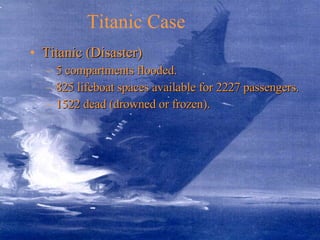
Titanic Case Titanic (Disaster) 5 compartments flooded. 825 lifeboat spaces available for 2227 passengers. 1522 dead (drowned or frozen).
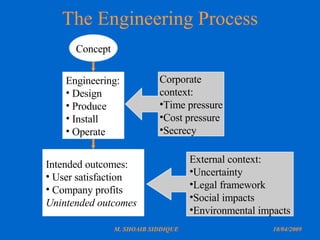
The Engineering Process Concept Corporate context: Time pressure Cost pressure Secrecy External context: Uncertainty Legal framework Social impacts Environmental impacts Engineering: Design Produce Install Operate Intended outcomes: User satisfaction Company profits Unintended outcomes
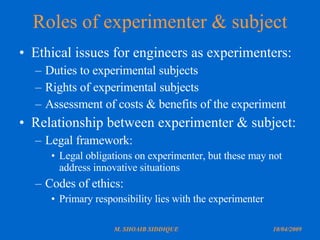
Roles of experimenter & subject Ethical issues for engineers as experimenters: Duties to experimental subjects Rights of experimental subjects Assessment of costs & benefits of the experiment Relationship between experimenter & subject: Legal framework: Legal obligations on experimenter, but these may not address innovative situations Codes of ethics: Primary responsibility lies with the experimenter
Learning from the Past It might be expected that engineers would learn not only from their own earlier design and operating results, but also from those of other engineers.
Lack of established channels of communications
Misplaced pride in not asking for information
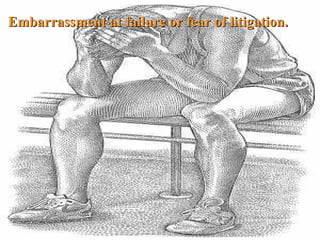
Embarrassment at failure or fear of litigation.
Plain neglect.
Learning from the Past It is not sufficient for engineers to rely on handbooks and computer programs without knowing the limits of the tables and algorithms underlying their favorite tools.
Visit shop floors and construction sites.
Learn from workers and foremen.
See how earlier projects faired.
How satisfied the customers are.
Examples Computers: Developed & adopted over about three decades Significant impacts on society: Not well understood or nor always predicted, e.g: The Y2K bug Y2K  was the common abbreviation for the year 2000 software problem. The abbreviation combines the letter  Y  for "year", and  k  for the Greek prefix kilo meaning 1000; hence,  2K  signifies 2000. It was also named the  Millennium Bug  because it was associated with the (popular, rather than literal) roll-over of the millennium
NUCLEAR POWER STATIONS Developed & adopted over about three decades Significant impacts on society: Not well understood nor always predicted, eg. Chernobyl Widespread concern & installed capacity in decline
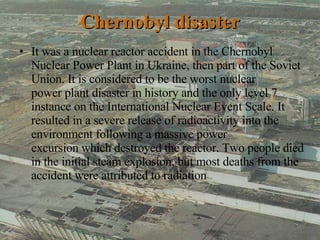
Chernobyl disaster It was a nuclear reactor accident in the Chernobyl Nuclear Power Plant in Ukraine, then part of the Soviet Union. It is considered to be the worst nuclear power plant disaster in history and the only level 7 instance on the International Nuclear Event Scale. It resulted in a severe release of radioactivity into the environment following a massive power excursion which destroyed the reactor. Two people died in the initial steam explosion, but most deaths from the accident were attributed to radiation
Experimental attributes of engineering Incomplete understanding of implications: Insufficient time or money Commercial advantage (desire for secrecy) Uncertainty about impacts (sometimes unknowable) Participation of experimental subjects: Products or services often target non-engineers Subjects share responsibility if voluntarily accept risk Reasons for monitoring outcomes: Commercial purposes (e.g. product improvement) Precautionary purposes (e.g. manage risk)
Nature of subjects & impacts Subjects: Individual consumers, groups or society as a whole: Those who can make informed choices, and Those requiring advocates: Disadvantaged, future generations, other species & the environment Impacts: Health, safety & the environment Changes to social structure & social status: Income & wealth distribution Lifestyles & personal empowerment Education, culture
Features of engineering experiments Absence of a ‘control group’ ( equivalent non-participants): Products & services usually offered to all Benefits may such that they can’t be withheld from a particular group Society may have little prior understanding: Innovative products & services Uncertainty in future impacts (positive or negative) Informed judgements are difficult to make: For both experimenter and subject
Current examples Consideration of an Australian Republic: Constitutional convention, referendum Introduction of genetically modified (GM) foods: Companies have not always revealed GM ingredients Legal requirements under development Electromagnetic radiation from cellular phones: Some companies provide information, headphones Telephone caller ID: Defaults ‘on’ but ‘off’ would allow informed consent
Knowledge Gained “ Engineering projects are experiments that are not necessarily designed to produce very much knowledge.” Unexpected outcomes. Affrms that we are right about something.
Summary Engineering is a form of social experimentation: Innovation with social & environmental impacts Uncertainty & risk in outcomes Stakeholders have a right to informed consent: Information, opportunity, decision making capability Problems in implementation: Lack of a control group & corporate pressures Difficulty in identifying stakeholders Irreducible uncertainty
M. ASAD IRSHAD 07-MCT-54
Engineers as Responsible Experimenters Engineers responsibility is shared with management, the public, and others. Engineers’ expertise places them in a unique position to monitor projects, to identify risks, and to provide clients and the public with the information needed to make reasonable decisions.
Engineers as Responsible Experimenters A primary obligation to protect the safety of human subjects and respect their right of consent. A constant awareness of the experimental nature of any project, imaginative forecasting of its possible side effects, and a reasonable effort to monitor them.
Engineers as Responsible Experimenters Autonomous, personal involvement in all steps of a project Accepting accountability for the results of a project.
Contemporary threats Conscientiousness (awareness) Relevant information Moral autonomy Accountability (responsibility)
Conscientiousness Conscientiousness implies consciousness (in the sense of awareness). Open eyes, open ears, and an open mind are required to recognize a given situation, its implications, and who is involved or affected.
Conscientiousness Some 90 percent of engineers are salaried employees, most of whom work within large bureaucracies under great pressure to function smoothly within the organization. The minimal negative duties, such as not falsifying data, not violating patent rights, and not breaching confidentiality, may come to be viewed as the full extent of moral aspiration.
Relevant Information Showing moral concern involves a commitment to obtain and properly assess all available information pertinent to meeting one’s moral obligations. Fully grasping the contect of one’s work which makes it count as an activity having a moral import.
Relevant Information Ways of losing perspactive on the nature of one’s work also hinder one in acquiring a full perspective along a second dimension of factual information. Social impact emphasizes the need for wide training in disciplines related to engineering and its results, as well as the need for a constant effort to imaginatively foresee dangers.
Moral Autonomy Moral beliefs and attitudes should be held on the basis of critical reflection rather than passive adoption of the particular conventions of one’s society, church, or profession. Must be integrated into the core of individual’s personality.
Moral Autonomy Comfortable illusions Performing acts directly serving a company’s interests. Attitude of management. Moral support from professional societies and other outside organizations.
Accountability Responsible people accept moral responsibility for their actions. The general disposition of being willing to submit one’s actions to moral scrutiny and be open and responsive to the assessments of others.
Accountability Willingness to present morally cogent reasons for one’s conduct when called upon to do so in appropriate circumstances. The divorce between causal influence and moral accountability is common in business and the professions, and engineering is no exception.
Accountability Fragmentation of work on large-scale projects. Diffusion of accountability within large institutions. Pressure to move on to a new project.
Industrial Standards Ready-made substitutes for lengthy design specifications. Established by companies for in-house use or by associations for industry-wide use. Preserve some competitiveness in industry.
Positive roles of codes of ethics for  Social Experimentation Inspiration & guidance for professionals: Sustain an ethical standard in the profession Practical support for ethical actions: Reduce the risks of victimisation Education & mutual understanding (trust): Between the profession & the public Maintain public image (avoid regulation) Deterrence & discipline (paralegal proceedings): To investigate & rule on alleged unethical activities
Example: the IEEE code of ethics 1. To accept responsibility in making engineering decisions consistent with the safety, health and welfare of the public, and to disclose promptly factors that might endanger the public or the environment 2. To avoid real or perceived conflicts of interest whenever possible, and to disclose them to affected parties when they do exist 3. To be and realistic in stating claims or estimates based on available data 4. To reject bribery in all its forms honest  5. To improve the understanding of technology, its appropriate application, and potential consequences
 
REFERANCES Most of data collected from book CH:3 (Mike w. Martin & Ronald shwingzer)  www.ieee.org www.scs.uiuc.edu   www.engineeringdaily.net  www.lmu.edu  ethics.tamu.edu  www.educationarcade.org

Social Experimentation

  • 1.
  • 2.
    Engineering as SocialExperimentation M. SHOAIB SIDDIQUE 07-MCT-31 M. ASAD IRSHAD 07-MCT-54
  • 3.
    Engineering is inherentlya risk activity SO.....
  • 4.
    It should beviewed as experimental process
  • 5.
  • 6.
    Whenever great riskto human life is involved…. “ safe exit” should be provided .
  • 7.
    Titanic Case TitanicCase Titanic (Information) Departed in April 1912. Was proclaimed the greatest engineering achievement ever. Believed virtually unsinkable. First totally safe ship. Could float with any 4 compartments flooded out of 16 watertight compartments .
  • 8.
    Titanic Case Titanic(Disaster) 5 compartments flooded. 825 lifeboat spaces available for 2227 passengers. 1522 dead (drowned or frozen).
  • 9.
    The Engineering ProcessConcept Corporate context: Time pressure Cost pressure Secrecy External context: Uncertainty Legal framework Social impacts Environmental impacts Engineering: Design Produce Install Operate Intended outcomes: User satisfaction Company profits Unintended outcomes
  • 10.
    Roles of experimenter& subject Ethical issues for engineers as experimenters: Duties to experimental subjects Rights of experimental subjects Assessment of costs & benefits of the experiment Relationship between experimenter & subject: Legal framework: Legal obligations on experimenter, but these may not address innovative situations Codes of ethics: Primary responsibility lies with the experimenter
  • 11.
    Learning from thePast It might be expected that engineers would learn not only from their own earlier design and operating results, but also from those of other engineers.
  • 12.
    Lack of establishedchannels of communications
  • 13.
    Misplaced pride innot asking for information
  • 14.
    Embarrassment at failureor fear of litigation.
  • 15.
  • 16.
    Learning from thePast It is not sufficient for engineers to rely on handbooks and computer programs without knowing the limits of the tables and algorithms underlying their favorite tools.
  • 17.
    Visit shop floorsand construction sites.
  • 18.
    Learn from workersand foremen.
  • 19.
    See how earlierprojects faired.
  • 20.
    How satisfied thecustomers are.
  • 21.
    Examples Computers: Developed& adopted over about three decades Significant impacts on society: Not well understood or nor always predicted, e.g: The Y2K bug Y2K  was the common abbreviation for the year 2000 software problem. The abbreviation combines the letter  Y  for "year", and  k  for the Greek prefix kilo meaning 1000; hence,  2K  signifies 2000. It was also named the  Millennium Bug  because it was associated with the (popular, rather than literal) roll-over of the millennium
  • 22.
    NUCLEAR POWER STATIONSDeveloped & adopted over about three decades Significant impacts on society: Not well understood nor always predicted, eg. Chernobyl Widespread concern & installed capacity in decline
  • 23.
    Chernobyl disaster It wasa nuclear reactor accident in the Chernobyl Nuclear Power Plant in Ukraine, then part of the Soviet Union. It is considered to be the worst nuclear power plant disaster in history and the only level 7 instance on the International Nuclear Event Scale. It resulted in a severe release of radioactivity into the environment following a massive power excursion which destroyed the reactor. Two people died in the initial steam explosion, but most deaths from the accident were attributed to radiation
  • 24.
    Experimental attributes ofengineering Incomplete understanding of implications: Insufficient time or money Commercial advantage (desire for secrecy) Uncertainty about impacts (sometimes unknowable) Participation of experimental subjects: Products or services often target non-engineers Subjects share responsibility if voluntarily accept risk Reasons for monitoring outcomes: Commercial purposes (e.g. product improvement) Precautionary purposes (e.g. manage risk)
  • 25.
    Nature of subjects& impacts Subjects: Individual consumers, groups or society as a whole: Those who can make informed choices, and Those requiring advocates: Disadvantaged, future generations, other species & the environment Impacts: Health, safety & the environment Changes to social structure & social status: Income & wealth distribution Lifestyles & personal empowerment Education, culture
  • 26.
    Features of engineeringexperiments Absence of a ‘control group’ ( equivalent non-participants): Products & services usually offered to all Benefits may such that they can’t be withheld from a particular group Society may have little prior understanding: Innovative products & services Uncertainty in future impacts (positive or negative) Informed judgements are difficult to make: For both experimenter and subject
  • 27.
    Current examples Considerationof an Australian Republic: Constitutional convention, referendum Introduction of genetically modified (GM) foods: Companies have not always revealed GM ingredients Legal requirements under development Electromagnetic radiation from cellular phones: Some companies provide information, headphones Telephone caller ID: Defaults ‘on’ but ‘off’ would allow informed consent
  • 28.
    Knowledge Gained “Engineering projects are experiments that are not necessarily designed to produce very much knowledge.” Unexpected outcomes. Affrms that we are right about something.
  • 29.
    Summary Engineering isa form of social experimentation: Innovation with social & environmental impacts Uncertainty & risk in outcomes Stakeholders have a right to informed consent: Information, opportunity, decision making capability Problems in implementation: Lack of a control group & corporate pressures Difficulty in identifying stakeholders Irreducible uncertainty
  • 30.
    M. ASAD IRSHAD07-MCT-54
  • 31.
    Engineers as ResponsibleExperimenters Engineers responsibility is shared with management, the public, and others. Engineers’ expertise places them in a unique position to monitor projects, to identify risks, and to provide clients and the public with the information needed to make reasonable decisions.
  • 32.
    Engineers as ResponsibleExperimenters A primary obligation to protect the safety of human subjects and respect their right of consent. A constant awareness of the experimental nature of any project, imaginative forecasting of its possible side effects, and a reasonable effort to monitor them.
  • 33.
    Engineers as ResponsibleExperimenters Autonomous, personal involvement in all steps of a project Accepting accountability for the results of a project.
  • 34.
    Contemporary threats Conscientiousness(awareness) Relevant information Moral autonomy Accountability (responsibility)
  • 35.
    Conscientiousness Conscientiousness impliesconsciousness (in the sense of awareness). Open eyes, open ears, and an open mind are required to recognize a given situation, its implications, and who is involved or affected.
  • 36.
    Conscientiousness Some 90percent of engineers are salaried employees, most of whom work within large bureaucracies under great pressure to function smoothly within the organization. The minimal negative duties, such as not falsifying data, not violating patent rights, and not breaching confidentiality, may come to be viewed as the full extent of moral aspiration.
  • 37.
    Relevant Information Showingmoral concern involves a commitment to obtain and properly assess all available information pertinent to meeting one’s moral obligations. Fully grasping the contect of one’s work which makes it count as an activity having a moral import.
  • 38.
    Relevant Information Waysof losing perspactive on the nature of one’s work also hinder one in acquiring a full perspective along a second dimension of factual information. Social impact emphasizes the need for wide training in disciplines related to engineering and its results, as well as the need for a constant effort to imaginatively foresee dangers.
  • 39.
    Moral Autonomy Moralbeliefs and attitudes should be held on the basis of critical reflection rather than passive adoption of the particular conventions of one’s society, church, or profession. Must be integrated into the core of individual’s personality.
  • 40.
    Moral Autonomy Comfortableillusions Performing acts directly serving a company’s interests. Attitude of management. Moral support from professional societies and other outside organizations.
  • 41.
    Accountability Responsible peopleaccept moral responsibility for their actions. The general disposition of being willing to submit one’s actions to moral scrutiny and be open and responsive to the assessments of others.
  • 42.
    Accountability Willingness topresent morally cogent reasons for one’s conduct when called upon to do so in appropriate circumstances. The divorce between causal influence and moral accountability is common in business and the professions, and engineering is no exception.
  • 43.
    Accountability Fragmentation ofwork on large-scale projects. Diffusion of accountability within large institutions. Pressure to move on to a new project.
  • 44.
    Industrial Standards Ready-madesubstitutes for lengthy design specifications. Established by companies for in-house use or by associations for industry-wide use. Preserve some competitiveness in industry.
  • 45.
    Positive roles ofcodes of ethics for Social Experimentation Inspiration & guidance for professionals: Sustain an ethical standard in the profession Practical support for ethical actions: Reduce the risks of victimisation Education & mutual understanding (trust): Between the profession & the public Maintain public image (avoid regulation) Deterrence & discipline (paralegal proceedings): To investigate & rule on alleged unethical activities
  • 46.
    Example: the IEEEcode of ethics 1. To accept responsibility in making engineering decisions consistent with the safety, health and welfare of the public, and to disclose promptly factors that might endanger the public or the environment 2. To avoid real or perceived conflicts of interest whenever possible, and to disclose them to affected parties when they do exist 3. To be and realistic in stating claims or estimates based on available data 4. To reject bribery in all its forms honest 5. To improve the understanding of technology, its appropriate application, and potential consequences
  • 47.
  • 48.
    REFERANCES Most ofdata collected from book CH:3 (Mike w. Martin & Ronald shwingzer) www.ieee.org www.scs.uiuc.edu www.engineeringdaily.net www.lmu.edu ethics.tamu.edu www.educationarcade.org