5/29/2024 p 1
Encoder Basics #1
Confidential p 2
Encoder Basics
We will be covering:
• Common names & definitions
• Types
• Technology
• Mechanical designs
• Output
• Applications
Confidential p 3
Different Names for Encoders
• Rotopulser
• Pulse Generator
• Digital Tachometer
• Tach
• Pulse Tach
• Shaft Encoder
A lot of names…..
Confidential p 4
Definitions
• Tachometer – Analog device that produces a voltage
proportional to speed.
• Encoder – Digital device that produces pulses based on
rotational position
Confidential p 5
Encoder Basics
Encoder Types:
• Incremental
– Provides identical electronic pulses at each division of shaft
rotation.
– Used for speed or velocity control of motors
• Absolute
– Provides a unique electronic piece of information at each
division of shaft position.
– Used for positioning systems
• Resolver
– Provides sine wave and cosine wave to provide both velocity
and position feedback.
Confidential p 6
Encoder Basics
Sensing Technologies:
• Magnetic (Magneto-resistive)
– Tough and simple
– Heavy Duty enough for Mills
– No Optics (no glass breakage)
– Limited to 2048 PPR
• Optical
– Higher Resolution (up to 10,000 PPR)
– Better signal quality
– Shafted and Hollow shaft designs
NORTHSTAR
DYNAPAR
&
NORTHSTAR HD OPTICAL
Confidential p 7
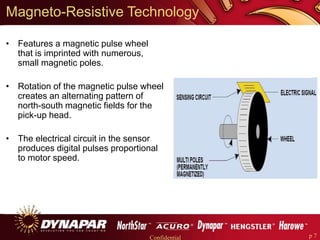
Magneto-Resistive Technology
• Features a magnetic pulse wheel
that is imprinted with numerous,
small magnetic poles.
• Rotation of the magnetic pulse wheel
creates an alternating pattern of
north-south magnetic fields for the
pick-up head.
• The electrical circuit in the sensor
produces digital pulses proportional
to motor speed.
Confidential p 8
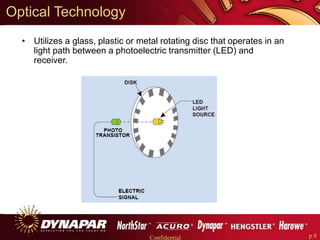
Optical Technology
• Utilizes a glass, plastic or metal rotating disc that operates in an
light path between a photoelectric transmitter (LED) and
receiver.
5/29/2024 p 9
Encoder Mounting Styles
Confidential p 10
Encoder Basics
Mechanical Designs:
• Hollow Shaft
– Encoder mounting on shaft
extension with bearings
and torque arm.
• Coupled
– Machined face, bracket,
stub shaft and a flexible
coupling.
• Bearingless
– Frame of encoder bolts to
motor, pulse wheel mounts
on shaft extension or stub
shaft.
NorthStar: HSD35,
HSD37, Slim Tach HS56
Dynapar:
HS20 & HS35
NorthStar: RIM 6200, HSD44
Dynapar: H56 Rotopulser
NorthStar:
SLIM Tach:
SL56, SL85, RL67
RIM Tach:
RIM8500, RIM1250
Confidential p 11
Hollow Shaft Encoders
• The lowest cost encoder to install
– No couplings to align or isolate
– No adapter (flower pot)
– No machined fan cover required on TEFC motors
• Flexible torque arm
– Allow encoder to ride freely on shaft extension
– If too rigid, provide stress on encoder bearings
– Arm must be isolated from motor to avoid motor shaft
currents from damaging encoder bearings
• Ideal for Reliance TEFC V*S Master motors
– Good for all motor enclosures
Confidential p 12
Coupled Encoders
• Highest installation cost.
– Requires a expensive, flexible coupling
– Requires adapter (flower pot) between encoder and motor
– On larger motors, an expensive insulated coupling may be required to
protect Coupled Encoder bearings
– V*S Master TEFC motors requires a special cast iron machined fan
cover
Flexible Coupling Machined Adapter Bracket
Confidential p 13
Bearingless Encoders
• Less space required
– No couplings to align or isolate
– Can have a thru shaft
– Can be mounted between brake and motor
– Can be mounted on drive or non-drive end
• No bearings to fail!
– Pulse wheel mounted directly on shaft extension
– Encoder housing bolted to motor bracket
– No concerns with motor currents damaging bearings
• Ideal for Reliance RPM-AC and DC motors
– Good to mount between brake and motor bracket on TENV, DPFV
and TEBC-PB enclosures
– Not recommended for V*S Master motors
5/29/2024 p 14
Incremental Outputs
Magnetic & Optical
Confidential p 15
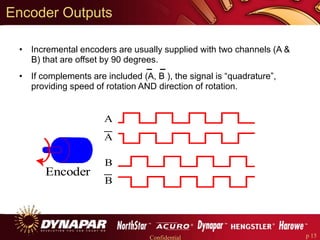
• Incremental encoders are usually supplied with two channels (A &
B) that are offset by 90 degrees.
• If complements are included (A, B ), the signal is “quadrature”,
providing speed of rotation AND direction of rotation.
Encoder Outputs
A
A
Encoder
B
B
Confidential p 16
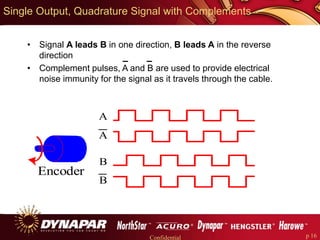
Single Output, Quadrature Signal with Complements
• Signal A leads B in one direction, B leads A in the reverse
direction
• Complement pulses, A and B are used to provide electrical
noise immunity for the signal as it travels through the cable.
A
A
Encoder
B
B
Confidential p 17
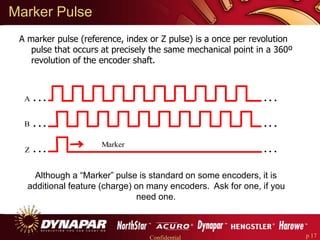
Marker Pulse
B
A
Z
Marker
Although a “Marker” pulse is standard on some encoders, it is
additional feature (charge) on many encoders. Ask for one, if you
need one.
A marker pulse (reference, index or Z pulse) is a once per revolution
pulse that occurs at precisely the same mechanical point in a 360º
revolution of the encoder shaft.

Encoder-Basics how encoder works types mechanism

  • 1.
  • 2.
    Confidential p 2 EncoderBasics We will be covering: • Common names & definitions • Types • Technology • Mechanical designs • Output • Applications
  • 3.
    Confidential p 3 DifferentNames for Encoders • Rotopulser • Pulse Generator • Digital Tachometer • Tach • Pulse Tach • Shaft Encoder A lot of names…..
  • 4.
    Confidential p 4 Definitions •Tachometer – Analog device that produces a voltage proportional to speed. • Encoder – Digital device that produces pulses based on rotational position
  • 5.
    Confidential p 5 EncoderBasics Encoder Types: • Incremental – Provides identical electronic pulses at each division of shaft rotation. – Used for speed or velocity control of motors • Absolute – Provides a unique electronic piece of information at each division of shaft position. – Used for positioning systems • Resolver – Provides sine wave and cosine wave to provide both velocity and position feedback.
  • 6.
    Confidential p 6 EncoderBasics Sensing Technologies: • Magnetic (Magneto-resistive) – Tough and simple – Heavy Duty enough for Mills – No Optics (no glass breakage) – Limited to 2048 PPR • Optical – Higher Resolution (up to 10,000 PPR) – Better signal quality – Shafted and Hollow shaft designs NORTHSTAR DYNAPAR & NORTHSTAR HD OPTICAL
  • 7.
    Confidential p 7 Magneto-ResistiveTechnology • Features a magnetic pulse wheel that is imprinted with numerous, small magnetic poles. • Rotation of the magnetic pulse wheel creates an alternating pattern of north-south magnetic fields for the pick-up head. • The electrical circuit in the sensor produces digital pulses proportional to motor speed.
  • 8.
    Confidential p 8 OpticalTechnology • Utilizes a glass, plastic or metal rotating disc that operates in an light path between a photoelectric transmitter (LED) and receiver.
  • 9.
    5/29/2024 p 9 EncoderMounting Styles
  • 10.
    Confidential p 10 EncoderBasics Mechanical Designs: • Hollow Shaft – Encoder mounting on shaft extension with bearings and torque arm. • Coupled – Machined face, bracket, stub shaft and a flexible coupling. • Bearingless – Frame of encoder bolts to motor, pulse wheel mounts on shaft extension or stub shaft. NorthStar: HSD35, HSD37, Slim Tach HS56 Dynapar: HS20 & HS35 NorthStar: RIM 6200, HSD44 Dynapar: H56 Rotopulser NorthStar: SLIM Tach: SL56, SL85, RL67 RIM Tach: RIM8500, RIM1250
  • 11.
    Confidential p 11 HollowShaft Encoders • The lowest cost encoder to install – No couplings to align or isolate – No adapter (flower pot) – No machined fan cover required on TEFC motors • Flexible torque arm – Allow encoder to ride freely on shaft extension – If too rigid, provide stress on encoder bearings – Arm must be isolated from motor to avoid motor shaft currents from damaging encoder bearings • Ideal for Reliance TEFC V*S Master motors – Good for all motor enclosures
  • 12.
    Confidential p 12 CoupledEncoders • Highest installation cost. – Requires a expensive, flexible coupling – Requires adapter (flower pot) between encoder and motor – On larger motors, an expensive insulated coupling may be required to protect Coupled Encoder bearings – V*S Master TEFC motors requires a special cast iron machined fan cover Flexible Coupling Machined Adapter Bracket
  • 13.
    Confidential p 13 BearinglessEncoders • Less space required – No couplings to align or isolate – Can have a thru shaft – Can be mounted between brake and motor – Can be mounted on drive or non-drive end • No bearings to fail! – Pulse wheel mounted directly on shaft extension – Encoder housing bolted to motor bracket – No concerns with motor currents damaging bearings • Ideal for Reliance RPM-AC and DC motors – Good to mount between brake and motor bracket on TENV, DPFV and TEBC-PB enclosures – Not recommended for V*S Master motors
  • 14.
    5/29/2024 p 14 IncrementalOutputs Magnetic & Optical
  • 15.
    Confidential p 15 •Incremental encoders are usually supplied with two channels (A & B) that are offset by 90 degrees. • If complements are included (A, B ), the signal is “quadrature”, providing speed of rotation AND direction of rotation. Encoder Outputs A A Encoder B B
  • 16.
    Confidential p 16 SingleOutput, Quadrature Signal with Complements • Signal A leads B in one direction, B leads A in the reverse direction • Complement pulses, A and B are used to provide electrical noise immunity for the signal as it travels through the cable. A A Encoder B B
  • 17.
    Confidential p 17 MarkerPulse B A Z Marker Although a “Marker” pulse is standard on some encoders, it is additional feature (charge) on many encoders. Ask for one, if you need one. A marker pulse (reference, index or Z pulse) is a once per revolution pulse that occurs at precisely the same mechanical point in a 360º revolution of the encoder shaft.